|
시장보고서
상품코드
2120391
프로그래머블 로직 컨트롤러(PLC) : 시장 점유율 분석, 업계 동향과 통계, 성장 예측(2026-2031년)Programmable Logic Controller (PLC) - Market Share Analysis, Industry Trends & Statistics, Growth Forecasts (2026 - 2031) |
||||||
 Mordor Intelligence
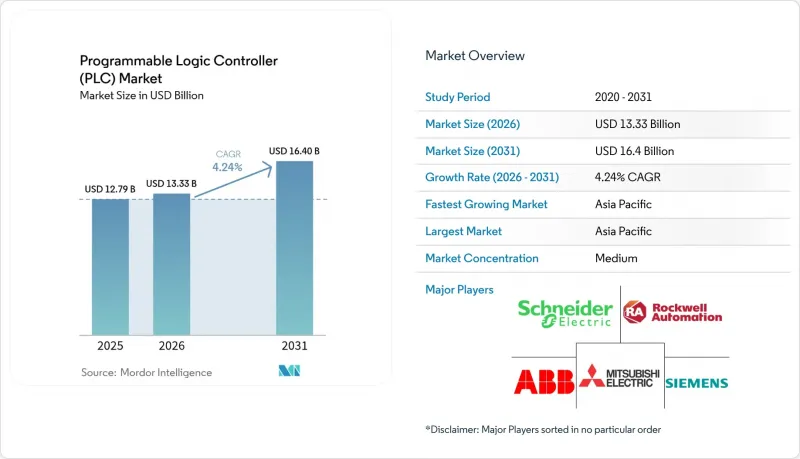
Mordor Intelligence에 따르면 프로그래머블 로직 컨트롤러(PLC) 시장 규모는 2025년 127억 9,000만 달러에서 2026년에는 133억 3,000만 달러로 확대하며, 2026-2031년에 CAGR 4.24%로 추이하며, 2031년까지 164억 달러에 달할 것으로 예측됩니다.
이 보고서는 제품 유형(컴팩트 PLC, 모듈형 PLC, 분산형 PLC, 소프트 PLC, 기타 제품), 구성 요소(하드웨어 및 소프트웨어, 서비스),제품 크기(나노 PLC, 마이크로 PLC, 소형 PLC, 중형 PLC, 대형 PLC), 최종사용자 산업(자동차, 식품 및 음료, 화학·석유화학, 기타) 및 지역별로 분류되어 있습니다. 시장 예측은 금액(달러) 기준으로 제시되어 있습니다.
전 세계 프로그래머블 로직 컨트롤러(PLC) 시장의 동향 및 인사이트
제조업에서의 인더스트리 4.0 도입 가속화
공장에서는 생산성 향상을 위해 디지털화가 진행되고 있으며, PLC는 기계와 기업용 소프트웨어를 연결하는 로컬 데이터 허브로서의 역할을 수행하고 있습니다. 독일 연방경제부는 인더스트리 4.0 도입률이 2023년 65%에서 2024년 78%로 급증했다고 보고했으며, 이는 컨트롤러 업그레이드가 진행되고 있음을 지원합니다. 중국과 인도의 보조금 제도 덕분에 소규모 생산자의 자동화 비용은 더욱 낮아지고 있습니다. 한편, 아우디의 가상 PLC 도입으로 시운전 시간이 23% 단축되고 실시간 최적화가 향상됨에 따라 소프트웨어 중심의 제어로의 전환이 입증되었습니다. ISO 9001의 추적성 요구 사항이 강화됨에 따라 제조업체들은 세밀한 데이터 로깅과 원활한 ERP 통합을 지원하는 최신 컨트롤러로 레거시 하드웨어를 교체해야 합니다. 이산형 산업 및 공정 산업 전반에 걸쳐, 사이버 보안 프로토콜을 훼손하지 않으면서 피드백 루프를 단축하는 에지 분석 기능이 내장된 PLC에 대한 수요가 집중되고 있습니다.
IIoT와 클라우드 통합을 통한 예측 유지보수 실현
엣지 지원 PLC는 진동, 온도, 전력 측정값을 로컬에서 분석하고, 선별된 인사이트만을 클라우드 대시보드로 전송하여 전체 설비군의 건전성을 모니터링합니다. 슈나이더 일렉트릭의 EcoStruxure 플랫폼은 온프레미스 로직과 클라우드 알고리즘을 융합하여 지속적인 최적화를 실현하는 하이브리드 모델의 좋은 예입니다. 5G 연결과 디지털 트윈 소프트웨어를 통해 분산된 PLC 노드를 실시간으로 연동시켜, 예기치 못한 가동 중단을 억제하는 자율적인 공정 조정을 지원합니다. 예지 보전을 도입한 공공 사업체 및 금속 공장에서는 OEE(종합 설비 효율)의 현저한 향상과 예비 부품 재고 감소가 보고되고 있으며, 사이버 보안에 대한 우려가 남아 있음에도 불구하고 투자의 타당성이 입증되고 있습니다.
소규모 제조업체에 대한 높은 초기 투자 비용
프로젝트의 평균 비용이 15,000-5만 달러에 달하므로 특히 통합, 교육, 가동 중단 비용을 고려할 때 여전히 많은 소규모 기업에게는 장벽으로 작용하고 있습니다. 가용 자금이 제한적이기 때문에 경험이 부족한 구매자가 예상되는 위험을 줄이려고 ‘일률적인 해결책’이라는 사고방식에 빠져 과도한 사양을 선정하는 경우가 종종 보입니다. 자금 조달 방식이나 공급업체를 통한 리스는 부담을 줄여주지만, 보수적인 투자 문화를 완전히 해소할 수는 없습니다. 구독형 가상 PLC는 더 낮은 도입 비용을 약속하고 있지만, 서비스가 아직 시작된 지 얼마 되지 않아 특히 인터넷 신뢰성이 낮은 지역에서는 도입 현황에 편차가 나타납니다.
부문 분석
2025년에는 모듈식 구성이 프로그래머블 로직 컨트롤러(PLC) 시장 점유율의 41.56%를 차지하며, 플랜트 업그레이드에 맞춰 I/O 및 연산 능력을 확장할 수 있다는 점이 높이 평가되었습니다. 이 아키텍처를 통해 엔지니어는 시스템 전체를 교체(포크리프트 교체)하지 않고도 모션, 안전 또는 AI 카드를 추가할 수 있으며, 자동차 및 소비자 가전의 다품종 생산 라인을 지원합니다. 소프트 PLC는 여전히 틈새 시장으로 남아 있지만, 하이퍼바이저가 결정론적 성능을 제공하고 벤더가 강화된 커널을 통합함에 따라 연평균 성장률(CAGR) 7.22%로 성장하고 있습니다.
디스크리트 산업과 프로세스 산업 모두에서 수요의 중심은 기계 수준의 이상 감지를 위한 엣지 분석을 호스팅하는 컨트롤러에 있습니다. 컴팩트 PLC는 독립형 기계에서 여전히 매력적이지만, 분산형 PLC는 내결함성이 뛰어나고 지역적으로 분산된 노드를 선호하는 대규모 정유소나 발전소에 채택되고 있습니다. TSN 상의 OPC-UA가 성숙해짐에 따라 사용자들은 원활한 상호 운용성을 기대하고 있으며, 이로 인해 하드웨어는 더욱 상품화되고, 차별화의 초점은 소프트웨어 툴체인 및 지원 생태계로 이동하고 있습니다.
2025년 시점에 하드웨어와 소프트웨어를 합친 프로그래머블 로직 컨트롤러(PLC) 시장 규모는 84.67%를 차지했으나, 사용자가 설비 투자(CapEx)에서 운영 비용(OpEx) 모델로 전환함에 따라비스 수익은 연평균 성장률(CAGR) 7.76%로 확대되고 있습니다. IIoT 연결의 각 계층마다 통합의 복잡성이 증가함에 따라 벤더 주도의 컨설팅 및 애플리케이션 엔지니어링에 대한 수요가 높아지고 있습니다.
예지보전 패키지에는 원격 모니터링, 펌웨어 관리, AI를 활용한 진단 기능이 포함되어 있으며, 장기 계약의 정착으로 이어지고 있습니다. 또한 각 벤더는 신흥 경제국에서 교육 아카데미를 확충하여 기술 격차 해소와 브랜드 인지도 제고를 도모하고 있습니다. 클라우드 기반 지원 포털을 통해 출장 비용이 절감되는 한편, 증강현실(AR)을 활용한 가이드를 통해 현장 수리 주기가 단축되면서, 하드웨어 중심의 교체 프로젝트에서도 서비스 수요가 더욱 증가하고 있습니다.
지역별 분석
아시아태평양의 제조업 부흥이 규모와 속도 모두를 지원하고 있으며, 2025년에는 매출의 35.10%를 차지하고, 2031년까지 연평균 성장률(CAGR)은 6.12%에 달할 것으로 전망됩니다. 중국에서는 팬데믹 이후의 경기 부양책에 따라 자동차 및 전자 분야에서의 컨트롤러 업그레이드가 지원되었습니다. 한편, 인도의 산업 회랑 건설은 PLC의 첫 도입을 촉진하고 있습니다. 일본의 ‘Quality-4.0’ 구상에 힘입어, 전자 부품 실장기에 사용되는 나노초 수준의 확정 응답형 컨트롤러에 대한 수요는 계속해서 높은 수준을 유지하고 있습니다. 한국의 조선소 및 반도체 공장에서는 미션 크리티컬한 가동 시간을 확보하기 위해 이중화된 PLC 클러스터가 지정되어 있으며, 이것이 높은 수익률의 수주를 지원하고 있습니다.
유럽의 지속가능성 노력에 따라 컨트롤러 구매는 에너지 관리 및 순환 경제 준수를 중시하는 방향으로 전환되고 있습니다. 2024년 EU 사이버 복원력 법에 따라 OEM 각사는 ‘보안 설계(Security by Design)’ 인증을 의무화하게 되어, 암호화 통신 및 이상 감지 기능을 내장한 제품에 대한 수요가 증가하고 있습니다. 독일의 자동차 제조사들은 소프트웨어 정의형 PLC 샌드박스 실증 실험을 진행 중이며, 프랑스와 이탈리아에서는 페일세이프 로직을 활용하여 항공우주용 복합재 생산 라인의 자동화가 추진되고 있습니다.
북미의 사용자들은 안전한 공급망과 국산 반도체 채택을 우선시하고 있습니다. ‘인프라 투자 및 고용법’에 따라 부하 분산 및 고장 부위 격리를 위한 최신 컨트롤러를 탑재한 변전소 개보수에 자금이 투입되고 있습니다. 멕시코에서의 니어쇼어 생산이 급속히 확대됨에 따라 자동차용 하네스 생산이 증가하고 있으며, 소형 PLC의 신속한 도입이 요구되고 있습니다. 캐나다의 광업 및 목재 업계에서는 광범위한 온도 범위를 견딜 수 있는 견고한 장비가 선호되고 있습니다. 전반적으로 각 지역의 구매 담당자들은 입찰 평가시 사이버 보안의 신뢰성과 국내 수리 지원을 매우 중요하게 여기고 있습니다.
기타 혜택:
- 엑셀 형식의 시장 예측(ME) 시트
- 3개월간의 애널리스트 지원
자주 묻는 질문
목차
제1장 서론
제2장 조사 방법
제3장 개요
제4장 시장 구도
제5장 시장 규모와 성장 예측
제6장 경쟁 구도
제7장 시장 기회와 향후 전망
KSA 26.09.02According to Mordor Intelligence, the programmable logic controller market size is expected to grow from USD 12.79 billion in 2025 to USD 13.33 billion in 2026 and is forecast to reach USD 16.4 billion by 2031 at 4.24% CAGR over 2026-2031.
This report is Segmented by Product Type (Compact PLC, Modular PLC, Distributed PLC, Soft PLC, Other Products), Component (Hardware and Software, Services), Product Size (Nano PLC, Micro PLC, Small PLC, Medium PLC, Large PLC), End-User Industry (Automotive, Food and Beverage, Chemical and Petrochemical, and More), and Geography. The Market Forecasts are Provided in Terms of Value (USD).
Global Programmable Logic Controller (PLC) Market Trends and Insights
Accelerated Industry 4.0 Adoption in Manufacturing
Factories digitalize to boost productivity, and PLCs act as the local data hubs that connect machines with enterprise software. The German Federal Ministry for Economic Affairs reported a jump to 78% Industry 4.0 adoption in 2024, up from 65% in 2023, underscoring the momentum behind controller upgrades. Subsidies in China and India further lower the cost of automation for small producers, while Audi's virtual PLC rollout cut commissioning time by 23% and improved real-time optimization, validating the transition toward software-centric control. Rising ISO 9001 traceability requirements obligate manufacturers to replace legacy hardware with modern controllers that support granular data logging and seamless ERP integration. Across discrete and process industries, demand concentrates on PLCs with built-in edge analytics that shorten feedback loops without compromising cybersecurity protocols.
IIoT and Cloud Integration Enabling Predictive Maintenance
Edge-ready PLCs analyze vibration, temperature, and power metrics locally, sending only refined insights to cloud dashboards for fleetwide health monitoring. Schneider Electric's EcoStruxure platform exemplifies the hybrid model, fusing on-premise logic with cloud algorithms for continuous optimization. 5G connectivity and digital-twin software now coordinate distributed PLC nodes in real time, supporting autonomous process adjustments that curb unplanned downtime. Utilities and metals plants that deploy predictive maintenance report sharper OEE gains and lower spare-parts inventories, validating the investment case despite residual cybersecurity concerns.
High Up-Front Capital Cost for Small Manufacturers
Average project outlays of USD 15,000-50,000 still deter many micro-scale firms, especially when integration, training, and downtime are counted. Limited cash reserves often lead to over-specification because novice buyers adopt a one-size-fits-all mindset to mitigate perceived risk. Financing schemes and vendor leasing ease pressure, but cannot fully offset conservative investment cultures. Subscription-based virtual PLCs promise lower entry points, yet nascent offerings leave adoption uneven, particularly in regions where internet reliability lags.
Other drivers and restraints analyzed in the detailed report include:
- Growing Demand for Compact Automation Among SMEs
- Shift to Software-Defined PLC Workstations
- Escalating Cybersecurity Threats to Connected PLCs
For complete list of drivers and restraints, kindly check the Table Of Contents.
Segment Analysis
Modular configurations dominated with 41.56% programmable logic controller market share in 2025, reflecting their ability to expand I/O and compute power alongside plant upgrades. The architecture lets engineers add motion, safety, or AI cards without forklift replacements, supporting mixed-model lines in automotive and consumer electronics. Soft PLCs, though still niche, are advancing at a 7.22% CAGR as hypervisors deliver deterministic performance and vendors embed hardened kernels.
Across both discrete and process industries, demand centers on controllers that host edge analytics for anomaly detection at the machine level. Compact PLCs retain appeal for stand-alone machines, while distributed PLCs serve large refineries and power stations that favor fault-tolerant, geographically separated nodes. As OPC-UA over TSN matures, users expect seamless interoperability, further commoditizing hardware and shifting differentiation to software toolchains and support ecosystems.
Hardware and software together held 84.67% of the programmable logic controller market size in 2025, yet service revenue is expanding at 7.76% CAGR as users pivot from CapEx to OpEx models. Integration complexity climbs with each layer of IIoT connectivity, elevating demand for vendor-led consulting and application engineering.
Predictive maintenance packages bundle remote monitoring, firmware management, and AI-driven diagnostics, creating sticky multi-year contracts. Vendors also ramp training academies in emerging economies to close the skills gap and lock in brand familiarity. Cloud-hosted support portals lower travel costs, while augmented-reality guides shorten onsite repair cycles, reinforcing service pull even in hardware-centric replacement projects.
Complete Report Scope:
- By Product Type
- Compact PLC
- Modular PLC
- Distributed PLC
- Soft PLC
- Other Products
- By Component
- Hardware and Software
- Services
- Installation and Integration
- Training and Support
- Maintenance
- By Product Size
- Nano PLC
- Micro PLC
- Small PLC
- Medium PLC
- Large PLC
- By End-user Industry
- Automotive
- Food and Beverage
- Chemical and Petrochemical
- Oil and Gas
- Energy and Utilities
- Water and Wastewater Treatment
- Pharmaceutical
- Pulp and Paper
- Metals and Mining
- Others
- By Geography
- North America
- United States
- Canada
- Mexico
- South America
- Brazil
- Argentina
- Rest of South America
- Europe
- Germany
- United Kingdom
- France
- Italy
- Spain
- Rest of Europe
- Asia-Pacific
- China
- Japan
- India
- South Korea
- South-East Asia
- Rest of Asia-Pacific
- Middle East and Africa
- Middle East
- Saudi Arabia
- United Arab Emirates
- Turkey
- Rest of Middle East
- Africa
- South Africa
- Nigeria
- Rest of Africa
- Middle East
- North America
Geography Analysis
Asia-Pacific's manufacturing resurgence underpins both scale and speed, with 35.10% revenue in 2025 and 6.12% CAGR to 2031. China's post-pandemic stimulus subsidized controller upgrades in automotive and electronics, while India's industrial corridor builds encourage first-time PLC rollouts. Japan's Quality-4.0 initiatives keep demand high for deterministic, nano-second-level controllers used in electronics placement machines. South Korean shipyards and fabs specify redundant PLC clusters for mission-critical uptime, anchoring high-margin orders.
Europe's sustainability push frames controller purchases around energy management and circular-economy compliance. The EU Cyber Resilience Act of 2024 obliges OEMs to certify security-by-design, boosting demand for products with encrypted communications and built-in anomaly detection. German automakers pilot software-defined PLC sandboxes, while France and Italy automate aerospace composites lines with fail-safe logic.
North American users prioritize secure supply chains and domestic semiconductor content. The Infrastructure Investment and Jobs Act funds substation refurbishments that incorporate modern controllers for load-balancing and fault isolation. Mexico's nearshore boom ramps automotive harness production, requiring swift deployment of compact PLCs. Canada's mining and lumber sectors favor rugged gear with extended temperature ratings. Overall, regional buyers weigh cybersecurity credentials and on-shore repair support heavily in tender scoring.
- Siemens AG
- Rockwell Automation Inc.
- Schneider Electric SE
- Mitsubishi Electric Corporation
- ABB Ltd.
- Omron Corporation
- Emerson Electric Co.
- Honeywell International Inc.
- Beckhoff Automation GmbH & Co. KG
- Delta Electronics Inc.
- Bosch Rexroth AG
- Panasonic Holdings Corporation
- Fuji Electric Co. Ltd.
- Hitachi Ltd.
- IDEC Corporation
- Keyence Corporation
- Toshiba Corporation
- General Electric Company
- Parker Hannifin Corporation
- Eaton Corporation plc
- Yokogawa Electric Corporation
- Inovance Technology Co. Ltd.
- Hollysys Automation Technologies Ltd.
- WAGO Kontakttechnik GmbH & Co. KG
- B&R Industrial Automation GmbH
Additional Benefits:
- The market estimate (ME) sheet in Excel format
- 3 months of analyst support
TABLE OF CONTENTS
1 INTRODUCTION
- 1.1 Study Assumptions and Market Definition
- 1.2 Scope of the Study
2 RESEARCH METHODOLOGY
3 EXECUTIVE SUMMARY
4 MARKET LANDSCAPE
- 4.1 Market Overview
- 4.2 Market Drivers
- 4.2.1 Accelerated Industry-4.0 adoption in manufacturing
- 4.2.2 Growing demand for compact automation among SMEs
- 4.2.3 IIoT and cloud integration enabling predictive maintenance
- 4.2.4 Shift to software-defined PLC workstations
- 4.2.5 Adoption of open industrial protocols (OPC-UA over TSN)
- 4.2.6 Cybersecurity-driven domestic sourcing mandates
- 4.3 Market Restraints
- 4.3.1 High up-front capital cost for small manufacturers
- 4.3.2 Escalating cybersecurity threats to connected PLCs
- 4.3.3 Substitution risk from industrial PCs and soft-PLCs
- 4.3.4 Semiconductor supply volatility inflating lead times
- 4.4 Industry Value Chain Analysis
- 4.5 Impact of Macroeconomic Factors
- 4.6 Regulatory Landscape
- 4.7 Technological Outlook
- 4.8 Porter's Five Forces Analysis
- 4.8.1 Threat of New Entrants
- 4.8.2 Bargaining Power of Suppliers
- 4.8.3 Bargaining Power of Buyers
- 4.8.4 Threat of Substitutes
- 4.8.5 Competitive Rivalry
5 MARKET SIZE AND GROWTH FORECASTS (VALUE)
- 5.1 By Product Type
- 5.1.1 Compact PLC
- 5.1.2 Modular PLC
- 5.1.3 Distributed PLC
- 5.1.4 Soft PLC
- 5.1.5 Other Products
- 5.2 By Component
- 5.2.1 Hardware and Software
- 5.2.2 Services
- 5.2.2.1 Installation and Integration
- 5.2.2.2 Training and Support
- 5.2.2.3 Maintenance
- 5.3 By Product Size
- 5.3.1 Nano PLC
- 5.3.2 Micro PLC
- 5.3.3 Small PLC
- 5.3.4 Medium PLC
- 5.3.5 Large PLC
- 5.4 By End-user Industry
- 5.4.1 Automotive
- 5.4.2 Food and Beverage
- 5.4.3 Chemical and Petrochemical
- 5.4.4 Oil and Gas
- 5.4.5 Energy and Utilities
- 5.4.6 Water and Wastewater Treatment
- 5.4.7 Pharmaceutical
- 5.4.8 Pulp and Paper
- 5.4.9 Metals and Mining
- 5.4.10 Others
- 5.5 By Geography
- 5.5.1 North America
- 5.5.1.1 United States
- 5.5.1.2 Canada
- 5.5.1.3 Mexico
- 5.5.2 South America
- 5.5.2.1 Brazil
- 5.5.2.2 Argentina
- 5.5.2.3 Rest of South America
- 5.5.3 Europe
- 5.5.3.1 Germany
- 5.5.3.2 United Kingdom
- 5.5.3.3 France
- 5.5.3.4 Italy
- 5.5.3.5 Spain
- 5.5.3.6 Rest of Europe
- 5.5.4 Asia-Pacific
- 5.5.4.1 China
- 5.5.4.2 Japan
- 5.5.4.3 India
- 5.5.4.4 South Korea
- 5.5.4.5 South-East Asia
- 5.5.4.6 Rest of Asia-Pacific
- 5.5.5 Middle East and Africa
- 5.5.5.1 Middle East
- 5.5.5.1.1 Saudi Arabia
- 5.5.5.1.2 United Arab Emirates
- 5.5.5.1.3 Turkey
- 5.5.5.1.4 Rest of Middle East
- 5.5.5.2 Africa
- 5.5.5.2.1 South Africa
- 5.5.5.2.2 Nigeria
- 5.5.5.2.3 Rest of Africa
- 5.5.5.1 Middle East
- 5.5.1 North America
6 COMPETITIVE LANDSCAPE
- 6.1 Market Concentration
- 6.2 Strategic Moves
- 6.3 Market Share Analysis
- 6.4 Company Profiles (includes Global level overview, Market level overview, Core segments, Financials as available, Strategic information, Market rank/share for key companies, Products and Services, and Recent developments)
- 6.4.1 Siemens AG
- 6.4.2 Rockwell Automation Inc.
- 6.4.3 Schneider Electric SE
- 6.4.4 Mitsubishi Electric Corporation
- 6.4.5 ABB Ltd.
- 6.4.6 Omron Corporation
- 6.4.7 Emerson Electric Co.
- 6.4.8 Honeywell International Inc.
- 6.4.9 Beckhoff Automation GmbH & Co. KG
- 6.4.10 Delta Electronics Inc.
- 6.4.11 Bosch Rexroth AG
- 6.4.12 Panasonic Holdings Corporation
- 6.4.13 Fuji Electric Co. Ltd.
- 6.4.14 Hitachi Ltd.
- 6.4.15 IDEC Corporation
- 6.4.16 Keyence Corporation
- 6.4.17 Toshiba Corporation
- 6.4.18 General Electric Company
- 6.4.19 Parker Hannifin Corporation
- 6.4.20 Eaton Corporation plc
- 6.4.21 Yokogawa Electric Corporation
- 6.4.22 Inovance Technology Co. Ltd.
- 6.4.23 Hollysys Automation Technologies Ltd.
- 6.4.24 WAGO Kontakttechnik GmbH & Co. KG
- 6.4.25 B&R Industrial Automation GmbH
7 MARKET OPPORTUNITIES AND FUTURE OUTLOOK
- 7.1 White-space and Unmet-need Assessment