|
시장보고서
상품코드
2120392
체온 모니터링 : 시장 점유율 분석, 업계 동향과 통계, 성장 예측(2026-2031년)Body Temperature Monitoring - Market Share Analysis, Industry Trends & Statistics, Growth Forecasts (2026 - 2031) |
||||||
 Mordor Intelligence
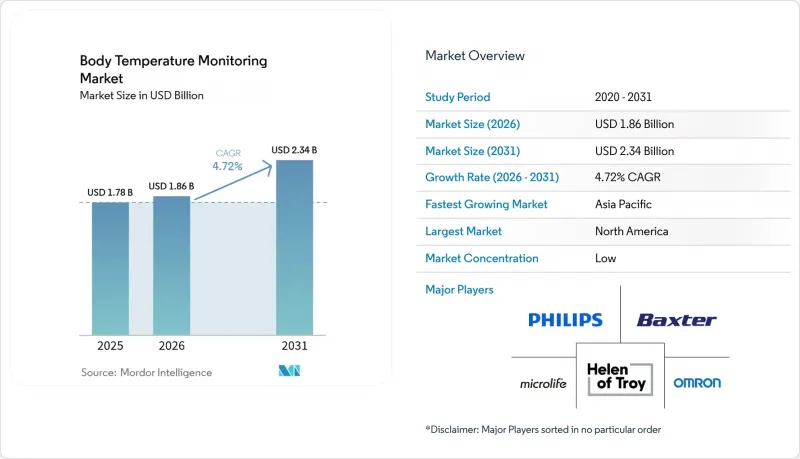
Mordor Intelligence에 따르면 2026년 체온 모니터링 시장의 규모는 18억 6,000만 달러로 추정되고 있으며, 2025년 17억 8,000만 달러에서 확대하며, 2031년에는 23억 4,000만 달러에 달할 것으로 예측됩니다.
2026-2031년까지 연평균 성장률(CAGR) 4.72%로 성장할 것으로 전망됩니다.
이 보고서는 제품별(접촉식 [디지털 체온계 등], 비접촉식 [비접촉식 적외선 체온계 등], 기타), 유통 채널별(오프라인 및 온라인), 용도별(구강내 등), 최종사용자별(병원 등), 지역별(북미, 유럽, 아시아태평양 등)로 분류되어 있습니다. 시장 전망은 금액(달러) 기준으로 제시되어 있습니다.
글로벌 체온 모니터링 시장의 동향 및 인사이트
감염병 확산이 선별 검사 수요를 견인
체온 측정은 병원, 학교, 기업 캠퍼스에서 일시적인 위기 대응에서 상시적인 일상 업무로 전환되었습니다. 미국 식품의약국(FDA)은 대규모 열화상 선별 검사 시스템에 대한 성능 권장 사항을 발표하여, 공공 장소에서의 비접촉식 기기 도입이 규제 당국에 의해 용인되었음을 시사하고 있습니다. AI를 활용한 보정 및 심박수, SpO2 입력값과 열화상 이미지를 연동하는 센서 융합 기술을 통해 팬데믹 초기 기기에서 나타났던 위음성 위험이 해소되었습니다.
디지털 및 웨어러블 센서의 혁신으로 소유 비용이 절감되었습니다.
소형화된 서미스터, 전력 관리 개선, 규제 요건 완화로 인해 지속적인 체온 추적 기능이 일반 소비자용 웨어러블 기기에 탑재되게 되었습니다. Withings사는 greenteg사의 CALERA 센서를 ScanWatch 2에 탑재하여, 일반 소비자용 스마트워치에서 24시간 365일 심부 체온 기록이 가능하게 했습니다. 2025년 6월, 미국 FDA는 특정 Class II 임상용 전자 체온계를 시판 전 신고 대상에서 제외함으로써 제품 출시까지의 기간을 단축하고 규정 준수 비용을 절감했습니다.
적외선 측정 기기의 정확도와 사용자의 오작동 우려
검토를 거친 평가에 따르면 일부 이마용 적외선 체온계는 관리되지 않은 환경에서 ±1°C 이상의 오차가 발생하여 임상적 발열 선별 기준치보다 낮게 측정되는 것으로 나타났습니다. 주변 온도나 습도, 사용자의 측정 위치에 따른 편차가 리콜 사례나 병원의 추가 프로토콜 도입을 초래하여 도입 속도를 둔화시키고 있습니다. 공급업체들은 교육, 자동 거리 측정, 다중 스펙트럼 모듈에 투자하고 있지만, 표면 방사율이라는 물리학의 근본적인 특성으로 인해 저가형 하드웨어에서 오차를 줄이는 데에는 여전히 한계가 있습니다.
부문 분석
접촉식 부문은 입증된 정확도와 수십년에 걸친 임상의들의 익숙한 사용법 덕분에 2025년에 체온 모니터링 시장의 62.05%를 차지했습니다. 귀용 프로브, 디지털 스틱형 체온계 및 삼킬 수 있는 정제는 특히 약물 투여 및 패혈증 모니터링에서 0.2°C 미만의 정확도가 요구되는 중환자 치료 프로토콜의 기반이 되고 있습니다. 비접촉식 적외선(IR) 기기는 감염 예방 지침 및 직장내 도입 의무화에 힘입어 2031년까지 가장 빠르게 성장하는 하위 카테고리가 될 것으로 예측됩니다. FDA 승인을 받은 ‘Radius T0’나 암 임상 시험에 사용되는 피부 패치와 같은 연속 측정형 웨어러블 기기는 퇴원부터 재택 요양까지의 가교 역할을 하는 지속적인 측정으로의 전환을 보여주고 있습니다. 각 기기 제조사들은 현재 침습적 처치용 일회용 접촉식 프로브와 방문자 선별 검사용 클라우드 연결형 적외선 키오스크를 결합한 하이브리드 제품 포트폴리오를 전개하고 있으며, 각 의료 현장이 최적의 워크플로우를 선택할 수 있게 되었습니다.
접촉형 부문의 광범위한 전개는 단순한 스틱형에 그치지 않는 혁신을 지원하고 있습니다. 중증 환자 병동에서는 중앙 간호 대시보드에 도킹된 무선 구강용 프로브를 통해 측정값의 자동화가 진행되고 있습니다. 알고리즘을 지원하는 데이터 스트림을 통해 패혈증 조기 탐지 모델 및 투약 조정 엔진이 가능해졌습니다. 한편, 비접촉식 시스템에서는 광학 기술, 측정 지점까지의 거리 비율, 주변 환경 보정 분야의 개선을 통해 일부 프리미엄 SKU의 정확도 오차가 ±0.4°C까지 축소되었습니다. 각 공급업체는 AI를 통합하여 측정 위치의 편차나 과도한 환경 드리프트를 경고하는 기능을 구현하고 있으며, 이를 통해 사용자의 신뢰를 높이고 대응 가능한 임상 사례를 확대하고 있습니다.
병원과 대규모 진료소는 심사 완료된 판매 대리점에 의존하고 있으며, 2025년 매출의 70.88%는 오프라인 채널을 통해 창출되고 있습니다. 그룹 구매 조직은 체온계를 수액 펌프나 모니터와 세트로 판매하고 있으며, 임상적 근거와 기술 서비스 계약을 제공하는 공급업체를 우선적으로 선정하고 있습니다. 오프라인의 강세에도 불구하고 소규모 진료소나 일반 가정이 브랜드 웹사이트나 마켓플레이스를 통해 직접 주문하는 경우가 늘어나면서 체온 모니터링 시장에서는 E-Commerce가 급속히 확산되고 있습니다. 온라인 판매는 COVID-19로 인한 봉쇄 기간 중 급증했으며, 소비자들이 자가 관리의 역할을 받아들이면서 그 기세가 지속되고 있습니다. 신흥 D2C(소비자 직판) 브랜드들은 데이터 대시보드, 앱 기반 코칭, 펌웨어 업데이트를 활용하여 가격 이외의 측면에서 차별화를 꾀하고 있습니다.
이에 대응하여 도매업체들은 카탈로그의 디지털화와 주문 처리 관리를 유지할 수 있는 ‘클릭 앤 콜렉트(Click & Collect)’ 모델을 도입하고 있습니다. 제조사들은 구독형 펌웨어 분석을 시범적으로 도입하여 기기 출하에 더해 지속적인 수입원을 창출하고 있습니다. 많은 기관 구매자들이 순수 E-Commerce 스토어에서는 아직 지원하지 못하는 교정 증명서나 기술적 현장 교육을 필요로 하므로 규제가 여전히 대규모 오프라인 시장의 기반을 지탱하고 있습니다.
지역별 분석
북미는 2025년에 41.10%라는 최대 지역 점유율을 기록했습니다. 이는 성숙한 환급 환경, 병원의 디지털화 프로그램, 그리고 AI를 활용한 분석 기술의 조기 도입의 혜택을 받은 결과입니다. 대학 부속 병원과 OEM(원래 장비 제조업체) 간의 통합 파트너십을 통해 체온, 혈중 산소 농도, 동작 데이터를 결합하여 상태 악화를 예측하는 멀티 센서 플랫폼의 시범 도입이 가속화되고 있습니다. 이 지역의 안정적인 연평균 성장률(CAGR) 4.31%는 만성질환 유병률이 높고, 지속적인 모니터링용 하드웨어 비용을 보상해 주는 원격의료 생태계의 확장에 힘입은 결과입니다.
아시아태평양은 연평균 성장률(CAGR) 5.52%로 가장 빠르게 성장하는 지역이며, 이는 중산층의 의료에 대한 기대감 고조와 스마트 병원을 위한 정부의 인센티브 정책과 관련이 있습니다. 중국의 국내 제조업체들은 규모의 경제와 부품의 수직 통합을 활용하여 경제적인 적외선 체온계를 수출 및 국내 시장에 공급하고 있습니다. 일본의 초고령 사회는 재택 간호를 위한 웨어러블 기기의 보급을 촉진하고 있습니다. 인도의 디지털 헬스 정책은 지방 진료소에 원격 생체 신호 측정 키트의 도입을 촉진하고 있으며, 체온 모니터링 시장의 범위를 도시 지역의 3차 의료 기관 이외의 지역으로도 확대하고 있습니다. 스마트폰 보급률이 높아짐에 따라 앱 기반 기기의 사용자 도입이 용이해지고 있는 반면, 다국적 브랜드들은 다양한 규제 체제에 대응하기 위해 합작 회사를 설립하고 있습니다.
유럽은 2031년까지 연평균 성장률(CAGR) 4.68%라는 견실한 성장 궤도를 유지하고 있습니다. 엄격한 데이터 보호 규제가 기기내 암호화 및 로컬 게이트웨이 스토리지 솔루션의 도입을 촉진하여 환자의 신뢰를 높이고 있습니다. ‘미나마타 협약’ 준수에 따라 수은 사용 기기의 사용 금지가 진행되고 있으며, 디지털 및 적외선 체온계의 교체 주기가 가속화되고 있습니다. 중동 및 아프리카는 연평균 성장률(CAGR) 5.29%로 성장하고 있으며, 석유 수입을 3차 의료 클러스터 및 공공 선별 검사 인프라에 투자하고 있습니다. 순례 등 대규모 행사로 인해 신속하고 비접촉식 선별 검사 포털에 대한 수요가 증가하고 있습니다. 남미 지역은 연평균 성장률(CAGR) 5.03%를 기록하고 있으며, 공공 보험 기관이 기본 장비를 업그레이드하고 민간 병원이 네트워크 접속형 모니터링 시스템을 도입하고 있습니다. 환율 변동과 수입 관세가 가격 책정에 지속적으로 영향을 미치고 있으며, 비용 절감 설계 및 현지 조립 전략이 유리하게 작용하고 있습니다.
기타 혜택:
- 엑셀 형식의 시장 예측(ME) 시트
- 3개월간의 애널리스트 지원
자주 묻는 질문
목차
제1장 서론
제2장 조사 방법
제3장 개요
제4장 시장 구도
제5장 시장 규모와 성장 예측
제6장 경쟁 구도
제7장 시장 기회와 향후 전망
KSA 26.09.02According to Mordor Intelligence, body temperature monitoring market size in 2026 is estimated at USD 1.86 billion, growing from 2025 value of USD 1.78 billion with 2031 projections showing USD 2.34 billion, growing at 4.72% CAGR over 2026-2031.
This report is Segmented by Product (Contact [Digital Thermometers and More], Non-Contact [Non-Contact Infrared Thermometers and More], and More), Distribution Channel (Offline and Online), Application (Oral Cavity and More), End Users (Hospitals and More), and Geography (North America, Europe, Asia-Pacific, and More). The Market Forecasts are Provided in Terms of Value (USD).
Global Body Temperature Monitoring Market Trends and Insights
Rising Infectious-Disease Outbreaks Drive Screening Demand
Temperature checks moved from ad-hoc crisis responses to permanent daily routines in hospitals, schools, and corporate campuses. The United States Food and Drug Administration issued performance recommendations for mass thermal screening systems, signaling regulatory acceptance of non-contact public venue deployment. AI-enhanced calibration and sensor fusion-linking thermal images with heart-rate or SpO2 inputs-now address the false-negative risk exhibited in early pandemic devices.
Digital & Wearable Sensor Innovations Lower Ownership Cost
Miniaturized thermistors, better power management, and relaxed regulatory pathways have pushed continuous temperature tracking into consumer wearables. Withings integrated greenteg's CALERA sensor into ScanWatch 2, enabling 24/7 core body temperature logging in a mass-market smartwatch. In June 2025 the US FDA exempted select Class II clinical electronic thermometers from premarket notification, shortening launch cycles and lowering compliance cost.
Accuracy & User-Error Concerns with IR Devices
Peer-reviewed evaluations show several forehead IR thermometers deviating by +-1 °C or more in uncontrolled environments, below clinical fever-screening thresholds. Variability from ambient temperature, humidity, and user alignment drives recall events and additional hospital protocol layers, tempering adoption pace. Suppliers invest in training, auto-distance targeting, and multi-spectral modules, yet fundamental physics of surface emissivity still limits error reduction in low-cost hardware.
Other drivers and restraints analyzed in the detailed report include:
- Hygiene-Focused Shift to Non-Contact IR Thermometers
- Expanding Pediatric & Geriatric Cohorts Needing Frequent Checks
- Mercury-Based Device Bans Squeezing Low-Income Markets
For complete list of drivers and restraints, kindly check the Table Of Contents.
Segment Analysis
The contact segment accounted for 62.05% of the body temperature monitoring market in 2025 thanks to proven accuracy and decades-long clinician familiarity. Ear probes, digital stick thermometers, and ingestible pills anchor intensive-care protocols, especially where medication dosing or sepsis surveillance requires sub-0.2 °C precision. Non-contact IR devices are forecast to be the fastest-growing sub-category through 2031, propelled by infection-control guidelines and workplace deployment mandates. Continuous wearables, such as FDA-cleared Radius T0 and skin patches used in oncology trials, illustrate a shift toward persistent measurement that bridges hospital discharge and home recovery. Device makers now position hybrid portfolios, pairing disposable contact probes for invasive procedures with cloud-connected IR kiosks for visitor screening, allowing each care setting to select the optimal workflow.
The contact segment's breadth supports innovation beyond simple sticks. High-acuity wards increasingly automate readings via cable-free oral probes docked in central nursing dashboards. Algorithm-ready data streams enable early sepsis detection models and medication titration engines. Meanwhile, non-contact system improvements in optics, distance-to-spot ratio, and ambient compensation have narrowed the accuracy gap to +-0.4 °C in some premium SKUs. Suppliers layer AI on board to flag poor aiming or excessive environmental drift, reinforcing user confidence and expanding addressable clinical cases.
Hospitals and large clinics rely on vetted distributors, generating 70.88% of 2025 revenue through the offline channel. Group purchasing organizations bundle thermometers with infusion pumps and monitors, favoring suppliers that offer clinical evidence and technical service contracts. Despite offline strength, the body temperature monitoring market witnesses rapid e-commerce uptake as small practices and households order direct from brand sites or marketplaces. Online sales surged during COVID-19 lockdowns and sustained momentum as consumers accepted self-care roles. Emerging direct-to-consumer brands leverage data dashboards, app-based coaching, and firmware updates to differentiate beyond price.
Distributors respond by digitizing catalogues and enabling click-and-collect models that preserve fulfillment control. Manufacturers experiment with subscription-based firmware analytics, creating recurring revenue on top of device shipments. Regulation continues to anchor a sizable offline base because many institutional buyers need calibration certificates and technical in-service training not yet matched by pure-play e-commerce storefronts.
Complete Report Scope:
- By Product
- Contact
- Digital Thermometers
- Infrared Ear Thermometers
- Other Contact Products
- Non-Contact
- Non-contact Infrared Thermometers
- Thermal Scanners
- Wearable & Continuous-Monitoring Devices
- Contact
- By Distribution Channel
- Offline
- Online
- By Application
- Oral Cavity
- Rectum
- Ear
- Other Applications
- By End-User
- Hospitals
- Clinics
- Home-care Settings
- Other End-Users
- By Geography
- North America
- United States
- Canada
- Mexico
- Europe
- Germany
- United Kingdom
- France
- Italy
- Spain
- Rest of Europe
- Asia-Pacific
- China
- India
- Japan
- Australia
- South Korea
- Rest of Asia-Pacific
- Middle East and Africa
- GCC
- South Africa
- Rest of Middle East and Africa
- South America
- Brazil
- Argentina
- Rest of South America
- North America
Geography Analysis
North America delivered the largest regional share at 41.10% in 2025, benefiting from mature reimbursement environments, hospital digitization programs, and early adoption of AI-enabled analytics. Integration partnerships between academic medical centers and OEMs fast-track pilots for multi-sensor platforms that combine temperature, blood oxygen, and motion data to predict deterioration events. The region's stable 4.31% CAGR is underwritten by chronic disease prevalence and an expanding remote-care ecosystem that reimburses continuous monitoring hardware.
Asia-Pacific is the fastest-growing territory at 5.52% CAGR, linked to rising middle-class healthcare expectations and government stimulus for smart hospitals. China's domestic manufacturers leverage scale and component verticalization to ship economical IR thermometers into export and domestic channels. Japan's super-aged society drives home-care wearable uptake. India's digital-health policy encourages remote vital sign kits in rural clinics, broadening the body temperature monitoring market footprint beyond urban tertiary centers. High smartphone penetration simplifies user onboarding for app-centric devices, while multinational brands form joint ventures to navigate heterogeneous regulatory schemes.
Europe maintains a robust trajectory with a 4.68% CAGR to 2031. Stringent data-protection rules catalyze on-device encryption and local gateway storage solutions, improving patient trust. Mercury device bans progress under the Minamata Convention alignment, triggering accelerated replacement cycles for digital and IR units. The Middle East and Africa, growing at 5.29% CAGR, channels oil revenues into tertiary healthcare clusters and public screening infrastructure. Mass events such as pilgrimages amplify demand for rapid, non-contact screening portals. South America progresses at 5.03% CAGR as public insurers upgrade basic equipment and private hospitals install connected monitoring suites. Currency swings and import tariffs continue to influence price positioning, rewarding value engineering and local assembly strategies.
- A&D Medical
- American Diagnostic Corp.
- Baxter
- Beckton Dickinson
- Bioland Technology Limited.
- Blue Spark Technologies, Inc.
- Briggs Healthcare
- Cardinal Health
- Citizen Systems Japan Co., Ltd.
- Easywell Biomedicals
- Exergen
- Famidoc Technology Co., Ltd.
- Guangzhou Berrcom Medical Device Co., Ltd.
- Hangzhou Hua'an Medical & Health Instruments Co.,Ltd.
- Hartmann Group
- Helen of Troy
- Hicks India
- iHealth Labs
- Kinsa Health, LLC
- Koninklijke Philips
- Microlife
- OMRON
- Shenzhen Jumper Medical Equipment Co., Ltd.
- Solventum Corporation
- Terumo
Additional Benefits:
- The market estimate (ME) sheet in Excel format
- 3 months of analyst support
TABLE OF CONTENTS
1 Introduction
- 1.1 Study Assumptions & Market Definition
- 1.2 Scope of the Study
2 Research Methodology
3 Executive Summary
4 Market Landscape
- 4.1 Market Overview
- 4.2 Market Drivers
- 4.2.1 Rising infectious-disease outbreaks drive screening demand
- 4.2.2 Digital & wearable sensor innovations lower ownership cost
- 4.2.3 Hygiene-focused shift to non-contact IR thermometers
- 4.2.4 Expanding pediatric & geriatric cohorts needing frequent checks
- 4.2.5 Smart-hospital IoT integration of temperature data
- 4.2.6 Fertility-tracking wearables using wrist-skin temperature
- 4.3 Market Restraints
- 4.3.1 Accuracy & user-error concerns with IR devices
- 4.3.2 Privacy pushback on continuous wearable data capture
- 4.3.3 Mercury-based device bans squeezing low-income markets
- 4.3.4 False-security risk from mass thermal imaging at public venues
- 4.4 Supply Chain Analysis
- 4.5 Regulatory Landscape
- 4.6 Technological Outlook
- 4.7 Porter's Five Forces Analysis
- 4.7.1 Threat of New Entrants
- 4.7.2 Bargaining Power of Buyers/Consumers
- 4.7.3 Bargaining Power of Suppliers
- 4.7.4 Threat of Substitute Products
- 4.7.5 Intensity of Competitive Rivalry
5 Market Size & Growth Forecasts (Value)
- 5.1 By Product
- 5.1.1 Contact
- 5.1.1.1 Digital Thermometers
- 5.1.1.2 Infrared Ear Thermometers
- 5.1.1.3 Other Contact Products
- 5.1.2 Non-Contact
- 5.1.2.1 Non-contact Infrared Thermometers
- 5.1.2.2 Thermal Scanners
- 5.1.3 Wearable & Continuous-Monitoring Devices
- 5.1.1 Contact
- 5.2 By Distribution Channel
- 5.2.1 Offline
- 5.2.2 Online
- 5.3 By Application
- 5.3.1 Oral Cavity
- 5.3.2 Rectum
- 5.3.3 Ear
- 5.3.4 Other Applications
- 5.4 By End-User
- 5.4.1 Hospitals
- 5.4.2 Clinics
- 5.4.3 Home-care Settings
- 5.4.4 Other End-Users
- 5.5 By Geography
- 5.5.1 North America
- 5.5.1.1 United States
- 5.5.1.2 Canada
- 5.5.1.3 Mexico
- 5.5.2 Europe
- 5.5.2.1 Germany
- 5.5.2.2 United Kingdom
- 5.5.2.3 France
- 5.5.2.4 Italy
- 5.5.2.5 Spain
- 5.5.2.6 Rest of Europe
- 5.5.3 Asia-Pacific
- 5.5.3.1 China
- 5.5.3.2 India
- 5.5.3.3 Japan
- 5.5.3.4 Australia
- 5.5.3.5 South Korea
- 5.5.3.6 Rest of Asia-Pacific
- 5.5.4 Middle East and Africa
- 5.5.4.1 GCC
- 5.5.4.2 South Africa
- 5.5.4.3 Rest of Middle East and Africa
- 5.5.5 South America
- 5.5.5.1 Brazil
- 5.5.5.2 Argentina
- 5.5.5.3 Rest of South America
- 5.5.1 North America
6 Competitive Landscape
- 6.1 Market Concentration
- 6.2 Competitive Benchmarking
- 6.3 Market Share Analysis
- 6.4 Company Profiles (includes Global level Overview, Market level overview, Core Segments, Financials as available, Strategic Information, Market Rank/Share for key companies, Products & Services, and Recent Developments)
- 6.4.1 A&D Medical
- 6.4.2 American Diagnostic Corp.
- 6.4.3 Baxter International
- 6.4.4 Becton, Dickinson and Company
- 6.4.5 Bioland Technology Limited.
- 6.4.6 Blue Spark Technologies, Inc.
- 6.4.7 Briggs Healthcare
- 6.4.8 Cardinal Health
- 6.4.9 Citizen Systems Japan Co., Ltd.
- 6.4.10 Easywell Biomedicals
- 6.4.11 Exergen Corporation
- 6.4.12 Famidoc Technology Co., Ltd.
- 6.4.13 Guangzhou Berrcom Medical Device Co., Ltd.
- 6.4.14 Hangzhou Hua'an Medical & Health Instruments Co.,Ltd.
- 6.4.15 Hartmann Group
- 6.4.16 Helen of Troy Limited
- 6.4.17 Hicks India
- 6.4.18 iHealth Labs Inc.
- 6.4.19 Kinsa Health, LLC
- 6.4.20 Koninklijke Philips N.V.
- 6.4.21 Microlife Corporation
- 6.4.22 Omron Corporation
- 6.4.23 Shenzhen Jumper Medical Equipment Co., Ltd.
- 6.4.24 Solventum Corporation
- 6.4.25 Terumo Corporation
7 Market Opportunities & Future Outlook
- 7.1 White-space & Unmet-need Assessment