
|
시장보고서
상품코드
2120436
영업 성과 관리 : 시장 점유율 분석, 업계 동향과 통계, 성장 예측(2026-2031년)Sales Performance Management - Market Share Analysis, Industry Trends & Statistics, Growth Forecasts (2026 - 2031) |
||||||
 Mordor Intelligence
Mordor Intelligence에 따르면 영업 성과 관리 시장 규모는 2025년 29억 5,000만 달러에서 2026년에는 34억 6,000만 달러로 확대되어, 2026년부터 2031년까지 CAGR 17.12%를 기록하며 2031년에는 76억 1,000만 달러에 달할 것으로 예측됩니다.

본 보고서는 배포 방식(온프레미스, 클라우드), 구성요소(소프트웨어, 서비스), 솔루션(인센티브 보상 관리, 영업 구역 관리 등), 조직 규모(대기업, 중소기업), 최종사용자 산업(BFSI, 제조업 등), 및 지역(북미, 유럽 등)별로 분류되어 있습니다. 시장 예측은 금액(달러) 기준으로 제시되어 있습니다.
세계 영업 성과 관리 시장의 동향 및 인사이트
AI를 활용한 판매 할당량 및 영업 구역 최적화
현재, 기계 학습 모델을 통해 고객 배정이 지속적으로 재조정되고 있으며, 새로운 수요 창출을 놓치기 쉬운 연례 스프레드시트 작업을 대체하고 있습니다. AI를 활용한 영업 구역 설계를 도입한 기업에서는 업무 부하의 불균형과 미개척 영역의 중복을 해소한 결과, 연간 매출이 최대 7% 증가했다고 보고되고 있습니다. 예측적 판매 목표 모델링은 계절성 및 개별 실적 패턴을 통합하므로, 영업 담당 리더는 파이프라인의 격차가 확대되기 전에 목표를 조정할 수 있습니다. 위치 정보 데이터, 제3자 기업 정보, 그리고 CRM의 참여 신호를 활용하여 마이크로 테리토리를 구축함으로써 출장의 비효율성을 최소화하고 고객 밀도를 향상시킵니다. 인센티브 엔진에 통합함으로써 난이도가 자동으로 조정되어 영업 담당자의 동기 부여를 유지하면서 보상 지출을 예측 가능한 범위로 억제할 수 있습니다. 이 기능은 수동 계획 수립이 관리 불가능할 정도로 확대되는 지역에서 여러 제품 라인을 관리하는 기업에게 특히 가치가 있습니다.
레거시 ICM 제품군의 지원 종료가 촉발한 ‘클라우드 퍼스트’로의 전환
2026년 12월 SAP CallidusCloud의 지원 종료에 따라 수천 개의 기업이 플랫폼 이전을 강요받게 되었으며, 클라우드 도입이 자연 증가 속도를 넘어 가속화되고 있습니다. 비용이 많이 드는 온프레미스 확장에 직면한 구매자들은 Salesforce, HubSpot 및 데이터 레이크 아키텍처와 원활하게 통합되는 멀티테넌트형 SPM 서비스를 선택하고 있습니다. 클라우드 기반 대체 솔루션은 맞춤형 미들웨어에 대한 의존도를 낮추고, 자동화된 문서화 기능을 통해 ASC 606에 기반한 감사 요건을 충족함으로써 월별 결산 주기를 단축합니다. Varicent, CaptivateIQ, Spiff와 같은 벤더들은 도입 기간을 단축하는 신속한 마이그레이션 툴킷과 도입 직후부터 사용할 수 있는 커넥터를 통해 차별화를 꾀하고 있습니다. RevOps 팀에게 이 전환은 온프레미스형 소프트웨어로는 경제적으로 실현할 수 없는 유연한 확장성과 지속적인 기능 업데이트를 가능하게 합니다.
‘효율적인 성장’ 요구에 따른 예산 축소
거시경제에 대한 경계감으로 인해 이사회는 자본 효율성을 우선시하게 되었고, 조달 팀은 명확한 ROI를 통해 SPM에 대한 지출을 정당화해야만 하는 상황에 처해 있습니다. 과거에는 사용자당 고가의 가격 정책을 수용하던 중견 기업의 구매자들도 현재는 SMB 수준의 예산으로 엔터프라이즈급 기능을 요구하고 있으며, 이로 인해 판매 주기가 길어지고 가격 인하 압박이 커지고 있습니다. CFO가 관여함에 따라, 가치 입증(PoV) 파일럿 단계에서는 계약 체결 전에 매출 목표 달성률 향상이나 관리 비용 절감을 정량적으로 입증해야 합니다. 검토가 엄격해지는 가운데, 벤더들은 분기별 예산에 맞춰 단계적인 도입이 가능한 모듈식 패키지로 대응하고 있지만, 이로 인해 수익이 세분화되고 고객 성공 담당자의 인력 배치가 복잡해지고 있습니다. 기업들이 투자 회수 기간을 단축하는 통합형 제품군을 우선시하며 단일 기능 도구를 단계적으로 폐지함에 따라, RevOps 스택 전체의 통합이 가속화되고 있습니다.
부문 분석
2025년 현재, 클라우드 부문은 영업 성과 관리 시장의 70.25%를 차지하고 있으며, 2031년까지 연평균 성장률(CAGR) 15.32%로 확대되고 있습니다. 클라우드 벤더는 API 연결성, 탄력적인 확장성, 그리고 사용자가 인프라 유지 관리에서 해방될 수 있게 해주는 자동 업그레이드와 같은 측면에서 우위를 점하고 있습니다. 온프레미스 방식은 규제가 엄격한 환경에서는 여전히 중요하지만, 그러한 구매자들조차도 기밀 데이터를 로컬에 격리하면서 분석 워크로드를 퍼블릭 클라우드로 오프로드하는 하이브리드 구성으로 점점 더 전환하고 있습니다. CallidusCloud의 계약 만료에 따라 뒤처져 있던 기업들도 최신 SaaS 플랫폼으로 전환하는 움직임이 가속화될 것으로 예상되므로, 클라우드 도입에 따른 영업 성과 관리 시장 규모는 2031년까지 약 3배로 성장할 것으로 전망됩니다.
멀티테넌트 아키텍처 덕분에 사용자당 비용이 절감되어, 중견 기업에서도 AI를 활용한 영업 지역 균형 조정과 같은 고급 기능을 널리 이용할 수 있게 됩니다. 자동화된 데이터 매핑 기능을 갖춘 마이그레이션 툴킷은 프로젝트 위험을 줄여주며, 우선 북미와 유럽에서의 도입을 촉진하고, 이어 그린필드 수요가 주류를 이루는 아시아태평양에서도 급속히 보급되고 있습니다. 샌드박스 테스트 및 롤백 기능을 제공하는 벤더는 규정 준수 관련 우려를 완화하고, BFSI(은행·금융·보험) 및 의료 등 엄격한 감사를 받는 산업에서 가치 실현까지 걸리는 시간을 단축하고 있습니다.
2025년에는 소프트웨어가 매출 점유율의 62.10%를 차지했으나, 도입 범위가 수수료 계산에서 종합적인 수익 최적화로 확대됨에 따라 서비스 수익은 연평균 16.55%의 성장이 예상됩니다. 고부가가치 계약에는 데이터 마이그레이션, 플랜 아키텍처 설계, 가동 후 관리 등이 포함되며, 많은 고객사는 사내에 이러한 자원을 보유하고 있지 않습니다. 지속적인 규칙 조정, 분쟁 해결, 감사 지원을 제공하는 매니지드 서비스는 특히 예측 가능한 구독형 운영비를 선호하는 중소기업 사이에서 인기를 얻고 있습니다. 도입 파트너는 시스템 가동 후 사용 편의성과 정착을 보장하기 위해 변경 관리 교육을 중시하고 있습니다.
컨설팅 및 매니지드 서비스와 관련된 영업 성과 관리 시장 규모는 플랫폼의 복잡성 증가에 따라 2031년까지 2배로 성장할 것으로 예상됩니다. 각 벤더사는 프로젝트 주기를 단축하면서도 지속적인 서비스 수익을 확보하기 위해 파트너 생태계 및 액셀러레이터 템플릿에 대한 투자를 추진하고 있습니다. GDPR 및 ASC 606 준수에 따라 감사 추적 기능 통합 및 문서화 자동화를 지원하는 자문 서비스에 대한 수요가 더욱 높아지고 있습니다.
지역별 분석
북미는 미국의 기술 집적도와 높은 RevOps 성숙도를 배경으로 2025년 지출의 41.10%를 차지했습니다. 대기업을 중심으로 한 1차 전환이 완료되면서 도입 성장세는 둔화되고 있지만, 업그레이드 주기를 통해 AI 및 내장형 분석 모듈이 추가되면서 수익 유지에 기여하고 있습니다. 캐나다와 멕시코는 제조업 및 에너지 분야의 도입을 통해 기여하고 있으며, ASC 606 및 SOX 규제로 인해 스프레드시트보다 자동화가 계속해서 선호되고 있습니다.
아시아태평양은 2031년까지 연평균 성장률(CAGR) 17.65%를 기록하며 가장 빠르게 성장하는 지역으로 자리매김하고 있습니다. 중국은 중앙 정부의 디지털화 프로그램과 다국적 유통업체의 사업 확대를 견인력으로 삼아 선두를 달리고 있습니다. 인도는 IT 서비스 수출과 고도의 커미션 자동화를 추구하는 국내 SaaS 신생 기업을 통해 성장세를 보이고 있습니다. 동남아시아 시장은 스마트폰 보급과 크로스보더 E-Commerce의 혜택을 받고 있으며, 기업들은 여러 통화와 언어를 아우르는 판매자에 대한 실시간 가시성을 요구하고 있습니다.
유럽에서는 GDPR(일반 데이터 보호 규정) 준수가 ‘프라이버시 바이 디자인’을 통합한 클라우드 기반 SPM 도입을 가속화하며, 10%대 중반의 꾸준한 성장을 기록하고 있습니다. 영국, 독일, 프랑스에서는 엄격한 감사 추적 및 다중 통화 지원이 필요한 BFSI(은행·금융·보험) 및 제조업 부문이 수요를 주도하고 있습니다. 브렉시트로 인한 무역의 복잡화로 인해 환율 및 세금 자동 계산 기능을 제공하는 플랫폼의 가치가 높아지고 있습니다. 남미, 중동 및 아프리카는 여전히 발전 단계에 있지만 미래성이 기대되고 있으며, 현지 기업들은 자본 집약적인 온프레미스 투자를 하지 않고도 다국적 기업의 판매 체제를 따라잡기 위해 구독형 클라우드 서비스에 주력하고 있습니다.
기타 혜택:
- 엑셀 형식의 시장 예측(ME) 시트
- 3개월간 애널리스트 지원
자주 묻는 질문
목차
제1장 소개
제2장 조사 방법
제3장 주요 요약
제4장 시장 구도
제5장 시장 규모와 성장 예측
제6장 경쟁 구도
제7장 시장 기회와 향후 전망
KSM 26.09.02According to Mordor Intelligence, the sales performance management market size is expected to grow from USD 2.95 billion in 2025 to USD 3.46 billion in 2026 and is forecast to reach USD 7.61 billion by 2031 at 17.12% CAGR over 2026-2031.
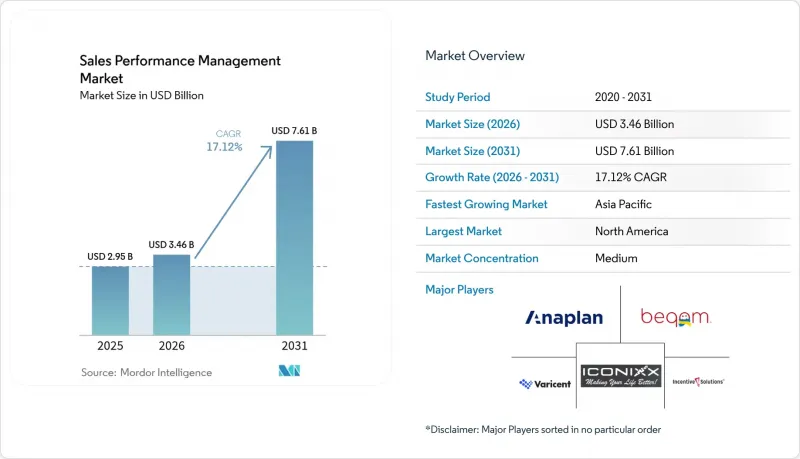
This report is Segmented by Deployment (On-Premise, Cloud), Component (Software, Services), Solution (Incentive Compensation Management, Territory Management, and More), Organization Size (Large Enterprises, Small and Medium Enterprises), End-User Vertical (BFSI, Manufacturing, and More), and Geography (North America, Europe, and More). The Market Forecasts are Provided in Terms of Value (USD).
Global Sales Performance Management Market Trends and Insights
AI-Driven Quota and Territory Optimization
Machine-learning models now rebalance account assignments continuously, replacing annual spreadsheet exercises that frequently miss emerging pockets of demand. Organizations deploying AI-guided territory design have reported up to 7% annual sales lifts after eliminating workload imbalances and white-space overlap. Predictive quota modeling integrates seasonality and individual performance patterns so revenue leaders can adjust goals before pipeline gaps widen. Geolocation data, third-party firmographics, and CRM engagement signals create micro-territories that minimize travel inefficiencies and improve account density. When embedded inside incentive engines, automatic difficulty adjustments maintain rep motivation while keeping payout expense predictable. The capability is particularly valuable for firms managing multi-product lines across expanding regions where manual planning becomes unmanageable.
Cloud-First Upgrades Triggered by Sunset of Legacy ICM Suites
The December 2026 retirement of SAP CallidusCloud obliges thousands of enterprises to re-platform, accelerating cloud adoption beyond organic rates. Buyers confronted with costly on-premises extensions are choosing multi-tenant SPM services that integrate natively with Salesforce, HubSpot, and data-lake architectures. Cloud alternatives reduce custom middleware dependencies and meet audit requirements under ASC 606 with automated documentation, shortening monthly close cycles. Vendors such as Varicent, CaptivateIQ, and Spiff differentiate through rapid migration toolkits and out-of-the-box connectors that compress deployment timelines. For RevOps teams, the shift unlocks elastic scaling and continuous feature updates that on-premises software cannot economically replicate.
Budget Compression from "Efficient-Growth" Mandates
Macroeconomic caution has boards prioritizing capital efficiency, forcing procurement teams to justify SPM spend through hard ROI. Mid-market buyers that once accepted premium per-seat pricing now demand enterprise-grade capability at SMB budgets, elongating sales cycles and escalating discount pressure. CFO involvement means proof-of-value pilots must quantify quota-attainment lifts and administrative cost reductions before contract signature. As scrutiny rises, vendors respond with modular packaging that allows phased rollouts aligned to quarterly budgets, though this fragments revenue and complicates customer success staffing. Consolidation across the RevOps stack intensifies as firms retire point tools in favor of unified suites that drive faster payback.
Other drivers and restraints analyzed in the detailed report include:
- Rise of Usage-Based and Subscription Pricing Models
- Embedded Analytics Inside CRM and RevOps Stacks
- Data-Quality and Integration Hurdles Across Siloed GTM Apps
For complete list of drivers and restraints, kindly check the Table Of Contents.
Segment Analysis
The cloud segment held 70.25% of the Sales Performance Management market in 2025, and it is advancing at a 15.32% CAGR to 2031. Cloud vendors win on API connectivity, elastic scaling, and automatic upgrades that shield users from infrastructure upkeep. On-premises remains relevant in highly regulated environments, yet even those buyers increasingly steer toward hybrid setups that quarantine sensitive data locally while exporting analytics workloads to public clouds. The Sales Performance Management market size for cloud deployments is forecast to almost triple by 2031 as expiring CallidusCloud contracts push laggards to modern SaaS platforms.
Multi-tenant architectures compress per-user costs and democratize advanced capabilities such as AI-assisted territory balancing for mid-market firms. Migration toolkits offering automated data mapping reduce project risk and fuel adoption across North America and Europe first, followed by rapid uptake in Asia-Pacific, where greenfield demand dominates. Vendors that provide sandbox testing and rollback options ease compliance anxiety, accelerating time-to-value for heavily audited sectors like BFSI and healthcare.
Software retained 62.10% revenue share in 2025, yet services revenue is projected to grow 16.55% annually as implementations widen in scope from commission calculation to holistic revenue optimization. High-value engagements cover data migration, plan architecture, and post-go-live administration that many clients lack in-house. Managed offerings supplying continuous rule adjustments, dispute resolution, and audit support are gaining momentum, especially among SMEs that prefer predictable subscription operating expenses. Implementation partners emphasize change-management training to ensure usability and adoption once the system goes live.
The Sales Performance Management market size tied to consulting and managed services is expected to double by 2031, mirroring increasing platform complexity. Vendors invest in partner ecosystems and accelerator templates to shorten project cycles while capturing recurring services revenue. Compliance with GDPR and ASC 606 further boosts demand for advisory help to embed audit trails and automate documentation.
Complete Report Scope:
- By Deployment
- On-premise
- Cloud
- By Component
- Software
- Services
- By Solution
- Incentive Compensation Management
- Territory Management
- Sales Planning and Monitoring
- Sales Analytics
- Other Solutions
- By Organization Size
- Large Enterprises
- Small and Medium Enterprises
- By End-user Vertical
- BFSI
- Manufacturing
- Energy and Utilities
- Healthcare
- IT and Telecom
- Retail and Consumer Goods
- Others (Transportation, Media, etc.)
- By Geography
- North America
- United States
- Canada
- Mexico
- Europe
- United Kingdom
- Germany
- France
- Italy
- Spain
- Russia
- Rest of Europe
- Asia-Pacific
- China
- Japan
- India
- South Korea
- Australia
- Rest of Asia-Pacific
- South America
- Brazil
- Argentina
- Rest of South America
- Middle East and Africa
- Middle East
- Israel
- Saudi Arabia
- United Arab Emirates
- Turkey
- Rest of Middle East
- Africa
- South Africa
- Egypt
- Rest of Africa
- Middle East
- North America
Geography Analysis
North America accounted for 41.10% of 2025 spending, anchored by the United States' technology concentration and advanced RevOps maturity. Adoption growth has slowed as large enterprises complete first-wave migrations, but upgrade cycles add AI and embedded analytics modules to sustain revenue. Canada and Mexico contribute through manufacturing and energy adoptions, while ASC 606 and SOX rules continue to favor automation over spreadsheets.
Asia-Pacific is on pace for an 17.65% CAGR through 2031, making it the fastest-expanding region. China leads with central government digitization programs and expanding multinational seller footprints. India adds momentum through IT-services exports and domestic SaaS insurgents that demand sophisticated commission automation. Southeast Asian markets benefit from smartphone diffusion and cross-border e-commerce, prompting firms to seek real-time seller visibility across multiple currencies and languages.
Europe records steady mid-teens growth as GDPR compliance accelerates cloud SPM uptake that embeds privacy-by-design. The United Kingdom, Germany, and France drive demand via the BFSI and manufacturing sectors that need rigorous audit trails and multi-currency support. Brexit-induced trade complexity elevates the value of platforms offering automated FX and tax calculations. South America and the Middle East and Africa remain nascent but promising, where local enterprises aim to match multinational sales discipline without capital-intensive on-premises investments, gravitating toward subscription cloud offers.
- SAP SE
- Oracle Corporation
- Varicent Inc.
- Xactly Corporation
- NICE Ltd.
- Anaplan Inc.
- Salesforce Inc.
- beqom SA
- Optymyze Inc.
- Performio Solutions Inc.
- CaptivateIQ Inc.
- Everstage Inc.
- Forma.ai Inc.
- Spiff Inc.
- Incentive Solutions Inc.
- Iconixx Software Corporation
- Board International S.A.
- Pigment SAS
- Akeron S.p.A.
- Jedox AG
Additional Benefits:
- The market estimate (ME) sheet in Excel format
- 3 months of analyst support
TABLE OF CONTENTS
1 INTRODUCTION
- 1.1 Study Assumptions and Market Definition
- 1.2 Scope of the Study
2 RESEARCH METHODOLOGY
3 EXECUTIVE SUMMARY
4 MARKET LANDSCAPE
- 4.1 Market Overview
- 4.2 Market Drivers
- 4.2.1 AI-driven quota and territory optimization
- 4.2.2 Cloud-first upgrades triggered by sunset of legacy ICM suites
- 4.2.3 Rise of usage-based and subscription pricing models
- 4.2.4 Embedded analytics inside CRM and RevOps stacks
- 4.2.5 Gamified seller-engagement add-ons for hybrid sales teams
- 4.2.6 Surge in SMB demand for no-code SPM
- 4.3 Market Restraints
- 4.3.1 Budget compression from efficient-growth mandates
- 4.3.2 Data-quality and integration hurdles across siloed GTM apps
- 4.3.3 Shortage of incentive-comp-ops talent
- 4.3.4 Rising compliance overhead (GDPR, SOX, ASC-606)
- 4.4 Value Chain Analysis
- 4.5 Regulatory Landscape
- 4.6 Technological Outlook
- 4.7 Porter's Five Forces Analysis
- 4.7.1 Bargaining Power of Suppliers
- 4.7.2 Bargaining Power of Buyers
- 4.7.3 Threat of New Entrants
- 4.7.4 Intensity of Competitive Rivalry
- 4.7.5 Threat of Substitutes
5 MARKET SIZE AND GROWTH FORECASTS (VALUE)
- 5.1 By Deployment
- 5.1.1 On-premise
- 5.1.2 Cloud
- 5.2 By Component
- 5.2.1 Software
- 5.2.2 Services
- 5.3 By Solution
- 5.3.1 Incentive Compensation Management
- 5.3.2 Territory Management
- 5.3.3 Sales Planning and Monitoring
- 5.3.4 Sales Analytics
- 5.3.5 Other Solutions
- 5.4 By Organization Size
- 5.4.1 Large Enterprises
- 5.4.2 Small and Medium Enterprises
- 5.5 By End-user Vertical
- 5.5.1 BFSI
- 5.5.2 Manufacturing
- 5.5.3 Energy and Utilities
- 5.5.4 Healthcare
- 5.5.5 IT and Telecom
- 5.5.6 Retail and Consumer Goods
- 5.5.7 Others (Transportation, Media, etc.)
- 5.6 By Geography
- 5.6.1 North America
- 5.6.1.1 United States
- 5.6.1.2 Canada
- 5.6.1.3 Mexico
- 5.6.2 Europe
- 5.6.2.1 United Kingdom
- 5.6.2.2 Germany
- 5.6.2.3 France
- 5.6.2.4 Italy
- 5.6.2.5 Spain
- 5.6.2.6 Russia
- 5.6.2.7 Rest of Europe
- 5.6.3 Asia-Pacific
- 5.6.3.1 China
- 5.6.3.2 Japan
- 5.6.3.3 India
- 5.6.3.4 South Korea
- 5.6.3.5 Australia
- 5.6.3.6 Rest of Asia-Pacific
- 5.6.4 South America
- 5.6.4.1 Brazil
- 5.6.4.2 Argentina
- 5.6.4.3 Rest of South America
- 5.6.5 Middle East and Africa
- 5.6.5.1 Middle East
- 5.6.5.1.1 Israel
- 5.6.5.1.2 Saudi Arabia
- 5.6.5.1.3 United Arab Emirates
- 5.6.5.1.4 Turkey
- 5.6.5.1.5 Rest of Middle East
- 5.6.5.2 Africa
- 5.6.5.2.1 South Africa
- 5.6.5.2.2 Egypt
- 5.6.5.2.3 Rest of Africa
- 5.6.5.1 Middle East
- 5.6.1 North America
6 COMPETITIVE LANDSCAPE
- 6.1 Market Concentration
- 6.2 Strategic Moves
- 6.3 Market Share Analysis
- 6.4 Company Profiles (includes Global-level Overview, Market-level Overview, Core Segments, Financials as available, Strategic Information, Market Rank/Share, Products and Services, and Recent Developments)
- 6.4.1 SAP SE
- 6.4.2 Oracle Corporation
- 6.4.3 Varicent Inc.
- 6.4.4 Xactly Corporation
- 6.4.5 NICE Ltd.
- 6.4.6 Anaplan Inc.
- 6.4.7 Salesforce Inc.
- 6.4.8 beqom SA
- 6.4.9 Optymyze Inc.
- 6.4.10 Performio Solutions Inc.
- 6.4.11 CaptivateIQ Inc.
- 6.4.12 Everstage Inc.
- 6.4.13 Forma.ai Inc.
- 6.4.14 Spiff Inc.
- 6.4.15 Incentive Solutions Inc.
- 6.4.16 Iconixx Software Corporation
- 6.4.17 Board International S.A.
- 6.4.18 Pigment SAS
- 6.4.19 Akeron S.p.A.
- 6.4.20 Jedox AG
7 MARKET OPPORTUNITIES AND FUTURE OUTLOOK
- 7.1 White-space and Unmet-need Assessment