

|
시장보고서
상품코드
2120439
크로마토그래피 시약 : 시장 점유율 분석, 업계 동향 및 통계, 성장 예측(2026-2031년)Chromatography Reagents - Market Share Analysis, Industry Trends & Statistics, Growth Forecasts (2026 - 2031) |
||||||
 Mordor Intelligence
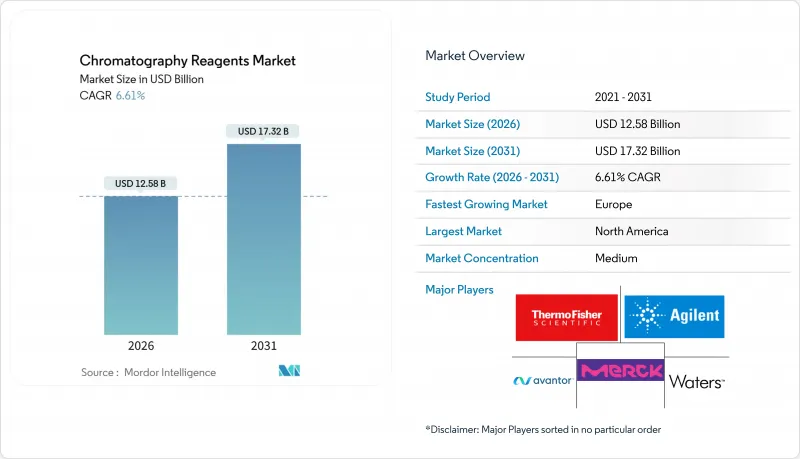
Mordor Intelligence에 의하면, 크로마토그래피 시약 시장 규모는 2026년에 125억 8,000만 달러로 추정되고 예측 기간(2026-2031년) CAGR 6.61%로 성장을 지속하여, 2031년에는 173억 2,000만 달러에 이를 전망입니다.
본 보고서는 유형(완충액, 이온 쌍 시약, 용매, 기타), 이동상의 물리적 상태(기체, 액체, 초임계 유체), 기술(이온 교환, 친화도 교환, 크기 배제, 기타),용도(제약, 기타), 지역(아시아태평양, 북미, 기타)별로 분류되어 있습니다. 시장 전망은 금액(달러) 기준으로 제시되어 있습니다.
세계의 크로마토그래피 시약 시장 동향 및 인사이트
제약 및 생명공학 제조 분야 수요 증가
2024년부터 2025년에 걸쳐 전 세계 CDMO 기업들은 일회용 바이오리액터의 생산 능력을 확대했습니다. 각 배치에는 포집 및 정제용 버퍼가 필요하며, 이로 인해 버퍼 대 제품 비율이 결정되어 시약 수요가 안정적으로 확보됩니다. 일회용 컬럼 방식은 세척 검증의 필요성을 제거함으로써 공정을 간소화하지만, 이러한 컬럼은 일반적으로 제한된 사이클 수 후에 폐기되므로 배치당 시약 비용도 증가합니다. 또한, 연속 바이오의약품 제조에 관한 FDA의 새로운 지침에서는 품질 관리(QC) 실험실에 의한 크로마토그래피 분석의 빈번한 실시가 의무화되어 있어, 기존의 배치 릴리스에 비해 용매 사용량이 대폭 증가하고 있습니다. 아시아태평양에서는 CDMO 기업들이 생산 능력을 급성장하고 있습니다. 특히 한국과 인도에서는 2024년부터 2025년에 걸쳐 크로마토그래피 대응 시설에 막대한 투자가 이루어져, 크로마토그래피 시약 시장의 세계 입지를 강화했습니다. 이러한 전략적 확장은 전반적인 매출의 예상되는 성장을 뒷받침하는 데 매우 중요합니다.
생명공학 및 생명과학 기관의 연구개발 예산 확대
2025년, 생명과학 분야의 연구 개발에 대한 전 세계 자금 지원은 상당한 수준에 도달했습니다. 특히, 단백질체학 및 대사체학 연구 프로그램에서는 LC-MS용 용매, 완충액, 표준 물질이 상당한 비중을 차지하고 있습니다. 대학들이 수동식 HPLC 장비에서 24시간 가동되는 자동 UHPLC 플랫폼으로 전환함에 따라, 장비 1대당 시약 소비량이 급증하고 있습니다. ‘호라이즌 유럽’은 미래를 내다보며 2025년까지 분자 의학 이니셔티브에 자금을 배정했습니다. 중요한 조건으로 인증된 용매를 사용한 표준화된 크로마토그래피법의 채택이 요구되었으며, 이로 인해 크로마토그래피 시약 시장은 더욱 활성화되었습니다. 주목할 만한 움직임으로, 중국 과학재단은 2025년에 분석화학 분야에 대한 보조금을 대폭 증액했습니다. 이러한 프로젝트의 상당수는 보다 친환경적인 이동상으로의 전환을 추진하고 있으며, 역설적이긴 하지만 이로 인해 방법 검증용 시약 구매가 단기적으로 급증하고 있습니다. 한편, 민간 생명공학 스타트업 기업들은 방법 개발을 CRO에 위탁하는 경향이 강해지고 있습니다. 이러한 CRO들은 수량 할인을 확보하면서도 재고 보유 비용을 최소화하기 위해, 적시 납품을 제공하는 공급업체를 우선적으로 선택하고 있습니다.
고순도 시약의 높은 비용과 변동성이 큰 원자재 가격
2025년, LC-MS 등급 아세토니트릴은 테크니컬 등급 제품에 비해 현저히 높은 가격이 책정되었습니다. 이러한 고가의 주된 요인은 원소 오염 수준을 1 ppb 미만으로 억제하도록 의무화하는 생산자 측의 엄격한 요건에 있습니다. 원자재 가격 변동은 단순한 우연이 아니라 생산 공정에 깊이 뿌리박혀 있습니다. 아세토니트릴은 주로 프로파일렌을 원료로 하는 아크릴로니트릴 제조의 부산물이기 때문에 그 가격은 석유화학 시장의 고유한 변동 영향을 받기 쉽습니다. 2024년에는 허리케인으로 인한 혼란이 미국 멕시코만 연안 지역의 생산량 감소를 초래했습니다. 이러한 공급 부족으로 인해 판매업체들은 할당량을 제한할 수밖에 없었고, 소규모 연구소들은 대체재로 메탄올로 전환할 수밖에 없었습니다. 그러나 이러한 전환에는 분석 시간의 장기화라는 대가가 따랐습니다.
부문 분석
펩타이드 및 올리고뉴클레오티드 파이프라인이 확대됨에 따라, 이온 쌍 시약은 2031년까지 연평균 성장률(CAGR) 6.75%를 기록할 전망이며, 크로마토그래피 시약 시장 전체 규모를 상회하는 성장이 예상됩니다. 용매는 여전히 매출의 대부분을 차지하고 있으며, 2025년에는 크로마토그래피 시약 시장 점유율의 52.75%를 차지했지만, 그라디언트 최적화와 내경이 좁은 컬럼으로 인해 평형 시간이 단축됨에 따라 분석당 사용량은 감소 추세를 보이고 있습니다.
일회용 바이오프로세싱에서는 로트 간 균일성이 중요시되므로, 미리 조제된 GMP 준수 완충액에 대한 수요는 계속해서 견조합니다. 각 공급업체는 JIT(Just-in-Time) 배송 및 위탁 재고 프로그램을 제공함으로써 차별화를 꾀하고, CDMO가 직면한 운전 자금 압박을 완화하고 있습니다. 휘발성이 높은 이온 쌍 형성제는 MS 대응 분리를 가능하게 하지만, 내식성이 있는 티타늄 재질의 유로(flow path)가 필요합니다. 이러한 요건으로 인해 크로마토그래피 시약 시장 내에서 뚜렷한 성장 궤도가 열리고 있습니다.
가스 크로마토그래피용 시약은 2031년까지 연평균 성장률(CAGR) 7.20%를 기록할 전망이며, 이는 물리적 상태별 부문 중 가장 높은 성장률입니다. 이는 2차원 GC-MS 워크플로우에 의존하는 농약 및 VOC(휘발성 유기 화합물) 스크리닝을 확대하는 EU 및 미국의 규제에 힘입은 결과입니다. 액체 크로마토그래피용 시약은 제약 품질 관리(QC) 및 바이오프로세스 PAT(공정 분석 기술) 용도에 힘입어 2025년 매출의 82.56%를 차지했습니다.
2024년, 규제 당국은 ‘산업 배출 지침’을 개정하여 VOC 배출 기준치를 하향 조정했습니다. 이 조치로 인해 실시간 GC 모니터링이 필요하게 되었으며, 그 결과 캐리어 가스 및 교정 표준 물질에 대한 수요가 기존 수준을 크게 상회하는 속도로 증가하고 있습니다. SFC 시약은 틈새 시장에 속하지만, 용매 사용량을 대폭 줄일 수 있습니다. 이는 약전에서는 아직 널리 인정받지 못하고 있는 부분이지만, 지속가능성에 관한 요건과 부합하는 것입니다. 향료 및 화장품 분석 분야에서 GCxGC의 채택이 확대됨에 따라 유도체화 시약과 초고순도 헬륨에 대한 수요가 증가하고 있으며, 크로마토그래피 시약 시장의 물리적 상은 더욱 다양해지고 있습니다.
지역별 분석
북미는 견조한 수요에 힘입어 2025년에는 시장의 46.82%를 차지했습니다. 전 세계 바이오의약품 생산 능력의 대부분을 보유한 미국에서는 엄격한 cGMP 규제가 시행되고 있어, 추적 가능성과 검증(validation)이 확보된 시약의 필요성이 강조되고 있습니다. 지역 내 CDMO 기업들은 미리 조제된 완충액의 채택을 확대하여 배치 공정의 효율화를 도모하는 한편, 용매 및 완충액의 처리 능력을 향상시키고 있습니다. 2024년 확대된 캐나다의 대마 검사 규제로 인해 현재 월간 크로마토그래피 분석 횟수가 증가하고 있으며, 유도체화 시약 및 LC-MS용 용매가 대량으로 사용되고 있습니다. 한편, 멕시코는 주요 니어쇼어링 거점으로 부상하고 있으며, 2025년 미국으로의 API 수출 증가가 그 증거로, 그 결과 HPLC용 용매 수요도 증가하고 있습니다.
유럽은 2031년까지 연평균 성장률(CAGR) 8.21%로 가장 빠르게 성장할 것으로 예측됩니다. 이러한 성장세는 주로 유럽의약품청(EMA)의 개정 조치에 기인하며, 이로 인해 원소 불순물의 허용 한도치가 절반으로 줄었습니다. 이러한 변경 사항으로 인해 업계 전반에 걸쳐 초저금속 용매로의 광범위한 전환이 의무화되면서 크로마토그래피 시약 시장 규모가 확대되고 있습니다. 독일에서는 프라운호퍼 연구소가 연속 크로마토그래피 파일럿 시설을 가동하며, 최적화 단계에서 매월 맞춤형 완충액을 사용하고 있습니다. 영국의 MHRA는 세포 치료 분야에서 일회용 기술의 도입을 추진하고 있으며, 이로 인해 완충액의 사용량이 증가하고 있습니다. 동시에 스웨덴의 KEMI는 2028년까지 할로겐화 용매의 사용을 단계적으로 폐지할 것을 연구소에 요청하고 있으며, 에탄올·수계로의 전환을 촉진하고 있습니다.
아시아태평양에서는 상황이 제각각입니다. 2025년, 중국의 NMPA는 새로운 생물제제 공장에 대한 승인을 내렸으며, 이로 인해 일회용 바이오리액터의 생산 능력이 증강되어 결과적으로 크로마토그래피 시약 수요의 확대로 이어졌습니다. 일본 약전에서는 일부 규격에 대해 UHPLC의 채택이 권장되기 시작했습니다. 컬럼 직경을 4.6 mm에서 2.1 mm로 변경함에 따라 1회 분석당 용매 사용량은 대폭 감소했으나, 시료 처리량 증가로 인해 용매의 총 사용량은 여전히 정체 상태를 유지하고 있습니다. 한국의 업계 선두 기업인 삼성바이오로직스와 셀트리온은 2025년까지 바이오시밀러 생산 능력을 공동으로 확대했으며, 그 결과 프로테인 A 수지의 수주가 증가했습니다. 한편, 싱가포르에서는 바이오의약품 생산량이 증가하고 있으며, 크로마토그래피용 소모품이 생산 비용의 상당 부분을 차지하고 있습니다. 이러한 지역별 다양한 동향은 크로마토그래피 시약 시장의 장기적인 견조함을 뒷받침하고 있습니다.
기타 혜택 :
- 엑셀 형식 시장 예측(ME) 시트
- 3개월간의 애널리스트 지원
자주 묻는 질문
목차
제1장 서론
제2장 조사 방법
제3장 주요 요약
제4장 시장 구도
제5장 시장 규모 및 성장 예측
제6장 경쟁 구도
제7장 시장 기회 및 향후 전망
KTH 26.09.10According to Mordor Intelligence, the chromatography reagents market size is estimated at USD 12.58 billion in 2026, and is expected to reach USD 17.32 billion by 2031, at a CAGR of 6.61% during the forecast period (2026-2031).
This report is Segmented by Type (Buffers, Ion Pair Reagents, Solvents, and Other Types), Physical State of Mobile Phase (Gas, Liquid, and Super-Critical Fluid), Technology (Ion Exchange, Affinity Exchange, Size Exclusion, and More), Application (Pharmaceutical, and More), and Geography (Asia-Pacific, North America, and More). The Market Forecasts are Provided in Terms of Value (USD).
Global Chromatography Reagents Market Trends and Insights
Rising Demand from Pharmaceutical and Biotech Manufacturing
Between 2024 and 2025, global CDMOs expanded their single-use bioreactor capacity. Each batch requires capture and polishing buffers, resulting in a buffer-to-product ratio and ensuring consistent reagent demand. While the disposable column format streamlines the process by eliminating the need for cleaning validation, it also increases per-batch reagent costs, as these columns are typically discarded after a limited number of cycles. Furthermore, new FDA guidelines on continuous biologics manufacturing mandate that QC labs conduct chromatography assays frequently, leading to a significant increase in solvent throughput compared to traditional batch releases. In the Asia-Pacific region, CDMOs are rapidly expanding their capacities. Notably, South Korea and India have made substantial investments in chromatography-enabled suites during 2024-2025, bolstering the global presence of the chromatography reagents market. These strategic expansions are pivotal in supporting the anticipated growth of overall revenue.
Expanding Research and Development Budgets in Biotechnology and Life-Science Institutes
In 2025, global funding for life-science research and development reached significant levels. Notably, programs in proteomics and metabolomics are consuming a substantial share of LC-MS solvents, buffers, and standards. As universities transition from manual HPLC benches to round-the-clock automated UHPLC platforms, reagent consumption per instrument has surged. Horizon Europe, with an eye on the future, allocated funds for molecular medicine initiatives through 2025. A key stipulation was the use of standardized chromatography methods with certified solvents, further bolstering the chromatography reagents market. In a notable move, China's science foundation amplified its analytical-chemistry grants in 2025. Many of these projects are pivoting towards greener mobile phases, which, paradoxically, is driving a short-term spike in reagent purchases for method validation. Meanwhile, private biotech startups are increasingly turning to CROs for method development. These CROs, while securing volume discounts, are also prioritizing suppliers that offer just-in-time deliveries, a strategy aimed at minimizing inventory carrying costs.
High Cost of High-Purity Reagents and Volatile Raw-Material Pricing
In 2025, LC-MS-grade acetonitrile commanded significantly higher prices than its technical-grade counterpart. This premium pricing is largely due to stringent producer requirements, mandating sub-1 ppb elemental contamination levels. Pricing fluctuations in raw materials are not merely incidental; they are deeply rooted in the production process. Acetonitrile is predominantly a by-product of propylene-based acrylonitrile production, making its pricing susceptible to the inherent volatilities of the petrochemical market. In 2024, disruptions caused by hurricanes led to a reduction in output from the U.S. Gulf Coast. This shortfall compelled distributors to ration their allocations, nudging smaller laboratories to pivot towards methanol as a substitute. However, this switch came with a trade-off: longer run times.
Other drivers and restraints analyzed in the detailed report include:
- Stricter Global Food-Safety and Environmental-Testing Regulations
- Shift to MS-Coupled HILIC Methods Requiring Ultra-Low-Metal Reagents
- Persistent Acetonitrile Supply Shocks and Price Volatility
For complete list of drivers and restraints, kindly check the Table Of Contents.
Segment Analysis
Ion pair reagents recorded a 6.75% CAGR outlook to 2031, outpacing the broader chromatography reagents market size, as peptide and oligonucleotide pipelines grow. Solvents still dominate revenue and captured a 52.75% chromatography reagents market share in 2025, but per-analysis volumes are slipping as gradient optimization and narrow-bore columns shorten equilibration times.
As single-use bioprocessing prioritizes lot-to-lot consistency, the demand for pre-formulated GMP buffers remains robust. Suppliers are setting themselves apart by offering just-in-time delivery and consignment stock programs, alleviating the working-capital pressures faced by CDMOs. While volatile ion-pairing agents facilitate MS-compatible separations, they necessitate corrosion-resistant titanium flow paths. This requirement carves out a distinct growth trajectory within the chromatography reagents market.
Gas chromatography reagents are set for a 7.20% CAGR to 2031, the fastest among physical-state segments, helped by EU and U.S. rules expanding pesticide and VOC screening that depend on two-dimensional GC-MS workflows. Liquid chromatography reagents retained 82.56% of 2025 revenue, anchored by pharmaceutical QC and bioprocess PAT applications.
In 2024, regulators revised the Industrial Emissions Directive, reducing VOC discharge limits. This move necessitated real-time GC monitoring, which now demands carrier gases and calibration standards at significantly higher rates than historical norms. While SFC reagents occupy a niche, they offer a substantial reduction in solvents. This aligns with sustainability mandates, even if they lack widespread recognition in pharmacopeias. The growing adoption of GCxGC in flavor and fragrance analytics is driving up the demand for derivatization chemicals and ultra-high-purity helium, further diversifying the physical phases of the chromatography reagents market.
Complete Report Scope:
- By Type
- Buffers
- Ion Pair Reagents
- Solvents
- Other Types
- By Physical State of Mobile Phase
- Gas Chromatography Reagents
- Liquid Chromatography Reagents
- Super-Critical Fluid Chromatography Reagents
- By Technology
- Ion Exchange
- Affinity Exchange
- Size Exclusion
- Hydrophobic Interaction
- Mixed-Mode
- Other Technologies
- By Application
- Pharmaceutical
- Food and Beverages
- Water and Environmental Analysis
- Other Applications
- By Geography
- Asia-Pacific
- China
- India
- Japan
- South Korea
- ASEAN Countries
- Rest of Asia-Pacific
- North America
- United States
- Canada
- Mexico
- Europe
- Germany
- United Kingdom
- Italy
- France
- Spain
- NORDIC Countries
- Rest of Europe
- South America
- Brazil
- Argentina
- Rest of South America
- Middle-East and Africa
- Saudi Arabia
- South Africa
- Rest of Middle-East and Africa
- Asia-Pacific
Geography Analysis
North America accounted for 46.82% of 2025, driven by robust demand. The U.S., housing a significant portion of the world's biologics capacity, enforces stringent cGMP regulations, emphasizing the need for traceable and validated reagents. Regional CDMOs are increasingly adopting pre-formulated buffers, streamlining batch processes, and enhancing solvent and buffer throughput. Canada's cannabis testing regulations, expanded in 2024, now account for additional monthly chromatography runs, heavily utilizing derivatization reagents and LC-MS solvents. Meanwhile, Mexico is emerging as a prominent near-shoring hub, evidenced by a rise in its API exports to the U.S. in 2025, subsequently driving up demand for HPLC solvents.
Europe is projected to grow the fastest at an 8.21% CAGR through 2031. This momentum is largely attributed to revisions by the EMA, which halved the permissible limits on elemental impurities. These changes have mandated a widespread shift to ultra-low-metal solvents across the industry, bolstering the market size for chromatography reagents. In Germany, the Fraunhofer Institute has initiated pilot continuous chromatography facilities, utilizing custom buffers monthly during their optimization phase. The UK's MHRA is championing single-use technology in cell therapies, leading to increased buffer volumes. Concurrently, Sweden's KEMI is urging labs to phase out halogenated solvents by 2028, driving a shift towards ethanol-water systems.
The Asia-Pacific region showcases a mixed landscape. In 2025, China's NMPA greenlit new biologics plants, contributing additional single-use bioreactor capacity and subsequently boosting demand for chromatography reagents. Japan's pharmacopoeia has begun endorsing UHPLC across several monographs. While the transition from 4.6 mm to 2.1 mm columns has achieved a significant reduction in solvent volume per run, the overall solvent volumes remain consistent due to increased sample throughput. South Korea's industry giants, Samsung Biologics and Celltrion, have collectively augmented their biosimilar capacity through 2025, leading to heightened orders for protein A resin. Singapore, on the other hand, has witnessed an uptick in biopharma output, with chromatography consumables constituting a notable portion of production costs. This diverse regional activity underscores the long-term robustness of the chromatography reagents market.
- Agilent Technologies Inc.
- Avantor Inc.
- Bio-Rad Laboratories Inc.
- DH Life Sciences, LLC.
- ITW Reagents
- Merck KGaA
- PerkinElmer
- Regis Technologies Inc.
- Repligen Corporation.
- Santa Cruz Biotechnology Inc.
- Shimadzu Corporation
- Spectrum Chemical Mfg.
- Thermo Fisher Scientific Inc.
- Tokyo Chemical Industry
- Tosoh Corporation
- Waters Corporation
Additional Benefits:
- The market estimate (ME) sheet in Excel format
- 3 months of analyst support
TABLE OF CONTENTS
1 Introduction
- 1.1 Study Assumptions and Market Definition
- 1.2 Scope of the Study
2 Research Methodology
3 Executive Summary
4 Market Landscape
- 4.1 Market Overview
- 4.2 Market Drivers
- 4.2.1 Rising demand from pharmaceutical and biotech manufacturing
- 4.2.2 Expanding research and development budgets in biotechnology and life-science institutes
- 4.2.3 Stricter global food-safety and environmental-testing regulations
- 4.2.4 Shift to MS-coupled HILIC methods requiring ultra-low-metal reagents
- 4.2.5 Continuous single-use bioprocessing boosting buffer and single-shot solutions
- 4.3 Market Restraints
- 4.3.1 High cost of high-purity reagents and volatile raw-material pricing
- 4.3.2 Persistent acetonitrile supply shocks and price volatility
- 4.3.3 Solvent-reduction/green-chemistry workflows lowering per-sample volumes
- 4.4 Value Chain Analysis
- 4.5 Porter's Five Forces
- 4.5.1 Bargaining Power of Suppliers
- 4.5.2 Bargaining Power of Buyers
- 4.5.3 Threat of New Entrants
- 4.5.4 Threat of Substitutes
- 4.5.5 Degree of Competition
5 Market Size and Growth Forecasts (Value)
- 5.1 By Type
- 5.1.1 Buffers
- 5.1.2 Ion Pair Reagents
- 5.1.3 Solvents
- 5.1.4 Other Types
- 5.2 By Physical State of Mobile Phase
- 5.2.1 Gas Chromatography Reagents
- 5.2.2 Liquid Chromatography Reagents
- 5.2.3 Super-Critical Fluid Chromatography Reagents
- 5.3 By Technology
- 5.3.1 Ion Exchange
- 5.3.2 Affinity Exchange
- 5.3.3 Size Exclusion
- 5.3.4 Hydrophobic Interaction
- 5.3.5 Mixed-Mode
- 5.3.6 Other Technologies
- 5.4 By Application
- 5.4.1 Pharmaceutical
- 5.4.2 Food and Beverages
- 5.4.3 Water and Environmental Analysis
- 5.4.4 Other Applications
- 5.5 By Geography
- 5.5.1 Asia-Pacific
- 5.5.1.1 China
- 5.5.1.2 India
- 5.5.1.3 Japan
- 5.5.1.4 South Korea
- 5.5.1.5 ASEAN Countries
- 5.5.1.6 Rest of Asia-Pacific
- 5.5.2 North America
- 5.5.2.1 United States
- 5.5.2.2 Canada
- 5.5.2.3 Mexico
- 5.5.3 Europe
- 5.5.3.1 Germany
- 5.5.3.2 United Kingdom
- 5.5.3.3 Italy
- 5.5.3.4 France
- 5.5.3.5 Spain
- 5.5.3.6 NORDIC Countries
- 5.5.3.7 Rest of Europe
- 5.5.4 South America
- 5.5.4.1 Brazil
- 5.5.4.2 Argentina
- 5.5.4.3 Rest of South America
- 5.5.5 Middle-East and Africa
- 5.5.5.1 Saudi Arabia
- 5.5.5.2 South Africa
- 5.5.5.3 Rest of Middle-East and Africa
- 5.5.1 Asia-Pacific
6 Competitive Landscape
- 6.1 Market Concentration
- 6.2 Strategic Moves
- 6.3 Market Share(%)/Ranking Analysis
- 6.4 Company Profiles (includes Global level Overview, Market level overview, Core Segments, Financials, Strategic Information, Products and Services, Recent Developments)
- 6.4.1 Agilent Technologies Inc.
- 6.4.2 Avantor Inc.
- 6.4.3 Bio-Rad Laboratories Inc.
- 6.4.4 DH Life Sciences, LLC.
- 6.4.5 ITW Reagents
- 6.4.6 Merck KGaA
- 6.4.7 PerkinElmer
- 6.4.8 Regis Technologies Inc.
- 6.4.9 Repligen Corporation.
- 6.4.10 Santa Cruz Biotechnology Inc.
- 6.4.11 Shimadzu Corporation
- 6.4.12 Spectrum Chemical Mfg.
- 6.4.13 Thermo Fisher Scientific Inc.
- 6.4.14 Tokyo Chemical Industry
- 6.4.15 Tosoh Corporation
- 6.4.16 Waters Corporation
7 Market Opportunities and Future Outlook
- 7.1 White-space and Unmet-Need Assessment


