|
시장보고서
상품코드
2120460
항고혈압제 : 시장 점유율 분석, 업계 동향 및 통계, 성장 예측(2026-2031년)Global Anti-hypertensive Drugs - Market Share Analysis, Industry Trends & Statistics, Growth Forecasts (2026 - 2031) |
||||||
 Mordor Intelligence
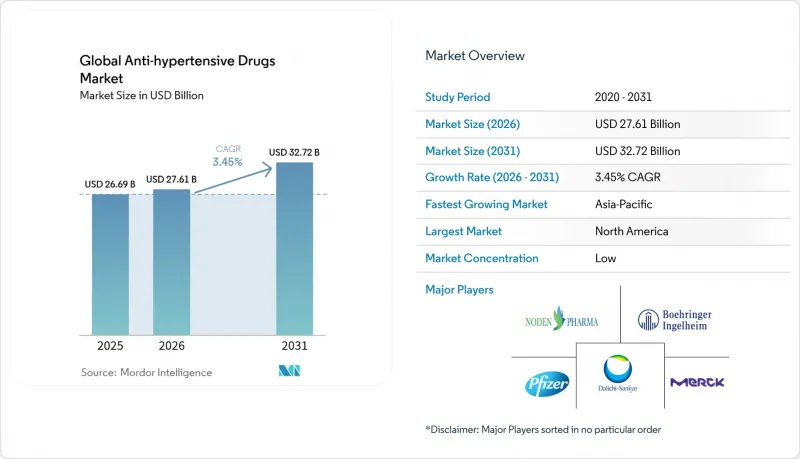
Mordor Intelligence에 의하면, 2026년 항고혈압제 시장 규모는 276억 1,000만 달러로 추정되고 2025년 266억 9,000만 달러에서 확대해, 2031년에는 327억 2,000만 달러에 이를 것으로 예측됩니다.
2026-2031년 동안 연평균 성장률(CAGR) 3.45%로 성장할 것으로 전망됩니다.
본 보고서에서는 산업을 치료 분류별(안지오텐신 전환 효소(ACE) 억제제, 안지오텐신 수용체 차단제(ARB), 기타), 유통 채널별(병원 약국, 기타), 투여 경로별(경구, 비경구·주사제, 기타),지역별(북미, 유럽, 아시아태평양, 기타)로 분류하고 있습니다. 시장 예측은 금액(달러) 기준으로 제시되어 있습니다.
세계의 항고혈압제 시장 동향 및 인사이트
가속화되는 비만 및 대사증후군
대사증후군은 전 세계 성인의 약 3분의 1에게 영향을 미치고 있으며, 이들 환자의 85%가 고혈압을 동반하고 있습니다. 임상의들은 체중, 혈당 조절, 혈압을 동시에 개선하는 약물, 특히 체중 감량과 무관하게 수축기 혈압을 7-10mmHg 낮추는 GLP-1 수용체 작용제로의 전환을 추진하고 있습니다. 의료 시스템 모델에 따르면, 고혈압을 방치할 경우 심혈관 질환 치료비는 2020년 1,600억 달러에서 2050년에는 5,130억 달러로 급증할 것으로 추정되며, 이는 적극적인 조기 치료의 경제적 근거를 더욱 공고히 하고 있습니다.
고정 용량 병용 요법의 확대
환자의 약 70%는 2유형 이상의 항고혈압제가 필요하지만, 복용하는 약의 수가 늘어날수록 복약 순응도는 떨어집니다. 2025년 FDA가 최초의 3제 복합제를 승인한 것은 위약군의 37%에 비해 70%의 혈압 조절률을 달성한 초기 단계부터의 다제 병용 제품에 대한 규제상 승인을 의미합니다. 의료경제학 연구에 따르면, 복약 순응도가 높은 환자 1인당 연간 입원비 절감액은 873달러로 추산되며, 이에 따라 보험사들은 이러한 치료법을 우선적으로 채택하고 있습니다.
블록버스터 ARB·CCB의 특허 만료
엔트레스트는 2025년 중반에 미국 내 독점권을 상실했으며, 여러 ARB 및 CCB 화합물도 마찬가지로 특허 만료를 맞이함에 따라 제네릭 의약품의 급속한 시장 진입이 예상됩니다. 역사적으로 볼 때, 이로 인해 1년 이내에 브랜드 의약품의 판매량이 최대 90%까지 감소하는 경향이 있습니다. 제약사들은 신규 제제나 복합제로 대응하고 있지만, 지불 기관은 비용 관리의 관점에서 제네릭 의약품을 선호하고 있습니다.
부문별 분석
안지오텐신 II 수용체 길항제(ARB)는 입증된 심장 및 신장에 대한 유익성과 우수한 내약성 덕분에 2025년 항고혈압제 시장에서 31.02%의 점유율을 차지했습니다. 레닌 억제제는 시장 규모는 작지만, 난치성 환자에 대한 새로운 치료 경로가 의사들에게 채택됨에 따라 연평균 성장률(CAGR) 4.12%로 성장할 전망입니다. 2025년에 새로 승인된 엔도세린 수용체 길항제와 알도스테론 합성 효소 억제제는 치료가 어려운 증례에 대한 추가적인 선택지를 제공할 것입니다. 베타 차단제와 일부 구형 칼슘 채널 차단제는 대사계 부작용으로 인해 점유율이 하락하고 있는 반면, 이뇨제는 저용량 제제를 통해 다시 주목을 받고 있습니다. 파이프라인의 다양성은 동반 질환 클러스터 및 난치성 고혈압이라는 틈새 시장을 겨냥한 정밀한 작용기전으로의 전환을 부각시키고 있습니다.
항고혈압제 시장에서는 유효성과 양호한 부작용 프로파일을 겸비한 약물군이 계속해서 우위를 점하고 있습니다. 라이프사이클 전략에서는 ARB와 CCB 또는 이뇨제를 조합한 3제 복합제가 중시되고 있으며, 제네릭 의약품의 압박 속에서도 브랜드 충성도를 확고히 하고 있습니다. 새로운 작용기전을 가진 약물은 명확한 치료 효과의 우월성이 입증된다면 프리미엄 가격을 책정할 수 있을 것으로 예상되며, 다가오는 특허 만료로 인한 수익에 미치는 영향을 완화할 것으로 보입니다. 제네릭 의약품과 혁신적인 신약을 모두 아우르는 폭넓은 포트폴리오를 보유한 제약사가 이 과도기를 가장 효과적으로 헤쳐 나갈 것으로 보입니다.
지역별 분석
북미는 고도의 심혈관 의료 네트워크, 종합적인 보험 적용, 신규 약물군의 신속한 보급을 활용하여 2025년 매출의 35.20%를 차지했습니다. 미국은 프리미엄 가격 책정과 디지털 헬스의 조기 도입에 힘입어 시장을 주도하고 있습니다. 캐나다는 비용 대비 효과를 중시하여 제네릭 의약품에 의존하고 있는 반면, 멕시코에서는 공적 의료 제도 내 보험 적용 범위 확대에 따라 판매량이 증가하고 있습니다.
유럽은 비용과 혁신을 동등하게 중시하는 성숙한 의료 제도 하에서 한 자릿수 중반대의 꾸준한 성장을 보이고 있습니다. 독일과 영국은 첨단 메커니즘의 임상 도입을 주도하고 있는 반면, 남유럽 국가들은 제네릭 의약품의 높은 보급률에 힘입고 있습니다. 가치 기반 계약(VBC)에 따라 주요 EU 시장에서는 고정 용량 제제의 보급이 가속화되고 있습니다.
아시아태평양은 연평균 성장률(CAGR) 5.52%를 기록하며 가장 빠르게 성장하는 지역으로 두각을 나타내고 있습니다. 중국에서는 일괄 조달 정책으로 가격이 억제되고 있음에도 판매량이 증가하고 있으며, 인도에서는 대규모 제조 체계와 국내 수요 증가가 호재로 작용하고 있습니다. 일본에서는 고령화가 진행되는 인구 구조로 인해 심혈관 및 대사 질환 치료에 대한 지출이 뒷받침되고 있습니다. 지역별 나트륨 민감도의 특징과 유전적 변이를 배경으로, 지역에 특화된 연구 프로그램이 진행되고 있어 차별화된 치료법의 전개가 기대되고 있습니다.
남미에서는 경제 회복과 고혈압 인식 제고 캠페인을 배경으로 완만한 개선세가 나타나고 있으나, 환율 변동으로 인해 고가 의약품의 보급은 주춤하고 있습니다. 중동 및 아프리카는 여전히 개발도상국 단계이지만, 각국 정부가 비감염성 질환 대책에 투자하고 민간 보험의 보급이 확대되고 있어 미래성이 기대되고 있습니다.
기타 혜택
- 엑셀 형식 시장 예측(ME) 시트
- 3개월간의 애널리스트 지원
자주 묻는 질문
목차
제1장 서론
제2장 조사 방법
제3장 주요 요약
제4장 시장 구도
제5장 시장 규모 및 성장 예측
제6장 경쟁 구도
제7장 시장 기회 및 향후 전망
KTH 26.09.04According to Mordor Intelligence, the antihypertensive drugs market size in 2026 is estimated at USD 27.61 billion, growing from 2025 value of USD 26.69 billion with 2031 projections showing USD 32.72 billion, growing at 3.45% CAGR over 2026-2031.
This report Segments the Industry Into Therapeutic Class (Angiotensin Converting Enzyme (ACE) Inhibitors, Angiotensin Receptor Blockers (ARBs) and More), by Distribution Channel (Hospital Pharmacies and More), by Route of Administration (Oral, Parenteral / Injectable and More) and Geography (North America, Europe, Asia-Pacific and More). The Market Forecasts are Provided in Terms of Value (USD).
Global Anti-hypertensive Drugs Market Trends and Insights
Accelerating Obesity and Metabolic Syndrome
Metabolic syndrome affects roughly one-third of adults worldwide, and hypertension co-exists in 85% of these patients. Clinicians are moving toward agents that simultaneously address weight, glycemic control, and blood pressure, particularly GLP-1 receptor agonists that cut systolic readings by 7-10 mmHg independent of weight loss. Health-system models estimate that unchecked hypertension could push annual cardiovascular treatment costs from USD 160 billion in 2020 to USD 513 billion by 2050, reinforcing the economic case for aggressive early therapy .
Growth of Fixed-Dose Combination Therapies
Roughly 70% of patients need two or more antihypertensive agents, yet adherence drops as pill count rises. FDA approval of the first triple-combination tablet in 2025 signals a regulatory green light for upfront multi-drug products that achieved 70% control rates versus 37% on placebo. Health-economic studies put annual hospitalization savings at USD 873 per adherent patient, spurring payers to prioritize such regimens.
Patent Cliffs for Blockbuster ARBs & CCBs
Entresto loses U.S. exclusivity in mid-2025, and multiple ARB and CCB molecules face similar expiries, inviting rapid generic entry that historically erodes branded volume by up to 90% within a year. Manufacturers are countering with novel formulations and combination products, though payers favor generics for cost control.
Other drivers and restraints analyzed in the detailed report include:
- Expanding Reimbursement for Single-Pill Regimens
- Uptake of Once-Weekly GLP-1 Combination Injectables
- Low Adherence Due to Asymptomatic Nature of Hypertension
For complete list of drivers and restraints, kindly check the Table Of Contents.
Segment Analysis
Angiotensin II Receptor Blockers held 31.02% antihypertensive drugs market share in 2025 thanks to proven cardio-renal benefits and favorable tolerability. Renin Inhibitors, although smaller, will climb at 4.12% CAGR as physicians adopt new pathways for resistant patients. Endothelin receptor antagonists and aldosterone synthase inhibitors, newly approved in 2025, bring additional options for hard-to-treat cases. Beta Blockers and some older Calcium Channel Blockers lose ground due to metabolic side effects, while diuretics gain renewed interest through low-dose formulations. Pipeline diversity underscores a shift toward precision mechanisms addressing comorbidity clusters and resistant hypertension niches.
The antihypertensive drugs market continues to reward classes that combine efficacy with favorable side-effect profiles. Lifecycle strategies now favor triple-combination tablets that integrate ARBs with CCBs or diuretics, anchoring brand loyalty even amid generic pressure. Novel mechanisms are expected to command premium pricing where they demonstrate clear outcome advantages, cushioning revenue against pending patent expiries. Manufacturers with broad portfolios straddling generics and innovations will navigate the transition most effectively.
Complete Report Scope:
- By Test Type (Value)
- Culture-based Tests
- Smear Microscopy
- Nucleic Acid Amplification Tests (NAAT)/PCR
- Interferon-Gamma Release Assays (IGRA)
- Tuberculin Skin Test (Mantoux)
- Radiographic & Imaging Tests
- Other Tests
- By Technology (Value)
- Culture-based
- Molecular Diagnostics (PCR/NAAT)
- Immunoassays (IGRA/LAM)
- Radiology/X-ray
- AI-enhanced Digital Microscopy
- Others
- By End-User (Value)
- Hospitals & Clinics
- Diagnostic Laboratories
- Academic & Research Institutes
- Others
- By Geography (Value)
- North America
- United States
- Canada
- Mexico
- Europe
- Germany
- United Kingdom
- France
- Italy
- Spain
- Rest of Europe
- Asia-Pacific
- China
- India
- Japan
- South Korea
- Australia
- Rest of Asia-Pacific
- South America
- Brazil
- Argentina
- Rest of South America
- Middle East and Africa
- GCC
- South Africa
- Rest of Middle East and Africa
- North America
Geography Analysis
North America captured 35.20% of 2025 revenue, leveraging sophisticated cardiology networks, strong insurance coverage, and fast uptake of novel classes. The United States leads, buoyed by premium prices and early use of digital health. Canada emphasizes cost-effectiveness, leaning on generics, while Mexico grows volume as coverage expands across public programs.
Europe contributes steady mid-single-digit growth under mature health systems that weigh cost and innovation in equal measure. Germany and the United Kingdom spearhead clinical adoption of advanced mechanisms, whereas Southern Europe leans on high generic penetration. Value-based contracting accelerates fixed-dose uptake in major EU markets.
Asia-Pacific stands out as the fastest-expanding region with a 5.52% CAGR. China's bulk-procurement policies have cut prices yet boosted volumes, while India benefits from large-scale manufacturing and rising domestic demand. Japan's aging demographic sustains spending on cardio-metabolic care. Local salt-sensitivity profiles and genetic variations prompt region-specific research programs, creating scope for differentiated therapies.
South America shows gradual improvement amid economic recovery and hypertension awareness campaigns, though currency volatility tempers premium-drug uptake. Middle East and Africa remain nascent but promising as governments invest in non-communicable disease control and private insurance penetration rises.
- Cepheid (Danaher)
- Roche
- Beckton Dickinson
- Abbott Laboratories
- Hologic
- QIAGEN
- Thermo Fisher Scientific
- bioMerieux
- Siemens Healthineers
- Beckman Coulter Diagnostics
- FUJIFILM
- SD Biosensor
- Molbio Diagnostics
- Oxford Immunotec
- Meridian Bioscience
- LumiraDx
- Tauns Laboratories
- QuantuMDx
- Luminex (DiaSorin)
Additional Benefits:
- The market estimate (ME) sheet in Excel format
- 3 months of analyst support
TABLE OF CONTENTS
1 Introduction
2 Research Methodology
3 Executive Summary
4 Market Landscape
- 4.1 Market Overview
- 4.2 Market Drivers
- 4.2.1 Rising prevalence of drug-resistant TB strains
- 4.2.2 WHO endorsement & national roll-outs of NAAT platforms
- 4.2.3 Government funding & global health initiatives
- 4.2.4 Emergence of AI-powered microscopy & digital radiology triage
- 4.2.5 Decentralised near-POC molecular platforms
- 4.2.6 Subscription-based diagnostics-as-a-service models
- 4.3 Market Restraints
- 4.3.1 High cost of molecular tests & cartridges
- 4.3.2 Shortage of skilled laboratory infrastructure
- 4.3.3 Supply-chain fragility for single-source cartridges
- 4.3.4 Competition from emerging non-sputum biomarkers
- 4.4 Supply-Chain Analysis
- 4.5 Regulatory Landscape
- 4.6 Technological Outlook
- 4.7 Porter's Five Forces
- 4.7.1 Threat of New Entrants
- 4.7.2 Bargaining Power of Suppliers
- 4.7.3 Bargaining Power of Buyers
- 4.7.4 Threat of Substitutes
- 4.7.5 Competitive Rivalry
5 Market Size & Growth Forecasts
- 5.1 By Test Type (Value)
- 5.1.1 Culture-based Tests
- 5.1.2 Smear Microscopy
- 5.1.3 Nucleic Acid Amplification Tests (NAAT)/PCR
- 5.1.4 Interferon-Gamma Release Assays (IGRA)
- 5.1.5 Tuberculin Skin Test (Mantoux)
- 5.1.6 Radiographic & Imaging Tests
- 5.1.7 Other Tests
- 5.2 By Technology (Value)
- 5.2.1 Culture-based
- 5.2.2 Molecular Diagnostics (PCR/NAAT)
- 5.2.3 Immunoassays (IGRA/LAM)
- 5.2.4 Radiology/X-ray
- 5.2.5 AI-enhanced Digital Microscopy
- 5.2.6 Others
- 5.3 By End-User (Value)
- 5.3.1 Hospitals & Clinics
- 5.3.2 Diagnostic Laboratories
- 5.3.3 Academic & Research Institutes
- 5.3.4 Others
- 5.4 By Geography (Value)
- 5.4.1 North America
- 5.4.1.1 United States
- 5.4.1.2 Canada
- 5.4.1.3 Mexico
- 5.4.2 Europe
- 5.4.2.1 Germany
- 5.4.2.2 United Kingdom
- 5.4.2.3 France
- 5.4.2.4 Italy
- 5.4.2.5 Spain
- 5.4.2.6 Rest of Europe
- 5.4.3 Asia-Pacific
- 5.4.3.1 China
- 5.4.3.2 India
- 5.4.3.3 Japan
- 5.4.3.4 South Korea
- 5.4.3.5 Australia
- 5.4.3.6 Rest of Asia-Pacific
- 5.4.4 South America
- 5.4.4.1 Brazil
- 5.4.4.2 Argentina
- 5.4.4.3 Rest of South America
- 5.4.5 Middle East and Africa
- 5.4.5.1 GCC
- 5.4.5.2 South Africa
- 5.4.5.3 Rest of Middle East and Africa
- 5.4.1 North America
6 Competitive Landscape
- 6.1 Market Concentration
- 6.2 Market Share Analysis
- 6.3 Company Profiles {(includes Global level Overview, Market level overview, Core Segments, Financials as available, Strategic Information, Market Rank/Share for key companies, Products & Services, and Recent Developments)}
- 6.3.1 Cepheid (Danaher)
- 6.3.2 Roche Diagnostics
- 6.3.3 Becton, Dickinson and Company
- 6.3.4 Abbott Laboratories
- 6.3.5 Hologic Inc.
- 6.3.6 Qiagen N.V.
- 6.3.7 Thermo Fisher Scientific Inc.
- 6.3.8 BioMerieux SA
- 6.3.9 Siemens Healthineers
- 6.3.10 Beckman Coulter Diagnostics
- 6.3.11 Fujifilm Holdings Corporation
- 6.3.12 SD Biosensor
- 6.3.13 Molbio Diagnostics
- 6.3.14 Oxford Immunotec
- 6.3.15 Meridian Bioscience
- 6.3.16 LumiraDx
- 6.3.17 Tauns Laboratories
- 6.3.18 QuantuMDx
- 6.3.19 Luminex (DiaSorin)
7 Market Opportunities & Future Outlook
- 7.1 White-space & Unmet-Need Assessment