

|
시장보고서
상품코드
2120463
자동차 로보틱스 : 시장 점유율 분석, 업계 동향 및 통계, 성장 예측(2026-2031년)Automotive Robotics - Market Share Analysis, Industry Trends & Statistics, Growth Forecasts (2026 - 2031) |
||||||
 Mordor Intelligence
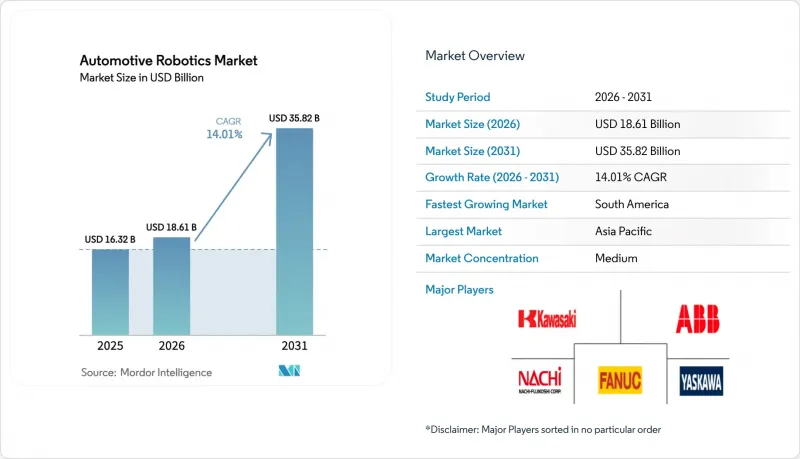
Mordor Intelligence에 의하면, 자동차 로보틱스 시장 규모는 2025년에 163억 2,000만 달러로 평가되었습니다. 2026년 186억 1,000만 달러에서 2031년까지 358억 2,000만 달러에 이를 것으로 예상되며, 예측 기간(2026-2031년) CAGR은 14.01%를 나타낼 전망입니다.
본 보고서는 최종 사용자 유형(자동차 제조업체(OEM), 부품 제조업체(Tier 1 및 2), 기타), 구성 요소 유형(컨트롤러, 로봇 암 등), 제품 유형(데카르트 로봇, 스카라 로봇 등), 기능 유형(도장 로봇, 용접 로봇 등), 지역(북미, 남미 등)별로 분류되어 있습니다. 시장 예측은 금액(달러) 기준으로 제시되어 있습니다.
세계의 자동차 로보틱스 시장 동향 및 인사이트
생산량과 품질을 향상시키는 자동화
각 제조업체들은 생산 병목 현상을 해소하는 가장 신속한 수단으로 자동화를 꼽고 있으며, 65.3%가 생산 라인의 처리량 향상을 위해 새로운 로봇에 대한 투자를 계획하고 있습니다. 국제로봇연맹(IFR)의 통계에 따르면, 2024년 가동 중인 산업용 로봇 대수는 14% 증가하여 2018년 이후 가장 높은 연간 증가율을 기록했습니다. 첨단 검사 셀은 현재 좌표 측정기보다 10배 빠르게 부품을 검사할 수 있어, 사이클 타임을 늘리지 않고도 100% 검사를 실현할 수 있는 길을 열어주고 있습니다. AI를 활용한 비전 시스템은 0.05mm 미만의 결함을 감지할 수 있어, 화이트 바디 용접 및 최종 트림 공정에서 새로운 품질 기준을 확립하고 있습니다. 하드웨어 가격 하락에 따라 많은 공장에서 1-3년 내에 설비 투자 비용을 회수하고 있어, 로봇 도입 대수 확대를 위한 비즈니스 사례가 더욱 견고해지고 있습니다.
EV 배터리 및 E-파워트레인 제조 요건
전기차 조립 공정에서는 더 무겁고 부품 수가 적은 하위 어셈블리가 도입되어, 각각 고유한 취급, 밀봉, 용접 기법이 필요합니다. ABB의 추정에 따르면, 계획된 80개의 기가팩토리를 건설하더라도 배터리 공급이 수요를 따라잡지 못할 전망이며, 이는 높은 처리량을 자랑하는 로봇 생산의 필요성을 부각시키고 있습니다. 배터리 생산 라인과 최종 조립 라인을 동일한 부지 내에 배치하는 것은 지속가능성 향상과 물류 비용 절감으로 이어지지만, 이는 로봇이 배터리 작업과 차체 작업을 번갈아 수행할 수 있는 경우에 한합니다. 전용 알루미늄 용접 셀이나 Thoth사의 ‘DisMantleBot’과 같은 폐차 해체용 로봇은 전기차로의 전환에 따라 등장하고 있는 새로운 틈새 시장을 상징합니다.
고액의 설비 투자와 설치 비용
중소 공급업체들은 가격이 하락하고 있음에도 불구하고, 6자리 수의 가격대를 형성하는 로봇 셀을 여전히 위험 부담이 큰 것으로 간주하고 있습니다. Rapid Robotics와 같은 ‘Robotics-as-a-Service(RaaS)’ 벤더들은 하드웨어, 서비스, 소프트웨어를 묶은 월정액 계약을 통해 고액의 초기 비용 부담을 완화하고 있습니다. 가드 설치, 비전 시스템 보정, 작업자 교육을 위해 생산 라인을 재구축해야 하기 때문에 통합에 따른 초기 비용은 종종 두 배로 늘어납니다. FANUC이 1억 1,000만 달러를 투자하여 오번힐스 캠퍼스를 확장한 것은 턴키 도입을 실현하는 데 필요한 생태계에 대한 투자를 보여줍니다. 총 소유 비용은 유지보수, 소프트웨어 업데이트, 사이버 보안 패치 적용에 따라 달라지지만, 이러한 요소들은 비즈니스 사례에서 종종 과소평가되는 경향이 있습니다.
부문 분석
2025년, 자동차 제조업체는 자동차 로보틱스 시장의 60.75%를 차지했으며, 이는 자본 비용을 흡수하고 모든 주요 생산 라인에 다관절 용접기, 도장기, 실러를 통합할 수 있는 능력을 반영합니다. 이 부문에서는 현재 트림 및 최종 검사를 위한 AI 비전을 우선시하고 있으며, 과거에는 사람이 담당하던 인체공학적 작업을 수행할 수 있는 코봇을 요구하고 있습니다. 서비스 센터는 가장 빠르게 성장하는 부문으로, 전기차(EV) 진단 및 ADAS 보정을 통해 기계화된 프로세스가 애프터마켓 정비소에 도입됨에 따라 연평균 성장률(CAGR) 14.12%로 성장을 지속하고 있습니다.
기술 향상은 여전히 매우 중요합니다. 메르세데스-벤츠와 같은 OEM(자동차 제조업체)은 반복적인 물품 취급 작업에서 직원을 해방시키기 위해 휴머노이드 로봇을 도입하고 있는 반면, 독립 정비소는 예약 시간을 단축하기 위해 로봇식 휠 얼라인먼트 시스템에 투자하고 있습니다. 복잡한 수리가 딜러에서 멀티 브랜드 센터로 계속 이동함에 따라, 자동차 로보틱스 시장은 향후 10년 동안 호황을 누릴 것입니다.
2025년에는 로봇 암이 매출의 35.96%를 차지했으나, 그 가치는 분석, 비전, 사이버 보안 대책이 적용된 컨트롤러로 빠르게 이동하고 있습니다. 소프트웨어 및 서비스는 연평균 성장률(CAGR) 14.38%로 확대되고 있으며, 이것이 주요 전략적 경쟁의 장이 되고 있습니다. 클라우드에서 호스팅되는 대시보드는 가동 상황을 추적하고 예측 경보를 발령함으로써 일회성 자본 지출(CAPEX)을 지속적인 수익원(연금)으로 전환합니다.
플릿 수준의 오케스트레이션 플랫폼은 수백 개의 셀을 하나의 가상 엔티티로 통합하여, 생산 계획 담당자가 며칠이 아닌 몇 분 만에 작업을 재배치할 수 있도록 합니다. 하드웨어 마진이 축소되는 가운데, 각 벤더는 지속적인 소프트웨어 업데이트와 앱 스토어 생태계를 통해 차별화를 꾀하며, 자동차 로보틱스 시장에서 성과 기반 계약으로의 전환을 촉진하고 있습니다.
지역별 분석
2025년, 아시아태평양은 자동차 로보틱스 시장의 46.10%를 차지했으며, 그 원동력은 중국의 42만 9,500대의 생산 대수와 근로자 1만 명당 470대의 로봇 밀도였습니다. Siasun 및 Estun과 같은 국내 벤더들은 도입 비용을 낮게 억제하는 국가의 인센티브 혜택을 받고 있는 반면, 일본의 시스템 통합사업자들은 다품종 소량 생산에 적합한 린(Lean) 로봇 셀을 지속적으로 개선하고 있습니다. 동남아시아 각국 정부는 생산 실적에 연동된 인센티브를 확대하며, OEM 각사에 완전 자동화된 배터리 팩 스테이션을 갖춘 전기차(EV) 생산 라인의 현지화를 촉진하고 있습니다.
다국적 기업들이 새로운 자본을 투입하는 가운데, 남미는 14.55%라는 가장 높은 연평균 성장률(CAGR)을 기록하고 있습니다. 스텔란티스는 유연한 전기차 생산 능력 구축에 56억 유로를 배정했으며, 제너럴 모터스는 브라질의 로봇화 차체 제조 공장에 14억 달러를 투자하고 있습니다. 이러한 계약에 포함된 기술 이전 조항 덕분에 현지 시스템 통합사업자들은 첨단 용접 소프트웨어 라이선스를 취득할 수 있게 되어, 국내 전문 지식 축적이 가속화되고 있습니다. 임금 인플레이션의 가속화는 특히 브라질의 섀시 및 파워트레인 공장에서 로봇화로의 전환을 촉진하고 있습니다.
북미에서는 지정학적 위험을 완화하기 위해 생산의 국내 복귀(리쇼어링)가 진행되고 있습니다. USMCA(미국·멕시코·캐나다 협정)의 원산지 규정에 따라, 인력 부족에도 불구하고 비용 경쟁력을 유지하기 위해 공급업체들은 자동화를 추진하도록 독려받고 있습니다. 배터리 생산을 대상으로 한 연방 정부의 세액 공제 제도는 셀 적층 및 모듈 조립에 고하중 로봇을 통합한 새로운 기가팩토리 프로젝트를 뒷받침하고 있습니다. 유럽은 안정적인 상황을 보이고 있으나, 기능 안전 기준에 대한 엄격한 준수가 요구되고 있어 이는 고부가가치 로봇 솔루션에 유리하게 작용하고 있습니다. 독일은 여전히 연구개발(R&D)의 거점 역할을 수행하고 있지만, 이익률 압박으로 인해 자동차 제조업체들은 양산을 저비용 지역으로 이전하는 움직임을 보이고 있습니다.
기타 혜택 :
- 엑셀 형식 시장 예측(ME) 시트
- 3개월간의 애널리스트 지원
자주 묻는 질문
목차
제1장 서론
제2장 조사 방법
제3장 주요 요약
제4장 시장 구도
제5장 시장 규모 및 성장 예측
제6장 경쟁 구도
제7장 시장 기회 및 향후 전망
KTH 26.09.10According to Mordor Intelligence, the automotive robotics market size was valued at USD 16.32 billion in 2025 and estimated to grow from USD 18.61 billion in 2026 to reach USD 35.82 billion by 2031, at a CAGR of 14.01% during the forecast period (2026-2031).
This report is Segmented by End-User Type (Vehicle Manufacturers (OEMs), Component Manufacturers (Tier-1 and 2), and More), Component Type (Controllers, Robotic Arms, and More), Product Type (Cartesian Robots, SCARA Robots, and More), Function Type (Painting Robots, Welding Robots, and More), and Geography (North America, South America, and More). The Market Forecasts are Provided in Terms of Value (USD).
Global Automotive Robotics Market Trends and Insights
Automation to Boost Throughput & Quality
Manufacturers cite automation as the quickest route to alleviate production bottlenecks; 65.3% plan new robot investments to raise line throughput. The International Federation of Robotics logged a 14% rise in operational industrial robots during 2024, marking the steepest annual jump since 2018. Advanced inspection cells now test parts 10 times faster than coordinate-measuring machines, opening the door to 100% inspection without extending cycle time. AI-enabled vision detects defects smaller than 0.05 mm, creating a new quality baseline for body-in-white welding and final trim. As hardware prices drop, many plants recover capital outlays in one to three years, reinforcing the business case for expanded fleets.
EV-Battery & E-Powertrain Manufacturing Needs
Electric-vehicle assembly introduces heavier yet fewer sub-assemblies that require distinct handling, sealing, and welding methods. ABB estimates that 80 planned gigafactories will still leave battery supply short of demand, underscoring the need for high-throughput robotic production . Co-locating battery lines with final assembly promotes sustainability and reduces logistics, but only if robots can alternate between battery and body tasks. Specialized aluminum welding cells and end-of-life disassembly robots such as Thoth's DisMantleBot illustrate new niches emerging from the EV shift.
High Capex & Installation Costs
Small and medium suppliers still view six-figure robot cells as risky despite falling price points. Robotics-as-a-service vendors such as Rapid Robotics offset sticker shock through monthly contracts that bundle hardware, service, and software. Integration often doubles upfront spend because lines must be re-rigged for guarding, vision calibration, and operator training. FANUC's USD 110 million Auburn Hills campus expansion shows the ecosystem investment needed to make turnkey deployment viable. Total cost of ownership also hinges on maintenance, software refreshes, and cyber-patching, often underestimated in business cases.
Other drivers and restraints analyzed in the detailed report include:
- Labor Shortages & Wage Inflation in Auto Hubs
- Tighter OEM Quality-Consistency Mandates
- Scarcity of Skilled Robot Programmers
For complete list of drivers and restraints, kindly check the Table Of Contents.
Segment Analysis
Vehicle makers held 60.75% of the automotive robotics market in 2025, reflecting their ability to absorb capital costs and embed articulated welders, painters, and sealers across every major line. This cohort now prioritizes AI vision for trim-and-final inspection and seeks cobots that can tackle ergonomic tasks once left to humans. Service centers form the fastest-growing slice, riding a 14.12% CAGR as EV diagnostics and ADAS calibration push mechanized processes into aftermarket bays.
Upskilling remains critical. OEMs such as Mercedes-Benz integrate humanoid robots to relieve staff from repetitive fetching tasks, while independent garages invest in robotic wheel alignment systems to shorten appointment times. Continued migration of complex repairs from dealerships to multi-brand centers will buoy the automotive robotics market into the next decade.
Robotic arms represented 35.96% of revenue in 2025, yet value is quickly shifting toward analytics, vision, and cyber-secure controllers. Software and services are advancing at a 14.38% CAGR, making this the prime strategic battleground. Cloud-hosted dashboards track utilization and issue predictive alerts, converting one-time capex into annuity streams.
Fleet-level orchestration platforms unify hundreds of cells into one virtual entity, enabling production planners to redeploy tasks in minutes rather than days. As hardware margins compress, vendors differentiate through continuous software updates and app-store ecosystems, reinforcing the automotive robotics market's move toward outcome-based contracting.
Complete Report Scope:
- By End-User Type
- Vehicle Manufacturers (OEMs)
- Component Manufacturers (Tier-1 and 2)
- After-market and Service Centers
- By Component Type
- Controllers
- Robotic Arms
- End Effectors
- Drives and Sensors
- Software and Services
- By Product Type
- Cartesian Robots
- SCARA Robots
- Articulated Robots
- Collaborative Robots (Cobots)
- Other Types (Parallel, Cylindrical)
- By Function Type
- Welding Robots
- Painting Robots
- Assembly and Disassembly Robots
- Cutting and Milling Robots
- Material-Handling Robots
- Inspection and Quality-Testing Robots
- By Geography
- North America
- United States
- Canada
- Mexico
- South America
- Brazil
- Argentina
- Rest of South America
- Europe
- Germany
- United Kingdom
- France
- Italy
- Spain
- Russia
- Rest of Europe
- Asia Pacific
- China
- India
- Japan
- South Korea
- South-East Asia
- Rest of Asia Pacific
- Middle East and Africa
- Turkey
- Saudi Arabia
- United Arab Emirates
- South Africa
- Rest of Middle East and Africa
- North America
Geography Analysis
Asia-Pacific retained 46.10% of the automotive robotics market in 2025, anchored by China's 429,500 unit output and a robot density of 470 per 10,000 workers. Domestic vendors such as Siasun and Estun benefit from state incentives that keep acquisition costs low, while Japanese integrators continue to refine lean robotic cells for high-mix assembly. Southeast Asian governments extend production-linked incentives, inviting OEMs to localize EV lines with fully automated battery pack stations.
South America logs the highest 14.55% CAGR as multinationals commit fresh capital: Stellantis has earmarked EUR 5.6 billion for flexible EV capacity, and General Motors is spending USD 1.4 billion on robotic body shops in Brazil. Technology-transfer clauses in these deals allow local integrators to license advanced welding software, accelerating domestic expertise. Rising wage inflation reinforces the shift to robotics, particularly in Brazil's chassis and powertrain plants.
North America pursues reshoring to mitigate geopolitical risk. USMCA rules of origin encourage suppliers to automate to maintain cost competitiveness despite labor shortages. Federal credits targeting battery production spark new gigafactory projects that integrate high-payload robots for cell stacking and module assembly. Europe holds steady yet demands high functional-safety compliance that favors premium robotic solutions. Germany continues to act as an R&D hub, even as margin pressure spurs automakers to transfer volume production to lower-cost regions.
- ABB Ltd
- FANUC Corporation
- KUKA AG
- Yaskawa Electric Corporation
- Kawasaki Heavy Industries (Robotics)
- Omron Adept Technologies
- Honda Motor Co (Robotics)
- Nachi-Fujikoshi Corp
- Harmonic Drive Systems
- RobCo SWAT Ltd
- Denso Wave Inc
- Comau SpA
- Staubli Robotics
- Universal Robots A/S
- Hyundai Robotics
- Epson Robots
- OTC Daihen
- Siasun Robot & Automation
- Estun Automation
- Techman Robot
Additional Benefits:
- The market estimate (ME) sheet in Excel format
- 3 months of analyst support
TABLE OF CONTENTS
1 Introduction
- 1.1 Study Assumptions & Market Definition
- 1.2 Scope of the Study
2 Research Methodology
3 Executive Summary
4 Market Landscape
- 4.1 Market Overview
- 4.2 Market Drivers
- 4.2.1 Automation to boost throughput and quality
- 4.2.2 EV-battery and e-powertrain manufacturing needs
- 4.2.3 Labor shortages and wage inflation in auto hubs
- 4.2.4 Tighter OEM quality-consistency mandates
- 4.2.5 Cobots enabling flexible mixed-model lines
- 4.2.6 Emerging-market production-linked incentives
- 4.3 Market Restraints
- 4.3.1 High capex and installation costs
- 4.3.2 Scarcity of skilled robot programmers
- 4.3.3 Cyber-security risks in connected cells
- 4.3.4 Servo-motor / chip supply volatility
- 4.4 Value / Supply-Chain Analysis
- 4.5 Regulatory Landscape
- 4.6 Technological Outlook
- 4.7 Porter's Five Forces
- 4.7.1 Threat of New Entrants
- 4.7.2 Bargaining Power of Buyers
- 4.7.3 Bargaining Power of Suppliers
- 4.7.4 Threat of Substitutes
- 4.7.5 Competitive Rivalry
5 Market Size & Growth Forecasts (Value (USD))
- 5.1 By End-User Type
- 5.1.1 Vehicle Manufacturers (OEMs)
- 5.1.2 Component Manufacturers (Tier-1 and 2)
- 5.1.3 After-market and Service Centers
- 5.2 By Component Type
- 5.2.1 Controllers
- 5.2.2 Robotic Arms
- 5.2.3 End Effectors
- 5.2.4 Drives and Sensors
- 5.2.5 Software and Services
- 5.3 By Product Type
- 5.3.1 Cartesian Robots
- 5.3.2 SCARA Robots
- 5.3.3 Articulated Robots
- 5.3.4 Collaborative Robots (Cobots)
- 5.3.5 Other Types (Parallel, Cylindrical)
- 5.4 By Function Type
- 5.4.1 Welding Robots
- 5.4.2 Painting Robots
- 5.4.3 Assembly and Disassembly Robots
- 5.4.4 Cutting and Milling Robots
- 5.4.5 Material-Handling Robots
- 5.4.6 Inspection and Quality-Testing Robots
- 5.5 By Geography
- 5.5.1 North America
- 5.5.1.1 United States
- 5.5.1.2 Canada
- 5.5.1.3 Mexico
- 5.5.2 South America
- 5.5.2.1 Brazil
- 5.5.2.2 Argentina
- 5.5.2.3 Rest of South America
- 5.5.3 Europe
- 5.5.3.1 Germany
- 5.5.3.2 United Kingdom
- 5.5.3.3 France
- 5.5.3.4 Italy
- 5.5.3.5 Spain
- 5.5.3.6 Russia
- 5.5.3.7 Rest of Europe
- 5.5.4 Asia Pacific
- 5.5.4.1 China
- 5.5.4.2 India
- 5.5.4.3 Japan
- 5.5.4.4 South Korea
- 5.5.4.5 South-East Asia
- 5.5.4.6 Rest of Asia Pacific
- 5.5.5 Middle East and Africa
- 5.5.5.1 Turkey
- 5.5.5.2 Saudi Arabia
- 5.5.5.3 United Arab Emirates
- 5.5.5.4 South Africa
- 5.5.5.5 Rest of Middle East and Africa
- 5.5.1 North America
6 Competitive Landscape
- 6.1 Market Concentration
- 6.2 Strategic Moves
- 6.3 Market Share Analysis
- 6.4 Company Profiles (Includes Global Level Overview, Market Level Overview, Core Segments, Financials as Available, Strategic Information, Market Rank/Share, Products & Services, and Recent Developments)
- 6.4.1 ABB Ltd
- 6.4.2 FANUC Corporation
- 6.4.3 KUKA AG
- 6.4.4 Yaskawa Electric Corporation
- 6.4.5 Kawasaki Heavy Industries (Robotics)
- 6.4.6 Omron Adept Technologies
- 6.4.7 Honda Motor Co (Robotics)
- 6.4.8 Nachi-Fujikoshi Corp
- 6.4.9 Harmonic Drive Systems
- 6.4.10 RobCo SWAT Ltd
- 6.4.11 Denso Wave Inc
- 6.4.12 Comau SpA
- 6.4.13 Staubli Robotics
- 6.4.14 Universal Robots A/S
- 6.4.15 Hyundai Robotics
- 6.4.16 Epson Robots
- 6.4.17 OTC Daihen
- 6.4.18 Siasun Robot & Automation
- 6.4.19 Estun Automation
- 6.4.20 Techman Robot
7 Market Opportunities & Future Outlook
- 7.1 White-space & Unmet-Need Assessment


