

|
시장보고서
상품코드
2120513
매니지드 인프라 서비스 : 시장 점유율 분석, 업계 동향 및 통계, 성장 예측(2026-2031년)Managed Infrastructure Services - Market Share Analysis, Industry Trends & Statistics, Growth Forecasts (2026 - 2031) |
||||||
 Mordor Intelligence
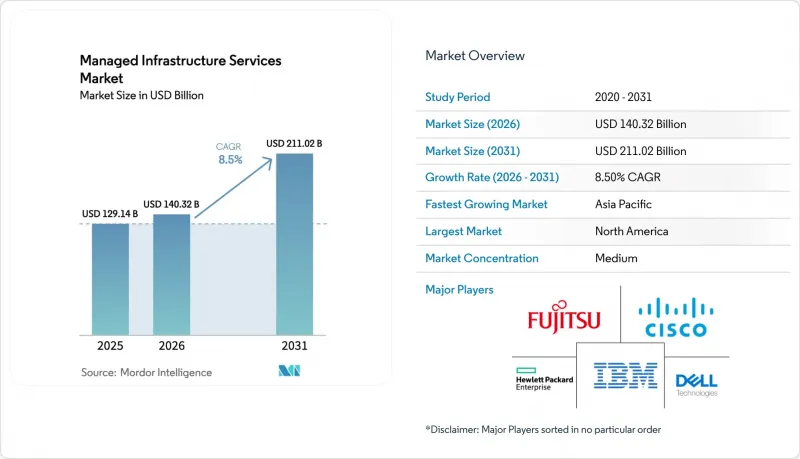
Mordor Intelligence에 의하면, 매니지드 인프라 서비스 시장 규모는 2025년 1,291억 4,000만 달러로 평가되었습니다. 2026년에는 1,403억 2,000만 달러로 확대되어 2031년까지 2,110억 2,000만 달러에 이를 것으로 예상되고 2026년부터 2031년에 걸쳐 CAGR 8.5%로 성장할 전망입니다.
본 보고서는 도입 모델(On-Premise 및 클라우드), 서비스 유형(데스크톱 및 인쇄, 서버 관리, 재고·자산 관리 등), 조직 규모(대기업 및 중소기업), 최종 사용자 업종(은행, 금융서비스 및 보험(BFSI), IT 및 통신, 의료, 제조, 소매, 정부 기관 등), 그리고 지역별로 분류되어 있습니다. 시장 전망은 금액(달러) 기준으로 제시되어 있습니다.
세계의 매니지드 인프라 서비스 시장 동향 및 인사이트
‘Everything-as-a-Service’ 비즈니스 모델로의 전환
사용량 기반 과금제는 소프트웨어에서 인프라로 전환되었으며, 기업은 고정적인 감가상각비를 실시간 수요에 따라 변동하는 가변적인 운영 비용으로 대체할 수 있게 되었습니다. 주요 클라우드 플랫폼은 스토리지, 네트워크, 데이터베이스 서비스에서 초 단위 과금을 더욱 추진하여, 오랫동안 존재해 온 최소 사용량에 대한 페널티를 철폐했습니다. 공급업체 집중 위험에 대한 이사회 차원의 면밀한 검토로 인해 멀티 벤더 전략이 가속화되고 있으며, 매니지드 서비스 제공업체는 현재 하이퍼스케일러, 코로케이션, 엣지 사이트 전반에 걸친 지출을 통합하여 비용과 비즈니스 가치를 연계한 단일 청구서를 제공합니다.
클라우드 네이티브 애플리케이션 현대화의 가속화
2025년, 기업들은 지난 10년 동안 폐지한 COBOL 코드 줄 수보다 더 많은 줄을 폐지했으며, 리프트 앤 시프트(lift-and-shift) 방식의 경제성이 쿠버네티스(Kubernetes)로 관리되는 컨테이너화된 마이크로서비스로 전환됨에 따라 기술 환경에서 큰 변화가 나타났습니다. 이러한 전환은 효율성과 확장성 향상을 목표로 한 현대화된 인프라 솔루션의 채택이 확대되고 있음을 여실히 보여줍니다. 싱가포르와 호주의 은행들은 핵심 시스템 리팩토링을 통해 인프라 비용을 40% 절감하는 놀라운 성과를 달성하는 한편, API 지연 시간을 50밀리초 미만으로 단축하여 현대화 노력이 가져다주는 구체적인 이점을 입증했습니다. 각 매니지드 서비스 제공업체들은 이처럼 진화하는 시장에서 공장식 마이그레이션 플레이북을 도입함으로써 경쟁사와의 차별화를 꾀하고 있습니다. 이러한 플레이북은 ISO 27001 통제 조치와 사이트 신뢰성 엔지니어링(SRE) 관행을 통합하여, 환경이 성능 최적화뿐만 아니라 감사에 대한 만반의 준비도 갖추고 있음을 보장함으로써 엄격한 규정 준수 및 운영 기준을 충족합니다.
증가하는 하이퍼스케일러에 대한 락인(lock-in) 위험
기업들은 전환 비용의 상승과, 특히 페타바이트 규모의 데이터를 본국으로 되돌릴 때 1GB당 0.09달러를 초과할 수도 있는 잠재적인 데이터 전송 요금에 직면해 있습니다. 이러한 비용은 특히 대규모 데이터 전송을 관리하는 조직에서 운영 예산에 중대한 영향을 미칠 수 있습니다. 관리형 서비스 제공업체는 운영을 간소화하기 위한 크로스 클라우드 추상화 계층을 제공하지만, 이러한 서비스를 이용하면월청구액이 12-18% 증가하게 됩니다. 게다가 이러한 서비스는 의존도를 더욱 심화시켜 벤더와의 관계 및 운영 유연성을 복잡하게 만들 우려가 있습니다. 관리형 서비스에 대한 의존도가 높아지고 있는 점은 반독점 규제 당국의 주목을 받고 있으며, 규제상의 우려가 제기됨에 따라 이러한 관행에 대한 감시가 점점 더 엄격해지고 있습니다.
부문 분석
클라우드 도입은 2025년 매출의 63.14%를 차지했으며, 연평균 성장률(CAGR) 8.67%를 나타낼 것으로 예측됩니다. 이러한 추세는 기업에 유연성과 확장성을 제공하는 종량제 모델로 매니지드 인프라 서비스 시장이 크게 전환되고 있음을 여실히 보여줍니다. 한편, On-Premise 환경의 점유율은 36.86%를 차지하고 있습니다. 이는 주로 지연 시간에 민감한 거래 플랫폼이나 기밀성이 높은 워크로드가 보안과 성능을 보장하기 위해 에어갭이 적용된 서버에 의존하고 있기 때문입니다. 또한, DORA와 같은 규제에서는 문서화된 대체 조치가 의무화되어 있어, 특정 이용 사례에서 On-Premise형 인프라의 필요성이 더욱 높아지고 있습니다. 서비스 제공업체들은 현재 프라이빗 랙, 코로케이션 케이지, 퍼블릭 IaaS를 통합한 통일된 제어 플레인을 제공하며, 정책과 텔레메트리 데이터를 통합하여 일관되고 효율적인 뷰로 제시함으로써 관리 및 의사 결정 능력을 향상시키고 있습니다.
점점 더 많은 기업이 운영 및 리소스 활용도를 최적화하기 위해 2계층 아키텍처를 채택하고 있습니다. 실시간 분석을 에지에 배치함으로써 의사 결정 속도를 높이고 지연 시간을 줄이는 동시에, GPU를 많이 사용하는 훈련 작업을 클라우드로 오프로드하여 그 연산 능력과 확장성을 활용하고 있습니다. 관리형 서비스 제공업체는 지연 시간, 비용, 주권 등의 요소를 고려하면서 이러한 배치를 능숙하게 조정하여 최적의 성능과 규정 준수를 보장하고 있습니다. 이러한 능력 덕분에 하이브리드 아키텍처는 단순한 ‘출구 전략’에서 ‘우선적으로 고려되는 설계 옵션’으로 발전하여, 기업에게 끊임없이 진화하는 비즈니스 및 기술적 요구 사항을 충족하는 균형 잡힌 접근 방식을 제공합니다.
서버 관리는 매출의 28.19%를 차지하고 있지만, 7.8%의 성장률은 AI를 접목한 관련 분야와 비교하면 뒤처집니다. 이 부문은 여전히 시장 전체에서 중요한 역할을 하고 있지만, 성장 둔화는 혁신적인 솔루션에 대한 수요가 증가하고 있음을 여실히 보여주고 있습니다. 기업들이 예측 유지보수로 전환함에 따라, AI를 활용한 가시성이 서비스 성장의 주도적 역할을 할 것으로 예상되며, 연평균 성장률(CAGR)은 11.81%로 전망됩니다. 이러한 추세는 효율성 향상과 운영 가동 중단 시간 감소 측면에서 인공지능의 중요성이 높아지고 있음을 뒷받침합니다.
하이브리드 근무의 확산으로 사무실 내 엔드포인트 밀도가 감소함에 따라, 데스크톱 및 프린트 서비스는 연간 6.9%의 감소세를 보이고 있습니다. 원격 근무 및 유연한 근무 환경으로의 전환은 기존 사무실 인프라에 대한 수요에 큰 영향을 미치고 있습니다. 한편, 현재 매출의 16.3%를 차지하는 네트워크 및 연결 서비스는 네트워크 성능과 확장성을 향상시키는 소프트웨어 정의 WAN(SD-WAN) 오버레이에 힘입어 성장하고 있습니다. 또한, 재고 및 자산 관리는 ISO 19770 준수 의무화의 혜택을 받고 있으며, 자동화를 통해 라이선스 대조 작업을 효율화하고 있습니다. 이러한 의무화는 규정 준수를 보장할 뿐만 아니라, 조직이 자산 활용도를 최적화하고 비용을 절감하는 데에도 도움이 됩니다.
지역별 분석
2025년, 북미는 전 세계 매출의 42.53%를 차지했으나, 시장 포화로 인해 단가가 압박을 받으면서 연평균 성장률(CAGR)은 8.2%에 그쳐 전 세계 평균을 하회했습니다. 이 지역의 실적은 대폭적인 확장 기회가 제한되어 성장이 제약을 받는 성숙한 시장의 실정을 반영하고 있습니다. 미국 수요는 금융 서비스, 기술, 그리고 여러 주에 걸쳐 있는 의료 네트워크에 크게 편중되어 있으며, 이들이 계속해서 첨단 클라우드 솔루션에 대한 투자를 주도하고 있습니다. 한편, 캐나다에서는 보안 및 규정 준수를 강화하기 위해 FedRAMP 기준을 엄격히 준수하는 ‘클라우드 퍼스트’ 이니셔티브가 추진되고 있습니다. 또한 멕시코에서는 니어쇼어링의 급증으로 인해, 특히 제조 거점 주변에서 엣지 컴퓨팅이 촉진되고 있습니다. 이는 기업들이 업무 최적화와 생산 공정에서의 지연 감소를 도모하고 있기 때문입니다.
아시아태평양은 인도, 인도네시아, 베트남 등 국가들의 소버린 클라우드 이니셔티브에 힘입어 연평균 성장률(CAGR) 10.21%라는 견실한 성장세를 보이며 시장을 주도하고 있습니다. 이 지역의 성장은 디지털화 노력의 확대와 현지 클라우드 생태계 육성을 목표로 한 정부의 지원 정책에 힘입고 있습니다. 인도의 ‘디지털 개인 데이터 보호법’은 현지 제공업체를 뒷받침하며, 타타 컨설팅 서비스(Tata Consultancy Services)나 위프로(Wipro)와 같은 하이퍼스케일러와의 제휴의 길을 열어주고 있습니다. 이들 기업은 규제상의 우위를 활용하여 시장 내 입지를 확대되고 있습니다. 한편, 알리바바 클라우드나 화웨이와 같은 대기업이 국가의 지원을 받아 사업을 확장함에 힘입어 중국이 이 지역의 지배적인 기업로 자리매김하고 있는 반면, 일본과 한국은 5G 및 인더스트리 4.0의 발전을 추진하기 위해 관리형 인프라에 주력하고 있습니다. 이러한 발전은 차세대 기술의 실현과 세계 시장에서의 경쟁력 유지를 위해 매우 중요합니다.
매출 점유율 18.3%를 차지하는 유럽에서는 8.6%의 성장률이 예상됩니다. ‘디지털 운영 복원력 법(Digital Operational Resilience Act)’은 업계 구도를 일변시켜 장기 계약을 해소하는 동시에, 벤더에 의존하지 않는 기업에게 유리한 멀티클라우드 전략을 추진하고 있습니다. 이러한 규제 변화는 유연하고 상호 운용 가능한 솔루션을 제공할 수 있는 공급업체에게 새로운 기회를 창출하고 있습니다. 독일에서는 생산성 향상과 국가 산업 기반 유지에 필수적인 공장 자동화를 위한 엣지-코어 통합이 크게 강조되고 있습니다. 한편, 영국에서는 공공 부문의 워크로드 통합이 진행되고 있으며, 높은 수준의 서비스 제공을 보장하는 컨세션 프레임워크를 통해 ISO 20000 인증을 취득한 공급업체가 우선적으로 선정되고 있습니다. 한편, 중동에서는 도시 인프라와 서비스를 혁신하는 스마트 시티 구상을 원동력으로 9.8%의 성장이 예상됩니다. 아프리카에서는 핀테크 및 모바일 머니 플랫폼의 확대로 대륙 전체의 금융 포용성이 촉진되며 11%의 성장률을 기록하고 있습니다. 9.3%의 성장률을 보이는 남미에서는 은행과 전자상거래 플랫폼이 매니지드 클라우드 서비스로 전환하고 있습니다. 이 모든 것은 해당 지역의 데이터 보호 및 개인정보 보호 강화를 목적으로 한, GDPR(EU 개인정보보호규정)을 연상시키는 규제 하에서 이루어지고 있습니다.
기타 혜택 :
- 엑셀 형식 시장 예측(ME) 시트
- 3개월간의 애널리스트 지원
자주 묻는 질문
목차
제1장 서론
제2장 조사 방법
제3장 주요 요약
제4장 시장 구도
제5장 시장 규모 및 성장 예측
제6장 경쟁 구도
제7장 시장 기회 및 향후 전망
KTH 26.09.10According to Mordor Intelligence, the managed infrastructure services market size is expected to increase from USD 129.14 billion in 2025 to USD 140.32 billion in 2026 and reach USD 211.02 billion by 2031, growing at a CAGR of 8.5% over 2026-2031.
This report is Segmented by Deployment Model (On-Premises, and Cloud), Service Type (Desktop and Print, Server Management, Inventory and Asset Management, and More), Organization Size (Large Enterprises, and SMEs), End-User Vertical (BFSI, IT and Telecom, Healthcare, Manufacturing, Retail, Government, and More), and Geography. The Market Forecasts are Provided in Terms of Value (USD).
Global Managed Infrastructure Services Market Trends and Insights
Shift to Everything-as-a-Service Business Models
Usage-based pricing has moved from software to infrastructure, allowing enterprises to swap fixed depreciation for variable operating costs that flex with real-time demand. Major cloud platforms deepened per-second billing to storage, networking, and database services, erasing long-standing minimum-commit penalties. Board-level scrutiny of supplier concentration risk has accelerated multi-vendor strategies, and managed-service providers now aggregate spend across hyperscalers, colocation, and edge sites to deliver a single invoice that maps cost to business value.
Accelerated Cloud-Native Application Modernization
In 2025, enterprises retired more COBOL lines than they had in the entire previous decade, marking a significant shift in the technology landscape as lift-and-shift economics transitioned to containerized microservices overseen by Kubernetes. This transition highlights the growing adoption of modernized infrastructure solutions aimed at improving efficiency and scalability. By refactoring their core systems, banks in Singapore and Australia achieved a notable 40% reduction in infrastructure costs, alongside API latency improvements to under 50 milliseconds, showcasing the tangible benefits of modernization efforts. Managed-service providers are setting themselves apart in this evolving market by employing factory-style migration playbooks. These playbooks integrate ISO 27001 controls with site-reliability engineering practices, ensuring their environments are not only optimized for performance but also fully prepared for audits, thereby meeting stringent compliance and operational standards.
Rising Hyperscaler Lock-In Risk
Enterprises face rising switching costs and potential egress fees, which can sometimes exceed USD 0.09 per GB, particularly when repatriating petabyte-scale data. These costs can significantly impact operational budgets, especially for organizations managing large-scale data transfers. While managed-service providers offer cross-cloud abstraction layers to simplify operations, these services come with a 12-18% increase to monthly bills. Additionally, they introduce further dependencies, which can complicate vendor relationships and operational flexibility. This growing reliance on managed services has drawn the attention of antitrust regulators, who are increasingly scrutinizing such practices for potential regulatory concerns.
Other drivers and restraints analyzed in the detailed report include:
- Need for Zero-Trust Security Frameworks in Hybrid Estates
- AI-Driven Observability and Self-Healing Infrastructure
- Talent Exodus from Traditional MSPs to Cloud Providers
For complete list of drivers and restraints, kindly check the Table Of Contents.
Segment Analysis
Cloud deployments accounted for 63.14% of the 2025 revenue and are projected to grow at a CAGR of 8.67%. This trend highlights a significant shift in the managed infrastructure services market towards pay-as-you-go models, which offer flexibility and scalability to enterprises. Meanwhile, on-premises setups hold a 36.86% share. This is largely because latency-sensitive trading platforms and classified workloads depend on air-gapped servers to ensure security and performance. Additionally, regulations like DORA mandate documented fallback arrangements, further reinforcing the need for on-premises infrastructure in specific use cases. Service providers are now offering unified control planes that integrate private racks, colocation cages, and public IaaS, merging policy and telemetry into a cohesive and streamlined view for better management and decision-making.
More enterprises are adopting two-tier architectures to optimize their operations and resource utilization. They are positioning real-time analytics at the edge, enabling faster decision-making and reduced latency, while offloading GPU-intensive training tasks to the cloud to leverage its computational power and scalability. Managed-service providers are adeptly orchestrating these placements, considering factors like latency, cost, and sovereignty to ensure optimal performance and compliance. This capability elevates hybrid architecture from merely an exit strategy to a preferred design choice, offering enterprises a balanced approach to meet their evolving business and technical requirements.
Despite commanding a 28.19% share of the revenue pie, server management's growth rate of 7.8% pales in comparison to its AI-infused counterparts. This segment continues to play a critical role in the broader market, but its slower growth highlights the increasing demand for innovative solutions. As enterprises pivot towards predictive maintenance, AI-driven observability is set to spearhead service growth, boasting a projected CAGR of 11.81%. This trend underscores the growing importance of artificial intelligence in driving efficiency and reducing operational downtime.
As hybrid work diminishes office endpoint density, desktop and print services face a 6.9% annual decline. The shift to remote and flexible work environments has significantly impacted the demand for traditional office infrastructure. Meanwhile, network and connectivity services, now accounting for 16.3% of revenue, are bolstered by software-defined WAN overlays, which enhance network performance and scalability. Additionally, inventory and asset management reaps the rewards of ISO 19770 compliance mandates, streamlining license reconciliation through automation. These mandates not only ensure compliance but also help organizations optimize their asset utilization and reduce costs.
Complete Report Scope:
- By Deployment Model
- On-Premises
- Cloud
- By Service Type
- Desktop and Print Services
- Server Management
- Inventory and Asset Management
- Network and Connectivity Services
- Other Managed Infrastructure Services
- By Organization Size
- Large Enterprises
- Small and Mid-Sized Enterprises
- By End-User Vertical
- Banking, Financial Services and Insurance (BFSI)
- Information Technology and Telecommunications
- Healthcare and Life Sciences
- Manufacturing
- Retail and e-Commerce
- Government and Public Sector
- Other Verticals
- By Geography
- North America
- United States
- Canada
- Mexico
- South America
- Brazil
- Argentina
- Rest of South America
- Europe
- Germany
- United Kingdom
- France
- Italy
- Spain
- Rest of Europe
- Asia Pacific
- China
- Japan
- South Korea
- India
- Australia
- New Zealand
- Rest of Asia-Pacific
- Middle East and Africa
- Middle East
- United Arab Emirates
- Saudi Arabia
- Turkey
- Rest of Middle East
- Africa
- South Africa
- Nigeria
- Kenya
- Rest of Africa
- Middle East
- North America
Geography Analysis
In 2025, North America accounted for 42.53% of global revenue, but its 8.2% CAGR lagged behind the global average due to market saturation squeezing unit prices. The region's performance reflects a mature market where growth is constrained by limited opportunities for significant expansion. Demand in the U.S. is heavily skewed towards financial services, technology, and multi-state healthcare networks, which continue to drive investments in advanced cloud solutions. Meanwhile, Canada is adopting cloud-first initiatives, closely aligning with FedRAMP standards to enhance security and compliance. Additionally, Mexico's nearshoring surge is propelling edge computing, especially near its manufacturing hubs, as companies seek to optimize operations and reduce latency in production processes.
Asia-Pacific is leading the charge with a robust 10.21% CAGR, spurred by sovereign-cloud initiatives in nations like India, Indonesia, and Vietnam. The region's growth is underpinned by increasing digitalization efforts and supportive government policies aimed at fostering local cloud ecosystems. India's Digital Personal Data Protection Act bolsters local providers, paving the way for collaborations with hyperscalers such as Tata Consultancy Services and Wipro, which are leveraging regulatory advantages to expand their market presence. While China, propelled by state-backed expansions from giants like Alibaba Cloud and Huawei, stands as the region's dominant player, Japan and South Korea are banking on managed infrastructure to drive their 5G and Industry 4.0 advancements. These advancements are critical for enabling next-generation technologies and maintaining competitiveness in the global market.
Europe, with an 18.3% revenue share, is witnessing an 8.6% growth rate. The Digital Operational Resilience Act is reshaping the landscape, breaking up lengthy contracts and pushing for multi-cloud strategies that benefit vendor-agnostic players. This regulatory shift is creating opportunities for providers that can offer flexible and interoperable solutions. In Germany, there's a strong emphasis on edge-to-core integration for factory automation, which is essential for enhancing productivity and supporting the country's industrial base. At the same time, the UK is consolidating public-sector workloads, favoring ISO 20000-certified providers through concession frameworks that ensure high standards of service delivery. Meanwhile, the Middle East sees a 9.8% growth, anchored by smart-city initiatives that are transforming urban infrastructure and services. Africa boasts an 11% rise, driven by the expansion of fintech and mobile money platforms, which are increasing financial inclusion across the continent. South America, growing at 9.3%, witnesses banks and e-commerce platforms transitioning to managed cloud services, all under regulations reminiscent of GDPR, which aim to enhance data protection and privacy in the region.
- International Business Machines Corporation
- Hewlett Packard Enterprise Company
- Dell Technologies Inc.
- Fujitsu Limited
- Cisco Systems, Inc.
- Microsoft Corporation
- Tata Consultancy Services Limited
- Nokia Corporation
- Verizon Communications Inc.
- Deutsche Telekom AG
- Xerox Holdings Corporation
- Ricoh Company, Ltd.
- Lexmark International, Inc.
- Konica Minolta, Inc.
- Canon Inc.
- Toshiba Corporation
- Citrix Systems, Inc.
- Amazon Web Services, Inc.
- Google LLC
- Atos SE
- NTT DATA Corporation
- Wipro Limited
- Capgemini SE
- Accenture plc
- Lenovo Group Limited
- Kyndryl Holdings, Inc.
- Orange Business Services
- Lumen Technologies, Inc.
Additional Benefits:
- The market estimate (ME) sheet in Excel format
- 3 months of analyst support
TABLE OF CONTENTS
1 INTRODUCTION
- 1.1 Study Assumptions and Market Definition
- 1.2 Scope of the Study
2 RESEARCH METHODOLOGY
3 EXECUTIVE SUMMARY
4 MARKET LANDSCAPE
- 4.1 Market Overview
- 4.2 Market Drivers
- 4.2.1 Shift to Everything-as-a-Service (XaaS) Business Models
- 4.2.2 Accelerated Cloud-Native Application Modernisation
- 4.2.3 Need for Zero-Trust Security Frameworks in Hybrid Estates
- 4.2.4 Edge-to-Core Orchestration for Industry 4.0 Roll-Outs
- 4.2.5 AI-Driven Observability and Self-Healing Infrastructure
- 4.2.6 Sustainability Mandates Driving Green Data-Centre Outsourcing
- 4.3 Market Restraints
- 4.3.1 Rising Hyperscaler Lock-In Risk
- 4.3.2 Talent Exodus from Traditional MSPs to Cloud Providers
- 4.3.3 Data-Sovereignty Barriers in Highly Regulated Sectors
- 4.3.4 Escalating Cyber-Insurance Premiums Eroding TCO Benefits
- 4.4 Industry Value-Chain Analysis
- 4.5 Regulatory Landscape
- 4.6 Technological Outlook
- 4.7 Porter's Five Forces Analysis
- 4.7.1 Bargaining Power of Buyers
- 4.7.2 Bargaining Power of Suppliers
- 4.7.3 Threat of New Entrants
- 4.7.4 Threat of Substitutes
- 4.7.5 Competitive Rivalry
5 MARKET SIZE AND GROWTH FORECASTS (VALUE)
- 5.1 By Deployment Model
- 5.1.1 On-Premises
- 5.1.2 Cloud
- 5.2 By Service Type
- 5.2.1 Desktop and Print Services
- 5.2.2 Server Management
- 5.2.3 Inventory and Asset Management
- 5.2.4 Network and Connectivity Services
- 5.2.5 Other Managed Infrastructure Services
- 5.3 By Organization Size
- 5.3.1 Large Enterprises
- 5.3.2 Small and Mid-Sized Enterprises
- 5.4 By End-User Vertical
- 5.4.1 Banking, Financial Services and Insurance (BFSI)
- 5.4.2 Information Technology and Telecommunications
- 5.4.3 Healthcare and Life Sciences
- 5.4.4 Manufacturing
- 5.4.5 Retail and e-Commerce
- 5.4.6 Government and Public Sector
- 5.4.7 Other Verticals
- 5.5 By Geography
- 5.5.1 North America
- 5.5.1.1 United States
- 5.5.1.2 Canada
- 5.5.1.3 Mexico
- 5.5.2 South America
- 5.5.2.1 Brazil
- 5.5.2.2 Argentina
- 5.5.2.3 Rest of South America
- 5.5.3 Europe
- 5.5.3.1 Germany
- 5.5.3.2 United Kingdom
- 5.5.3.3 France
- 5.5.3.4 Italy
- 5.5.3.5 Spain
- 5.5.3.6 Rest of Europe
- 5.5.4 Asia Pacific
- 5.5.4.1 China
- 5.5.4.2 Japan
- 5.5.4.3 South Korea
- 5.5.4.4 India
- 5.5.4.5 Australia
- 5.5.4.6 New Zealand
- 5.5.4.7 Rest of Asia-Pacific
- 5.5.5 Middle East and Africa
- 5.5.5.1 Middle East
- 5.5.5.1.1 United Arab Emirates
- 5.5.5.1.2 Saudi Arabia
- 5.5.5.1.3 Turkey
- 5.5.5.1.4 Rest of Middle East
- 5.5.5.2 Africa
- 5.5.5.2.1 South Africa
- 5.5.5.2.2 Nigeria
- 5.5.5.2.3 Kenya
- 5.5.5.2.4 Rest of Africa
- 5.5.5.1 Middle East
- 5.5.1 North America
6 COMPETITIVE LANDSCAPE
- 6.1 Market Concentration
- 6.2 Strategic Moves
- 6.3 Market Share Analysis
- 6.4 Company Profiles (includes Global Level Overview, Market Level Overview, Core Segments, Financials as available, Strategic Information, Market Rank/Share, Products and Services, Recent Developments)
- 6.4.1 International Business Machines Corporation
- 6.4.2 Hewlett Packard Enterprise Company
- 6.4.3 Dell Technologies Inc.
- 6.4.4 Fujitsu Limited
- 6.4.5 Cisco Systems, Inc.
- 6.4.6 Microsoft Corporation
- 6.4.7 Tata Consultancy Services Limited
- 6.4.8 Nokia Corporation
- 6.4.9 Verizon Communications Inc.
- 6.4.10 Deutsche Telekom AG
- 6.4.11 Xerox Holdings Corporation
- 6.4.12 Ricoh Company, Ltd.
- 6.4.13 Lexmark International, Inc.
- 6.4.14 Konica Minolta, Inc.
- 6.4.15 Canon Inc.
- 6.4.16 Toshiba Corporation
- 6.4.17 Citrix Systems, Inc.
- 6.4.18 Amazon Web Services, Inc.
- 6.4.19 Google LLC
- 6.4.20 Atos SE
- 6.4.21 NTT DATA Corporation
- 6.4.22 Wipro Limited
- 6.4.23 Capgemini SE
- 6.4.24 Accenture plc
- 6.4.25 Lenovo Group Limited
- 6.4.26 Kyndryl Holdings, Inc.
- 6.4.27 Orange Business Services
- 6.4.28 Lumen Technologies, Inc.
7 MARKET OPPORTUNITIES AND FUTURE OUTLOOK
- 7.1 White-Space and Unmet-Need Assessment


