
|
시장보고서
상품코드
2120535
클라우드 암호화 소프트웨어 : 시장 점유율 분석, 업계 동향 및 통계, 성장 예측(2026-2031년)Cloud Encryption Software - Market Share Analysis, Industry Trends & Statistics, Growth Forecasts (2026 - 2031) |
||||||
 Mordor Intelligence
Mordor Intelligence에 의하면, 2026년 클라우드 암호화 소프트웨어 시장 규모는 95억 1,000만 달러로 추정되고 2025년 74억 3,000만 달러에서 확대해, 2031년에는 325억 5,000만 달러에 이를 것으로 예측됩니다.
2026년부터 2031년까지 연평균 성장률(CAGR) 27.92%로 성장할 것으로 전망됩니다.
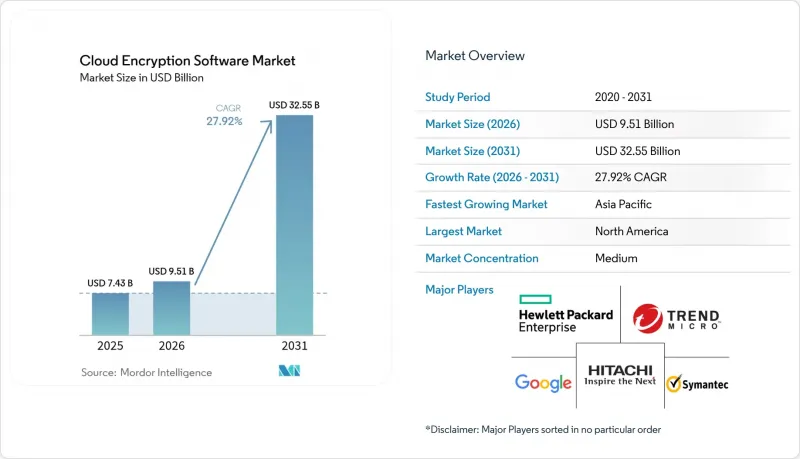
본 보고서는 암호화 유형(대칭 암호화, 비대칭 암호화/PKI, 기타), 용도(저장 데이터, 전송 데이터, 기타), 조직 규모(대기업, 중소기업(SME)), 산업 분야(은행, 금융서비스 및 보험(BFSI), 헬스케어 및 생명과학,교육, 소매 및 전자상거래, 기타) 및 지역별로 분류되어 있습니다. 시장 전망은 금액(달러) 기준으로 제시되어 있습니다.
세계의 클라우드 암호화 소프트웨어 시장 동향 및 인사이트
데이터 보호 규제 강화
세계 각국의 법령에 따라 보안 기준이 강화되고 있습니다. 2025년 3월에 시행된 PCI DSS 4.0에서는 모든 카드 소지자 환경에서 연례 암호화 검토 및 다중 요소 인증이 의무화됩니다. 유럽의 ‘디지털 운영 복원력 법’ 및 ‘NIS 2 지침’은 은행업 및 중요 인프라에 대해 2030년까지 양자 내성 암호화를 도입할 것을 의무화하고 있습니다. 미국에서는 ‘양자 컴퓨팅 사이버 보안 준비법’에 따라 연방 기관은 NIST(미국 국립표준기술연구소)가 승인한 포스트 양자 알고리즘으로의 전환이 의무화되어 있으며, 민간 부문도 이를 따르는 추세입니다. FedRAMP는 이미 모든 연방 정부용 클라우드 서비스에 대해 FIPS 140-2 인증 모듈의 사용을 의무화하고 있으며, 규정 준수는 사실상 시장 진입 조건이 되고 있습니다. 2002년 FERPA(가족 교육 권리 및 개인정보 보호법)의 틀에서는 클라우드에 저장되는 학생 데이터가 고려되지 않았기 때문에 대학조차도 관리 체제를 강화하고 있으며, 법적 최소 기준을 뛰어넘는 암호화 대책이 마련되어 있습니다.
클라우드를 겨냥한 고도의 사이버 공격 급증
2024년에 기록된 사이버 사고 중 클라우드 워크로드가 차지하는 비율은 31%에 달했으며, 금융 서비스 업계에서 랜섬웨어 피해로 인한 평균 비용은 537만 달러에 이르렀습니다. 고도화된 지속적 위협(APT) 공격자들은 미래의 양자 복호화를 염두에 두고, 암호화된 대량의 데이터를 수집하고 있습니다. 이에 따라 실시간암호화 모니터링과 기존 방식과 양자 이후 암호화를 결합한 하이브리드 키 교환이 주목받고 있습니다. 퍼블릭 클라우드에서 발생하는 정보 유출의 44%는 설정 오류가 원인이기 때문에 관리자의 기술력에 의존하지 않고 모든 객체에 암호화를 적용하는 자동화된 정책 엔진이 필수로 자리 잡고 있습니다. 공격자들은 엔드포인트보다 제어 플레인의 ID를 표적으로 삼는 경향이 강해지고 있어, 경계 통제가 작동하지 않는 경우에도 유효성을 유지할 수 있는 데이터 중심의 보호 필요성이 더욱 높아지고 있습니다.
성능 오버헤드 및 지연 시간
데이터 암호화에는 연산 사이클과 I/O 대기 시간이 추가됩니다. 기존의 저장 시 암호화는 대용량 데이터베이스에서 SQL 쿼리 처리를 수백 밀리초 지연시킵니다. 완전 동형 암호화는 개인 정보 보호 측면에서 획기적이지만, 하드웨어 가속을 채택하지 않는 한 처리 시간을 1,000배까지 늘릴 가능성이 있습니다. 『Computers, Materials and Continua』지에 게재된 최근 벤치마크 연구에 따르면, GPU를 활용한 프레임워크는 이러한 오버헤드를 약 12% 줄일 수 있다고 합니다. 엣지 컴퓨팅 시나리오에서는 암호화로 인한 지연이 기존의 네트워크 레이턴시와 결합되어 그 영향이 특히 커지므로, 설계자는 실시간 응답성과 기밀성 사이의 균형을 신중하게 고려할 수밖에 없습니다. 또한, 포스트 양자 알고리즘은 키 크기가 커서 계산 부하가 증가하며, 저전력 장치에서의 성능 예산 수립을 어렵게 만들고 있습니다.
부문 분석
2025년에는 대칭 암호화 방식이 클라우드 암호화 소프트웨어 시장에서 35.02%의 점유율을 차지하며 시장을 주도했습니다. 이는 처리 속도와 낮은 CPU 오버헤드가 높이 평가받고 있기 때문입니다. 완전 동형 암호화는 아직 발전 단계에 있음에도 불구하고 가장 빠르게 성장하는 기술이며, 기밀 계산의 이용 사례가 확대됨에 따라 연평균 성장률(CAGR) 28.57%를 나타낼 것으로 예측됩니다. 2024년 8월에 공개된 FIPS 203,FIPS 204, FIPS 205는 포스트 양자 키 캡슐화, 디지털 서명, 그리고 스테이트리스 해시 기반 서명에 관한 기준을 정한 것으로, 각 벤더들은 이러한 알고리즘을 제품 로드맵에 반영하도록 권장받고 있습니다.
기업들은 알고리즘의 취약성에 대비하기 위해 기존의 타원 곡선 방식과 포스트 양자 격자 기술을 결합한 하이브리드 암호화를 도입하고 있습니다. 또한, 포맷 보존형 암호화는 레거시 용도이 스키마를 재설계하지 않고도 보호된 데이터를 저장할 수 있기 때문에 그 사용이 확대되고 있습니다. NIST가 2025년 3월, 다양성을 한층 더 높일 제5의 알고리즘으로 HQC를 선정함에 따라, 암호화 대응을 위한 유연한 도구는 경영진 차원의 우선순위가 되고 있습니다. 그 결과, 대칭 워크로드를 위한 클라우드 암호화 소프트웨어 시장 규모는 꾸준히 확대될 것으로 예상되는 반면, 양자 보안 대책이 적용된 솔루션은 신규 도입에서 더 큰 점유율을 차지할 것으로 전망됩니다.
2025년 클라우드 암호화 소프트웨어 시장에서 저장 데이터(Data-at-rest)는 여전히 용도 스택의 최상위를 차지하며 36.10%의 점유율을 유지했습니다. 이는 백업 및 스토리지 관행이 성숙해졌음을 반영합니다. 그러나 주목받고 있는 것은 사용 중인 데이터(Data-in-use)의 암호화이며, TEE(신뢰 실행 환경)를 통해 평문 처리라는 오랜 장벽이 제거됨에 따라 연평균 성장률(CAGR) 29.11%라는 급격한 성장을 이루고 있습니다. 따라서 기밀 컴퓨팅 워크로드를 위한 클라우드 암호화 소프트웨어 시장 규모는 다른 어떤 부문보다 빠르게 확대될 전망입니다.
클라우드 간 연결에서는 전송 계층의 보호가 여전히 필수적이지만, 성능 최적화는 포스트 양자 핸드셰이크 알고리즘으로 전환되고 있습니다. SaaS 협업 도구에서는 조직이 암호 키에 대한 관리 권한을 유지할 수 있도록 클라이언트 측 암호화의 도입이 확대되고 있습니다. 검색 가능한 대칭 암호화는 고가치 쿼리에 대해 지연 시간 오버헤드가 허용되는 빅데이터 환경에서도 채택되기 시작했습니다. 이러한 변화들이 합쳐지면서, 데이터 라이프사이클 전반에 걸친 지속적이고 상태에 의존하지 않는 보호라는 비전이 진전되고 있습니다.
지역별 분석
2025년, 북미는 클라우드 암호화 소프트웨어 시장의 38.52%를 차지했습니다. 이는 FedRAMP 요건, 국방부 지침, 그리고 기업의 포스트 양자 보안으로의 적극적인 전환에 힘입은 결과입니다. 멀티클라우드 보급률은 높으며, 벤더들은 관리형 키 서비스와 암호화 애자일 오케스트레이션을 통해 수익을 확보하고 있습니다. 또한 대규모 의료 및 금융 분야 고객들도 기밀 컴퓨팅 프레임워크를 대규모로 시범 도입하여 혁신 주기를 가속화하고 있습니다.
아시아태평양은 2031년까지 연평균 성장률(CAGR)이 28.96%로 가장 빠르게 성장하는 지역입니다. 호주, 일본, 한국, 인도의 주권 클라우드 청사진에서는 암호화 키를 국내에 보유할 것을 요구하고 있으며, 필요에 따라 국가 알고리즘을 지원하는 외부 키 관리 게이트웨이 및 하드웨어 보안 모듈의 판매를 촉진하고 있습니다. 아시아개발은행(ADB)의 추산에 따르면, 클라우드 정책 개선으로 인해 2024년부터 2028년까지 지역 GDP가 최대 0.7% 상승할 가능성이 있으며, 암호화가 그 중요한 촉진요인으로 꼽히고 있습니다. 중국 및 동남아시아의 하이퍼스케일러 기업들은 서유럽 경쟁사들에 뒤처지지 않기 위해, 양자 내성 네트워크 암호화를 실현하기 위해 칩 제조업체들과 국내에서 제휴를 맺고 있습니다.
유럽에서는 GDPR(EU 개인정보보호규정) 시행과 ‘디지털 운영 복원력 법(Digital Operational Resilience Act)’을 원동력으로 삼아 꾸준한 확장이 이어지고 있습니다. 금융 기관은 양자 내성 알고리즘으로의 전환을 개괄한 복원력 계획을 제출해야 할 의무가 있으며, 이러한 움직임으로 인해 유럽은 국경을 초월한 키 예치 상호 운용성에 관한 실험장이 되어가고 있습니다. 특히 의료 및 모빌리티 분야의 개인정보 보호형 분석은 완전 동형 암호화에 대한 수요를 자극하고 있습니다. 남미와 중동 및 아프리카의 소규모 시장은 뒤처져 있지만, 특히 5G 확산에 따라 경량화되고 지연 시간이 짧은 암호화가 필요한 엣지 클라우드 아키텍처가 도입되는 지역에서는 미개척 비즈니스 기회가 생겨나고 있습니다.
기타 혜택 :
- 엑셀 형식 시장 예측(ME) 시트
- 3개월간의 애널리스트 지원
자주 묻는 질문
목차
제1장 서론
제2장 조사 방법
제3장 주요 요약
제4장 시장 구도
제5장 시장 규모 및 성장 예측
제6장 경쟁 구도
제7장 시장 기회 및 향후 전망
KTH 26.09.10According to Mordor Intelligence, the cloud encryption software market size in 2026 is estimated at USD 9.51 billion, growing from 2025 value of USD 7.43 billion with 2031 projections showing USD 32.55 billion, growing at 27.92% CAGR over 2026-2031.

This report is Segmented by Encryption Type (Symmetric, Asymmetric / PKI, and More), Application (Data-At-Rest, Data-In-Transit, and More), Organization Size (Large Enterprises and Small and Medium Enterprises (SMEs)), Industry Vertical (BFSI, Healthcare and Life Sciences, Education, Retail and E-Commerce, and More), and Geography. The Market Forecasts are Provided in Terms of Value (USD).
Global Cloud Encryption Software Market Trends and Insights
Tightening Data-Protection Regulations
Worldwide statutes are raising the security baseline. PCI DSS 4.0, effective March 2025, forces annual cryptographic reviews and multi-factor authentication across all card-holder environments. Europe's Digital Operational Resilience Act and NIS 2 directive require quantum-resistant encryption by 2030 for banking and critical infrastructure. In the United States, the Quantum Computing Cybersecurity Preparedness Act compels federal agencies to pivot to NIST-approved post-quantum algorithms, setting a template the private sector is following. FedRAMP has already mandated FIPS 140-2 validated modules for all federal cloud services, turning compliance into a de facto market entry ticket. Even universities are hardening controls because the 2002 FERPA framework never anticipated cloud-stored student data, prompting encryption measures that exceed legal minima.
Surge in Sophisticated Cyber-Attacks on Cloud
Cloud workloads absorbed 31% of recorded cyber incidents in 2024, with ransomware costs in financial services averaging USD 5.37 million. Advanced persistent-threat actors now harvest encrypted troves, betting on future quantum decryption. Real-time encryption monitoring and hybrid classical-plus-post-quantum key exchange are therefore gaining traction. Misconfigurations cause 44% of public-cloud breaches, so automated policy engines that wrap encryption around every object-independent of administrator skill-are becoming mandatory. Attackers increasingly target control-plane identities rather than endpoints, reinforcing the need for data-centric protection that stays effective even when perimeter controls fail.
Performance Overhead and Latency
Encrypting data adds compute cycles and I/O waits. Classical encryption-at-rest slows SQL queries by several hundred milliseconds in high-volume databases. Fully homomorphic encryption, while revolutionary for privacy, can inflate processing time by 1 000X unless hardware acceleration is employed. GPU-assisted frameworks cut that overhead by roughly 12% according to recent benchmark studies published in Computers, Materials and Continua. Edge-computing scenarios feel the penalty most because encryption delay compounds existing network latency, forcing architects to weigh real-time responsiveness against confidentiality. Post-quantum algorithms also raise computational tax because of larger key sizes, challenging performance budgeting in low-power devices.
Other drivers and restraints analyzed in the detailed report include:
- Enterprise Multi-Cloud Adoption
- Confidential-Computing Demand
- Key-Management Complexity
For complete list of drivers and restraints, kindly check the Table Of Contents.
Segment Analysis
Symmetric methods dominate the cloud encryption software market with 35.02% share in 2025, favored for their speed and low CPU overhead. Fully homomorphic encryption, despite its infancy, is the fastest-rising technique, forecast to grow at 28.57% CAGR as confidential-computing use cases blossom. The August 2024 release of FIPS 203, FIPS 204, and FIPS 205 set the baseline for post-quantum key encapsulation, digital signatures, and stateless hash-based signatures, prompting vendors to embed these algorithms into product road maps.
Enterprises are deploying hybrid cryptography that blends classical elliptic-curve methods with post-quantum lattices, hedging against algorithmic failure. Format-preserving encryption is also expanding because it lets legacy applications store protected data without schema redesign. With NIST's March 2025 selection of HQC as a fifth algorithm for additional diversity, crypto-agile tooling has become a board-level priority. As a result, the cloud encryption software market size for symmetric workloads is projected to climb steadily, while quantum-safe options capture a larger slice of new deployments.
Data-at-rest still tops the application stack with 36.10% share of the cloud encryption software market in 2025, reflecting mature backup and storage practices. Yet it is data-in-use encryption that makes headlines, surging at a 29.11% CAGR as TEEs remove the longstanding barrier of processing on plaintext. The cloud encryption software market size for confidential-computing workloads will therefore expand faster than any other segment.
Transport-layer protection remains indispensable for inter-cloud links, but performance tuning has shifted toward post-quantum handshake algorithms. SaaS collaboration tools are seeing wider client-side encryption rollouts so organizations retain control over cryptographic keys. Searchable symmetric encryption now appears in big-data environments, where latency overhead can be tolerated for high-value queries. Together these shifts advance the vision of persistent, state-agnostic protection across the entire data life cycle.
Complete Report Scope:
- By Encryption Type
- Symmetric
- Asymmetric / PKI
- Format-Preserving
- Fully Homomorphic
- Quantum-resistant Algorithms
- By Application
- Data-at-Rest (storage, backup)
- Data-in-Transit (TLS/VPN)
- Data-in-Use / Confidential Computing
- SaaS File and Collaboration Encryption
- Database / Big-data Encryption
- By Organization Size
- Large Enterprises
- Small and Medium Enterprises (SMEs)
- By Industry Vertical
- BFSI
- Healthcare and Life Sciences
- Education
- Retail and e-Commerce
- IT and Telecom
- Government and Defense
- Other Industry Verticals
- By Geography
- North America
- United States
- Canada
- Mexico
- Europe
- Germany
- United Kingdom
- France
- Italy
- Spain
- Rest of Europe
- Asia-Pacific
- China
- Japan
- India
- South Korea
- Australia
- Rest of Asia-Pacific
- South America
- Brazil
- Argentina
- Rest of South America
- Middle East and Africa
- Middle East
- Saudi Arabia
- United Arab Emirates
- Turkey
- Rest of Middle East
- Africa
- South Africa
- Egypt
- Nigeria
- Rest of Africa
- Middle East
- North America
Geography Analysis
North America held 38.52% of the cloud encryption software market in 2025, underpinned by FedRAMP mandates, Department of Defense directives and aggressive enterprise migration to post-quantum controls. Multi-cloud penetration is high, and vendors secure revenue through managed key services and crypto-agile orchestration. Large healthcare and finance clients also test confidential-computing frameworks at scale, accelerating innovation cycles.
Asia-Pacific is the fastest-growing region with a 28.96% CAGR through 2031. Sovereign-cloud blueprints in Australia, Japan, South Korea and India demand that encryption keys remain on domestic soil, spurring sales of external key-management gateways and hardware security modules that support national algorithms where required. The Asian Development Bank estimates improved cloud policy could lift regional GDP by up to 0.7% during 2024-2028, and encryption is cited as a pivotal enabler. Chinese and Southeast Asian hyperscalers are forming in-country alliances with chipmakers to deliver quantum-safe network encryption, keeping pace with Western rivals.
Europe maintains steady expansion driven by GDPR enforcement and the Digital Operational Resilience Act. Financial institutions must file resilience plans outlining migration to quantum-resistant algorithms, a move that is turning Europe into a laboratory for cross-border key-escrow interoperability. Privacy-preserving analytics-especially in health and mobility-stimulate demand for fully homomorphic encryption. Smaller markets in South America and the Middle East and Africa trail but present greenfield opportunities, particularly where 5G rollouts introduce edge-cloud architectures that require lightweight, low-latency encryption.
- Trend Micro
- CipherCloud / Lookout CASB
- Broadcom (Symantec)
- Hewlett Packard Enterprise
- Google LLC
- Sophos
- Micro Focus (Voltage)
- CyberArk
- Thales (SafeNet)
- Hitachi Vantara
- Boxcryptor
- Microsoft Corporation
- Amazon Web Services
- IBM Corporation
- Check Point Software
- Palo Alto Networks
- Netskope
- Fortanix
- Zscaler
- Akeyless Security
Additional Benefits:
- The market estimate (ME) sheet in Excel format
- 3 months of analyst support
TABLE OF CONTENTS
1 INTRODUCTION
- 1.1 Study Assumptions and Market Definition
- 1.2 Scope of the Study
2 RESEARCH METHODOLOGY
3 EXECUTIVE SUMMARY
4 MARKET LANDSCAPE
- 4.1 Market Overview
- 4.2 Market Drivers
- 4.2.1 Tightening data-protection regulations
- 4.2.2 Surge in sophisticated cyber-attacks on cloud
- 4.2.3 Enterprise multi-cloud adoption
- 4.2.4 Confidential-computing demand
- 4.2.5 Post-quantum encryption urgency
- 4.2.6 "Encryption-as-code" DevSecOps tools
- 4.3 Market Restraints
- 4.3.1 Performance overhead and latency
- 4.3.2 Key-management complexity
- 4.3.3 Lack of interoperability in trusted-execution
- 4.3.4 Edge-cloud data-sovereignty dampening demand
- 4.4 Value Chain Analysis
- 4.5 Regulatory Landscape
- 4.6 Technological Outlook
- 4.7 Porter's Five Forces Analysis
- 4.7.1 Bargaining Power of Suppliers
- 4.7.2 Bargaining Power of Buyers
- 4.7.3 Threat of New Entrants
- 4.7.4 Threat of Substitutes
- 4.7.5 Intensity of Competitive Rivalry
- 4.8 Pricing Analysis
- 4.9 Investment Analysis
- 4.10 Assessment of the Impact of Macroeconomic Trends on the Market
5 MARKET SIZE AND GROWTH FORECASTS (VALUE)
- 5.1 By Encryption Type
- 5.1.1 Symmetric
- 5.1.2 Asymmetric / PKI
- 5.1.3 Format-Preserving
- 5.1.4 Fully Homomorphic
- 5.1.5 Quantum-resistant Algorithms
- 5.2 By Application
- 5.2.1 Data-at-Rest (storage, backup)
- 5.2.2 Data-in-Transit (TLS/VPN)
- 5.2.3 Data-in-Use / Confidential Computing
- 5.2.4 SaaS File and Collaboration Encryption
- 5.2.5 Database / Big-data Encryption
- 5.3 By Organization Size
- 5.3.1 Large Enterprises
- 5.3.2 Small and Medium Enterprises (SMEs)
- 5.4 By Industry Vertical
- 5.4.1 BFSI
- 5.4.2 Healthcare and Life Sciences
- 5.4.3 Education
- 5.4.4 Retail and e-Commerce
- 5.4.5 IT and Telecom
- 5.4.6 Government and Defense
- 5.4.7 Other Industry Verticals
- 5.5 By Geography
- 5.5.1 North America
- 5.5.1.1 United States
- 5.5.1.2 Canada
- 5.5.1.3 Mexico
- 5.5.2 Europe
- 5.5.2.1 Germany
- 5.5.2.2 United Kingdom
- 5.5.2.3 France
- 5.5.2.4 Italy
- 5.5.2.5 Spain
- 5.5.2.6 Rest of Europe
- 5.5.3 Asia-Pacific
- 5.5.3.1 China
- 5.5.3.2 Japan
- 5.5.3.3 India
- 5.5.3.4 South Korea
- 5.5.3.5 Australia
- 5.5.3.6 Rest of Asia-Pacific
- 5.5.4 South America
- 5.5.4.1 Brazil
- 5.5.4.2 Argentina
- 5.5.4.3 Rest of South America
- 5.5.5 Middle East and Africa
- 5.5.5.1 Middle East
- 5.5.5.1.1 Saudi Arabia
- 5.5.5.1.2 United Arab Emirates
- 5.5.5.1.3 Turkey
- 5.5.5.1.4 Rest of Middle East
- 5.5.5.2 Africa
- 5.5.5.2.1 South Africa
- 5.5.5.2.2 Egypt
- 5.5.5.2.3 Nigeria
- 5.5.5.2.4 Rest of Africa
- 5.5.5.1 Middle East
- 5.5.1 North America
6 COMPETITIVE LANDSCAPE
- 6.1 Market Concentration
- 6.2 Strategic Moves
- 6.3 Market Share Analysis
- 6.4 Company Profiles (includes Global level Overview, Market level overview, Core Segments, Financials as available, Strategic Information, Market Rank/Share for key companies, Products and Services, and Recent Developments)
- 6.4.1 Trend Micro
- 6.4.2 CipherCloud / Lookout CASB
- 6.4.3 Broadcom (Symantec)
- 6.4.4 Hewlett Packard Enterprise
- 6.4.5 Google LLC
- 6.4.6 Sophos
- 6.4.7 Micro Focus (Voltage)
- 6.4.8 CyberArk
- 6.4.9 Thales (SafeNet)
- 6.4.10 Hitachi Vantara
- 6.4.11 Boxcryptor
- 6.4.12 Microsoft Corporation
- 6.4.13 Amazon Web Services
- 6.4.14 IBM Corporation
- 6.4.15 Check Point Software
- 6.4.16 Palo Alto Networks
- 6.4.17 Netskope
- 6.4.18 Fortanix
- 6.4.19 Zscaler
- 6.4.20 Akeyless Security
7 MARKET OPPORTUNITIES AND FUTURE OUTLOOK
- 7.1 White-space and Unmet-Need Assessment