

|
시장보고서
상품코드
2120540
밀리미터파 기술 : 시장 점유율 분석, 업계 동향 및 통계, 성장 예측(2026-2032년)Millimeter Wave Technology - Market Share Analysis, Industry Trends & Statistics, Growth Forecasts (2026 - 2032) |
||||||
 Mordor Intelligence
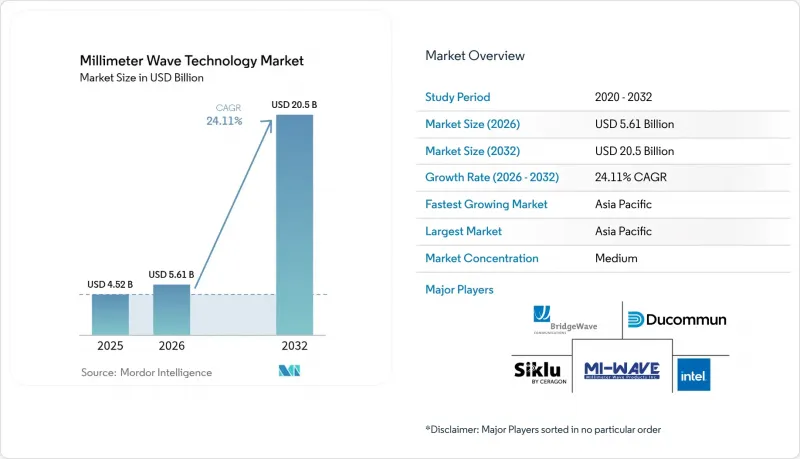
Mordor Intelligence에 의하면, 밀리미터파 기술 시장 규모는 2025년 45억 2,000만 달러로 평가되었습니다. 2026년에는 56억 1,000만 달러로 확대되어 2026-2032년 CAGR 24.11%로 성장을 지속하여, 2032년에는 205억 달러에 이를 것으로 예측됩니다.
본 보고서는 구성 요소별(안테나 및 트랜시버, 통신·네트워크용 IC, 인터페이스 및 제어용 IC, 주파수 발생 및 필터 등), 라이선싱 모델별(전체/부분 라이선스 및 비라이선스),주파수 대역별(24-57GHz, 57-95GHz, 95-300GHz), 용도별(통신 인프라, 모바일 및 소비자용 기기, 고정 무선 액세스 등), 그리고 지역별로 분류되어 있습니다.
세계의 밀리미터파 기술 시장 동향 및 인사이트
5G 네트워크의 고밀도화와 스몰 셀·백홀 수요
통신 사업자들은 스몰 셀의 밀도가 도시의 구역 지정 상한을 초과하면 광섬유가 경제적으로 비효율적이라는 사실을 금세 깨달았습니다. 그 결과, 60GHz 및 E-밴드 무선 링크가 채택되어 사이트 간 연결이 몇 달이 아닌 몇 주 만에 실현되고 있습니다. 중국, 미국, 인도에서 실시된 현장 시험에서는 멀티 기가비트급 처리량이 확인되었으며, 밀리파 백홀이 고비용의 개착 공사를 대체할 수 있음이 입증되었습니다. 현재 벤더들은 소프트웨어 정의 빔 스티어링을 통합하여 조정 시간을 단축하고 있으며, 한편 도시 당국은 옥상 설치 허가 절차를 효율화하여 기지국 가동을 가속화하고 있습니다. 자본 효율성 향상과 시장 출시 기간 단축을 통해 무선 백홀은 밀리미터파 기술 시장의 기반이 되고 있습니다.
24-100GHz 대역에서 모바일 및 고정 무선 데이터 트래픽 증가
고정 무선 서비스 이용자는 모바일 가입자보다 최대 5배 많은 데이터 트래픽을 소비하고 있으며, 이로 인해 통신 사업자들은 주거용 게이트웨이에 연속된 28GHz 대역의 주파수 블록을 할당할 수밖에 없게 되었습니다. 규제 당국은 이에 대응하여 더 넓은 채널 폭을 가능하게 하기 위해 70/80/90GHz 대역에 대한 규제를 통일하고 있습니다. 또한, 칩셋 제조업체들은 링크 최적화를 위한 AI를 통합한 2세대 CPE 플랫폼을 발표하고 있습니다. 이러한 발전은 지방의 광대역 보급 프로그램을 지원하고, 밀리미터파 기술 시장 전체 수요를 촉진하고 있습니다.
100GHz를 초과하는 주파수 대역에서는 RF 프런트엔드의 열 관리가 과제가 됩니다.
주파수가 상승함에 따라 열 집중이 불균형적으로 증가하여, 갈륨 질화물 소자는 신뢰성을 저하시키는 접합 온도에 도달하게 됩니다. 다이아몬드 기판이나 미세 유체 냉각을 이용한 첨단 패키징 기술이 주목받고 있지만, 이러한 접근 방식은 재료 비용을 증가시키고 인증 주기를 길게 만듭니다. 확장 가능한 열 관리 솔루션이 등장하기 전까지는 단기적인 도입이 100GHz 미만에 집중될 것이며, 밀리미터파 기술 시장의 고주파 대역 성장은 둔화될 것입니다.
부문 분석
이미징 센서는 테라헤르츠 이미징이 종양학 분야에서 라벨이 필요 없는 조직 진단 및 화상 평가를 가능하게 함에 따라, 2031년까지 가장 높은 연평균 성장률(CAGR) 24.86%를 나타낼 것으로 예측됩니다. 대조적으로, 안테나 및 트랜시버는 모바일 기지국용 무선 프런트엔드를 공급함으로써 2025년에 37.55%라는 최대 점유율을 유지했습니다. 병원들이 비이온화 진단 도구를 도입함에 따라, 이미징 센서의 밀리미터파 기술 시장 규모는 2031년까지 32억 5,000만 달러를 넘어설 것으로 예측됩니다. 통신 및 네트워크용 IC의 상호 보완적인 성장은 매크로셀의 고밀도 구축에 기인하는 반면, 인터페이스 및 제어용 IC는 레이더 온 칩(Radar-on-Chip) 통합 추세를 타고 있습니다.
NTT가 300GHz에서 280 Gbps 신호를 생성한 것과 같은 연구 개발의 획기적인 성과는 링크 버저트를 개선하고, 주파수 가변 신디사이저에 대한 수요를 자극하고 있습니다. 한편, 통합 업체들이 높은 전력 밀도를 추구하는 가운데, 주로 첨단 기판 및 열 인터페이스 재료로 구성된 ‘기타 부품’의 존재감이 커지고 있습니다. 그 결과, 밀리미터파 기술 시장을 지탱하는 부품 스택이 확대되고 있습니다.
전체 또는 부분적으로 라이선스가 부여된 주파수 대역은 2025년 매출의 77.20%를 차지하며, 통신 매크로셀 및 국방 네트워크에서의 간섭 없는 운영에 대한 부가가치가 반영되었습니다. 그러나 95GHz를 초과하는 면허가 필요 없는 주파수 대역은 규제 당국이 최소한의 행정 절차로 해결되는 산업용 존재 감지 규정을 제정함에 따라 연평균 성장률(CAGR) 25.60%로 확대되고 있습니다. 중소기업들은 이러한 간소화된 규제 제도를 활용하여 로봇 공학 및 품질 검사를 위한 공장 내 레이더를 도입하고 있으며, 이는 밀리미터파 기술 시장에 새로운 수익원을 창출하고 있습니다.
각 벤더들은 현재 규제 환경을 자동으로 감지하고 EIRP 설정을 실시간으로 조정하는 듀얼 모드 칩셋을 도입하고 있으며, 이를 통해 도입의 주요 장벽이 제거되고 있습니다. 면허 대역은 여전히 미션 크리티컬 통신 링크에 필수적이지만, 면허가 필요 없는 대역의 급증으로 인해 전체 대상 시장이 확대되고 있습니다.
지역별 분석
아시아태평양은 2025년 매출의 41.60%를 차지했으며, 중국의 440만 개 5G 기지국과 인도의 FWA 급속한 보급에 힘입어 2031년까지 연평균 성장률(CAGR) 27.20%를 나타낼 것으로 예측됩니다. 각 지역 정부는 5G-Advanced 연구에 공적 자금을 배정하고 있으며, 수탁 제조업체들은 공급의 현지화를 도모하기 위해 갈륨 질화물 웨이퍼 생산 라인에 투자하고 있습니다. 일본의 민간 5G 모델의 경우, 설치 장소 확보가 복잡하여 밀리미터파의 보급이 지연되고 있지만, 기업 캠퍼스에서는 AR 훈련을 위해 60GHz 대역의 실내 네트워크 시범 운영이 진행되고 있습니다.
북미에서는 주파수 정책을 산업 혁신과 연계하여 37GHz 및 70/80/90GHz 대역을 개방하는 한편, ‘CHIPS 법’의 인센티브를 국내 반도체 제조 공장에 유도하고 있습니다. 방위용 레이더의 업그레이드와 고정 무선 네트워크의 구축이 견고한 고객 기반을 뒷받침하고 있으며, 노키아(Nokia)와 T-Mobile과 같은 파트너십을 통해 수년에 걸친 장비 공급 파이프라인이 확보되어 있습니다. 캐나다에서는 지방의 광대역 실증 실험에 밀리파를 채택하고 있으며, 이로 인해 밀리미터파 기술 시장이 더욱 확대되고 있습니다.
유럽은 기술의 실험장으로서의 위상을 확립하고 있습니다. 독일은 6G 테스트베드와 마이크로일렉트로닉스 클러스터를 지원하고 있으며, 규제 당국은 제조 혁신을 우선시하는 42GHz 대역 경매 조건을 마련하고 있습니다. 독일 자동차 제조업체(OEM)의 자동차용 레이더 수요가 전문 칩 제조업체와의 협력을 촉진하고 있는 한편, 영국에서는 60GHz 대역을 활용한 교통 인프라용 통신 링크에 대한 검토가 진행되고 있습니다. 중동에서는 스마트 시티 실증 실험에 투자가 이루어지고 있으며, 남아프리카공화국에서는 28GHz 대역의 FWA(고정 무선 접속) 시범 운영이 실시되고, 브라질에서는 밀리미터파 CPE 조립을 대상으로 한 세제 혜택 조치가 도입되었습니다. 이러한 신흥 시장의 매출 기여도는 여전히 한 자릿수에 그치고 있지만, 성장률은 성숙한 지역을 상회하며 밀리미터파 기술 시장에 활력을 불어넣고 있습니다.
기타 혜택 :
- 엑셀 형식 시장 예측(ME) 시트
- 3개월간의 애널리스트 지원
자주 묻는 질문
목차
제1장 서론
제2장 조사 방법
제3장 주요 요약
제4장 시장 구도
제5장 시장 규모 및 성장 예측
제6장 경쟁 구도
제7장 시장 기회 및 향후 전망
KTH 26.09.10According to Mordor Intelligence, the millimeter wave technology market size is expected to grow from USD 4.52 billion in 2025 to USD 5.61 billion in 2026 and is forecast to reach USD 20.5 billion by 2032 at 24.11% CAGR over 2026-2032.
This report is Segmented by Component (Antennas and Transceivers, Communications and Networking ICs, Interface and Control ICs, Frequency Generation and Filters, and More), Licensing Model (Fully/Partly Licensed and Unlicensed), Frequency Band (24-57 GHz, 57-95 GHz, and 95-300 GHz), Application (Telecom Infrastructure, Mobile and Consumer Devices, Fixed Wireless Access, and More), and Geography.
Global Millimeter Wave Technology Market Trends and Insights
5G network densification and small-cell backhaul demand
Operators quickly discover that fiber becomes uneconomical when small-cell density exceeds urban zoning caps, so 60 GHz and E-band radio links are adopted to connect sites within weeks instead of months. Field trials in China, the United States, and India deliver multi-gigabit throughput, confirming that millimeter-wave backhaul can substitute for high-cost trenching activities. Equipment vendors now integrate software-defined beam steering to reduce alignment time, while urban authorities streamline rooftop permitting to accelerate site activation. Capital efficiency and time-to-market gains make wireless backhaul a cornerstone of the millimeter wave technology market.
Rising mobile and fixed-wireless data traffic in 24-100 GHz bands
Fixed-wireless customers consume up to five times the data of mobile subscribers, forcing operators to allocate contiguous 28 GHz blocks to residential gateways. Regulatory agencies respond by harmonizing 70/80/90 GHz rules to enable wider channels, and chipset makers have announced second-generation CPE platforms with integrated AI for link optimization. These advances support rural broadband programs and stimulate demand across the millimeter wave technology market.
RF front-end thermal management limits above 100 GHz
Heat concentration rises disproportionately as frequency increases, pushing gallium-nitride devices toward junction temperatures that degrade reliability. Advanced packaging using diamond substrates and micro-fluidic cooling is under evaluation, yet these approaches add material cost and prolong qualification cycles. Until scalable thermal solutions emerge, near-term deployments will cluster below 100 GHz, tempering the millimeter wave technology market's upper-band growth.
Other drivers and restraints analyzed in the detailed report include:
- Spectrum liberalization and new auctions above 40 GHz
- Defense radar upgrades to 94 GHz
- High-cost phased-array calibration in volume production
For complete list of drivers and restraints, kindly check the Table Of Contents.
Segment Analysis
Imaging Sensors deliver the fastest 24.86% CAGR through 2031, as terahertz imaging enables label-free tissue diagnosis in oncology and burn assessment. In contrast, Antennas and Transceivers preserve the largest 37.55% share in 2025 by supplying radio front-ends for mobile base stations. The millimeter wave technology market size for Imaging Sensors is expected to cross USD 3.25 billion by 2031 as hospitals adopt non-ionizing diagnostic tools. Complementary growth in Communication and Networking ICs arises from densified macro-cell deployments, while Interface and Control ICs ride the trend toward radar-on-chip integration.
R&D breakthroughs such as NTT's 280 Gbps signal generation at 300 GHz improve link budgets and stimulate demand for frequency-agile synthesizers. Meanwhile, Other Components, chiefly advanced substrates and thermal interface materials, gain visibility as integrators seek higher power density. The result is a broadening component stack that anchors the millimeter wave technology market.
Fully or Partly Licensed spectrum delivered 77.20% of 2025 revenue, reflecting the premium attached to interference-free operations in telecom macro cells and defense networks. However, unlicensed allocations above 95 GHz advance at 25.60% CAGR as regulators create industrial presence-sensing rules that require minimal paperwork. SMEs leverage the simplified regime to deploy factory-floor radar for robotics and quality inspection, adding fresh revenue streams to the millimeter wave technology market.
Vendors now introduce dual-mode chipsets that auto-detect regulatory environments and adjust EIRP settings in real time, removing a key adoption barrier. Licensed spectrum will remain critical for mission-critical links, yet the unlicensed surge broadens the overall addressable base.
Complete Report Scope:
- By Component
- Antennas and Transceivers
- Communication and Networking ICs
- Interface and Control ICs
- Frequency Generation and Filters
- Imaging Sensors
- Other Components
- By Licensing Model
- Fully/Partly Licensed
- Unlicensed
- By Frequency Band
- 24-57 GHz
- 57-95 GHz
- 95-300 GHz
- By Application
- Telecom Infrastructure (RAN and backhaul)
- Mobile and Consumer Devices
- Fixed Wireless Access (FWA)
- Radar and Security Imaging
- Automotive ADAS and V2X
- Industrial Automation and IIoT
- Medical and Life-Sciences Imaging
- Aerospace and Defense Communications
- Other Applications
- By Geography
- North America
- United States
- Canada
- Mexico
- South America
- Brazil
- Argentina
- Rest of South America
- Europe
- United Kingdom
- Germany
- France
- Italy
- Russia
- Rest of Europe
- Asia-Pacific
- China
- Japan
- India
- South Korea
- Rest of Asia-Pacific
- Middle East and Africa
- Middle East
- United Arab Emirates
- Saudi Arabia
- Turkey
- Rest of Middle East
- Africa
- Nigeria
- South Africa
- Rest of Africa
- Middle East
- North America
Geography Analysis
Asia Pacific commands 41.60% of 2025 revenue and is forecast to grow at 27.20% CAGR through 2031, propelled by China's 4.4 million 5G base stations and India's rapid FWA penetration. Regional governments allocate public funds to 5G-Advanced research, and contract manufacturers invest in gallium-nitride wafer lines to localize supply. Japan's private 5G model shows slower mmWave uptake due to site-acquisition complexity, but corporate campuses are piloting 60 GHz indoor networks for AR training.
North America aligns spectrum policy with industrial innovation, releasing 37 GHz and 70/80/90 GHz bands while channeling CHIPS-Act incentives toward domestic fabs. Defense radar upgrades and fixed-wireless deployments underpin a resilient customer base, and partnerships such as Nokia-T-Mobile secure multi-year equipment pipelines. Canada adopts mmWave for rural broadband pilots, further expanding the millimeter wave technology market.
Europe positions itself as a technology laboratory. Germany supports 6G testbeds and micro-electronics clusters, and regulators craft 42 GHz auction terms that prioritize manufacturing innovation. Automotive radar demand from German OEMs drives collaboration with specialist chipmakers, while the UK explores 60 GHz transport-infrastructure links. The Middle East invests in smart-city proof-of-concepts, South Africa pilots 28 GHz FWA, and Brazil introduces targeted tax breaks for mmWave CPE assembly. Although revenue contributions from these emerging markets remain single-digit, growth rates surpass mature regions, adding dynamism to the millimeter wave technology market.
- Anokiwave Inc.
- Aviat Networks
- Broadcom Inc.
- BridgeWave Communications (REMEC)
- Ducommun Incorporated
- Eravant (SAGE Millimeter)
- Farran Technology
- Huawei Technologies
- Intel Corporation
- Keysight Technologies
- L3Harris Technologies
- Millimeter Wave Products Inc.
- NEC Corporation
- Nokia Corporation
- NXP Semiconductors
- Qualcomm Technologies
- Samsung Electronics
- Sivers Semiconductors
- Siklu Communication (Ceragon)
- Smiths Interconnect
- Vubiq Networks
Additional Benefits:
- The market estimate (ME) sheet in Excel format
- 3 months of analyst support
TABLE OF CONTENTS
1 INTRODUCTION
- 1.1 Study Assumptions and Market Definition
- 1.2 Scope of the Study
2 RESEARCH METHODOLOGY
3 EXECUTIVE SUMMARY
4 MARKET LANDSCAPE
- 4.1 Market Overview
- 4.2 Market Drivers
- 4.2.1 5G network densification and small-cell backhaul demand
- 4.2.2 Rising mobile and fixed-wireless data traffic in 24-100 GHz bands
- 4.2.3 Spectrum liberalisation and new auctions above 40 GHz
- 4.2.4 Defense radar upgrades to 94 GHz for low-latency targeting
- 4.2.5 Indoor millimetre-wave FWA for last-50-metre fibre substitution
- 4.2.6 Emerging 122 GHz industrial presence-sensing regulations
- 4.3 Market Restraints
- 4.3.1 RF front-end thermal management limits above 100 GHz
- 4.3.2 High-cost phased-array calibration in volume production
- 4.3.3 Municipal "street-furniture" zoning hurdles for dense sites
- 4.3.4 Gallium-nitride wafer supply chain concentration risk
- 4.4 Value/Supply-Chain Analysis
- 4.5 Regulatory Landscape
- 4.6 Technological Outlook
- 4.6.1 Significance of GaN across mmWave applications
- 4.6.2 mmWave substrate landscape: LCP, PI, PTFE impact on 5G HW
- 4.7 Porter's Five Forces Analysis
- 4.7.1 Bargaining Power of Suppliers
- 4.7.2 Bargaining Power of Buyers
- 4.7.3 Threat of New Entrants
- 4.7.4 Intensity of Competitive Rivalry
- 4.7.5 Threat of Substitutes
- 4.8 COVID-19 Impact Assessment
5 MARKET SIZE AND GROWTH FORECASTS (VALUE)
- 5.1 By Component
- 5.1.1 Antennas and Transceivers
- 5.1.2 Communication and Networking ICs
- 5.1.3 Interface and Control ICs
- 5.1.4 Frequency Generation and Filters
- 5.1.5 Imaging Sensors
- 5.1.6 Other Components
- 5.2 By Licensing Model
- 5.2.1 Fully/Partly Licensed
- 5.2.2 Unlicensed
- 5.3 By Frequency Band
- 5.3.1 24-57 GHz
- 5.3.2 57-95 GHz
- 5.3.3 95-300 GHz
- 5.4 By Application
- 5.4.1 Telecom Infrastructure (RAN and backhaul)
- 5.4.2 Mobile and Consumer Devices
- 5.4.3 Fixed Wireless Access (FWA)
- 5.4.4 Radar and Security Imaging
- 5.4.5 Automotive ADAS and V2X
- 5.4.6 Industrial Automation and IIoT
- 5.4.7 Medical and Life-Sciences Imaging
- 5.4.8 Aerospace and Defense Communications
- 5.4.9 Other Applications
- 5.5 By Geography
- 5.5.1 North America
- 5.5.1.1 United States
- 5.5.1.2 Canada
- 5.5.1.3 Mexico
- 5.5.2 South America
- 5.5.2.1 Brazil
- 5.5.2.2 Argentina
- 5.5.2.3 Rest of South America
- 5.5.3 Europe
- 5.5.3.1 United Kingdom
- 5.5.3.2 Germany
- 5.5.3.3 France
- 5.5.3.4 Italy
- 5.5.3.5 Russia
- 5.5.3.6 Rest of Europe
- 5.5.4 Asia-Pacific
- 5.5.4.1 China
- 5.5.4.2 Japan
- 5.5.4.3 India
- 5.5.4.4 South Korea
- 5.5.4.5 Rest of Asia-Pacific
- 5.5.5 Middle East and Africa
- 5.5.5.1 Middle East
- 5.5.5.1.1 United Arab Emirates
- 5.5.5.1.2 Saudi Arabia
- 5.5.5.1.3 Turkey
- 5.5.5.1.4 Rest of Middle East
- 5.5.5.2 Africa
- 5.5.5.2.1 Nigeria
- 5.5.5.2.2 South Africa
- 5.5.5.2.3 Rest of Africa
- 5.5.5.1 Middle East
- 5.5.1 North America
6 COMPETITIVE LANDSCAPE
- 6.1 Market Concentration
- 6.2 Strategic Moves
- 6.3 Market Share Analysis
- 6.4 Company Profiles (includes Global level Overview, Market level overview, Core Segments, Financials, Strategic Information, Market Rank/Share, Products and Services, Recent Developments)
- 6.4.1 Anokiwave Inc.
- 6.4.2 Aviat Networks
- 6.4.3 Broadcom Inc.
- 6.4.4 BridgeWave Communications (REMEC)
- 6.4.5 Ducommun Incorporated
- 6.4.6 Eravant (SAGE Millimeter)
- 6.4.7 Farran Technology
- 6.4.8 Huawei Technologies
- 6.4.9 Intel Corporation
- 6.4.10 Keysight Technologies
- 6.4.11 L3Harris Technologies
- 6.4.12 Millimeter Wave Products Inc.
- 6.4.13 NEC Corporation
- 6.4.14 Nokia Corporation
- 6.4.15 NXP Semiconductors
- 6.4.16 Qualcomm Technologies
- 6.4.17 Samsung Electronics
- 6.4.18 Sivers Semiconductors
- 6.4.19 Siklu Communication (Ceragon)
- 6.4.20 Smiths Interconnect
- 6.4.21 Vubiq Networks
7 MARKET OPPORTUNITIES AND FUTURE OUTLOOK
- 7.1 White-space and Unmet-Need Assessment


