

|
시장보고서
상품코드
2120569
단백질 공학 : 시장 점유율 분석, 업계 동향 및 통계, 성장 예측(2026-2031년)Protein Engineering - Market Share Analysis, Industry Trends & Statistics, Growth Forecasts (2026 - 2031) |
||||||
 Mordor Intelligence
에 의하면, 2026년 세계의 단백질 공학 시장 규모는 47억 4,000만 달러로 추정되고 2025년 40억 9,000만 달러에서 확대해, 2031년에는 99억 6,000만 달러에 이를 것으로 예측됩니다.
2026년부터 2031년까지 연평균 성장률(CAGR) 15.98%로 성장할 것으로 전망됩니다.
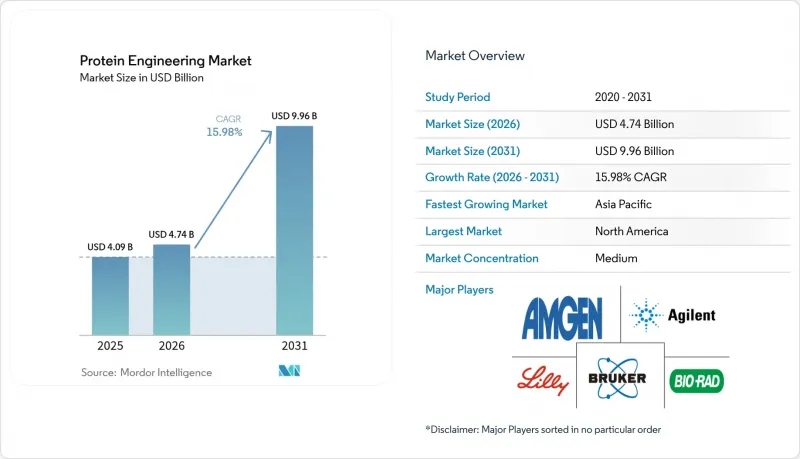
본 보고서는 단백질 유형별(단일클론 항체, 인슐린, 백신, 기타), 제품 및 서비스별(장비, 소모품(시약 및 키트),소프트웨어 및 서비스), 기술별(합리적 단백질 설계, 비합리적·지향적 진화 설계, 하이브리드·세미라셔널 설계), 최종 사용자별(제약·바이오기술 기업, 학술·연구 기관, 기타), 지역별(북미, 유럽, 기타)로 분류되어 있습니다. 시장 전망은 금액(달러) 기준으로 제시되어 있습니다.
세계의 단백질 공학 시장 동향 및 인사이트
단일클론 항체(MAb) 상용화의 급증
단일클론 항체는 계속해서 후기 개발 파이프라인의 중심을 차지하고 있으며, FDA의 승인 가속화와 종양학 이외의 적응증 확장에 힘입어 2025년까지 연간 매출이 3,150억 달러에 달할 것으로 예측됩니다. 현재, 신규 신청의 상당 부분을 이중 특이성 항체가 차지하고 있으며, RSV 예방을 목적으로 한 머크(Merck)의 크레스로비맙(creslovimab) 등의 최근 승인은 그 치료 범위의 폭이 넓음을 입증하고 있습니다. 제조 기술의 혁신으로 제조 원가가 낮아지고 있으며, Sutro Biopharma의 항체-약물 복합체(ADC) 상업적 규모의 무세포 발현이 그 대표적인 예입니다. 이러한 발전은 환자의 접근성을 개선함과 동시에 단백질 공학 시장의 수익 기반을 강화하고 있습니다.
AI를 활용한 인실리코 단백질 설계 플랫폼
인공지능(AI) 덕분에 신약 개발 기간이 수년에서 수개월로 단축되고 있습니다. AlphaProteo는 기존 기술에 비해 친화도가 300배 향상되었음을 입증했습니다. Generate : Biomedicines의 Chroma는 실험을 통해 검증된 310종의 단백질이 우수한 특성을 지닌다는 사실을 확인했으며, 이는 Novartis사와의 10억 달러 규모의 다중 대상 계약의 기반이 되었습니다. 뮌헨 공과대학교 연구진은 AlphaFold2를 1,000개 아미노산 설계까지 확장하여 예측과 맞춤형 서열 생성 간의 격차를 해소했습니다. 이러한 일련의 진전을 통해 AI는 단백질 공학 시장의 주요 성장 동력으로서의 입지를 확고히 하고 있습니다.
장비 및 특수 시약의 높은 비용
첨단 장비, 단일 세포 단백질체학 워크플로우, 독자적으로 개발된 시약으로 인해 자본 집약도는 여전히 높은 수준을 유지하고 있습니다. 단일 세포 단백질 분석 비용은 처리 능력에 따라 세포당 2달러 미만에서 50달러 이상까지 폭이 넓습니다. 업계 추정에 따르면, 신규 단백질을 대규모로 생산하려면 수십억 달러의 투자가 필요한 것으로 알려져 있으며, 중소규모 기업들은 이러한 부담을 줄이기 위해 외부 위탁이나 시설 공유를 하는 경우가 많습니다. 로봇 기술을 활용한 저비용 효소 발굴 파이프라인은 번거로운 작업을 자동화함으로써 비용 격차를 좁혀가고 있습니다. 이러한 혁신으로 압박은 완화되고 있지만, 높은 초기 투자 비용은 여전히 단백질 공학 시장의 성장을 저해하는 요인으로 작용하고 있습니다.
부문별 분석
단일클론 항체는 2025년 매출의 39.78%를 차지하며 단백질 공학 시장에서 가장 큰 점유율을 확보했습니다. 지속적인 규제 당국의 승인, 적응증 확대, 무세포 발현과 같은 제조 기술의 발전으로 인해 진입 장벽은 높은 수준을 유지하면서도 상업적 예측 가능성도 확고해지고 있습니다. 백신은 mRNA의 범용성을 활용하여 신속한 항원 설계와 강력한 면역원성을 실현함으로써, 2031년까지 연평균 성장률(CAGR) 18.07%를 기록할 전망입니다. 이중 특이성 항체와 항체-약물 복합체(ADC)에 대한 지속적인 투자는 이 부문의 파이프라인 견고성을 더욱 강화하고 있습니다.
백신 부문의 성장 기회는 팬데믹 대응 지출을 발판으로 탄력을 받고 있으며, AI를 활용한 항원 설계를 통해 후보 물질 선정이 가속화되고 있습니다. 인슐린과 응고 인자는 성숙한 시장이지만, 지속형 제제나 유전자 치료를 통한 대안으로 계속 진화하고 있습니다. 성장 인자와 융합 단백질은 재생 의학 및 대사성 질환과 같은 틈새 시장을 대상으로 하며, 품질 관리를 향상시키는 FDA의 신속 당사슬 프로파일링 방법과 같은 규제상의 노력에 힘입어 성장하고 있습니다. 이러한 동향들이 합쳐져 단백질 공학 시장의 확대 추세를 뒷받침하고 있습니다.
소모품은 2025년 매출의 51.92%를 차지하며, 실험실 워크플로우 전반에 걸친 시약 및 키트에 대한 지속적인 수요를 뒷받침했습니다. 반면, 소프트웨어 및 서비스는 연평균 성장률(CAGR) 19.55%로 가장 빠르게 성장할 것으로 예측되며, 이는 업계가 AI를 활용한 모델링 및 클라우드 기반 협업으로 중심을 옮기고 있음을 나타냅니다. 알고리즘이 무차별 대입 스크리닝을 대체함에 따라, 소프트웨어 및 서비스 부문의 단백질 공학 시장 규모는 하드웨어 예산을 넘어설 것으로 예측됩니다.
계산 집약적인 접근 방식 덕분에 소규모 기업도 시장에 진입하기 쉬워지고 있습니다. Generate : Biomedicines와 Novartis 간의 10억 달러 규모 제휴나 Cradle의 7,300만 달러 규모의 시리즈 B 자금 조달 등은 알고리즘을 통한 설계가 신약 개발 기간을 단축할 수 있다는 확신을 반영하고 있습니다. 장비 부문에서는 여전히 꾸준한 업그레이드가 진행되고 있으며, 차세대 단백질체학를 심화시키는 서모피셔의 31억 달러 규모 Olink 인수가 그 대표적인 예입니다. 하드웨어가 디지털 플랫폼과 통합됨에 따라, 그 시너지 효과가 단백질 공학 시장에서 다음 단계의 효율성 향상을 이끌어낼 것으로 예측됩니다.
지역별 분석
2025년, 북미는 단백질 공학 시장을 주도하며 매출의 44.32%를 차지했습니다. 이는 미국의 성숙한 벤처 생태계, 일류 학술 연구, 혁신을 장려하는 FDA의 정책에 힘입은 결과입니다. DARPA의 ‘Switch’ 이니셔티브와 NSF의 4,000만 달러 규모 단백질 설계 보조금 풀과 같은 연방 정부 프로그램이 이 지역의 우위를 더욱 공고히 하고 있습니다. 바이오의약품 제조업체들은 국내에 대규모 시설을 건설함으로써 공급망을 강화하고 있습니다. 일라이 릴리(Eli Lilly)와 노보 노르디스크(Novo Nordisk)는 GLP-1 생산을 뒷받침할 노스캐롤라이나주의 신규 시설에 총 61억 달러를 투자했습니다. 단백질 공학 시장은 신약 개발 연구소, 규제 당국, 확장 가능한 생산 능력이 인접해 있다는 점에서 혜택을 받고 있습니다.
아시아태평양은 2031년까지 연평균 성장률(CAGR) 19.41%를 나타낼 것으로 예측되며, 이는 지역별 성장률 중 가장 높은 수치입니다. 중국은 생명공학 분야의 자급자족에 주력하고 있으며, 자본 시장의 역풍에도 불구하고 2024년에는 4억 7,100만 달러의 스타트업 자금을 조달했습니다. 한국은 발효 기술과 농업 혁신을 융합하고 있는 반면, 호주의 CSIRO는 최근 4,450만 달러의 보조금을 바탕으로 2040년까지 300억 달러 규모의 합성생물학 산업이 형성될 것으로 예측했습니다. 일본의 생태계는 가격 압박으로 인해 뒤처지는 모습을 보이고 있지만, 중외제약 등 국내 대기업들은 독자적인 항체 기술을 강점으로 삼아 2024년에 사상 최대 매출을 기록했습니다. 이러한 동향이 맞물리면서 아시아태평양의 단백질 공학 시장에서의 존재감은 더욱 높아지고 있습니다.
유럽은 협력적인 정책과 견고한 학술 네트워크에 힘입어 여전히 영향력 있는 거점으로 자리 잡고 있습니다. EU의 2024년판 ‘자연과 함께하는 미래 구축(Building the Future with Nature)’ 청사진은 생명공학의 자율성과 지속가능성을 추진하고 있습니다. 영국의 1억 파운드(1억 2,500만 달러) 규모의 공학 생물학 프로그램은 팬데믹 대비를 가속화하고 있는 반면,Nuclera가 Innovate UK로부터 받은 114만 파운드(140만 달러)의 보조금은 신속한 단백질 발현 도구에 대한 시드 단계 지원의 한 예가 되고 있습니다. 네덜란드의 6,000만 유로(6,500만 달러) 규모의 세포 농업 펀드는 생명공학의 원칙을 식량 시스템으로 확대되고 있습니다. 이러한 노력은 유럽의 경쟁력을 유지하는 동시에 단백질 공학 시장의 세계 확장을 다각화하고 있습니다.
기타 혜택
- 엑셀 형식 시장 예측(ME) 시트
- 3개월간의 애널리스트 지원
자주 묻는 질문
목차
제1장 서론
제2장 조사 방법
제3장 주요 요약
제4장 시장 구도
제5장 시장 규모 및 성장 예측
제6장 경쟁 구도
제7장 시장 기회 및 향후 전망
KTH 26.09.04According to Mordor Intelligence, the global protein engineering market size in 2026 is estimated at USD 4.74 billion, growing from 2025 value of USD 4.09 billion with 2031 projections showing USD 9.96 billion, growing at 15.98% CAGR over 2026-2031.
This report is Segmented by Protein Type (Insulin, Monoclonal Antibodies, Vaccines, and More), Product & Service (Instruments, Consumables, and Software & Services), Technology (Irrational Design, Rational Design, and Hybrid Design), End User (Pharmaceutical and Biotechnology Companies, and More), and Geography (North America, Europe, and More). The Market Forecasts are Provided in Terms of Value (USD).
Global Protein Engineering Market Trends and Insights
Surge in Monoclonal Antibody Commercialization
Monoclonal antibodies continue to headline late-stage pipelines, with forecasts pointing to USD 315 billion in annual sales by 2025, propelled by accelerated FDA approvals and expanded indications beyond oncology. Bispecific formats now comprise a notable share of new filings, and recent clearances such as Merck's clesrovimab for RSV prevention underscore the therapeutic breadth. Manufacturing innovation is lowering cost-of-goods, exemplified by Sutro Biopharma's commercial-scale cell-free expression of an antibody-drug conjugate. These gains improve patient access and reinforce the revenue base for the protein engineering market.
AI-Driven In-Silico Protein Design Platforms
Artificial intelligence is compressing discovery timelines from years to months. AlphaProteo has shown 300-fold affinity improvements over legacy techniques. Generate:Biomedicines' Chroma validated 310 experimentally tested proteins with favorable properties, underpinning a USD 1 billion multi-target deal with Novartis. Technical University of Munich researchers extended AlphaFold2 to 1,000-amino-acid designs, bridging a gap between prediction and custom sequence generation. Collective advances position AI as a primary engine of growth for the protein engineering market.
High Cost of Instruments and Specialty Reagents
Sophisticated equipment, single-cell proteomics workflows and proprietary reagents keep capital intensity high. Single-cell protein analysis can range from under USD 2 to more than USD 50 per cell depending on throughput. Industry estimates point to multibillion-dollar investment needs to bring novel proteins to scale, a burden that smaller firms often mitigate by outsourcing or sharing facilities. Robotics-enabled, low-cost enzyme discovery pipelines are beginning to narrow cost gaps by automating tedious tasks. While these innovations ease pressure, high upfront spending remains a moderating force on the protein engineering market.
Other drivers and restraints analyzed in the detailed report include:
- Growing Chronic-Disease Burden Demanding Biologics
- Government and VC Funding for Synthetic-Biology Start-Ups
- Complex IP and Freedom-to-Operate Hurdles
For complete list of drivers and restraints, kindly check the Table Of Contents.
Segment Analysis
Monoclonal antibodies retained 39.78% of 2025 revenue, securing the largest slice of the protein engineering market. Sustained regulatory approvals, broadening indications and manufacturing advances such as cell-free expression keep entry barriers high while cementing commercial predictability. Vaccines are set to register an 18.07% CAGR through 2031, leveraging mRNA versatility to deliver rapid antigen design and robust immunogenicity. Continued investment in bispecifics and antibody-drug conjugates further fortifies the segment's pipeline resilience.
The vaccine opportunity gains momentum from pandemic preparedness spending, with AI-directed antigen design accelerating candidate selection. Insulin and coagulation factors remain mature but evolve through long-acting formulations and gene-therapy alternatives. Growth factors and fusion proteins address regenerative medicine and metabolic disease niches, supported by regulatory initiatives such as the FDA's rapid glycan-profiling method that improves quality oversight. Collectively, these developments reinforce the expansion trajectory of the protein engineering market.
Consumables generated 51.92% of 2025 revenue, underscoring the recurring demand for reagents and kits across laboratory workflows. Yet software and services are projected to scale fastest at a 19.55% CAGR, signifying an industry pivot toward AI-enabled modeling and cloud-based collaboration. The protein engineering market size for software and services is expected to outpace hardware budgets as algorithms replace brute-force screening.
Compute-rich approaches lower the barrier for smaller entities to participate. Generate:Biomedicines' billion-dollar alliance with Novartis and Cradle's USD 73 million Series B reflect confidence that algorithmic design can shorten discovery timelines. Instruments still see steady upgrades, highlighted by Thermo Fisher's USD 3.1 billion Olink acquisition that deepens next-generation proteomics. As hardware integrates with digital platforms, synergy will drive the next efficiency leap within the protein engineering market.
Complete Report Scope:
- By Protein Type
- Monoclonal Antibodies
- Insulin
- Coagulation Factors
- Vaccines
- Growth Factors
- Other Protein Types
- By Product & Service
- Instruments
- Consumables (Reagents & Kits)
- Software & Services
- By Technology
- Rational Protein Design
- Irrational / Directed-Evolution Design
- Hybrid / Semi-Rational Design
- By End User
- Pharmaceutical & Biotechnology Companies
- Academic & Research Institutions
- Contract Research Organizations
- Others
- Geography
- North America
- United States
- Canada
- Mexico
- Europe
- Germany
- United Kingdom
- France
- Italy
- Spain
- Rest of Europe
- Asia-Pacific
- China
- Japan
- India
- South Korea
- Australia
- Rest of Asia-Pacific
- Middle East and Africa
- GCC
- South Africa
- Rest of Middle East and Africa
- South America
- Brazil
- Argentina
- Rest of South America
- North America
Geography Analysis
North America led the protein engineering market with a 44.32% revenue contribution in 2025, anchored by the United States' mature venture ecosystem, premier academic research and FDA policies that reward innovation. Federal programs such as DARPA's Switch initiative and the NSF's USD 40 million protein-design grant pool amplify the regional advantage. Biopharma manufacturers are reinforcing supply chains through large domestic builds; Eli Lilly and Novo Nordisk together earmarked USD 6.1 billion for new facilities in North Carolina that will support GLP-1 production. The protein engineering market benefits from proximity between discovery labs, regulators and scalable production capacity.
Asia-Pacific is forecast to grow at 19.41% CAGR, the fastest regional clip through 2031. China's commitment to biotech self-sufficiency yielded USD 471 million in 2024 start-up funding despite capital-market headwinds. South Korea is pairing fermentation expertise with agricultural innovation, while Australia's CSIRO projects a USD 30 billion synthetic-biology industry by 2040 supported by USD 44.5 million in recent grants. Japan's ecosystem lags due to pricing pressures, yet domestic champions such as Chugai delivered record 2024 revenue on the strength of proprietary antibody technologies. These developments collectively sharpen Asia-Pacific's stake in the protein engineering market.
Europe remains an influential node, supported by coordinated policy and a strong academic network. The EU's 2024 "Building the Future with Nature" blueprint promotes biotechnology sovereignty and sustainability. The United Kingdom's GBP 100 million (USD 125 million) engineering-biology program accelerates pandemic readiness, while Nuclera's GBP 1.14 million (USD 1.4 million) Innovate UK grant exemplifies seed-stage support for rapid protein expression tools. The Netherlands' EUR 60 million (USD 65 million) cellular-agriculture fund extends biotech principles into food systems. These initiatives maintain Europe's competitiveness and diversify the global footprint of the protein engineering market.
- Agilent Technologies
- Amgen
- Bruker
- Bio-Rad Laboratories
- Eli Lilly and Company
- Merck
- Novo Nordisk
- PerkinElmer
- Thermo Fisher Scientific
- Waters Corporation
- GenScript Biotech
- GE Healthcare
- Lonza Group
- Abzena
- Codexis
- Takara Bio
- AbCellera
- Johnson & Johnson
- Genentech (Roche)
- Sangamo Therapeutics
Additional Benefits:
- The market estimate (ME) sheet in Excel format
- 3 months of analyst support
TABLE OF CONTENTS
1 Introduction
- 1.1 Study Assumptions & Market Definition
- 1.2 Scope of the Study
2 Research Methodology
3 Executive Summary
4 Market Landscape
- 4.1 Market Overview
- 4.2 Market Drivers
- 4.2.1 Surge In Monoclonal Antibody (Mab) Commercialization
- 4.2.2 AI-Driven In-Silico Protein Design Platforms
- 4.2.3 Growing Chronic-Disease Burden Demanding Biologics
- 4.2.4 Government & VC Funding For Synthetic-Biology Start-Ups
- 4.2.5 Cell-Free Protein Synthesis Enabling Rapid Prototyping
- 4.3 Market Restraints
- 4.3.1 High Cost Of Instruments & Specialty Reagents
- 4.3.2 Complex IP & Freedom-To-Operate Hurdles
- 4.3.3 Sustainability & Regulatory Scrutiny Of Bioprocess Waste
- 4.4 Porter's Five Forces
- 4.4.1 Bargaining Power of Suppliers
- 4.4.2 Bargaining Power of Buyers/Consumers
- 4.4.3 Threat of New Entrants
- 4.4.4 Threat of Substitute Products
- 4.4.5 Intensity of Competitive Rivalry
5 Market Size & Growth Forecasts (Value, USD)
- 5.1 By Protein Type
- 5.1.1 Monoclonal Antibodies
- 5.1.2 Insulin
- 5.1.3 Coagulation Factors
- 5.1.4 Vaccines
- 5.1.5 Growth Factors
- 5.1.6 Other Protein Types
- 5.2 By Product & Service
- 5.2.1 Instruments
- 5.2.2 Consumables (Reagents & Kits)
- 5.2.3 Software & Services
- 5.3 By Technology
- 5.3.1 Rational Protein Design
- 5.3.2 Irrational / Directed-Evolution Design
- 5.3.3 Hybrid / Semi-Rational Design
- 5.4 By End User
- 5.4.1 Pharmaceutical & Biotechnology Companies
- 5.4.2 Academic & Research Institutions
- 5.4.3 Contract Research Organizations
- 5.4.4 Others
- 5.5 Geography
- 5.5.1 North America
- 5.5.1.1 United States
- 5.5.1.2 Canada
- 5.5.1.3 Mexico
- 5.5.2 Europe
- 5.5.2.1 Germany
- 5.5.2.2 United Kingdom
- 5.5.2.3 France
- 5.5.2.4 Italy
- 5.5.2.5 Spain
- 5.5.2.6 Rest of Europe
- 5.5.3 Asia-Pacific
- 5.5.3.1 China
- 5.5.3.2 Japan
- 5.5.3.3 India
- 5.5.3.4 South Korea
- 5.5.3.5 Australia
- 5.5.3.6 Rest of Asia-Pacific
- 5.5.4 Middle East and Africa
- 5.5.4.1 GCC
- 5.5.4.2 South Africa
- 5.5.4.3 Rest of Middle East and Africa
- 5.5.5 South America
- 5.5.5.1 Brazil
- 5.5.5.2 Argentina
- 5.5.5.3 Rest of South America
- 5.5.1 North America
6 Competitive Landscape
- 6.1 Market Concentration
- 6.2 Market Share Analysis
- 6.3 Company Profiles (includes Global level Overview, Market level overview, Core Segments, Financials as available, Strategic Information, Market Rank/Share for key companies, Products & Services, and Recent Developments)
- 6.3.1 Agilent Technologies Inc.
- 6.3.2 Amgen Inc.
- 6.3.3 Bruker Corporation
- 6.3.4 Bio-Rad Laboratories
- 6.3.5 Eli Lilly and Company
- 6.3.6 Merck KGaA
- 6.3.7 Novo Nordisk
- 6.3.8 PerkinElmer
- 6.3.9 Thermo Fisher Scientific
- 6.3.10 Waters
- 6.3.11 GenScript Biotech
- 6.3.12 GE HealthCare
- 6.3.13 Lonza Group AG
- 6.3.14 Abzena
- 6.3.15 Codexis
- 6.3.16 Takara Bio
- 6.3.17 AbCellera
- 6.3.18 Johnson & Johnson (Janssen)
- 6.3.19 Genentech (Roche)
- 6.3.20 Sangamo Therapeutics
7 Market Opportunities & Future Outlook
- 7.1 White-space & Unmet-Need Assessment


