

|
시장보고서
상품코드
2120574
정맥 조명기 : 시장 점유율 분석, 업계 동향 및 통계, 성장 예측(2026-2031년)Vein Illuminator - Market Share Analysis, Industry Trends & Statistics, Growth Forecasts (2026 - 2031) |
||||||
 Mordor Intelligence
Mordor Intelligence에 의하면, 정맥 조명기 시장 규모는 2025년 3억 달러로 평가되었습니다. 2026년에는 3억 8,130만 달러로 확대되어 2026년부터 2031년에 걸쳐 CAGR 27.10%로 성장을 지속하여, 2031년에는 12억 6,000만 달러에 이를 것으로 예측됩니다.
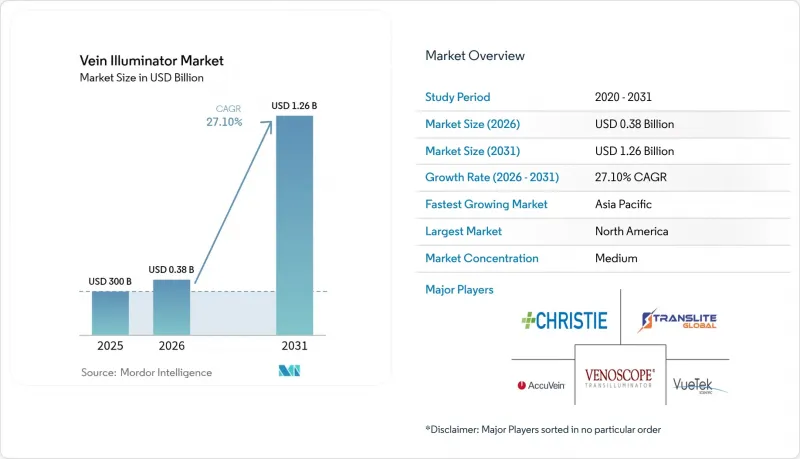
본 보고서는 기술별(근적외선(NIR) 조명, 투과 조명 등), 제품 유형별(핸드헬드형 및 휴대형, 탁상형/카트 탑재형, 웨어러블형 및 클립온형 모듈), 용도별(정맥 내(IV) 접근,채혈/정맥 천자 지원 등), 최종 사용자(병원 및 진료소, 헌혈장·혈액은행 등), 지역별로 분류되어 있습니다.
세계의 정맥 조명기 시장 동향 및 인사이트
첫 번째 천자 성공률 향상으로 품질 지표 개선
소아과 병동에서 실시된 임상시험에서 AccuVein AV400을 사용했을 때의 첫 천자 성공률은 74.1%에 달한 반면, 촉진만 사용했을 때는 40.7%에 그쳤으며, 시술 시간은 169초에서 44초로 단축되었습니다. 의료 기관 경영진은 이러한 성과를 HCAHPS 환자 경험 점수 향상으로 직접 연결하고, 이것이 메디케어 환급액에 영향을 미칩니다는 점을 고려하여 의료기기 구매를 전략적 우선 과제로 삼고 있습니다. 환자 설문조사에 따르면, 응답자의 93%가 직원이 시각화 도구를 활용하는 병원을 더 높게 평가하는 것으로 나타났습니다.
만성 질환에 따른 채혈 증가
당뇨병 및 심혈관 질환 환자를 대상으로 한 HbA1c, 지질, 신기능 검사 빈도가 증가함에 따라 연간 채혈 건수가 늘어나 채혈 역량에 부담이 가중되고 있습니다. 혈관의 노화 및 약물로 인한 정맥의 취약화로 인해 실패 위험이 높아지고 있는 만큼, 의료기관에서는 재천자 및 소모품 폐기를 줄일 수 있는 휴대형 NIR 파인더를 검사실에 도입하고 있습니다.
높은 초기 투자 비용과 대당 비용
고급 NIR 시스템의 정가는 4,000달러에서 2만 7,000달러 사이로, 소규모 병원의 예산을 압박하고 있습니다. 재활용된 광학 부품을 사용하여 구축된 실험적인 오픈소스 모델은 25달러로 동등한 정맥 대비를 구현하고 있으며, 향후 가격 하락이 예상됩니다.
부문 분석
2025년에는 근적외선(NIR) 조명이 매출의 49.74%를 차지하며, 성숙하고 비용 효율적인 플랫폼으로서 정맥 조명기 시장을 지탱했습니다. 초음파 기능이 강화된 장치는 2031년까지 연평균 성장률(CAGR) 30.9%를 기록하며, 더 깊은 영상 진단과 기존 초음파 카트와의 시너지 효과로 인해 정맥 접근이 어려운 환자층에서 시장 점유율을 확대되고 있습니다. 투과형 조명은 빛이 부드러워 여전히 소아 의료의 틈새 분야에 머물러 있지만, 다중 스펙트럼 하이브리드형은 연구 분야에서 주목을 받고 있습니다. 듀얼 모드 VeinCAP 시스템 등의 특허 출원은 근적외선(NIR)과 확산형 초분광 영사을 모두 제공하는 단일 기기로의 수렴 추세를 보여주고 있습니다. 기능 세트가 확대되는 가운데, 각 벤더는 정맥의 품질을 자동으로 평가하고 성공 지표를 전자 차트에 기록하는 AI 알고리즘을 통해 차별화를 꾀하고 있습니다.
2025년 매출 중 핸드헬드형 및 휴대용 기기가 60.55%를 차지했습니다. 이는 간호사들이 병동 간 이동이 용이한 포켓 사이즈의 도구를 선호하기 때문입니다. 연평균 성장률(CAGR) 32.4%로 성장하고 있는 웨어러블 및 클립온형 모듈은 복잡한 캐뉼라 삽입 시 임상의의 손을 자유롭게 해주고, 교육용으로 스마트 글래스에 영상을 전송합니다. 데스크톱형 카트는 장시간의 채혈에 대비해 카메라 보정이 유지되는 혈액은행에서 계속해서 사용되고 있습니다. IoT 연결은 설계상의 우선순위를 재정의하고 있습니다. 차세대 웨어러블 기기는 Wi-Fi와 클라우드 대시보드를 통합하고, 첫 천자 성공률을 벤치마킹함으로써 기본적인 조명을 품질 관리의 거점으로 변화시키고 있습니다.
지역별 분석
북미는 첨단 인프라와 환자 경험 성과에 대한 보상을 지급하는 상환 프로그램을 바탕으로 2025년 매출에서 36.80%의 1위 자리를 유지했습니다. 미국 병원에서는 첫 천자 성공률 통계를 품질 대시보드에 통합하여 기기의 재주문을 확보하고 있습니다. 캐나다의 단일 지불자 제도에서는 단위당 비용을 절감하는 주 전체 계약이 중시되는 반면, 멕시코의 민간 의료 관광 클리닉에서는 환자의 편안함을 차별화하는 요소로 파인더가 도입되고 있습니다.
유럽의 다중 지불자 환경은 꾸준한 보급을 이끌고 있습니다. 독일의 대학 병원에서는 다중 모드 장치의 시범 도입이 진행되고 있으며, 영국의 NHS는 혈관 접근 안전 목표를 지원하기 위해 일괄 가격 협상을 진행하고 있습니다. CE 마크의 조화로 국경을 넘는 판매가 원활해지면서 스칸디나비아와 동유럽에서의 신규 진입이 촉진되고 있습니다.
아시아태평양의 정맥 조명기 시장 규모는 연평균 성장률(CAGR) 31.7%로 확대되고 있으며, 이는 세계 성장의 원동력이 되고 있습니다. 인도의 ‘생산 연계형 인센티브(PLI) 제도’는 국내 의료기기 제조 공장에 보조금을 지급하여 수입 의존도를 낮추고 있습니다. 중국의 병원 개보수 프로그램에서는 간호 효율을 높이는 기기가 요구되고 있으며, 현지 브랜드는 시각화 장치와 수액 키트를 세트로 판매함으로써 수입품보다 저렴한 가격을 실현하고 있습니다. 일본의 초고령화 사회와 엄격한 의료기기 기준은 프리미엄 듀얼 모드 시스템 수요를 뒷받침하고 있는 반면, 한국의 스타트업 기업들은 재택 수액 주입 서비스를 위해 AI가 탑재된 스마트폰용 어댑터를 시범 도입하고 있습니다.
기타 혜택 :
- 엑셀 형식 시장 예측(ME) 시트
- 3개월간의 애널리스트 지원
자주 묻는 질문
목차
제1장 서론
제2장 조사 방법
제3장 주요 요약
제4장 시장 구도
제5장 시장 규모 및 성장 예측
제6장 경쟁 구도
제7장 시장 기회 및 향후 동향
KTH 26.09.10According to Mordor Intelligence, the vein illuminator market size is expected to grow from USD 300 million in 2025 to USD 381.3 million in 2026 and is forecast to reach USD 1.26 billion by 2031 at 27.10% CAGR over 2026-2031.
This report is Segmented by Technology (Near-Infrared (NIR) Illumination, Transillumination, and More), Product Type (Hand-Held and Portable, Table-Top/Cart-Mounted, and Wearable and Clip-On Modules), Application (Intravenous (IV) Access, Blood Draw/Venipuncture Assistance, and More), End-User (Hospitals and Clinics, Blood Donation Camps and Blood Banks, and More), and Geography.
Global Vein Illuminator Market Trends and Insights
Rising First-Attempt Success Rates Drive Quality Metrics
Clinical trials in pediatric units showed first-stick success climbing to 74.1% with AccuVein AV400 compared with 40.7% using palpation, trimming procedure time from 169 seconds to 44 seconds. Health-system executives translate these gains directly into higher HCAHPS patient-experience scores, which shape Medicare reimbursements, elevating device purchases to strategic priorities. Patient surveys reveal 93% of respondents rate hospitals higher when staff employ visualization tools.
Growth in Chronic-Disease Blood Draws
More frequent HbA1c, lipid, and renal tests among diabetic and cardiovascular cohorts raise annual venipuncture volumes, stressing phlebotomy capacity. Aging vasculature and drug-induced vein fragility heighten failure risk, prompting facilities to equip labs with portable NIR finders that cut repeat sticks and consumable waste.
High Capital and Per-Unit Device Costs
Premium NIR systems list between USD 4,000 and USD 27,000, squeezing budgets of small hospitals. Experimental open-source models built from recycled optics have demonstrated comparable vein contrast for USD 25, hinting at future price erosion.
Other drivers and restraints analyzed in the detailed report include:
- Ageing and Obese Populations Challenge Traditional Methods
- Hospital Push for Patient-Experience KPIs
- Lack of Reimbursement Codes
For complete list of drivers and restraints, kindly check the Table Of Contents.
Segment Analysis
Near-Infrared Illumination controlled 49.74% revenue in 2025, underpinning the vein illuminator market with a mature, cost-efficient platform. Ultrasound-Augmented units, posting 30.9% CAGR to 2031, carve share in difficult-access patients via deeper imaging and synergy with existing ultrasound carts. Transillumination remains a pediatric niche due to softer light, while multispectral hybrids gain research traction. Patent filings such as the dual-mode VeinCAP system illustrate convergence trends toward single devices offering NIR plus diffuse hyperspectral views. As feature sets widen, vendors differentiate on AI algorithms that auto-grade vein quality and log success metrics to electronic health records.
Hand-held and Portable devices occupied 60.55% of 2025 revenue because nurses favor pocketable tools that shift easily between wards. Wearable and Clip-On Modules, climbing at 32.4% CAGR, free clinicians' hands during complex cannulations, and feed video to smart glasses for teaching. Table-top carts persist in blood banks where mounted cameras stay calibrated for long draws. IoT connectivity is redefining design priorities: next-generation wearables integrate Wi-Fi and cloud dashboards that benchmark first-stick rates, transforming basic lights into quality-management nodes.
Complete Report Scope:
- By Technology
- Near-Infrared (NIR) Illumination
- Transillumination
- Ultrasound-Augmented
- Multispectral/Hybrid
- Others
- By Product Type
- Hand-held and Portable
- Table-Top/Cart-Mounted
- Wearable and Clip-On Modules
- By Application
- Intravenous (IV) Access
- Blood Draw/Venipuncture Assistance
- Sclerotherapy and Varicose Vein Treatment
- Emergency and Critical Care
- Cosmetic/Aesthetic Injections
- By End-user
- Hospitals and Clinics
- Blood Donation Camps and Blood Banks
- Ambulatory Surgical Centers
- Rehabilitation and Nursing Homes
- Academic and Research Institutions
- By Geography
- North America
- United States
- Canada
- Mexico
- South America
- Brazil
- Argentina
- Chile
- Rest of South America
- Europe
- Germany
- United Kingdom
- France
- Italy
- Spain
- Russia
- Rest of Europe
- Asia-Pacific
- China
- India
- Japan
- South Korea
- Malaysia
- Singapore
- Australia
- Rest of Asia-Pacific
- Middle East and Africa
- Middle East
- United Arab Emirates
- Saudi Arabia
- Turkey
- Rest of Middle East
- Africa
- South Africa
- Nigeria
- Rest of Africa
- Middle East
- North America
Geography Analysis
North America retained 36.80% 2025 revenue leadership on the back of sophisticated infrastructure and reimbursement programs that pay for patient-experience outcomes. U.S. hospitals embed first-stick statistics into quality dashboards, ensuring repeat device orders. Canada's single-payer system favors province-wide contracts that lower per-unit costs, while Mexico's private medical-tourism clinics install finders as patient-comfort differentiators.
Europe's multi-payer environment produces steady uptake; Germany's university hospitals pilot multi-modal units, and the United Kingdom's NHS negotiates bulk pricing to support vascular-access safety goals. CE Mark harmonization smooths cross-border sales and encourages newer entrants from Scandinavia and Eastern Europe.
The vein illuminator market size in Asia-Pacific is expanding at a 31.7% CAGR, making it the global growth engine. India's Production-Linked Incentive scheme subsidizes domestic device plants, reducing import reliance. China's hospital-upgrade program requires equipment that boosts nursing efficiency; local brands undercut imports by bundling visualization with IV kits. Japan's super-aged population and high device standards favor premium dual-mode systems, while South Korea's start-ups test AI-enabled smartphone adapters for home infusion services.
- AccuVein Inc.
- Christie Medical Holdings Inc.
- TransLite LLC (Veinlite)
- VueTek Scientific LLC
- Venoscope LLC
- Near Infrared Imaging Inc.
- ZD Medical Inc.
- VeinSight (Surmount Electronic)
- Shenzhen Vivolight Medical Device and Technology Co.
- Veincas Medical Ltd.
- SIFSOF LLC
- NextVein LLC
- Infinium Medical Inc.
- B. Braun Medical Inc.
- Koninklijke Philips N.V.
- Siemens Healthineers AG
- Baxter International Inc.
- GE Healthcare Technologies Inc.
- Osang Healthcare Co., Ltd.
- Kingmaker Biomedical Inc.
- Dhanika Instrument Co.
- Zhongke Micro-Light Medical Equipment Co.
- YSENMED Medical Equipment Co.
- Xavant Medical (Pty) Ltd.
- ALEH Medical Laser and Systems
- FY Medical Devices Co.
Additional Benefits:
- The market estimate (ME) sheet in Excel format
- 3 months of analyst support
TABLE OF CONTENTS
1 INTRODUCTION
- 1.1 Study Assumptions and Market Definition
- 1.2 Scope of the Study
2 RESEARCH METHODOLOGY
3 EXECUTIVE SUMMARY
4 MARKET LANDSCAPE
- 4.1 Market Overview
- 4.2 Market Drivers
- 4.2.1 Rising first-attempt success rates for IV and phlebotomy
- 4.2.2 Growth in chronic-disease related blood draws
- 4.2.3 Ageing and obese populations with difficult venous access
- 4.2.4 Hospital push for patient-experience KPIs
- 4.2.5 AI-integrated mobile vein-finder apps
- 4.2.6 Adoption in cosmetic/aesthetic injections
- 4.3 Market Restraints
- 4.3.1 High capital and per-unit device costs
- 4.3.2 Lack of reimbursement codes
- 4.3.3 Training gaps in low-resource settings
- 4.3.4 Regulatory ambiguity for aesthetic-only devices
- 4.4 Industry Value Chain Analysis
- 4.5 Regulatory Landscape
- 4.6 Technological Outlook
- 4.7 Industry Attractiveness - Porter's Five Forces Analysis
- 4.7.1 Bargaining Power of Suppliers
- 4.7.2 Bargaining Power of Buyers
- 4.7.3 Threat of New Entrants
- 4.7.4 Threat of Substitutes
- 4.7.5 Intensity of Competitive Rivalry
- 4.8 Impact of Macroeconomic Factors on the Market
5 MARKET SIZE AND GROWTH FORECASTS (VALUES)
- 5.1 By Technology
- 5.1.1 Near-Infrared (NIR) Illumination
- 5.1.2 Transillumination
- 5.1.3 Ultrasound-Augmented
- 5.1.4 Multispectral/Hybrid
- 5.1.5 Others
- 5.2 By Product Type
- 5.2.1 Hand-held and Portable
- 5.2.2 Table-Top/Cart-Mounted
- 5.2.3 Wearable and Clip-On Modules
- 5.3 By Application
- 5.3.1 Intravenous (IV) Access
- 5.3.2 Blood Draw/Venipuncture Assistance
- 5.3.3 Sclerotherapy and Varicose Vein Treatment
- 5.3.4 Emergency and Critical Care
- 5.3.5 Cosmetic/Aesthetic Injections
- 5.4 By End-user
- 5.4.1 Hospitals and Clinics
- 5.4.2 Blood Donation Camps and Blood Banks
- 5.4.3 Ambulatory Surgical Centers
- 5.4.4 Rehabilitation and Nursing Homes
- 5.4.5 Academic and Research Institutions
- 5.5 By Geography
- 5.5.1 North America
- 5.5.1.1 United States
- 5.5.1.2 Canada
- 5.5.1.3 Mexico
- 5.5.2 South America
- 5.5.2.1 Brazil
- 5.5.2.2 Argentina
- 5.5.2.3 Chile
- 5.5.2.4 Rest of South America
- 5.5.3 Europe
- 5.5.3.1 Germany
- 5.5.3.2 United Kingdom
- 5.5.3.3 France
- 5.5.3.4 Italy
- 5.5.3.5 Spain
- 5.5.3.6 Russia
- 5.5.3.7 Rest of Europe
- 5.5.4 Asia-Pacific
- 5.5.4.1 China
- 5.5.4.2 India
- 5.5.4.3 Japan
- 5.5.4.4 South Korea
- 5.5.4.5 Malaysia
- 5.5.4.6 Singapore
- 5.5.4.7 Australia
- 5.5.4.8 Rest of Asia-Pacific
- 5.5.5 Middle East and Africa
- 5.5.5.1 Middle East
- 5.5.5.1.1 United Arab Emirates
- 5.5.5.1.2 Saudi Arabia
- 5.5.5.1.3 Turkey
- 5.5.5.1.4 Rest of Middle East
- 5.5.5.2 Africa
- 5.5.5.2.1 South Africa
- 5.5.5.2.2 Nigeria
- 5.5.5.2.3 Rest of Africa
- 5.5.5.1 Middle East
- 5.5.1 North America
6 COMPETITIVE LANDSCAPE
- 6.1 Market Concentration
- 6.2 Strategic Moves
- 6.3 Market Share Analysis
- 6.4 Company Profiles (includes Global level Overview, Market level overview, Core Segments, Financials as available, Strategic Information, Market Rank/Share for key companies, Products and Services, and Recent Developments)
- 6.4.1 AccuVein Inc.
- 6.4.2 Christie Medical Holdings Inc.
- 6.4.3 TransLite LLC (Veinlite)
- 6.4.4 VueTek Scientific LLC
- 6.4.5 Venoscope LLC
- 6.4.6 Near Infrared Imaging Inc.
- 6.4.7 ZD Medical Inc.
- 6.4.8 VeinSight (Surmount Electronic)
- 6.4.9 Shenzhen Vivolight Medical Device and Technology Co.
- 6.4.10 Veincas Medical Ltd.
- 6.4.11 SIFSOF LLC
- 6.4.12 NextVein LLC
- 6.4.13 Infinium Medical Inc.
- 6.4.14 B. Braun Medical Inc.
- 6.4.15 Koninklijke Philips N.V.
- 6.4.16 Siemens Healthineers AG
- 6.4.17 Baxter International Inc.
- 6.4.18 GE Healthcare Technologies Inc.
- 6.4.19 Osang Healthcare Co., Ltd.
- 6.4.20 Kingmaker Biomedical Inc.
- 6.4.21 Dhanika Instrument Co.
- 6.4.22 Zhongke Micro-Light Medical Equipment Co.
- 6.4.23 YSENMED Medical Equipment Co.
- 6.4.24 Xavant Medical (Pty) Ltd.
- 6.4.25 ALEH Medical Laser and Systems
- 6.4.26 FY Medical Devices Co.
7 MARKET OPPORTUNITIES AND FUTURE TRENDS
- 7.1 White-Space and Unmet-Need Assessment


