

|
시장보고서
상품코드
2120592
북미의 전사적 자원 계획 : 시장 점유율 분석, 업계 동향 및 통계, 성장 예측(2026-2031년)North America Enterprise Resource Planning - Market Share Analysis, Industry Trends & Statistics, Growth Forecasts (2026 - 2031) |
||||||
 Mordor Intelligence
Mordor Intelligence에 의하면, 북미의 전사적 자원 계획(ERP) 시장 규모는 2025년 244억 3,000만 달러로 평가되었습니다. 2026년에는 268억 6,000만 달러로 확대되어 2031년까지 414억 4,000만 달러에 이를 것으로 예측되며, 2026-2031년에 걸쳐 CAGR 9.06%로 성장할 전망입니다.
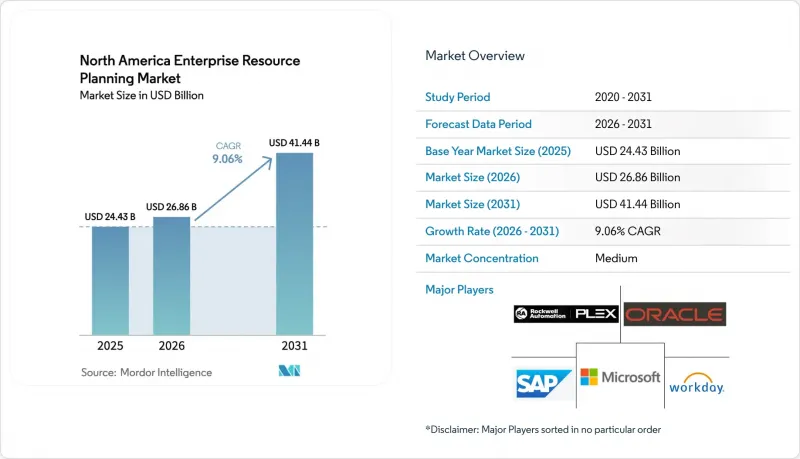
본 보고서는 유형별(클라우드 네이티브 제품군, 모바일 퍼스트형 ERP, 기타), 부문별(재무 및 회계, 기타), 배포 모델별(On-Premise, 클라우드), 조직 규모별(대기업, 중소기업(SME)), 산업 부문별(제조업, 기타), 국가별로 분류되어 있습니다. 시장 전망은 금액(달러)으로 표시되어 있습니다.
북미의 전사적 자원 계획(ERP) 시장 동향 및 인사이트
‘클라우드 퍼스트’ ERP 배포 모델로의 급속한 전환
구독형 가격 책정, 분기별 기능 업데이트 자동화, 자본 인프라 제거를 통해 클라우드 제품군은 기본 선택지로서의 입지를 확고히 했습니다. SAP의 ‘S/4HANA Cloud Public Edition’은 청구서 대조 및 수요 예측용 생성형 AI 기능을 추가하여 2024년에 1,200건의 전환을 촉진했습니다. Oracle의 ‘Fusion Cloud ERP’ AI 에이전트는 기업 간 거래를 재현하고 지출 이상을 감지함으로써, 시범 사용자에서 월별 결산 시간을 30% 단축했습니다. 마이크로소프트는 ‘Dynamics 365 Finance’에 ‘Copilot’을 통합하여, 반복적인 분개장 검토 작업의 40%를 처리할 수 있게 했습니다. 또한, 워크데이가 ‘Sana’를 인수함에 따라 HCM(인적 자원 관리) 프로세스 전반에 대화형 AI가 통합되었습니다. 2024년 하반기 『Industry Week』가 제조업체를 대상으로 실시한 설문조사에 따르면, 응답자의 90%가 24개월 이내에 클라우드 기반 ERP로 업그레이드할 계획이라고 답했으며, 이는 2년 전의 72%에서 증가한 수치입니다.
실시간 의사결정을 위한 AI 내장형 분석의 급증
머신러닝 모델을 트랜잭션 워크플로우에 통합함으로써, ERP는 정적인 기록 관리에서 선제적인 인사이트력 창출로 전환됩니다. 2,500개 기업을 대상으로 한 IBM의 조사에 따르면, AI 모델을 통합한 기업은 ERP 투자 수익률(ROI)이 27% 향상되었으며, 재고 부족을 18%, 과잉 재고를 22% 줄일 수 있었던 것으로 나타났습니다. SAP와 Snowflake의 제휴를 통해 자동차 제조업체는 조달 데이터와 외부 반도체 리드타임 정보를 통합하여 생산 계획을 즉시 재조정할 수 있게 됩니다. Workday의 ‘AI Gateway’는 데이터 상주성을 보호하면서 대규모 언어 모델에 대한 접근을 가능하게 합니다. 이는 개인정보 보호 규제가 엄격해지는 가운데 필수적인 두 가지 요건을 충족하는 것입니다. BCG는 분석 기능을 단순한 부가 기능으로 취급할 경우, 데이터 추출이 오래되거나 예측 정확도가 떨어질 위험이 있다고 경고하고 있습니다.
도입 및 변경 관리에 드는 초기 비용 및 라이프사이클 비용
델로이트가 2024년에 300건의 프로젝트를 대상으로 실시한 조사에 따르면, 중견 기업용 도입 시 5년간의 총 비용 중앙값은 270만 달러였으며, 그중 42%가 변경 관리와 데이터 정제에 소요되었습니다. PwC의 조사에 따르면, 프로젝트의 38%가 예산을 25% 초과했으며, 29%는 가동 예정일이 지연되어 제품 출시나 수익 확대를 늦추는 결과를 낳은 것으로 나타났습니다. 사용자 수가 증가함에 따라 지속적인 구독료 인상이 예산을 압박할 가능성이 있습니다. 또한 벤더는 일반적으로 영구 라이선스의 연간 유지보수 비용으로 18-22%를 청구하기 때문에 CFO는 생산성 향상과 지속적인 지출 사이에서 균형을 맞추어야만 합니다.
부문별 분석
엣지 및 2계층 아키텍처는 9.45%의 연평균 성장률(CAGR)로 확대되고 있으며, 이는 ERP 아키텍처 중 가장 빠른 속도입니다. 이는 기업들이 본사의 재무 핵심 시스템과 현지 규정 준수, 통화, 저지연 현장 데이터를 처리하기 위한 경량화된 공장 현장 또는 자회사 인스턴스를 통합하고 있기 때문입니다. 2025년에도 클라우드 네이티브 제품군은 여전히 지출의 41.11%를 차지하며, 벤더 관리형 인프라에 대한 폭넓은 신뢰를 보여주고 있습니다. 모바일 퍼스트형 ERP는 보급률이 약 12%에 그쳐 여전히 틈새 시장으로 남아 있지만, 오프라인 데이터 수집이나 GPS 타임스탬프가 필요한 유틸리티 및 현장 서비스 사업자들로부터 지지를 받고 있습니다. 반면, 소셜 및 협업형 ERP는 Teams나 Slack 커넥터가 동등한 채팅 기반 승인 흐름을 제공하게 되면서 성장이 주춤하고 있습니다.
NetSuite의 2025년 버전 양방향 커넥터를 통해 인수에 따른 통합 기간이 대폭 단축되었으며, 멕시코 마킬라도라에 위치한 엣지 노드는 다운타임 로그를 야간에 미국의 코어 시스템으로 복제함으로써 WAN 혼잡을 방지하고 있습니다. ISO 27001 및 SOC 2 인증은 규제가 엄격한 제약 및 항공우주 제조 거점의 시스템 선정에 영향을 미치고 있으며, On-Premise 에지 노드가 현장에서 감사 추적을 저장하도록 유도하고 있습니다. 벤더에 따라 특성은 다릅니다. SAP와 Oracle은 클라우드 네이티브 및 2계층 솔루션을 주도하는 반면, ServiceMax와 같은 전문 벤더는 기술자를 대상으로 하는 모바일 부문의 틈새 시장에서 뛰어난 실적을 거두고 있습니다.
공급망 및 운영용 소프트웨어는 IoT 센서, 수요 예측 알고리즘, 주문에서 입금까지의 주기를 단축하는 공급업체 포털 도입에 힘입어 연간 10.61%의 성장률을 보이고 있습니다. 2025년 지출에서 재무 및 회계 부문은 32.59%로 여전히 가장 큰 비중을 차지했습니다. 이는 모든 기업이 총계정원장, 임베디드채무 관리, 법정 보고서를 필요로 하기 때문이지만, 현재는 추가 예산이 고급 계획 및 스케줄링,창고 관리, 운송 최적화에 할당되고 있습니다. AI를 활용한 수요 예측을 통해 예측 오차가 최대 50% 감소했으며, 기존에는 안전 재고로 묶여 있던 운전 자금이 확보된 것으로 나타났습니다. Workday의 대화형 AI는 복리후생 관련 문의를 효율화하고 있으며, 이는 HCM 분야도 내장형 AI의 혜택을 받고 있음을 보여줍니다.
생명과학 부문의 추적성 요건으로 인해 제조 실행 및 품질 관리 모듈의 중요성이 높아지고 있으며, 단일 데이터베이스로의 통합을 통해 베스트 오브 브리드(Best-of-Breed)형 아키텍처에 비해 대조 작업의 부담이 경감됩니다. 클라우드 벤더들이 재무, 운영, HCM에 예측 모델과 디지털 어시스턴트를 도입함에 따라 부서 간 워크플로우의 속도가 향상되고 있습니다. 이러한 추세는 신규 라이선스 취득 및 시스템 확장을 촉진하여, 북미의 전사적 자원 계획(ERP) 시장을 프론트오피스와 백오피스 프로세스 모두를 아우르는 디지털 기반으로 확고히 자리매김하고 있습니다.
기타 혜택
- 엑셀 형식 시장 예측(ME) 시트
- 3개월간의 애널리스트 지원
자주 묻는 질문
목차
제1장 서론
제2장 조사 방법
제3장 주요 요약
제4장 시장 구도
제5장 시장 규모 및 성장 예측
제6장 경쟁 구도
제7장 시장 기회 및 향후 전망
KTH 26.09.04According to Mordor Intelligence, the North America enterprise resource planning market size is expected to increase from USD 24.43 billion in 2025 to USD 26.86 billion in 2026 and reach USD 41.44 billion by 2031, growing at a CAGR of 9.06% over 2026-2031.
This report is Segmented by Type (Cloud-Native Suite, Mobile-First ERP, and More), Business Function (Finance and Accounting, and More), Deployment Model (On-Premise and Cloud), Organization Size (Large Enterprises and Small and Medium Enterprises (SMEs)), Industry Vertical (Manufacturing, and More), and Country. The Market Forecasts are Provided in Terms of Value (USD).
North America Enterprise Resource Planning Market Trends and Insights
Rapid Shift Toward Cloud-First ERP Deployment Models
Subscription pricing, automated quarterly feature drops, and removal of capital infrastructure have elevated cloud suites to default status. SAP's S/4HANA Cloud Public Edition added generative AI for invoice matching and demand forecasting, triggering 1,200 migrations in 2024. Oracle's Fusion Cloud ERP AI agents replicate intercompany transactions and flag spend anomalies, slicing monthly close times by 30% in pilot users. Microsoft embedded Copilot into Dynamics 365 Finance to handle 40% of repetitive journal reviews, and Workday's Sana acquisition integrates conversational AI across HCM flows. Manufacturers surveyed by Industry Week in late 2024 revealed that 90% planned cloud-based ERP upgrades within 24 months, up from 72% two years earlier.
Surge in AI-Embedded Analytics for Real-Time Decision-Making
Embedding machine-learning models into transactional workflows shifts ERP from static record-keeping to proactive insight-generation. An IBM study of 2,500 enterprises found that firms integrating AI models achieved 27% higher ERP ROI, reducing stockouts by 18% and excess inventory by 22%. SAP's partnership with Snowflake lets automakers blend purchasing data with external chip lead-time signals to recalibrate production plans on the fly. Workday's AI Gateway protects data residency while opening access to large language models, a dual imperative as privacy rules tighten. BCG warns that treating analytics as a bolt-on risks stale data extracts and eroded forecast accuracy.
Up-Front and Life-Cycle Costs of Implementation and Change-Management
Deloitte's 2024 survey of 300 projects pegged the median five-year total cost at USD 2.7 million for mid-market rollouts, with 42% spent on change management and data cleansing. PwC found that 38% of projects were running 25% over budget and 29% were missing go-live dates, delaying product launches and revenue expansion. Ongoing subscription escalators can strain budgets as user counts grow, and vendors typically charge 18-22% for annual maintenance on perpetual licenses, forcing CFOs to weigh productivity gains against recurring spend.
Other drivers and restraints analyzed in the detailed report include:
- Two-Tier ERP Adoption to Harmonize HQ and Subsidiary Operations
- Rising SMB Demand for Affordable, Modular SaaS Suites
- Cyber-Security and Data-Sovereignty Concerns in Multitenant Clouds
For complete list of drivers and restraints, kindly check the Table Of Contents.
Segment Analysis
Edge and two-tier architectures are expanding at a 9.45% CAGR, the fastest pace among ERP architectures, as firms marry headquarters finance cores with lightweight plant-floor or subsidiary instances to handle local compliance, currencies, and low-latency shop-floor data. Cloud-native suites still held 41.11% of spending in 2025, indicating widespread confidence in vendor-managed infrastructure. Mobile-first ERP remains niche at roughly 12% penetration, favored by utilities and field-service fleets that need offline capture and GPS timestamping, while social and collaborative ERP has stalled because Teams and Slack connectors now provide comparable chat-based approval flows.
NetSuite's 2025 bidirectional connectors slash integration weeks for acquisitions, and edge nodes in Mexican maquiladoras replicate downtime logs to United States cores overnight, preventing WAN congestion. ISO 27001 and SOC 2 certifications shape type selection in regulated pharma or aerospace plants, prompting on-premises edge nodes to preserve audit trails on-site. Vendors differ in their specialties: SAP and Oracle dominate cloud-native and two-tier solutions, whereas specialists such as ServiceMax excel in technician-focused mobile niches.
Supply-chain and operations software is growing at 10.61% annually, driven by the adoption of IoT sensors, demand-sensing algorithms, and supplier portals that compress order-to-cash cycles. Finance and accounting retain the largest slice at 32.59% of 2025 spending because every firm needs general ledger, payables, and statutory reports, yet incremental budgets now fund advanced planning and scheduling, warehouse management, and transportation optimization. Found that AI-driven demand forecasting reduced forecast error by up to 50%, freeing up working capital previously tied up in safety stock. Workday's conversational AI streamlines benefits queries, demonstrating that HCM also benefits from embedded intelligence.
Traceability mandates in life sciences push manufacturing execution and quality modules higher, and convergence on a single database reduces reconciliation overhead compared with best-of-breed architectures. As cloud vendors infuse finance, operations, and HCM with predictive models and digital assistants, cross-functional workflows gain velocity. This dynamic drives new licenses and expansions, solidifying North America's enterprise resource planning market as the digital backbone for both front- and back-office processes.
Complete Report Scope:
- By Type
- Cloud-Native Suite
- Mobile-First ERP
- Social / Collaborative ERP
- Two-Tier / Edge ERP
- By Business Function
- Finance And Accounting
- Supply-Chain And Operations
- Human Capital Management
- Customer Relationship And Commerce
- Manufacturing Execution And Quality
- By Deployment Model
- On-Premise
- Cloud
- By Organization Size
- Large Enterprises
- Small And Medium Enterprises (SMEs)
- By Industry Vertical
- Manufacturing
- Retail And E-Commerce
- BFSI
- Government And Public Sector
- IT And Telecom
- Healthcare And Life Sciences
- Others Industry Vertical
- By Country
- United States
- Canada
- Mexico
List of Companies Covered in this Report:
- SAP SE
- Oracle Corporation
- Microsoft Corporation
- Workday Inc.
- Infor Inc.
- Epicor Software Corporation
- IBM Corporation
- The Sage Group plc
- Plex Systems Inc. (Rockwell Automation Inc.)
- FinancialForce.com Inc.
- Unit4 NV
- Deltek Inc.
- Deacom Inc.
- Acumatica Inc.
- IFS AB
- Syspro USA Inc.
- QAD Inc.
- Oracle NetSuite
- SAP Business One
- Odoo SA
Additional Benefits:
- The market estimate (ME) sheet in Excel format
- 3 months of analyst support
TABLE OF CONTENTS
1 INTRODUCTION
- 1.1 Study Assumptions and Market Definition
- 1.2 Scope of The Study
2 RESEARCH METHODOLOGY
3 EXECUTIVE SUMMARY
4 MARKET LANDSCAPE
- 4.1 Market Overview
- 4.2 Market Drivers
- 4.2.1 Rapid Shift Toward Cloud-First ERP Deployment Models
- 4.2.2 Surge In AI-Embedded Analytics For Real-Time Decision-Making
- 4.2.3 Two-Tier ERP Adoption To Harmonise HQ And Subsidiary Operations
- 4.2.4 Rising SMB Demand For Affordable, Modular SaaS Suites
- 4.2.5 ESG-Linked Reporting Mandates Accelerating System Upgrades
- 4.2.6 Edge/IoT Data Integration For Closed-Loop Operations
- 4.3 Market Restraints
- 4.3.1 Up-Front And Life-Cycle Costs Of Implementation And Change-Management
- 4.3.2 Cyber-Security And Data-Sovereignty Concerns In Multitenant Clouds
- 4.3.3 Shortage Of North America-Based ERP Talent And Project Bandwidth
- 4.3.4 Vendor Lock-In Risk Amid Shrinking On-Premise Support Windows
- 4.4 Industry Value-Chain Analysis
- 4.5 Regulatory Landscape
- 4.6 Technological Outlook
- 4.7 Porter's Five Forces Analysis
- 4.7.1 Bargaining Power Of Suppliers
- 4.7.2 Bargaining Power Of Buyers
- 4.7.3 Threat Of New Entrants
- 4.7.4 Threat Of Substitutes
- 4.7.5 Intensity Of Competitive Rivalry
- 4.8 Impact Of Macroeconomic Factors On The Market
5 MARKET SIZE AND GROWTH FORECASTS (VALUE)
- 5.1 By Type
- 5.1.1 Cloud-Native Suite
- 5.1.2 Mobile-First ERP
- 5.1.3 Social / Collaborative ERP
- 5.1.4 Two-Tier / Edge ERP
- 5.2 By Business Function
- 5.2.1 Finance And Accounting
- 5.2.2 Supply-Chain And Operations
- 5.2.3 Human Capital Management
- 5.2.4 Customer Relationship And Commerce
- 5.2.5 Manufacturing Execution And Quality
- 5.3 By Deployment Model
- 5.3.1 On-Premise
- 5.3.2 Cloud
- 5.4 By Organization Size
- 5.4.1 Large Enterprises
- 5.4.2 Small And Medium Enterprises (SMEs)
- 5.5 By Industry Vertical
- 5.5.1 Manufacturing
- 5.5.2 Retail And E-Commerce
- 5.5.3 BFSI
- 5.5.4 Government And Public Sector
- 5.5.5 IT And Telecom
- 5.5.6 Healthcare And Life Sciences
- 5.5.7 Others Industry Vertical
- 5.6 By Country
- 5.6.1 United States
- 5.6.2 Canada
- 5.6.3 Mexico
6 COMPETITIVE LANDSCAPE
- 6.1 Market Concentration
- 6.2 Strategic Moves
- 6.3 Market Share Analysis
- 6.4 Company Profiles (Includes Global Level Overview, Market Level Overview, Core Segments, Financials As Available, Strategic Information, Market Rank/Share For Key Companies, Products And Services, And Recent Developments)
- 6.4.1 SAP SE
- 6.4.2 Oracle Corporation
- 6.4.3 Microsoft Corporation
- 6.4.4 Workday Inc.
- 6.4.5 Infor Inc.
- 6.4.6 Epicor Software Corporation
- 6.4.7 IBM Corporation
- 6.4.8 The Sage Group plc
- 6.4.9 Plex Systems Inc. (Rockwell Automation Inc.)
- 6.4.10 FinancialForce.com Inc.
- 6.4.11 Unit4 NV
- 6.4.12 Deltek Inc.
- 6.4.13 Deacom Inc.
- 6.4.14 Acumatica Inc.
- 6.4.15 IFS AB
- 6.4.16 Syspro USA Inc.
- 6.4.17 QAD Inc.
- 6.4.18 Oracle NetSuite
- 6.4.19 SAP Business One
- 6.4.20 Odoo SA
7 MARKET OPPORTUNITIES AND FUTURE OUTLOOK
- 7.1 White-Space And Unmet-Need Assessment


