|
시장보고서
상품코드
2120599
폴리머 나노복합재 : 시장 점유율 분석, 업계 동향 및 통계, 성장 예측(2026-2031년)Polymer Nanocomposite - Market Share Analysis, Industry Trends & Statistics, Growth Forecasts (2026 - 2031) |
||||||
 Mordor Intelligence
Mordor Intelligence에 의하면, 2026년 폴리머 나노복합재 시장 규모는 153억 달러로 추정되고 2025년 132억 3,000만 달러에서 확대해, 2031년에는 316억 달러에 이를 것으로 예측됩니다.
2026-2031년 동안의 연평균 성장률(CAGR)은 15.62%가 될 것으로 전망됩니다.
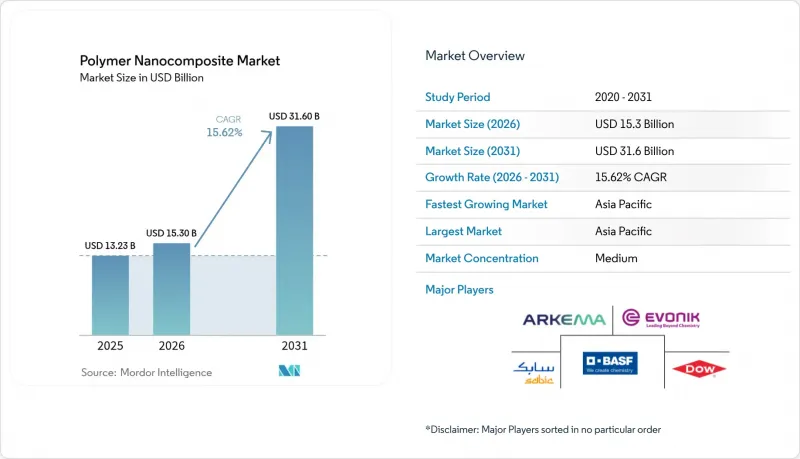
본 보고서는 필러 유형별(탄소나노튜브, 금속 산화물, 나노클레이, 기타), 폴리머 매트릭스별(열가소성, 열경화성, 바이오 폴리머), 최종 사용자 산업별(자동차, 포장, 항공우주 및 방위, 기타),지역별(아시아태평양, 북미, 유럽, 남미, 중동 및 아프리카)로 분류되어 있습니다. 시장 예측은 금액(미 달러) 기준으로 제시되어 있습니다.
세계의 폴리머 나노복합재 시장 동향 및 인사이트
식품·의약품 부문에서 고차단성 포장에 대한 수요 증가
폴리머 나노복합재는 산소 투과율을 0.1cc/m²/일 이하로 낮추고, 다층 라미네이트와 동등한 성능을 발휘하면서도 필름 두께를 최대 40%까지 줄여줍니다. 항균성 금속 산화물 나노 입자로 인해 유통 기한이 연장됨에 따라, 식품 가공업체들은 화학 방부제에서 능동형 포장 형태로 전환하고 있습니다. 습기에 민감한 의약품도 이러한 혜택을 받고 있으며, 재활용을 단순화하는 단층 블리스터 설계가 가능해졌습니다. 나노 물질 위험 평가에 관한 FDA 지침으로 승인 주기가 단축되었으며, 생산 라인에 통합함으로써 라미네이션 공정이 불필요해져 처리량과 폐기물 비율이 개선되었습니다.
자동차 및 모빌리티용 복합재의 경량화 목표
탄소섬유 강화 열가소성 나노복합재는 강철에 비해 40%의 질량 감소를 실현하며, 자동 섬유 배열 라인에 대응하기 때문에 대량 생산되는 e-모빌리티 프로그램에 적합합니다. 재활용 가능성 덕분에 전체 수명 주기의 경제성이 향상되어 순환 경제의 요건을 충족합니다. 질량 감소에 더해, 나노 규모의 충전재는 충돌 시 에너지 흡수 능력을 높이고 NVH를 저감하므로 얇은 두께의 설계가 가능해집니다. 유럽의 각 OEM 업체들은 2030년까지 20-25%의 경량화를 계획하고 있으며, 이는 수지와 보강재에 대한 투자를 촉진하고 있습니다.
높은 복합화·분산화 비용
높은 종횡비의 충전재를 균일하게 분산시키려면 더 강한 전단력을 발생시키는 이축 스크류 압출기가 필요하며, 표준 폴리머에 비해 가공 비용이 200-400% 증가합니다. 나노튜브의 응집을 억제하기 위한 기능화 처리에는 추가 공정 및 라이선스 비용이 발생합니다. 드라이 파우더나 마스터배치 방식은 설비 투자(CAPEX)를 절감할 수 있지만, 공급망의 복잡성을 증가시킵니다. 비용 압박으로 인해 규모의 경제가 실현되기 전까지는 가격에 민감한 포장 자재 및 소비재 부문으로의 침투는 제한적일 것으로 보입니다.
부문별 분석
나노클레이는 저비용과 확립된 필름 압출 기술의 강점을 활용하여, 2025년에는 폴리머 나노복합재 시장에서 37.65%의 점유율을 차지했습니다. 차단 성능의 향상으로 인해 유통 기한을 해치지 않으면서 스낵 포장 두께를 5-7 마이크로미터 얇게 만들 수 있게 되었습니다. 탄소나노튜브는 10^3S/m의 전도성이 높은 가격을 상쇄하는 프리미엄 틈새 시장을 차지하고 있는 반면, 금속 산화물 필러는 자외선 차단, 항균, 난연성 수요에 대응하고 있습니다. ‘기타 필러’ 부문은 확장성이 뛰어난 그래핀과 나노다이아몬드 등급이 EMI 차폐 및 열전도 채널의 가능성을 넓힘에 따라 18.72%의 연평균 성장률(CAGR)을 기록하고 있습니다. 이러한 동향을 종합해 보면, 단일 필러가 시장을 지배하기보다는 배합의 다양성이 확대될 것으로 예측됩니다.
지역별 분석
2025년 아시아태평양 폴리머 나노복합재 시장 점유율 39.92%는 탄탄한 제조 생태계와 적극적인 정부 프로그램을 반영하고 있습니다. 중국의 그래핀 나노튜브 생산 규모 확대가 비용 곡선을 낮추는 한편, 인도의 적층 가공(적층 성형) 로드맵은 세계 시장 점유율 5%를 목표로 하고 있어 하류 수요를 자극하고 있습니다. 일본은 지속가능성과 높은 탄성률을 모두 갖춘 셀룰로오스 나노섬유 시범 프로젝트에 자금을 지원하고 있으며, 가전 및 자동차 1차 공급업체들을 유치하고 있습니다.
북미에서는 자동차 경량화에 관한 법규와 항공우주 부문의 인증 취득 절차를 활용하고 있습니다. USMCA(미국·멕시코·캐나다 협정)의 무역 프레임워크에 따라 컴파운드 펠릿의 국경 간 공급이 원활해져, 멕시코에서 조립되지만 미국에서 판매되는 차량 플랫폼의 생산을 지원하고 있습니다. 유럽에서는 엄격한 EHS(환경·보건·안전) 규제와 순환 경제 목표가 맞물려, 건축용 패널 및 철도 차량 내장재에 무할로겐 나노복합재의 채택이 가속화되고 있습니다. 중동 및 아프리카에서는 그린 빌딩 규제와 석유화학 산업의 다각화를 통해 수요 거점이 열리고 있습니다. 한편, 남미의 진전은 브라질의 포장용 컨버터와 아직 발전 단계에 있는 전기차(EV) 부품 생산 라인에 좌우됩니다. 전반적으로, 이러한 지역별 특성이 예측 기간 동안 폴리머 나노복합재 시장의 균형 잡힌 성장을 보장하고 있습니다.
기타 혜택
- 엑셀 형식 시장 예측(ME) 시트
- 3개월간의 애널리스트 지원
자주 묻는 질문
목차
제1장 서론
제2장 조사 방법
제3장 주요 요약
제4장 시장 구도
제5장 시장 규모 및 성장 예측
제6장 경쟁 구도
제7장 시장 기회 및 향후 전망
KTH 26.09.04According to Mordor Intelligence, the polymer nanocomposite market size in 2026 is estimated at USD 15.3 billion, growing from 2025 value of USD 13.23 billion with 2031 projections showing USD 31.6 billion, growing at 15.62% CAGR over 2026-2031.
This report is Segmented by Filler Type (Carbon Nanotube, Metal Oxide, Nanoclay, and More), Polymer Matrix (Thermoplastics, Thermosets, and Bio-Based Polymers), End-User Industry (Automotive, Packaging, Aerospace and Defense, and More), and Geography (Asia-Pacific, North America, Europe, South America, and Middle-East and Africa). The Market Forecasts are Provided in Terms of Value (USD).
Global Polymer Nanocomposite Market Trends and Insights
Growing Demand for High-Barrier Packaging in Food and Pharma
Polymer nanocomposites lower oxygen transmission below 0.1 cc/m2/day, matching multilayer laminates while cutting film thickness by up to 40%. Antimicrobial metal-oxide nanoparticles extend shelf life, so food processors shift from chemical preservatives to active-packaging formats. Moisture-sensitive pharmaceuticals also benefit, allowing single-layer blister designs that simplify recycling. FDA guidance on nanomaterial risk assessment shortens approval cycles, and line integration eliminates lamination steps, improving throughput and waste ratios.
Lightweighting Targets in Automotive and Mobility Composites
Carbon-fiber-reinforced thermoplastic nanocomposites yield 40% mass savings versus steel and support automated fiber-placement lines, aligning with high-volume e-mobility programs. Recyclability boosts total-life economics, meeting circular mandates. Beyond mass reduction, nanoscale fillers enhance crash energy absorption and damp NVH, enabling thin-wall designs. European OEMs plan 20-25% weight cuts by 2030, catalyzing resin and reinforcement investment.
High Compounding and Dispersion Costs
Uniform distribution of high-aspect-ratio fillers demands twin-screw extruders with intensified shear, adding 200-400% to processing cost versus standard polymers. Functionalization to curb nanotube agglomeration introduces extra steps and licensing fees. Dry-powder and masterbatch routes lower capex but widen supply-chain complexity. Cost pressure limits penetration into price-sensitive packaging and consumer goods until scale economies materialize.
Other drivers and restraints analyzed in the detailed report include:
- Thermal Management Needs in 5G and Power Electronics
- Regulatory Push for Flame-Retardant, Halogen-Free Materials
- Nanotoxicity/EHS Compliance Uncertainty
For complete list of drivers and restraints, kindly check the Table Of Contents.
Segment Analysis
Nanoclay held 37.65% polymer nanocomposites market share in 2025 on the strength of low cost and established film-extrusion know-how. Barrier gains allow 5-7 µm downgauging in snack packaging without compromising shelf life. Carbon nanotubes occupy premium niches where 10^3 S/m conductivity offsets price, while metal-oxide fillers address UV, antimicrobial, and flame-retardant needs. The other-filler category captures 18.72% CAGR as scalable graphene and nanodiamond grades unlock EMI shielding and thermal paths. Combined, these trends suggest widening formulation diversity rather than one-filler dominanc.
Complete Report Scope:
- By Filler Type
- Carbon Nanotube
- Metal Oxide
- Nanoclay
- Nanofiber
- Other Filler Types
- By Polymer Matrix
- Thermoplastics
- Thermosets
- Bio-based Polymers
- By End-user Industry
- Automotive
- Packaging
- Aerospace and Defense
- Electrical and Electronics
- Energy and Storage
- Other End-user Industries
- By Geography
- Asia-Pacific
- China
- India
- Japan
- South Korea
- ASEAN
- Rest of Asia-Pacific
- North America
- United States
- Canada
- Mexico
- Europe
- Germany
- United Kingdom
- France
- Italy
- Spain
- Russia
- Rest of Europe
- South America
- Brazil
- Argentina
- Rest of South America
- Middle-East and Africa
- Saudi Arabia
- United Arab Emirates
- South Africa
- Egypt
- Rest of Middle-East and Africa
- Asia-Pacific
Geography Analysis
Asia-Pacific's 39.92% polymer nanocomposites market share in 2025 mirrors deep manufacturing ecosystems and proactive state programs. China's scale in graphene nanotube production compresses cost curves, while India's additive-manufacturing roadmap targets a 5% global stake, stimulating downstream demand. Japan funds cellulose nanofiber pilots that blend sustainability with high modulus, drawing appliance and auto tier-ones.
North America leverages automotive lightweighting legislation and aerospace certification pipelines. The USMCA trade framework eases cross-border supply of compounded pellets, aiding vehicle platforms assembled in Mexico yet sold in the United States. Europe couples stringent EHS rules with circular-economy targets, accelerating halogen-free nanocomposite adoption in building panels and rail interiors. The Middle East and Africa open pockets of demand through green-building codes and petrochemical diversification, while South America's progress hinges on Brazilian packaging converters and nascent EV component lines. Collectively, regional differentiation ensures balanced expansion for the polymer nanocomposites market over the forecast horizon.
- 3D Systems Inc.
- Altana
- Arkema
- AxiPolymer Inc.
- BASF
- Birla Carbon
- Dow
- DuPont
- Evonik Industries AG
- Foster, LLC
- Hybrid Plastics Inc.
- Inframat Corporation
- Mitsubishi Chemical Group Corporation
- Nanocyl SA
- Powdermet Inc.
- RTP Company
- SABIC
- ShayoNano Singapore Private Ltd.
- Solesence
- Sumitomo Chemical Co. Ltd.
- TORAY INDUSTRIES, INC.
Additional Benefits:
- The market estimate (ME) sheet in Excel format
- 3 months of analyst support
TABLE OF CONTENTS
1 Introduction
- 1.1 Study Assumptions and Market Definition
- 1.2 Scope of the Study
2 Research Methodology
3 Executive Summary
4 Market Landscape
- 4.1 Market Overview
- 4.2 Market Drivers
- 4.2.1 Growing Demand for High-Barrier Packaging in Food and Pharma
- 4.2.2 Lightweighting Targets in Automotive and Mobility Composites
- 4.2.3 Thermal Management Needs in 5G and Power Electronics
- 4.2.4 Regulatory Push for Flame-Retardant, Halogen-Free Materials
- 4.2.5 Battery-Housing Materials for Electric Vehicles
- 4.3 Market Restraints
- 4.3.1 High Compounding and Dispersion Costs
- 4.3.2 Nanotoxicity/EHS Compliance Uncertainty
- 4.3.3 Scale-Up Challenges for Graphene and CNT Supply
- 4.4 Value Chain Analysis
- 4.5 Technological Outlook
- 4.6 Porter's Five Forces
- 4.6.1 Bargaining Power of Suppliers
- 4.6.2 Bargaining Power of Buyers
- 4.6.3 Threat of New Entrants
- 4.6.4 Threat of Substitutes
- 4.6.5 Degree of Competition
- 4.7 Patent Analysis
5 Market Size and Growth Forecasts (Value)
- 5.1 By Filler Type
- 5.1.1 Carbon Nanotube
- 5.1.2 Metal Oxide
- 5.1.3 Nanoclay
- 5.1.4 Nanofiber
- 5.1.5 Other Filler Types
- 5.2 By Polymer Matrix
- 5.2.1 Thermoplastics
- 5.2.2 Thermosets
- 5.2.3 Bio-based Polymers
- 5.3 By End-user Industry
- 5.3.1 Automotive
- 5.3.2 Packaging
- 5.3.3 Aerospace and Defense
- 5.3.4 Electrical and Electronics
- 5.3.5 Energy and Storage
- 5.3.6 Other End-user Industries
- 5.4 By Geography
- 5.4.1 Asia-Pacific
- 5.4.1.1 China
- 5.4.1.2 India
- 5.4.1.3 Japan
- 5.4.1.4 South Korea
- 5.4.1.5 ASEAN
- 5.4.1.6 Rest of Asia-Pacific
- 5.4.2 North America
- 5.4.2.1 United States
- 5.4.2.2 Canada
- 5.4.2.3 Mexico
- 5.4.3 Europe
- 5.4.3.1 Germany
- 5.4.3.2 United Kingdom
- 5.4.3.3 France
- 5.4.3.4 Italy
- 5.4.3.5 Spain
- 5.4.3.6 Russia
- 5.4.3.7 Rest of Europe
- 5.4.4 South America
- 5.4.4.1 Brazil
- 5.4.4.2 Argentina
- 5.4.4.3 Rest of South America
- 5.4.5 Middle-East and Africa
- 5.4.5.1 Saudi Arabia
- 5.4.5.2 United Arab Emirates
- 5.4.5.3 South Africa
- 5.4.5.4 Egypt
- 5.4.5.5 Rest of Middle-East and Africa
- 5.4.1 Asia-Pacific
6 Competitive Landscape
- 6.1 Market Concentration
- 6.2 Strategic Moves
- 6.3 Market Share Analysis
- 6.4 Company Profiles (includes Global level Overview, Market level overview, Core Segments, Financials as available, Strategic Information, Market Rank/Share for key companies, Products and Services, and Recent Developments)
- 6.4.1 3D Systems Inc.
- 6.4.2 Altana
- 6.4.3 Arkema
- 6.4.4 AxiPolymer Inc.
- 6.4.5 BASF
- 6.4.6 Birla Carbon
- 6.4.7 Dow
- 6.4.8 DuPont
- 6.4.9 Evonik Industries AG
- 6.4.10 Foster, LLC
- 6.4.11 Hybrid Plastics Inc.
- 6.4.12 Inframat Corporation
- 6.4.13 Mitsubishi Chemical Group Corporation
- 6.4.14 Nanocyl SA
- 6.4.15 Powdermet Inc.
- 6.4.16 RTP Company
- 6.4.17 SABIC
- 6.4.18 ShayoNano Singapore Private Ltd.
- 6.4.19 Solesence
- 6.4.20 Sumitomo Chemical Co. Ltd.
- 6.4.21 TORAY INDUSTRIES, INC.
7 Market Opportunities and Future Outlook
- 7.1 White-space and Unmet-Need Assessment