

|
시장보고서
상품코드
2120622
항공기용 합성 비전 시스템 : 시장 점유율 분석, 업계 동향 및 통계, 성장 예측(2026-2031년)Aircraft Synthetic Vision Systems - Market Share Analysis, Industry Trends & Statistics, Growth Forecasts (2026 - 2031) |
||||||
 Mordor Intelligence
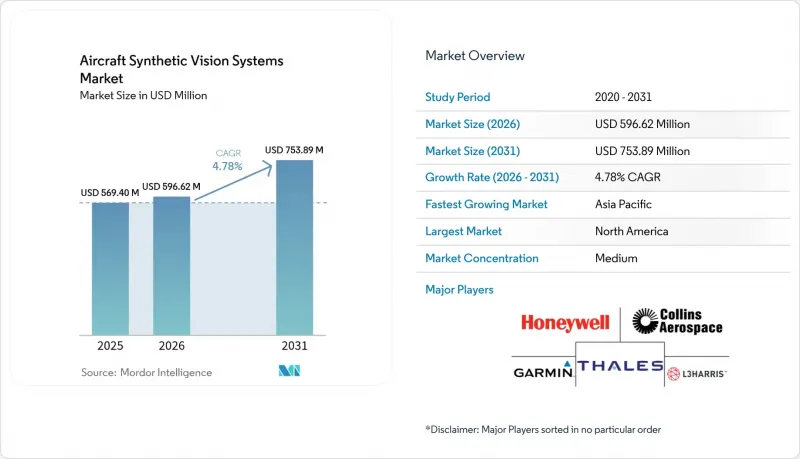
Mordor Intelligence에 의하면, 항공기용 합성 비전 시스템 시장 규모는 2025년 5억 6,940만 달러로 평가되었습니다. 2026년에는 5억 9,662만 달러로 확대되어 2026-2031년에 걸쳐 CAGR 4.78%로 성장을 지속하여, 2031년까지 7억 5,389만 달러에 이를 것으로 예측됩니다.
본 보고서는 유형별(주 비행 디스플레이, 기타), 구성 요소별(디스플레이 시스템, 기타), 플랫폼별(고정익기, 기타), 장착 유형별(OEM 라인 핏, 기타), 최종 사용자별(군사, 기타), 지역별(북미, 유럽, 기타)로 분류되어 있습니다. 시장 예측은 금액(달러) 기준으로 제시되어 있습니다.
세계의 항공기용 합성 비전 시스템 시장 동향 및 인사이트
출고 시 통합 비전 스위트가 장착된 비즈니스 제트기 인도 대수 증가
현재, 신규 비즈니스 제트기 인도 시에는 합성 비전과 확장 비전을 단일 디스플레이에 통합한 복합 비전 스위트가 표준으로 장착되고 있습니다. 봄바르디아의 ‘세계 8000’과 세스나의 ‘사이테이션 어센드’는 이러한 기능을 표준 사양으로 통합하여, 비용이 많이 드는 애프터마켓에서의 사후 설치를 불필요하게 만들었습니다. 운항사는 조종사의 업무 부담 경감이라는 이점을 누릴 수 있는 한편, 제조업체는 2025-2026년에 걸쳐 개조가 예정된 기존 기종으로부터 지속적인 업그레이드 수익을 확보하게 될 것입니다.
6세대 전투기 조종석 내 SVS 지원 HUD의 급속한 보급(미국·EU)
NGAD F-47과 같은 6세대 전투기 프로그램에서는 전술 데이터와 실시간 지형 이미지를 융합하는 헬멧 장착형 디스플레이가 채택되고 있습니다. Collins Aerospace가 F-35용으로 개발한 3세대 헬멧은 합성 비전이 야간 투시 장치를 대체할 수 있음을 이미 입증하여, 군의 보다 광범위한 채택의 길을 열었습니다. 그 후, 민간 항공기도 이러한 견고한 기술을 계승함으로써 인증 주기가 단축될 것입니다.
데이터베이스 중심 비전 알고리즘의 인증 병목 현상
머신러닝을 활용한 지형 데이터베이스는 결정론적인 DO-178C 프레임워크에 원활하게 부합하지 않아 승인 절차를 장기화시키고 개발 비용을 상승시키고 있습니다. 경우에 따라 OEM이나 항공전자 장비 공급업체가 인증 위험을 줄이기 위해 SVS 기능의 복잡성을 제한하기도 합니다. 그 결과, 동적 지형 렌더링, 도시 지역의 3D 모델링, 또는 EO/IR 피드와의 통합과 같은 기능 구현이 지연되고 있습니다. 예를 들어, Mercury Systems의 이미지 일관성 도구는 어느 정도 개선을 가져오지만, 여전히 설계 보증 수준 C의 검증이 필요하며, 이는 소규모 공급업체에게는 장벽이 됩니다. 인증 비용은 대개 운항사에 전가되기 때문에 SVS 업그레이드 비용이 고액이 됩니다. 이로 인해 소형 터보프롭기나 헬리콥터 시장에서의 SVS의 상업적 실현 가능성이 제한되고 있습니다.
부문별 분석
2025년, 주 비행 디스플레이(PFD)는 항공기용 합성 비전 시스템 시장의 45.02%를 차지했습니다. 이는 조종사가 모든 중요한 비행 정보를 이 중앙 스크린에 의존하기 때문입니다. 헤드업 디스플레이(HUD)와 헬멧 장착형 디스플레이(HMD)는 연평균 성장률(CAGR) 10.82%로 가장 빠른 성장세를 보이고 있으며, 그 주된 요인은 방위 관련 수주와 군사 기술이 민간 항공기로 확산되고 있기 때문입니다. Garmin사의 SVT 업그레이드 경로를 통해 운항 사업자는 조종실 배선 공사를 다시 하지 않고도 기존 PFD에 3D 지형 정보를 추가할 수 있게 되었습니다. 첨단 에어 모빌리티 플랫폼에서는 경량화를 위해 웨어러블 디스플레이가 선호되기 때문에 헬멧 장착형 솔루션의 항공기용 합성 비전 시스템 시장 규모는 2031년까지 확대될 것으로 예측됩니다.
이 부문의 성장세는 합성 지형 이미지에 적외선 이미지를 중첩시키는 통합형 복합 비전 제품으로까지 확대되어, 추가 모니터 없이도 전천후 대응 능력을 실현하고 있습니다. 유니버설 아비오닉스(Universal Avionics)의 ‘ClearVision’은 민간 제트기에 웨어러블 HUD를 도입한 선례를 세운 반면, 콜린스 에어로스페이스(Collins Aerospace)는 전투기용 헬멧을 민간 회전익기에 적용하고 있습니다. 이러한 동향은 항공기용 합성 비전 시스템 시장을 개별 제품이 아닌 기술의 연속체로 자리매김하게 하여, 플랫폼 간 지식 공유와 규모의 경제를 가능하게 하고 있습니다.
2025년에는 모든 설치에 여전히 인증된 스크린이 필요하기 때문에 디스플레이 하드웨어가 매출의 39.68%를 차지했습니다. 그러나 소프트웨어와 지형·장애물 데이터베이스는 연평균 성장률(CAGR) 9.09%로 성장하고 있으며, 이는 비행 중 업데이트되는 AI를 많이 활용한 컨텐츠로의 전환을 반영하고 있습니다. 이러한 변화로 인해 소프트웨어 관련 항공기용 합성 시각 시스템 시장 규모가 2020년대 후반에는 하드웨어 단독 패키지를 능가할 것으로 예측됩니다.
공급업체들은 디스플레이와 별도로 렌더링 엔진 라이선싱을 확대하고 있으며, 이를 통해 사업자들은 더 저렴한 상용 모니터로 교체할 수 있게 되었습니다. Honeywell의 MEMS 기반 KSG7200 레퍼런스 시스템은 기존 LRU 내에 처리 능력을 통합한 센서 퓨전 모듈의 광범위한 추세를 잘 보여줍니다. 데이터베이스 구독은 지속적인 현금 흐름을 창출하고 고객과의 관계를 공고히 하며, 항공기용 합성 시각 시스템 산업에서 소프트웨어의 전략적 가치를 강조합니다.
지역별 분석
북미는 FAA(연방항공청)의 ‘향상된 비행 시야(Enhanced Flight Vision)’에 관한 명확한 규제와 비즈니스 제트기의 견조한 이용률에 힘입어 2025년에는 전 세계 매출의 34.92%를 차지했습니다. 운항 사업자들은 겨울 폭풍 발생 시에도 일정을 유지할 수 있는 ‘접근 크레딧(Approach Credit)’을 확보하기 위해 합성 비전 시스템을 도입하고 있습니다. F-47 프로그램 등의 방위 계약을 통해 지역 내 전문 지식이 축적됨에 따라, 공급업체들은 민간 및 군사 부문 전반에 걸쳐 연구개발비를 상각할 수 있게 되었습니다.
아시아태평양은 연평균 성장률(CAGR) 8.33%로 가장 빠르게 성장하는 시장입니다. 이는 중국, 인도, 인도네시아 각국 정부가 지방 공항 확충을 추진하는 동시에, ACMI 운항 사업자에게 기체 확충을 장려하고 있기 때문입니다. 항공기용 합성 비전 시스템 시장은 과거에는 주요 허브 공항에서만 시행되던 저시정 시 절차가 이들 국가에서도 널리 채택되면서 유망한 성장 기반을 마련하고 있습니다. 지상 기반 ILS 도입이 주춤하는 가운데, 위성 기반 보강 시스템과 새로운 GNSS 위성군이 도입을 더욱 촉진하고 있습니다.
유럽에서는 SESAR 지침과 강력한 국방 프로그램을 배경으로 꾸준한 성장이 예상됩니다. EASA의 ‘전천후 운항’ 프레임워크에 따라 항공사는 CAT II/III 지상 시스템을 도입하지 않고도 합성 비전 시스템을 도입할 경제적 인센티브를 얻고 있습니다. 지속가능성 목표 또한 추가적인 촉진요인으로 작용하고 있습니다. 정확한 지형 모델을 통해 구현되는 최적화된 비행 경로는 연료 소비량과 CO₂ 배출량을 줄여줍니다. 이러한 요인들이 유럽 항공기용 합성 비전 시스템 시장의 균형 잡힌 성장을 뒷받침하고 있습니다.
기타 혜택
- 엑셀 형식 시장 예측(ME) 시트
- 3개월간의 애널리스트 지원
자주 묻는 질문
목차
제1장 서론
제2장 조사 방법
제3장 주요 요약
제4장 시장 구도
제5장 시장 규모 및 성장 예측
제6장 경쟁 구도
제7장 시장 기회 및 향후 전망
KTH 26.09.04According to Mordor Intelligence, the aircraft synthetic vision systems market size is expected to grow from USD 569.40 million in 2025 to USD 596.62 million in 2026 and is forecast to reach USD 753.89 million by 2031 at 4.78% CAGR over 2026-2031.
This report is Segmented by Type (Primary Flight Display, and More), End User (Military, and More), Installation Type (OEM Line-Fit, and More), Component (Display System and More), Platform (Fixed-Wing Aircraft, and More) and Geography (North America, Europe, and More). The Market Forecasts are Provided in Terms of Value (USD).
Global Aircraft Synthetic Vision Systems Market Trends and Insights
Rising Business-Jet Deliveries with Factory-Fitted Combined Vision Suites
Deliveries of new business jets now routinely include combined vision suites that merge synthetic and enhanced vision on a single display. Bombardier's Global 8000 and Cessna's Citation Ascend integrate these features as baseline equipment, eliminating costly aftermarket installations. Operators benefit from lower pilot workload, while manufacturers capture recurring upgrade revenue on legacy fleets scheduled for retrofits in 2025-2026.
Rapid Adoption of SVS-Enabled Huds in Gen-6 Fighter Cockpits (US And EU)
Sixth-generation fighter programs like the NGAD F-47 rely on helmet-mounted displays that fuse tactical data with real-time terrain imagery. Collins Aerospace's Gen III helmet for the F-35 already demonstrates how synthetic vision replaces night-vision gear, paving the way for wider military adoption. Subsequently, civil platforms inherit these hardened technologies, shortening certification cycles.
Certification Bottlenecks for Database-Centric Vision Algorithms
Machine-learning terrain databases do not fit neatly into deterministic DO-178C frameworks, prolonging approvals and raising development costs. In some cases, OEMs and avionics vendors limit the complexity of SVS features to reduce certification risk. Thus, features like dynamic terrain rendering, urban 3D modeling, or integration with EO/IR feeds are delayed. For instance, Mercury Systems' image-integrity tools provide partial relief but still require Design Assurance Level C validation, a hurdle for smaller suppliers. Certification costs are passed on to operators in most cases, making SVS upgrades more expensive. This limits their commercial viability in the markets for small turboprop aircraft and helicopters.
Other drivers and restraints analyzed in the detailed report include:
- Demand for Low-Visibility Approach Credits at Tier-2 Airports
- Urban-Air-Mobility eVTOL Programs Requiring High-Integrity SVS
- Cost Sensitivity in Turboprop and Light-Helicopter Retrofits
For complete list of drivers and restraints, kindly check the Table Of Contents.
Segment Analysis
Primary flight displays held 45.02% of the aircraft synthetic vision systems market share in 2025 because pilots rely on these central screens for all critical flight cues. Heads-up and helmet-mounted displays exhibit the fastest growth at 10.82% CAGR, largely due to defence orders and the trickle-down of military technology into civil variants. Garmin's SVT upgrade path shows operators adding 3-D terrain onto existing PFDs without re-wiring the cockpit. The aircraft synthetic vision systems market size for helmet-mounted solutions is projected to increase by 2031 as advanced air-mobility platforms favour wearable displays for weight savings.
The segment's momentum extends to integrated combined-vision products that overlay infrared imagery onto synthetic terrain, delivering all-weather capability without added monitors. Universal Avionics' ClearVision set a precedent for wearable HUD adoption in commercial jets, while Collins Aerospace adapts fighter-grade helmets for civil rotorcraft. These developments reinforce the aircraft synthetic vision systems market as a technology continuum rather than a discrete product, enabling cross-platform learning and volume efficiencies.
Display hardware captured 39.68% revenue in 2025 because every installation still needs certified screens. Yet software and terrain-obstacle databases are growing at 9.09% CAGR, reflecting a pivot toward AI-rich content that refreshes during flight. This shift explains why the aircraft synthetic vision systems market size linked to software is forecast to overtake hardware-only packages in the late 2020s.
Suppliers increasingly licence rendering engines separate from displays, allowing operators to swap in lower-cost commercial-off-the-shelf monitors. Honeywell's MEMS-based KSG7200 reference system highlights a broader trend toward sensor-fusion modules that package processing power within existing LRUs. Database subscriptions create recurring cash flows and cement customer relationships, underscoring software's strategic value in the aircraft synthetic vision systems industry.
Complete Report Scope:
- By Type
- Primary Flight Display
- Navigation Display
- Heads-up and Helmet-mounted Display
- Other Types
- By Component
- Synthetic Vision Computer/Processing Unit
- Air-data and GPS Sensor Suite
- Display System
- Software/Terrain-Obstacle Databases
- Other Components
- By Platform
- Fixed-Wing Aircraft
- Rotary-Wing Aircraft
- Unmanned Aerial Vehicles (UAV)
- Advanced Air-Mobility/eVTOL
- By Installation Type
- OEM Line-fit
- Retrofit
- By End User
- Military
- Commercial
- General Aviation
- By Geography
- North America
- United States
- Canada
- Mexico
- Europe
- Germany
- United Kingdom
- France
- Russia
- Rest of Europe
- Asia-Pacific
- China
- Japan
- India
- South Korea
- Rest of Asia-Pacific
- South America
- Brazil
- Rest of South America
- Middle East and Africa
- Middle East
- United Arab Emirates
- Saudi Arabia
- Rest of Middle East
- Africa
- Egypt
- South Africa
- Rest of Africa
- Middle East
- North America
Geography Analysis
North America generated 34.92% of global sales in 2025, supported by the FAA's clear rules on Enhanced Flight Vision and robust business-jet utilisation. Operators embrace synthetic vision to secure approach credits that keep schedules intact during winter storm activity. Defence contracts such as the F-47 program deepen the regional expertise pool, allowing suppliers to amortise R&D across civil and military lines.
Asia-Pacific is the fastest-growing arena at 8.33% CAGR because governments in China, India, and Indonesia are upgrading secondary airports while encouraging ACMI carriers to expand fleets. The aircraft synthetic vision systems market finds fertile ground in these nations, where low-visibility procedures were once the preserve of flagship hubs. Satellite-based augmentation and new GNSS constellations further boost uptake as ground-based ILS rollouts slow.
Europe grows steadily on the back of SESAR directives and strong defence programs. EASA's All Weather Operations framework gives carriers economic incentives to add synthetic vision without installing CAT II/III ground systems. Sustainability goals add another driver: optimised flight paths enabled by accurate terrain models cut fuel burn and CO2. These factors sustain a balanced expansion of the continent's aircraft synthetic vision systems market.
- Honeywell International Inc.
- Collins Aerospace (RTX Corporation)
- Garmin Ltd.
- Thales Group
- Elbit Systems Ltd.
- L3Harris Technologies, Inc.
- Mercury Systems, Inc.
- Aspen Avionics, Inc.
- Avidyne Corporation
- ENSCO Inc.
- Astronics Corporation
- Universal Avionics Systems Corporation
- Esterline Technologies (TransDigm Group Incorporated)
- BAE Systems plc
- Genesys Aerosystems (Moog, Inc.)
- Saab AB
Additional Benefits:
- The market estimate (ME) sheet in Excel format
- 3 months of analyst support
TABLE OF CONTENTS
1 INTRODUCTION
- 1.1 Study Assumptions and Market Definition
- 1.2 Scope of the Study
2 RESEARCH METHODOLOGY
3 EXECUTIVE SUMMARY
4 MARKET LANDSCAPE
- 4.1 Market Overview
- 4.2 Market Drivers
- 4.2.1 Rising business-jet deliveries with factory-fitted combined vision suites
- 4.2.2 Rapid adoption of SVS-enabled HUDs in Gen-6 fighter cockpits
- 4.2.3 Demand for low-visibility approach credits at Tier-2 airports
- 4.2.4 Urban-air-mobility eVTOL programs requiring high-integrity SVS
- 4.2.5 OEM partnerships around AI-based terrain-rendering engines
- 4.2.6 Mandated retrofit of SVS under FAA NextGen and EASA SESAR timelines
- 4.3 Market Restraints
- 4.3.1 Certification bottlenecks for database-centric vision algorithms
- 4.3.2 Cost sensitivity in turboprop and light-helicopter retrofits
- 4.3.3 Limited GPU thermal budgets in cockpit-mounted hardware
- 4.3.4 Cyber-hardening gaps in connected avionics buses
- 4.4 Value Chain Analysis
- 4.5 Regulatory and Technological Outlook
- 4.6 Porter's Five Forces Analysis
- 4.6.1 Threat of New Entrants
- 4.6.2 Bargaining Power of Buyers
- 4.6.3 Bargaining Power of Suppliers
- 4.6.4 Threat of Substitutes
- 4.6.5 Intensity of Competitive Rivalry
5 MARKET SIZE AND GROWTH FORECASTS (VALUE)
- 5.1 By Type
- 5.1.1 Primary Flight Display
- 5.1.2 Navigation Display
- 5.1.3 Heads-up and Helmet-mounted Display
- 5.1.4 Other Types
- 5.2 By Component
- 5.2.1 Synthetic Vision Computer/Processing Unit
- 5.2.2 Air-data and GPS Sensor Suite
- 5.2.3 Display System
- 5.2.4 Software/Terrain-Obstacle Databases
- 5.2.5 Other Components
- 5.3 By Platform
- 5.3.1 Fixed-Wing Aircraft
- 5.3.2 Rotary-Wing Aircraft
- 5.3.3 Unmanned Aerial Vehicles (UAV)
- 5.3.4 Advanced Air-Mobility/eVTOL
- 5.4 By Installation Type
- 5.4.1 OEM Line-fit
- 5.4.2 Retrofit
- 5.5 By End User
- 5.5.1 Military
- 5.5.2 Commercial
- 5.5.3 General Aviation
- 5.6 By Geography
- 5.6.1 North America
- 5.6.1.1 United States
- 5.6.1.2 Canada
- 5.6.1.3 Mexico
- 5.6.2 Europe
- 5.6.2.1 Germany
- 5.6.2.2 United Kingdom
- 5.6.2.3 France
- 5.6.2.4 Russia
- 5.6.2.5 Rest of Europe
- 5.6.3 Asia-Pacific
- 5.6.3.1 China
- 5.6.3.2 Japan
- 5.6.3.3 India
- 5.6.3.4 South Korea
- 5.6.3.5 Rest of Asia-Pacific
- 5.6.4 South America
- 5.6.4.1 Brazil
- 5.6.4.2 Rest of South America
- 5.6.5 Middle East and Africa
- 5.6.5.1 Middle East
- 5.6.5.1.1 United Arab Emirates
- 5.6.5.1.2 Saudi Arabia
- 5.6.5.1.3 Rest of Middle East
- 5.6.5.2 Africa
- 5.6.5.2.1 Egypt
- 5.6.5.2.2 South Africa
- 5.6.5.2.3 Rest of Africa
- 5.6.5.1 Middle East
- 5.6.1 North America
6 COMPETITIVE LANDSCAPE
- 6.1 Market Concentration
- 6.2 Strategic Moves
- 6.3 Market Share Analysis
- 6.4 Company Profiles (includes Global level Overview, Market level overview, Core Segments, Financials as available, Strategic Information, Market Rank/Share for key companies, Products and Services, and Recent Developments)
- 6.4.1 Honeywell International Inc.
- 6.4.2 Collins Aerospace (RTX Corporation)
- 6.4.3 Garmin Ltd.
- 6.4.4 Thales Group
- 6.4.5 Elbit Systems Ltd.
- 6.4.6 L3Harris Technologies, Inc.
- 6.4.7 Mercury Systems, Inc.
- 6.4.8 Aspen Avionics, Inc.
- 6.4.9 Avidyne Corporation
- 6.4.10 ENSCO Inc.
- 6.4.11 Astronics Corporation
- 6.4.12 Universal Avionics Systems Corporation
- 6.4.13 Esterline Technologies (TransDigm Group Incorporated)
- 6.4.14 BAE Systems plc
- 6.4.15 Genesys Aerosystems (Moog, Inc.)
- 6.4.16 Saab AB
7 MARKET OPPORTUNITIES AND FUTURE OUTLOOK
- 7.1 White-space and Unmet-Need Assessment


