

|
시장보고서
상품코드
2120629
가시광 통신 : 시장 점유율 분석, 업계 동향과 통계, 성장 예측(2026-2031년)Visible Light Communication - Market Share Analysis, Industry Trends & Statistics, Growth Forecasts (2026 - 2031) |
||||||
 Mordor Intelligence
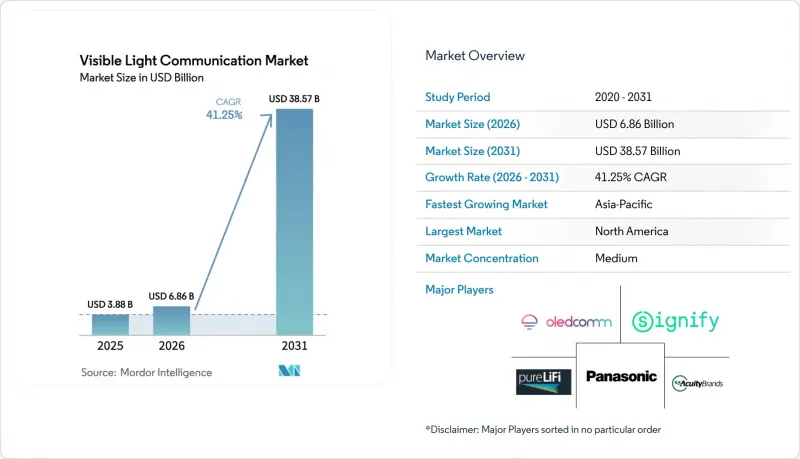
Mordor Intelligence에 의하면, 가시광 통신 시장 규모는 2025년에 38억 8,000만 달러, 2026년에 68억 6,000만 달러, 2031년까지 385억 7,000만 달러에 이를 것으로 예측되며, 2026-2031년 CAGR 41.25%를 기록할 전망입니다.
본 보고서는 구성 부품(LED, 광검출기, 마이크로컨트롤러, 소프트웨어 및 서비스), 전송 방식(단방향, 양방향), 용도(국방·보안, 운송, 공공 인프라, 생명과학 등), 최종 사용자 산업(의료, 소매 등) 및 지역별로 분류되어 있습니다. 시장 전망은 금액(달러) 기준으로 제시되어 있습니다.
전 세계 가시광 통신 시장 동향 및 인사이트
실내 조명 인프라의 LED로의 급속한 전환
건물 소유주들은 에너지 효율에 관한 규제 요건을 충족하기 위해 LED로의 전환을 가속화했으며, 적은 비용으로 Li-Fi 송수신기를 통해 업그레이드할 수 있는 조명 기구 도입 기반을 구축했습니다. 예를 들어, 로스앤젤레스에서는 22만 개의 가로등 중 98%를 LED로 교체했으며, 그중 3만 7,000개의 노드가 이미 원격 진단을 위해 네트워크로 연결되어 있어 광무선 오버레이 도입을 위한 기반이 마련되어 있습니다. 현재, 출고 시 Li-Fi 칩셋이 내장된 상용 조명 기구가 등장하고 있으며, 규모의 경제를 활용함으로써 단가가 절감되고 있습니다. 광 검출기와 마이크로컨트롤러가 장착된 후장착 키트를 통해 병원이나 학교에서는 업무에 지장을 주는 배선 공사를 피할 수 있으며, LED 교체 주기가 단축됨에 따라 Li-Fi 지원 프로젝트의 안정적인 공급이 보장되고 있습니다. 이러한 변화들이 합쳐져 장기적인 CAGR에 8.5포인트 증가 효과가 나타날 것입니다.
병원 및 항공기 객실에서의 RF 프리 연결 수요 급증
중환자실이나 항공기 객실에서는 전자기 간섭 제한으로 인해 Wi-Fi나 블루투스보다 광무선 링크가 선호됩니다. 영국 국민보건서비스(NHS England)가 2024년에 실시한 구급차 주차장 시험에서는 pureLiFi 장치를 사용하여 생명 유지 장치에 지장을 주지 않고 환자 기록을 업로드했습니다. EU의 ‘Aircraft Light Communication’ 프로젝트에서는 기내에서 1Gbps의 처리량이 입증되어, 항공사의 도입을 위한 현실적인 근거가 제시되었습니다. Li-Fi 신호는 조명이 비치는 범위 내에서만 유지되기 때문에 의료진은 전자 차트를 위해 확실하고 안전한 대역폭을 확보할 수 있는 반면, 항공사는 동축 케이블로 인한 백본의 무게 부담을 피할 수 있습니다. 이러한 추세는 CAGR에 7.2%의 긍정적 기여를 가져오고 있습니다.
세계적인 상호운용성 기준의 부재
IEEE 802.11bb는 물리 계층의 매개변수만을 규정하고 있으며, 미디어 액세스 규칙에 대해서는 각 벤더가 독자적으로 조정할 수 있기 때문에 구매자는 단일 벤더와의 계약에 묶이게 됩니다. Wi-Fi Alliance에 상응하는 인증 제도는 여전히 존재하지 않기 때문에 기업은 벤더의 자체 선언에 의존할 수밖에 없으며, 이로 인해 위험 인식이 높아지고 있습니다. 지역별 전자기 호환성(EMC) 규제가 서로 다르기 때문에 제조업체는 대륙을 넘나들며 제품을 재시험해야만 하며, 이로 인해 시장 출시 기간이 지연되어 연평균 성장률(CAGR)을 2.8% 포인트 끌어내리고 있습니다.
부문 분석
마이크로컨트롤러는 2026년부터 2031년까지 연평균 성장률(CAGR) 42.11%로 성장하여 가시광 통신 시장 전체를 능가하는 속도를 보일 것으로 전망됩니다. 양방향 Li-Fi 링크에는 실시간 채널 추정, 적응형 등화 및 전방 오류 정정이 필요하기 때문에 설계자들은 디스크리트 FPGA에서 디지털 신호 프로세서가 통합된 고속 시스템 온 칩(SoC) 컨트롤러로 전환하고 있습니다. 르네사스, ST마이크로일렉트로닉스, 텍사스 기기는 현재 Li-Fi 전용 명령어 세트를 갖춘 200 MHz 디바이스를 공급하고 있으며, 기판 면적과 전력 소비를 줄이고 있습니다. 퀄컴의 특허를 통해 광트랜시버와 무선 트랜시버를 통합한 휴대전화용 칩셋이 시사되고 있어, 일반 소비자 시장에서의 보급 가능성을 엿볼 수 있습니다.
LED는 조명과 전송이라는 이중 역할을 수행하기 때문에 2025년에도 가시광 통신 시장의 43.78% 점유율을 유지했으나, LED의 교체 주기가 성숙기에 접어들면서 그 성장세는 둔화되고 있습니다. 광 검출기는 주변광에 대한 내성을 향상시키는 아발란체 다이오드의 발전으로 혜택을 받고 있으며, 소프트웨어 정의 Li-Fi 스택은 변조 방식의 업그레이드를 무선으로 배포함으로써 하드웨어의 수명을 연장하고 있습니다. 통신 사업자들이 성과 기반 계약으로 전환함에 따라, 네트워크 관리, 예측 유지보수, 분석을 아우르는 서비스 계층은 꾸준히 성장하고 있습니다.
2025년에는 비용 중심의 위치 정보 제공 및 사이니지 용도에 대응하는 단방향 링크가 가시광 통신 시장의 66.83%를 차지했지만, 양방향 시스템은 연평균 성장률(CAGR) 41.47%로 그 격차를 좁히고 있습니다. 양방향 Li-Fi는 일반적으로 가시광선을 이용한 다운링크와 적외선을 이용한 업링크를 결합하여, 원격 의료나 군사 지휘실에 적합한 안전하고 전이중 연결을 실현합니다. 2025년 모바일 월드 콩그레스(Mobile World Congress)에서 발표된 pureLiFi사의 ‘LINXC Bridge’는 100명의 동시 사용자와 기가비트급 총 처리량을 지원하여, 회의장이나 공항 라운지 도입에 매력적입니다. Signify사의 ‘Trulifi 6004’는 2025년에 FIPS 140-3 인증을 획득하여 미국 국방부 내 조달 요건을 충족했습니다.
비용 효율성을 중시하는 소매 시장에서는 합리적인 가격과 간편함 덕분에 여전히 단방향 키트가 주류를 이루고 있지만, 기업에서는 양방향 패키지를 선택하는 경향이 강해지고 있습니다. 이러한 패키지는 인증, 지연 보장, 암호화된 업링크 등 안전하고 효율적인 운영에 필수적인 중요한 요구 사항을 충족합니다. 또한, 전이중 아키텍처를 통해 IEEE 802.11bb 표준을 준수하는 서비스 품질(QoS) 태깅과 같은 고급 기능이 구현됩니다. 이러한 준수를 통해 광무선의 처리량 관리를 익숙한 Wi-Fi 도구와 원활하게 통합할 수 있게 되어, 네트워크 전체의 성능과 신뢰성이 향상됩니다.
지역별 분석
북미는 스마트 시티로의 조기 도입과 국방 관련 계약을 배경으로 2025년 가시광 통신 시장 점유율의 37.49%를 차지했습니다. 로스앤젤레스의 가로등 프로그램에서는 22만 개의 조명 기구 중 98%를 LED로 교체하고, 3만 7,000개의 노드를 네트워크화하여 Li-Fi 오버레이를 지원할 수 있는 인프라를 구축했습니다. 워싱턴 D.C.의 7만 5,000개 LED 가로등 기둥도 마찬가지로, 공공 Wi-Fi 핸드오프를 지원할 수 있는 기반을 구축하고 있습니다. 캐나다에서는 연방 정부의 보조금을 병원 및 캠퍼스 내 시범 사이트에 투자하고 있으며, 한편 멕시코의 쇼핑몰 운영사는 방문객 분석 능력을 향상시키기 위해 Li-Fi를 활용한 길 안내 기능을 도입하고 있습니다.
아시아태평양은 중국의 ‘제14차 5개년 계획’과 일본의 산업 자동화 추진에 힘입어 2026년부터 2031년까지 연평균 성장률(CAGR) 42.27%를 나타낼 것으로 예측되며, 이는 세계에서 가장 빠른 속도입니다. 푸단대학교와 칭화대학교는 모두 스마트 시티 프로토타입 개발을 위해 정부로부터 자금을 지원받고 있습니다. 파나소닉과 나카가와 연구소는 공장 및 고속도로 연선을 위한 멀티 기가비트급 테스트베드를 공개했습니다. 인도의 ‘100개 도시 스마트 미션’에서는 델리와 방갈로르에서 Li-Fi 시범 사업이 계획되어 있으며, 한국의 ETRI는 6G 규격 청사진에 광무선을 포함시키고 있습니다. 호주에서는 전파로 인한 스파크가 폭발 위험을 초래할 수 있는 지하 광산에서 Li-Fi 통신의 활용이 검토되고 있습니다.
유럽에서는 엄격한 전자기 호환성(EMC) 규제가 효과를 발휘하여, 병원이나 항공기 객실에서의 광무선 기술 도입이 촉진되고 있습니다. 영국은 Li-Fi와 보행자 안전 분석 기능을 결합한 가로등 시범 사업에 400만 파운드(500만 달러)를 투자했습니다. 독일의 지멘스와 BMW는 Li-Fi를 통해 프로그래머블 로직 컨트롤러(PLC)를 연결하는 공장에서 시범 운영을 진행하고 있습니다. 프랑스에서는 소매 분야에서의 도입이 확대되고 있으며, 까르푸는 시그니파이의 조명 그리드를 활용하여 매장별 프로모션을 전개하고 있습니다. 중동에서는 고급 소매점과 호텔에서 Li-Fi 도입이 진행되고 있으며, 아프리카의 ‘Zero 1’ 이니셔티브는 인프라가 미비한 지역에서 태양광 발전식 LED 폴을 활용한 실험을 진행하고 있습니다. 남미에서는 자금 부족과 기존 설비 개보수 비용이 단기적인 장벽으로 작용하고 있어 여전히 검토 단계에 머물러 있습니다.
기타 혜택:
- 엑셀 형식 시장 예측(ME) 시트
- 3개월간의 애널리스트 지원
자주 묻는 질문
목차
제1장 서론
제2장 조사 방법
제3장 주요 요약
제4장 시장 구도
제5장 시장 규모와 성장 예측
제6장 경쟁 구도
제7장 시장 기회와 향후 전망
LSH 26.09.08According to Mordor Intelligence, the visible light communication market size is projected to be USD 3.88 billion in 2025, USD 6.86 billion in 2026, and reach USD 38.57 billion by 2031, growing at a CAGR of 41.25% from 2026 to 2031.
This report is Segmented by Component (Light-Emitting Diode, Photodetectors, Microcontrollers, and Software and Services), Transmission Type (Unidirectional, and Bidirectional), Application (Defense and Security, Transportation, Public Infrastructure, Life Sciences, and More), End-User Vertical (Healthcare, Retail, and More), and Geography. The Market Forecasts are Provided in Terms of Value (USD).
Global Visible Light Communication Market Trends and Insights
Rapid LED Replacement in Indoor Lighting Infrastructure
Building owners accelerated LED conversions to meet energy-efficiency mandates, creating an installed base of fixtures that can be upgraded with Li-Fi transceivers at marginal cost. Los Angeles, for example, upgraded 98% of its 220,000 streetlights to LED, with 37,000 nodes already networked for remote diagnostics, paving the way for optical wireless overlays. Factory-integrated Li-Fi chipsets are now appearing in commercial luminaires, reducing per-unit costs by leveraging economies of scale. Retrofit kits equipped with photodetectors and microcontrollers allow hospitals and schools to avoid disruptive cabling work, and shorter LED replacement cycles guarantee a steady pipeline of Li-Fi-ready projects. Collectively, these shifts add 8.5 percentage points to the long-term CAGR impact.
Surging Demand for RF-Free Connectivity in Hospitals and Aircraft Cabins
Electromagnetic interference limits in critical-care zones and aircraft cabins favor optical wireless links over Wi-Fi and Bluetooth. NHS England's 2024 ambulance-bay trial used pureLiFi units to upload patient records without disturbing life-support equipment. The EU Aircraft Light Communication project proved 1 Gbps cabin throughput, showing viable grounds for airline deployment. Because Li-Fi signals stay within illuminated zones, healthcare providers gain deterministic, secure bandwidth for electronic health records, while airlines avoid the weight of coaxial backbones. This dynamic contributes a 7.2% positive swing to CAGR.
Absence of Global Interoperability Standards
IEEE 802.11bb resolves only physical-layer parameters, leaving media-access rules open to proprietary tweaks that trap buyers into single-vendor contracts. Certification regimes equivalent to those of the Wi-Fi Alliance are still missing, so enterprises rely on vendor self-declarations, which raises perceived risk. Regional electromagnetic-compatibility rules diverge, forcing manufacturers to re-test products across continents, which delays time to market and subtracts 2.8% from CAGR momentum.
Other drivers and restraints analyzed in the detailed report include:
- Government-Funded Smart-City Streetlight Retrofits
- Retail Indoor-Positioning Roll-Outs by Big-Box Chains
- High Up-Front Fixture Retrofit Costs
For complete list of drivers and restraints, kindly check the Table Of Contents.
Segment Analysis
Microcontrollers are set to outpace the broader visible light communication market at a 42.11% CAGR between 2026 and 2031. Because bidirectional Li-Fi links require real-time channel estimation, adaptive equalization, and forward-error correction, designers are shifting from discrete FPGAs to high-speed system-on-chip controllers that integrate digital signal processors. Renesas, STMicroelectronics, and Texas Instruments now ship 200 MHz devices with Li-Fi-specific instruction sets, shrinking board space and power draw. Qualcomm patents point to handset-grade chipsets that merge optical and radio transceivers, hinting at mass-market consumer potential.
Light-emitting diodes retained 43.78% of the visible light communication market share in 2025, thanks to their dual illumination-and-transmission role, yet growth moderates as the LED replacement cycle matures. Photodetectors benefit from advances in avalanche diodes that improve immunity to ambient light, and software-defined Li-Fi stacks extend hardware life by pushing modulation upgrades over the air. Service layers spanning network management, predictive maintenance, and analytics grow steadily as operators shift to outcome-based contracting.
Although unidirectional links captured 66.83% of the visible light communication market in 2025 because they serve cost-sensitive positioning and signage jobs, bidirectional systems are closing the gap with a 41.47% CAGR. Bidirectional Li-Fi typically pairs a visible downlink with an infrared uplink, delivering secure, full-duplex connectivity suited to telemedicine or military command rooms. pureLiFi's LINXC Bridge, unveiled at Mobile World Congress 2025, supports 100 concurrent users and gigabit aggregate throughput, making it appealing to conference venues and airport lounges. Signify's Trulifi 6004 gained FIPS 140-3 validation in 2025, clearing procurement paths inside the United States Department of Defense.
While cost-driven retail roll-outs continue to favor unidirectional kits due to their affordability and simplicity, businesses are increasingly opting for bidirectional packages. These packages address critical needs such as authentication, latency guarantees, and encrypted uplinks, which are essential for secure and efficient operations. Additionally, full-duplex architectures enable advanced features like quality-of-service tagging, adhering to IEEE 802.11bb standards. This alignment allows optical wireless throughput management to integrate seamlessly with familiar Wi-Fi tools, enhancing overall network performance and reliability.
Complete Report Scope:
- By Component
- Light-Emitting Diodes
- Photodetectors
- Microcontrollers
- Software and Services
- By Transmission Type
- Unidirectional
- Bidirectional
- By Application
- Consumer Electronics
- Defense and Security
- Transportation
- Public Infrastructure
- Life Sciences
- Other Applications
- By End-User Vertical
- Healthcare
- Retail
- Industrial and Manufacturing
- Aerospace and Aviation
- Education
- By Geography
- North America
- United States
- Canada
- Mexico
- Europe
- Germany
- United Kingdom
- France
- Russia
- Rest of Europe
- Asia-Pacific
- China
- Japan
- India
- South Korea
- Australia
- Rest of Asia-Pacific
- Middle East and Africa
- Middle East
- Saudi Arabia
- United Arab Emirates
- Rest of Middle East
- Africa
- South Africa
- Egypt
- Rest of Africa
- Middle East
- South America
- Brazil
- Argentina
- Rest of South America
- North America
Geography Analysis
North America held 37.49% of the visible light communication market share in 2025, on the back of early smart-city deployments and defense contracts. The Los Angeles streetlight program converted 98% of 220,000 luminaires to LED and networked 37,000 nodes, positioning the grid for Li-Fi overlays. Washington, D.C.'s 75,000 LED poles similarly create a ready backbone for public Wi-Fi handoffs. Canada channels federal grants into hospital and campus pilot sites, while Mexico's mall operators embed Li-Fi wayfinding to lift footfall analytics.
Asia Pacific is projected to record a 42.27% CAGR from 2026-2031, the fastest globally, underpinned by China's 14th Five-Year Plan and Japan's industrial-automation push. Fudan University and Tsinghua University both receive government funding for smart-city prototypes. Panasonic and Nakagawa Laboratories showcase multi-gigabit test beds for factories and highway corridors. India's 100-city smart mission plants Li-Fi pilots in Delhi and Bangalore, and South Korea's ETRI embeds optical wireless within its 6G standards blueprint. Australia probes Li-Fi links in underground mines where radio sparks pose explosion risks.
Europe benefits from strict electromagnetic-compatibility mandates that encourage hospitals and aircraft cabins to adopt optical wireless. The United Kingdom invested GBP 4 million (USD 5 million) in streetlight pilots that combine Li-Fi with pedestrian-safety analytics. Germany's Siemens and BMW are running factory trials that connect programmable logic controllers via Li-Fi. France extends retail deployments, with Carrefour using Signify's lighting grid to deliver aisle-level promotions. The Middle East is rolling out Li-Fi in luxury retail and hotels, and Africa's Zero 1 initiative is experimenting with solar-powered LED poles in underserved regions. South America remains exploratory, citing funding gaps and retrofit costs as near-term hurdles.
- Signify N.V.
- pureLiFi Ltd.
- Oledcomm S.A.S.
- Acuity Brands, Inc.
- Panasonic Corporation
- LVX System Corp.
- Velmenni OU
- VLNComm Inc.
- Lucibel SA
- LightPointe Communications, Inc.
- Renesas Electronics Corporation
- GE Lighting, LLC
- Qualcomm Incorporated
- Fujitsu Limited
- Kyocera SLD Laser, Inc.
- Nakagawa Laboratories Inc.
- Outstanding Technology Co., Ltd.
- Wuxi Axrtek Co., Ltd.
- ByteLight, Inc.
- Zero1 Pte Ltd.
- AeroLiFi GmbH
Additional Benefits:
- The market estimate (ME) sheet in Excel format
- 3 months of analyst support
TABLE OF CONTENTS
1 INTRODUCTION
- 1.1 Study Assumptions and Market Definition
- 1.2 Scope of the Study
2 RESEARCH METHODOLOGY
3 EXECUTIVE SUMMARY
4 MARKET LANDSCAPE
- 4.1 Market Overview
- 4.2 Market Drivers
- 4.2.1 Rapid LED Replacement in Indoor Lighting Infrastructure
- 4.2.2 Surging Demand for RF-Free Connectivity in Hospitals and Aircraft Cabins
- 4.2.3 Government-Funded Smart-City Street-Light Retrofits
- 4.2.4 Retail Indoor-Positioning Roll-Outs by Big-Box Chains
- 4.2.5 Adoption of Li-Fi as a 6G Backhaul Candidate
- 4.2.6 Quantum-Dot Micro-LED Breakthroughs Enabling 10 Gbps+ Links
- 4.3 Market Restraints
- 4.3.1 Absence of Global Interoperability Standards
- 4.3.2 High Up-Front Fixture Retrofit Costs
- 4.3.3 Ambient-Light Noise in Tropical and Outdoor Deployments
- 4.3.4 Supply-Chain Dependency on High-Speed Driver Ics
- 4.4 Industry Value Chain Analysis
- 4.5 Impact of Macroeconomic Factors on the Market
- 4.6 Regulatory Landscape
- 4.7 Technological Outlook
- 4.8 Porter's Five Forces Analysis
- 4.8.1 Bargaining Power of Suppliers
- 4.8.2 Bargaining Power of Buyers
- 4.8.3 Threat of New Entrants
- 4.8.4 Threat of Substitute Products
- 4.8.5 Intensity of Competitive Rivalry
5 MARKET SIZE AND GROWTH FORECASTS (VALUE)
- 5.1 By Component
- 5.1.1 Light-Emitting Diodes
- 5.1.2 Photodetectors
- 5.1.3 Microcontrollers
- 5.1.4 Software and Services
- 5.2 By Transmission Type
- 5.2.1 Unidirectional
- 5.2.2 Bidirectional
- 5.3 By Application
- 5.3.1 Consumer Electronics
- 5.3.2 Defense and Security
- 5.3.3 Transportation
- 5.3.4 Public Infrastructure
- 5.3.5 Life Sciences
- 5.3.6 Other Applications
- 5.4 By End-User Vertical
- 5.4.1 Healthcare
- 5.4.2 Retail
- 5.4.3 Industrial and Manufacturing
- 5.4.4 Aerospace and Aviation
- 5.4.5 Education
- 5.5 By Geography
- 5.5.1 North America
- 5.5.1.1 United States
- 5.5.1.2 Canada
- 5.5.1.3 Mexico
- 5.5.2 Europe
- 5.5.2.1 Germany
- 5.5.2.2 United Kingdom
- 5.5.2.3 France
- 5.5.2.4 Russia
- 5.5.2.5 Rest of Europe
- 5.5.3 Asia-Pacific
- 5.5.3.1 China
- 5.5.3.2 Japan
- 5.5.3.3 India
- 5.5.3.4 South Korea
- 5.5.3.5 Australia
- 5.5.3.6 Rest of Asia-Pacific
- 5.5.4 Middle East and Africa
- 5.5.4.1 Middle East
- 5.5.4.1.1 Saudi Arabia
- 5.5.4.1.2 United Arab Emirates
- 5.5.4.1.3 Rest of Middle East
- 5.5.4.2 Africa
- 5.5.4.2.1 South Africa
- 5.5.4.2.2 Egypt
- 5.5.4.2.3 Rest of Africa
- 5.5.4.1 Middle East
- 5.5.5 South America
- 5.5.5.1 Brazil
- 5.5.5.2 Argentina
- 5.5.5.3 Rest of South America
- 5.5.1 North America
6 COMPETITIVE LANDSCAPE
- 6.1 Market Concentration
- 6.2 Strategic Moves
- 6.3 Market Share Analysis
- 6.4 Company Profiles (includes Global Level Overview, Market Level Overview, Core Segments, Financials as available, Strategic Information, Market Rank/Share for key companies, Products and Services, and Recent Developments)
- 6.4.1 Signify N.V.
- 6.4.2 pureLiFi Ltd.
- 6.4.3 Oledcomm S.A.S.
- 6.4.4 Acuity Brands, Inc.
- 6.4.5 Panasonic Corporation
- 6.4.6 LVX System Corp.
- 6.4.7 Velmenni OU
- 6.4.8 VLNComm Inc.
- 6.4.9 Lucibel SA
- 6.4.10 LightPointe Communications, Inc.
- 6.4.11 Renesas Electronics Corporation
- 6.4.12 GE Lighting, LLC
- 6.4.13 Qualcomm Incorporated
- 6.4.14 Fujitsu Limited
- 6.4.15 Kyocera SLD Laser, Inc.
- 6.4.16 Nakagawa Laboratories Inc.
- 6.4.17 Outstanding Technology Co., Ltd.
- 6.4.18 Wuxi Axrtek Co., Ltd.
- 6.4.19 ByteLight, Inc.
- 6.4.20 Zero1 Pte Ltd.
- 6.4.21 AeroLiFi GmbH
7 MARKET OPPORTUNITIES AND FUTURE OUTLOOK
- 7.1 White-Space and Unmet-Need Assessment


