|
시장보고서
상품코드
2120642
재해 복구 서비스(DRaaS) : 시장 점유율 분석, 업계 동향 및 통계, 성장 예측(2026-2031년)Disaster Recovery As A Service (DRaaS) - Market Share Analysis, Industry Trends & Statistics, Growth Forecasts (2026 - 2031) |
||||||
 Mordor Intelligence
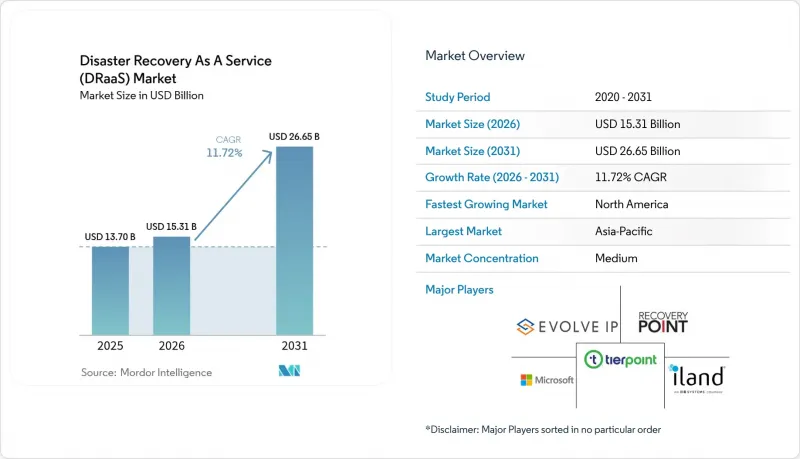
재해 복구 서비스(DRaaS) 시장 규모는 2025년에 137억 달러로 평가되었습니다. 2026년 153억 1,000만 달러에서 2031년에는 266억 5,000만 달러에 이를 것으로 예상되며, 예측 기간(2026-2031년) CAGR은 11.72%를 나타낼 전망입니다.
본 보고서는 서비스 유형(풀 매니지드, 어시스트형, 기타), 도입 모델(퍼블릭 클라우드, 프라이빗 클라우드, 기타), 서비스 구성 요소(백업 및 복구, 실시간 복제, 기타),조직 규모(대기업, 중소기업), 최종 사용자 업종(은행, 금융서비스 및 보험(BFSI), IT 및 통신, 기타), 지역별로 분류되어 있습니다. 시장 예측은 금액(미 달러) 기준으로 제시되어 있습니다.
세계의 클라우드 기반 재해 복구 서비스(DRaaS) 시장 동향 및 인사이트
랜섬웨어 및 데이터 유출 사고의 급증
현재 공격자들은 시스템이 침해된 지 몇 시간 이내에 데이터를 유출하고 있으며, 조직들은 최신 DRaaS 플랫폼만이 대규모로 제공할 수 있는 불변 스냅샷 및 격리된 복구 구역의 도입을 강요받고 있습니다. 2024년에는 IT 팀의 87%가 SaaS 데이터 유출을 경험했지만, 신속한 복구에 자신감을 가진 비율은 14%에 그쳤습니다. 의료 서비스 제공업체들은 HIPAA 준수를 유지하고 환자 치료의 연속성을 보장하기 위해 클라우드 네이티브 복구를 도입하고 있습니다. 사이버 보험사들은 검증된 장애 전환 기능을 보험료 할인 혜택으로 제공하고 있으며, 이는 CFO에게 DRaaS 도입에 대한 명확한 재무적 근거를 제시하고 있습니다.
기존 DR 인프라 대비 TCO 절감
DRaaS는 보조 사이트나 전문 인력에 대한 설비 투자를 불필요하게 만들고, 사용량에 따른 종량제 구독 모델로 대체합니다. Veeam의 보고서에 따르면, 88%의 조직이 2년 이내에 DRaaS로 전환할 계획을 세우고 있으며, 그 가장 큰 동기로 비용 최적화를 꼽고 있습니다. 구독 방식의 가격 책정을 통해 하드웨어의 노후화를 방지할 수 있으며, IT 팀은 하드웨어 유지보수 대신 혁신 프로젝트에 집중할 수 있게 됩니다. 중소기업의 경우, 규모에 따른 투자 없이도 엔터프라이즈급 복구를 실현할 수 있어 그 경제성이 특히 매력적이며, 이로 인해 ‘재해 복구 서비스(DRaaS)’ 시장의 총 잠재 규모가 확대되고 있습니다.
하이브리드/멀티 클라우드 환경에서의 도입 및 오케스트레이션의 복잡성
레거시 On-Premise 자산을 여러 퍼블릭 클라우드와 통합하는 것은 사내 팀의 부담을 가중시키고, 조직이 다양한 API와 보안 모델을 익혀야 하는 상황을 초래합니다. 미국 국가안보국(NSA)은 하이브리드 복구 스크립트의 신뢰성을 유지하기 위해 지속적인 테스트와 ‘인프라스트럭처 애즈 코드(IaC)’의 실천을 권장하고 있습니다. 기술 인력 부족으로 인해 관리형 DRaaS 파트너에 대한 의존도가 높아지고 있지만, 구매자가 공급자의 고도화된 자동화 역량과 규제에 대한 이해도를 평가함에 따라 판매 주기가 길어지고 있습니다.
부문별 분석
2025년, 턴키 방식의 오케스트레이션, 모니터링, 규정 준수 보고에 대한 기업 수요를 배경으로, 풀 매니지드형 서비스가 재해 복구 서비스(DRaaS) 시장 점유율의 46.60%를 차지했습니다. 고객은 멀티 클라우드 엔지니어링 및 연중무휴 24시간 복구 실행을 공급자에 의존하고 있으며, 이는 그렇지 않았다면 사내 인력을 대폭 늘려야 하는 업무입니다. 셀프 서비스형 옵션은 지원에 의존하는 측면이 있기는 하지만, 중소기업이 자율성과 비용의 균형을 잘 맞춘 구성 가능한 포털을 선호하기 때문에 연평균 성장률(CAGR) 12.08%로 성장을 지속하고 있습니다. 어시스트형 모델은 양극단의 중간에 위치하며, 어느 정도의 클라우드 기술을 보유하고 있으면서도 여전히 런북을 통한 지원이 필요한 중견 기업에 적합합니다.
매니지드 서비스의 성장세는 더 광범위한 현실을 부각시키고 있습니다. 즉, 복원력은 이제 인프라, 용도, 그리고 규제 준수 입증에까지 미치고 있다는 것입니다. 2025년에 NPS 91을 기록한 HYCU와 같은 벤더는 서비스의 깊이와 고객 경험이 기능적 동등성을 능가함을 보여주고 있습니다. 그 결과, 재해 복구 서비스(DRaaS) 시장에서는 서비스 품질에 따른 세분화가 더욱 명확해질 것입니다. 프리미엄 지원 계층에서는 연간 반복 수익(ARR) 배율이 더 높아지는 반면, 상품화된 셀프 서비스 계층은 가격에 민감한 틈새 시장을 공략하게 될 것입니다.
퍼블릭 클라우드는 하이퍼스케일 기반의 경제성과 온디맨드 확장성 덕분에 매출의 57.50%를 계속 차지하고 있지만, 기업이 집중 위험을 헤지하고 데이터 상주 요건을 충족하기 위해 하이브리드/멀티 클라우드 구성은 연평균 성장률(CAGR) 14.15%로 성장을 지속하고 있습니다. 하이브리드 배포 환경에서의 ‘클라우드 기반 재해 복구 서비스(DRaaS)’ 시장 규모는 기업이 핵심 데이터베이스를 자국의 클라우드로 복제하는 동시에 중요도가 낮은 용도를 전 세계 리전으로 페일오버할 수 있게 됨에 따라 급속히 확대될 것으로 예측됩니다. 프라이빗 클라우드는 엄격한 데이터 분류가 요구되는 워크로드나 에어 갭이 필요한 워크로드에서 계속해서 활용되고 있습니다.
버라이즌은 하이브리드 환경의 유연성을 현대 비즈니스 연속성 계획의 핵심으로 간주하고 있습니다. N2WS 리서치의 조사도 이 견해에 동의하며, 멀티클라우드 복제를 통해 벤더 종속성이 완화되고 페일오버의 세분화가 향상된다고 지적하고 있습니다. 그러나 서로 다른 클라우드 환경 전반에 걸쳐 동일한 복구 시간 목표(RTO)를 조정하는 것은 여전히 복잡한 문제이며, 클라우드 네이티브 고유의 특성을 추상화하는 도구에 대한 수요가 증가하고 있습니다.
지역별 분석
북미는 하이퍼스케일 클라우드의 가용성, 성숙한 사이버 보험 생태계, 그리고 규범적인 규제 프레임워크를 융합함으로써 2025년에도 39.30%의 점유율을 유지했습니다. 랜섬웨어의 확산이 이사회 차원의 긴급성을 높이는 한편, 『연방 클라우드 운영 모범 사례 가이드』는 공공 기관에 청사진이 될 기준을 제공합니다. 특히 금융 기관에서는 입증 가능한 재해 복구(DR) 테스트 실시를 보험료 할인 조건과 연계하여 도입을 더욱 촉진하고 있습니다. 이 지역의 ‘서비스형 재해 복구(DRaaS)’ 시장에서는 현재 가격 경쟁이 나타나고 있지만, 엣지 배포 증가와 ESG 보고의 확대에 힘입어 수요는 견조한 추세를 보이고 있습니다.
아시아태평양은 각국 정부가 GDP 확대를 촉진하기 위해 클라우드 성장을 주도하고 있어 14.25%라는 최고 수준의 연평균 성장률(CAGR)을 기록하고 있습니다. 아시아개발은행(ADB)은 클라우드 정책 개선을 통해 2024년부터 2028년 사이에 지역 GDP를 최대 0.7%까지 끌어올릴 수 있을 것으로 전망하고 있습니다. 싱가포르의 적극적인 ‘클라우드 퍼스트’ 자세가 정책의 벤치마크가 되고 있는 반면, 일본과 호주는 아키텍처 청사진을 수립하는 데 있어 엄격한 데이터 주권 심사를 실시했습니다. 자연재해 노출 위험을 배경으로, 내결함성이 높은 ICT 백본의 도입이 의무화되어 있으며, 각 기관은 ADB의 2025년판 재해 대책 가이드를 참고하여 AI 센서와 클라우드 기반 복구 기능을 통합하고 있습니다. 은행들은 핀테크의 민첩성에 대응하기 위해 DRaaS를 채택하고 있으며, 제조업체들은 공급망의 안정성을 확보하기 위해 지리적으로 분산된 페일오버에 의존하고 있습니다.
유럽에서는 도입 인센티브와 규정 준수상의 장벽 간 균형이 맞추어지고 있습니다. GDPR(EU 개인정보보호규정) 및 향후 시행될 EU 클라우드 인증법은 역내 내 복제를 의무화하고 있어 설계상의 제약이 되는 한편, 주권에 부합하는 ‘EU 역내 한정’ 복구 노드에 대한 수요도 불러일으키고 있습니다. 지속가능성에 관한 법규제로 인해 ‘그린 DRaaS’에 대한 관심이 높아지고 있으며, 재생에너지로 가동되는 데이터센터를 활용하여 기업의 배출량 감축 목표 달성을 목표로 하고 있습니다. 공공 부문의 디지털 서비스 목표에 따라 공급업체에 대한 요구가 가속화되고 있는 반면, 금융 기관은 ‘디지털 운영 복원력법(DORA)’의 요건을 충족하기 위해 투자를 지속하고 있습니다. 비용 측면의 압박이 있기는 하지만, 시민 대상 서비스를 유지해야 한다는 필요성 때문에 시장은 계속 확대되고 있습니다.
기타 혜택 :
- 엑셀 형식 시장 예측(ME) 시트
- 3개월간의 애널리스트 지원
자주 묻는 질문
목차
제1장 서론
제2장 조사 방법
제3장 주요 요약
제4장 시장 구도
제5장 시장 규모 및 성장 예측
제6장 경쟁 구도
제7장 시장 기회 및 향후 전망
KTH 26.09.04According to Mordor Intelligence, the disaster recovery as a Service market size was valued at USD 13.7 billion in 2025 and estimated to grow from USD 15.31 billion in 2026 to reach USD 26.65 billion by 2031, at a CAGR of 11.72% during the forecast period (2026-2031).
This report is Segmented by Service Type (Fully Managed, Assisted, and More), Deployment Model (Public Cloud, Private Cloud, and More), Service Component (Backup and Recovery, Real-Time Replication, and More), Organization Size (Large Enterprises, Small and Medium Enterprises), End-User Vertical (BFSI, IT and Telecom, and More), and Geography. The Market Forecasts are Provided in Terms of Value (USD).
Global Disaster Recovery As A Service (DRaaS) Market Trends and Insights
Escalating ransomware and data-breach incidents
Attackers now exfiltrate data within hours after compromise, forcing organizations to adopt immutable snapshots and isolated recovery zones that only modern DRaaS platforms supply at scale.In 2024, 87% of IT teams experienced SaaS data loss, yet only 14% felt confident about rapid recovery. Healthcare providers embrace cloud-native recovery to stay HIPAA-compliant and safeguard patient care continuity. Cyber-insurance carriers reward verified failover capabilities with premium discounts, giving CFOs a clear financial argument for DRaaS adoption.
Lower TCO versus traditional DR infrastructure
DRaaS removes capital spending on secondary sites and specialist staff, replacing them with pay-as-you-go subscriptions that align cost to use. Veeam reports that 88% of organizations plan to shift toward DRaaS within two years, ranking cost optimization as their top motivation. Subscription pricing prevents hardware obsolescence and frees IT teams to focus on transformation projects rather than hardware upkeep. SMEs find the economics especially compelling because enterprise-grade recovery becomes attainable without scale-driven investments, broadening the total addressable Disaster Recovery as a Service market.
Deployment and orchestration complexity in hybrid/multi-cloud
Integrating legacy on-premises assets with several public clouds stretches internal teams and forces organizations to learn disparate APIs and security models. The US National Security Agency advises constant testing and infrastructure-as-code practices to keep hybrid recovery scripts reliable. Skills shortages drive reliance on managed DRaaS partners but also prolong sales cycles, as buyers evaluate providers for deep automation and regulatory comprehension.
Other drivers and restraints analyzed in the detailed report include:
- Cloud-first and SaaS adoption accelerating DRaaS uptake
- Cyber-insurance compliance mandating automated fail-over testing
- Data-sovereignty and regulatory barriers
For complete list of drivers and restraints, kindly check the Table Of Contents.
Segment Analysis
Fully Managed offerings controlled 46.60% of Disaster Recovery as a Service market share in 2025 on the back of enterprise demand for turnkey orchestration, monitoring, and compliance reporting. Customers lean on providers for multi-cloud engineering and 24X7 recovery execution, activities that would otherwise balloon internal headcount. Self-Service options, though lean on assistance, post a 12.08% CAGR because SMEs prefer configurable portals that balance autonomy with cost. Assisted models sit between both ends, suiting mid-market firms that own some cloud skills yet still need run-book support.
Managed service momentum underscores a broader reality: resilience now spans infrastructure, applications, and regulatory proof. Vendors like HYCU, which scored a 91 NPS in 2025, showcase how service depth and customer experience trump feature parity. As a result, the Disaster Recovery as a Service market will likely witness sharper service-quality segmentation, where premium support tiers justify higher annual-recurring-revenue multiples, while commodity self-service tiers chase price-sensitive niches.
Public Cloud retains 57.50% revenue thanks to hyperscale economies and on-demand scalability, yet Hybrid/Multi-Cloud configurations command a 14.15% CAGR as firms hedge concentration risk and satisfy residency rules. Disaster Recovery as a Service market size for Hybrid deployments is forecast to expand swiftly because enterprises can replicate critical databases to a sovereign cloud while failing over less-sensitive apps to global regions. Private Cloud persists for workloads steeped in strict data classifications or requiring air-gapping.
Verizon calls hybrid flexibility the linchpin of modern continuity planning verizon. N2WS research agrees, noting that multi-cloud replication cuts vendor lock-in and improves failover granularity. However, orchestrating identical recovery time objectives across divergent clouds remains complex, opening room for tooling that abstracts cloud-native idiosyncrasies.
Complete Report Scope:
- By Service Type
- Fully Managed
- Assisted
- Self-Service
- By Deployment Model
- Public Cloud
- Private Cloud
- Hybrid/Multi-Cloud
- By Service Component
- Backup and Recovery
- Real-time Replication
- Orchestration and Automation
- Data Security and Compliance
- By Organization Size
- Large Enterprises
- Small and Medium Enterprises
- By End-user Vertical
- BFSI
- IT and Telecom
- Government and Public Sector
- Healthcare and Life Sciences
- Manufacturing
- Retail and E-commerce
- Media and Entertainment
- Others
- By Geography
- North America
- United States
- Canada
- Mexico
- South America
- Brazil
- Rest of South America
- Europe
- Germany
- United Kingdom
- France
- Russia
- Rest of Europe
- Asia-Pacific
- China
- Japan
- South Korea
- India
- South East Asia
- Rest of Asia-Pacific
- Middle East and Africa
- Middle East
- Africa
- North America
Geography Analysis
North America maintained a 39.30% share in 2025 by blending hyperscale cloud availability, mature cyber-insurance ecosystems, and prescriptive regulatory frameworks. High ransomware prevalence amplifies board-level urgency, while the Federal Cloud Operations Best Practices Guide supplies public agencies with blueprint standards. Financial institutions, in particular, tie premium discounts to demonstrable DR testing, further cementing uptake. Although the region's Disaster Recovery as a Service market now sees price competition, rising edge deployments and ESG reporting keep demand resilient.
Asia-Pacific registers the highest 14.25% CAGR as governments champion cloud growth to spur GDP. The Asian Development Bank projects that improved cloud policies can lift regional GDP by up to 0.7% between 2024 and 2028. Singapore's aggressive "cloud-first" posture sets policy benchmarks, while Japan and Australia impose rigorous data-sovereignty checks that shape architectural blueprints. National disaster exposure drives mandates for resilient ICT backbones, with agencies referencing ADB's 2025 disaster-preparedness guide to integrate AI sensors and cloud-based recovery. Banks adopt DRaaS to match fintech agility, and manufacturers rely on geo-distributed failover for supply-chain assurance.
Europe balances adoption incentives and compliance roadblocks. GDPR and incoming EU Cloud Certification laws oblige in-region replication, constraining design but also triggering demand for sovereignty-aligned "intra-EU only" recovery nodes. Sustainability legislation boosts interest in "Green-DRaaS," leveraging renewable-powered data centers to hit corporate emissions targets.Public-sector digital-service goals accelerate provider outreach, while financial entities continue to invest to satisfy the Digital Operational Resilience Act (DORA). Despite cost pressure, the imperative to preserve citizen-facing services keeps the market expanding.
- IBM Corporation
- Microsoft Corporation
- Amazon Web Services Inc.
- VMware Inc.
- Zerto Ltd. (HPE)
- Google Cloud Platform
- iLand Internet Solutions Inc.
- Recovery Point Systems LLC
- Evolve IP LLC
- TierPoint LLC
- Sungard Availability Services LP
- C&W Comminications Limited
- Expedient LLC
- CloudHPT Inc.
- InterVision Systems Technologies LLC
- PhoenixNAP Global IT Services LLC
- Flexential LLC
- Acronis International GmbH
- Veeam Software Inc.
- Druva Inc.
- Rackspace Technology inc.
- Databarracks Ltd.
- NTT Ltd.
Additional Benefits:
- The market estimate (ME) sheet in Excel format
- 3 months of analyst support
TABLE OF CONTENTS
1 INTRODUCTION
- 1.1 Study Assumptions and Market Definition
- 1.2 Scope of the Study
2 RESEARCH METHODOLOGY
3 EXECUTIVE SUMMARY
4 MARKET LANDSCAPE
- 4.1 Market Overview
- 4.2 Market Drivers
- 4.2.1 Escalating ransomware and data-breach incidents
- 4.2.2 Lower TCO vs. traditional DR infrastructure
- 4.2.3 Cloud-first and SaaS adoption accelerating DRaaS uptake
- 4.2.4 Cyber-insurance compliance mandating automated fail-over testing
- 4.2.5 Edge-computing roll-outs needing geo-distributed micro-recovery nodes
- 4.2.6 Green-DRaaS: Net-zero pressures favouring renewably-powered recovery sites
- 4.3 Market Restraints
- 4.3.1 Deployment and orchestration complexity in hybrid/multi-cloud
- 4.3.2 Data-sovereignty and regulatory barriers to cross-border replication
- 4.3.3 Provider lock-in and egress-cost uncertainty
- 4.3.4 Shortage of multi-cloud DR engineers and skills
- 4.4 Industry Ecosystem Analysis
- 4.5 Technological Outlook
- 4.6 Porter's Five Forces Analysis
- 4.6.1 Bargaining Power of Suppliers
- 4.6.2 Bargaining Power of Consumers
- 4.6.3 Threat of New Entrants
- 4.6.4 Intensity of Competitive Rivalry
- 4.6.5 Threat of Substitutes
5 MARKET SIZE AND GROWTH FORECASTS (VALUES)
- 5.1 By Service Type
- 5.1.1 Fully Managed
- 5.1.2 Assisted
- 5.1.3 Self-Service
- 5.2 By Deployment Model
- 5.2.1 Public Cloud
- 5.2.2 Private Cloud
- 5.2.3 Hybrid/Multi-Cloud
- 5.3 By Service Component
- 5.3.1 Backup and Recovery
- 5.3.2 Real-time Replication
- 5.3.3 Orchestration and Automation
- 5.3.4 Data Security and Compliance
- 5.4 By Organization Size
- 5.4.1 Large Enterprises
- 5.4.2 Small and Medium Enterprises
- 5.5 By End-user Vertical
- 5.5.1 BFSI
- 5.5.2 IT and Telecom
- 5.5.3 Government and Public Sector
- 5.5.4 Healthcare and Life Sciences
- 5.5.5 Manufacturing
- 5.5.6 Retail and E-commerce
- 5.5.7 Media and Entertainment
- 5.5.8 Others
- 5.6 By Geography
- 5.6.1 North America
- 5.6.1.1 United States
- 5.6.1.2 Canada
- 5.6.1.3 Mexico
- 5.6.2 South America
- 5.6.2.1 Brazil
- 5.6.2.2 Rest of South America
- 5.6.3 Europe
- 5.6.3.1 Germany
- 5.6.3.2 United Kingdom
- 5.6.3.3 France
- 5.6.3.4 Russia
- 5.6.3.5 Rest of Europe
- 5.6.4 Asia-Pacific
- 5.6.4.1 China
- 5.6.4.2 Japan
- 5.6.4.3 South Korea
- 5.6.4.4 India
- 5.6.4.5 South East Asia
- 5.6.4.6 Rest of Asia-Pacific
- 5.6.5 Middle East and Africa
- 5.6.5.1 Middle East
- 5.6.5.2 Africa
- 5.6.1 North America
6 COMPETITIVE LANDSCAPE
- 6.1 Market Concentration
- 6.2 Strategic Moves
- 6.3 Market Share Analysis
- 6.4 Company Profiles (includes Global level Overview, Market level overview, Core Segments, Financials as available, Strategic Information, Market Rank/Share for key companies, Products and Services, and Recent Developments)
- 6.4.1 IBM Corporation
- 6.4.2 Microsoft Corporation
- 6.4.3 Amazon Web Services Inc.
- 6.4.4 VMware Inc.
- 6.4.5 Zerto Ltd. (HPE)
- 6.4.6 Google Cloud Platform
- 6.4.7 iLand Internet Solutions Inc.
- 6.4.8 Recovery Point Systems LLC
- 6.4.9 Evolve IP LLC
- 6.4.10 TierPoint LLC
- 6.4.11 Sungard Availability Services LP
- 6.4.12 C&W Comminications Limited
- 6.4.13 Expedient LLC
- 6.4.14 CloudHPT Inc.
- 6.4.15 InterVision Systems Technologies LLC
- 6.4.16 PhoenixNAP Global IT Services LLC
- 6.4.17 Flexential LLC
- 6.4.18 Acronis International GmbH
- 6.4.19 Veeam Software Inc.
- 6.4.20 Druva Inc.
- 6.4.21 Rackspace Technology inc.
- 6.4.22 Databarracks Ltd.
- 6.4.23 NTT Ltd.
7 MARKET OPPORTUNITIES AND FUTURE OUTLOOK
- 7.1 White-space and Unmet-need Assessment