|
시장보고서
상품코드
2120659
플렉서블 디스플레이 : 시장 점유율 분석, 업계 동향과 통계, 성장 예측(2026-2031년)Flexible Display - Market Share Analysis, Industry Trends & Statistics, Growth Forecasts (2026 - 2031) |
||||||
 Mordor Intelligence
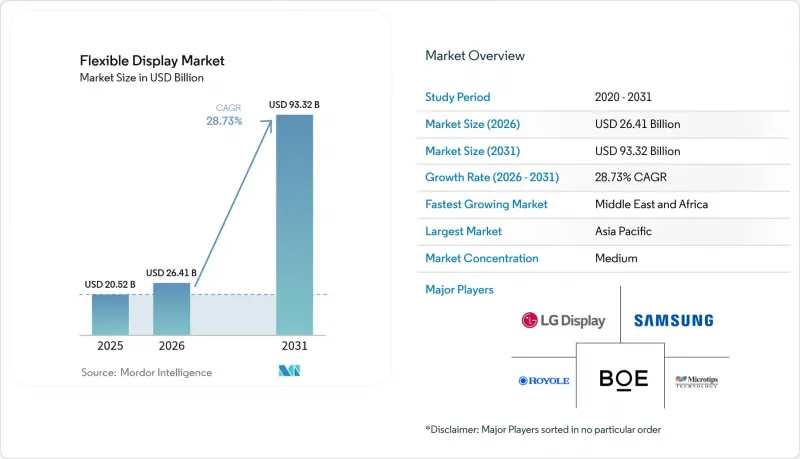
Mordor Intelligence에 의하면, 플렉서블 디스플레이 시장 규모는 2025년에 205억 2,000만 달러로 평가되었고, 2026년에는 264억 1,000만 달러에서 성장하여 2031년까지 933억 2,000만 달러에 달할 것으로 예측됩니다.
예측 기간(2026년-2031년) 동안 연평균 성장률(CAGR)은 28.73%를 나타낼 것으로 전망됩니다.
본 보고서는 디스플레이 유형(OLED, 페이퍼 디스플레이 등), 폼 팩터(폴더블, 롤업, 플렉서블, 마이크로 LED 등),기판 소재(유리, 플라스틱-폴리이미드(PI), 플라스틱-PET/PEN, 금속박 등), 용도(스마트폰 및 태블릿, 스마트 웨어러블, TV 및 디지털 사이니지 등), 그리고 지역별로 분류되어 있습니다. 시장 예측은 금액(달러) 기준으로 제시되어 있습니다.
세계 플렉서블 디스플레이 시장 동향 및 인사이트
중국과 한국에서 롤형 및 폴더블 스마트폰의 출시가 가속화되고 있습니다.
2024년, 플렉서블 OLED 스마트폰 패널 출하 대수는 26% 증가하여 7억 8,400만 대에 달했습니다. 이는 참신한 폼 팩터가 기기 교체 수요를 자극하고 있음을 여실히 보여줍니다. 2025년 하반기에 출시될 예정인 새로운 3단 접이식 디자인은 360도 회전 기능과 접힘 자국을 줄여주는 초박형 유리를 채택하여 브랜드 간 차별화를 더욱 강화하고 있습니다. 중국의 신생 기업들은 힌지의 내구성 목표를 달성하고 설계부터 출시까지의 주기를 단축함으로써 빠르게 규모를 확장하고 있으며, 가격과 혁신 속도 면에서 기존 기업들에 압박을 가하고 있습니다. 힌지, 내열성 폴리이미드, 투명 커버 필름을 둘러싼 부품 생태계는 직접적인 혜택을 보고 있습니다. 이러한 호황은 액세서리 및 수리 시장으로도 파급되어 새로운 서비스 수익원을 창출하고 있습니다.
유럽 전역에서 프리미엄 전기차(EV)용 곡면 OLED 콕핏 채택
고급 전기차(EV)는 EQS SUV의 ‘하이퍼스크린’처럼, 연속된 유리 커버 아래에 여러 디스플레이를 통합한 광활한 곡면 대시보드를 통해 차량 내 경험을 향상시키고 있습니다. 자동차 제조업체들은 얇은 두께, 균일한 밝기, 그리고 높은 디자인 자유도를 이유로 플렉서블 OLED를 선호하고 있으며, 그 결과 차량 1대당 디스플레이 면적이 급증하고 있습니다. Tier 1 공급업체들은 패널 제조업체와의 제휴를 강화하여 콕핏 플랫폼을 공동 개발하고 있는 반면, 소프트웨어 정의 차량(SDV) 전략에서는 지속적인 무선 업데이트(OTA)를 지원하는 디스플레이가 요구되고 있습니다. 자율 주행 기능이 성숙해짐에 따라, 멀티모달 상호작용과 필러에서 필러까지 이어지는 스크린으로 인해 차량당 디스플레이 소비 면적(제곱미터)은 더욱 증가할 전망입니다.
Gen-8+ 폴리이미드의 수율 저하가 스크랩 비용을 상승시키고 있다.
마더 글라스의 대형화에 따라 플렉서블 PI 기판에 가해지는 열 응력이 강해져, 결함으로 인한 수율 저하를 초래하고, 단가 상승을 부추기고 있습니다. 에어로겔 강화 PI 섬유에 대한 연구는 열 안정성 향상에 유망한 것으로 평가되고 있으나, 산업계에서의 도입은 아직 초기 단계에 머물러 있어 양산 개시 단계에서 공장은 고가의 스크랩 발생 위험에 노출되어 있습니다. 현재 수율 회복 프로그램에서는 양산 개시 전에 결함 밀도를 낮추기 위해 실시간 인라인 계측 및 AI를 활용한 예측 유지보수에 중점을 두고 있습니다.
부문 분석
2025년, OLED는 플렉서블 디스플레이 시장에서 84.25%의 점유율을 차지했습니다. 이는 백라이트가 필요 없고, 더 얇으며 곡면 구현이 용이한 모듈을 실현하는 발광형 화소를 활용한 결과입니다. 중국 제조 공장의 비용 절감과 증착 장비의 처리량 향상으로 인해 OLED는 스마트폰, 스마트 워치, 곡면 인포테인먼트 클러스터용 패널로 계속해서 선택되고 있습니다. 한편, 마이크로 LED의 출하량은 시범 단계에서 초기 양산 단계로 확대되고 있으며, 양자점 컬러 컨버터, 물질 이송 정밀도 및 수리 수율의 향상에 따라 연평균 성장률(CAGR)은 35.4%로 예측됩니다. 자동차용 헤드업 디스플레이와 견고한 웨어러블 기기가 가장 먼저 혜택을 보는 이유는 마이크로 LED가 밝기를 10,000니트까지 높이고 높은 열 부하 하에서도 긴 수명을 실현하기 때문입니다. 이는 티엔마(Tianma)사의 8인치 프로토타입이 입증하고 있습니다. 전자 종이는 저전력 간판 및 물류용 태그와 같은 틈새 시장에서 입지를 확고히 하고 있는 반면, 양자점 LCD 하이브리드는 중급 기기에서 가격과 색역의 격차를 계속해서 메우는 역할을 하고 있습니다.
OLED의 우위에는 세 가지 압박 요인이 있습니다. 첫째, 무기 마이크로 LED 소재의 내구성으로 인해 OLED의 번인 위험에 대한 우려가 줄어들고 있습니다. 둘째, 8.6세대의 비용 우위로 인해 리지드 OLED와 플렉서블 OLED의 평균 판매 가격(ASP) 차이가 좁혀지면서, 저가대 부문이 연질 폼 팩터로 전환되고 있습니다. 셋째, 양자점 온칩 방식이 롤투롤 방식의 플라스틱 기판에 대응할 수 있게 됨에 따라, 초대형 투명 윈도우 분야에서의 미래 경쟁의 씨앗이 뿌려지고 있습니다. 그렇긴 하지만, 생태계의 성숙도, 설비의 감가상각, 그리고 풍부한 공급량으로 인해 중기적으로는 OLED가 여전히 확고한 주도권을 유지할 것입니다.
2025년에는 접이식 기기가 플렉서블 디스플레이 시장의 70.20%를 차지하며, 각 스마트폰 제조업체들이 2단 접이식, 3단 접이식 및 랩어라운드 형태의 제품 개발을 경쟁하는 가운데, 여전히 판매 대수의 견인차 역할을 하고 있습니다. 힌지 형태 및 UTG 라미네이션에 관한 특허 장벽은 선도 기업의 우위를 공고히 하고 있지만, 라이선싱이나 대체 가능한 키네마틱 스택의 독자적인 개발을 통해 경쟁사 시장 진입을 막는 요인은 아닙니다. 연평균 성장률(CAGR) 37.9%로 확대될 것으로 예상되는 롤업형 디스플레이는 컴팩트한 케이스 내에 수납되어 공간 효율을 높이며, 주머니에 들어갈 수 있으면서도 넉넉한 표시 영역을 원하는 소비자의 요구를 충족시킵니다. 초기 노트북 및 태블릿용 롤업형 디스플레이의 경우, 전동 스풀과 신축 제한 라미네이션을 통해 3만 회 이상의 작동에 대한 재현성이 실현된 것으로 입증되었습니다.
구부릴 수 있고 컨포머블한 디스플레이는 기계적 부하가 비교적 단순하기 때문에 곡면 에지가 적용된 스마트폰, 피트니스 밴드, 자동차용 레이더 분야에서 여전히 주류를 이루고 있습니다. 신축성 있는 기판 메쉬와 사행형 회로 패턴을 통해 구현되는 새로운 ‘폼 팩터 프리’ 카테고리는 피부에 부착하는 헬스 패치나 소프트 로봇을 위해 현재 활발히 연구되고 있습니다. 신축성 디스플레이에 관한 학술 논문 수는 2014년 17편에서 2023년 197편으로 급증했으며, 이는 연구개발 투자의 확대를 반영하고 있습니다. 상용화는 다소 뒤처지고 있지만, 이러한 진전은 이번 10년 후반에 유비쿼터스 앰비언트 디스플레이 표면의 실현을 위한 토대를 마련하고 있습니다.
지역별 분석
2025년에는 PI 수지 합성부터 모듈 조립에 이르기까지를 아우르는 한국, 중국, 대만의 긴밀한 제조 생태계에 힘입어 아시아태평양이 매출의 56.40%를 차지하며 시장을 독점했습니다. 중국은 2028년까지 연간 8%의 플렉서블 OLED 생산 능력을 확대하고 있는 반면, 한국의 확대율은 2%에 그치고 있어, 이에 따라 중국이 전 세계 패널 생산량에서 차지하는 점유율은 68%에서 74%로 상승하고 있습니다. 지역별 정책 인센티브를 통해 현지 대기업에는 유리한 토지, 세제, 전력 조건이 제공되는 한편, 국내 스마트폰 OEM 제조업체들이 확실한 수요를 창출하고 있습니다. 이러한 선순환이 공급망의 자급자족을 공고히 하고, 신규 생산 라인의 양산 개시까지의 기간을 단축시키고 있습니다.
북미는 AR/VR, 고성능 컴퓨팅, 프리미엄 노트북 분야에서의 리더십을 바탕으로 기술적 견인력을 발휘하고 있습니다. 미국의 각 브랜드 기업들은 2026년을 목표로 맥북급 OLED 패널을 조달하고 있으며, 공급업체들은 정적 UI 부하 하에서 수명을 연장하는 산화물 TFT 및 탠덤 스택 구조에 대한 인증 획득을 서두르고 있습니다. 힌지 관련 특허에서 비롯되는 법적 리스크는 계속해서 주시해야 할 사항이지만, 각사는 출시 시기를 확보하기 위해 화해나 교차 라이선스 계약을 체결하는 경우가 많습니다. 마이크로일렉트로닉스의 국내 복귀에 대한 정부의 보조금은 특히 백플레인이나 유리 없는 봉지용 금형의 경우, 생태계의 일부를 미국으로 되돌릴 가능성이 있습니다.
유럽은 에코디자인 규정 및 향후 도입될 ‘디지털 제품 여권’을 통해 규제 측면에서 영향력을 발휘하고 있으며, 업계에 재활용 가능한 구조와 재료 정보의 완전한 공개를 추진하고 있습니다. 독일, 스웨덴, 영국의 자동차용 클러스터에서는 곡면 OLED 클러스터의 도입이 빠르게 진행되고 있어, 현지 통합, 접착, 시험 파트너들에게 활기를 불어넣고 있습니다. 2030년까지 24%라는 유럽의 순환형 소재 이용 목표가 용제 함량을 줄인 PI, 생분해성 접착제, 그리고 손쉬운 분리를 가능하게 하는 기계적 패스너에 대한 연구 개발을 촉진하고 있습니다.
중동 및 아프리카은 규모는 비교적 작지만, 교통 허브, 스포츠 경기장, 레저 시설에서의 디지털 사이니지 확대를 배경으로 연평균 성장률(CAGR) 31.1%라는 가장 빠른 성장세를 기록하고 있습니다. 유리 파사드에 밀착되는 플렉서블 LED 필름 스크린은 참신한 형태에 대한 건축 업계 수요를 상징합니다. 정부 주도의 스마트 시티 프로젝트와 주변 조도가 높은 환경으로 인해 고휘도 마이크로 LED가 매력적인 선택지가 되고 있습니다. 남미는 스마트폰 보급률이 높아지고 있는 데다, 자동차 조립 공장에서 수출용 모델에 플렉서블 클러스터 채택을 지정하기 시작함에 따라 그 뒤를 잇고 있습니다.
기타 혜택:
- 엑셀 형식 시장 예측(ME) 시트
- 3개월간의 애널리스트 지원
자주 묻는 질문
목차
제1장 서론
제2장 조사 방법
제3장 주요 요약
제4장 시장 구도
제5장 시장 규모와 성장 예측
제6장 경쟁 구도
제7장 시장 기회와 향후 전망
LSH 26.09.08According to Mordor Intelligence, the flexible display market size was valued at USD 20.52 billion in 2025 and estimated to grow from USD 26.41 billion in 2026 to reach USD 93.32 billion by 2031, at a CAGR of 28.73% during the forecast period (2026-2031).
This report is Segmented by Display Type (OLED, -Paper Display, and More), Form Factor (Foldable, Rollable, Bendable, Micro-LED, and More), Substrate Material (Glass, Plastic - Polyimide (PI), Plastic - PET/PEN, Metal Foil, and More), Application (Smartphones and Tablets, Smart Wearables, Televisions and Digital Signage, and More), and Geography. The Market Forecasts are Provided in Terms of Value (USD).
Global Flexible Display Market Trends and Insights
Rollable and foldable smartphone launch momentum in China and Korea
Shipments of flexible OLED smartphone panels climbed 26% in 2024 to 784 million units, underscoring how fresh form factors stimulate replacement demand.New tri-fold designs slated for late 2025 bring 360-degree rotation and ultra-thin glass that lowers crease visibility, intensifying brand differentiation. Chinese entrants scale quickly by matching hinge durability targets and shortening design-to-launch cycles, pressuring incumbents on price and innovation tempo. Component ecosystems around hinges, temperature-resistant polyimide and transparent cover films benefit directly. The upturn also spills into accessory and repair markets, creating incremental service revenue streams.
Premium-EV curved OLED cockpit adoption across Europe
Luxury electric vehicles elevate interior experience through expansive curved dashboards such as the EQS SUV Hyper-screen, which merges multiple displays under a continuous glass cover.Automotive OEMs prefer flexible OLED for its thin profile, uniform luminance and design latitude, leading to a surge in display-area per vehicle. Tier-1 suppliers deepen partnerships with panel makers to co-develop cockpit platforms, while software-defined vehicle strategies demand displays that support continuous over-the-air upgrades. As autonomous functionality matures, multi-modal interaction and stretchable pillar-to-pillar screens are set to multiply display square-meter consumption per car.
Gen-8+ polyimide yield losses elevating scrap costs
Scaling to larger mother-glass intensifies thermal stress on flexible PI substrates, driving defect-induced yield drops that inflate per-unit cost. Research on aerogel-reinforced PI fibers shows promise in lifting thermal stability yet industrial adoption remains nascent, leaving fabs exposed to expensive scrap during ramp-up.Yield recovery programmes now focus on real-time in-line metrology and AI-based predictive maintenance to shave defect density before mass output begins.
Other drivers and restraints analyzed in the detailed report include:
- Lightweight AR/VR micro-OLED demand in North America
- Cost reduction from Gen-8.6 flexible OLED fabs in China
- Encapsulation material supply crunch
For complete list of drivers and restraints, kindly check the Table Of Contents.
Segment Analysis
OLED held an 84.25% share of the flexible display market in 2025, leveraging emissive pixels that enable thinner, curve-friendly modules without backlights. Cost erosion from Chinese fabs and evaporator throughput gains have kept OLED the panel of choice for smartphones, watches and curved infotainment clusters. At the same time, micro-LED shipments are scaling from pilot to early mass production, posting a 35.4% forecast CAGR as quantum-dot colour converters, mass-transfer accuracy and repair yields improve. Automotive head-up displays and rugged wearables benefit first because micro-LED pushes brightness to 10,000 nits and delivers long lifetimes even under high thermal load, as evidenced by Tianma's 8-inch prototype. E-paper holds a niche in low-power signage and logistics tags, while quantum-dot LCD hybrids continue bridging price and colour-gamut gaps for mid-range devices.
OLED dominance faces three pressure points. First, inorganic micro-LED material longevity dilutes OLED's burn-in risk narrative. Second, Gen-8.6 cost advantages narrow the ASP gap between rigid and flexible OLED, nudging budget segments toward flexible form factors. Third, quantum-dot on-chip approaches are now compatible with roll-to-roll plastic substrates, seeding future competition in ultra-large transparent windows. Even so, ecosystem maturity, equipment depreciation and abundant supply keep OLED firmly in charge through the mid-term.
Foldable devices captured 70.20% of the flexible display market in 2025 and remain the volume engine as smartphone vendors race to iterate bi-fold, tri-fold and wrap-around formats. Patent barricades on hinge geometry and UTG lamination reinforce the lead of first movers yet do not preclude rivals that licence or innovate alternative kinematic stacks. Rollable screens, forecast to expand at a 37.9% CAGR, unlock spatial efficiency by retracting into compact housings, aligning with consumer demand for pocket-friendly yet expansive displays. Early notebook and tablet rollables demonstrate that motorised spools and stretch-limiting lamination can achieve repeatability over 30,000 actuations.
Bendable and conformable displays remain staples in curved edge phones, fitness bands and automotive radars thanks to their simpler mechanical loads. A nascent "form-factor free" class, enabled by stretchable substrate meshes and serpentine circuit patterns, is under active exploration for skin-adhesive health patches and soft robots. Academic output on stretchable displays jumped from 17 papers in 2014 to 197 in 2023, mirroring heightened R&D investment. While commercialisation lags, the progress sets the stage for ubiquitous ambient display surfaces later in the decade.
Complete Report Scope:
- By Display Type
- OLED
- LCD
- E-Paper Display (EPD)
- Micro-LED
- Quantum-Dot and Other Emerging Types
- By Form Factor
- Foldable
- Rollable
- Bendable
- Conformable (Curved/Wrap-around)
- By Substrate Material
- Glass
- Plastic - Polyimide (PI)
- Plastic - PET/PEN
- Metal Foil
- Others (Polycarbonate, Ultra-thin Glass)
- By Application
- Smartphones and Tablets
- Smart Wearables (Watches, Patches)
- Televisions and Digital Signage
- Personal Computers and Laptops
- Automotive Cockpit and Infotainment
- AR/VR Head-Mounted Displays
- Industrial and Public Transport Displays
- By Geography
- North America
- United States
- Canada
- Mexico
- Europe
- Germany
- United Kingdom
- France
- Italy
- Spain
- Rest of Europe
- Asia-Pacific
- China
- Japan
- South Korea
- India
- South East Asia
- Rest of Asia-Pacific
- South America
- Brazil
- Rest of South America
- Middle East and Africa
- Middle East
- United Arab Emirates
- Saudi Arabia
- Rest of Middle East
- Africa
- South Africa
- Rest of Africa
- Middle East
- North America
Geography Analysis
Asia Pacific dominated with 56.40% revenue in 2025, propelled by dense manufacturing ecosystems in Korea, China and Taiwan that span PI resin synthesis to module assembly. China alone is adding 8% annual flexible OLED capacity through 2028 against Korea's 2% run-rate, lifting its share of global panel output from 68% to 74%. Regional policy incentives grant favourable land, tax and power terms to local champions, while domestic smartphone OEMs provide ready demand. This virtuous cycle cements supply-chain self-sufficiency and accelerates time-to-yield for new lines.
North America commands technology pull on account of its leadership in AR/VR, high-performance computing and premium notebook segments. US brands source OLED MacBook-class panels for 2026, compelling suppliers to qualify oxide TFT and tandem stack architectures that lengthen lifetime under static UI loads. Legal exposure arising from hinge patents remains a watch-item; however, players often settle or cross-licence to safeguard launch windows. Government grants for microelectronic reshoring may redirect portions of the ecosystem stateside, particularly in backplane and glass-free encapsulation tooling.
Europe exerts regulatory influence through the Ecodesign Regulation and the upcoming Digital Product Passport, pushing the industry toward recyclable structures and full material disclosure. Automotive clusters in Germany, Sweden and the United Kingdom adopt curved OLED clusters at a brisk pace, stimulating local integration, bonding and test partners. The continent's circular material use target of 24% by 2030 drives R&D into solvent-reduced PI, biodegradable adhesives and mechanical fasteners that enable easy separation.
The Middle East and Africa, while comparatively small, records the fastest growth at a 31.1% CAGR off expanding digital signage in transport hubs, sports arenas and leisure venues. Flexible LED film screens that conform to glass facades exemplify the architectural appetite for novel form factors. Government-backed smart-city projects and high ambient-light conditions make high-brightness micro-LED an attractive option. South America follows with rising smartphone penetration and automotive assembly plants beginning to specify flexible clusters for export models.
- Samsung Display Co., Ltd.
- LG Display Co., Ltd.
- BOE Technology Group Co., Ltd.
- ROYOLE Corporation
- E Ink Holdings Inc.
- AU Optronics Corp.
- Sharp Corporation
- Innolux Corporation
- TCL CSOT
- Visionox Co., Ltd.
- Tianma Micro-electronics Co., Ltd.
- Truly International Holdings
- Japan Display Inc.
- Microtips Technology
- FlexEnable Technology Ltd.
- Plastic Logic Germany
- Chunghwa Picture Tubes Ltd.
- Shenzhen China Star Optoelectronics Technology
- Huawei Technologies Co., Ltd. (Panel R&D)
- Guangzhou OED Technologies Co., Ltd.
- Universal Display Corporation
Additional Benefits:
- The market estimate (ME) sheet in Excel format
- 3 months of analyst support
TABLE OF CONTENTS
1 INTRODUCTION
- 1.1 Study Assumptions and Market Definition
- 1.2 Scope of the Study
2 RESEARCH METHODOLOGY
3 EXECUTIVE SUMMARY
4 MARKET LANDSCAPE
- 4.1 Market Overview
- 4.2 Market Drivers
- 4.2.1 Rollable and Foldable Smartphone Launch Momentum in China and Korea
- 4.2.2 Premium-EV Curved OLED Cockpit Adoption Across Europe
- 4.2.3 Demand Spike for Lightweight AR/VR Micro-OLED Panels in North America
- 4.2.4 Cost Reduction from Gen-8.6 Flexible OLED Fabs in China
- 4.2.5 EU Circular-Economy Push for Glass-Free Modules
- 4.2.6 Growth in Flexible Medical Wearables in Japan and South Korea
- 4.3 Market Restraints
- 4.3.1 Gen-8+ Polyimide Yield Losses Elevating Scrap Costs
- 4.3.2 Encapsulation Material Supply Crunch
- 4.3.3 US-Centric Patent Litigation on Foldable Hinges
- 4.3.4 Cold-Climate Reliability Issues of Plastic-LCD Signage
- 4.4 Industry Ecosystem Analysis
- 4.5 Technological Outlook
- 4.6 Porter's Five Forces Analysis
- 4.6.1 Bargaining Power of Suppliers
- 4.6.2 Bargaining Power of Buyers
- 4.6.3 Threat of New Entrants
- 4.6.4 Threat of Substitutes
- 4.6.5 Intensity of Competitive Rivalry
5 MARKET SIZE AND GROWTH FORECASTS (VALUES)
- 5.1 By Display Type
- 5.1.1 OLED
- 5.1.2 LCD
- 5.1.3 E-Paper Display (EPD)
- 5.1.4 Micro-LED
- 5.1.5 Quantum-Dot and Other Emerging Types
- 5.2 By Form Factor
- 5.2.1 Foldable
- 5.2.2 Rollable
- 5.2.3 Bendable
- 5.2.4 Conformable (Curved/Wrap-around)
- 5.3 By Substrate Material
- 5.3.1 Glass
- 5.3.2 Plastic - Polyimide (PI)
- 5.3.3 Plastic - PET/PEN
- 5.3.4 Metal Foil
- 5.3.5 Others (Polycarbonate, Ultra-thin Glass)
- 5.4 By Application
- 5.4.1 Smartphones and Tablets
- 5.4.2 Smart Wearables (Watches, Patches)
- 5.4.3 Televisions and Digital Signage
- 5.4.4 Personal Computers and Laptops
- 5.4.5 Automotive Cockpit and Infotainment
- 5.4.6 AR/VR Head-Mounted Displays
- 5.4.7 Industrial and Public Transport Displays
- 5.5 By Geography
- 5.5.1 North America
- 5.5.1.1 United States
- 5.5.1.2 Canada
- 5.5.1.3 Mexico
- 5.5.2 Europe
- 5.5.2.1 Germany
- 5.5.2.2 United Kingdom
- 5.5.2.3 France
- 5.5.2.4 Italy
- 5.5.2.5 Spain
- 5.5.2.6 Rest of Europe
- 5.5.3 Asia-Pacific
- 5.5.3.1 China
- 5.5.3.2 Japan
- 5.5.3.3 South Korea
- 5.5.3.4 India
- 5.5.3.5 South East Asia
- 5.5.3.6 Rest of Asia-Pacific
- 5.5.4 South America
- 5.5.4.1 Brazil
- 5.5.4.2 Rest of South America
- 5.5.5 Middle East and Africa
- 5.5.5.1 Middle East
- 5.5.5.1.1 United Arab Emirates
- 5.5.5.1.2 Saudi Arabia
- 5.5.5.1.3 Rest of Middle East
- 5.5.5.2 Africa
- 5.5.5.2.1 South Africa
- 5.5.5.2.2 Rest of Africa
- 5.5.5.1 Middle East
- 5.5.1 North America
6 COMPETITIVE LANDSCAPE
- 6.1 Market Concentration
- 6.2 Strategic Moves
- 6.3 Market Share Analysis
- 6.4 Company Profiles (includes Global level Overview, Market level overview, Core Segments, Financials as available, Strategic Information, Market Rank/Share for key companies, Products and Services, and Recent Developments)
- 6.4.1 Samsung Display Co., Ltd.
- 6.4.2 LG Display Co., Ltd.
- 6.4.3 BOE Technology Group Co., Ltd.
- 6.4.4 ROYOLE Corporation
- 6.4.5 E Ink Holdings Inc.
- 6.4.6 AU Optronics Corp.
- 6.4.7 Sharp Corporation
- 6.4.8 Innolux Corporation
- 6.4.9 TCL CSOT
- 6.4.10 Visionox Co., Ltd.
- 6.4.11 Tianma Micro-electronics Co., Ltd.
- 6.4.12 Truly International Holdings
- 6.4.13 Japan Display Inc.
- 6.4.14 Microtips Technology
- 6.4.15 FlexEnable Technology Ltd.
- 6.4.16 Plastic Logic Germany
- 6.4.17 Chunghwa Picture Tubes Ltd.
- 6.4.18 Shenzhen China Star Optoelectronics Technology
- 6.4.19 Huawei Technologies Co., Ltd. (Panel R&D)
- 6.4.20 Guangzhou OED Technologies Co., Ltd.
- 6.4.21 Universal Display Corporation
7 MARKET OPPORTUNITIES AND FUTURE OUTLOOK
- 7.1 White-space and Unmet-Need Assessment