|
시장보고서
상품코드
2120662
생분해성 폴리머 : 시장 점유율 분석, 업계 동향 및 통계, 성장 예측(2026-2031년)Bio-degradable Polymers - Market Share Analysis, Industry Trends & Statistics, Growth Forecasts (2026 - 2031) |
||||||
 Mordor Intelligence
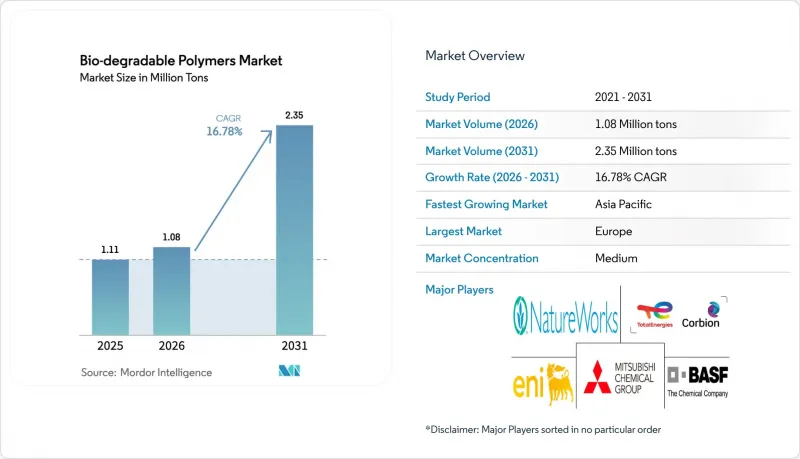
생분해성 폴리머 시장 규모는 2025년 111만 톤에서 2026년에는 108만 톤으로 감소한 후, 2031년까지 235만 톤에 이르고, 2026년부터 2031년에 걸쳐 CAGR 16.78%를 나타낼 것으로 예측되고 있습니다.
본 보고서는 원료(사탕수 및 사탕무, 옥수수 및 기타 전분 작물 등), 유형(전분계 플라스틱, 폴리젖산(PLA) 등), 최종 사용자 산업(포장, 소비재, 섬유, 농업 등), 지역(아시아태평양, 북미, 유럽, 남미, 중동 및 아프리카)별로 분류되어 있습니다. 시장 전망은 수량(톤) 단위로 제시되어 있습니다.
세계의 생분해성 폴리머 시장 동향 및 인사이트
일회용 플라스틱을 금지하는 정부 규제
2024년 1월부터 전면 시행된 EU의 일회용 플라스틱 지침에 따라 10개 범주에 걸친 옥소분해성 제품이 배제되었으며, 2025년에는 PLA 및 전분 필름 수요가 18만 톤을 초과했습니다. 중국의 전국적인 비닐봉지 금지 조치 및 비생분해성 멀칭 필름 규제로 인해 각 성에서 보조금이 투입되어, 2025년까지 PLA 및 PBAT의 정격 생산 능력이 32만 톤 증가하게 되었습니다. 인도에서는 2024년 ‘플라스틱 폐기물 규정’ 개정에 따라 얇은 일회용 플라스틱이 금지되면서, IS 17088 기준을 충족하는 9만 5,000톤 규모의 전분 혼합물 시장이 창출되었습니다. 현재 각 생산 기업들은 규제가 엄격한 지역 근처에 거점을 집중하고 있습니다. 예를 들어, 네이처웍스의 태국 PLA 공장은 아세안(ASEAN) 지역에 공급하고 있으며, 다니머 사이언티피크의 켄튀르키예주 PHA 생산 라인은 미국 연안 시장을 목표로 하고 있습니다.
지속 가능하고 친환경적인 포장재에 대한 수요 증가
유니레버는 2027년까지 유연 필름의 35%를 인증된 퇴비화 가능 소재로 전환하겠다고 약속하고, 토탈에너지즈 코비온 및 BASF와 다년간공급 계약을 체결했습니다. 네슬레는 유럽에서 제과류용 PHA 코팅 종이 포장재를 시범 도입하고 있으며, 이를 통해 2026년까지 2만 2,000톤의 배리어 등급 PHA 수요가 창출될 것으로 예측됩니다. 프록터 앤 갬블이 2024년에 취득한 해양 분해성 PLA-PBAT 세제 포드에 관한 특허는 해안 지역의 폐기물 처리 솔루션을 새롭게 제공할 것입니다. 아마존은 북미 배송의 18%에서 이미 전분으로 만든 완충재와 PLA 배송 봉투를 사용하고 있으며, 2025년에는 4만 3,000톤의 폴리에틸렌을 대체할 것이라고 밝혔습니다. 브랜드 소유자들 수요에 따라 산업용, 가정용 또는 해양에서의 분해 경로가 점점 더 구체적으로 지정되고 있으며, 인증 요건이 세분화되면서 제품 포트폴리오의 복잡성이 증가하고 있습니다.
기존 플라스틱에 비해 높은 생산 비용
범용 PLA의 가격이 1kg당 2.80-3.50달러인 반면, 폴리에틸렌은 1.20-1.40달러로 90-140%의 가격 차이가 유지되고 있어, 규제 대상이나 수수료 부담이 있는 유통 경로 외에서는 보급이 제한되고 있습니다. 해양용 PHA는 발효 공정의 복잡성을 반영하여 1kg당 5.00-6.50달러에 거래되고 있습니다. 2024년 옥수수 전분 가격이 28% 급등함에 따라 네이처웍스(NatureWorks)와 카길(Cargill)의 매출 총이익률은 24%로 축소되었습니다. 신규 PHA 플랜트는 5만 톤 규모의 라인당 1억 8,000만-2억 2,000만 달러가 소요되며, 이는 동 규모의 폴리에틸렌 플랜트 비용의 2배에 달하기 때문에 신규 진출기업의 기세가 주춤하고 있습니다. 생산 능력이 두 배로 늘어날 때마다의 학습 효과는 12-15%에 그쳐 기존 플라스틱에 뒤처지고 있어, 가격 경쟁력을 확보하기까지의 기간이 길어지고 있습니다.
부문별 분석
사탕수수와 사탕무가 2025년 생산량의 37.91%를 차지했습니다. 이는 브라질의 광대한 사탕수수 재배 면적과 유럽의 사탕무 생산량에 힘입은 것으로, 이들 원료는 1kg당 0.32-0.38달러 상당의 발효용 당을 공급하고 있습니다. 이러한 비용 구조는 남북 양반구에서 PLA 및 바이오 PE 생산을 위한 생분해성 폴리머 시장 규모의 기반이 되고 있습니다. 옥수수 및 기타 전분 작물은 미국 및 중국 북동부 지역의 확립된 습식 제분 및 철도 물류 시스템의 혜택을 받고 있습니다.
조류 및 미생물 유래 바이오매스는 PHA 농도(120 g/L 이상)에 기반하여 연평균 성장률(CAGR) 18.26%로 확대되고 있으며, 발효 비용이 PLA와 비슷한 수준에 가까워짐에 따라 생분해성 폴리머 시장에서의 점유율을 높일 가능성이 있습니다. 북유럽의 펄프 공장이 폐기물을 효과적으로 활용하고 있어 셀룰로오스 잔여물은 적정한 시장 점유율을 확보하고 있으나, 재생 가능 디젤 연료 의무화로 인해 폐유 공급은 점점 부족해지고 있습니다.
지역별 분석
유럽은 2025년 총량의 38.95%를 차지했으며, 통일된 인증 제도, 견고한 퇴비화 인프라, 그리고 비인증 수입품에 비해 평균 판매 가격을 12-18% 끌어올리는 국내 금지 조치에 힘입고 있습니다. 독일 시장은 BASF사의 ‘ecovio(R)’ 통합과 현지 조달을 우선시하는 엄격한 DIN CERTCO 요건에 의해 견인되고 있습니다. 프랑스와 이탈리아에서는 비닐봉지 및 멀칭 필름 규제로 인해 대체가 가속화되었고, 이에 따라 수요도 증가했습니다.
아시아태평양은 연평균 성장률(CAGR) 19.24%를 기록하며 유럽의 우위를 뒤엎을 기세를 보이고 있습니다. 2024년부터 2025년에 걸쳐 중국의 생산 능력 확대와 인도의 일회용 제품 금지 조치가 맞물려 예상되는 수요 증가량을 뒷받침하고 있습니다. 저장 Hisun사의 10만 톤 규모 PBAT 생산 라인과 NatureWorks사의 태국 내 확장 계획은 지역의 자급자족을 위한 자본 배분을 여실히 보여주고 있습니다. 아세안(ASEAN) 국가들의 농업용 필름에 대한 보조금 제도는 잠재 수요를 더욱 확대시키고 있습니다.
북미에서는 적당한 소비가 관찰되었으며, 캘리포니아주, 뉴욕주, 워싱턴주가 비닐봉지 및 외식 산업용 플라스틱 제품 사용 금지를 주도했습니다. 캐나다 연방 정부의 금지 조치가 수요를 뒷받침한 반면, 멕시코시티 및 할리스코주의 조치가 멕시코의 소비를 끌어올렸습니다. 남미, 중동 및 아프리카는 여전히 규모는 작지만, 브라질의 사탕수수 유래 바이오 PE와 사우디아라비아 및 남아프리카공화국에서 부상하고 있는 순환형 경제 정책의 혜택을 받고 있습니다.
기타 혜택 :
- 엑셀 형식 시장 예측(ME) 시트
- 3개월간 애널리스트 지원
자주 묻는 질문
목차
제1장 서론
제2장 조사 방법
제3장 주요 요약
제4장 시장 구도
제5장 시장 규모 및 성장 예측
제6장 경쟁 구도
제7장 시장 기회 및 향후 전망
KTH 26.09.04According to Mordor Intelligence, the bio-degradable polymers market size is expected to increase from 1.11 Million tons in 2025 to 1.08 Million tons in 2026 and reach 2.35 Million tons by 2031, growing at a CAGR of 16.78% over 2026-2031.
This report is Segmented by Feedstock (Sugarcane and Sugar Beets, Corn and Other Starch Crops, and More), Type (Starch-Based Plastics, Polylactic Acid (PLA), and More), End-User Industry (Packaging, Consumer Goods, Textile, Agriculture, and More), and Geography (Asia-Pacific, North America, Europe, South America, and Middle-East and Africa). The Market Forecasts are Provided in Terms of Volume (Tons).
Global Bio-degradable Polymers Market Trends and Insights
Government Regulations Banning Single-Use Plastics
The EU Single-Use Plastics Directive, fully enforced from January 2024, eliminated oxo-degradable items across ten categories and lifted PLA and starch-film demand above 180,000 tons in 2025. China's nationwide plastic-bag ban and restrictions on non-degradable mulch films injected provincial subsidies that added 320,000 tons of PLA and PBAT nameplate capacity by 2025. India's 2024 amendment to the Plastic-Waste Rules barred thin single-use plastics, opening a 95,000-ton starch-blend opportunity that meets IS 17088 criteria. Producers now co-locate near high-enforcement regions: NatureWorks' Thailand PLA plant supplies ASEAN, while Danimer Scientific's Kentucky PHA line targets U.S. coastal markets.
Rising Demand for Sustainable, Eco-Friendly Packaging
Unilever pledged to convert 35% of its flexible films to certified-compostable materials by 2027, securing multi-year offtakes with TotalEnergies Corbion and BASF. Nestle trials PHA-coated paperboard wrappers for confectionery in Europe, creating a 22,000-ton barrier-grade PHA window by 2026. Procter & Gamble's 2024 patent on marine-degradable PLA-PBAT detergent pods adds a coastal disposal solution. Amazon disclosed that 18% of its North American shipments already use starch loose-fill and PLA mailers, displacing 43,000 tons of polyethylene in 2025. Brand-owner demand increasingly specifies industrial, home, or marine degradation pathways, fragmenting certification needs and widening portfolio complexity.
High Production Cost vs. Conventional Plastics
Commodity PLA sells at USD 2.80-3.50 per kg versus USD 1.20-1.40 for polyethylene, maintaining a 90-140% premium that restricts uptake outside mandated or fee-burdened streams. Marine-grade PHA commands USD 5.00-6.50 per kg, reflecting fermentation complexity. Corn-starch price spikes of 28% in 2024 compressed NatureWorks and Cargill gross margins to 24%. Greenfield PHA plants require USD 180-220 million per 50,000-ton line, double comparable polyethylene units, slowing new entrant traction. Learning rates of 12-15% per capacity doubling lag conventional plastics, prolonging parity timelines.
Other drivers and restraints analyzed in the detailed report include:
- Accelerating Adoption in Healthcare Applications
- Growing Use of Biodegradable Films in Agriculture
- Limited Mechanical Performance for Automotive Parts
For complete list of drivers and restraints, kindly check the Table Of Contents.
Segment Analysis
Sugarcane and sugar beets delivered 37.91% of 2025 volume, anchored by Brazil's vast cane acreage and European beet output that supply fermentable sugars at USD 0.32-0.38 per kg. This cost base underpins the bio-degradable polymers market size for PLA and bio-PE production in both hemispheres. Corn and other starch crops are benefiting from established wet-milling and rail logistics in the United States and Northeast China.
Algal and microbial biomass is expanding at an 18.26% CAGR on titers above 120 g/L for PHA, a trajectory that could lift its bio-degradable polymers market share as fermentation costs near PLA parity. Cellulose residues secured moderate share as Nordic pulp mills valorize waste streams, while waste oils face tightening supplies from renewable-diesel mandates.
Complete Report Scope:
- By Feedstock
- Sugarcane and Sugar Beets
- Corn and Other Starch Crops
- Cellulose and Wood Biomass
- Waste Vegetable Oils and Fats
- Algal and Microbial Biomass
- By Type
- Starch-Based Plastics
- Polylactic Acid (PLA)
- Polyhydroxyalkanoates (PHA)
- Polyesters (PBS, PBAT and PCL)
- Cellulosic Derivatives
- By End-user Industry
- Packaging
- Consumer Goods
- Textile
- Agriculture
- Healthcare
- Other End-user Industries (Automotive, Construction, etc.)
- By Geography
- Asia-Pacific
- China
- India
- Japan
- South Korea
- ASEAN Countries
- Rest of Asia-Pacific
- North America
- United States
- Canada
- Mexico
- Europe
- Germany
- United Kingdom
- Italy
- France
- NORDIC Countries
- Rest of Europe
- South America
- Brazil
- Argentina
- Rest of South America
- Middle-East and Africa
- Saudi Arabia
- South Africa
- Rest of Middle-East and Africa
- Asia-Pacific
Geography Analysis
Europe accounted for 38.95% of 2025 volume, supported by harmonized certification, robust composting infrastructure, and national bans that elevate average selling prices by 12-18% over non-certified imports. Germany's market is driven by BASF's ecovio(R) integration and stringent DIN CERTCO requirements that favor local supply. France and Italy followed demand as carrier-bag and mulch-film regulations accelerated substitution.
Asia-Pacific is poised to overturn European dominance with a 19.24% CAGR. China's capacity additions during 2024-2025 and India's single-use bans together underpin projected incremental tonnage. Zhejiang Hisun's 100,000-ton PBAT line and NatureWorks' planned Thai expansion illustrate capital allocation toward regional self-sufficiency. ASEAN agricultural-film subsidies further expand addressable demand.
North America captured moderate consumption, with California, New York, and Washington leading bag and food-service bans. Canada's federal prohibition bolstered demand, while Mexico City and Jalisco state measures lifted Mexico's consumption. South America and the Middle East and Africa remain smaller but benefit from cane-based bio-PE in Brazil and emerging circular-economy policies in Saudi Arabia and South Africa.
- BASF
- BEWI
- Biome Bioplastics
- BIOTEC Biologische Naturverpackungen GmbH & Co. KG.
- Braskem
- CJ CheilJedang Corp
- Danimer Scientific
- DuPont
- Eni S.p.A.
- Evonik Industries AG
- FKuR
- GENECIS
- Mitsubishi Chemical Group Corporation
- NatureWorks LLC
- Plantic
- PTT MCC Biochem Co., Ltd.
- TEIJIN LIMITED
- TORAY INDUSTRIES, INC.
- TotalEnergies Corbion
- Zhejiang Hisun Biomaterials Co., Ltd.
Additional Benefits:
- The market estimate (ME) sheet in Excel format
- 3 months of analyst support
TABLE OF CONTENTS
1 Introduction
- 1.1 Study Assumptions and Market Definition
- 1.2 Scope of the Study
2 Research Methodology
3 Executive Summary
4 Market Landscape
- 4.1 Market Overview
- 4.2 Market Drivers
- 4.2.1 Government Regulations Banning Single-Use Plastics
- 4.2.2 Rising Demand for Sustainable, Eco-Friendly Packaging
- 4.2.3 Accelerating Adoption in Healthcare Applications
- 4.2.4 Growing Use of Biodegradable Films in Agriculture
- 4.2.5 Carbon-Capture-Derived Monomers Enabling Negative-Emission Plastics
- 4.3 Market Restraints
- 4.3.1 High Production Cost Vs. Conventional Plastics
- 4.3.2 Limited Mechanical Performance for Automotive Parts
- 4.3.3 Feedstock-Price Volatility from Non-Food Biomass Demand
- 4.4 Value Chain Analysis
- 4.5 Porter's Five Forces
- 4.5.1 Bargaining Power of Suppliers
- 4.5.2 Bargaining Power of Buyers
- 4.5.3 Threat of New Entrants
- 4.5.4 Threat of Substitutes
- 4.5.5 Degree of Competition
5 Market Size and Growth Forecasts (Volume)
- 5.1 By Feedstock
- 5.1.1 Sugarcane and Sugar Beets
- 5.1.2 Corn and Other Starch Crops
- 5.1.3 Cellulose and Wood Biomass
- 5.1.4 Waste Vegetable Oils and Fats
- 5.1.5 Algal and Microbial Biomass
- 5.2 By Type
- 5.2.1 Starch-Based Plastics
- 5.2.2 Polylactic Acid (PLA)
- 5.2.3 Polyhydroxyalkanoates (PHA)
- 5.2.4 Polyesters (PBS, PBAT and PCL)
- 5.2.5 Cellulosic Derivatives
- 5.3 By End-user Industry
- 5.3.1 Packaging
- 5.3.2 Consumer Goods
- 5.3.3 Textile
- 5.3.4 Agriculture
- 5.3.5 Healthcare
- 5.3.6 Other End-user Industries (Automotive, Construction, etc.)
- 5.4 By Geography
- 5.4.1 Asia-Pacific
- 5.4.1.1 China
- 5.4.1.2 India
- 5.4.1.3 Japan
- 5.4.1.4 South Korea
- 5.4.1.5 ASEAN Countries
- 5.4.1.6 Rest of Asia-Pacific
- 5.4.2 North America
- 5.4.2.1 United States
- 5.4.2.2 Canada
- 5.4.2.3 Mexico
- 5.4.3 Europe
- 5.4.3.1 Germany
- 5.4.3.2 United Kingdom
- 5.4.3.3 Italy
- 5.4.3.4 France
- 5.4.3.5 NORDIC Countries
- 5.4.3.6 Rest of Europe
- 5.4.4 South America
- 5.4.4.1 Brazil
- 5.4.4.2 Argentina
- 5.4.4.3 Rest of South America
- 5.4.5 Middle-East and Africa
- 5.4.5.1 Saudi Arabia
- 5.4.5.2 South Africa
- 5.4.5.3 Rest of Middle-East and Africa
- 5.4.1 Asia-Pacific
6 Competitive Landscape
- 6.1 Market Concentration
- 6.2 Strategic Moves
- 6.3 Market Share (%)/Ranking Analysis
- 6.4 Company Profiles {(includes Global level Overview, Market level overview, Core Segments, Financials as available, Strategic Information, Products and Services, Recent Developments)}
- 6.4.1 BASF
- 6.4.2 BEWI
- 6.4.3 Biome Bioplastics
- 6.4.4 BIOTEC Biologische Naturverpackungen GmbH & Co. KG.
- 6.4.5 Braskem
- 6.4.6 CJ CheilJedang Corp
- 6.4.7 Danimer Scientific
- 6.4.8 DuPont
- 6.4.9 Eni S.p.A.
- 6.4.10 Evonik Industries AG
- 6.4.11 FKuR
- 6.4.12 GENECIS
- 6.4.13 Mitsubishi Chemical Group Corporation
- 6.4.14 NatureWorks LLC
- 6.4.15 Plantic
- 6.4.16 PTT MCC Biochem Co., Ltd.
- 6.4.17 TEIJIN LIMITED
- 6.4.18 TORAY INDUSTRIES, INC.
- 6.4.19 TotalEnergies Corbion
- 6.4.20 Zhejiang Hisun Biomaterials Co., Ltd.
7 Market Opportunities and Future Outlook
- 7.1 White-space and Unmet-Need Assessment
- 7.2 Marine-degradable Polymers for Ocean Cleanup Nets and Gear