|
시장보고서
상품코드
2120667
무수프탈산(PA) : 시장 점유율 분석, 업계 동향과 통계, 성장 예측(2026-2031년)Phthalic Anhydride - Market Share Analysis, Industry Trends & Statistics, Growth Forecasts (2026 - 2031) |
||||||
 Mordor Intelligence
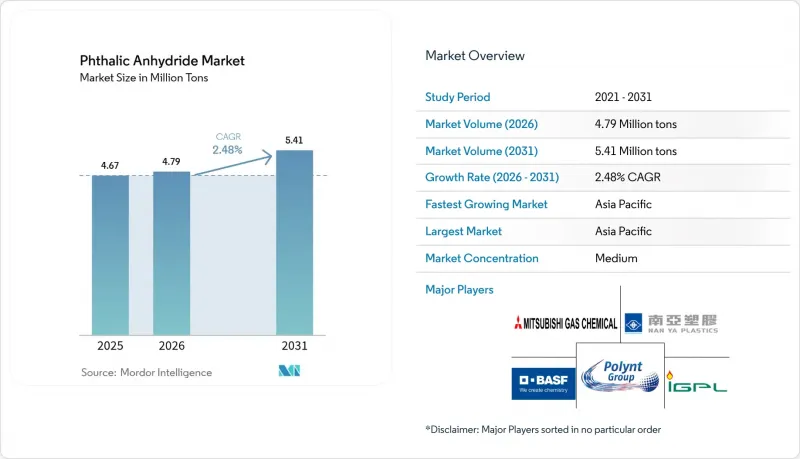
Mordor Intelligence에 의하면, 무수프탈산(PA) 시장 규모는 2025년 467만 톤에서 2026년에는 479만 톤으로 확대되어 2031년까지 541만 톤에 이를 것으로 예상되며, 2026-2031년 CAGR 2.48%를 기록할 전망입니다.
본 보고서는 원료(오르토-자일렌 및 나프탈렌), 용도(가소제, 알키드 수지, 불포화 폴리에스터 수지, 기타 용도), 최종 사용자 산업(자동차, 전기 및 전자,페인트 및 코팅, 플라스틱, 기타 최종 사용자 산업), 그리고 지역(아시아태평양, 북미, 유럽, 남미, 중동 및 아프리카)별로 분류되어 있습니다.
세계 프탈산 무수물 시장 동향 및 분석
풍력 터빈 블레이드에서 불포화 폴리에스테르 수지(UPR) 사용 확대
풍력 발전 설비의 증설은 불포화 폴리에스테르 수지 수요 구조를 변화시키고 있으며, 그 결과 프탈산 무수물의 소비량도 증가하고 있습니다. 전 세계 풍력 터빈 설치에는 유리섬유와 UPR 매트릭스를 결합한 복합재 블레이드가 필요하며, 해상 풍력 발전의 용량 1메가와트당 약 15-20톤의 복합재가 소비됩니다. 중국은 2025년에 70GW 이상을 가동할 예정이며, 인도는 2030년까지 500GW의 재생에너지를 도입하는 것을 목표로 하고 있어, 이러한 움직임이 내식성 수지 시스템 분야에서 고순도 프탈산 무수물에 대한 지속적인 수요를 견인하고 있습니다. 북해와 대만 해협에서의 해상 프로젝트도 수요를 더욱 확대시키고 있습니다. 해양 환경에서는 우수한 가수분해 안정성을 갖춘 수지 시스템이 필수적이며, 이러한 성능 특성은 프탈산 무수물의 방향족 골격의 강성과 직접적인 관련이 있습니다.
전기차용 와이어·케이블의 가소제 수요 급증
전기자동차 아키텍처에서는 400-800볼트 시스템에 대응하는 와이어 하네스가 필요하며, 케이블의 절연체는 15년에 걸친 수명 동안 열 사이클, 전자기 간섭 및 기계적 마모를 견뎌야 합니다. 배터리식 전기차 1대당 최대 2km의 케이블이 탑재되어 있으며, 여기에는 3-4kg의 가소화 PVC가 필요합니다. 2025년에는 전 세계 전기차 생산 대수가 1,400만 대를 돌파할 전망이며, 기존의 오르토프탈산 에스테르류에 대한 REACH 규정의 0.1 wt% 제한을 충족하기 위해,DOTP나 DINCH와 같은 대체 물질에 대한 관심이 높아지는 한편, DINP 및 DIDP와 같은 프탈산 에스테르의 소비량은 증가했습니다.
코팅 분야에서의 바이오 유래 무수물로의 전환
알키드 수지 배합 제조업체들은 지속가능성 목표를 달성하고 스코프 3 배출량을 감축하기 위해, 프탈산 무수물의 대신 아젤레인산, 푸마르산 및 리그닌 유래 방향족 단량체를 채택하고 있습니다. 2024년에 가동을 시작한 인도 사야카에 위치한 파스토프(Perstorp)의 ISCC PLUS 인증 공장에서는 재생 가능한 원료로부터 물질 수지 방식을 통해 폴리올 및 중간체를 생산하고 있으며, 이를 통해 도료 제조업체는 배합을 변경하지 않고도 최대 70%의 바이오 함유율을 표기할 수 있게 되었습니다. 현재 유럽의 도료 제조업체들은 프탈산 원료의 8-10%를 아젤레인산 또는 리그닌 유래 산으로 대체하고 있으며, 70%의 바이오 함유율 표기를 가능하게 하는 퍼스토프(Perstorp)사의 ISCC PLUS 인증 소재를 활용하고 있습니다. 장식용 도료 라인이 먼저 전환되고 있는 이유는 라벨 표시에 따른 마케팅 효과가 20-30%의 가격 프리미엄을 상쇄하기 때문이지만, 자동차 OEM용 탑코트의 경우 경도 및 내후성을 확보하기 위해 여전히 프탈산계 화학 물질에 의존하고 있습니다.
부문 분석
나프탈렌은 2025년 원료의 83.18%를 차지했으나, 콜타르 공급 부족과 유럽 및 미국의 공장 폐쇄는 구조적인 전환을 시사하고 있습니다. 통합된 방향족 화합물 공급에 힘입은 오르토-자일렌은 연평균 성장률(CAGR) 3.31%를 나타낼 것으로 예측되며, 프탈산 무수물 시장 규모에서 나프탈렌의 선두를 서서히 따라잡을 전망입니다. 코퍼스(Copper’s)사의 철수는 단독 타르 가공업체의 취약성을 여실히 드러내고 있는 반면, 중국의 나프탈렌 수입은 국내의 비용 우위를 약화시키고 있습니다.
아시아의 통합형 복합 시설에서는 접촉 개질 장치에서 생산된 혼합 자일렌을 직접 오르토자일렌으로 전환하고 있어, 이를 통해 변동 비용을 절감하고 있습니다. 중국석유천연가스그룹(CNPC)은 파라자일렌 수입이 19% 감소했다고 보고했는데, 이는 현지 방향족 화합물 자급률 상승을 뒷받침하는 것으로, 그 영향은 프탈산 무수물 시장에도 파급되고 있습니다. 제조 공정을 전환하려면 새로운 고정층 산화 반응 장치가 필요하며, 이는 기존 나프탈렌 플랜트에 있어 설비 투자상의 장벽이 되고 있습니다.
지역별 분석
아시아태평양은 2025년 생산량의 61.78%를 차지하고 있으며, 2031년까지 연평균 3.22%의 성장률을 유지할 것으로 보입니다. 중국만으로도 생산 능력의 3분의 1 이상을 차지하고 있으며, 허베이성 프로젝트(4만 톤)에 더해 에쿄(Ekkong)사의 닝보 확장 계획(5만 톤)으로 인해 2025년 국내 가격이 9.6% 하락하여 5,967 위안/톤(830.606달러/톤)으로 떨어졌음에도 불구하고, 중국의 주도적 지위는 더욱 공고해지고 있습니다. 인도의 370억 달러 규모 설비 투자 계획에 따라 국내 중간재 생산량이 증가하여 수입 의존도를 45% 절감하는 동시에, 이미 국내 공급의 70%를 차지하는 2개 기업에 의한 듀오폴리 체제가 확고해질 전망입니다.
북미에서는 콜타르 공급원이 축소되고 있어, 2025년 코퍼스(Copper’s)사의 철수 이후에는 수입에 의존하는 상황이 될 전망입니다. 남아 있는 통합형 생산 거점은 틈새 시장을 충당하고 있는 반면, 멕시코에서는 완성된 PVC 부품이 미국의 자동차 및 전자기기 공급망에 재공급되고 있습니다. 유럽은 높은 에너지 비용과 REACH 규제의 제약에 직면해 있습니다. 랑세스(Lanxess)는 독자적인 촉매 기술을 통해 지역 생산을 유지하고 있지만, 아시아산 수입품에 의한 가격 경쟁으로 인해 EBITDA 압박이 지속되고 있습니다.
남미 및 중동 및 아프리카는 여전히 비교적 소규모 시장에 머물러 있습니다. 브라질의 회복은 자동차 생산에 좌우되며, 사우디아라비아의 ‘비전 2030’은 범용 방향족 화합물에 그치지 않는 현지 가공을 더욱 심화시킬 가능성이 있습니다. 현재로서는 두 지역 모두 프탈산 무수물 시장에서 새로운 수요의 견인차라기보다는 주로 아시아 및 유럽으로의 수출 거점으로서의 역할을 수행하고 있습니다.
기타 혜택:
- 엑셀 형식 시장 예측(ME) 시트
- 3개월간의 애널리스트 지원
자주 묻는 질문
목차
제1장 서론
제2장 조사 방법
제3장 주요 요약
제4장 시장 구도
제5장 시장 규모와 성장 예측
제6장 경쟁 구도
제7장 시장 기회와 향후 전망
LSH 26.09.08According to Mordor Intelligence, the phthalic anhydride market size is expected to increase from 4.67 million tons in 2025 to 4.79 million tons in 2026 and reach 5.41 million tons by 2031, growing at a CAGR of 2.48% over 2026-2031.
This report is Segmented by Raw Material (Ortho-Xylene and Naphthalene), Application (Plasticizers, Alkyd Resins, Unsaturated Polyester Resins, and Other Applications), End-User Industry (Automotive, Electrical and Electronics, Paints and Coatings, Plastics, and Other End-User Industries), and Geography (Asia-Pacific, North America, Europe, South America, and Middle-East and Africa).
Global Phthalic Anhydride Market Trends and Insights
Expansion of UPR Use in Wind-Turbine Blades
Wind-energy capacity additions are reshaping unsaturated polyester resin demand, which in turn pulls phthalic anhydride consumption upward. Global wind-turbine installations require composite blades that blend glass fiber with UPR matrices, and each megawatt of offshore capacity consumes approximately 15-20 tons of composite material. China brought more than 70 GW online in 2025, while India targets 500 GW of renewables by 2030, driving sustained pull for high-purity phthalic anhydride in corrosion-resistant resin systems. Offshore projects in the North Sea and Taiwan Strait further amplify demand, as marine environments mandate resin systems with superior hydrolytic stability, a performance attribute directly linked to phthalic anhydride's aromatic backbone rigidity.
Electric-Vehicle Wire-and-Cable Plasticizer Boom
Electric-vehicle architectures require wire harnesses rated for 400-800 volt systems, and cable insulation must withstand thermal cycling, electromagnetic interference, and mechanical abrasion over 15-year service lives. Each battery electric vehicle carries up to 2 km of cabling that requires 3-4 kg of plasticized PVC. Global EV output topped 14 million units in 2025, lifting phthalate ester consumption for DINP and DIDP despite parallel interest in DOTP and DINCH alternatives to meet REACH limits of 0.1 wt% on legacy ortho-phthalates.
Shift Toward Bio-Based Anhydrides in Coatings
Alkyd resin formulators are substituting phthalic anhydride with azelaic acid, fumaric acid, and lignin-derived aromatic monomers to meet sustainability targets and reduce Scope 3 emissions. Perstorp's ISCC PLUS-certified plant in Sayakha, India, commissioned in 2024, produces mass-balanced polyols and intermediates from renewable feedstocks, enabling paint manufacturers to claim up to 70% bio-content without reformulation. European paint makers now substitute 8-10% of phthalic feedstock with azelaic or lignin-derived acids, leveraging Perstorp's ISCC PLUS materials that enable 70% bio-content claims. Decorative lines move first because label marketing offsets the 20-30% price premium, while automotive OEM topcoats still rely on phthalic chemistry for hardness and weatherability.
Other drivers and restraints analyzed in the detailed report include:
- Capacity Additions by Low-Cost Asian Producers
- PAN-Based MOFs for Carbon Capture and Utilisation
- Declining Coal-Tar Supply for Naphthalene Route
For complete list of drivers and restraints, kindly check the Table Of Contents.
Segment Analysis
Naphthalene retained 83.18% of 2025 feedstock, yet tightening coal-tar supply and Western plant closures signal a structural pivot. Ortho-xylene, supported by integrated aromatics streams, is set for a 3.31% CAGR and will gradually trim naphthalene's lead within phthalic anhydride market size metrics. Koppers' withdrawal highlights the vulnerability of stand-alone tar processors, while China's naphthalene imports dilute domestic cost advantages.
Integrated Asian complexes convert mixed xylene from catalytic reformers directly into ortho-xylene, lowering variable costs. CNPC reports reduced paraxylene imports to 19%, confirming rising local aromatics sufficiency that spills over into the phthalic anhydride market. Switching routes demands new fixed-bed oxidation reactors, posing a capital hurdle for legacy naphthalene plants.
Complete Report Scope:
- By Raw Material
- Ortho-xylene
- Naphthalene
- By Application
- Plasticizers
- Alkyd Resins
- Unsaturated Polyester Resins
- Other Applications (Dyes and Pigments, Insecticides, etc.)
- By End-user Industry
- Automotive
- Electrical and Electronics
- Paints and Coatings
- Plastics
- Other End-user Industries (Chemicals, Agriculture, etc.)
- By Geography
- Asia-Pacific
- China
- India
- Japan
- South Korea
- Rest of Asia-Pacific
- North America
- United States
- Canada
- Mexico
- Europe
- Germany
- United Kingdom
- France
- Italy
- Rest of Europe
- South America
- Brazil
- Argentina
- Rest of South America
- Middle-East and Africa
- Saudi Arabia
- South Africa
- Rest of Middle-East and Africa
- Asia-Pacific
Geography Analysis
Asia-Pacific commanded 61.78% of the 2025 volume and is climbing at 3.22% through 2031. China alone hosts more than one-third of the capacity, and projects in Hebei (40,000 tons) plus Aekyung's Ningbo expansion (50,000 tons) consolidate its lead even as domestic prices dropped 9.6% to RMB 5,967 t (USD 830.606 t) in 2025. India's USD 37 billion capex plan raises native intermediates output, cutting 45% import dependence and cementing a two-company duopoly that already holds 70% of local supply.
North America faces shrinking coal-tar feed and now leans on imports after Koppers' 2025 exit. Remaining integrated units cover niche demand, while Mexico channels finished PVC parts back into the US auto and electronics chains. Europe grapples with high energy costs and REACH limits; LANXESS safeguards regional output through proprietary catalysts but still reports EBITDA squeeze as Asian imports undercut prices.
South America and the Middle East & Africa remain comparatively small. Brazil's recovery hinges on automotive output, and Saudi Arabia's Vision 2030 could deepen local conversion beyond commodity aromatics. For now, both regions act mainly as export yards feeding Asia and Europe rather than drivers of fresh demand within the phthalic anhydride market.
- AEKYUNG
- BASF
- EMCO Dyestuff
- IG Petrochemicals Ltd.
- Koppers Inc.
- LANXESS
- MITSUBISHI GAS CHEMICAL COMPANY, INC.
- NAN YA PLASTICS CORPORATION
- Paari Chem Resources
- Perstorp
- Polynt S.p.A.
- Shandong Hongxin Chemical Co., Ltd.
- Stepan Company
- Thirumalai Chemicals
- UPC Technology Corporation
Additional Benefits:
- The market estimate (ME) sheet in Excel format
- 3 months of analyst support
TABLE OF CONTENTS
1 Introduction
- 1.1 Study Assumptions and Market Definition
- 1.2 Scope of the Study
2 Research Methodology
3 Executive Summary
4 Market Landscape
- 4.1 Market Overview
- 4.2 Market Drivers
- 4.2.1 Expansion of UPR use in wind-turbine blades
- 4.2.2 Electric-vehicle wire-and-cable plasticizer boom
- 4.2.3 Capacity additions by low-cost Asian producers
- 4.2.4 PAN-based MOFs for carbon capture and utilisation
- 4.2.5 Electro-additive role in high-voltage Li-ion cells
- 4.3 Market Restraints
- 4.3.1 Shift toward bio-based anhydrides in coatings
- 4.3.2 Declining coal-tar supply for naphthalene route
- 4.3.3 Phthalate-free alkyd chemistries gaining share
- 4.4 Value Chain Analysis
- 4.5 Porter's Five Forces
- 4.5.1 Bargaining Power of Suppliers
- 4.5.2 Bargaining Power of Buyers
- 4.5.3 Threat of New Entrants
- 4.5.4 Threat of Substitutes
- 4.5.5 Degree of Competition
- 4.6 Technological Snapshot
- 4.7 Pricing Analysis
- 4.8 Import and Export Trends
5 Market Size and Growth Forecasts (Volume)
- 5.1 By Raw Material
- 5.1.1 Ortho-xylene
- 5.1.2 Naphthalene
- 5.2 By Application
- 5.2.1 Plasticizers
- 5.2.2 Alkyd Resins
- 5.2.3 Unsaturated Polyester Resins
- 5.2.4 Other Applications (Dyes and Pigments, Insecticides, etc.)
- 5.3 By End-user Industry
- 5.3.1 Automotive
- 5.3.2 Electrical and Electronics
- 5.3.3 Paints and Coatings
- 5.3.4 Plastics
- 5.3.5 Other End-user Industries (Chemicals, Agriculture, etc.)
- 5.4 By Geography
- 5.4.1 Asia-Pacific
- 5.4.1.1 China
- 5.4.1.2 India
- 5.4.1.3 Japan
- 5.4.1.4 South Korea
- 5.4.1.5 Rest of Asia-Pacific
- 5.4.2 North America
- 5.4.2.1 United States
- 5.4.2.2 Canada
- 5.4.2.3 Mexico
- 5.4.3 Europe
- 5.4.3.1 Germany
- 5.4.3.2 United Kingdom
- 5.4.3.3 France
- 5.4.3.4 Italy
- 5.4.3.5 Rest of Europe
- 5.4.4 South America
- 5.4.4.1 Brazil
- 5.4.4.2 Argentina
- 5.4.4.3 Rest of South America
- 5.4.5 Middle-East and Africa
- 5.4.5.1 Saudi Arabia
- 5.4.5.2 South Africa
- 5.4.5.3 Rest of Middle-East and Africa
- 5.4.1 Asia-Pacific
6 Competitive Landscape
- 6.1 Market Concentration
- 6.2 Strategic Moves
- 6.3 Market Share(%)/Ranking Analysis
- 6.4 Company Profiles (includes Global Overview, Market Overview, Core Segments, Financials, Strategic Information, Products and Services, Recent Developments)
- 6.4.1 AEKYUNG
- 6.4.2 BASF
- 6.4.3 EMCO Dyestuff
- 6.4.4 IG Petrochemicals Ltd.
- 6.4.5 Koppers Inc.
- 6.4.6 LANXESS
- 6.4.7 MITSUBISHI GAS CHEMICAL COMPANY, INC.
- 6.4.8 NAN YA PLASTICS CORPORATION
- 6.4.9 Paari Chem Resources
- 6.4.10 Perstorp
- 6.4.11 Polynt S.p.A.
- 6.4.12 Shandong Hongxin Chemical Co., Ltd.
- 6.4.13 Stepan Company
- 6.4.14 Thirumalai Chemicals
- 6.4.15 UPC Technology Corporation
7 Market Opportunities and Future Outlook
- 7.1 White-space and Unmet-Need Assessment