|
시장보고서
상품코드
2120673
산업용 전분 : 시장 점유율 분석, 업계 동향 및 통계, 성장 예측(2026-2031년)Industrial Starches - Market Share Analysis, Industry Trends & Statistics, Growth Forecasts (2026 - 2031) |
||||||
 Mordor Intelligence
산업용 전분 시장 규모는 2025년에 572억 7,000만 달러로 평가되었습니다. 2026년 595억 3,000만 달러에서 2031년까지 728억 2,000만 달러에 이를 것으로 예상되며, 예측 기간(2026-2031년) CAGR은 4.11%를 나타낼 전망입니다.
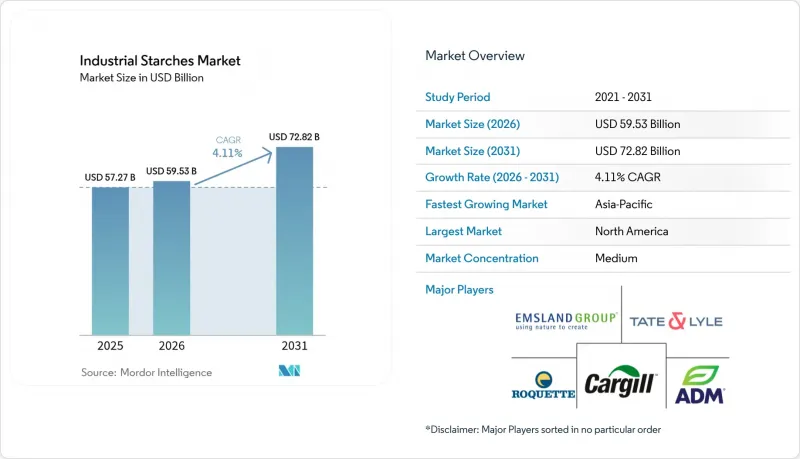
본 보고서는 원료별(옥수수, 타피오카/카사바, 감자 등), 유형별(천연 전분, 가공 전분),용도별(식품 및 음료, 의약품, 퍼스널케어 등), 지역별(북미, 유럽, 아시아태평양, 남미, 중동 및 아프리카)로 분류되어 있습니다. 시장 예측은 금액(미 달러) 및 수량(톤)으로 제시되어 있습니다.
세계의 산업용 전분 시장 동향 및 인사이트
가공식품 및 인스턴트 식품 소비 증가
도시화와 맞벌이 가구 증가는 즉석식품, 제빵 제품, 상온 보관이 가능한 소스의 소비 확대에 크게 기여하고 있습니다. 이러한 제품들은 식감, 점도, 동결-해동 안정성과 같은 필수적인 특성을 확보하기 위해 전분에 크게 의존하고 있습니다. 미국 농무부에 따르면, 아시아태평양의 가공식품 출하량은 현저한 성장세를 보이고 있으며, 인스턴트 라면이나 냉동 만두 등 전분을 많이 사용하는 품목이 수량 면에서 주도적인 역할을 하고 있습니다. 샐러드 드레싱의 경우, 높은 전단 혼합이나 산성 pH 환경에서도 시네레시스(수분 분리)를 일으키지 않는다는 특성 덕분에, 구아검의 대체재로 가공 왁스 옥수수 전분이 채택되고 있습니다. 이러한 기술적 이점은 클린 라벨 브랜드가 포장 전면 표시에서 강조하고 있는 부분입니다. 라틴아메리카에서는 스낵 제조업체들이 바람직한 바삭함을 실현하면서도 기름 흡수를 억제하기 위해 타피오카 전분을 배합하여 압출 성형 제품의 레시피를 재검토하고 있습니다. 이러한 접근 방식은 생산 비용을 절감할 뿐만 아니라, 더 건강한 제품을 원하는 소비자의 기호에도 부합합니다. 전통적인 가정식에서 산업적 식품 조리로의 전환에 따라, 전분 수요는 소수의 대형 구매업체에 집중되고 있습니다. 이러한 추세는 레시피 개발자의 협상력을 높이는 한편, 일관된 품질에 대한 기대치도 높이고 있으며, 이 기준을 대규모로 효과적으로 충족시킬 수 있는 것은 최상위급 공급업체뿐입니다.
클린 라벨 및 천연 원료로의 전환
북미와 유럽의 소매업체들은 성분 수가 10종 미만인 원재료 목록을 요구하는 경향이 강해지고 있으며, 이에 따라 각 브랜드는 화학적으로 가공된 전분을 소비자가 ‘최소한의 가공’으로 인식하는 천연 전분이나 물리적으로 가공된 대체품으로 대체하도록 촉진받고 있습니다. 잉그레디언(Ingredion)이 2025년에 발표한 연례 보고서에 따르면, 클린 라벨 전분 수요는 눈부신 성장을 보이고 있으며, 전분 부문 전체의 실적을 크게 상회하고 있습니다. 이러한 변화는 주로 유럽연합(EU)의 표시 규정에 따라 의무화된 ‘E 번호’ 표기를 피하기 위해 제빵 및 유제품 제조업체들이 제품 배합을 재검토하고 있기 때문입니다. 유기농 요거트 제조에서는 아세틸화 또는 하이드록시프로파일화된 전분의 대체재로 천연 타피오카 전분의 사용이 점점 더 늘어나고 있습니다. 이는 미국 농무부(USDA)의 ‘전미 유기농 프로그램(NOP)’ 인증 요건을 충족하면서도 추가 서류 제출이 필요하지 않아, 공급망 감사를 효율화할 수 있기 때문입니다. 그러나 천연 전분에는 가공 가능한 온도 범위가 좁고, 냉장 보관 중 레트로그레이드가 발생하기 쉬우며, 고속 혼합 시 전단 희석 현상이 발생하는 등 일정한 제한이 있습니다. 이러한 과제로 인해 배합 담당자는 사용량을 늘리거나 하이드로콜로이드와 조합할 수밖에 없는 경우가 많으며, 이는 이익률에 부정적인 영향을 미칠 가능성이 있습니다. 유럽식품안전청(EFSA)은 2024년에 변성 전분을 재평가하여 안전상의 우려는 없습니다는 결론을 내렸지만, 소비자들의 회의적인 시각은 여전히 뿌리 깊게 남아 있습니다. 이러한 분위기가 지속됨에 따라 ‘클린’한 대체재에 대한 프리미엄 가격 책정이 유지되고 있으며, 화학 시약을 사용하지 않는 효소 기반의 변성 기법 도입이 촉진되고 있습니다.
식품, 의약품, 포장에 관한 규제의 복잡성과 기준의 차이
‘가공 전분’에 대한 정의가 엇갈리는 점이 규정 준수상의 과제를 야기하고 있습니다. 미국 식품의약국(FDA)은 ‘천연’ 표시 하에 효소 가수분해를 허용하는 반면, 유럽식품안전청(EFSA)은 동일한 공정을 E 번호 표시가 필요한 가공으로 분류하고 있습니다. 이러한 차이로 인해 다국적 브랜드는 시장별로 서로 다른 배합과 패키지 디자인을 마련할 수밖에 없는 실정입니다. 인도 식품안전기준청(FSSAI)은 코덱스 위원회가 정한 기준에 비해 더 엄격한 중금속 잔류 한도를 부과하는 전분 순도 기준안을 도입했습니다. 이로 인해 수입업체는 이온 교환 정제 설비를 갖춘 공장에서 전분을 조달할 수밖에 없게 되지만, 이러한 능력을 갖춘 시설은 전 세계적으로도 제한적입니다. 의약품용 전분은 미생물 한도, 연소 잔류물 및 pH에 대해 미국 약전(USP) 규격을 준수해야 합니다. 그러나 유럽 약전(EP)은 이산화황 잔류물에 대해 더 엄격한 허용치를 설정하고 있어, 공급업체는 이중 생산 체제를 구축하거나 특정 시장 진출을 포기할 수밖에 없습니다. 또한, 유럽연합(EU)이 제안한 ‘포장 및 포장 폐기물 규정’에서 전분과 폴리에스터의 혼합물이 퇴비화 인증 대상이 될지 여부가 심의되고 있어, 포장 필름 가공업체들도 불확실성에 직면해 있습니다. 이 결정은 향후 몇 년간 압출 라인에 대한 설비 투자에 큰 영향을 미칠 것으로 보입니다.
부문별 분석
2025년, 산업용 전분 매출의 70.54%를 옥수수가 차지했습니다. 이는 미국 중서부 지역에 오랫동안 확립된 습식 제분 인프라와, 필름 형성 용도에 유리한 옥수수의 높은 아밀로스 함량에 힘입은 결과입니다. 그러나 모든 원료 부문 중에서 가장 빠른 성장세를 보이고 있는 것은 타피오카와 카사바이며, 2031년까지 연평균 성장률은 7.82%로 예측됩니다. 2025년, 태국의 카사바 전분 수출량은 320만 미터톤에 달하여 11% 증가했습니다. 이는 유럽의 식품 브랜드들이 미국산 옥수수에 대한 의존도가 높은 공급망을 다각화하기 위해 비유전자변형(비GMO) 인증과 물 발자국 감소를 요구했기 때문입니다. 감자 전분은 수출량 기준으로 3위를 차지하지만, 인산 에스테르기를 포함하고 있어 화학적 변형을 거치지 않아도 정제의 분해성을 높일 수 있어, 의약품 첨가제 시장에서 20%에서 30%의 가격 프리미엄이 붙고 있습니다. 이러한 ‘클린 라벨’의 장점은 인도의 제네릭 의약품 제조업체들에 의해 활용되고 있습니다.
밀 전분은 여전히 틈새 제품이며, 미세한 입자 크기와 낮은 온도로 인해 주로 유럽의 제지용 코팅 공장에서 사용되고 있습니다. 그러나 2025년에 밀 글루텐 가격이 40% 변동하는 등 글루텐 제품별 가격 변동이 심하기 때문에 생산 능력 확대는 진전되지 않고 있습니다. 카사바에 대한 수요가 증가하면서 무역 동향이 변화하고 있습니다. 2024년, 베트남에서는 옥수수 유전자 변형 작물(GMO)과의 연관성이 시장 진입 장벽이 되고 있는 의약품 및 생분해성 필름 시장을 겨냥하여, 연간 총 생산 능력 18만 메트르톤 규모의 타피오카 전분 공장 2곳이 가동을 시작했습니다. 지속적인 성장을 보이고는 있지만, 카사바는 아밀로오스 대 아밀로펙틴 비율이 낮기 때문에 옥수수나 감자 전분이 기술적 우위를 유지하고 있는 고투명 필름이나 레토르트 내성이 있는 소스로의 응용에는 한계가 있습니다.
지역별 분석
2025년, 북미는 산업용 전분 매출의 30.56%를 차지했습니다. 이는 고과당 옥수수 시럽, 옥수수유 및 사료용 글루텐을 병산하는 미국 옥수수 벨트의 통합형 습식 제분 복합 시설이 주도한 결과입니다. 2025년 2월에 완료된 잉그레디온(Ingredion)사의 시더래피즈(Cedar Rapids) 5,000만 달러 규모의 확장 프로젝트를 통해, 의약품 및 클린 라벨 식품 시장에 대응하기 위해 옥수수 전분의 연간 생산 능력이 12만 미터톤 증가했습니다. 이는 북미가 고수익률의 특수 전분 등급으로 전환되고 있음을 여실히 보여줍니다. 미국 식품의약국(FDA)이 2024년에 발표한 부형제 추적성에 관한 지침으로 인해 소규모 전분 생산업체의 규정 준수 비용이 증가하고 있으며, 전자 배치 기록 시스템 및 제3자 감사에 투자할 수 있는 상위 4개 전분 제조업체 사이에 시장 점유율이 집중되고 있습니다. 캐나다 전분 업계는 여전히 수출 지향적이며, 서스캐처원주의 밀 전분 제조업체들이 미국 제지 코팅 업계 고객들에게 제품을 공급하고 있습니다. 그러나 2025년 캐나다와 미국 간의 침엽수 목재 분쟁은 건축자재용 골판지 상자 수주를 감소시킴으로써 간접적으로 전분 수요에 영향을 미쳤습니다.
아시아태평양은 가장 빠른 성장을 보이고 있으며, 2031년까지 연평균 6.11%의 성장이 예상됩니다. 이러한 성장은 태국, 인도네시아, 베트남의 카사바 전분 생산 능력 확대, 인도의 의약품 정제 생산 증가, 그리고 중국의 전자상거래 분야에서 생분해성 포장재의 채택에 의해 주도되고 있습니다. 태국의 타피오카 전분 수출량은 2025년에 320만 메트릭톤에 달했으며, 비유전자변형(Non-GMO) 인증 획득을 통해 기존에는 미국산 옥수수 전분에 의존하던 유럽 및 일본 식품 시장에 진출할 수 있게 되었습니다. 인도의 전분 수입량은 국내 옥수수 전분 생산량이 의약품 수요를 충족시키는 데 어려움을 겪으면서 2025 회계연도에 14% 증가했습니다. 인도 식품안전표준청은 시행될 경우 국내 생산자들에게 혜택을 줄 가능성이 있는 순도 기준을 마련 중입니다. 중국에서는 2025년 1월부터 46개 도시에서 시행되는 생분해성 포장 의무화에 따라, 식품 배달 용기에 전분과 폴리부틸렌 아디페이트 테레프탈레이트(PBA-PTT) 혼합 소재의 사용이 촉진되고 있습니다. 그러나 폴리스티렌에 비해 40%에서 60% 높은 비용이 장벽이 되어, 1급 도시권 이외 지역에서의 보급은 제한적입니다.
유럽의 산업용 전분 시장에서는 소비자의 ‘클린 라벨’ 선호 경향과, 2030년까지 플라스틱 포장의 65%를 재생 소재로 사용하도록 의무화하는 유럽연합(EU)의 ‘포장 및 포장 폐기물 규정’ 간의 균형이 맞추어지고 있습니다. 이 규제로 인해 산업용 퇴비화 처리를 통해 생분해되는 전분·폴리에스터 블렌드의 사용이 촉진되고 있습니다. 독일의 감자 전분 생산량은 병해 문제로 인해 2025년에 6% 감소했으나, 독일은 여전히 유럽연합(EU) 최대 생산국이며, 엠스란트 그룹과 아베베가 이 지역의 생산 능력의 3분의 2를 차지하고 있습니다. 유럽식품안전청(EFSA)이 2024년에 실시한 가공 전분 재평가에서는 안전상의 우려가 확인되지 않았습니다. 그러나 포장 표시의 ‘클린 라벨’ 주장에서는 여전히 천연 전분이나 효소 가공 전분이 선호되고 있으며, 아세틸화 또는 가교 처리된 품종에 대해서는 이익률에 대한 압박이 지속되고 있습니다.
기타 혜택 :
- 엑셀 형식 시장 예측(ME) 시트
- 3개월간의 애널리스트 지원
자주 묻는 질문
목차
제1장 서론
제2장 조사 방법
제3장 주요 요약
제4장 시장 구도
제5장 시장 규모 및 성장 예측
제6장 경쟁 구도
제7장 시장 기회 및 향후 전망
KTH 26.09.04According to Mordor Intelligence, the industrial starches market size was valued at USD 57.27 billion in 2025 and is estimated to grow from USD 59.53 billion in 2026 to reach USD 72.82 billion by 2031, at a CAGR of 4.11% during the forecast period (2026-2031).

This report is Segmented by Source (Corn, Tapioca / Cassava, Potato, and More), Type (Native, and Modified), Application (Food and Beverage, Pharmaceutical, Personal Care, and More), and Geography (North America, Europe, Asia-Pacific, South America, and Middle East and Africa). The Market Forecasts are Provided in Terms of Value (USD) and Volume (Tonnes).
Global Industrial Starches Market Trends and Insights
Increasing consumption of processed and convenience foods
Urbanization and the increasing prevalence of dual-income households are significantly contributing to the growing consumption of ready-to-eat meals, bakery products, and shelf-stable sauces. These products heavily rely on starches to provide essential properties such as texture, viscosity, and freeze-thaw stability. According to the United States Department of Agriculture, processed food shipments in the Asia-Pacific region have experienced notable growth, with starch-intensive categories like instant noodles and frozen dumplings leading the way in terms of volume. Modified waxy-maize starches are being adopted as a replacement for guar gum in salad dressings due to their ability to endure high-shear mixing and acidic pH levels without causing syneresis, a technical advantage that clean-label brands emphasize in their front-of-pack claims. In Latin America, snack manufacturers are reformulating extruded products by incorporating tapioca starch to achieve a desirable crispness while reducing oil absorption. This approach not only lowers production costs but also aligns with consumer preferences for healthier product options. The shift from traditional home cooking to industrial food preparation has concentrated starch demand among a smaller number of larger buyers. This trend provides formulators with increased negotiating power but also raises expectations for consistent quality, a standard that only top-tier suppliers are equipped to meet effectively at scale.
Shift toward clean-label and natural ingredients
Retailers in North America and Europe are increasingly requiring ingredient lists with fewer than ten components, prompting brands to replace chemically modified starches with native or physically modified alternatives that consumers perceive as minimally processed. According to the annual report released by Ingredion for the year 2025, the demand for clean-label starches has shown remarkable growth, significantly surpassing the overall performance of the starch division. This shift is largely driven by bakery and dairy manufacturers reformulating their products to avoid E-number declarations, which are mandated by the labeling regulations of the European Union . Native tapioca starch is increasingly being used as a substitute for acetylated and hydroxypropylated variants in organic yogurt production. This is because it complies with the certification requirements of the United States Department of Agriculture (USDA) National Organic Program without necessitating additional documentation, thereby streamlining supply chain audits. However, native starches come with certain limitations, such as narrower processing windows, the tendency to retrograde during refrigerated storage, and shear-thinning when subjected to high-speed mixing. These challenges often compel formulators to use higher quantities or combine them with hydrocolloids, which can negatively impact profit margins. Although the European Food Safety Authority conducted a re-evaluation of modified starches in 2024 and found no safety concerns, consumer skepticism remains strong. This ongoing sentiment continues to sustain the premium pricing for "clean" alternatives and drives the adoption of enzyme-based modification methods that do not involve chemical reagents .
Regulatory complexity and variations across food, pharma, and packaging standards
Divergent definitions of "modified starch" create compliance challenges. The United States Food and Drug Administration (FDA) allows enzymatic hydrolysis under the "native" label, while the European Food Safety Authority (EFSA) classifies the same process as a modification requiring E-number disclosure . This discrepancy forces multinational brands to maintain separate formulations and packaging artwork for each market. India's Food Safety and Standards Authority (FSSAI) has introduced draft starch-purity standards that impose stricter heavy-metal residue limits compared to those set by Codex Alimentarius. This compels importers to source starch from mills equipped with ion-exchange purification, a capability available only at a limited number of global facilities. Pharmaceutical starch must comply with United States Pharmacopeia (USP) monograph specifications for microbial limits, residue on ignition, and pH. However, the European Pharmacopoeia enforces stricter tolerances on sulfur dioxide residues, requiring suppliers to either conduct dual production campaigns or forgo access to one of the markets. Additionally, packaging-film converters face uncertainty as the European Union's proposed Packaging and Packaging Waste Regulation deliberates whether starch-polyester blends qualify for composting certification. This decision will significantly influence capital investments in extrusion lines over the next several years.
Other drivers and restraints analyzed in the detailed report include:
- Rise of plant-based and gluten-free product formulations
- Expansion of pharmaceutical sector using starch as binder and disintegrant
- Stringent GMO restrictions on corn-based starches
For complete list of drivers and restraints, kindly check the Table Of Contents.
Segment Analysis
In 2025, corn accounted for 70.54% of industrial starch revenue, driven by the United States Midwest's long-established wet-milling infrastructure and corn's high amylose content, which is advantageous for film-forming applications. However, tapioca and cassava are experiencing the fastest growth among all source segments, with an annual growth rate of 7.82% projected through 2031. Thailand's cassava-starch exports reached 3.2 million metric tons in 2025, an 11% increase, as European food brands sought non-genetically modified organism (non-GMO) certification and a lower water footprint to diversify supply chains heavily reliant on United States corn. Potato starch, while ranking third in volume, commands a 20% to 30% price premium in pharmaceutical excipients due to its phosphate ester groups, which enhance tablet disintegration without chemical modification. This clean-label advantage is being leveraged by generic-drug manufacturers in India.
Wheat starch remains a niche product, primarily used in European paper-coating mills for its fine granule size and low gelatinization temperature. However, volatility in gluten co-product prices, as wheat gluten prices fluctuated by 40% in 2025, has discouraged capacity expansions. The growing preference for cassava is altering trade dynamics. In 2024, Vietnam commissioned two new tapioca-starch plants with a combined annual capacity of 180,000 metric tons, targeting pharmaceutical and biodegradable-film markets where corn's genetically modified organism (GMO) association poses a barrier to market access. Despite its growth, cassava's lower amylose-to-amylopectin ratio limits its application in high-clarity films and retort-stable sauces, where corn and potato starches maintain technical advantages.
Complete Report Scope:
- By Source
- Corn
- Tapioca / Cassava
- Potato
- Wheat
- Others
- By Type
- Native
- Modified
- By Application
- Food and Beverage
- Pharmaceutical
- Personal Care
- Paper, Cardboard, and Corrugated Board
- Textile
- Animal Feed
- Chemicals
- By Geography
- North America
- United States
- Canada
- Mexico
- Rest of North America
- Europe
- Germany
- United Kingdom
- Italy
- France
- Spain
- Netherlands
- Poland
- Belgium
- Sweden
- Rest of Europe
- Asia-Pacific
- China
- India
- Japan
- Australia
- Indonesia
- South Korea
- Thailand
- Singapore
- Rest of Asia-Pacific
- South America
- Brazil
- Argentina
- Colombia
- Chile
- Peru
- Rest of South America
- Middle East and Africa
- South Africa
- Saudi Arabia
- United Arab Emirates
- Nigeria
- Egypt
- Morocco
- Turkey
- Rest of Middle East and Africa
- North America
Geography Analysis
North America accounted for 30.56% of the industrial starch revenue in 2025, driven by the United States Corn Belt's integrated wet-milling complexes, which co-produce high-fructose corn syrup, corn oil, and animal-feed gluten. Ingredion's USD 50 million expansion in Cedar Rapids, completed in February 2025, added 120,000 metric tons of annual corn-starch capacity to cater to pharmaceutical and clean-label food markets, highlighting North America's shift toward higher-margin specialty starch grades. The United States Food and Drug Administration's 2024 excipient traceability guidance is increasing compliance costs for smaller starch producers, consolidating market share among the top four millers capable of investing in electronic batch-record systems and third-party audits. Canada's starch industry remains export-focused, with wheat-starch mills in Saskatchewan supplying United States paper-coating customers. However, the 2025 Canada-United States softwood lumber dispute indirectly impacted starch demand by reducing corrugated-box orders for construction materials.
The Asia-Pacific region is experiencing the fastest growth, with an annual rate of 6.11% projected through 2031. This growth is driven by cassava-starch capacity expansions in Thailand, Indonesia, and Vietnam, increased pharmaceutical tablet production in India, and the adoption of biodegradable packaging in China's e-commerce sector. Thailand's tapioca-starch exports reached 3.2 million metric tons in 2025, with non-GMO (non-genetically modified organism) certification enabling access to European and Japanese food markets that previously relied on United States corn starch. India's starch imports rose by 14% in fiscal 2025 as domestic maize-starch production struggled to meet pharmaceutical demand. The Food Safety and Standards Authority of India is drafting purity standards that could benefit domestic producers once implemented. In China, the biodegradable-packaging mandate, effective January 2025 in 46 cities, is driving the use of starch-polybutylene adipate terephthalate blends in food-delivery containers. However, cost premiums of 40% to 60% over polystyrene are limiting adoption beyond tier-one urban centers.
Europe's industrial starch market is balancing clean-label consumer preferences with the European Union's Packaging and Packaging Waste Regulation, which requires 65% recycled content in plastic packaging by 2030. This regulation is encouraging the use of starch-polyester blends that biodegrade in industrial composting. Germany's potato-starch production declined by 6% in 2025 due to late-blight issues, but the country remains the European Union's largest producer, with Emsland Group and Avebe controlling two-thirds of the region's capacity. The European Food Safety Authority's 2024 re-evaluation of modified starches found no safety concerns. However, clean-label claims on packaging continue to favor native and enzymatically modified starches, putting pressure on margins for acetylated and cross-linked variants.
- Cargill Inc.
- Archer Daniels Midland Co.
- Roquette Freres SA
- Tate and Lyle PLC
- Emsland Group
- Agrana Beteiligungs-AG
- Tereos Group
- Sanwa Starch Co., Ltd.
- Grain Processing Corporation
- Altia Plc
- Manildra Group
- Angel Starch and Food Pvt. Ltd
- Japan Corn Starch Co. Ltd
- Universal Starch-Chem Allied Ltd
- Gulshan Polyols Ltd
- GrainCorp Ltd
- Siam Modified Starch Co.
- Vedan International (Holdings) Ltd
- Honest Derivatives Pvt. Ltd
- Avebe U.A.
Additional Benefits:
- The market estimate (ME) sheet in Excel format
- 3 months of analyst support
TABLE OF CONTENTS
1 INTRODUCTION
- 1.1 Study Assumptions and Market Definition
- 1.2 Scope of the Study
2 RESEARCH METHODOLOGY
3 EXECUTIVE SUMMARY
4 MARKET LANDSCAPE
- 4.1 Market Overview
- 4.2 Market Drivers
- 4.2.1 Increasing consumption of processed and convenience foods
- 4.2.2 Shift toward clean-label and natural ingredients
- 4.2.3 Rise of plant-based and gluten-free product formulations
- 4.2.4 Expansion of pharmaceutical sector using starch as binder and disintegrant
- 4.2.5 Widespread adoption of starches in paper, paperboard, and textile sizing/coating
- 4.2.6 Growing demand for bio-based and biodegradable products in packaging
- 4.3 Market Restraints
- 4.3.1 Regulatory complexity and variations across food, pharma, and packaging standards
- 4.3.2 Stringent GMO restrictions on corn-based starches
- 4.3.3 Variability in agricultural supply due to weather, droughts, and crop diseases
- 4.3.4 Complex processing requirements for modified starches
- 4.4 Value Chain Analysis
- 4.5 Regulatory Outlook
- 4.6 Porter's Five Forces
- 4.6.1 Threat of New Entrants
- 4.6.2 Bargaining Power of Buyers
- 4.6.3 Bargaining Power of Suppliers
- 4.6.4 Threat of Substitute Products
- 4.6.5 Intensity of Competitive Rivalry
5 MARKET SIZE AND GROWTH FORECASTS (VALUE AND VOLUME)
- 5.1 By Source
- 5.1.1 Corn
- 5.1.2 Tapioca / Cassava
- 5.1.3 Potato
- 5.1.4 Wheat
- 5.1.5 Others
- 5.2 By Type
- 5.2.1 Native
- 5.2.2 Modified
- 5.3 By Application
- 5.3.1 Food and Beverage
- 5.3.2 Pharmaceutical
- 5.3.3 Personal Care
- 5.3.4 Paper, Cardboard, and Corrugated Board
- 5.3.5 Textile
- 5.3.6 Animal Feed
- 5.3.7 Chemicals
- 5.4 By Geography
- 5.4.1 North America
- 5.4.1.1 United States
- 5.4.1.2 Canada
- 5.4.1.3 Mexico
- 5.4.1.4 Rest of North America
- 5.4.2 Europe
- 5.4.2.1 Germany
- 5.4.2.2 United Kingdom
- 5.4.2.3 Italy
- 5.4.2.4 France
- 5.4.2.5 Spain
- 5.4.2.6 Netherlands
- 5.4.2.7 Poland
- 5.4.2.8 Belgium
- 5.4.2.9 Sweden
- 5.4.2.10 Rest of Europe
- 5.4.3 Asia-Pacific
- 5.4.3.1 China
- 5.4.3.2 India
- 5.4.3.3 Japan
- 5.4.3.4 Australia
- 5.4.3.5 Indonesia
- 5.4.3.6 South Korea
- 5.4.3.7 Thailand
- 5.4.3.8 Singapore
- 5.4.3.9 Rest of Asia-Pacific
- 5.4.4 South America
- 5.4.4.1 Brazil
- 5.4.4.2 Argentina
- 5.4.4.3 Colombia
- 5.4.4.4 Chile
- 5.4.4.5 Peru
- 5.4.4.6 Rest of South America
- 5.4.5 Middle East and Africa
- 5.4.5.1 South Africa
- 5.4.5.2 Saudi Arabia
- 5.4.5.3 United Arab Emirates
- 5.4.5.4 Nigeria
- 5.4.5.5 Egypt
- 5.4.5.6 Morocco
- 5.4.5.7 Turkey
- 5.4.5.8 Rest of Middle East and Africa
- 5.4.1 North America
6 COMPETITIVE LANDSCAPE
- 6.1 Market Concentration
- 6.2 Strategic Moves
- 6.3 Market Ranking Analysis
- 6.4 Company Profiles (includes Global-level Overview, Market-level Overview, Core Segments, Financials (if available), Strategic Information, Market Rank/Share, Products and Services, Recent Developments)
- 6.4.1 Cargill Inc.
- 6.4.2 Archer Daniels Midland Co.
- 6.4.3 Roquette Freres SA
- 6.4.4 Tate and Lyle PLC
- 6.4.5 Emsland Group
- 6.4.6 Agrana Beteiligungs-AG
- 6.4.7 Tereos Group
- 6.4.8 Sanwa Starch Co., Ltd.
- 6.4.9 Grain Processing Corporation
- 6.4.10 Altia Plc
- 6.4.11 Manildra Group
- 6.4.12 Angel Starch and Food Pvt. Ltd
- 6.4.13 Japan Corn Starch Co. Ltd
- 6.4.14 Universal Starch-Chem Allied Ltd
- 6.4.15 Gulshan Polyols Ltd
- 6.4.16 GrainCorp Ltd
- 6.4.17 Siam Modified Starch Co.
- 6.4.18 Vedan International (Holdings) Ltd
- 6.4.19 Honest Derivatives Pvt. Ltd
- 6.4.20 Avebe U.A.