

|
시장보고서
상품코드
2120682
민간 항공우주 교육 및 시뮬레이션 : 시장 점유율 분석, 업계 동향 및 통계, 성장 예측(2026-2031년)Civil Aerospace Training And Simulation - Market Share Analysis, Industry Trends & Statistics, Growth Forecasts (2026 - 2031) |
||||||
 Mordor Intelligence
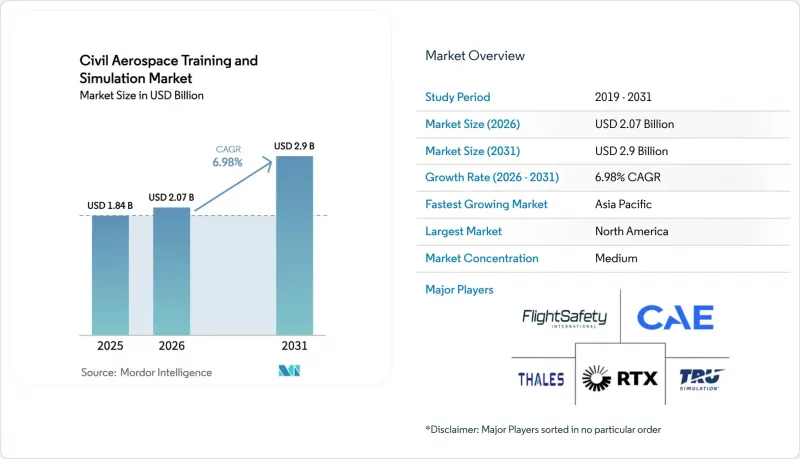
민간 항공우주 교육 및 시뮬레이션 시장 규모는 2025년 19억 3,000만 달러로 평가되었습니다. 2026년에는 20억 7,000만 달러로 확대되어 2026년부터 2031년에 걸쳐 CAGR 6.98%로 성장을 지속하여, 2031년에는 29억 달러에 이를 것으로 예측됩니다.
본 보고서는 시뮬레이터 유형(풀 플라이트 시뮬레이터, 비행 훈련 장치, 기타 시뮬레이터), 용도(민간 항공 및 우주), 최종 사용자(민간 항공사, 비행 훈련 기관, 우주 기관, 기타), 지역(북미, 남미 등)별로 분류되어 있습니다. 시장 예측은 금액(달러) 기준으로 제시되어 있습니다.
세계의 민간 항공우주 교육 및 시뮬레이션 시장 동향 및 인사이트
훈련을 받은 조종사, 기술자, 승무원에 대한 전 세계적 수요 증가
세계 항공기 보유 대수 증가가 인력 공급을 초과하고 있습니다. 보잉사의 2025년 전망에 따르면, 2043년까지 64만 9,000명의 신규 민간 조종사가 필요할 것이며, 그중 42%가 아시아태평양에 집중될 것으로 보입니다. 중국은 2035년까지 약 4,930대의 여객기를 운항하기 위해 10만 명의 조종사를 추가로 채용하는 것을 목표로 하고 있습니다. 인도의 항공사들은 2023년부터 2025년 사이에 1,000대 이상의 협폭체 제트기를 발주해, 이로 인해 각 항공사는 수년 앞까지 시뮬레이터 예약 일정을 확보해야 하는 상황에 처해 있습니다. 또한 정비 기술자에게는 신세대 기체에 대응한 복합재 수리 및 항공전자 장비 업데이트에 관한 정기적인 연수가 요구되고 있으며, 승무원은 고밀도 상황에서의 대피 절차에 관한 인증을 취득해야 합니다. 이러한 수요가 맞물리면서, 학생들은 민간 항공우주 교육 및 시뮬레이션 시장으로 기존 훈련 센터가 감당할 수 있는 규모를 훨씬 뛰어넘는 속도로 유입되고 있으며, 이는 피크 시간대의 부하를 완화하는 고정형 레벨 D 장비와 이동식 VR 유닛 모두에 대한 수요를 촉진하고 있습니다.
초기 단계 훈련에서 VR 및 AR 기반 휴대용 시뮬레이터의 채택 확대
헤드마운트 디스플레이의 보급으로 인해 초급 훈련 커리큘럼은 기존의 교실에서 모듈식 공간으로 전환되고 있습니다. Loft Dynamics는 2024년, EASA(유럽항공안전청)로부터 운영자가 해양 플랫폼이나 임시 교실에 설치할 수 있는 케이블이 필요 없는 VR 헬리콥터 시뮬레이터에 대한 승인을 획득했습니다. CAE가 2025년에 출시할 증강현실(AR) 제품군 ‘CAE Rise’는 조종석 모형에 체크리스트를 오버레이로 표시하여, 훈련 시작 후 50시간 동안의 인지 부하를 경감시킵니다. 미국 공군의 ‘Pilot Training Next’ 프로젝트에서는 첫 비행까지 걸리는 기간을 30% 단축했습니다. 이 지표를 참고하여 민간 학교들도 처리 능력 향상을 도모하고 있습니다. VR 기기의 비용은 레벨 D 시뮬레이터의 불과 2% 정도에 불과하기 때문에 소규모 항공 학교에서도 막대한 부채를 지는 일 없이 민간 항공우주 교육 및 시뮬레이션 시장에 진입할 수 있게 됩니다. 지방 도시의 항공사에서는 현재 이러한 장비를 임대하여 후보생의 사전 선발에 활용하고 있으며, 풀 모션 베이(Full Motion Bay)를 중요한 시험에 할당할 수 있게 되었습니다.
풀플라이트 및 레벨 D 시뮬레이터에 수반되는 높은 자본 비용
B737 MAX나 A320neo 등의 항공기용 레벨 D 시뮬레이터는 해당 항공기의 고도의 기술적 요구 사항을 반영하여 막대한 설비 투자와 지속적인 유지 관리 비용이 소요됩니다. 동남아시아나 아프리카의 은행은 담보로 사전 판매된 이용 시간을 요구하지만, 항공사는 이용 가능량에 대한 증명이 없는 한 장기 계약 체결을 주저하기 때문에 소규모 훈련 학교는 자금 조달의 악순환에 빠지게 됩니다. 리스는 설비 투자 부담을 경감시켜 주지만, 금리 프리미엄이 수반되어 미미한 이익률을 압박하게 됩니다. 와이드바디기용 시뮬레이터의 경우, 가동 시간이 4,000시간 미만이 되면 자산으로서 수익성을 확보할 수 없게 되어, 용량이 메가 허브에 집중되고 주변 지역에 대한 서비스 제공이 불충분해지게 됩니다.
부문별 분석
2025년, 풀플라이트 시뮬레이터는 민간 항공우주 교육 및 시뮬레이션 시장의 75.47%를 차지했습니다. FAA 14 CFR Part 60과 같은 규제 체계에 따라 기종 인증이나 정기 점검 시 사용이 의무화되어 있어, 항공 수요가 침체된 시기에도 일정한 수요가 확보되고 있습니다. 그러나 기타 시뮬레이터 유형에 속하는 민간 항공우주 시뮬레이션 및 훈련 시장 규모는 연평균 성장률(CAGR) 7.24%로 확대될 것으로 예측됩니다. 이는 항공사들이 초급 훈련 및 재훈련을 VR 헤드셋이나 고정식 시뮬레이터(FBD)로 전환하고 있음을 반영합니다.
휴대용 시스템의 보급으로 자본 집약도가 낮아지는 동시에 지리적 전개 범위도 확대되고 있습니다. Loft Dynamics사의 무선 플랫폼은 유압식 모션 메커니즘을 배제하고 운송용 컨테이너에 수납될 수 있어, 팝업식 교실로 활용이 가능합니다. Redbird Flight Simulations사는 2025년에 미국 Part 141 인증 학교로부터 고정식 훈련 장비 수주가 40% 증가했다고 보고했습니다. 규제 당국이 합성 비행 시간 인증을 점진적으로 확대함에 따라, 민간 항공우주 교육 및 시뮬레이션 시장은 고위험 체크 시험을 위한 고충실도 베이와 대량 처리를 지원하는 확장 가능한 VR 랩이라는 이중 구조를 형성하고 있습니다.
지역별 분석
북미는 2025년 매출의 47.17%를 차지하며, OEM 클러스터, 200곳이 넘는 훈련 센터의 밀집된 네트워크, 그리고 정기 점검의 최대 50%를 시뮬레이터 훈련으로 인정하는 FAA 규정이 성장을 주도했습니다. 대당 연간 가동 시간은 5,000시간을 넘는 경우가 많아, 신속한 투자 회수와 소프트웨어 업데이트에 대한 안정적인 애프터마켓 수요가 확보되어 있습니다. 성장은 신규 건설보다 노후화된 베이(bay)의 갱신으로 전환되고 있으며, 777X 및 eVTOL 시뮬레이터의 도입에 따른 추가적인 상승세가 예상됩니다.
아시아태평양은 민간 항공우주 교육 및 시뮬레이션 시장의 견인차 역할을 하고 있으며, 중국, 인도, 인도네시아, 베트남이 역사적인 항공기 확충에 나서고 있어 2031년까지 연평균 7.75%의 성장이 예상됩니다. 중국 정부는 훈련 기관의 금리 부담을 경감하기 위한 우대 융자를 시행하고 있는 반면, 인도에서는 100% 외국인 직접 투자(FDI)가 허용된 것을 계기로 2024년에 CAE와 InterGlobe의 합작 사업이 출범하여 델리와 방갈로르에서 8대의 시뮬레이터가 가동되고 있습니다. 인도네시아의 라이온에어는 2025년에 737 MAX용 시뮬레이터 6대를 발주했으며, 기종 인증 능력의 현지화를 통한 물류상의 이점을 그 이유로 꼽고 있습니다.
EASA(유럽항공안전청)의 관할 하에 있는 유럽에서는 표면상의 성장률은 낮지만, 5년마다 실시되는 재인증 주기를 통해 안정적인 수익을 얻고 있습니다. 이 주기에서는 항공기 소프트웨어 베이스라인에 맞추어 업그레이드를 실시해야 합니다. 중동의 거대 항공사들은 자사 전용 훈련 센터를 운영하고 있으며, 이곳들은 아프리카와 남아시아의 조종사들을 위한 제3자 허브 역할도 하고 있습니다. 지리적 중심성을 활용하여 높은 수익성을 자랑하는 가동률을 실현하고 있습니다. 아프리카에서는 남아프리카 항공이 요하네스버그 센터를 폐쇄한 영향으로 여전히 시장 침투율이 낮은 상황이 지속되고 있습니다. 이로 인해 수습 조종사들은 해외로 나가야만 하며, 그 비용이 수요를 억제하는 요인이 되고 있습니다. 남미는 브라질에 집중되어 있으며, 아줄 항공은 상파울루에서 규모는 작지만 수익성이 높은 A320 및 737 시뮬레이터 클러스터를 운영하고 있습니다.
기타 혜택 :
- 엑셀 형식 시장 예측(ME) 시트
- 3개월간의 애널리스트 지원
자주 묻는 질문
목차
제1장 서론
제2장 조사 방법
제3장 주요 요약
제4장 시장 구도
제5장 시장 규모 및 성장 예측
제6장 경쟁 구도
제7장 시장 기회 및 향후 전망
KTH 26.09.04According to Mordor Intelligence, the civil aerospace simulation and training market size is expected to grow from USD 1.93 billion in 2025 to USD 2.07 billion in 2026 and is forecasted to reach USD 2.9 billion by 2031 at a 6.98% CAGR over 2026-2031.
This report is Segmented by Simulator Type (Full Flight Simulator, Flight Training Devices, and Other Simulator Types), Application (Commercial Aviation and Space), End User (Commercial Airlines, Flight Training Organizations, Space Agencies, and Others), and Geography (North America, South America, and More). Market Forecasts are Provided in Terms of Value (USD).
Global Civil Aerospace Training And Simulation Market Trends and Insights
Rising Global Demand for Trained Pilots, Technicians, and Cabin Crew
The worldwide fleet expansion has outpaced the talent pipelines. Boeing's 2025 outlook indicated a need for 649,000 new commercial pilots by 2043, with 42% of them located in the Asia-Pacific region. China aims to recruit an additional 100,000 pilots by 2035 to operate nearly 4,930 transport aircraft. India's airlines ordered more than 1,000 narrowbody jets between 2023 and 2025, forcing carriers to reserve simulator slots years in advance. Maintenance technicians also require recurrent composite repair and avionics updates for new-generation airframes, while cabin crews must certify in high-density evacuation procedures. These combined needs funnel students into the civil aerospace simulation and training market far more quickly than legacy training centers can scale, fueling demand for both fixed-site Level-D devices and mobile VR units that alleviate peak load.
Growing Adoption of VR- and AR-Based Portable Simulators for Early Stage Training
Head-mounted displays are shifting ab-initio curricula from brick-and-mortar schools to modular spaces. Loft Dynamics gained EASA approval in 2024 for an untethered VR helicopter simulator that operators can deploy aboard offshore platforms or in temporary classrooms. CAE's 2025 rollout of the CAE Rise augmented-reality suite overlays checklists onto cockpit mock-ups, thereby reducing cognitive load during the first 50 hours of training. The US Air Force's Pilot Training Next project cut time-to-wings by 30%, a metric that civilian schools emulate to accelerate throughput. VR devices cost barely 2% of a Level-D simulator, enabling smaller academies to tap into the civil aerospace simulation and training market without incurring heavy debt. Airlines in secondary cities now lease such equipment to pre-screen cadets, freeing full-motion bays for high-stakes checks.
High Capital Costs Associated with Full-Flight and Level-D Simulators
A Level-D simulator for aircraft such as the B737 MAX or A320neo involves significant capital investment and recurring maintenance costs, reflecting the advanced technical requirements of these aircraft. Banks in Southeast Asia and Africa demand pre-sold hours as collateral, yet airlines hesitate to sign lengthy contracts without proof of availability, trapping small schools in a financing loop. Leasing eases capital expenditures but carries rate premiums that erode thin margins. For widebody simulators, utilization below 4,000 hours turns the asset uneconomic, concentrating capacity in megahubs and leaving outlying regions underserved.
Other drivers and restraints analyzed in the detailed report include:
- Use of Digital Twin Technologies to Personalize and Optimize Training Outcomes
- Expansion of Airline Fleets and Introduction of New Aircraft Types Increasing Transition Training Needs
- Limited Availability of Qualified Simulator Instructors and Examiners
For complete list of drivers and restraints, kindly check the Table Of Contents.
Segment Analysis
Full-flight simulators accounted for 75.47% of the civil aerospace simulation and training market in 2025. Regulatory frameworks, such as FAA 14 CFR Part 60, compel their use for type ratings and recurrent checks, ensuring baseline demand even during traffic downturns. Yet, the civil aerospace simulation and training market size for other simulator types is projected to expand at a 7.24% CAGR, reflecting airlines' shifting of ab-initio and refresher tasks to VR headsets and fixed-base devices.
Growth in portable systems reduces capital intensity while widening geographic reach. Loft Dynamics' untethered platform eliminates hydraulic motion and fits inside shipping containers for pop-up classrooms. Redbird Flight Simulations logged a 40% rise in fixed-training-device orders among US Part 141 schools in 2025. As regulators gradually credit more synthetic hours, the civil aerospace simulation and training market gains a two-tier structure: high-fidelity bays for high-stakes checks and scalable VR labs for volume throughput.
Complete Report Scope:
- By Simulator Type
- Full Flight Simulator (FFS)
- Flight Training Devices (FTDs)
- Other Simulator Types
- By Application
- Commercial Aviation
- Space
- By End User
- Commercial Airlines
- Flight Training Organizations
- Space Agencies
- Others
- By Geography
- North America
- United States
- Canada
- Mexico
- South America
- Brazil
- Rest of South America
- Europe
- United Kingdom
- Germany
- France
- Italy
- Spain
- Rest of Europe
- Asia-Pacific
- China
- India
- Japan
- South Korea
- Australia
- Rest of Asia-Pacific
- Middle East and Africa
- Middle East
- Saudi Arabia
- United Arab Emirates
- Rest of Middle East
- Africa
- South Africa
- Rest of Africa
- Middle East
- North America
Geography Analysis
North America retained 47.17% of the 2025 revenue, driven by OEM clusters, a dense network of over 200 training centers, and FAA rules that allow up to 50% of recurrent checks to be credited to simulators. Utilization frequently exceeds 5,000 hours per device per year, ensuring swift payback and steady aftermarket demand for software refreshes. Growth moderates toward replacement of aging bays rather than greenfield builds, with incremental upside tied to 777X and eVTOL simulator launches.
The Asia-Pacific is the locomotive of the civil aerospace simulation and training market, forecasted to grow at a 7.75% annual rate to 2031, as China, India, Indonesia, and Vietnam embark on historic fleet expansions. Beijing funds concessional loans that cut interest costs for training academies, while India's 100% FDI allowance spurred a CAE-InterGlobe joint venture in 2024 with eight simulators online in Delhi and Bangalore. Indonesia's Lion Air ordered six 737 MAX devices in 2025, citing the logistical advantage of localizing type-rating capacity.
Europe, under EASA, exhibits lower headline growth but steady revenue from the five-year revalidation cycle, which compels upgrades to match aircraft software baselines. Middle East mega-carriers operate captive centers that also serve as third-party hubs for African and South Asian pilots, leveraging geographic centrality to achieve high-yield utilization. Africa remains under-penetrated after South African Airways shuttered its Johannesburg center, forcing trainees to travel abroad, an expense that dampens demand. South America is concentrated in Brazil, where Azul sustains a small but profitable cluster of A320 and 737 simulators in Sao Paulo.
- CAE Inc.
- FlightSafety International Inc.
- Thales Group
- RTX Corporation
- The Boeing Company
- TRU Simulation + Training Inc.
- Indra Sistemas S.A.
- FRASCA International, Inc.
- ALSIM EMEA
- Redbird Flight Simulations, Inc.
- Loft Dynamics AG
- REISER Simulation and Training GmbH
- Entrenadores Olarte, S.L.
- Elite Simulation Solutions AG
- Havelsan Inc.
- AXIS Flight Training Systems GmbH
- Airbus SE
- Pan Am Flight Academy
Additional Benefits:
- The market estimate (ME) sheet in Excel format
- 3 months of analyst support
TABLE OF CONTENTS
1 INTRODUCTION
- 1.1 Study Assumptions and Market Definition
- 1.2 Scope of the Study
2 RESEARCH METHODOLOGY
3 EXECUTIVE SUMMARY
4 MARKET LANDSCAPE
- 4.1 Market Overview
- 4.2 Market Drivers
- 4.2.1 Rising global demand for trained pilots, technicians, and cabin crew
- 4.2.2 Increasingly stringent safety and regulatory training requirements
- 4.2.3 Cost advantages of simulation-based training compared to live aircraft operations
- 4.2.4 Growing adoption of VR- and AR-based portable simulators for early stage training
- 4.2.5 Use of digital twin technologies to personalize and optimize training outcomes
- 4.2.6 Expansion of airline fleets and introduction of new aircraft types increasing transition training needs
- 4.3 Market Restraints
- 4.3.1 High capital costs associated with full flight and Level-D simulators
- 4.3.2 Regulatory certification and approval backlogs delaying simulator deployment
- 4.3.3 Rising cybersecurity and data-protection costs for cloud-connected training systems
- 4.3.4 Limited availability of qualified simulator instructors and examiners constraining training capacity
- 4.4 Value / Supply-Chain Analysis
- 4.5 Regulatory Landscape
- 4.6 Technological Outlook
- 4.7 Porter's Five Forces
- 4.7.1 Bargaining Power of Suppliers
- 4.7.2 Bargaining Power of Buyers
- 4.7.3 Threat of New Entrants
- 4.7.4 Threat of Substitutes
- 4.7.5 Competitive Rivalry
5 MARKET SIZE AND GROWTH FORECASTS (VALUE)
- 5.1 By Simulator Type
- 5.1.1 Full Flight Simulator (FFS)
- 5.1.2 Flight Training Devices (FTDs)
- 5.1.3 Other Simulator Types
- 5.2 By Application
- 5.2.1 Commercial Aviation
- 5.2.2 Space
- 5.3 By End User
- 5.3.1 Commercial Airlines
- 5.3.2 Flight Training Organizations
- 5.3.3 Space Agencies
- 5.3.4 Others
- 5.4 By Geography
- 5.4.1 North America
- 5.4.1.1 United States
- 5.4.1.2 Canada
- 5.4.1.3 Mexico
- 5.4.2 South America
- 5.4.2.1 Brazil
- 5.4.2.2 Rest of South America
- 5.4.3 Europe
- 5.4.3.1 United Kingdom
- 5.4.3.2 Germany
- 5.4.3.3 France
- 5.4.3.4 Italy
- 5.4.3.5 Spain
- 5.4.3.6 Rest of Europe
- 5.4.4 Asia-Pacific
- 5.4.4.1 China
- 5.4.4.2 India
- 5.4.4.3 Japan
- 5.4.4.4 South Korea
- 5.4.4.5 Australia
- 5.4.4.6 Rest of Asia-Pacific
- 5.4.5 Middle East and Africa
- 5.4.5.1 Middle East
- 5.4.5.1.1 Saudi Arabia
- 5.4.5.1.2 United Arab Emirates
- 5.4.5.1.3 Rest of Middle East
- 5.4.5.2 Africa
- 5.4.5.2.1 South Africa
- 5.4.5.2.2 Rest of Africa
- 5.4.5.1 Middle East
- 5.4.1 North America
6 COMPETITIVE LANDSCAPE
- 6.1 Market Concentration
- 6.2 Strategic Moves
- 6.3 Market Share Analysis
- 6.4 Company Profiles (includes Global level Overview, Market level overview, Core Segments, Financials as available, Strategic Information, Market Rank/Share, Products and Services, Recent Developments)
- 6.4.1 CAE Inc.
- 6.4.2 FlightSafety International Inc.
- 6.4.3 Thales Group
- 6.4.4 RTX Corporation
- 6.4.5 The Boeing Company
- 6.4.6 TRU Simulation + Training Inc.
- 6.4.7 Indra Sistemas S.A.
- 6.4.8 FRASCA International, Inc.
- 6.4.9 ALSIM EMEA
- 6.4.10 Redbird Flight Simulations, Inc.
- 6.4.11 Loft Dynamics AG
- 6.4.12 REISER Simulation and Training GmbH
- 6.4.13 Entrenadores Olarte, S.L.
- 6.4.14 Elite Simulation Solutions AG
- 6.4.15 Havelsan Inc.
- 6.4.16 AXIS Flight Training Systems GmbH
- 6.4.17 Airbus SE
- 6.4.18 Pan Am Flight Academy
7 MARKET OPPORTUNITIES AND FUTURE OUTLOOK
- 7.1 White-space and Unmet-Need Assessment


