

|
시장보고서
상품코드
2120683
바이오세라믹 : 시장 점유율 분석, 업계 동향과 통계, 성장 예측(2026-2031년)Bioceramics - Market Share Analysis, Industry Trends & Statistics, Growth Forecasts (2026 - 2031) |
||||||
 Mordor Intelligence
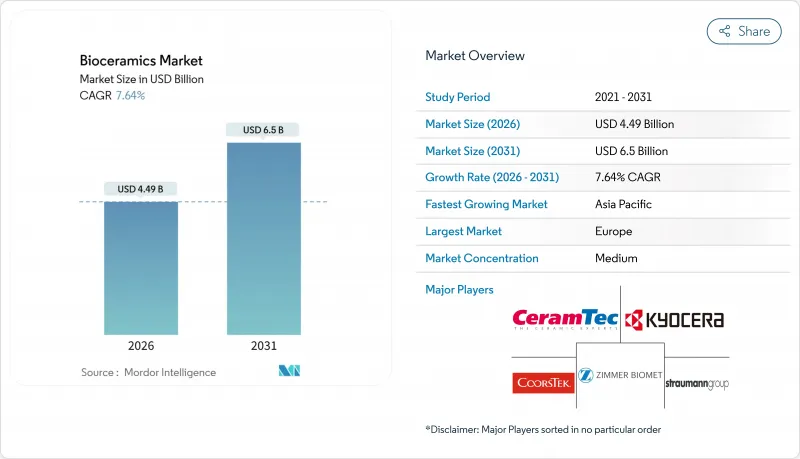
Mordor Intelligence에 의하면, 바이오세라믹 시장 규모는 2026년에 44억 9,000만 달러로 추정되며, 예측 기간(2026년-2031년)에 CAGR 7.64%로 성장을 지속하여, 2031년까지 65억 달러에 이를 전망입니다.
본 보고서는 재료 유형(알루미늄 산화물, 지르코니아 등), 형태(분말 등), 유형(생체 불활성 등), 용도(정형외과 등), 최종 사용자(병원·수술센터,치과·치과 기공소 등), 지역(아시아태평양, 북미, 유럽, 남미, 중동 및 아프리카)별로 분류되어 있습니다. 시장 예측은 금액(달러) 기준으로 제시되어 있습니다.
세계 바이오세라믹 시장 동향 및 인사이트
3D 프린팅을 통한 맞춤형 임플란트의 급속한 보급
현재 미국 규제 당국은 510(k) 심사 절차를 바탕으로 환자 맞춤형 바이오세라믹 의료기기에 대해, 기존 신청 시 36개월이 소요되던 승인 기간을 최단 12개월로 단축하여 승인하고 있습니다. 스트라이커(Stryker)사는 생체 뼈의 다공성을 재현하고 혈관 침투 시간을 절반으로 줄이는 인산칼슘 재질의 두개안면 임플란트에 대한 승인을 획득했습니다. 외과의사들은 복잡한 재건 수술 시 수술 중 성형 작업이 필요 없어지고 마취 시간이 단축되기 때문에 이러한 격자 구조를 선호하여 채택하고 있습니다. 독일 프라운호퍼 연구소의 보고에 따르면, 바인더 제트 공법을 이용한 알루미나 제품은 리드 타임을 5일로 단축하고, 재료 폐기율을 8%까지 낮춥니다. 또한, 층 두께와 후처리를 표준화하는 ISO/ASTM 52900 규격의 도입으로 제조업체는 CE 마크 인증을 위한 통일된 프로세스를 확립할 수 있게 되어, 도입이 더욱 촉진되고 있습니다.
지르코니아 보급을 뒷받침하는 치과 임플란트의 확산 가속화
5년간의 코호트 연구에 따르면, 지르코니아 아바트먼트에서 임플란트 주위염 발생률은 불과 3.2%인 반면, 티타늄 아바트먼트에서는 5.8%로 나타났으며, 이 결과를 바탕으로 임상의들은 세라믹 수복물로 전환을 추진하고 있습니다. 스트로만(Straumann)사는 2025년에 지르코니아 관련 매출이 14% 증가했다고 보고했으며, 이는 동사의 전체 임플란트 제품 라인 성장률을 크게 상회하는 수치입니다. CEREC 플랫폼과 같은 체어사이드 시스템은 예비 소결된 블랭크를 12분 만에 가공하여 당일 납품이 가능하게 함으로써, 치과 기공소의 간접비를 40% 절감합니다. FDA는 지르코니아 세라믹을 클래스 II 의료기기로 분류하는 반면, EU의 MDR은 시판 후 파절 감시를 의무화하고 있어, 이러한 행정 비용이 수직 통합형 기업에 대한 공급 집중을 촉진하고 있습니다.
FDA의 나노 세라믹 분산액에 대한 더욱 엄격한 지침
FDA는 현재 주사용 세라믹에 대해 동적 광산란법 및 전자현미경을 이용한 입자 크기 시험을 의무화하고 있으며, 2년간의 생체 분포 시험도 요구하고 있습니다. 이로 인해 전임상시험 비용에 약 120만 달러가 추가됩니다. 소규모 개발 기업들은 신청에 18개월의 지연을 감수해야 하지만, 유럽 규제 당국은 이를 따르지 않고 있어 기업들은 우선 CE 마크 획득을 우선시하고 있습니다. CeramTec사는 이 규정을 준수하기 위해 2개의 제품 라인을 재설계하고 출시 시기를 2026년으로 연기했습니다.
부문 분석
2025년 현재, 알루미늄 산화물은 바이오세라믹 시장에서 50.18%의 점유율을 유지하고 있으며, 4,000 MPa를 초과하는 압축 강도에 힘입어 2031년까지 연평균 성장률(CAGR) 7.91%를 나타낼 것으로 예측됩니다. 지르코니아는 굽힘 강도를 1,200 MPa 이상으로 높이는 변태 인성화 작용 덕분에 치과 및 두개안면 영역의 적응증에서 더욱 빠르게 성장하고 있습니다.
알루미나(Alumina)는 화학적으로 비활성 물질이기 때문에 인공 고관절 및 인공 슬관절 치환술에서 장기적인 내구성을 뒷받침하는 반면, 지르코니아는 치아 색과 유사한 외관을 특징으로 하여 전치부 수복에 점점 더 많이 채택되고 있습니다. 인산칼슘계 재료는 12개월 이내에 천연 뼈로 재형성되기 때문에 뼈 이식 대체재 시장을 독점하고 있습니다. 탄소계 바이오세라믹는 추간판 등 특수한 틈새 시장을 차지하고 있으며, 생체활성 유리는 전신 항생제를 사용하지 않고 감염 위험을 줄여주는 항균 코팅재로 부상하고 있습니다.
분말 제품은 공차를 ±0.05mm 이내로 유지하는 경제적인 프레스 및 소결 라인 덕분에 2025년 바이오세라믹 시장 규모의 48.45%를 차지했습니다. 한편, 척추체 성형술 및 척추체 후방 성형술이 외래 치료로 전환됨에 따라 액상 주입제는 연평균 성장률(CAGR) 7.88%로 확대되고 있습니다.
주입제는 인산칼슘 또는 황산칼슘에 점도 조절제를 배합하여 12분의 작업 가능 시간을 확보하고 있으며, 형광 투시 하에서 11게이지 바늘을 이용한 투여를 가능하게 합니다. 과립 및 블록은 외과의가 수작업에 의한 형상 형성을 중시하는 턱·안면 외과 분야에서 여전히 중요한 역할을 하고 있습니다. 아시아태평양에서는 고령화에 따라 입원 기간을 1일로 단축할 수 있는 저침습적 척추 보강술이 선호됨에 따라 주입제의 보급률이 가장 높습니다.
지역별 분석
유럽은 2025년 매출의 44.10%를 차지할 것으로 예상되며, 그 기반이 되는 것은 독일의 정밀 가공 클러스터와 폴리에틸렌보다 세라믹 베어링을 우선시하는 프랑스의 보험 환급 제도입니다. 독일에서는 인공 고관절 치환술 시행률이 인구 10만 명당 280건을 초과하여 견실한 치환 주기가 확보되어 있지만, 뼈 상태가 악화된 경우 파절 우려로 인해 재치환술 시 세라믹 사용이 줄어들고 있습니다. 영국에서는 2025년에 지르코니아 임플란트의 보험 적용 범위가 확대되어, 민간 진료가 주류를 이루는 런던 및 잉글랜드 남동부에서 수요가 대폭 증가할 것으로 예측됩니다. 남유럽의 의료 제도에서는 비용 억제가 중시되고 있어, 고급 세라믹 제품은 의료 관광객을 수용하는 민간 클리닉으로 한정되어 있습니다.
아시아태평양은 2031년까지 연평균 성장률(CAGR)이 8.04%로 가장 빠르게 성장하고 있는 지역이며, 그 원동력은 중국의 1조 2,000억 위안 규모의‘건강 중국 2030’ 계획에 대한 지출과, 인도의 5억 국민을 대상으로 하는 ‘아유슈만 바라트’ 보험입니다. 일본의 의약품 및 의료기기 종합기구(PMDA)는 세라믹 제품 임플란트의 수명이 30년에 달한다는 점을 인정하고, 더 젊은 환자에 대한 적용 승인을 확대되고 있습니다. 한국에서는 현재 재이식 수술 시 생체활성 유리 코팅에 대한 보험 적용이 이루어지고 있으며, 감염과 관련된 재입원을 18% 줄이고 연간 2,400억 원의 비용 절감을 목표로 하고 있습니다. 규제 일정에 차이가 보입니다. 중국에서는 국내 임상시험이 의무화되어 있는 반면, 인도에서는 FDA 승인을 인정하는 경우가 많아 다국적 기업에게는 속도 면에서 우위가 있습니다.
북미, 남미, 중동 및 아프리카가 합쳐서 나머지 시장 점유율을 차지하고 있습니다. 미국에서는 메디케어의 DRG 470에 따라 세라믹 고관절 베어링에 대해 건당 1만 8,500달러의 환급이 이루어지고 있어, 활동적인 환자를 대상으로 하는 외래 진료 센터에서의 도입이 촉진되고 있습니다. 캐나다에서는 각 주의 대기 목록으로 인해 환자들이 보다 신속한 치료 옵션을 추구하는 경향이 있어, 자비로 진행하는 업그레이드 사례가 증가하고 있습니다. 브라질에서는 척추체 압박 골절에 대한 생체활성 세라믹의 보험 적용이 승인되었으며, 이 변경으로 인해 연간 8만 5,000건의 수술이 추가되고 있습니다. 사우디아라비아의 ‘비전 2030’에서는 주요 의료 도시에서 60세 미만 환자에 대한 세라믹 인공 고관절 사용이 명시되어 있어, ISO 13356 인증을 취득한 공급업체에 유리한 지역적 수요가 촉진되고 있습니다.
기타 혜택:
- 엑셀 형식 시장 예측(ME) 시트
- 3개월간의 애널리스트 지원
자주 묻는 질문
목차
제1장 서론
제2장 조사 방법
제3장 주요 요약
제4장 시장 구도
제5장 시장 규모와 성장 예측
제6장 경쟁 구도
제7장 시장 기회와 향후 전망
LSH 26.09.08According to Mordor Intelligence, the bioceramics market size is estimated at USD 4.49 billion in 2026, and is expected to reach USD 6.5 billion by 2031, at a CAGR of 7.64% during the forecast period (2026-2031).
This report is Segmented by Material Type (Aluminum Oxide, Zirconia, and More), Form (Powder, and More), Type (Bio-Inert, and More), Application (Orthopedics, and More), End-User (Hospitals and Surgical Centers, Dental Clinics and Laboratories, and More), and Geography (Asia Pacific, North America, Europe, South America, and Middle East and Africa). The Market Forecasts are Provided in Terms of Value (USD).
Global Bioceramics Market Trends and Insights
Rapid Adoption of 3D-Printed Custom Implants
Regulators in the United States now clear patient-specific bioceramic devices under the 510(k) pathway in as little as 12 months, down from 36 months in conventional filings. Stryker won clearance for a calcium-phosphate craniofacial implant that replicates native bone porosity and halves vascular ingrowth time. Surgeons prefer these lattice geometries in complex reconstructions because they eliminate intraoperative contouring and shorten anesthesia exposure. Germany's Fraunhofer Institute reports that binder-jetting alumina slashes lead times to five days and material waste to 8%. Adoption is further helped by ISO/ASTM 52900, which standardizes layer thickness and post-processing, giving manufacturers a harmonized path toward CE-mark approval.
Accelerated Dental-Implant Penetration Boosting Zirconia
Five-year cohort studies show peri-implantitis in only 3.2% of zirconia abutments compared with 5.8% for titanium, nudging clinicians toward ceramic restorations. Straumann reported a 14% jump in zirconia-based revenue in 2025, well ahead of its overall implant line. Chairside systems such as the CEREC platform mill pre-sintered blanks in 12 minutes and allow same-day delivery, slicing laboratory overhead by 40%. The FDA categorizes zirconia ceramics as Class II devices, while the EU MDR imposes post-market fracture surveillance, an administrative cost that consolidates supply among vertically integrated firms.
Stricter FDA Nanoceramic Dispersion Guidelines
The FDA now requires particle-size testing by dynamic light scattering and electron microscopy for injectable ceramics and demands two-year biodistribution studies, adding roughly USD 1.2 million to preclinical costs. Smaller developers face 18-month submission delays while European regulators have not followed suit, prompting firms to seek CE marks first. CeramTec reformulated two product lines to comply, pushing launch dates into 2026.
Other drivers and restraints analyzed in the detailed report include:
- Government Spine-Surgery Programs Fueling Calcium-Phosphate Use
- OEM Shift from Metal to Bio-Inert Ceramic Bearings
- High Sintering Energy Costs Compressing Margins
For complete list of drivers and restraints, kindly check the Table Of Contents.
Segment Analysis
Aluminum oxide retained 50.18% of the bioceramics market share in 2025 and is projected to post a 7.91% CAGR through 2031, supported by compressive strength exceeding 4,000 MPa. Zirconia is growing faster in dental and craniofacial indications due to transformation toughening that boosts flexural strength beyond 1,200 MPa.
Alumina's chemical inertness underpins long-term survival in hip and knee replacements, while zirconia's tooth-colored appearance fuels its uptake in anterior restorations. Calcium-phosphate materials dominate bone-graft substitutes because they remodel into native bone within 12 months. Carbon-based bioceramics occupy specialized niches such as intervertebral discs, and bioactive glass is emerging in antimicrobial coatings that cut infection risk without systemic antibiotics.
Powder products captured 48.45% of the 2025 bioceramics market size thanks to economical press-and-sinter lines that hold tolerances within +-0.05 millimeters. Liquid injectables, however, are advancing at a 7.88% CAGR as vertebroplasty and kyphoplasty shift toward outpatient settings.
Injectables blend calcium phosphate or sulfate with viscosity modifiers to achieve 12-minute working windows, enabling delivery through 11-gauge needles under fluoroscopy. Granules and blocks remain relevant in maxillofacial surgery, where surgeons value manual contouring. Asia Pacific shows the highest injectable penetration because aging populations favor minimally invasive vertebral augmentation that trims hospital stays to a single day.
Complete Report Scope:
- By Material Type
- Aluminum Oxide
- Zirconia
- Calcium Phosphate
- General Purpose
- Hydroxyapatite
- Calcium Sulfate
- Carbon
- Glass
- By Form
- Powder
- Liquid (Injectable)
- Other Forms
- By Type
- Bio-inert
- Bio-active
- Bio-resorbable
- By Application
- Orthopedics
- Dental
- Biomedical
- By End-user
- Hospitals and Surgical Centers
- Dental Clinics and Laboratories
- Research and Academic Institutes
- Biotechnology and Pharmaceutical Companies
- By Geography
- Asia Pacific
- China
- India
- Japan
- South Korea
- Rest of Asia
- North America
- United States
- Canada
- Mexico
- Europe
- Germany
- United Kingdom
- France
- Italy
- Spain
- Rest of Europe
- South America
- Brazil
- Argentina
- Rest of South America
- Middle East and Africa
- Saudi Arabia
- United Arab Emirates
- South Africa
- Egypt
- Rest of Middle East and Africa
- Asia Pacific
Geography Analysis
Europe generated 44.10% of 2025 revenue, anchored by Germany's precision-machining clusters and France's reimbursement that prefers ceramic bearings over polyethylene. Hip replacement incidence exceeds 280 per 100,000 population in Germany, securing a robust replacement cycle, yet revision cases use fewer ceramics due to fracture concerns in compromised bone. The United Kingdom extended zirconia-implant reimbursement in 2025, adding significant volumes in London and Southeast England, where private practice is dominant. Southern European health systems emphasize cost containment, confining premium ceramics to private clinics that serve medical tourists.
Asia Pacific is the fastest-growing region at an 8.04% CAGR through 2031, driven by China's RMB 1.2 trillion Healthy China 2030 spending and India's Ayushman Bharat insurance covering 500 million citizens. Japan's Pharmaceuticals and Medical Devices Agency extends ceramic approvals to younger patients, recognizing their 30-year implant life. South Korea now reimburses bioactive-glass coatings in revision cases, aiming to cut infection-related readmissions by 18% and save KRW 240 billion annually. Regulatory timelines diverge: China requires in-country trials, while India often accepts FDA clearances, giving multinationals a speed advantage.
North America, South America, and the Middle East & Africa collectively hold the remaining share. In the United States, Medicare DRG 470 reimburses ceramic hip bearings at USD 18,500 per procedure, supporting adoption in ambulatory centers that target active patients. Canada sees private-pay upgrades because provincial wait lists push patients toward faster options. Brazil reimburses bioactive ceramics for vertebral compression fractures, a change that adds 85,000 procedures yearly. Saudi Arabia's Vision 2030 specifies ceramic hips for patients under 60 in flagship medical cities, fostering regional demand that favors suppliers with ISO 13356 certification.
- Berkeley Advanced Biomaterials
- BoneSupport AB
- CAM Bioceramics
- CeramTec GmbH
- CGbio
- CoorsTek Inc.
- CTL Amedica
- Dentsply Sirona
- dsm-firmenich
- FKG Dentaire Sarl
- Himed
- Institut Straumann AG
- Ivoclar Vivadent AG
- Jyoti Ceramic
- KYOCERA Corporation
- Medical Device Business Services, Inc.
- Morgan Advanced Materials
- Sagemax
- Shandong Sinocera Functional Materials Co., Ltd.
- Stryker
- TOSOH CERAMICS CO., LTD.
- Zimmer Biomet
Additional Benefits:
- The market estimate (ME) sheet in Excel format
- 3 months of analyst support
TABLE OF CONTENTS
1 Introduction
- 1.1 Study Assumptions & Market Definition
- 1.2 Scope of the Study
2 Research Methodology
3 Executive Summary
4 Market Landscape
- 4.1 Market Overview
- 4.2 Market Drivers
- 4.2.1 Rapid adoption of 3D-printed custom implants
- 4.2.2 Accelerated dental-implant penetration boosting zirconia
- 4.2.3 Government spine-surgery programs fuelling calcium-phosphate use
- 4.2.4 OEM shift from metal to bio-inert ceramic bearings
- 4.2.5 Bioactive-glass coatings for antimicrobial orthopedic screws
- 4.3 Market Restraints
- 4.3.1 Stricter FDA nanoceramic dispersion guidelines
- 4.3.2 Threat of substitutes
- 4.3.3 High sintering energy costs compressing margins
- 4.4 Value Chain Analysis
- 4.5 Porter's Five Forces
- 4.5.1 Bargaining Power of Suppliers
- 4.5.2 Bargaining Power of Buyers
- 4.5.3 Threat of New Entrants
- 4.5.4 Threat of Substitutes
- 4.5.5 Degree of Competition
5 Market Size and Growth Forecasts (Value)
- 5.1 By Material Type
- 5.1.1 Aluminum Oxide
- 5.1.2 Zirconia
- 5.1.3 Calcium Phosphate
- 5.1.3.1 General Purpose
- 5.1.3.2 Hydroxyapatite
- 5.1.4 Calcium Sulfate
- 5.1.5 Carbon
- 5.1.6 Glass
- 5.2 By Form
- 5.2.1 Powder
- 5.2.2 Liquid (Injectable)
- 5.2.3 Other Forms
- 5.3 By Type
- 5.3.1 Bio-inert
- 5.3.2 Bio-active
- 5.3.3 Bio-resorbable
- 5.4 By Application
- 5.4.1 Orthopedics
- 5.4.2 Dental
- 5.4.3 Biomedical
- 5.5 By End-user
- 5.5.1 Hospitals and Surgical Centers
- 5.5.2 Dental Clinics and Laboratories
- 5.5.3 Research and Academic Institutes
- 5.5.4 Biotechnology and Pharmaceutical Companies
- 5.6 By Geography
- 5.6.1 Asia Pacific
- 5.6.1.1 China
- 5.6.1.2 India
- 5.6.1.3 Japan
- 5.6.1.4 South Korea
- 5.6.1.5 Rest of Asia
- 5.6.2 North America
- 5.6.2.1 United States
- 5.6.2.2 Canada
- 5.6.2.3 Mexico
- 5.6.3 Europe
- 5.6.3.1 Germany
- 5.6.3.2 United Kingdom
- 5.6.3.3 France
- 5.6.3.4 Italy
- 5.6.3.5 Spain
- 5.6.3.6 Rest of Europe
- 5.6.4 South America
- 5.6.4.1 Brazil
- 5.6.4.2 Argentina
- 5.6.4.3 Rest of South America
- 5.6.5 Middle East and Africa
- 5.6.5.1 Saudi Arabia
- 5.6.5.2 United Arab Emirates
- 5.6.5.3 South Africa
- 5.6.5.4 Egypt
- 5.6.5.5 Rest of Middle East and Africa
- 5.6.1 Asia Pacific
6 Competitive Landscape
- 6.1 Market Concentration
- 6.2 Strategic Moves
- 6.3 Market Share(%)/Ranking Analysis
- 6.4 Company Profiles (includes Global level Overview, Market level overview, Core Segments, Financials as available, Strategic Information, Market Rank/Share for key companies, Products and Services, and Recent Developments)
- 6.4.1 Berkeley Advanced Biomaterials
- 6.4.2 BoneSupport AB
- 6.4.3 CAM Bioceramics
- 6.4.4 CeramTec GmbH
- 6.4.5 CGbio
- 6.4.6 CoorsTek Inc.
- 6.4.7 CTL Amedica
- 6.4.8 Dentsply Sirona
- 6.4.9 dsm-firmenich
- 6.4.10 FKG Dentaire Sarl
- 6.4.11 Himed
- 6.4.12 Institut Straumann AG
- 6.4.13 Ivoclar Vivadent AG
- 6.4.14 Jyoti Ceramic
- 6.4.15 KYOCERA Corporation
- 6.4.16 Medical Device Business Services, Inc.
- 6.4.17 Morgan Advanced Materials
- 6.4.18 Sagemax
- 6.4.19 Shandong Sinocera Functional Materials Co., Ltd.
- 6.4.20 Stryker
- 6.4.21 TOSOH CERAMICS CO., LTD.
- 6.4.22 Zimmer Biomet
7 Market Opportunities and Future Outlook
- 7.1 White-space and Unmet-need Assessment
- 7.2 Developing Methods to Produce Customized Nano-ceramics


