

|
시장보고서
상품코드
2120692
예방 배신 : 시장 점유율 분석, 업계 동향과 통계, 성장 예측(2026-2031년)Preventive Vaccines - Market Share Analysis, Industry Trends & Statistics, Growth Forecasts (2026 - 2031) |
||||||
 Mordor Intelligence
Mordor Intelligence에 의하면, 예방 배신 시장 규모는 2026년에 795억 2,000만 달러로 추정되며, 예측 기간(2026년-2031년)에 CAGR5.46%로 확대되어 2031년에는 1,037억 3,000만 달러에 이를 전망입니다.
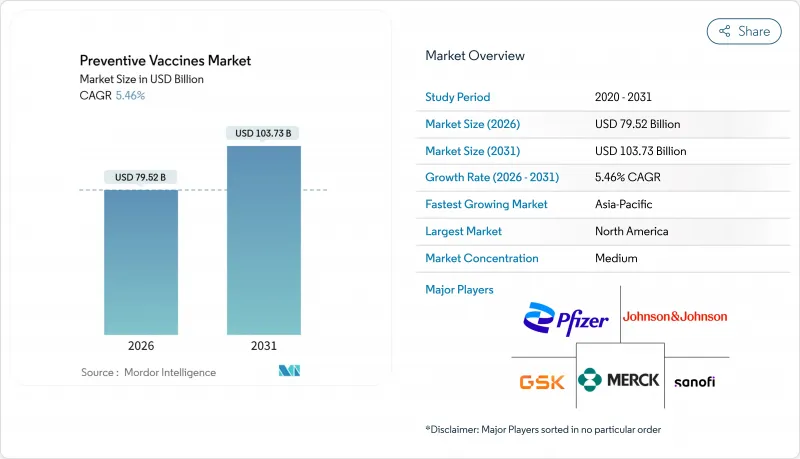
본 보고서는 백신의 유형(생백신/약독화 백신, 불활성화 백신 등), 질병의 유형(폐렴구균, 소아마비 바이러스, 간염, 인플루엔자, 홍역, 유행성 이하선염, 풍진(MMR) 등),연령대(소아, 청소년 등), 최종 사용자(정부 예방접종 프로그램 등), 지역(북미 등)별로 분류되어 있습니다. 시장 전망은 금액(달러) 기준으로 제시되어 있습니다.
전 세계 예방 백신 시장 동향 및 인사이트
감염병 확산
2024년부터 2025년에 걸쳐 동남아시아 및 사하라 이남 아프리카 전역에서 홍역 환자 수가 15% 증가하여, 지난 10년간의 감소 추세가 역전되었습니다. 이에 따라 모듈식 충전 및 마무리 라인을 보유한 공급업체에 우대 조치가 적용되는 60일간의 긴급 조달 조치가 발동되었습니다. 도시화와 기후 변화에 따른 병원체 감염 경로의 확대로 인해, 임상의들은 폐렴구균 등의 병원체에 대한 예방 대책을 우선시할 수밖에 없게 되었습니다. 2024년부터 2025년 시즌 동안, 미국에서 RSV로 인한 영아 입원 환자 수가 22% 증가했습니다. 이에 따라 임산부에 대한 백신 접종이 권장되게 되어, 연간 370만 명의 신생아가 예방접종 대상에 포함될 것입니다. 그 결과, 기초 수요가 급증하면서 예방 백신 시장은 장기적인 성장 기반으로서 더욱 견고해지고 있습니다.
정부의 예방접종 자금 지원 및 의무화
정책 입안자들이 감염병 유행으로 인한 비용을 인식함에 따라, 백신 접종에 대한 전 세계 공공 예산은 2023년 141억 달러에서 2025년에는 183억 달러로 증가했습니다. 미국의 ‘어린이 백신(VFC)’ 프로그램은 대상 범위를 19-26세의 무보험 성인으로 확대하여, HPV 및 수막구균 백신 접종 대상자가 420만 명 증가했습니다. 인도의 전국적 규모의 폐렴구균 백신 입찰(4억 2,000만 달러 상당)은 세람 인스티튜트와 바라트 바이오텍에 균등하게 분배되어, 국내 공급을 우선시하는 입장이 부각되었습니다. 유럽에서는 학교와 직장에서의 백신 접종 의무화가 강화되고, 면제 조항의 허점이 메워지면서 기초 접종률이 상승하고 있습니다.
부작용 위험과 백신 접종에 대한 주저함이 급증
유럽의약품청(EMA) 기록에 따르면, 2025년에는 1억 회 접종당 1,847건의 중대한 이상반응이 보고되었으나, 이는 2023년과 거의 비슷한 수준이었습니다. 그러나 소셜 미디어를 통한 확산으로 인해 일시적으로 접종률이 하락했습니다. 널리 보도된 심근염 사례로 인해 미국의 백신 신뢰도는 9포인트 하락했으나,위험-이익에 관한 최신 데이터가 100만 회 접종당 심근염 발병 건수는 불과 12.6건인 반면, 코로나19 감염 100만 건당 450건의 입원을 예방할 수 있음을 보여주자, 8개월 이내에 신뢰도는 회복되었습니다. WHO의 ‘백신 안전망(Vaccine Safety Net)’은 5,000만 명의 사용자에게 도달한 3,200건의 허위 정보 게시물을 식별했으며, 이에 따라 플랫폼 측과 실시간 사실 확인에 관한 협약을 체결해야 했습니다.
부문 분석
2025년, 생백신 및 약독화 백신은 MMR 및 수두 예방접종 일정에 힘입어 예방 백신 시장 점유율의 26.55%를 유지했습니다. 서브유닛 및 재조합 플랫폼은 규제 당국이 역변이 위험을 배제하고 물류를 간소화하는 제조법을 선호함에 따라 연평균 성장률(CAGR) 6.25%로 확대될 것으로 예측됩니다. 화이자의 20가 백신 ‘프리브너 20’은 혈청형 커버리지를 확대함으로써 2024년 6월 출시 후 12개월 이내에 미국 성인 시장에서 38%의 점유율을 확보했습니다. 불활성화 소아마비 백신 및 A형 간염 백신은 1회당 비용이 조달을 좌우하는 대규모 예방접종 캠페인에서 계속해서 지배적인 위치를 차지하고 있습니다. 독소이드 제제는 산부인과 의료 및 외상 예방과 관련하여 부스터 접종에 대한 안정적인 수요를 유지하고 있습니다.
mRNA 백신의 성장세는 코로나19에 그치지 않고, 인플루엔자 및 RSV 적응증으로까지 확대되고 있습니다. 모더나(Moderna)는 2025년 1월, mRNA 기반 인플루엔자·코로나19 복합 백신의 3상 임상시험을 시작했으며, 연 2회 접종을 1회로 통합하는 2027년 출시를 목표로 하고 있습니다. 바이오엔테크(BioNTech)의 말라리아 백신 후보는 2025년 탄자니아와 모잠비크에서 2b상 임상시험에 들어갈 예정이며, 자사의 지질 나노입자 플랫폼을 재사용함으로써 일반적인 개발 기간을 3-4년 단축했습니다. 바이러스 벡터나 바이러스 유사 입자(VLP)를 이용한 백신은 비용에 민감한 시장에서 에볼라 출혈열의 ‘링 전략’이나 HPV 백신 접종 캠페인 등 틈새 시장에서 역할을 수행하고 있습니다.
2025년, 인플루엔자는 질병 관련 매출의 20.53%를 차지했으며, 매년 이루어지는 제제 개선과 고용주의 예방접종 프로그램에 힘입어 성장세를 이어갔습니다. 홍역·유행성 이하선염·풍진(MMR) 백신은 팬데믹 기간에 발생한 접종률 격차가 유행을 초래함에 따라, 2031년까지 연평균 성장률(CAGR) 6.85%를 나타낼 것으로 예측됩니다. WHO의 집계에 따르면, 2024년 홍역 환자 수는 12만 건으로 전년 대비 40% 증가했습니다. 폐렴구균 백신은 병원 내에서 유행하고 있는 내성 균주에 대응하기 위해 접종 대상 연령이 확대됨에 따라 혜택을 보고 있습니다.
코로나19 부스터 접종은 2025년에 풍토병으로 전환되어, 고령자에 대한 연 1회 접종이 권장되고 있습니다. 이에 따라 화이자(Pfizer)와 모더나(Moderna)는 2025년 4분기 한 분기 동안만 62억 달러의 수익을 올렸습니다. HPV 백신의 접종률은 유효성을 유지하면서 비용을 60% 절감하는 Gavi의 1회 접종 지침 덕분에 저·중소득 국가(LMICs)에서 가속화되고 있습니다. 고령자 및 임산부를 대상으로 한 RSV 백신은 2023년 중반까지는 존재하지 않았던 카테고리로, 가장 빠르게 성장하고 있는 분야가 되었습니다.
지역별 분석
북미는 2025년 예방 백신 시장 점유율의 39.13%를 차지했습니다. 이는 1인당 지출액이 높은 데다, 변이주 승인 기간을 6개월로 단축한 FDA의 ‘프로젝트 넥스트젠(Project NextGen)’과 같은 신속 승인 체계에 힘입은 결과입니다. 메디케어의 비용 분담 폐지로 대상 고령자 수가 1,200만 명 증가했고, 캐나다가 2025년에 RSV 관련 지침을 통일함에 따라 북미 대륙 전체에 걸쳐 통일된 수요 곡선이 형성되었습니다.
아시아태평양은 2031년까지 연평균 성장률(CAGR) 7.51%를 나타낼 것으로 예측되며, 이는 세계에서 가장 빠른 성장률입니다. 인도에서 4억 2,000만 달러 규모의 폐렴구균 백신 입찰이 Bharat Biotech사와 Serum Institute사로 분할된 것은 생산 능력의 현지화를 상징하는 사례입니다. 중국 규제 당국은 2025년, 시노팜(Sinopharm)사의 4가 독감 백신과 캔시노(CanSino)사의 흡입형 코로나19 부스터를 포함한 14종의 신규 백신을 승인했습니다. 이는 중국의 ‘제14차 5개년 계획’에 명시된 혁신 목표에 부합하는 조치입니다. 일본은 2024년에 HPV 백신의 권장 대상을 남성으로까지 확대했으며, 한편 호주는 2025년에 GSK사의 RSV 백신을 신속 승인함으로써 아시아태평양 고소득 국가들 간의 보조를 맞췄습니다.
유럽에서는 EMA를 통한 규제 조화와 공동 조달에 의존하고 있으며, 이를 통해 협상력이 강화되고 있습니다. 프랑스와 독일은 2025년부터 어린이집 입소에 MMR 백신 접종을 의무화하여, 이에 따라 수요가 120만 회분 증가했습니다. 아프리카 28개국에 걸친 디지털 등록 제도를 통해 모바일 기반 인식 제고 활동을 실시한 결과, 2024년부터 2025년에 걸쳐 백신 미접종 아동 수가 19% 감소했습니다. 남미 지역의 성장 동력은 브라질의 국가 프로그램과 단위 비용을 최대 35% 절감하는 PAHO의 입찰에 집중되어 있습니다. 한편, 아르헨티나는 2025년에 영아용 B형 수막구균 백신을 추가하여 2,800만 달러 규모의 조달 경로를 개척했습니다.
기타 혜택:
- 엑셀 형식 시장 예측(ME) 시트
- 3개월간의 애널리스트 지원
자주 묻는 질문
목차
제1장 서론
제2장 조사 방법
제3장 주요 요약
제4장 시장 구도
제5장 시장 규모와 성장 예측
제6장 경쟁 구도
제7장 시장 기회와 향후 전망
LSH 26.09.08According to Mordor Intelligence, the preventive vaccines market size is estimated at USD 79.52 billion in 2026, and is expected to reach USD 103.73 billion by 2031, at a CAGR of 5.46% during the forecast period (2026-2031).
This report is Segmented by Vaccine Type (Live/Attenuated Vaccines, Inactivated Vaccines and More), Disease Type (Pneumococcal, Poliovirus, Hepatitis, Influenza, Measles, Mumps, and Rubella (MMR), and More), Age Group (Pediatrics, Adolescents, and More), End-User (Government Immunization Programs, and More), and Geography (North America, and More). The Market Forecasts are Provided in Terms of Value (USD).
Global Preventive Vaccines Market Trends and Insights
Growing Prevalence of Infectious Diseases
Measles cases climbed 15% across Southeast Asia and Sub-Saharan Africa from 2024 to 2025, reversing a decade of gains and triggering 60-day emergency procurements that reward suppliers with modular fill-finish lines. Vector expansion linked to urbanization and climate change is pushing clinicians to prioritize prevention for pathogens such as pneumococcus. U.S. RSV hospitalizations among infants rose 22% in the 2024-2025 season, prompting a maternal vaccination recommendation that opens an additional 3.7 million annual births to immunization. The net effect is a surge in base demand that reinforces the preventive vaccines market as a long-term growth platform.
Government Immunization Funding & Mandates
Global public budgets for vaccination escalated to USD 18.3 billion in 2025, up from USD 14.1 billion in 2023, as policymakers internalize outbreak costs. The U.S. Vaccines for Children program widened eligibility to uninsured adults aged 19-26, adding 4.2 million beneficiaries for HPV and meningococcal coverage. India's nationwide pneumococcal tender worth USD 420 million split evenly between Serum Institute and Bharat Biotech, underscoring domestic supply preference. Tightening school and workplace mandates in Europe are closing exemption loopholes and shoring up baseline uptake.
Risk of Adverse Events & Hesitancy Spikes
The European Medicines Agency logged 1,847 serious events per 100 million doses in 2025, a flat rate versus 2023, yet social amplification temporarily depressed uptake. A well-publicized myocarditis case cut U.S. confidence by 9 points but rebounded within 8 months after updated risk-benefit data showed only 12.6 myocarditis cases per million doses against 450 hospitalizations averted per million COVID-19 infections. WHO's Vaccine Safety Net flagged 3,200 misinformation posts reaching 50 million users, necessitating real-time fact-checking deals with platforms.
Other drivers and restraints analyzed in the detailed report include:
- Breakthroughs in mRNA & Modular Vaccine Platforms
- Expansion of Life-Course (Adult & Senior) Vaccination Programs
- High R&D and Compliance Costs
For complete list of drivers and restraints, kindly check the Table Of Contents.
Segment Analysis
Live and attenuated products retained 26.55% preventive vaccines market share in 2025, anchored by MMR and varicella schedules. Subunit and recombinant platforms are forecast to advance at a 6.25% CAGR as regulators favor constructs that remove reversion risk and simplify logistics. Pfizer's 20-valent Prevnar 20 secured 38% of the U.S. adult market within 12 months of its June 2024 launch by expanding serotype coverage. Inactivated polio and hepatitis A vaccines continue to dominate mass campaigns where dose cost rules procurement. Toxoid options retain steady booster demand tied to obstetric care and injury prophylaxis.
Momentum for mRNA vaccines extends beyond COVID-19 into influenza and RSV indications. Moderna began Phase III testing of a combined mRNA flu-COVID shot in January 2025, eyeing a 2027 launch that consolidates two annual injections into one. BioNTech's malaria candidate entered Phase IIb in Tanzania and Mozambique during 2025, reusing its lipid nanoparticle platform to shave 3-4 years off typical timelines. Viral-vector and virus-like particle constructs play niche roles such as Ebola rings and HPV campaigns in cost-sensitive markets.
Influenza held 20.53% of disease revenue in 2025, sustained by annual reformulation and employer programs. Measles-mumps-rubella vaccines are projected to grow 6.85% CAGR through 2031 as pandemic-era coverage gaps spark outbreaks; WHO tallied 120,000 measles cases in 2024, a 40% jump year over year. Pneumococcal vaccines benefit from wider age indications addressing resistant strains circulating in hospitals.
COVID-19 boosters transitioned to endemic status in 2025 with annual recommendations for older adults, generating USD 6.2 billion revenue in Q4 2025 alone for Pfizer and Moderna. HPV uptake accelerates in LMICs thanks to single-dose Gavi guidelines that cut costs 60% while maintaining efficacy. RSV shots for older adults and maternal schedules constitute the fastest-growing slice, a category absent before mid-2023.
Complete Report Scope:
- By Vaccine Type
- Live / Attenuated Vaccines
- Inactivated Vaccines
- Subunit / Recombinant Vaccines
- Toxoid Vaccines
- mRNA Vaccines
- Other Vaccine Types
- By Disease Type
- Pneumococcal
- Poliovirus
- Hepatitis (A, B, E)
- Influenza
- Measles, Mumps & Rubella (MMR)
- COVID-19
- Human Papillomavirus (HPV)
- Respiratory Syncytial Virus (RSV)
- Other Disease Types
- By Age Group
- Pediatrics (0-18 yrs)
- Adolescents (12-18 yrs)
- Adults (19-59 yrs)
- Geriatrics (?60 yrs)
- By End-User
- Government Immunization Programs
- Hospitals & Specialty Clinics
- Retail & Community Pharmacies
- Online / Tele-pharmacy Channels
- By Geography
- North America
- United States
- Canada
- Mexico
- Europe
- Germany
- United Kingdom
- France
- Italy
- Spain
- Rest of Europe
- Asia-Pacific
- China
- India
- Japan
- Australia
- South Korea
- Rest of Asia-Pacific
- Middle East and Africa
- GCC
- South Africa
- Rest of Middle East and Africa
- South America
- Brazil
- Argentina
- Rest of South America
- North America
Geography Analysis
North America commanded 39.13% of preventive vaccines market share in 2025, sustained by high per-capita spending and rapid approval frameworks such as the FDA's Project NextGen, which cut variant clearance timelines to 6 months. Medicare's removal of cost-sharing expanded the senior addressable pool by 12 million individuals, and Canada synchronized RSV guidance in 2025, creating a unified continental demand curve.
Asia-Pacific is forecast to post a 7.51% CAGR to 2031, the swiftest worldwide. India's USD 420 million pneumococcal tender split between Bharat Biotech and Serum Institute exemplifies capacity localization. China's regulator cleared 14 new vaccines in 2025, including Sinopharm's quadrivalent flu and CanSino's inhaled COVID-19 booster, consistent with its Five-Year Plan innovation targets. Japan broadened HPV recommendations to boys in 2024, while Australia fast-tracked GSK's RSV shot in 2025 to maintain synchronicity across high-income APAC nodes.
Europe relies on EMA harmonization and pooled procurement that amplify bargaining power. France and Germany mandated MMR for daycare entry in 2025, lifting demand by 1.2 million doses. Digital registries across 28 African countries cut zero-dose children 19% during 2024-2025 via mobile outreach. South American momentum centers on Brazil's national program and PAHO tenders that trim unit costs up to 35%, while Argentina added meningococcal B for infants in 2025, opening a USD 28 million procurement lane.
- AstraZeneca
- Bavarian Nordic
- Bharat Biotech International Ltd.
- BioNTech
- CSL Limited (Seqirus)
- Daiichi Sankyo
- Emergent Bio Solutions
- GlaxoSmithKline
- Johnson & Johnson
- Merck
- Moderna
- Novavax
- Pfizer
- Sanofi
- Serum Institute of India
- Sinopharm Group Co. Ltd.
- Sinovac Biotech
- Takeda Pharmaceuticals
- Valneva
- Walvax Biotechnology Co. Ltd.
Additional Benefits:
- The market estimate (ME) sheet in Excel format
- 3 months of analyst support
TABLE OF CONTENTS
1 Introduction
- 1.1 Study Assumptions & Market Definition
- 1.2 Scope of the Study
2 Research Methodology
3 Executive Summary
4 Market Landscape
- 4.1 Market Overview
- 4.2 Market Drivers
- 4.2.1 Growing prevalence of infectious diseases
- 4.2.2 Government immunization funding & mandates
- 4.2.3 Breakthroughs in mRNA & modular vaccine platforms
- 4.2.4 Expansion of life-course (adult & senior) vaccination programs
- 4.2.5 Digital immunization registries enabling micro-targeting in LMICs
- 4.2.6 Thermostable formulations reducing cold-chain dependency
- 4.3 Market Restraints
- 4.3.1 Risk of adverse events & hesitancy spikes
- 4.3.2 High R&D and compliance costs
- 4.3.3 Global glass-vial & fill-finish bottlenecks
- 4.3.4 Margin squeeze from tender-based procurement in MICs
- 4.4 Supply-Chain Analysis
- 4.5 Regulatory Landscape
- 4.6 Technological Outlook
- 4.7 Porter's Five Forces
- 4.7.1 Threat of New Entrants
- 4.7.2 Bargaining Power of Buyers
- 4.7.3 Bargaining Power of Suppliers
- 4.7.4 Threat of Substitutes
- 4.7.5 Intensity of Competitive Rivalry
5 Market Size & Growth Forecasts (Value, USD)
- 5.1 By Vaccine Type
- 5.1.1 Live / Attenuated Vaccines
- 5.1.2 Inactivated Vaccines
- 5.1.3 Subunit / Recombinant Vaccines
- 5.1.4 Toxoid Vaccines
- 5.1.5 mRNA Vaccines
- 5.1.6 Other Vaccine Types
- 5.2 By Disease Type
- 5.2.1 Pneumococcal
- 5.2.2 Poliovirus
- 5.2.3 Hepatitis (A, B, E)
- 5.2.4 Influenza
- 5.2.5 Measles, Mumps & Rubella (MMR)
- 5.2.6 COVID-19
- 5.2.7 Human Papillomavirus (HPV)
- 5.2.8 Respiratory Syncytial Virus (RSV)
- 5.2.9 Other Disease Types
- 5.3 By Age Group
- 5.3.1 Pediatrics (0-18 yrs)
- 5.3.2 Adolescents (12-18 yrs)
- 5.3.3 Adults (19-59 yrs)
- 5.3.4 Geriatrics (?60 yrs)
- 5.4 By End-User
- 5.4.1 Government Immunization Programs
- 5.4.2 Hospitals & Specialty Clinics
- 5.4.3 Retail & Community Pharmacies
- 5.4.4 Online / Tele-pharmacy Channels
- 5.5 By Geography
- 5.5.1 North America
- 5.5.1.1 United States
- 5.5.1.2 Canada
- 5.5.1.3 Mexico
- 5.5.2 Europe
- 5.5.2.1 Germany
- 5.5.2.2 United Kingdom
- 5.5.2.3 France
- 5.5.2.4 Italy
- 5.5.2.5 Spain
- 5.5.2.6 Rest of Europe
- 5.5.3 Asia-Pacific
- 5.5.3.1 China
- 5.5.3.2 India
- 5.5.3.3 Japan
- 5.5.3.4 Australia
- 5.5.3.5 South Korea
- 5.5.3.6 Rest of Asia-Pacific
- 5.5.4 Middle East and Africa
- 5.5.4.1 GCC
- 5.5.4.2 South Africa
- 5.5.4.3 Rest of Middle East and Africa
- 5.5.5 South America
- 5.5.5.1 Brazil
- 5.5.5.2 Argentina
- 5.5.5.3 Rest of South America
- 5.5.1 North America
6 Competitive Landscape
- 6.1 Market Concentration
- 6.2 Market Share Analysis
- 6.3 Company Profiles (includes Global level Overview, Market level overview, Core Segments, Financials, Strategic Information, Market Rank/Share, Products & Services, Recent Developments)
- 6.3.1 AstraZeneca PLC
- 6.3.2 Bavarian Nordic A/S
- 6.3.3 Bharat Biotech International Ltd.
- 6.3.4 BioNTech SE
- 6.3.5 CSL Limited (Seqirus)
- 6.3.6 Daiichi Sankyo Company Limited
- 6.3.7 Emergent BioSolutions Inc.
- 6.3.8 GSK plc
- 6.3.9 Johnson & Johnson Services, Inc.
- 6.3.10 Merck & Co., Inc.
- 6.3.11 Moderna, Inc.
- 6.3.12 Novavax Inc.
- 6.3.13 Pfizer Inc.
- 6.3.14 Sanofi
- 6.3.15 Serum Institute of India Pvt. Ltd.
- 6.3.16 Sinopharm Group Co. Ltd.
- 6.3.17 Sinovac Biotech Ltd.
- 6.3.18 Takeda Pharmaceutical Co. Ltd.
- 6.3.19 Valneva SE
- 6.3.20 Walvax Biotechnology Co. Ltd.
7 Market Opportunities & Future Outlook
- 7.1 White-space & Unmet-need Assessment


