

|
시장보고서
상품코드
2120712
클라우드 서비스 중개(CSB) : 시장 점유율 분석, 업계 동향과 통계, 성장 예측(2026-2031년)Cloud Services Brokerage (CSB) - Market Share Analysis, Industry Trends & Statistics, Growth Forecasts (2026 - 2031) |
||||||
 Mordor Intelligence
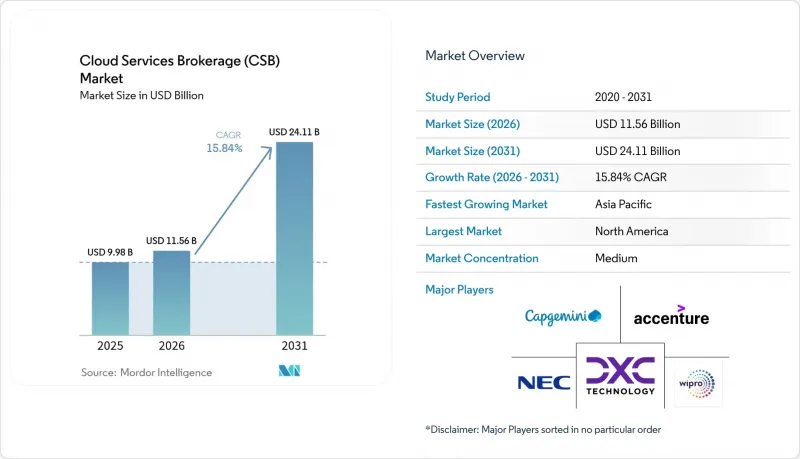
클라우드 서비스 중개 시장 규모는 2026년에 115억 6,000만 달러로 추정되며, 2025년 99억 8,000만 달러에서 확대되어 2031년에는 241억 1,000만 달러에 달할 것으로 예측됩니다.
2026년부터 2031년까지의 연평균 성장률(CAGR)은 15.84%가 될 것으로 전망됩니다.
본 보고서는 플랫폼(사내 브로커 기능 및 사외 브로커 기능), 도입 모델(퍼블릭 클라우드, 프라이빗 클라우드, 하이브리드 클라우드), 기업 규모(중소기업 및 대기업), 최종사용자 산업(IT·통신, 은행·금융 서비스·보험, 소매·소비재 등) 및 지역별로 분류되어 있습니다.
세계 클라우드 서비스 중개(CSB) 시장 동향 및 인사이트
하이브리드 및 멀티 클라우드 도입 급증
하이브리드 및 멀티 클라우드 전략은 현재 CIO의 로드맵을 주도하고 있으며, 2025년까지 기업의 92%가 멀티 클라우드 아키텍처를 추구할 것으로 예상됩니다. 그 결과 발생하는 환경의 분산에는 서로 다른 환경을 통합된 정책 도메인으로 통합하면서, 조직을 벤더 종속성으로부터 보호하는 브로커 플랫폼이 요구되고 있습니다. 데이터 거주지 규제로 인해 퍼블릭 클라우드로의 완전한 마이그레이션이 금지됨에 따라, 금융 서비스 기업이 그 최전선에 서 있습니다. Oracle과 Google Cloud의 직접 상호연결은 서비스 브로커가 개방형 인터넷을 거치지 않고도 저지연 크로스 클라우드 데이터 흐름을 실현하는 방법을 보여줍니다. 컨테이너의 보급은 복잡성을 가중시키고 있으며, DevOps 팀이 콘솔별 스크립트를 활용하는 수고를 덜 수 있도록 CSB에는 고급 쿠버네티스 오케스트레이션 기능 제공이 요구되고 있습니다. 엣지 워크로드가 추가됨에 따라, 브로커는 온프레미스, 퍼블릭, 엣지 각 노드에 걸쳐 단일 거버넌스 패브릭을 제공하여 기술 격차와 운영 위험을 최소화합니다.
기업 클라우드 지출 가속화
최종사용자의 클라우드 지출은 2025년에 7,234억 달러에 달할 것으로 예상되며, 이는 2024년 수준 대비 21.20% 증가한 수치입니다. 청구액 증가로 인해 재무 책임자는 예산 초과 위험에 노출되며, FinOps에 대한 인사이트는 이사회 차원에서 필수 요건이 되고 있습니다. 현재 CSB 플랫폼에는 사용량 급증을 예측하고 자동적인 규모 조정을 촉발하는 머신러닝 알고리즘이 내장되어 있습니다. 은행 업계가 그 시급성을 여실히 보여주고 있습니다. 이미 확정된 클라우드 지출의 불과 49%만 사용하고 있음에도 불구하고, 프리미엄 GPU가 필요한 AI 모델을 가동하기 위해 예산 배정을 더욱 확대할 계획입니다. 브로커 주도의 위험 관리 대책이 없다면, 많은 CFO들은 ‘청구서 충격’을 우려하고 있습니다. 이는 범위 설정이 불충분한 단일 데이터 과학 프로젝트로 인해 불과 몇 달 만에 연간 지출 한도가 소진되는 사태를 가리킵니다.
보안 및 규정 준수 관련 우려
책임 분담 모델은 많은 리스크 관리 담당자들을 당혹스럽게 하고 있습니다. 특히 ‘디지털 서비스법’이 클라우드 사업자에게 새로운 통지 및 조치 규정을 부과하게 된 현재 상황에서는 더욱 그렇습니다. 따라서 브로커는 연결된 모든 공급자에 걸쳐 세밀한 접근 제어, 지오펜싱, 변조 방지 기능을 갖춘 감사 로그를 지원해야 합니다. 이러한 고급 대책을 구현하면 연구 개발 비용이 증가하고, 구매자가 철저한 침투 테스트 증거를 요구하기 때문에 판매 주기 또한 길어집니다. 신원 관리는 여전히 가장 어려운 요소입니다. CSB는 최소 권한 기본 설정을 유지하면서 Azure AD, AWS IAM, Google Identity 전반에 걸쳐 인증 정보를 연동해야 합니다.
부문 분석
외부 브로커 지원 플랫폼은 벤더 중립성이라는 매력과 성숙한 기능 세트 덕분에 2025년에는 클라우드 서비스 중개 시장의 50.60%를 차지했습니다. 반면, 내부형 브로커 지원 플랫폼은 클라우드 거버넌스를 기업의 DevOps 파이프라인에 기본적으로 통합하려는 경영진의 노력을 반영하여 연평균 성장률(CAGR) 18.45%로 성장할 것으로 예측됩니다. 포춘 500에 선정된 은행 및 통신 사업자들이 ServiceNow, Jira, CI/CD 스택과 연동된 맞춤형 포털을 구축함에 따라, 내부 플랫폼과 관련된 클라우드 서비스 중개 시장 규모는 2031년까지 2배 이상으로 증가할 것으로 예상됩니다.
이러한 사내의 급속한 성장은 플랫폼 엔지니어링 담당자의 증가와, Terraform 및 Vault의 자동화 기능을 통합하여 제공하는 HashiCorp를 IBM이 64억 달러에 인수한 것과 같은 전략적 인수가 뒷받침하고 있습니다. 또한 사내형 CSB는 장기적으로 라이선스 비용을 절감하고, 보안 팀이 코드 수준에서 조직 고유의 제어 기능을 통합할 수 있게 해줍니다. 외부 벤더는 더 빠른 가치 실현(Time-to-Value)과 지속적으로 업데이트되는 마켓플레이스 통합을 제공함으로써 여전히 입지를 유지하고 있으며, 레거시 시스템, 사내 시스템, SaaS 환경을 통합적으로 관리하는 ‘브로커 오브 브로커(Broker of Brokers)’로서의 역할을 확립하고 있습니다.
퍼블릭 클라우드 서비스는 계속 확장되는 하이퍼스케일러의 가용성 영역에 힘입어 2025년 클라우드 서비스 중개 시장에서 53.20%의 점유율을 유지했습니다. 그러나 CFO들이 데이터 전송 비용과 규정 준수 요건을 저울질하는 가운데, 하이브리드 클라우드 도입은 연평균 성장률(CAGR) 20.05%라는 기세로 급속히 확대되고 있습니다. EU의 주권 클라우드 관련 노력에 따라, 규제 대상 데이터는 온프레미스에 보관하고 분석 처리만 퍼블릭 클라우드 용량으로 유연하게 확장하는 아키텍처에 구매자들의 관심이 쏠리고 있습니다. 이는 마이크로소프트의 ‘EU Sovereign Cloud’가 명확히 목표로 삼고 있는 패턴입니다.
엣지 컴퓨팅은 제조업체들이 지연 시간에 민감한 워크로드를 공장 현장에서 처리하고자 하는 요구로 인해 하이브리드 도입을 더욱 촉진하고 있습니다. 각 브로커 업체들은 현재 로컬 쿠버네티스 클러스터와 클라우드 백엔드를 연동하여 원클릭으로 워크로드를 이동시킬 수 있도록 하고 있습니다. 5G 프라이빗 네트워크가 보급됨에 따라, CSB 콘솔이 기존의 IaaS 리소스뿐만 아니라 온프레미스 MEC 노드도 관리하게 될 것으로 예상됩니다. 이는 퍼블릭 클라우드만을 다루는 브로커에게는 실현할 수 없는 기능입니다.
지역별 분석
북미는 클라우드 성숙도가 빠르고 파트너 생태계가 잘 갖춰져 있어, 2025년에도 전 세계 매출의 43.30%를 계속 차지했습니다. 금융 서비스 및 의료 서비스 제공업체가 도입을 주도하고 있으며, 서벤스-옥슬리법(Sarbanes-Oxley Act) 및 HIPAA 보고 업무를 효율화하는 브로커에 매력을 느끼고 있습니다. 반도체 부족으로 인해 지역의 랙 비용은 계속 상승하고 있지만, 브로커는 저비용 구역으로의 워크로드 배치를 최적화함으로써 그 영향을 완화하고 있습니다. 연방 정부 기관 및 방위 관련 기업들이 국내 데이터 보관을 보장할 것을 요구하는 가운데, ‘소버린 클라우드’에 대한 논의가 고조되고 있으며, 브로커들은 FedRAMP High 규정 준수 인증을 획득해야 하는 압박을 받고 있습니다.
아시아태평양은 2031년까지 연평균 성장률(CAGR)이 18.22%로 가장 빠르게 성장하고 있는 지역입니다. 인도에서 일본에 이르는 각국 정부가 ‘클라우드 퍼스트’ 정책을 추진하는 가운데, 클라우드 컴퓨팅이 지역 GDP에 미치는 상승 효과는 0.25%-2.23%로 추정됩니다. 사쿠라 인터넷(Sakura Internet) 등 일본의 제공업체들은 현재 국내 클라우드에 브로커 기능을 결합하고 있어, 국경을 넘는 데이터 전송 규제를 우려하는 기업들의 관심을 모으고 있습니다. 한편, 대만과 한국에 위치한 반도체 제조 클러스터는 현지 데이터센터 구축을 위한 부품 공급을 확보함으로써 지정학적 리스크를 상쇄하고 있습니다.
유럽은 규제 측면에서의 주도력이 두드러집니다. ‘EU 데이터법’과 ‘GAIA-X’는 엄격한 데이터 이식성 및 주권에 관한 목표를 제시하고 있습니다. 마이크로소프트의 ‘소버린 클라우드’ 로드맵과 Oracle의 ‘EU 규제 대응 클라우드’는 브로커 오버레이에 최적화된 서비스 환경의 도래를 시사하고 있습니다. 중동 및 아프리카 및 남미는 여전히 신흥 시장이지만, 미래성이 기대되고 있습니다. UAE, 사우디아라비아, 브라질의 국가적 디지털 경제 프로그램은 하이퍼스케일러의 지역 진출에 자금을 지원하고 있으며, 연결성 격차가 해소되면 브로커의 보급을 위한 비옥한 토양이 마련될 것입니다.
기타 혜택:
- 엑셀 형식의 시장 예측(ME) 시트
- 3개월간의 애널리스트 지원
자주 묻는 질문
목차
제1장 소개
제2장 조사 방법
제3장 주요 요약
제4장 시장 구도
제5장 시장 규모와 성장 예측
제6장 경쟁 구도
제7장 시장 기회와 향후 전망
KSM 26.09.02According to Mordor Intelligence, cloud services brokerage market size in 2026 is estimated at USD 11.56 billion, growing from 2025 value of USD 9.98 billion with 2031 projections showing USD 24.11 billion, growing at 15.84% CAGR over 2026-2031.
This report is Segmented by Platform (Internal Brokerage Enablement and External Brokerage Enablement ), Deployment Model (Public Cloud, Private Cloud, and Hybrid Cloud), Enterprise (Small and Medium-Sized Enterprises and Large Enterprises), End-User Industry (IT and Telecommunications, Banking, Financial Services and Insurance, Retail and Consumer Goods, and More), and Geography.
Global Cloud Services Brokerage (CSB) Market Trends and Insights
Hybrid and Multi-Cloud Adoption Surge
Hybrid and multi-cloud strategies now dominate CIO roadmaps, with 92% of enterprises expected to pursue multi-cloud architectures by 2025. The resulting sprawl demands brokerage platforms that stitch disparate environments into unified policy domains while shielding organizations from vendor lock-in. Financial services firms stand at the forefront because data-residency mandates bar outright public-cloud migration. Oracle's direct interconnect with Google Cloud demonstrates how service brokers enable low-latency cross-cloud data flows without traversing the open internet. Container proliferation compounds complexity, pushing CSBs to deliver deep Kubernetes orchestration so DevOps teams avoid juggling console-specific scripts. With edge workloads entering the mix, a broker offers one governance fabric spanning on-prem, public, and edge nodes, minimizing skills gaps and operational risk.
Enterprise Cloud-Spend Acceleration
End-user cloud spending is on track to hit USD 723.4 billion in 2025, a 21.20% jump over 2024 levels. Bigger invoices expose finance leaders to budget overruns, turning FinOps insight into a board-level mandate. CSB platforms now embed machine-learning algorithms that forecast consumption spikes and trigger automated right-sizing. Banks showcase the urgency: despite using only 49% of their committed cloud outlays, they plan to boost allocations further to run AI models requiring premium GPUs. Without broker-led guardrails, many CFOs fear "bill shock," where a single poorly scoped data-science project can wipe out annual spend thresholds within months.
Security and Compliance Concerns
Shared-responsibility models confuse many risk officers, especially when the Digital Services Act imposes fresh notice-and-action rules on cloud operators. Brokers must therefore support granular access controls, geo-fencing, and tamper-proof audit logs across every connected provider. Implementing such depth raises R&D costs and lengthens sales cycles as buyers demand exhaustive penetration-test evidence. Identity management remains the hardest element: CSBs must federate credentials across Azure AD, AWS IAM, and Google Identity while preserving least-privilege defaults.
Other drivers and restraints analyzed in the detailed report include:
- Need for Centralized Cost and Governance
- Hyperscaler Marketplace Co-Sell Boom
- Low SME Awareness of CSB Value
For complete list of drivers and restraints, kindly check the Table Of Contents.
Segment Analysis
External Brokerage Enablement platforms accounted for 50.60% of the cloud service brokerage market share in 2025, thanks to their vendor-neutral appeal and mature feature sets. Internal Brokerage Enablement, however, is forecast to compound at 18.45% CAGR, reflecting management's push to embed cloud governance natively into enterprise DevOps pipelines. The cloud service brokerage market size tied to internal platforms is set to more than double by 2031 as Fortune 500 banks and telecoms spin up bespoke portals linked to ServiceNow, Jira, and CI/CD stacks.
This internal surge rides on rising platform-engineering headcount and strategic acquisitions such as IBM's USD 6.4 billion purchase of HashiCorp, which delivers Terraform and Vault automation under one roof. Internal CSBs also cut license spend over time and let security teams inject organization-specific controls at the code level. External vendors still hold ground by offering faster time-to-value and evergreen marketplace integrations, positioning themselves as "broker of brokers" layers that manage legacy, internal, and SaaS estates together.
Public Cloud services retained 53.20% of the cloud service brokerage market in 2025, propelled by ever-expanding hyperscaler availability zones. Yet, Hybrid Cloud deployments are sprinting ahead at 20.05% CAGR as CFOs weigh egress fees against compliance mandates. EU sovereign initiatives have nudged buyers toward architectures where regulated data stays on-prem while analytics elastically burst to public capacity, a pattern Microsoft's EU Sovereign Cloud expressly targets.
Edge computing further boosts hybrid adoption because manufacturers want latency-critical workloads processed on factory floors. Brokers now knit local Kubernetes clusters with cloud back-ends, granting one-click workload mobility. As 5G private networks spread, expect CSB consoles to manage on-prem MEC nodes alongside classic IaaS resources, a capability public-only brokers cannot match.
Complete Report Scope:
- By Platform
- Internal Brokerage Enablement
- External Brokerage Enablement
- By Deployment Model
- Public Cloud
- Private Cloud
- Hybrid Cloud
- By Enterprise Size
- Small and Medium-sized Enterprises
- Large Enterprises
- By End-user Industry
- IT and Telecommunications
- Banking, Financial Services and Insurance
- Retail and Consumer Goods
- Healthcare and Life Sciences
- Government and Public Sector
- Manufacturing
- Media and Entertainment
- By Geography
- North America
- United States
- Canada
- Mexico
- South America
- Brazil
- Argentina
- Chile
- Rest of the South America
- Europe
- Germany
- United Kingdom
- France
- Rest of Europe
- Asia Pacific
- China
- Japan
- India
- Rest of Asia Pacific
- Middle East and Africa
- United Arab Emirates
- Saudi Arabia
- South Africa
- Rest of Middle East and Africa
- North America
Geography Analysis
North America retained 43.30% of global revenue in 2025, owing to early cloud maturity and dense partner ecosystems. Financial services and healthcare providers dominate adoption, drawn to brokers that streamline Sarbanes-Oxley and HIPAA reporting. Semiconductor shortages continue to inflate regional rack costs, yet brokers mitigate the impact by optimizing workload placement across lower-cost zones. Sovereign-cloud conversations are growing louder as federal agencies and defense contractors seek domestic data-residency assurances, nudging brokers to certify FedRAMP High controls.
Asia Pacific is the fastest-growing territory at an 18.22% CAGR through 2031. Governments from India to Japan run "cloud-first" directives, while regional GDP uplift from cloud computing is estimated at 0.25%-2.23%. Japanese providers such as Sakura Internet now bundle brokerage functions with domestic clouds, appealing to firms wary of trans-border data transfer rules. Meanwhile, semiconductor manufacturing clusters in Taiwan and South Korea secure component supply for local data-center rollout, counterbalancing geopolitical risks.
Europe stands out for regulatory pull: the EU Data Act and GAIA-X lay down stringent portability and sovereignty targets. Microsoft's sovereign-cloud roadmap and Oracle's EU Regulated Cloud hint at a service landscape tailor-made for broker overlays. The Middle East and Africa, plus South America, remain emergent but promising; national digital-economy programs in the UAE, Saudi Arabia, and Brazil are funding hyperscaler region launches, planting fertile ground for broker uptake once connectivity gaps close.
- Accenture
- IBM
- Wipro
- Capgemini
- DXC Technology
- NEC
- NTT Data
- Cognizant
- Jamcracker
- VMware
- Flexera (RightScale)
- Ingram Micro Cloud
- Arrow Electronics (CloudBlue)
- AppDirect
- Pax8
- Cloudmore
- Boomi
- DoubleHorn
- TietoEVRY
- Tech Mahindra
Additional Benefits:
- The market estimate (ME) sheet in Excel format
- 3 months of analyst support
TABLE OF CONTENTS
1 INTRODUCTION
- 1.1 Study Assumptions and Market Definition
- 1.2 Scope of the Study
2 RESEARCH METHODOLOGY
3 EXECUTIVE SUMMARY
4 MARKET LANDSCAPE
- 4.1 Market Overview
- 4.2 Market Drivers
- 4.2.1 Hybrid and multi-cloud adoption surge
- 4.2.2 Enterprise cloud-spend acceleration
- 4.2.3 Need for centralized cost and governance
- 4.2.4 Hyperscaler marketplace co-sell boom
- 4.2.5 AI-driven FinOps within CSBs
- 4.2.6 Sovereign-cloud compliance layers
- 4.3 Market Restraints
- 4.3.1 Security and compliance concerns
- 4.3.2 Low SME awareness of CSB value
- 4.3.3 Native hyperscaler tools cannibalize CSBs
- 4.3.4 Fee-compression squeezes margins
- 4.4 Value/Supply-Chain Analysis
- 4.5 Regulatory Landscape
- 4.6 Technological Outlook
- 4.7 Porter's Five Forces Analysis
- 4.7.1 Threat of New Entrants
- 4.7.2 Bargaining Power of Buyers
- 4.7.3 Bargaining Power of Suppliers
- 4.7.4 Threat of Substitutes
- 4.7.5 Intensity of Rivalry
5 MARKET SIZE AND GROWTH FORECASTS (VALUE)
- 5.1 By Platform
- 5.1.1 Internal Brokerage Enablement
- 5.1.2 External Brokerage Enablement
- 5.2 By Deployment Model
- 5.2.1 Public Cloud
- 5.2.2 Private Cloud
- 5.2.3 Hybrid Cloud
- 5.3 By Enterprise Size
- 5.3.1 Small and Medium-sized Enterprises
- 5.3.2 Large Enterprises
- 5.4 By End-user Industry
- 5.4.1 IT and Telecommunications
- 5.4.2 Banking, Financial Services and Insurance
- 5.4.3 Retail and Consumer Goods
- 5.4.4 Healthcare and Life Sciences
- 5.4.5 Government and Public Sector
- 5.4.6 Manufacturing
- 5.4.7 Media and Entertainment
- 5.5 By Geography
- 5.5.1 North America
- 5.5.1.1 United States
- 5.5.1.2 Canada
- 5.5.1.3 Mexico
- 5.5.2 South America
- 5.5.2.1 Brazil
- 5.5.2.2 Argentina
- 5.5.2.3 Chile
- 5.5.2.4 Rest of the South America
- 5.5.3 Europe
- 5.5.3.1 Germany
- 5.5.3.2 United Kingdom
- 5.5.3.3 France
- 5.5.3.4 Rest of Europe
- 5.5.4 Asia Pacific
- 5.5.4.1 China
- 5.5.4.2 Japan
- 5.5.4.3 India
- 5.5.4.4 Rest of Asia Pacific
- 5.5.5 Middle East and Africa
- 5.5.5.1 United Arab Emirates
- 5.5.5.2 Saudi Arabia
- 5.5.5.3 South Africa
- 5.5.5.4 Rest of Middle East and Africa
- 5.5.1 North America
6 COMPETITIVE LANDSCAPE
- 6.1 Market Concentration
- 6.2 Strategic Moves
- 6.3 Market Share Analysis
- 6.4 Company Profiles (includes Global-level Overview, Market-level Overview, Core Segments, Financials as available, Strategic Information, Market Rank/Share, Products and Services, Recent Developments)
- 6.4.1 Accenture
- 6.4.2 IBM
- 6.4.3 Wipro
- 6.4.4 Capgemini
- 6.4.5 DXC Technology
- 6.4.6 NEC
- 6.4.7 NTT Data
- 6.4.8 Cognizant
- 6.4.9 Jamcracker
- 6.4.10 VMware
- 6.4.11 Flexera (RightScale)
- 6.4.12 Ingram Micro Cloud
- 6.4.13 Arrow Electronics (CloudBlue)
- 6.4.14 AppDirect
- 6.4.15 Pax8
- 6.4.16 Cloudmore
- 6.4.17 Boomi
- 6.4.18 DoubleHorn
- 6.4.19 TietoEVRY
- 6.4.20 Tech Mahindra
7 MARKET OPPORTUNITIES AND FUTURE OUTLOOK
- 7.1 White-space and Unmet-need Assessment


