
|
시장보고서
상품코드
2120724
해군 전투 시스템 : 시장 점유율 분석, 업계 동향과 통계, 성장 예측(2026-2031년)Naval Combat Systems - Market Share Analysis, Industry Trends & Statistics, Growth Forecasts (2026 - 2031) |
||||||
 Mordor Intelligence
Mordor Intelligence에 의하면, 2026년 해군 전투 시스템 시장 규모는 570억 8,000만 달러로 추정되며, 2025년 536억 5,000만 달러에서 2031년에는 778억 3,000만 달러에 달할 것으로 예측됩니다.
또한 2026-2031년 연평균 성장률(CAGR)은 6.40%를 기록할 전망입니다.
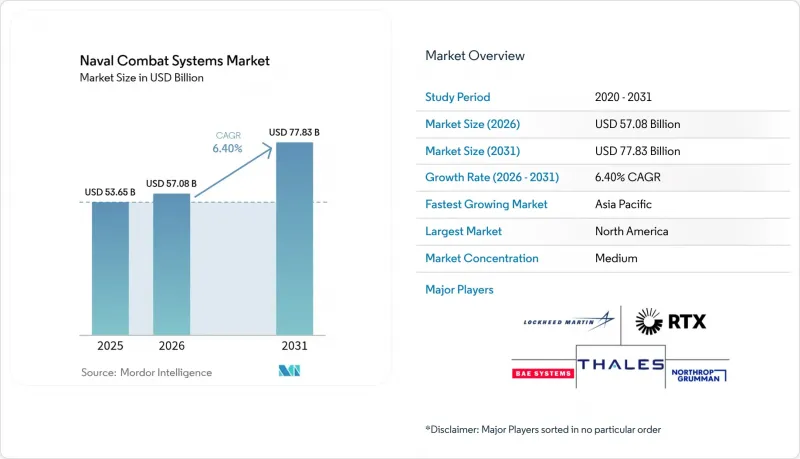
본 보고서는 유형별(무기 시스템, 전자전, C4ISR, 지향성 에너지 무기, 통합 전투 시스템, 무인 해상 시스템 등), 플랫폼별(항공모함, 구축함, 호위함, 코르벳함, 잠수함, 연안 전투함 등), 지역별(북미, 유럽 등)로 분류되어 있습니다. 시장 전망은 금액(미 달러) 기준으로 제시되어 있습니다.
전 세계 해군 전투 시스템 시장 동향 및 인사이트
주요 해군의 함대 현대화 프로그램
세계 함대 현대화 노력은 선체 교체 주기에서 플러그 앤 플레이 방식의 전투 시스템 제품군이 필요한 능력 중심의 조달로 전환되고 있습니다. ‘그레이 플래그 2024’ 훈련에서는 동맹국의 군함이 몇 시간이 아닌 몇 분 만에 표적 데이터를 공유할 수 있는 공동 소프트웨어 기준선의 유효성이 입증되었습니다. 호주가 2034년까지 수상 전력을 2배 이상 증강하겠다는 공약은 프리깃함 중심의 구성에서 첨단 센서 융합을 필요로 하는 분산형 편성으로의 전환을 추진하고 있습니다. 독일의 ‘2035 청사진’은 모듈식 임무 패키지를 중시하고 있으며, 이는 향후 함정이 최초 전투 시스템 탑재 기간을 넘어 운용될 것임을 뒷받침합니다. 일본이 호주와 차세대 프리깃함을 공동 개발하고 있는 것은 파트너국들이 연구개발 자원을 공유하고 취역을 가속화하는 방법을 보여주고 있습니다. 이러한 노력들이 어우러져 해군 전투 시스템 시장에 안정적인 자금 공급을 가져오고, 수십 년에 걸친 유지보수 수요를 확보하고 있습니다.
고조되는 인도-태평양 지역의 지정학적 긴장
중국의 항공모함 ‘푸젠’ 배치는 아시아태평양 전체에서 조달 리드타임을 단축시켜, 각국 해군으로 하여금 예정보다 빠른 시기에 장비를 배치하도록 압박하고 있습니다. 남중국해에서의 다자간 순찰은 작전상 협력이 단순한 계획상의 업그레이드가 아니라 실시간 능력 공유를 필요로 하고 있음을 보여줍니다. 지역 내 국가들이 분산형 작전에 대비함에 따라 수륙양용 능력이 급증하고 있으며, 통합된 방공·공격 패키지에 대한 수요가 높아지고 있습니다. RIMPAC에서 일본의 항공모함 2척이 수행한 임무는 출격 빈도 증가를 여실히 보여주었으며, 장기 전개 시 전투 시스템의 내구성이 시험대에 올랐습니다. 방위 산업 협력에 관한 새로운 양자 포럼은 기술 이전을 제도화하여 해군 전투 시스템 시장의 확대에 기여하고 있습니다.
예산 상한선이 수상 전투함 조달을 지연시키고 있다.
엄격한 예산 상한선으로 인해 ‘콘스텔레이션’급 호위함의 취역이 2년 지연되고 있으며, 이는 동맹국과의 공동 생산 계획에 파급 효과를 미쳐 공급업체의 현금 흐름에 부담을 주고 있습니다. 프랑스의 기획 담당자들은 현행 함대의 유지와 ‘호라이즌’급 구축함의 현대화 자금 확보 사이에서 어려운 절충점을 맞이하고 있습니다. 캔버라의 대규모 조선 계획은 국내 조선소의 생산 능력과 수입 서브시스템 간의 균형을 맞추어야 하므로, 일정 차질이 발생할 위험이 있습니다. 예산 지연이 발생하면 조선소는 숙련된 인력 확보에 어려움을 겪게 되며, 그 결과 톤당 비용이 상승할 뿐만 아니라 해군 전투 시스템 시장을 지탱하는 전투 시스템의 구매가 미뤄지게 됩니다.
부문 분석
지향성 에너지 무기는 9.44%의 연평균 성장률(CAGR)이 예상되며, 가장 빠른 성장 궤도를 그릴 것으로 전망됩니다. 이는 버크급 구축함에서의 HELIOS 실증 실험이 성공하여 해상에서의 빔 제어 안정성이 입증된 것이 뒷받침되고 있습니다. 2025년에도 무기 시스템은 해군 전투 시스템 시장 점유율의 45.02%를 계속 차지하고 있으며, 이는 운동 에너지에 의한 공격에 대한 지속적인 수요를 반영하는 한편, 에너지 무기로의 전환 경향도 시사하고 있습니다. 전자전 시스템은 분쟁 초기 단계에서 전자파에 의한 교란이 지배적이기 때문에 수년에 걸쳐 자금 조달 증가가 확보되었습니다. C4ISR 패키지도 같은 흐름을 타고 있으며, 우주, 공중, 수상의 센서를 연계하는 ‘전 영역 통합’ 공동 교리에 의해 추진되고 있습니다. 통합 전투 소프트웨어가 모든 패키지의 기반이 되고 있으며, 해군은 순찰 중간에 업데이트를 배포할 수 있을 뿐만 아니라, 민첩한 파이프라인을 확장할 수 있는 주요 제조업체들에게 있어 해군 전투 시스템 시장에서 규모의 우위를 유지하고 있습니다. 무인 해상 시스템의 페이로드 베이에는 지향성 에너지 포탑용 배선이 사전에 설치되어 있어, 향후 고출력 모듈과의 하위 호환성이 보장됩니다. 훈련 및 시뮬레이션에 대한 투자도 이에 발맞추고 있으며, J.F. 테일러(J.F. Taylor)사와 체결한 5억 6,300만 달러 규모의 계약이 그 증거입니다. 이 계약이 없었습니다면 승조원들은 복잡한 다영역 킬 체인(multi-domain kill chain) 훈련을 수행할 수 없었을 것입니다.
지역별 분석
북미는 2025년 매출의 37.44%를 차지하며, 해군 전투 시스템 시장에서 가장 큰 기여를 하는 지역으로서의 위상을 유지했습니다. 미국 해군의 2025 회계연도 총 예산에서는 이지스, 차세대 재머, 그리고 2024년에 49척이 추가된 장거리 수상 드론 프로그램에 대한 수십억 규모의 자금 배정이 유지되었습니다. HII사와 체결한 30억 달러 규모의 포괄 계약은 해당 지역의 하위 시스템 공급업체에 대한 파급 효과를 더욱 강화하고 있습니다. 동시에, 한국 조선소와의 제휴는 생산 능력을 동맹국에 아웃소싱하는 하이브리드 생산 모델의 도입을 시사하고 있습니다. 캐나다의 CSC 호위함 및 멕시코의 OPV 현대화 사업은 고객 기반을 확대하고 있지만, 금액 면에서는 여전히 소규모입니다. 이 지역 전체에서 주요 기업들은 제로 트러스트 지침을 준수하며, 광범위한 해군 전투 시스템 시장을 보호하기 위해 안전한 DevSecOps 파이프라인을 우선시하고 있습니다.
아시아태평양은 2031년까지 연평균 성장률(CAGR)이 6.58%로 가장 빠르게 성장하는 지역입니다. 푸젠성의 해상 시운전을 계기로 일본, 인도, 한국의 함대 갱신이 가속화되었습니다. 현재 각국의 함정에는 연합 임무에서 동맹국과의 상호 운용성을 확보하기 위해 개방형 아키텍처의 전투 시스템이 탑재되어 있습니다. 호주가 수상 함대를 두 배로 늘리기로 결정함에 따라 100억 달러 규모의 비즈니스 기회가 생겨났으며, 일본의 조선사들은 ‘모가미’급을 제안하며 적극적으로 수주를 노리고 있습니다. 허드슨 연구소의 보고서에 따르면, 일본은 턴키 방식의 전투함을 수출함으로써 미국의 생산 능력 부족을 보완할 가능성이 있으며, 이 시나리오는 해군 전투 시스템 시장을 기반으로 한 서브시스템 수주를 두 배로 늘리게 될 것입니다. 인도가 5척의 함정에 콘스버그사의 물류 스위트를 채택함에 따라, 스칸디나비아계 공급업체의 사업 범위가 확대되고 있습니다.
유럽에서는 정책 주도의 꾸준한 성장이 나타나고 있습니다. 베를린의 2035년 해군 계획에서는 F126 프리깃을 위한 모듈식 전투 시스템에 자금이 배정되어 있으며, 함정 수 증강보다 소프트웨어 개편이 우선시되고 있습니다. 파리는 로마와 공동으로 ‘호라이즌’급 구축함 개조에 자금을 지원하며, 프랑스와 이탈리아 간의 레이더 및 미사일 연계 체제를 강화하고 있습니다. 런던의 ‘유형 83’ 구상은 소프트웨어 중심의 핵심을 내세우고 있지만, 사이버 내성 강화 목표에 대한 진척 속도 조정에 어려움을 겪고 있습니다. 마드리드와 오슬로는 경쟁 입찰을 통한 CMS 개조를 통해 구형 함정을 업그레이드하고 있습니다. 유럽의 총 예산 규모는 미국의 지출보다 적지만, 공동 연구 개발 및 표준화된 인터페이스 덕분에 견고하고 수출 지향적인 해군 전투 시스템 시장이 유지되고 있습니다.
기타 혜택:
- 엑셀 형식 시장 예측(ME) 시트
- 3개월간의 애널리스트 지원
자주 묻는 질문
목차
제1장 서론
제2장 조사 방법
제3장 주요 요약
제4장 시장 구도
제5장 시장 규모와 성장 예측
제6장 경쟁 구도
제7장 시장 기회와 향후 전망
LSH 26.09.08According to Mordor Intelligence, naval combat systems market size in 2026 is estimated at USD 57.08 billion, growing from 2025 value of USD 53.65 billion with 2031 projections showing USD 77.83 billion, growing at 6.40% CAGR over 2026-2031.
This report is Segmented by Type (Weapon Systems, Electronic Warfare, C4ISR, Directed Energy Weapons, Integrated Combat Systems, Unmanned Sea Systems and More), Platform (Aircraft Carriers, Destroyers, Frigates, Corvettes, Submarines, Littoral Combat Ships, and More), and Geography (North America, Europe, and More). The Market Forecasts are Provided in Terms of Value (USD).
Global Naval Combat Systems Market Trends and Insights
Fleet-modernization programs in major navies
Global fleet-renewal initiatives are moving away from hull-replacement cycles and toward capability-centric buys that demand plug-and-play combat suites. Gray Flag 2024 validated joint software baselines that let allied warships share targeting data in minutes rather than hours. Australia's pledge to more than double its surface force by 2034 drives a pivot from frigate-heavy constructs to distributed formations requiring advanced sensor fusion. Germany's 2035 blueprint stresses modular mission packages, confirming that future hulls will outlive their first combat-system fit. Japan's co-development of next-generation frigates with Australia shows how partners pool R&D to speed entry into service. Together, these actions channel steady funding into the naval combat systems market and ensure multi-decade sustainment demand.
Rising Indo-Pacific Geopolitical Tensions
Beijing's deployment of the carrier Fujian has compressed acquisition lead times across Asia-Pacific, pushing navies to field hardware ahead of schedule. Multilateral patrols in the South China Sea illustrate how operational coalitions dictate real-time capability swaps rather than paper upgrades. Amphibious capacity is surging as regional states prepare for distributed operations, raising demand for integrated air-defence and strike packages. Japan's dual-carrier tasking during RIMPAC underscores an elevated sortie tempo that tests combat-system resilience in prolonged deployments. New bilateral forums on defence industrial cooperation institutionalise technology transfers that expand the naval combat systems market footprint.
Budget Caps Delaying Surface-Combatant Procurement
Tight ceilings have pushed the Constellation frigate two years right, rippling across allied co-production slots and stretching supplier cash-flow profiles. French planners face hard trade-offs between sustaining today's fleet and funding Horizon destroyer renewals. Canberra's massive shipbuilding plan must juggle domestic yard throughput with imported subsystems, risking schedule mismatch. When budgets lag, yards struggle to maintain skilled labor pipelines, raising cost per tonne and deferring combat-system buys that feed the naval combat systems market.
Other drivers and restraints analyzed in the detailed report include:
- Rapid Uptake of Integrated Combat-Management Suites
- Expansion of Naval Electronic-Warfare and C4ISR Demand
- Extended Weapon-Integration Certification Cycles
For complete list of drivers and restraints, kindly check the Table Of Contents.
Segment Analysis
Directed Energy Weapons claimed the fastest trajectory with a 9.44% CAGR forecast, supported by successful HELIOS proofs aboard Burke-class destroyers that validated beam-control stability at sea. Weapon Systems still hold a 45.02% slice of the naval combat systems market share for 2025, reflecting enduring demand for kinetic strike but acknowledging an inflection toward energy arms. Electronic-warfare suites secured multiyear funding upticks because electromagnetic denial dominates early-phase conflict. C4ISR packages ride the same wave, driven by a joint all-domain doctrine that links space, air, and surface sensors. Integrated combat software anchors every package, allowing navies to deploy updates between patrols and protecting the naval combat systems market size advantage for primes able to scale agile pipelines. Unmanned sea-system payload bays are being pre-wired for directed-energy turrets, ensuring backwards compatibility with future high-power modules. Training and simulation investments keep pace, as evidenced by the USD 563 million contract to J.F. Taylor, without which crews could not rehearse complex multi-domain kill chains.
Complete Report Scope:
- By Type
- Weapon Systems
- Electronic Warfare (EW)
- C4ISR
- Directed Energy Weapons (DEW)
- Integrated Combat Systems
- Unmanned Sea Systems
- Simulation and Training Systems
- Combat-Management Software
- By Platform
- Aircraft Carriers
- Destroyers
- Frigates
- Corvettes
- Submarines
- Littoral Combat Ships (LCS)
- Unmanned Surface Vessels (USV)
- Unmanned Underwater Vehicles (UUV)
- Other Platforms
- By Geography
- North America
- United States
- Canada
- Mexico
- Europe
- United Kingdom
- France
- Germany
- Italy
- Spain
- Rest of Europe
- Asia-Pacific
- China
- India
- Japan
- Australia
- Rest of Asia-Pacific
- South America
- Brazil
- Rest of South America
- Middle East and Africa
- Middle East
- Saudi Arabia
- Israel
- Rest of Middle East
- Africa
- Egypt
- South Africa
- Rest of Africa
- Middle East
- North America
Geography Analysis
North America retained 37.44% of 2025 revenue as the largest regional naval combat systems market contributor. The US Navy's FY25 topline preserved multi-billion funding lines for Aegis, Next Generation Jammer, and the long-range surface drone program that added 49 hulls in 2024. HII's USD 3 billion umbrella contract amplifies the region's pull-through effect on subsystem suppliers. At the same time, partnerships with South Korean yards hint at a blended production model that externalises capacity to allies. Canada's CSC frigate and Mexico's OPV modernization widen the customer base, though still modest in dollar terms. Across the region, primes prioritise secure DevSecOps pipelines to comply with zero-trust directives and protect an expansive naval combat systems market.
Asia-Pacific is the fastest-growing theatre at 6.58% CAGR to 2031. Fujian's sea trials triggered accelerated Japanese, Indian, and Korean fleet renewals; each now embeds open-architecture combat suites to guarantee allied plug-in during coalition missions. Australia's decision to double its surface fleet unleashes a USD 10 billion opportunity actively courted by Japanese yards offering the Mogami-class. The Hudson Institute reports that Japan could fill US capacity gaps by exporting turnkey combatants, a scenario that multiplies subsystem orders anchored in the naval combat systems market. India's adoption of KONGSBERG logistics suites for five ships widens Scandinavian supplier reach.
Europe shows steady, policy-driven growth. Berlin's 2035 naval plan funds modular combat suites for F126 frigates, prioritising software refresh over hull count. Paris co-finances Horizon destroyer upgrades with Rome, reinforcing Franco-Italian radar and missile chains. London's Type 83 concept champions a software-centric core but grapples with pacing against cyber-hardening targets. Madrid and Oslo upgrade legacy tonnage through competitively tendered CMS refits. While aggregated European budgets trail US outlays, pooled R&D and standardised interfaces sustain a robust, export-oriented Naval Combat Systems market.
- BAE Systems plc
- Lockheed Martin Corporation
- RTX Corporation
- Thales Group
- General Dynamics Mission Systems (General Dynamics Corporation)
- Saab AB
- L3Harris Technologies, Inc.
- Northrop Grumman Corporation
- Elbit Systems Ltd.
- Terma A/S
- Kongsberg Gruppen ASA
- Huntington Ingalls Industries, Inc.
- Leonardo S.p.A
- ATLAS ELEKTRONIK GmbH
- MBDA
- Naval Group
- Israel Aerospace Industries Ltd.
- Hanwha Systems Co., Ltd.
- Mitsubishi Electric Corporation
Additional Benefits:
- The market estimate (ME) sheet in Excel format
- 3 months of analyst support
TABLE OF CONTENTS
1 INTRODUCTION
- 1.1 Study Assumptionsand Market Definition
- 1.2 Scope of the Study
2 RESEARCH METHODOLOGY
3 EXECUTIVE SUMMARY
4 MARKET LANDSCAPE
- 4.1 Market Overview
- 4.2 Market Drivers
- 4.2.1 Fleet-modernization programs in major navies
- 4.2.2 Rising Indo-Pacific geopolitical tensions
- 4.2.3 Rapid uptake of integrated combat-management suites
- 4.2.4 Expansion of naval electronic warfare (EW) and C4ISR demand
- 4.2.5 Shift to distributed unmanned surface/underwater fleets
- 4.2.6 DevSecOps-based "continuous upgrade" architectures
- 4.3 Market Restraints
- 4.3.1 Budget caps delaying surface-combatant procurement
- 4.3.2 Extended weapon-integration certification cycles
- 4.3.3 Cyber-vulnerability of network-centric warships
- 4.3.4 GaN radar-chip supply-chain bottlenecks
- 4.4 Value Chain Analysis
- 4.5 Regulatory Landscape
- 4.6 Technological Outlook
- 4.7 Porter's Five Forces Analysis
- 4.7.1 Threat of New Entrants
- 4.7.2 Bargaining Power of Buyers/Consumers
- 4.7.3 Bargaining Power of Suppliers
- 4.7.4 Threat of Substitute Products
- 4.7.5 Intensity of Competitive Rivalry
5 MARKET SIZE AND GROWTH FORECASTS (VALUE)
- 5.1 By Type
- 5.1.1 Weapon Systems
- 5.1.2 Electronic Warfare (EW)
- 5.1.3 C4ISR
- 5.1.4 Directed Energy Weapons (DEW)
- 5.1.5 Integrated Combat Systems
- 5.1.6 Unmanned Sea Systems
- 5.1.7 Simulation and Training Systems
- 5.1.8 Combat-Management Software
- 5.2 By Platform
- 5.2.1 Aircraft Carriers
- 5.2.2 Destroyers
- 5.2.3 Frigates
- 5.2.4 Corvettes
- 5.2.5 Submarines
- 5.2.6 Littoral Combat Ships (LCS)
- 5.2.7 Unmanned Surface Vessels (USV)
- 5.2.8 Unmanned Underwater Vehicles (UUV)
- 5.2.9 Other Platforms
- 5.3 By Geography
- 5.3.1 North America
- 5.3.1.1 United States
- 5.3.1.2 Canada
- 5.3.1.3 Mexico
- 5.3.2 Europe
- 5.3.2.1 United Kingdom
- 5.3.2.2 France
- 5.3.2.3 Germany
- 5.3.2.4 Italy
- 5.3.2.5 Spain
- 5.3.2.6 Rest of Europe
- 5.3.3 Asia-Pacific
- 5.3.3.1 China
- 5.3.3.2 India
- 5.3.3.3 Japan
- 5.3.3.4 Australia
- 5.3.3.5 Rest of Asia-Pacific
- 5.3.4 South America
- 5.3.4.1 Brazil
- 5.3.4.2 Rest of South America
- 5.3.5 Middle East and Africa
- 5.3.5.1 Middle East
- 5.3.5.1.1 Saudi Arabia
- 5.3.5.1.2 Israel
- 5.3.5.1.3 Rest of Middle East
- 5.3.5.2 Africa
- 5.3.5.2.1 Egypt
- 5.3.5.2.2 South Africa
- 5.3.5.2.3 Rest of Africa
- 5.3.5.1 Middle East
- 5.3.1 North America
6 COMPETITIVE LANDSCAPE
- 6.1 Market Concentration
- 6.2 Strategic Moves
- 6.3 Market Share Analysis
- 6.4 Company Profiles (includes Global level Overview, Market level overview, Core Segments, Financials as available, Strategic Information, Market Rank/Share for key companies, Products and Services, and Recent Developments)
- 6.4.1 BAE Systems plc
- 6.4.2 Lockheed Martin Corporation
- 6.4.3 RTX Corporation
- 6.4.4 Thales Group
- 6.4.5 General Dynamics Mission Systems (General Dynamics Corporation)
- 6.4.6 Saab AB
- 6.4.7 L3Harris Technologies, Inc.
- 6.4.8 Northrop Grumman Corporation
- 6.4.9 Elbit Systems Ltd.
- 6.4.10 Terma A/S
- 6.4.11 Kongsberg Gruppen ASA
- 6.4.12 Huntington Ingalls Industries, Inc.
- 6.4.13 Leonardo S.p.A
- 6.4.14 ATLAS ELEKTRONIK GmbH
- 6.4.15 MBDA
- 6.4.16 Naval Group
- 6.4.17 Israel Aerospace Industries Ltd.
- 6.4.18 Hanwha Systems Co., Ltd.
- 6.4.19 Mitsubishi Electric Corporation
7 MARKET OPPORTUNITIES AND FUTURE OUTLOOK
- 7.1 White-space and Unmet-Need Assessment