|
시장보고서
상품코드
2120725
아시아태평양의 종이 포장 : 시장 점유율 분석, 업계 동향과 통계, 성장 예측(2026-2031년)Asia Pacific Paper Packaging - Market Share Analysis, Industry Trends & Statistics, Growth Forecasts (2026 - 2031) |
||||||
 Mordor Intelligence
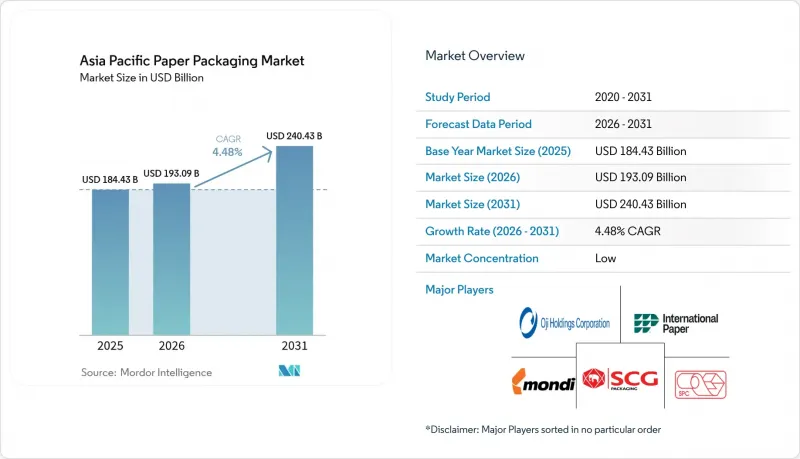
아시아태평양의 종이 포장 시장 규모는 2025년에 1,844억 3,000만 달러, 2026년에 1,930억 9,000만 달러에 달하고, 2031년까지 2,404억 3,000만 달러에 달할 것으로 예측되며, 2026년부터 2031년까지 CAGR 4.48%로 성장할 것으로 전망됩니다.
본 보고서는 포장 유형(골판지 원지, 컨테이너보드), 등급(SBS, SUS, FBB, CRB, URB, 화이트탑 크라프트 라이너, 기타 크라프트 라이너, 화이트탑 테스트 라이너 등), 제품(접이식 카톤, 골판지 상자 등), 최종사용자 산업(식품, 음료, 헬스케어·의약품 등), 및 지역별로 분류되어 있습니다. 시장 예측은 금액(달러) 기준으로 제시되어 있습니다.
아시아태평양 종이 포장 시장의 동향 및 인사이트
E-Commerce용 포장재 수요의 급증
2025년, 중국의 온라인 소매 보급률은 소매 총매출의 27.6%에 달했으며, 인도의 E-Commerce 주문 건수는 21% 증가했습니다. 소포 처리량의 급증으로 주문 단위가 세분화됨에 따라 물류 사업자들은 더 가볍고 강도가 높은 컨테이너보드 등급을 선호하는 추세입니다. 동남아시아 전역의 소포 허브에서는 현재 골판지 크기가 표준화되어 있어, 고압축성 단층 골판지 상자의 대량 주문을 촉진하고 있습니다. 디지털 인쇄를 통한 소량 생산 접이식 상자는 D2C(소비자 직접 판매) 브랜드가 개봉 경험을 개인화할 수 있게 해 주며, 이는 원자재에 대한 추가 수요를 촉진하고 있습니다.
재활용지 등급으로의 급속한 전환
2030년까지 종이 포장재 재활용률 60%를 달성하겠다는 일본의 목표와 2025년까지 재생재 함유율 50%를 의무화하는 호주의 규제에 따라, 제지 업체들은 탈색 라인 개조 및 국내 폐기물 공급원 확보를 추진하고 있습니다. 또한, 베트남 수출 지역에서 골판지 상자에 재활용 재료 함유율 25%를 의무화하는 규제로 인해 현지 수거 협동조합에 대한 투자가 가속화되고 있습니다. 2025년 동남아시아로의 폐지 수입량은 전년 대비 12% 감소할 것으로 예상되며, 이는 자급률 향상과 인증받은 지속가능한 등급의 프리미엄 가격 형성을 시사합니다.
부문별 분석
컨테이너 보드는 E-Commerce용 골판지 상자 출하량에 힘입어 2025년에는 50.01%의 점유율을 차지했으나, 카톤 보드는 2031년까지 연평균 성장률(CAGR)이 5.84%를 기록하며 아시아태평양 종이 포장 시장을 130베이시스포인트 상회할 것으로 예측됩니다. 고급 식품 및 화장품 분야에서 고해상도 인쇄와 촉감 마감에 대한 수요가 증가함에 따라 접이식 카톤의 보급이 확대되고 있습니다.
생성형 AI를 활용한 구조 설계를 통해 소재의 무게를 줄이고, 강도를 유지하면서 플라스틱과의 비용 격차를 확대하고 있습니다. 한편, 100 g/m² 미만의 초경량 컨테이너 보드는 자동차 및 전자기기 운송 분야에서 재사용 가능한 플라스틱 토트 케이스가 시장 점유율을 빼앗아 가는 가운데, 물류 분야에서의 점유율 유지를 목표로 하고 있습니다.
기타 혜택:
- 엑셀 형식의 시장 예측(ME) 시트
- 3개월간의 애널리스트 지원
자주 묻는 질문
목차
제1장 소개
제2장 조사 방법
제3장 주요 요약
제4장 시장 구도
제5장 시장 규모와 성장 예측
제6장 경쟁 구도
제7장 시장 기회와 향후 전망
KSM 26.09.02According to Mordor Intelligence, the Asia Pacific paper packaging market size is projected to be USD 184.43 billion in 2025, USD 193.09 billion in 2026, and reach USD 240.43 billion by 2031, growing at a CAGR of 4.48% from 2026 to 2031.
This report is Segmented by Packaging Type (Carton Board, and Containerboard), Grade (SBS, SUS, FBB, CRB, URB, White-Top Kraftliner, Other Kraftliners, White-Top Testliner, and More), Product (Folding Cartons, Corrugated Boxes, and More), End-User Industry (Food, Beverage, Healthcare and Pharmaceuticals, and More), and Geography. The Market Forecasts are Provided in Terms of Value (USD).
Asia Pacific Paper Packaging Market Trends and Insights
Surge in E-commerce Packaging Demand
Online retail penetration in China climbed to 27.6% of total retail sales during 2025, and India's e-commerce orders increased 21%. Parcel-volume spikes are fragmenting order sizes, so logistics providers prefer lighter, stronger containerboard grades. Parcel hubs across Southeast Asia now standardize corrugated dimensions, driving bulk orders for high-compression single-wall boxes. Digitally printed, short-run folding cartons enable direct-to-consumer brands to personalize unboxing experiences, which fuels additional substrate demand.
Rapid Shift Toward Recycled Paper Grades
Japan's 60% recycling-rate target for paper packaging by 2030 and Australia's 50% recycled-content mandate for 2025 are prompting mills to retrofit de-inking lines and secure domestic waste streams. Vietnam's 25% recycled-content rule for corrugated boxes in export zones accelerates investment in local collection cooperatives. Recovered-paper imports into Southeast Asia fell 12% year on year in 2025, signalling improved self-sufficiency and premium pricing for certified sustainable grades.
Other drivers and restraints analyzed in the detailed report include:
- Expansion of Food, Beverage and Healthcare Sectors
- High-Barrier Coated Paper Replacing Plastics
For complete list of drivers and restraints, kindly check the Table Of Contents.
Segment Analysis
Containerboard held a 50.01% share in 2025, buoyed by e-commerce corrugated-box volumes, yet carton board is forecast to outpace the Asia Pacific paper packaging market by 130 bp with a 5.84% CAGR through 2031. Rising demand for high-definition printing and tactile finishes in premium food and cosmetics supports folding-carton uptake.
Generative-AI structural design trims material weight, widening cost gaps with plastic while preserving integrity. Meanwhile, ultra-lightweight containerboard below 100 g m-2 aims to sustain share in logistics as reusable plastic totes nibble at automotive and electronics transport.
Complete Report Scope:
- By Packaging Type
- Carton Board
- Solid Bleached Sulfate (SBS)
- Solid Unbleached Sulfate (SUS)
- Folding Boxboard (FBB)
- Coated Recycled Board (CRB)
- Uncoated Recycled Board (URB)
- Containerboard
- White-top Kraftliner
- Other Kraftliners
- White-top Testliner
- Other Testliners
- Semi-chemical Fluting
- Recycled Fluting
- Carton Board
- By Product
- Folding Cartons
- Corrugated Boxes
- Liquid Packaging Board
- Paper Bags and Sacks
- By End-User Industry
- Food
- Beverage
- Healthcare and Pharmaceuticals
- Personal Care and Cosmetics
- Household Care
- Electrical and Electronics
- Other End-User Industry
- By Geography
- China
- India
- Japan
- Indonesia
- Thailand
- Vietnam
- Australia and New Zealand
- Rest of Asia-Pacific
List of Companies Covered in this Report:
- Nine Dragons Paper (Holdings) Ltd
- Oji Holdings Corporation
- SCG Packaging PCL
- International Paper Company
- Mondi PLc
- Smurfit WestRock plc
- Huhtamaki Oyj
- Rengo Co., Ltd
- DS Smith plc
- Pratt Industries, Inc.
- Stora Enso Oyj
- Nippon Paper Industries Co., Ltd.
- APP (Asia Pulp & Paper) Group
- Visy Industries Holdings Pty Ltd
- Harta Packaging Industries
- Sarnti Packaging Co. Ltd
- Hong Thai Packaging Co. Ltd
- New Asia Industries Co. Ltd
- C&H Paperbox (Thailand) Co. Ltd
- Continental Packaging (Thailand) Co. Ltd
- Lee & Man Paper Manufacturing Ltd
- Thai Containers Group Co., Ltd
- Shandong Sun Paper Industry Joint Stock Co., Ltd
- Greatview Aseptic Packaging Co., Ltd
Additional Benefits:
- The market estimate (ME) sheet in Excel format
- 3 months of analyst support
TABLE OF CONTENTS
1 INTRODUCTION
- 1.1 Study Assumptions and Market Definition
- 1.2 Scope of the Study
2 RESEARCH METHODOLOGY
3 EXECUTIVE SUMMARY
4 MARKET LANDSCAPE
- 4.1 Market Overview
- 4.2 Market Drivers
- 4.2.1 Surge in E-commerce Packaging Demand
- 4.2.2 Rapid Shift Toward Recycled Paper Grades
- 4.2.3 Expansion of Food, Beverage and Healthcare Sectors
- 4.2.4 High-Barrier Coated Paper Replacing Plastics
- 4.2.5 EPR and Content-Mandate Regulations Across Asia-Pacific
- 4.2.6 Generative AI-Enabled Design and Short-Run Printing
- 4.2.7 Adoption of Bamboo and Agricultural-Residue Fibre
- 4.3 Market Restraints
- 4.3.1 Pulp Price Volatility and Supply Shocks
- 4.3.2 Cost-Competitive Flexible Plastic Alternatives
- 4.3.3 Carbon-Intensity Pressure on Paper Mills
- 4.3.4 Chinese Over-Capacity Driving Price Wars
- 4.3.5 Logistics Bottlenecks from Emerging APAC Ports
- 4.4 Industry Value-Chain Analysis
- 4.5 Regulatory Landscape
- 4.6 Technological Outlook
- 4.7 Impact of Macroeconomic Factors on the Market
- 4.8 Porter's Five Forces Analysis
- 4.8.1 Threat of New Entrants
- 4.8.2 Bargaining Power of Suppliers
- 4.8.3 Bargaining Power of Buyers
- 4.8.4 Threat of Substitutes
- 4.8.5 Competitive Rivalry
- 4.9 Investment Analysis
5 MARKET SIZE AND GROWTH FORECASTS (VALUE)
- 5.1 By Packaging Type
- 5.1.1 Carton Board
- 5.1.1.1 Solid Bleached Sulfate (SBS)
- 5.1.1.2 Solid Unbleached Sulfate (SUS)
- 5.1.1.3 Folding Boxboard (FBB)
- 5.1.1.4 Coated Recycled Board (CRB)
- 5.1.1.5 Uncoated Recycled Board (URB)
- 5.1.2 Containerboard
- 5.1.2.1 White-top Kraftliner
- 5.1.2.2 Other Kraftliners
- 5.1.2.3 White-top Testliner
- 5.1.2.4 Other Testliners
- 5.1.2.5 Semi-chemical Fluting
- 5.1.2.6 Recycled Fluting
- 5.1.1 Carton Board
- 5.2 By Product
- 5.2.1 Folding Cartons
- 5.2.2 Corrugated Boxes
- 5.2.3 Liquid Packaging Board
- 5.2.4 Paper Bags and Sacks
- 5.3 By End-User Industry
- 5.3.1 Food
- 5.3.2 Beverage
- 5.3.3 Healthcare and Pharmaceuticals
- 5.3.4 Personal Care and Cosmetics
- 5.3.5 Household Care
- 5.3.6 Electrical and Electronics
- 5.3.7 Other End-User Industry
- 5.4 By Geography
- 5.4.1 China
- 5.4.2 India
- 5.4.3 Japan
- 5.4.4 Indonesia
- 5.4.5 Thailand
- 5.4.6 Vietnam
- 5.4.7 Australia and New Zealand
- 5.4.8 Rest of Asia-Pacific
6 COMPETITIVE LANDSCAPE
- 6.1 Market Concentration
- 6.2 Strategic Moves
- 6.3 Market Share Analysis
- 6.4 Company Profiles (includes Global Level Overview, Market Level Overview, Core Segments, Financials as available, Strategic Information, Market Rank/Share, Products and Services, Recent Developments)
- 6.4.1 Nine Dragons Paper (Holdings) Ltd
- 6.4.2 Oji Holdings Corporation
- 6.4.3 SCG Packaging PCL
- 6.4.4 International Paper Company
- 6.4.5 Mondi PLc
- 6.4.6 Smurfit WestRock plc
- 6.4.7 Huhtamaki Oyj
- 6.4.8 Rengo Co., Ltd
- 6.4.9 DS Smith plc
- 6.4.10 Pratt Industries, Inc.
- 6.4.11 Stora Enso Oyj
- 6.4.12 Nippon Paper Industries Co., Ltd.
- 6.4.13 APP (Asia Pulp & Paper) Group
- 6.4.14 Visy Industries Holdings Pty Ltd
- 6.4.15 Harta Packaging Industries
- 6.4.16 Sarnti Packaging Co. Ltd
- 6.4.17 Hong Thai Packaging Co. Ltd
- 6.4.18 New Asia Industries Co. Ltd
- 6.4.19 C&H Paperbox (Thailand) Co. Ltd
- 6.4.20 Continental Packaging (Thailand) Co. Ltd
- 6.4.21 Lee & Man Paper Manufacturing Ltd
- 6.4.22 Thai Containers Group Co., Ltd
- 6.4.23 Shandong Sun Paper Industry Joint Stock Co., Ltd
- 6.4.24 Greatview Aseptic Packaging Co., Ltd
7 MARKET OPPORTUNITIES AND FUTURE OUTLOOK
- 7.1 White-Space and Unmet-Need Assessment