|
시장보고서
상품코드
2120726
등온 핵산 증폭 기술 : 시장 점유율 분석, 업계 동향과 통계, 성장 예측(2026-2031년)Isothermal Nucleic Acid Amplification Technology - Market Share Analysis, Industry Trends & Statistics, Growth Forecasts (2026 - 2031) |
||||||
 Mordor Intelligence
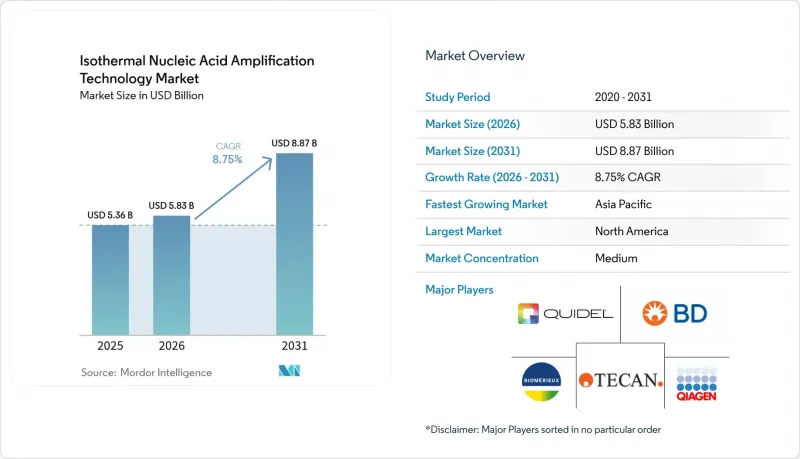
Mordor Intelligence에 의하면, 등온 핵산 증폭 기술 시장 규모는 2025년 53억 6,000만 달러에서 2026년에는 58억 3,000만 달러에 이르고, 2026-2031년 CAGR 8.75%로 성장을 지속하여 2031년에는 88억 7,000만 달러에 달할 것으로 예측됩니다.
본 보고서에서는 업계를 기술별(헬리케이스 의존 증폭(HDA) 등), 제품별(장비 등), 용도별(감염병 진단 등), 최종 사용자별(병원 및 검사 기관 등), 지역별(북미, 유럽, 아시아태평양 등)로 분류하고 있습니다. 시장 예측은 금액(달러) 기준으로 제시되어 있습니다.
전 세계 등온 핵산 증폭 기술 시장 동향 및 인사이트
포인트 오브 케어(Point-of-Care)에서의 감염병 진단 도입
응급실에서는 현재, 몇 분 만에 검사실 수준의 정확도를 가진 결과를 제공하는 INAAT 호흡기 패널이 활용되고 있으며, 이를 통해 환자 처리 능력이 향상되고 항생제의 적정 사용이 촉진되고 있습니다. 2024년 6월 Cepheid사의 ‘Xpert HCV’가 FDA 승인을 획득함에 따라, 손가락 끝에서 채취한 혈액 샘플을 이용한 당일 C형 간염 진단이 가능해졌으며, 이는 여러 차례의 내원으로 인한 후속 관리 누락을 해소하는 획기적인 진전이 되었습니다. 검사 결과의 정확도는 PCR과 동등하며, 정온 반응 방식은 자원이 제한된 환경에서도 유용한 배터리 구동식 휴대용 기기에 적합합니다.
고령화와 만성 질환의 부담
65세 이상 어르신들은 감염증이나 암 재발과 관련된 정기적인 바이오마커 검사가 필요합니다. INAAT 기반의 액체 생검 시스템은 94.1%의 민감도로 미세 잔류 병변을 감지할 수 있어, 자택이나 지역 클리닉에서 모니터링이 가능합니다. 원격의료 플랫폼과의 통합을 통해 검사 결과 확인이 효율화되고, 불필요한 병원 방문이 줄어들며, 시스템 비용 절감으로 이어집니다.
PCR 및 DCR 플랫폼과의 경쟁
이미 확립된 PCR 인프라는 열순환 플랫폼, 자동 검체 처리 시스템, 그리고 기존 증폭 워크플로우에 최적화된 기술자 교육 프로그램에 투자해 온 검사실에게 큰 전환 비용을 초래하고 있습니다. 디지털 PCR 플랫폼은 특히 정밀한 바이러스 부하 모니터링이나 복제수 변이 분석이 필요한 용도에서 INAAT가 현재 따라잡을 수 없는 절대 정량 기능을 제공함으로써 경쟁을 더욱 치열하게 만들고 있습니다. 검사실 책임자는 INAAT 도입을 검토할 때, 기존의 품질 관리 절차, 규제상 검증 및 직원의 역량이 PCR 검사 방법에 부합하고 있기 때문에 워크플로우의 혼란을 우려하고 있습니다.
부문 분석
LAMP는 2025년에 등온 핵산 증폭 기술 시장의 43.72%를 차지할 것으로 예상되며, 2031년까지 연평균 성장률(CAGR) 13.02%로 성장할 것으로 전망됩니다. 이 검사 기법은 6개의 유전자 영역을 대상으로 하며, 열 순환 과정 없이도 높은 특이성을 발휘합니다. HDA나 NEAR와 같은 보완적인 접근 방식은 저온에서의 이용 사례를 지원하는 반면, TMA는 RNA 검출이 중요한 혈액 선별 검사에서 여전히 그 가치를 유지하고 있습니다.
검출 기술의 혁신이 등온 핵산 증폭 기술(INAAT) 시장을 재편하고 있으며, 개발자들은 LAMP와 CRISPR-Cas 시스템을 결합하여 30분 이내에 아토몰 수준의 감도를 달성하고 있습니다. 비색법을 이용한 횡류 스트립은 카트리지에 직접 내장되어 있어, 형광 판독기를 보유하지 않은 진료소에서의 채택이 확대되고 있습니다.
시약 및 소모품은 2025년 매출의 62.94%를 차지하며, 연구 개발(R&D)을 뒷받침하는 지속적인 현금 흐름을 제공합니다. Bst 폴리머라제공급 안정성은 대부분의 INAAT 키트의 기반이 되고 있으므로 여전히 매우 중요합니다. 장비 시장은 각 벤더들이 마이크로플루이딕스 기술과 원스텝 추출 기능을 통합함에 따라 연평균 10.98%의 성장이 예상되며, iPonatic사의 30분 만에 완전한 워크플로우 자동화를 실현하는 카트리지가 그 대표적인 예입니다.
기기 혁신은 통합과 소형화에 중점을 두고 있으며, 각 제조업체는 시료 전처리, 증폭, 검출을 일회용 카트리지 형태로 결합한 휴대용 플랫폼을 개발하고 있습니다. iPonatic 시스템은 이러한 추세를 상징하는 것으로, 실온에서의 추출과 통합된 검출 기능을 활용하여 30분 이내에 핵산 검사를 완료합니다. 마이크로플루이딕스 기술의 통합을 통해 정밀한 액체 취급과 온도 제어가 가능해지는 한편, 시약 소비량과 오염 위험을 줄일 수 있지만, 제조의 복잡성과 비용 측면의 과제로 인해 그 채택은 고부가가치 용도로 제한되고 있습니다.
지역별 분석
북미는 2025년에 매출의 35.12%를 차지하며 시장을 선도하고 있습니다. 이는 15분 만에 결과가 나오는 호흡기 패널을 진료소에 도입하는 CLIA 면제 규정 등 FDA의 승인 절차에 힘입은 것입니다(fda.gov). 광범위한 보험 적용 덕분에 병원은 예산 부담 없이 INAAT를 도입할 수 있습니다. 연구 자금과 꾸준한 벤처 캐피털 유입이 국내 의료기기 시장 출시를 가속화하고 있습니다.
아시아태평양은 성장의 원동력이며, 연평균 성장률(CAGR)은 15.1%로 예측됩니다. 중국 국가약품감독관리국(NMPA)은 심사 기간을 24개월에서 12개월로 단축하고, 다국적 기업들이 현지 생산을 하도록 장려하고 있습니다(nmpa.gov.cn). 일본에서는 고령화가 진행됨에 따라 재택 진단이 촉진되고 있으며, 인도에서는 공중보건 프로그램의 일환으로 결핵 및 뎅기열 감시를 위한 저렴한 INAAT 키트가 조달되고 있습니다. 현지 생산은 환율 위험을 완화하고, 전 세계적인 공급 차질이 발생할 때에도 안정적인 공급을 보장합니다.
유럽에서는 IVDR(체외진단의료기기규정)에 따른 기준 조화가 진행되어 꾸준한 성장이 예상되지만, 중소 혁신 기업들에게는 CE 마크 획득을 위한 증거 확보의 문턱이 높아지고 있습니다. 독일과 영국은 강력한 병원 네트워크와 중개연구의 성과를 통해 수요 기반을 뒷받침하고 있습니다. 비용 절감 정책에 따라, PCR에 비해 에너지와 인력을 절약할 수 있는 항온 시스템이 선호되고 있습니다.
기타 혜택:
- 엑셀 형식 시장 예측(ME) 시트
- 3개월간의 애널리스트 지원
자주 묻는 질문
목차
제1장 서론
제2장 조사 방법
제3장 주요 요약
제4장 시장 구도
제5장 시장 규모와 성장 예측
제6장 경쟁 구도
제7장 시장 기회와 향후 전망
LSH 26.09.08According to Mordor Intelligence, the isothermal nucleic acid amplification technology market size is expected to grow from USD 5.36 billion in 2025 to USD 5.83 billion in 2026 and is forecast to reach USD 8.87 billion by 2031 at 8.75% CAGR over 2026-2031.
This report Segments the Industry Into by Technology (Helicase-Dependent Amplification (HDA), and More), Product (Instruments, and More), Application (Infectious-Disease Diagnostics, and More), End-User (Hospitals and Reference Labs, and More), and Geography (North America, Europe, Asia-Pacific, and More). The Market Forecasts are Provided in Terms of Value (USD).
Global Isothermal Nucleic Acid Amplification Technology Market Trends and Insights
Point-of-care infectious-disease adoption
Emergency departments now rely on INAAT respiratory panels that deliver lab-quality answers in minutes, boosting patient throughput and antibiotic stewardship. FDA clearance of Cepheid's Xpert HCV in June 2024 allows same-visit hepatitis C diagnosis from a fingertip blood sample, a milestone that removes multi-visit loss to follow-up. Result accuracy remains on par with PCR while constant-temperature reactions suit battery-powered, portable devices useful in resource-limited settings.
Aging population & chronic-disease burden
Populations over 65 years demand regular biomarker checks for infections and cancer recurrence. INAAT-based liquid-biopsy systems can detect minimal residual disease with 94.1% sensitivity, enabling home or community clinic monitoring. Integration with telemedicine platforms streamlines result review, curbing unnecessary hospital visits and lowering system costs.
Competition From PCR & DCR Platforms
Established PCR infrastructure represents significant switching costs for laboratories that have invested in thermal cycling platforms, automated sample handling systems, and technician training programs optimized for traditional amplification workflows. Digital PCR platforms further intensify competition by offering absolute quantification capabilities that INAAT currently cannot match, particularly in applications requiring precise viral load monitoring or copy number variation analysis. Laboratory directors cite workflow disruption concerns when evaluating INAAT adoption, as existing quality control procedures, regulatory validations, and staff competencies align with PCR methodologies.
Other drivers and restraints analyzed in the detailed report include:
- Workflow shift from PCR to INAAT
- Lower per-test cost economics
- Awareness and Reimbursement Gaps
For complete list of drivers and restraints, kindly check the Table Of Contents.
Segment Analysis
LAMP captured 43.72% of the Isothermal Nucleic Acid Amplification Technology market in 2025 and is forecast to grow at 13.02% CAGR to 2031. The methodology targets six gene regions, conferring high specificity without thermal cycling. Complementary approaches like HDA and NEAR address low-temperature use cases, while TMA retains value in blood screening where RNA detection matters.
Detection innovation is reshaping the Isothermal Nucleic Acid Amplification Technology market as developers pair LAMP with CRISPR-Cas systems to reach attomolar sensitivity in 30 minutes. Colourimetric lateral-flow strips integrate directly into cartridges, widening adoption in clinics lacking fluorescence readers.
Reagents and consumables generated 62.94% of 2025 revenue, providing recurring cash flow that subsidises R&D. Bst polymerase supply resilience remains critical because it underpins most INAAT kits. Instruments are set to expand 10.98% annually as vendors embed microfluidics and one-step extraction, evidenced by iPonatic's 30-minute cartridge achieving full workflow automation.
Instrument innovation focuses on integration and miniaturization, with manufacturers developing portable platforms that combine sample preparation, amplification, and detection in single-use cartridge formats. The iPonatic system exemplifies this trend, delivering complete nucleic acid testing within 30 minutes using room-temperature extraction and integrated detection capabilities. Microfluidic integration enables precise fluid handling and thermal control while reducing reagent consumption and contamination risks, though manufacturing complexity and cost considerations limit adoption to high-value applications.
Complete Report Scope:
- By Technology
- Helicase-Dependent Amplification (HDA)
- Nicking Enzyme Amplification Reaction (NEAR)
- Loop-Mediated Isothermal Amplification (LAMP)
- Strand Displacement Amplification (SDA)
- Nucleic Acid Sequence-Based Amplification (NASBA)
- Transcription-Mediated Amplification (TMA)
- Single-Primer Isothermal Amplification (SPIA)
- Other Technologies
- By Product
- Instruments
- Reagents & Consumables
- By Application
- Infectious-Disease Diagnostics
- Oncology and Liquid Biopsy
- Blood-Screening and Transfusion Safety
- Food- & Water-Safety Testing
- Veterinary and Agricultural Diagnostics
- By End-User
- Hospitals & Reference Labs
- Point-of-Care / Decentralised Clinics
- Academic & Research Institutes
- By Geography
- North America
- United States
- Canada
- Mexico
- Europe
- Germany
- United Kingdom
- France
- Italy
- Spain
- Rest of Europe
- Asia-Pacific
- China
- Japan
- India
- Australia
- South Korea
- Rest of Asia-Pacific
- Middle East & Africa
- GCC
- South Africa
- Rest of Middle East & Africa
- South America
- Brazil
- Argentina
- Rest of South America
- North America
Geography Analysis
North America leads with 35.12% revenue in 2025, underpinned by FDA pathways such as CLIA waiver rules that bring fifteen-minute respiratory panels into clinics fda.gov. Extensive insurance coverage permits hospitals to adopt INAAT without budget disruption. Research funding and robust venture capital accelerate domestic device launches.
Asia-Pacific is the growth engine, forecast at 15.1% CAGR. China's NMPA shortened review timelines from 24 to 12 months, attracting multinationals to localise production nmpa.gov.cn. Japan's senior population spurs home-based diagnostics, while India's public-health programmes source affordable INAAT kits for tuberculosis and dengue surveillance. Local manufacturing dampens currency risk and secures supply during global disruptions.
Europe grows steadily as the IVDR harmonises standards, though smaller innovators face higher evidence hurdles for CE marking. Germany and the United Kingdom anchor demand through strong hospital networks and translational research output. Cost-containment policies favour constant-temperature systems that save energy and labour compared with PCR.
- Abbott Laboratories
- Amplifica Labs
- Beckton Dickinson
- bioMerieux
- DiaSorin
- Eiken Chemical Co., Ltd.
- Genomera Inc.
- Hologic
- Lucigen (LGC Biosearch)
- Meridian Bioscience
- Molbio Diagnostics
- New England Biolabs
- OptiGene Ltd.
- QIAGEN
- QuidelOrtho Corp.
- Roche
- Tecan Group
- Thermo Fisher Scientific
- TwistDx Ltd.
- Ustar Biotechnologies
Additional Benefits:
- The market estimate (ME) sheet in Excel format
- 3 months of analyst support
TABLE OF CONTENTS
1 Introduction
- 1.1 Study Assumptions & Market Definition
- 1.2 Scope of the Study
2 Research Methodology
3 Executive Summary
4 Market Landscape
- 4.1 Market Overview
- 4.2 Market Drivers
- 4.2.1 Point-of-Care Infectious-Disease Adoption
- 4.2.2 Aging Population and Chronic-Disease Burden
- 4.2.3 Workflow Shift from PCR to INAAT
- 4.2.4 Lower Per-Test Cost Economics
- 4.2.5 Microfluidic Battery-Powered Cartridges (UTR)
- 4.2.6 Crispr-Enhanced Assay Specificity (UTR)
- 4.3 Market Restraints
- 4.3.1 Competition From PCR and DCR Platforms
- 4.3.2 Awareness and Reimbursement Gaps
- 4.3.3 Enzyme-Supply Volatility for Bst Reagents
- 4.3.4 Stringent CLIA-Waiver / IVDR Evidence Hurdles (UTR)
- 4.4 Porter's Five Forces Analysis
- 4.4.1 Threat of New Entrants
- 4.4.2 Bargaining Power of Buyers
- 4.4.3 Bargaining Power of Suppliers
- 4.4.4 Threat of Substitutes
- 4.4.5 Competitive Rivalry
5 Market Size & Growth Forecasts (Value in USD)
- 5.1 By Technology
- 5.1.1 Helicase-Dependent Amplification (HDA)
- 5.1.2 Nicking Enzyme Amplification Reaction (NEAR)
- 5.1.3 Loop-Mediated Isothermal Amplification (LAMP)
- 5.1.4 Strand Displacement Amplification (SDA)
- 5.1.5 Nucleic Acid Sequence-Based Amplification (NASBA)
- 5.1.6 Transcription-Mediated Amplification (TMA)
- 5.1.7 Single-Primer Isothermal Amplification (SPIA)
- 5.1.8 Other Technologies
- 5.2 By Product
- 5.2.1 Instruments
- 5.2.2 Reagents & Consumables
- 5.3 By Application
- 5.3.1 Infectious-Disease Diagnostics
- 5.3.2 Oncology and Liquid Biopsy
- 5.3.3 Blood-Screening and Transfusion Safety
- 5.3.4 Food- & Water-Safety Testing
- 5.3.5 Veterinary and Agricultural Diagnostics
- 5.4 By End-User
- 5.4.1 Hospitals & Reference Labs
- 5.4.2 Point-of-Care / Decentralised Clinics
- 5.4.3 Academic & Research Institutes
- 5.5 By Geography
- 5.5.1 North America
- 5.5.1.1 United States
- 5.5.1.2 Canada
- 5.5.1.3 Mexico
- 5.5.2 Europe
- 5.5.2.1 Germany
- 5.5.2.2 United Kingdom
- 5.5.2.3 France
- 5.5.2.4 Italy
- 5.5.2.5 Spain
- 5.5.2.6 Rest of Europe
- 5.5.3 Asia-Pacific
- 5.5.3.1 China
- 5.5.3.2 Japan
- 5.5.3.3 India
- 5.5.3.4 Australia
- 5.5.3.5 South Korea
- 5.5.3.6 Rest of Asia-Pacific
- 5.5.4 Middle East & Africa
- 5.5.4.1 GCC
- 5.5.4.2 South Africa
- 5.5.4.3 Rest of Middle East & Africa
- 5.5.5 South America
- 5.5.5.1 Brazil
- 5.5.5.2 Argentina
- 5.5.5.3 Rest of South America
- 5.5.1 North America
6 Competitive Landscape
- 6.1 Market Concentration
- 6.2 Market Share Analysis
- 6.3 Company Profiles (includes Global level Overview, Market level overview, Core Segments, Financials as available, Strategic Information, Market Rank/Share for key companies, Products & Services, and Recent Developments)
- 6.3.1 Abbott Laboratories
- 6.3.2 Amplifica Labs
- 6.3.3 Becton, Dickinson & Co.
- 6.3.4 BioMerieux SA
- 6.3.5 DiaSorin SpA
- 6.3.6 Eiken Chemical Co., Ltd.
- 6.3.7 Genomera Inc.
- 6.3.8 Hologic Inc.
- 6.3.9 Lucigen (LGC Biosearch)
- 6.3.10 Meridian Bioscience
- 6.3.11 Molbio Diagnostics
- 6.3.12 New England Biolabs
- 6.3.13 OptiGene Ltd.
- 6.3.14 Qiagen N.V.
- 6.3.15 QuidelOrtho Corp.
- 6.3.16 Roche Diagnostics
- 6.3.17 Tecan Genomics Inc.
- 6.3.18 Thermo Fisher Scientific
- 6.3.19 TwistDx Ltd.
- 6.3.20 Ustar Biotechnologies
7 Market Opportunities & Future Outlook
- 7.1 White-Space & Unmet-Need Assessment