|
시장보고서
상품코드
2120751
아민 : 시장 점유율 분석, 업계 동향과 통계, 성장 예측(2026-2031년)Amines - Market Share Analysis, Industry Trends & Statistics, Growth Forecasts (2026 - 2031) |
||||||
 Mordor Intelligence
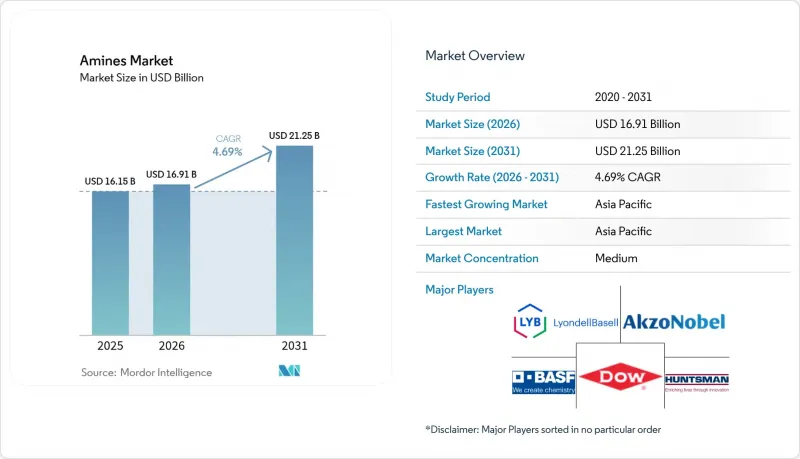
Mordor Intelligence에 의하면, 2026년 아민 시장 규모는 169억 1,000만 달러로 추정되며, 2025년 161억 5,000만 달러에서 2031년에는 212억 5,000만 달러에 달할 것으로 예측됩니다.
또한 2026-2031년 연평균 성장률(CAGR)은 4.69%를 기록할 전망입니다.
본 보고서는 유형별(에틸렌아민, 알킬아민, 지방족 아민, 특수 아민, 에탄올아민),최종 이용 산업(고무, 퍼스널케어 제품, 세정제, 접착제·도료·수지, 농약, 석유·석유화학제품, 기타 최종 용도), 지역(아시아태평양, 북미, 유럽, 남미, 중동 및 아프리카)별로 분류되어 있습니다. 시장 예측은 금액(달러) 단위로 제시되어 있습니다.
세계 아민 시장 동향 및 인사이트
아시아 퍼스널케어 제품 제조업체 수요 급증
아미노산 계면활성제는 기존의 황산염계를 능가하며, 2010년 이후 연평균 18%의 성장률을 기록하고 있습니다. 아시아의 제형 개발 기업들은 저자극성과 높은 생분해성을 갖춘 글루탐산 및 알라닌산 유도체를 주류로 채택하고 있으며, 이로 인해 아민 공급업체들은 국제 지속가능성 및 탄소 인증(ISCC-PLUS)을 획득한 바이오 제품 라인을 확대할 수밖에 없게 되었습니다. 누리용(Nuriyon)의 인증을 받은 친환경 에틸렌옥사이드 및 에탄올아민 생산은 플랜트 운영자가 클린 라벨 제형을 위해 제품 포트폴리오를 재편하고 있음을 보여주는 실제 사례입니다. 이와 병행하여, 각 제조업체들이 높은 발포성을 가지면서도 순한 사용감을 추구하는 가운데, 다기능 아민 옥사이드가 샴푸, 바디워시, 가정용 제품 부문에서 시장 점유율을 확대되고 있습니다. 중산층 소비자들이 ‘천연 유래 지수’가 100%에 가까운 제품을 선호하는 경향이 있어, 아민 시장은 아시아의 급성장하는 클린 뷰티 생태계에서 중요한 추진력으로서의 역할을 더욱 공고히 할 전망입니다.
신흥 농업 거점에서의 농약 급속한 보급
아시아태평양 및 남미의 현대적인 농업 관행에서는 정밀한 화학 물질 투입이 요구되고 있으며, 이로 인해 아민계 농약 염 및 유화제에 대한 수요가 증가하여 아민 시장의 성장을 뒷받침하고 있습니다. 재생에너지를 동력원으로 하는 새로운 분산형 암모니아 플랜트는 특히 브라질과 인도에서 물류 비용 절감과 지역 공급 안정성 향상에 기여하고 있습니다. CF 인더스트리즈와 POET가 실시한 저탄소 암모니아 비료 파일럿 프로젝트는 그린 수소 공급 경로를 통합함으로써 농업 및 지속가능성 측면에서 얻는 이점을 입증하고 있습니다. 이러한 동향은 제초제, 살충제, 종자 처리제에 사용되는 에탄올아민, 알킬아민, 지방아민의 장기적인 수요를 뒷받침하고 있습니다.
비목재 펄프 및 디지털 문서로 전환
선진국에서 사무용지 소비량이 감소함에 따라 아민계 펄프 표백제 및 제지용 코팅제 수요가 위축되고 있습니다. 각 기업은 이러한 장기적인 수요 감소의 영향을 완화하기 위해, 성장세가 빠른 퍼스널케어 및 건설 분야로 생산량을 재분배하고 있습니다. BASF가 기존의 아민 관련 자산을 특수 화학제품용으로 재편하기로 결정한 것은 이러한 구조적 변화에 대한 업계의 적극적인 대응을 여실히 보여줍니다.
부문별 분석
에탄올아민은 가스 스위트닝, 퍼스널케어용 계면활성제, 부식 방지제에서 필수적인 역할을 수행하고 있어 2025년에는 아민 시장 전체의 42.18%를 차지했습니다. 천연가스 처리 및 트리에탄올아민계 시멘트 첨가제로부터의 견조한 수요가, 탄소 포집용 용매 분야에서 새로운 용도가 등장하고 있는 상황 속에서도 견고한 기반을 뒷받침하고 있습니다. 이 부문의 규모가 크기 때문에 주요 공급업체들은 에톡실레이트에서 모르폴린에 이르는 파생 제품 체인 전반에 걸쳐 비용 면에서의 우위와 사업적 시너지 효과를 얻고 있습니다. 대조적으로, 특수 아민은 전자, 의약품 및 첨단 복합재료 분야의 틈새 용도에 힘입어 2031년까지 연평균 성장률(CAGR) 4.84%로 가장 높은 성장률을 나타낼 것으로 예측됩니다.
각 생산 업체들은 고순도 모르폴린, 디아민, 키랄 아민 중간체 간 전환을 신속하게 수행할 수 있는 다목적 반응 장치를 도입하고 있습니다. 에보닉의 난징 공장 확장은 이러한 고부가가치 분자로의 전환을 상징합니다. 동시에, 재생 가능한 원료로 90%의 수율을 달성한 루테늄/트리포스 촉매와 같은 학술적 돌파구는 특수 등급을 위한 지속 가능한 원료 풀을 확대할 가능성을 내포하고 있습니다. 에탄올아민의 규모의 경제와 특수 아민의 성장이 시너지를 발휘하여, 아민 시장의 균형 잡힌 장기 성장 궤도를 뒷받침하고 있습니다.
지역별 분석
아시아태평양은 2025년에 전 세계 매출의 38.55%를 차지하고, 2031년까지 연평균 성장률(CAGR) 5.64%로 확대되는 등 두 주요 리더로서의 지위를 유지했습니다. 중국의 4,552만 톤에 달하는 암모니아 생산 능력이 이 지역의 원료 측면에서의 우위를 뒷받침하고 있습니다. 인도의 특수 화학제품 대기업인 Alkyl Amines와 Balaji Amines 등은 비용 경쟁력 있는 제조 체제를 활용하여 20개 이상의 공장을 운영하며 100개국 이상에 수출하고 있습니다. 대만, 한국, 중국 본토의 반도체 산업 확대가 전자기기용 아민 수요를 견인하고 있는 반면, 아세안(ASEAN) 국가들에서는 의약품, 농약, 가정용품을 통해 추가적인 성장이 예상됩니다. BASF가 계획 중인 100억 달러 규모의 잔장(湛江) 베르분트 프로젝트는 전적으로 재생 가능 전력을 통해 가동될 예정이며, 다국적 기업들이 이 지역의 지속 가능한 성장 기회를 어떻게 포착하려 하고 있는지를 보여줍니다.
북미는 성숙 단계에 있지만 전략적으로 매우 중요한 클러스터이며, 탄소 포집 시스템과 통합된 블루 암모니아 시설에 대한 투자가 증가하고 있습니다. 미국에서는 2030년까지 암모니아 생산 능력이 4배로 증가할 것으로 예측됩니다. 이러한 확장은 국내 비료 공급을 확보하는 동시에 에탄올아민 및 요소 유도체를 위한 현지 원료 기반을 제공할 것입니다. 한편, 캐나다는 풍부한 수력발전을 바탕으로 국내 시장과 수출 시장을 모두 겨냥한 저탄소 아민 생산의 유력한 후보지로 부상하고 있습니다.
유럽에서는 순환 경제 목표가 지속적으로 추구되고 있으며, 바이오 유래 중간체 및 에너지 효율이 높은 반응 장치에 대한 혁신이 촉진되고 있습니다. 누리용의 그린 에틸렌옥사이드에 대한 ISCC-PLUS 인증은 친환경 라벨이 부착된 계면활성제에 대한 지역적 수요를 뒷받침하고 있습니다. 유럽연합 집행위원회의 VOC(휘발성 유기화합물) 규제 강화에 따라, 배합 제조업체들은 기존의 휘발성 아민을 성능 기준을 충족하는 인화점 높은 유도체로 대체하도록 촉구받고 있습니다.
중동 및 아프리카에서는 천연가스를 원료로 확보할 수 있다는 이점이 있어, 특히 사우디아라비아와 오만에서 경쟁력 있는 가격으로 암모니아 및 하류 아민 생산 체인을 구축할 수 있게 되었습니다.
남미에서는 대두와 옥수수 재배에 중점을 두고 있어 제초제용 아민 염의 안정적인 소비가 예상되며, 특히 브라질과 아르헨티나가 그 수요를 주도하고 있습니다.
기타 혜택:
- 엑셀 형식 시장 예측(ME) 시트
- 3개월간의 애널리스트 지원
자주 묻는 질문
목차
제1장 서론
제2장 조사 방법
제3장 주요 요약
제4장 시장 구도
제5장 시장 규모와 성장 예측
제6장 경쟁 구도
제7장 시장 기회와 향후 전망
LSH 26.09.08According to Mordor Intelligence, amines market size in 2026 is estimated at USD 16.91 billion, growing from 2025 value of USD 16.15 billion with 2031 projections showing USD 21.25 billion, growing at 4.69% CAGR over 2026-2031.
This report is Segmented by Type (Ethyleneamines, Alkylamines, Fatty Amines, Specialty Amines, Ethanolamines), End-Use Industry (Rubber, Personal Care Products, Cleaning Products, Adhesives/Paints/Resins, Agro-Chemicals, Oil/Petrochemicals, Other End-Uses), and Geography (Asia-Pacific, North America, Europe, South America, Middle East and Africa). The Market Forecasts are Provided in Terms of Value (USD).
Global Amines Market Trends and Insights
Surging Demand from Asian Personal-Care Formulators
Amino acid-based surfactants have outpaced traditional sulfate systems, recording 18% average annual growth since 2010. Asian formulators are mainstreaming glutamate and alaninate derivatives that offer low irritation and high biodegradability, forcing amine suppliers to expand bio-based lines with International Sustainability and Carbon Certification (ISCC-PLUS) credentials. Nouryon's certified production of green ethylene oxide and ethanolamines illustrates how plant operators are realigning portfolios toward clean-label formulations. In tandem, multifunctional amine oxides are gaining ground in shampoo, body-wash and household categories as manufacturers pursue high-foaming yet mild profiles. With middle-class consumers gravitating toward products boasting a natural-origin index approaching 100%, the amines market is set to deepen its role as a pivotal enabler of Asia's fast-growing clean-beauty ecosystem.
Rapid Pesticide Adoption in Emerging Agriculture Hubs
Modern farming practices in Asia Pacific and South America require precision chemical inputs, lifting demand for amine-based pesticide salts and emulsifiers, supporting growth in the amines market. Novel decentralized ammonia plants powered by renewable electricity are lowering logistics costs and improving regional supply security, notably in Brazil and India. CF Industries and POET's pilot of low-carbon ammonia fertilizer demonstrates the agronomic and sustainability pay-off of integrating green hydrogen pathways. Such developments bolster long-term offtake for ethanolamines, alkylamines, and fatty amines used in herbicides, insecticides, and seed-treatment agents.
Shift to Wood-Free Paper & Digital Documentation
Declining office-paper consumption in developed economies is dampening demand for amine-based pulp bleaching agents and paper coatings. Companies are reallocating volumes toward faster-growing personal-care and construction segments to cushion the long-term drag. BASF's decision to reconfigure legacy amine assets toward specialty chemicals highlights the industry's proactive adjustment to this structural shift.
Other drivers and restraints analyzed in the detailed report include:
- Infrastructure Boom Spurring Construction Chemicals
- Electronics-Grade Amines for Advanced Semiconductor Fabs
- Volatile Ammonia & Ethylene Feedstock Pricing
For complete list of drivers and restraints, kindly check the Table Of Contents.
Segment Analysis
Ethanolamines captured 42.18% of the overall amines market in 2025, owing to their indispensable role in gas sweetening, personal-care surfactants and corrosion inhibitors. Steady demand from natural-gas treatment and triethanolamine-based cement additives underpins a robust baseline, even as newer uses in carbon-capture solvents emerge. The segment's scale gives leading suppliers cost leverage and operational synergies across derivative chains ranging from ethoxylates to morpholine. In contrast, specialty amines are projected to post the fastest 4.84% CAGR through 2031, propelled by niche applications in electronics, pharmaceuticals and advanced composites.
Producers are installing multipurpose reactors capable of quick changeovers between high-purity morpholines, diamines and chiral amine intermediates. Evonik's expansion in Nanjing exemplifies this pivot toward higher value-added molecules. Concurrently, academic breakthroughs such as ruthenium/triphos catalysts achieving 90% yields on renewable feedstocks promise to widen the sustainable feedstock pool for specialty grades. The interplay of scale in ethanolamines and growth in specialty amines underpins the balanced long-term trajectory of the amines market.
Complete Report Scope:
- By Type
- Ethyleneamines
- Alkylamines
- Fatty Amines
- Specialty Amines
- Ethanolamines
- By End-use Industry
- Rubber
- Personal Care Products
- Cleaning Products
- Adhesives, Paints and Resins
- Agro-Chemicals
- Oil and Petrochemicals
- Other End-uses
- By Geography
- Asia-Pacific
- China
- India
- Japan
- South Korea
- Rest of Asia-Pacific
- North America
- United States
- Canada
- Mexico
- Europe
- Germany
- United Kingdom
- France
- Italy
- Rest of Europe
- South America
- Brazil
- Argentina
- Rest of South America
- Middle East and Africa
- Saudi Arabia
- South Africa
- Rest of Middle East and Africa
- Asia-Pacific
Geography Analysis
Asia Pacific retained its dual leadership position, generating 38.55% of global revenue in 2025 and expanding at a 5.64% CAGR through 2031. China's 45.52 million t ammonia capacity anchors the region's raw-material advantage. India's specialty chemicals champions, including Alkyl Amines and Balaji Amines, operate more than 20 plants and export to over 100 countries, leveraging cost-competitive manufacturing. Semiconductor expansions across Taiwan, South Korea and mainland China are pushing demand for electronics-grade amines, while ASEAN nations add incremental growth through pharmaceuticals, agro chemicals and household products. BASF's planned USD 10 billion Zhanjiang Verbund project, powered entirely by renewable electricity, illustrates how multinationals intend to capture enduring regional upside.
North America represents a mature yet strategically vital cluster, with rising investments in blue ammonia facilities integrated with carbon-capture systems. The United States is expected to quadruple ammonia capacity by 2030. This expansion safeguards domestic fertilizer supply and provides a local feedstock base for ethanolamine and urea derivatives. Meanwhile, Canada's abundant hydropower positions it as a contender for low-carbon amine production targeting both domestic and export markets.
Europe continues to pursue circular-economy objectives, driving innovations in bio-based intermediates and energy-efficient reactors. Nouryon's ISCC-PLUS certification for green ethylene oxide supports regional demand for eco-labeled surfactants. The European Commission's stricter VOC targets are encouraging formulators to substitute conventional volatile amines with higher-flashpoint derivatives that meet performance criteria.
The Middle East and Africa benefit from natural-gas feedstock availability, enabling competitively priced ammonia and downstream amine chains, especially in Saudi Arabia and Oman.
South America's focus on soybean and corn cultivation assures steady consumption of herbicidal amine salts, with Brazil and Argentina leading uptake.
- Air Products and Chemicals, Inc.
- Akzo Nobel N.V.
- Alkyl Amines Chemicals Limited
- Arkema
- BASF SE
- Celanese Corporation
- Clariant
- Daicel Corporation
- Dow
- Eastman Chemical Company
- Huntsman International LLC
- INEOS
- Invista
- Kemipex
- LyondellBasell Industries Holdings B.V.
- MITSUBISHI GAS CHEMICAL COMPANY, INC
- NIPPON SHOKUBAI CO., LTD.
- SABIC
- Solvay
- Tosoh Corporation
Additional Benefits:
- The market estimate (ME) sheet in Excel format
- 3 months of analyst support
TABLE OF CONTENTS
1 Introduction
- 1.1 Study Assumptions and Market Definition
- 1.2 Scope of the Study
2 Research Methodology
3 Executive Summary
4 Market Landscape
- 4.1 Market Overview
- 4.2 Market Drivers
- 4.2.1 Surging demand from Asian personal-care formulators
- 4.2.2 Rapid pesticide adoption in emerging agriculture hubs
- 4.2.3 Infrastructure boom spurring construction chemicals
- 4.2.4 Electronics-grade amines for advanced semiconductor fabs
- 4.2.5 On-site green-hydrogen-derived amines pilots
- 4.3 Market Restraints
- 4.3.1 Shift to wood-free paper and digital documentation
- 4.3.2 Volatile ammonia and ethylene feedstock pricing
- 4.3.3 Stricter amine VOC/odor regulations
- 4.4 Value Chain Analysis
- 4.5 Regulatory Landscape
- 4.6 Technological Outlook
- 4.6.1 Current Technologies
- 4.6.1.1 Zeolite-catalyzed methylamine processes
- 4.6.1.2 Direct amination of isobutylene
- 4.6.1.3 Catalytic distillation
- 4.6.1.4 Ammonolysis of EDC
- 4.6.2 Upcoming Technologies
- 4.6.1 Current Technologies
- 4.7 Porter's Five Forces
- 4.7.1 Bargaining Power of Suppliers
- 4.7.2 Bargaining Power of Buyers
- 4.7.3 Threat of New Entrants
- 4.7.4 Threat of Substitutes
- 4.7.5 Degree of Competition
- 4.8 Price Analysis
- 4.9 Production Analysis
5 Market Size and Growth Forecasts (Value)
- 5.1 By Type
- 5.1.1 Ethyleneamines
- 5.1.2 Alkylamines
- 5.1.3 Fatty Amines
- 5.1.4 Specialty Amines
- 5.1.5 Ethanolamines
- 5.2 By End-use Industry
- 5.2.1 Rubber
- 5.2.2 Personal Care Products
- 5.2.3 Cleaning Products
- 5.2.4 Adhesives, Paints and Resins
- 5.2.5 Agro-Chemicals
- 5.2.6 Oil and Petrochemicals
- 5.2.7 Other End-uses
- 5.3 By Geography
- 5.3.1 Asia-Pacific
- 5.3.1.1 China
- 5.3.1.2 India
- 5.3.1.3 Japan
- 5.3.1.4 South Korea
- 5.3.1.5 Rest of Asia-Pacific
- 5.3.2 North America
- 5.3.2.1 United States
- 5.3.2.2 Canada
- 5.3.2.3 Mexico
- 5.3.3 Europe
- 5.3.3.1 Germany
- 5.3.3.2 United Kingdom
- 5.3.3.3 France
- 5.3.3.4 Italy
- 5.3.3.5 Rest of Europe
- 5.3.4 South America
- 5.3.4.1 Brazil
- 5.3.4.2 Argentina
- 5.3.4.3 Rest of South America
- 5.3.5 Middle East and Africa
- 5.3.5.1 Saudi Arabia
- 5.3.5.2 South Africa
- 5.3.5.3 Rest of Middle East and Africa
- 5.3.1 Asia-Pacific
6 Competitive Landscape
- 6.1 Market Concentration
- 6.2 Strategic Moves
- 6.3 Market Share Analysis
- 6.4 Company Profiles (includes Global level Overview, Market level overview, Core Segments, Financials as available, Strategic Information, Market Rank/Share for key companies, Products and Services, and Recent Developments)
- 6.4.1 Air Products and Chemicals, Inc.
- 6.4.2 Akzo Nobel N.V.
- 6.4.3 Alkyl Amines Chemicals Limited
- 6.4.4 Arkema
- 6.4.5 BASF SE
- 6.4.6 Celanese Corporation
- 6.4.7 Clariant
- 6.4.8 Daicel Corporation
- 6.4.9 Dow
- 6.4.10 Eastman Chemical Company
- 6.4.11 Huntsman International LLC
- 6.4.12 INEOS
- 6.4.13 Invista
- 6.4.14 Kemipex
- 6.4.15 LyondellBasell Industries Holdings B.V.
- 6.4.16 MITSUBISHI GAS CHEMICAL COMPANY, INC
- 6.4.17 NIPPON SHOKUBAI CO., LTD.
- 6.4.18 SABIC
- 6.4.19 Solvay
- 6.4.20 Tosoh Corporation
7 Market Opportunities and Future Outlook
- 7.1 White-space and Unmet-Need Assessment