|
시장보고서
상품코드
2120761
지오폼 : 시장 점유율 분석, 업계 동향과 통계, 성장 예측(2026-2031년)Geofoams - Market Share Analysis, Industry Trends & Statistics, Growth Forecasts (2026 - 2031) |
||||||
 Mordor Intelligence
Mordor Intelligence에 따르면 지오폼 시장 규모는 2025년에 10억 4,000만 달러로 평가되며, 2026년 11억 달러에서 2031년까지 14억 7,000만 달러에 달할 것으로 예측되며, 예측 기간(2026-2031년) 동안 CAGR은 5.95%가 될 전망입니다.
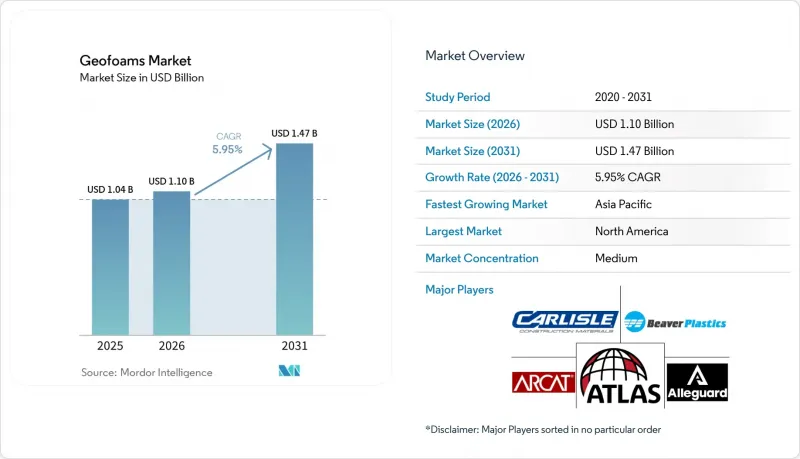
본 보고서는 종류별(발포 폴리스티렌(EPS), 압출 폴리스티렌(XPS)), 최종사용자 산업별(도로, 건축), 지역별(아시아태평양, 북미, 유럽, 남미, 중동 및 아프리카)로 분류되어 있습니다. 시장 전망은 금액(달러) 기준으로 제시되어 있습니다.
세계 지오폼 시장의 동향 및 인사이트
도로 및 교량 성토 분야의 수요 증가
교통 기관들은 불균일 침하를 완화하고, 건설 기간을 단축하며, 비용이 많이 드는 지반 개량 공사를 피하기 위해 지오폼 블록을 채택하고 있습니다. 콜로라도주의 긴급 고속도로 보수 공사에서는 기존의 토공 대신 지오폼을 사용함으로써 공사 기간을 30% 단축할 수 있음이 입증되었습니다. 노르웨이의 고속도로 프로젝트에서는 350곳의 시공 사례에서 100년의 내구성이 확인되었으며, 동결·융해 주기 하에서도 이 재료가 내성을 발휘한다는 것이 입증되었습니다. 특히 교량의 진입로에서는 깊은 기초를 필요로 하지 않고 연약 지반 위에서도 형상을 유지할 수 있다는 큰 장점이 있습니다. 토양에 대한 밀도가 1%에 불과하기 때문에 시공 후 몇 주가 아닌 며칠 만에 교통을 재개할 수 있습니다. 장기 모니터링 결과, 지진이나 온도 변화가 발생했을 때에도 설계 모델과 일치하는 하중 분포가 확인되었습니다.
기존 경량 성토를 대체할 비용 대비 효과가 높은 대안
지오폼의 매력은 단가에만 그치지 않습니다. 프리캐스트 블록을 사용함으로써 현장에서의 혼합 및 양생이 불필요해져, 사면 보수 공사의 노동 시간을 최대 40%까지 절감할 수 있습니다. 골재 산지가 수백 킬로미터 떨어져 있는 경우, 운송 비용 절감 효과는 현저합니다. 블록은 수작업으로 이동할 수 있으므로 소수의 작업자와 경량 장비만으로 충분해 연료비나 임대 비용을 절감할 수 있습니다. 공장에서 관리된 밀도와 압축 강도로 인해, 현장 혼합 방식에 수반되는 품질 보증 비용을 대폭 절감할 수 있습니다. 이러한 특성을 종합함으로써 프로젝트 예산 배분을 재검토하고, 배수 설비 개량 등의 부대 공사에 자금을 전환할 수 있게 됩니다.
석유계 용제 및 탄화수소에 대한 높은 취약성
폴리스티렌은 탄화수소계 용제와 친화성이 높기 때문에 연료 취급 구역 인근에서의 사용은 제한됩니다. NOAA의 화학제품 데이터베이스에 따르면, EPS가 가솔린과 접촉하면 부피가 급격히 감소하는 것으로 지적되어 있어, HDPE 제 지오멤브레인을 이용한 장벽 설치가 필요하며, 이로 인해 설치 비용이 5-10% 증가합니다. 유출 위험이 높은 도로에서는 감시 우물이나 비상용 라이너의 설치가 필수적이며, 이로 인해 설계가 복잡해집니다. 산업용 저장 야드도 유사한 위험에 직면해 있으며, 사양 수립자들은 대체 충진재나 복합 봉쇄 시스템을 채택하는 경향을 보이고 있습니다. 코팅 기술은 발전하고 있지만, 장기간에 걸친 현장 실증 사례는 여전히 제한적이기 때문에 설계자들은 중요한 시설에 대해 신중한 태도를 유지하고 있습니다.
부문 분석
2025년, 발포 폴리스티렌(EPS)은 지오폼 시장 점유율의 64.54%를 차지했으나, 압출 폴리스티렌(XPS)은 2031년까지 연평균 성장률(CAGR) 6.37%로 성장할 것으로 예측됩니다. EPS는 조달 전략이 부피에 좌우되는 비용 중심의 도로 성토 분야에서 수요가 높아, 지오폼 시장 전체를 지탱하고 있습니다. 한편, XPS(압출 폴리스티렌)는 수분 흡수율이 낮고 압축 강도도 뛰어나기 때문에 긴 수명이 요구되는 교량, 터널, 한랭 지역의 기초 공사에 적합합니다. 듀폰사의 시험에 따르면, XPS는 단면 두께를 30-40% 얇게 해도 동등한 단열 성능(R값)을 발휘할 수 있는 것으로 밝혀져, 과도한 굴착을 피하면서 노반의 단열을 도모하고자 하는 설계자들에게 지지를 받고 있습니다.
생산 비용 측면에서 볼 때, EPS가 생산량 면에서 우위를 차지하는 이유는 분명합니다. 증기 발포법에서는 에너지와 스티렌 투입량이 적어 단위 비용을 XPS보다 15-20% 낮게 유지할 수 있습니다. 한편, XPS의 연속 압출 성형은 크리프에 내성이 있는 균일한 셀 크기를 만들어 내어, 설계 수명이 75년을 넘는 고급 용도를 뒷받침하고 있습니다. 재활용 인프라 측면에서는 EPS가 더 유리합니다. 블록의 잔여물은 쉽게 펠릿화되어 증기를 이용해 새로운 비즈로 재생될 수 있는 반면, XPS의 재압출에는 보다 엄격한 용융 여과가 필요하기 때문입니다. 미래를 내다보면, 적극적인 친환경 건축 규제를 도입하고 있는 지자체에서는 내습성으로 인해 유지 관리 비용이 절감되므로 XPS의 시장 점유율이 더욱 확대될 가능성이 있습니다. 그러나 가격 면에서의 우위 덕분에 EPS는 대규모 벌크 충진 용도에서 계속해서 확고한 입지를 유지할 것입니다.
지역별 분석
2025년, 북미는 전 세계 매출의 34.86%를 차지했습니다. 이는 대규모 고속도로 개보수 및 교량 진입로에서의 엄격한 침하 억제 기준에 힘입은 결과입니다. 콜로라도주, 미네소타주, 온타리오주에서 진행된 프로젝트들은 불균일한 침하가 억제됨으로써 수명주기 비용이 절감되었음을 입증하고 있습니다. 캐나다의 북극권 회랑에서는 지오폼의 단열성을 활용하여 영구 동토층을 안정화시키고, 활주로 및 파이프라인 아래에서 해빙으로 인한 침하를 방지하고 있습니다.
아시아태평양은 연간 1조 7,000억 달러에 달하는 인프라 수요를 배경으로 2031년까지 연평균 성장률(CAGR) 6.66%로 확대될 것으로 예측되며, 이는 세계에서 가장 빠른 속도입니다. 중국과 인도의 대형 철도 회랑에서는 깊은 굴착 없이 연약한 충적토를 관리하기 위해 지오폼이 채택되고 있습니다. 일본의 내진 기준에서는 관성 하중을 줄이는 경량 성토가 권장되고 있는 반면, 한국의 고속도로에서는 램프 확장 프로젝트에서 EPS 블록의 사용이 표준화되어 있습니다.
유럽에서는 순환 경제의 의무화와 해안 지역의 기후 변화에 따른 과제를 배경으로, 꾸준한 도입이 진행되고 있습니다. 독일과 프랑스에서는 EU의 폐기물 감축 목표에 따라 재활용 소재를 포함한 지오폼을 홍수 방어 공사에 적용하고 있습니다. 영국의 스마트 고속도로 개보수 프로젝트에서는 통행 금지 기간을 최소화하기 위해 지오폼 사용이 지정되어 있으며, 이는 이용자의 지연 비용 절감과 연계된 시공사 인센티브를 뒷받침하고 있습니다. 북유럽 국가들에서는 영하의 환경 조건에서 지오폼의 내구성을 입증하는 30년에 걸친 현장 데이터를 활용하고 있으며, 이를 통해 지오폼 사용 확대에 대한 국민의 신뢰와 규제 당국의 승인이 더욱 강화되고 있습니다.
기타 혜택:
- 엑셀 형식의 시장 예측(ME) 시트
- 3개월간의 애널리스트 지원
자주 묻는 질문
목차
제1장 소개
제2장 조사 방법
제3장 주요 요약
제4장 시장 구도
제5장 시장 규모와 성장 예측
제6장 경쟁 구도
제7장 시장 기회와 향후 전망
KSM 26.09.02According to Mordor Intelligence, the geofoams market size was valued at USD 1.04 billion in 2025 and estimated to grow from USD 1.10 billion in 2026 to reach USD 1.47 billion by 2031, at a CAGR of 5.95% during the forecast period (2026-2031).
This report is Segmented by Type (Expanded Polystyrene (EPS), Extruded Polystyrene (XPS)), End-User Industry (Roadways, Buildings), and Geography (Asia-Pacific, North America, Europe, South America, Middle East and Africa). The Market Forecasts are Provided in Terms of Value (USD).
Global Geofoams Market Trends and Insights
Rising Demand from Roadway & Bridge Embankments
Transportation agencies are turning to geofoam blocks to mitigate differential settlement, shorten construction schedules and avoid costly ground-improvement programs. Colorado's emergency highway repair demonstrated 30% schedule compression when geofoam replaced traditional earthwork. Norwegian highway projects show 100-year durability across 350 installations, proving the material's resilience under freeze-thaw cycles. Bridge approach ramps gain particular benefit, maintaining geometry over weak soils without deep foundations. The 1% density versus soil allows traffic to reopen days, not weeks, after placement. Long-term monitoring confirms load distribution that matches design models during seismic and thermal events.
Cost-Effective Alternative to Traditional Lightweight Fills
Geofoam's attraction extends beyond unit price. Prefabricated blocks bypass on-site mixing and curing, trimming labor hours by up to 40% in slope repair works. Transport savings are pronounced where aggregate sources lie hundreds of kilometers away. Because blocks can be manually maneuvered, smaller crews and lighter equipment reduce fuel and rental costs. Factory-controlled density and compressive strength slash quality-assurance outlays tied to field-mixed solutions. Together, these attributes reposition project budgets, freeing capital for ancillary scope such as drainage upgrades.
High Vulnerability to Petroleum Solvents & Hydrocarbons
Polystyrene's affinity for hydrocarbon solvents constrains deployment near fuel handling zones. NOAA's chemical database cites rapid volumetric loss when EPS contacts gasoline, necessitating HDPE geomembrane barriers that add 5-10% to installed cost. Roadways with high spill risk must incorporate monitoring wells and contingency liners, complicating designs. Industrial storage yards face similar exposure, pushing specifiers toward alternative fills or composite encapsulation systems. Although coating technologies are advancing, long-term field validation remains limited, keeping designers cautious in critical facilities.
Other drivers and restraints analyzed in the detailed report include:
- Surging Infrastructure CAPEX in Asia-Pacific
- Accelerated Modular Bridge Programs Using EPS Geofoam Blocks
- Stricter Fire-Resistance Standards Driving Cost Up
For complete list of drivers and restraints, kindly check the Table Of Contents.
Segment Analysis
Expanded polystyrene retained 64.54% of geofoams market share in 2025, while extruded polystyrene is forecast to grow at a 6.37% CAGR to 2031. EPS thrives in cost-sensitive roadway embankments where volume rules procurement strategies, sustaining the overall geofoams market. Yet XPS's lower water absorption and superior compressive strength satisfy bridge, tunnel and cold-climate foundations demanding long service life. DuPont tests reveal XPS can deliver the same thermal R-value with 30-40% thinner sections, appealing to designers seeking subgrade insulation without over-excavation.
Production economics illustrate why EPS dominates volume: steam expansion uses less energy and input styrene, keeping unit costs 15-20% below XPS. Conversely, XPS's continuous extrusion yields uniform cell size that resists creep, supporting premium applications where design life exceeds 75 years. Recycling infrastructure favors EPS because block off-cuts can be readily granulated and steamed into new beads, whereas XPS re-extrusion demands stricter melt-filtering. Looking forward, municipalities with aggressive green-building codes may tilt share further toward XPS as moisture durability lessens maintenance budgets, but EPS will stay entrenched in large-scale bulk fills owing to its price advantage.
Complete Report Scope:
- By Type
- Expanded Polystyrene (EPS)
- Extruded Polystyrene (XPS)
- By End-user Industry
- Roadways
- Buildings
- By Geography
- Asia-Pacific
- China
- India
- Japan
- South Korea
- Rest of Asia-Pacific
- North America
- United States
- Canada
- Mexico
- Europe
- Germany
- United Kingdom
- France
- Italy
- Russia
- Rest of Europe
- South America
- Brazil
- Argentina
- Rest of South America
- Middle East and Africa
- Saudi Arabia
- United Arab Emirates
- South Africa
- Nigeria
- Rest of Middle East and Africa
- Asia-Pacific
Geography Analysis
North America accounted for 34.86% of global revenue in 2025, underpinned by extensive highway rehabilitation and stringent settlement-control criteria in bridge approaches. Projects in Colorado, Minnesota and Ontario testify to lifecycle cost savings once differential settlement is curtailed. Canadian Arctic corridors leverage geofoam's insulating value to stabilize permafrost, preventing thaw settlement beneath runways and pipelines.
Asia-Pacific is projected to expand at a 6.66% CAGR to 2031, the fastest globally, on the back of USD 1.7 trillion yearly infrastructure needs. Mega-rail corridors in China and India favor geofoam to manage weak alluvial soils without deep excavation. Japanese seismic codes reward lightweight fills that reduce inertial loads, while South Korean expressways have standardized EPS blocks for ramp widening projects.
Europe demonstrates steady adoption driven by circular-economy mandates and coastal climate challenges. Germany and France integrate recycled-content geofoam into flood-defense works, aligning with EU waste-reduction targets. The United Kingdom's smart-motorway upgrades specify geofoam to minimize closure times, supporting contractor incentives tied to user delay cost savings. Nordic countries capitalize on three decades of field data validating geofoam resilience in sub-zero conditions, reinforcing public trust and regulatory approval for expanded use.
- Airfoam
- Alleguard
- ARCAT, Inc.
- Atlas Roofing Corporation
- BASF SE
- Beaver Plastics Ltd.
- Benchmark Foam Inc.
- Carlisle Construction Materials LLC
- FMI-EPS LLC
- Harbor Foam Inc.
- NOVA Chemicals Corporate
- Plasti-Fab Ltd
- Poly Molding LLC
- Styro Insulations Mat. Ind. LLC.
- ThermaFoam, LLC
- Universal Foam Products
Additional Benefits:
- The market estimate (ME) sheet in Excel format
- 3 months of analyst support
TABLE OF CONTENTS
1 Introduction
- 1.1 Study Assumptions and Market Definition
- 1.2 Scope of the Study
2 Research Methodology
3 Executive Summary
4 Market Landscape
- 4.1 Market Overview
- 4.2 Market Drivers
- 4.2.1 Rising demand from roadway and bridge embankments
- 4.2.2 Cost-effective alternative to traditional lightweight fills
- 4.2.3 Surging infrastructure CAPEX in Asia-Pacific
- 4.2.4 Accelerated modular bridge programs using EPS geofoam blocks
- 4.2.5 Circular-economy push for recycled-EPS geofoam reuse
- 4.3 Market Restraints
- 4.3.1 High vulnerability to petroleum solvents and hydrocarbons
- 4.3.2 Limited design know-how in emerging economies
- 4.3.3 Stricter fire-resistance standards driving cost up
- 4.4 Value Chain Analysis
- 4.5 Porter's Five Forces
- 4.5.1 Bargaining Power of Suppliers
- 4.5.2 Bargaining Power of Buyers
- 4.5.3 Threat of New Entrants
- 4.5.4 Threat of Substitutes
- 4.5.5 Degree of Competition
5 Market Size and Growth Forecasts (Value)
- 5.1 By Type
- 5.1.1 Expanded Polystyrene (EPS)
- 5.1.2 Extruded Polystyrene (XPS)
- 5.2 By End-user Industry
- 5.2.1 Roadways
- 5.2.2 Buildings
- 5.3 By Geography
- 5.3.1 Asia-Pacific
- 5.3.1.1 China
- 5.3.1.2 India
- 5.3.1.3 Japan
- 5.3.1.4 South Korea
- 5.3.1.5 Rest of Asia-Pacific
- 5.3.2 North America
- 5.3.2.1 United States
- 5.3.2.2 Canada
- 5.3.2.3 Mexico
- 5.3.3 Europe
- 5.3.3.1 Germany
- 5.3.3.2 United Kingdom
- 5.3.3.3 France
- 5.3.3.4 Italy
- 5.3.3.5 Russia
- 5.3.3.6 Rest of Europe
- 5.3.4 South America
- 5.3.4.1 Brazil
- 5.3.4.2 Argentina
- 5.3.4.3 Rest of South America
- 5.3.5 Middle East and Africa
- 5.3.5.1 Saudi Arabia
- 5.3.5.2 United Arab Emirates
- 5.3.5.3 South Africa
- 5.3.5.4 Nigeria
- 5.3.5.5 Rest of Middle East and Africa
- 5.3.1 Asia-Pacific
6 Competitive Landscape
- 6.1 Market Concentration
- 6.2 Strategic Moves
- 6.3 Market Share Analysis
- 6.4 Company Profiles (includes Global level Overview, Market level overview, Core Segments, Financials as available, Strategic Information, Market Rank/Share for key companies, Products and Services, and Recent Developments)
- 6.4.1 Airfoam
- 6.4.2 Alleguard
- 6.4.3 ARCAT, Inc.
- 6.4.4 Atlas Roofing Corporation
- 6.4.5 BASF SE
- 6.4.6 Beaver Plastics Ltd.
- 6.4.7 Benchmark Foam Inc.
- 6.4.8 Carlisle Construction Materials LLC
- 6.4.9 FMI-EPS LLC
- 6.4.10 Harbor Foam Inc.
- 6.4.11 NOVA Chemicals Corporate
- 6.4.12 Plasti-Fab Ltd
- 6.4.13 Poly Molding LLC
- 6.4.14 Styro Insulations Mat. Ind. LLC.
- 6.4.15 ThermaFoam, LLC
- 6.4.16 Universal Foam Products
7 Market Opportunities and Future Outlook
- 7.1 White-space and Unmet-need Assessment