

|
시장보고서
상품코드
2120767
호르몬 대체요법 : 시장 점유율 분석, 업계 동향과 통계, 성장 예측(2026-2031년)Hormone Replacement Therapy - Market Share Analysis, Industry Trends & Statistics, Growth Forecasts (2026 - 2031) |
||||||
 Mordor Intelligence
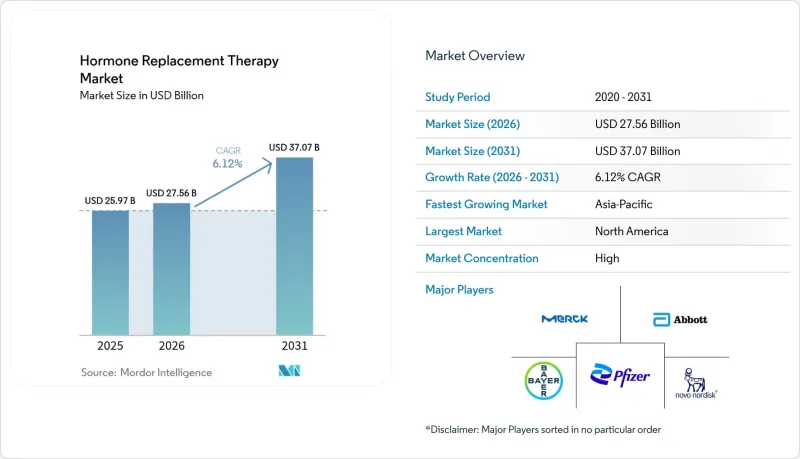
Mordor Intelligence에 의하면, 호르몬 대체요법 시장 규모는 2025년에 259억 7,000만 달러로 평가되었고, 2026년 275억 6,000만 달러에서 2031년까지 370억 7,000만 달러에 이를 것으로 예측되며, 예측 기간(2026년-2031년) CAGR은 6.12%를 기록할 전망입니다.
본 보고서는 치료법(에스트로겐, 성장 호르몬, 갑상선 호르몬 등), 투여 경로(경구, 비경구,경피, 질내/자궁내 등), 적응증(갱년기 장애, 갑상선 기능 저하증 등), 유통 채널(병원 약국 등), 지역(북미, 유럽, 아시아태평양 등)별로 분류되어 있습니다. 시장 예측은 금액(미 달러) 기준으로 제시되어 있습니다.
전 세계 호르몬 대체 요법 시장 동향 및 인사이트
폐경 후 인구의 급증과 평균 수명의 연장
인구 통계학적 변화로 인해 잠재적인 치료 대상자가 확대되고 있습니다. 이는 여성이 인생의 약 3분의 1을 폐경 후로 보내게 되었기 때문입니다. 관리되지 않은 갱년기 증상과 관련하여 일본이 연간 120억 달러의 부담을 지고 있는 등, 노동력의 생산성 저하는 의료 보험사 및 고용주에게 적극적인 호르몬 관리 프로그램의 도입을 촉구하고 있습니다. 공중보건 전략에 포함된 장수 지향적 노력은 증상 완화에 그치지 않고, 장기적인 예방 요법으로 이어지는 지속적인 수요를 창출하고 있습니다.
생체동등 호르몬 제제의 급속한 보급
임상적 증거에 따르면, 미립자 프로게스테론과 에스트라디올의 복합제는 기존의 결합형 말 에스트로겐에 비해 심혈관 및 대사 위험과 종양학적 위험이 낮은 것으로 나타났으며, 이로 인해 20-30%의 프리미엄 가격 책정이 가능해져 건강 의식이 높은 중년 여성들 사이에서 급속히 보급되고 있습니다. TherapeuticsMD사의 ‘BIJUVA’ 승인은 규제상의 벤치마크를 확립했습니다. 또한, 2032년까지의 특허 보호를 통해 혁신적인 기업들에게 방어력이 있는 틈새 시장을 제공합니다. Biote사의 503B 조제 시설 인수를 대표로 하는 인수를 통한 생산 능력 확대는 품질 표준화를 도모하면서 공급을 확보하고 있습니다.
WHI 및 추적 조사 이후의 암 위험에 대한 인식
21년간의 추적 조사 데이터에 따르면, 에스트로겐 단독 요법은 유방암 발병률을 23%, 사망률을 40% 감소시키는 것으로 나타났지만, 2002년 WHI에 관한 초기 헤드라인이 여전히 여론을 형성하고 있습니다. 비호르몬제인 페졸리네탄트에 적용된 사례 등, 최근 FDA의 박스 경고로 인해 안전성에 대한 논의가 계속해서 주목받고 있으며, 의사의 설명이 복잡해지고 있습니다. 전문 학회는 맞춤형 상담을 전제로 65세 이상의 치료를 허용한다는 입장을 업데이트했으나, 이를 널리 보급하기 위해서는 지속적인 계몽 활동이 필수적입니다.
부문 분석
에스트로겐 제제는 2025년 매출의 42.10%를 차지하며, 호르몬 대체 요법 시장에서 그 중심적인 위치를 부각시키고 있습니다. 한편, 부갑상선 부문은 새로운 적응증이 등장함에 따라 2031년까지 연평균 성장률(CAGR) 8.23%로 성장을 지속하고, 있어, 호르몬 대체 요법 시장 규모를 다양한 성장 궤도로 끌어올리고 있습니다. 만성 부갑상선 기능 저하증 치료제 ‘YORVIPATH’와 같은 전문성이 높은 제품은 고가대로 제공되며, 광범위한 증상 관리에서 표적화된 장기 지원으로의 전환을 부각시키고 있습니다.
정밀성을 중시하는 파이프라인에서는 미량 투여 에스트로겐과 조직 선택적 조절제를 결합하여 환자의 다양한 프로파일에 대응하고 있습니다. 여러 호르몬을 아우르는 포트폴리오를 보유한 기업은 유리한 입장에 있는 반면, 단일 제품에 의존하는 기업은 시장 점유율 감소 위험에 직면해 있습니다. 테스토스테론 수요는 심혈관계 관련 경고 표시 강화로 인해 억제되고 있지만, 성장 호르몬은 장수를 중시하는 소비자층 사이에서 꾸준한 확산세를 이어가고 있습니다.
경구 제제는 2025년에 39.85%의 시장 점유율을 차지할 것으로 예상되며, 편의성이 높아 여전히 널리 처방되고 있습니다. 7.58%의 예측 연평균 성장률(CAGR)에 힘입은 경피 패치와 젤은 첫 통과 대사를 거치지 않고 안정적인 혈장 농도를 유지할 수 있어, 호르몬 대체 요법 시장이 개인 맞춤형 투여로 전환되는 데 기여하고 있습니다. 노바티스의 ‘에스트라도트’ 마이크로 패치는 소형화된 시스템이 복약 순응도를 어떻게 향상시키는지를 보여줍니다.
MIT의 SLIM 마이크로크리스탈 기술과 같은 지속형 주사제는 분기별 또는 반기별 투여 주기를 가능하게 할 잠재력을 가지고 있습니다. 질 내 및 자궁 내 장치 또한 전신 노출을 최소화하면서 국소적인 비뇨생식기 증상을 지속적으로 관리함으로써 투여 방법의 선택 폭을 넓히고 있습니다.
지역별 분석
북미는 강력한 보험 환급 제도, FDA 지침의 명확성, 그리고 원격의료의 급속한 확장을 뒷받침하는 생태계 덕분에 2025년에도 38.20%의 점유율을 유지했습니다. 성별 확인 치료에 대한 메디케어의 보험 적용 선례는 정책이 어떻게 새로운 시장 부문을 개척할 수 있는지를 보여줍니다. 제네릭 에스트라디올 젤의 승인으로 저렴한 가격에 쉽게 구할 수 있게 되었지만, 향후 특허 만료로 인해 기존 브랜드에는 압박이 가해질 가능성이 있습니다.
아시아태평양은 2031년까지 연평균 성장률(CAGR) 7.12%를 나타낼 것으로 예측됩니다. 도시 지역의 소득 증가, 고령화, 여성 건강에 대한 문화적 인식의 변화가 보급의 기반이 되고 있는 반면, 일본 기업들은 갱년기와 관련된 결근으로 인한 손실을 연간 120억 달러로 추산하고 있으며, 이는 고용주가 자금을 지원하는 웰니스 프로그램 도입을 촉진하고 있습니다. 중국의 성전환 치료에 대한 규제 시범 사업과 인도의 중산층 구매력 향상 등이 맞물려, 이 지역 전체에서 호르몬 대체 요법 시장 규모가 확대되고 있습니다.
유럽에서는 지침에 기반한 안정적인 수요가 나타나고 있지만, 의료 기술 평가 기관에 의한 비용 대비 효과에 대한 면밀한 검토에 직면해 있습니다. 내분비 교란 물질의 배출에 관한 엄격한 환경 규제가 생산 비용에 영향을 미치고 있으며, 유럽의약품청(EMA)은 유럽 전역에 걸친 모니터링을 의무화하고 있습니다. 중동 및 아프리카, 남미의 신흥 지역은 성장 잠재력을 지니고 있으나, 다양한 문화적·규제적 상황에 맞춘 현지화 전략이 요구됩니다.
기타 혜택:
- 엑셀 형식 시장 예측(ME) 시트
- 3개월간의 애널리스트 지원
자주 묻는 질문
목차
제1장 서론
제2장 조사 방법
제3장 주요 요약
제4장 시장 구도
제5장 시장 규모와 성장 예측
제6장 경쟁 구도
제7장 시장 기회와 향후 전망
LSH 26.09.08According to Mordor Intelligence, the hormone replacement therapy market size was valued at USD 25.97 billion in 2025 and estimated to grow from USD 27.56 billion in 2026 to reach USD 37.07 billion by 2031, at a CAGR of 6.12% during the forecast period (2026-2031).
This report is Segmented by Therapy (Estrogen, Growth Hormone, Thyroid, and More), Route of Administration (Oral, Parenteral, Transdermal, Vaginal/Intra-uterine, and More), Indication (Menopause, Hypothyroidism, and More), Distribution Channel (Hospital Pharmacy, and More), and Geography (North America, Europe, Asia-Pacific, and More). The Market Forecasts are Provided in Terms of Value (USD).
Global Hormone Replacement Therapy Market Trends and Insights
Surging Post-Menopausal Population & Life-Expectancy Gains
Demographic momentum is enlarging the potential treatment pool as women now spend roughly one-third of their lives post-menopause. Workforce productivity losses, such as Japan's USD 12 billion annual burden tied to unmanaged menopausal symptoms, nudge healthcare payers and employers toward proactive hormone care programs. Integrated longevity initiatives in public health strategies are creating sustained demand that moves beyond symptom relief toward long-term preventive regimens.
Rapid Adoption of Bio-Identical Hormone Formulations
Clinical evidence shows micronized progesterone and estradiol combinations exhibit lower cardiometabolic and oncologic risk than earlier conjugated equine estrogens, enabling 20-30% premium pricing and faster uptake among health-conscious mid-life women. TherapeuticsMD's BIJUVA approval set a regulatory benchmark and, with patent protection to 2032, provides a defensible niche for innovators. Capacity expansion through acquisitions, exemplified by Biote's purchase of 503B compounding facilities, secures supply while standardizing quality.
Cancer-Risk Perception After WHI & Follow-Up Studies
Though 21-year follow-up data indicate estrogen-only regimens reduce breast cancer incidence by 23% and mortality by 40%, the original 2002 WHI headlines still shape public opinion. Recent FDA boxed warnings, such as that applied to non-hormonal fezolinetant, keep safety debates visible and complicate physician messaging. Professional societies have updated positions to allow therapy beyond age 65 with individualized counseling, yet broad adoption hinges on continuous educational outreach.
Other drivers and restraints analyzed in the detailed report include:
- Expanding Tele-Health BHRT Subscription Models
- Pipeline of Micro-Dosed & Tissue-Selective SERMs/SARMs
- High Lifetime Therapy Cost & Lack of Generic Bio-Identicals
For complete list of drivers and restraints, kindly check the Table Of Contents.
Segment Analysis
Estrogen products retained 42.10% of 2025 revenue, underlining their central position in the hormone replacement therapy market. The parathyroid segment, however, is charting an 8.23% CAGR through 2031 as newer indications surface, pushing the hormone replacement therapy market size toward diversified growth corridors. Specialized products such as YORVIPATH for chronic hypoparathyroidism command premium pricing and underscore the shift from broad symptom control to targeted organ support.
Precision-oriented pipelines pair micro-dosed estrogens with tissue-selective modulators to serve nuanced patient profiles. Companies with multi-hormone portfolios are well positioned, whereas single-product players risk share attrition. Testosterone demand is dampened by heightened cardiovascular labeling while growth hormone continues steady uptake among longevity-focused consumers.
Oral regimens held 39.85% share in 2025 and remain widely prescribed owing to convenience. Transdermal patches and gels, buoyed by a 7.58% forecast CAGR, offer consistent plasma levels without first-pass metabolism, helping the hormone replacement therapy market transition toward personalized dosing. Novartis's Estradot micro-patch illustrates how miniaturized systems elevate compliance.
Long-acting injectables such as MIT's SLIM microcrystal technology hint at quarterly or semi-annual dosing horizons. Vaginal and intrauterine devices continue to address local genitourinary symptoms with minimal systemic exposure, adding breadth to delivery choices.
Complete Report Scope:
- By Therapy
- Estrogen
- Growth Hormone
- Thyroid
- Testosterone
- Parathyroid
- By Route of Administration
- Oral
- Parenteral
- Transdermal
- Vaginal/Intra-uterine
- Implantable Pellets
- By Indication
- Menopause
- Hypothyroidism
- Growth Hormone Deficiency
- Other Indications
- By Distribution Channel
- Hospital Pharmacy
- Retail Pharmacy
- Online/Direct-to-Consumer Clinics
- Geography
- North America
- United States
- Canada
- Mexico
- Europe
- Germany
- United Kingdom
- France
- Italy
- Spain
- Rest of Europe
- Asia-Pacific
- China
- Japan
- India
- Australia
- South Korea
- Rest of Asia-Pacific
- Middle East & Africa
- GCC
- South Africa
- Rest of Middle East & Africa
- South America
- Brazil
- Argentina
- Rest of South America
- North America
Geography Analysis
North America sustained 38.20% share in 2025 owing to strong reimbursement frameworks, FDA guidance clarity, and an ecosystem that supports rapid telehealth scaling. Medicare's precedent on gender-affirming coverage signals how policy can unlock new segments. Generic estradiol gel approvals improve affordability, though upcoming patent expiries may pressure established brands.
Asia-Pacific is projected to grow at 7.12% CAGR through 2031. Rising urban incomes, aging populations, and shifting cultural perceptions on women's health underpin uptake, while corporate Japan quantifies menopause-related absenteeism at USD 12 billion annually, spurring employer-financed wellness offerings. Regulatory pilots in China for gender-affirming therapies and increasing Indian middle-class purchasing power collectively expand the hormone replacement therapy market footprint across the region.
Europe shows steady, guideline-driven demand yet faces cost-effectiveness scrutiny by health technology assessment bodies. Tough environmental rules on endocrine-active emissions influence production costs, with the European Medicines Agency mandating statewide monitoring ema. Emerging regions across the Middle East, Africa, and South America present growth runways but require localization strategies that align with diverse cultural and regulatory landscapes.
- Abbott Laboratories
- Bayer
- Eli Lilly and Company
- Roche
- Merck
- Mylan Viatris
- Novartis
- Novo Nordisk
- Pfizer
- Amgen
- Abbvie
- Hisamitsu Pharma
- Endo International
- TherapeuticsMD
- BioTE Medical
- Viatris
- Ascend Therapeutics
- Acerus Pharma
- Johnson & Johnson
- Teva Pharmaceutical Industries
Additional Benefits:
- The market estimate (ME) sheet in Excel format
- 3 months of analyst support
TABLE OF CONTENTS
1 Introduction
- 1.1 Study Assumptions & Market Definition
- 1.2 Scope of the Study
2 Research Methodology
3 Executive Summary
4 Market Landscape
- 4.1 Market Overview
- 4.2 Market Drivers
- 4.2.1 Surging Post-Menopausal Population & Life-Expectancy Gains
- 4.2.2 Rapid Adoption of Bio-Identical Hormone Formulations
- 4.2.3 Expanding Tele-Health BHRT Subscription Models
- 4.2.4 Insurance Reimbursement Expansion for Transgender HRT
- 4.2.5 Pipeline Of Micro-Dosed & Tissue-Selective Serms / Sarms
- 4.2.6 Wearable Transdermal Patch Innovations & Long-Acting Injectables
- 4.3 Market Restraints
- 4.3.1 Cancer-Risk Perception After WHI & Follow-Up Studies
- 4.3.2 High Lifetime Therapy Cost & Lack of Generic Bio-Identicals
- 4.3.3 Patent-Cliff & Pricing Pressure on Legacy Estrogen Brands
- 4.3.4 Tightening Environmental Rules on Endocrine-Active Emissions
- 4.4 Regulatory Landscape
- 4.5 Technological Outlook
- 4.6 Porter's Five Forces Analysis
- 4.6.1 Threat of New Entrants
- 4.6.2 Bargaining Power of Buyers/Consumers
- 4.6.3 Bargaining Power of Suppliers
- 4.6.4 Threat of Substitute Products
- 4.6.5 Intensity of Competitive Rivalry
5 Market Size & Growth Forecasts (Value, USD)
- 5.1 By Therapy
- 5.1.1 Estrogen
- 5.1.2 Growth Hormone
- 5.1.3 Thyroid
- 5.1.4 Testosterone
- 5.1.5 Parathyroid
- 5.2 By Route of Administration
- 5.2.1 Oral
- 5.2.2 Parenteral
- 5.2.3 Transdermal
- 5.2.4 Vaginal/Intra-uterine
- 5.2.5 Implantable Pellets
- 5.3 By Indication
- 5.3.1 Menopause
- 5.3.2 Hypothyroidism
- 5.3.3 Growth Hormone Deficiency
- 5.3.4 Other Indications
- 5.4 By Distribution Channel
- 5.4.1 Hospital Pharmacy
- 5.4.2 Retail Pharmacy
- 5.4.3 Online/Direct-to-Consumer Clinics
- 5.5 Geography
- 5.5.1 North America
- 5.5.1.1 United States
- 5.5.1.2 Canada
- 5.5.1.3 Mexico
- 5.5.2 Europe
- 5.5.2.1 Germany
- 5.5.2.2 United Kingdom
- 5.5.2.3 France
- 5.5.2.4 Italy
- 5.5.2.5 Spain
- 5.5.2.6 Rest of Europe
- 5.5.3 Asia-Pacific
- 5.5.3.1 China
- 5.5.3.2 Japan
- 5.5.3.3 India
- 5.5.3.4 Australia
- 5.5.3.5 South Korea
- 5.5.3.6 Rest of Asia-Pacific
- 5.5.4 Middle East & Africa
- 5.5.4.1 GCC
- 5.5.4.2 South Africa
- 5.5.4.3 Rest of Middle East & Africa
- 5.5.5 South America
- 5.5.5.1 Brazil
- 5.5.5.2 Argentina
- 5.5.5.3 Rest of South America
- 5.5.1 North America
6 Competitive Landscape
- 6.1 Market Concentration
- 6.2 Market Share Analysis
- 6.3 Company Profiles (includes Global level Overview, Market level overview, Core Segments, Financials as available, Strategic Information, Market Rank/Share for key companies, Products & Services, and Recent Developments)
- 6.3.1 Abbott Laboratories
- 6.3.2 Bayer AG
- 6.3.3 Eli Lilly and Company
- 6.3.4 F. Hoffmann-La Roche
- 6.3.5 Merck KGaA
- 6.3.6 Mylan Viatris
- 6.3.7 Novartis AG
- 6.3.8 Novo Nordisk A/S
- 6.3.9 Pfizer Inc.
- 6.3.10 Amgen Inc.
- 6.3.11 AbbVie Inc.
- 6.3.12 Hisamitsu Pharma
- 6.3.13 Endo International
- 6.3.14 TherapeuticsMD
- 6.3.15 BioTE Medical
- 6.3.16 Viatris Inc.
- 6.3.17 Ascend Therapeutics
- 6.3.18 Acerus Pharma
- 6.3.19 Johnson & Johnson (Janssen)
- 6.3.20 Teva Pharmaceuticals
7 Market Opportunities & Future Outlook
- 7.1 White-space & Unmet-Need Assessment


