

|
시장보고서
상품코드
2120784
대사체학 : 시장 점유율 분석, 업계 동향과 통계, 성장 예측(2026-2031년)Metabolomics - Market Share Analysis, Industry Trends & Statistics, Growth Forecasts (2026 - 2031) |
||||||
 Mordor Intelligence
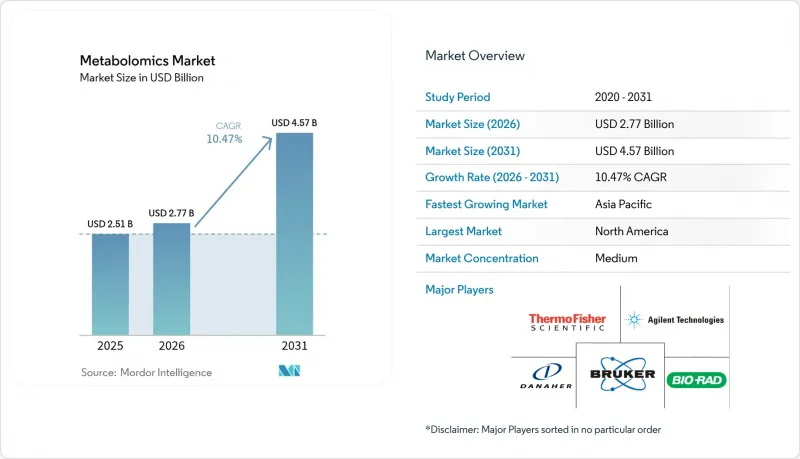
Mordor Intelligence에 의하면, 대사체학 시장 규모는 2025년에 25억 1,000만 달러로 평가되었고, 2026년 27억 7,000만 달러에서 2031년까지 45억 7,000만 달러에 이를 것으로 예측되며, 예측 기간(2026년-2031년) CAGR은 10.47%를 기록할 전망입니다.
본 보고서에서는 업계를 제품 및 서비스별(분석 기기(분리 기술 등) 등), 용도별(바이오마커 및 신약 개발, 독성학 등), 적응증별(종양학 등), 최종 사용자별(학술·연구 기관 등), 지역별(북미, 유럽, 아시아태평양 등)로 분류하고 있습니다. 시장 예측은 금액(달러) 기준으로 제시되어 있습니다.
세계 대사체학 시장 동향 및 인사이트
맞춤형 의료/정밀의료에 대한 수요 증가
정밀 영양학 및 맞춤형 치료의 노력에 힘입어, 대사체학에 의한 측정 결과가 임상적 의사결정 과정에 확고하게 통합되고 있습니다. 미국 국립보건원(NIH)은 식이·유전자·대사체의 상호작용을 연구하기 위해 5년간 1억 5,600만 달러를 배정하고 있으며, 환자 맞춤형 중재에 대한 정책 차원의 노력이 강조되고 있습니다. 바스켓형 및 우산형 임상시험 설계에서는 순환 대사체 프로파일을 기반으로 환자를 계층화하는 것이 일반화되고 있으며, 이를 통해 피험자 등록이 가속화되고 통계적 검정력이 향상됩니다. 대사체학을 유전체학 및 단백체학 계층과 통합한 분자 프로파일은 진단의 특이도를 높이고, 이상반응 발생률을 낮추며, 평가 대상 치료법을 치료 효과가 기대되는 하위 집단으로 유도합니다. 제약 기업들은 대사체학 데이터를 높이 평가했습니다. 이는 정적인 유전자 바이오마커를 보완하는 실시간 약력학적 피드백을 제공하기 때문입니다. 현재 검증이 진행 중인 포인트-오브-케어(Point-of-Care) 기기는 이러한 기능을 1차 진료 현장까지 확대하여 이용 가능한 환자층을 넓히고, 대사체학 시장 전체에 걸쳐 긍정적인 확산 추세를 더욱 강화할 것으로 기대됩니다.
오믹스 기반 신약 개발을 위한 공공 및 민간 연구개발 자금 확대
장기적인 연구 예산에서 멀티오믹스 인프라에 대한 전용 예산 배분이 증가하고 있으며, 대사체학은 중요한 우선순위로 자주 거론되고 있습니다. 대형 제약사들은 현재 PandaOmics와 같은 AI 기반 어노테이션 엔진을 통합하고, 대사체학, 전사체학, 단백체학 데이터 세트를 통합함으로써 새로운 신약 개발 표적을 규명하고 있습니다. 또한, 유럽 및 아시아태평양의 경쟁적 지원 프로그램에서는 희귀질환 연구를 위한 중개 대사체학에도 자금이 지원되고 있으며, 이는 국경을 초월한 협력과 차세대 염기서열 분석(NGS)을 활용한 화합물 스크리닝 처리 능력 향상을 뒷받침하고 있습니다. 벤처 캐피탈 및 성장 자본(Growth Equity) 투자자들은 대사체 라이브러리를 실용적인 치료적 인사이트로 전환하는 전문 플랫폼 기업에 지속적으로 자금을 지원하며, 대사체학 시장에 새로운 자본과 상업적 규율을 가져오고 있습니다. 이러한 누적된 자금 투입으로 인해 개발 리스크가 흡수되고, 풍부한 데이터를 기반으로 한 서비스 시장 출시 기간이 단축되고 있습니다.
고급 분석 장비의 자본 집약적 특성
최첨단 고분해능 질량 분석기는 대개 50만-200만 달러에 판매되며, 정기적인 유지보수 계약으로 인해 구매 가격의 10-15%가 매년 추가 비용으로 발생합니다. 소규모 기관은 이러한 자본 지출을 정당화하기 어려워, 그 결과 보급이 제한되고 자금력이 있는 연구센터에 이용이 집중되고 있습니다. 벤더가 제공하는 리스 모델이나 공동 핵심 시설 네트워크는 일시적인 해결책이 되고 있지만, 예산 측면의 역풍은 여전히 큰 걸림돌로 작용하고 있습니다. 그럼에도 불구하고, 모듈식 3D 프린팅 부품으로 인해 제조 비용이 절감됨에 따라, 대사체학 시장에서는 비용이 점진적으로 낮아지고 있습니다. 원격 조작 및 데이터 처리가 가능한 클라우드 연결형 플랫폼은 현장 인프라 요구 사항을 더욱 경감시켜, 시간이 지남에 따라 이러한 제약의 심각성을 다소 완화하고 있습니다.
부문 분석
생물정보학 도구 및 서비스 부문은 2025년에 대사체학 시장 규모의 50.55%를 차지할 것으로 예상되며, 2031년까지 연평균 성장률(CAGR) 11.21%를 유지할 것으로 전망됩니다. 이는 현대의 대사체학 워크플로가 데이터 중심이라는 경향을 반영한 것입니다. 이러한 주도적 지위는 기록된 스펙트럼의 2% 미만만이 큐레이션된 라이브러리와 대조될 수 있다는 인식에 기인하며, 알고리즘에 의한 어노테이션이 이 분야의 주요 병목 현상이 되고 있습니다. 새롭게 등장한 클라우드 네이티브 엔진은 점점 더 대규모화되는 리포지토리와 스펙트럼 데이터를 자동으로 대조하는 동시에, 추정된 화합물의 동정을 확률적 신뢰도 점수로 순위를 매깁니다. 멀티테넌트형 도입 모델은 계산 부하를 분산시켜 자원이 제한적인 연구소의 진입 장벽을 낮추고, 대사체학 시장 내 잠재적 사용자 수를 더욱 확대되고 있습니다.
microbeMASST와 같은 정교한 파이프라인은 현재 분류학적 메타데이터를 통합하여, 지금까지 보이지 않았던 미생물과 대사산물의 연관성을 규명하고, 하류 기능 오믹스 연구를 촉진하고 있습니다. 사용자 인터페이스가 단순화됨에 따라, 고급 코딩 경험이 없는 실험실 연구자라도 고차원적인 경로 매핑을 수행할 수 있게 되어, 결과적으로 가설 생성이 가속화됩니다. 하드웨어 공급업체들은 장비에서 클라우드로의 종단간 데이터 수집 및 자동 업로드 유틸리티를 제공함으로써 시너지 효과를 내는 수요를 뒷받침하고 있습니다. 이러한 선순환을 통해 생물정보학은 백오피스의 지원적 역할에서 주요 수익원으로 승격되었으며, 더 광범위한 대사체학 시장에서 이 부문이 계속해서 중요한 위치를 차지할 것이 보장됩니다.
2025년, 바이오마커 및 신약 개발 분야는 매출 점유율 31.05%를 유지했지만, 맞춤형 의료 워크플로는 연평균 성장률(CAGR) 14.68%로 성장을 주도하며 환자 맞춤형 개입의 전략적 중요성을 입증하고 있습니다. 영양 기반 질병 예방에 대한 소비자의 관심과 치료를 최적화하는 분석법의 임상 도입이 맞물리면서, 투자 우선순위는 종합적인 프로파일 매칭 서비스로 재조정되고 있습니다. 독성학 프로그램에서는 비표적 대사체학 스크리닝을 활용하여 개발 파이프라인의 초기 단계에서 경로 외 위험을 파악함으로써, 후기 단계에서의 개발 중단에 따른 비용을 절감하는 동시에 개정 주기를 유도하고 있습니다. 뉴트리제노믹스 응용 분야에서는 생리활성 화합물의 생체 이용률과 대사 적응을 평가하여, 대사체학 시장 전반에서 건강을 중시하는 이해관계자들의 공감을 불러일으키는 실용적인 식이 지침을 제공합니다.
임상 실험실에서는 대사 장애, 만성 신장 질환 및 암 재발 모니터링을 위해 검증된 패널이 도입되어 있으며, 실제 임상에서의 유용성과 보험 급여 대응이 입증되었습니다. 수백 가지 분석 대상 물질을 동시에 정량할 수 있는 다중 분석법의 등장으로, 검체당 진단 효율이 향상되고 표적당 비용이 절감되어 임상의들의 도입이 확대되고 있습니다. 전자차트 시스템과의 통합을 통해 대사체학 데이터가 일상 진료에 더욱 정착하고 있으며, 맞춤형 의료는 대사체학 시장에서 고성장 분야로서의 입지를 공고히 하고 있습니다.
지역별 분석
북미는 2025년에도 매출의 41.10%를 차지하며 시장을 계속 주도했습니다. 이는 미국 국립보건원(NIH) 및 기업 차원의 견실한 연구개발(R&D) 지출, 성숙한 규제 체계, 그리고 서모피셔 사이언티픽(Thermo Fisher Scientific)의 20억 달러 규모 생산 능력 확대 계획으로 대표되는 현지 제조에 대한 재투자에 힘입은 결과입니다. 미국의 대사체학 시장 규모는 멀티오믹스 암 검사의 광범위한 도입, 대사 패널 검사에 대한 보험 급여가 빠르게 확대되고 있는 점, 그리고 학계와 산업계의 광범위한 협력을 반영하고 있습니다. 캐나다의 정밀의료(Precision Health)에 대한 노력과 멕시코의 의약품 수출 능력 확대가 추가적인 상승 요인이 되어, 이 지역의 총 매출 점유율을 유지하고 있습니다. 캘리포니아주 소비자 개인정보 보호법(CCPA) 등 데이터 개인정보 보호 관련 법규가 개인정보 보호형 컴퓨팅의 조기 도입을 촉진하고 있으며, 안전하고 상호 운용 가능한 대사체학 데이터 플랫폼 분야에서 북미의 주도적 위치를 강화하고 있습니다.
아시아태평양은 2031년까지 연평균 성장률(CAGR)이 13.22%로 가장 빠르게 성장하는 지역이며, 그 원동력은 중국의 하이엔드 질량 분석기 조립 현지화와 인도의 임상시험 인프라 확충입니다. 정밀 의학을 대상으로 한 정부의 경제 부양책과 외국인 직접 투자가 맞물려 주요 병원(Tier-1)의 역량 확충을 뒷받침하고 있습니다. 일본의 ‘기능성 식품’ 프레임워크에 따라 대사체학에 근거한 기능성 식품 표기가 가능해졌으며, 정가 대비 프리미엄 가격 책정이 실현되고 있습니다. 이로 인해 상업적 중요성은 제약 분야를 넘어 소비자 건강 분야로 확대되고 있습니다. 호주와 한국은 강력한 학술 생태계를 활용하여 다국적 기업의 임상시험을 유치하고 있으며, 이를 통해 지역 대사체학 시장 규모를 더욱 확대되고 있습니다.
유럽은 ‘호라이즌(Horizon)’ 프로그램의 자금 지원을 받은 협력적 연구 네트워크, 확립된 바이오의약품 클러스터, 그리고 개인정보 보호형 데이터 페더레이션 도입 가속화를 통해 전 세계 매출의 상당 부분을 차지하고 있습니다. 독일의 공학 기술력을 바탕으로 계측 기기의 지속적인 혁신이 뒷받침되는 한편, 영국은 대사체학을 국민보건서비스(NHS)의 시범 진료 경로에 통합하는 중개 의학 프로그램을 추진하고 있습니다. 프랑스는 멀티오믹스 암 검사의 보험 환급 절차를 간소화하여 국내 검사실 수요를 촉진하고 있습니다. 이탈리아와 스페인에서는 임상 조사 아웃소싱 프로젝트 증가로 시장 규모가 확대되고 있습니다. 유럽연합 집행위원회가 환경을 고려한 지속 가능한 농업 및 식품 공급망을 중시함에 따라, 식품의 진위성 검증 및 환경 모니터링 분야에서 대사체학의 새로운 응용 분야가 등장하며 유럽 전역에서 다양한 수익원이 창출되고 있습니다.
기타 혜택:
- 엑셀 형식 시장 예측(ME) 시트
- 3개월간의 애널리스트 지원
자주 묻는 질문
목차
제1장 서론
제2장 조사 방법
제3장 주요 요약
제4장 시장 구도
제5장 시장 규모와 성장 예측
제6장 경쟁 구도
제7장 시장 기회와 향후 전망
LSH 26.09.08According to Mordor Intelligence, the metabolomics market size was valued at USD 2.51 billion in 2025 and estimated to grow from USD 2.77 billion in 2026 to reach USD 4.57 billion by 2031, at a CAGR of 10.47% during the forecast period (2026-2031).
This report Segments the Industry Into by Product & Service (Analytical Instruments [Separation Techniques, and More], and More), Application (Biomarker and Drug Discovery, Toxicology, and More), Indication (Oncology, and More), End User (Academic & Research Institutes, and More), and Geography (North America, Europe, Asia-Pacific, and More). The Market Forecasts are Provided in Terms of Value (USD).
Global Metabolomics Market Trends and Insights
Rising Demand for Personalized/Precision Medicine
Precision-nutrition and individualized-therapy initiatives are firmly embedding metabolomic readouts into clinical-decision pathways. The NIH has earmarked USD 156 million over five years to study diet-gene-metabolome interactions, underscoring policy-level commitment to patient-specific interventions. Basket and umbrella clinical-trial designs routinely stratify patients by circulating metabolite profiles, which accelerates enrollment and enhances statistical power. Molecular portraits that integrate metabolomics with genomic and proteomic layers improve diagnostic specificity, reduce adverse-event rates, and direct evaluated therapies toward responsive sub-populations. Pharmaceutical sponsors value metabolomic data because it delivers real-time pharmacodynamic feedback that complements static genetic biomarkers. Point-of-care devices, currently undergoing validation, promise to extend these capabilities to primary-care settings, broadening the total accessible patient pool and reinforcing positive uptake momentum across the metabolomics market.
Escalating Public & Private R&D Funding for Omics-Based Drug Discovery
Long-cycle research budgets increasingly allocate dedicated lines to multi-omics infrastructure, with metabolomics frequently cited as a critical short-list priority. Large pharmaceutical enterprises now integrate AI-driven annotation engines, such as PandaOmics, to converge metabolomic, transcriptomic, and proteomic datasets, thereby illuminating novel druggable targets. Competitive grant programs in Europe and Asia-Pacific also fund translational metabolomics for rare-disease research, boosting cross-border collaboration and NGS-linked compound-screening throughput. Venture and growth-equity investors continue to fund specialist platform companies that convert metabolite libraries into actionable therapeutic insights, bringing fresh capital and commercial discipline to the metabolomics market. These cumulative injections of funding absorb development risk and accelerate time-to-market for data-rich services.
Capital-Intensive Nature of Advanced Analytical Instruments
State-of-the-art high-resolution mass spectrometers often sell for USD 500,000-2 million, with recurrent service contracts adding 10-15% of purchase cost annually. Smaller institutions struggle to justify such capital outlays, constraining broader diffusion and keeping usage concentrated among well-funded centers. Vendor-hosted leasing models and collaborative core-facility networks provide interim relief, yet budgetary headwinds remain a formidable drag. The metabolomics market nevertheless benefits from gradual cost compression as modular, 3D-printed components reduce manufacturing expense. Cloud-connected platforms that enable remote operation and data processing further alleviate on-site infrastructure requirements, slightly easing this restraint's severity over time.
Other drivers and restraints analyzed in the detailed report include:
- Technological Advances in High-Resolution MS and LC Platforms
- Growing Adoption of Multi-Omics Workflow Integration in Pharma Pipelines
- Shortage of Bioinformaticians with Metabolome Expertise
For complete list of drivers and restraints, kindly check the Table Of Contents.
Segment Analysis
The bioinformatics tools and services segment captured 50.55% of the metabolomics market size in 2025 and is projected to sustain an 11.21% CAGR through 2031, reflecting the data-centric orientation of modern metabolomics workflows. This leadership is anchored in the recognition that fewer than 2% of recorded spectra can be matched to curated libraries, turning algorithmic annotation into the field's primary bottleneck. Emerging cloud-native engines automatically cross-reference spectral data against ever-larger repositories while ranking putative compound identities with probabilistic confidence scores. Multi-tenant deployment models distribute computational overhead and lower entry barriers for resource-constrained laboratories, further expanding total addressable users inside the metabolomics market.
Sophisticated pipelines such as microbeMASST now integrate taxonomic metadata, unlocking previously invisible microbial-metabolite linkages and fuelling downstream functional-omics investigations. As user interfaces simplify, bench scientists without advanced coding experience can execute high-dimensional pathway mapping, which in turn accelerates hypothesis generation. Hardware vendors reinforce symbiotic demand by offering end-to-end instrument-to-cloud data capture and automated upload utilities. This virtuous cycle elevates bioinformatics from a back-office support role to a primary revenue engine, ensuring the segment's continued prominence within the broader metabolomics market.
Biomarker and drug discovery maintained 31.05% revenue share in 2025; however, personalized-medicine workflows will lead expansion at a 14.68% CAGR, confirming the strategic importance of patient-specific interventions. Consumer interest in nutrition-based disease prevention, alongside clinical adoption of treatment-tailoring assays, is realigning investment priorities toward comprehensive profile-matching services. Toxicology programs leverage untargeted metabolomic screens to uncover off-pathway liabilities earlier in the pipeline, saving late-stage attrition cost and guiding revision cycles. Nutrigenomics applications assess bioactive-compound bioavailability and metabolic adaptation, delivering actionable dietary recommendations that resonate with wellness-oriented stakeholders across the metabolomics market.
Clinical laboratories implement validated panels for metabolic disorders, chronic kidney disease, and oncology recurrence monitoring, demonstrating real-world utility and reimbursement readiness. The rise of multiplex assays capable of quantifying hundreds of analytes simultaneously enhances diagnostic yield per sample, lowering per-target cost and increasing clinician adoption. Integration with electronic health-record systems further embeds metabolomic data into routine care, reinforcing personalized medicine's status as the high-growth frontier of the metabolomics market.
Complete Report Scope:
- By Product & Service
- Analytical Instruments
- Separation Techniques
- Liquid Chromatography
- Gas Chromatography
- Capillary Electrophoresis
- Detection Techniques
- Mass Spectrometry
- Nuclear Magnetic Resonance
- Other Detection Techniques
- Separation Techniques
- Bioinformatics Tools & Services
- Analytical Instruments
- By Application
- Biomarker & Drug Discovery
- Toxicology
- Nutrigenomics
- Personalized Medicine
- Clinical Diagnostics
- Environmental & Agricultural Research
- By Indication
- Oncology
- Cardiovascular Diseases
- Neurological Disorders
- Infectious Diseases
- Metabolic Disorders
- By End User
- Academic & Research Institutes
- Pharmaceutical & Biotechnology Companies
- Contract Research Organizations
- Hospitals & Diagnostic Laboratories
- By Geography
- North America
- United States
- Canada
- Mexico
- Europe
- Germany
- United Kingdom
- France
- Italy
- Spain
- Rest of Europe
- Asia-Pacific
- China
- Japan
- India
- Australia
- South Korea
- Rest of Asia-Pacific
- Middle East & Africa
- GCC
- South Africa
- Rest of Middle East & Africa
- South America
- Brazil
- Argentina
- Rest of South America
- North America
Geography Analysis
North America preserved 41.10% revenue leadership in 2025, fortified by robust NIH and enterprise-level R&D spending, mature regulatory frameworks, and local manufacturing reinvestment exemplified by Thermo Fisher Scientific's USD 2.0 billion capacity expansion plan. The metabolomics market size for the United States reflects widespread deployment of multi-omics oncology tests, fast catch-up of metabolic-panel reimbursement, and extensive academic-industry partnerships. Canada's precision-health initiatives and Mexico's growing pharmaceutical export capacity provide incremental lift, sustaining the region's aggregate revenue share. Data-privacy legislation such as the California Consumer Privacy Act drives early adoption of privacy-enhancing computation, reinforcing North American leadership in secure, interoperable metabolomics data platforms.
Asia-Pacific represents the fastest-growing territory at a 13.22% CAGR through 2031, driven by China's localization of high-end mass-spectrometer assembly and India's scaling clinical-trial infrastructure. Government stimulus packages covering precision medicine, coupled with inward foreign-direct investment, underpin capacity build-out across Tier-1 hospitals. Japan's Foods with Function Claims framework enables metabolomics-supported functional-food labels that command premium shelf pricing, extending commercial relevance beyond pharma into consumer-health sectors. Australia and South Korea leverage strong academic ecosystems to attract multinational-sponsored trials, further enlarging the regional metabolomics market footprint.
Europe maintains a substantial portion of global revenue through coordinated Horizon-funded research networks, established biopharmaceutical clusters, and accelerated adoption of privacy-preserving data federations. Germany's engineering prowess undergirds continued instrumentation innovation, while the United Kingdom pushes translational medicine programs that embed metabolomics into National Health Service pilot pathways. France streamlines reimbursement for multi-omics oncology tests, stimulating domestic laboratory demand. Italy and Spain add volume via growing clinical-research outsourcing assignments. The European Commission's emphasis on green and sustainable agrifood supply chains triggers additional metabolomics market applications in food authenticity and environmental surveillance, providing diversified revenue channels across the continent.
- Thermo Fisher Scientific
- Agilent Technologies
- Danaher - SCIEX
- Waters Corporation
- Bruker
- Shimadzu
- PerkinElmer
- LECO
- Bio-Rad Laboratories
- Kore Technology
- Metabolon
- Biocrates Life Sciences
- Chenomx
- Metabolomic Discoveries
- Creative Proteomics
- Human Metabolome Technologies
- Metabolomics Australia
- Exalenz Bioscience
- Owlstone Medical
- AbsoluteIDQ
Additional Benefits:
- The market estimate (ME) sheet in Excel format
- 3 months of analyst support
TABLE OF CONTENTS
1 Introduction
- 1.1 Study Assumptions & Market Definition
- 1.2 Scope of the Study
2 Research Methodology
3 Executive Summary
4 Market Landscape
- 4.1 Market Overview
- 4.2 Market Drivers
- 4.2.1 Rising Demand for Personalized / Precision Medicine
- 4.2.2 Escalating Public & Private R&D Funding for Omics-Based Drug Discovery
- 4.2.3 Technological Advances in High-Resolution MS And LC Platforms
- 4.2.4 Growing Adoption of Multi-Omics Workflow Integration in Pharma Pipelines
- 4.2.5 AI-Driven Metabolite-Annotation Platforms Shortening Analysis Time
- 4.2.6 Expansion of Single-Cell & Spatial Metabolomics for Rare-Cell Profiling
- 4.3 Market Restraints
- 4.3.1 Capital-Intensive Nature of Advanced Analytical Instruments
- 4.3.2 Shortage of Bioinformaticians with Metabolome Expertise
- 4.3.3 Lack of Globally Harmonised Metabolite Reference Standards
- 4.3.4 Data-Privacy Hurdles in Federated Clinical Metabolomics Networks
- 4.4 Porter's Five Forces Analysis
- 4.4.1 Threat of New Entrants
- 4.4.2 Bargaining Power of Buyers
- 4.4.3 Bargaining Power of Suppliers
- 4.4.4 Threat of Substitutes
- 4.4.5 Intensity of Competitive Rivalry
5 Market Size & Growth Forecasts (Value in USD)
- 5.1 By Product & Service
- 5.1.1 Analytical Instruments
- 5.1.1.1 Separation Techniques
- 5.1.1.1.1 Liquid Chromatography
- 5.1.1.1.2 Gas Chromatography
- 5.1.1.1.3 Capillary Electrophoresis
- 5.1.1.2 Detection Techniques
- 5.1.1.2.1 Mass Spectrometry
- 5.1.1.2.2 Nuclear Magnetic Resonance
- 5.1.1.2.3 Other Detection Techniques
- 5.1.1.1 Separation Techniques
- 5.1.2 Bioinformatics Tools & Services
- 5.1.1 Analytical Instruments
- 5.2 By Application
- 5.2.1 Biomarker & Drug Discovery
- 5.2.2 Toxicology
- 5.2.3 Nutrigenomics
- 5.2.4 Personalized Medicine
- 5.2.5 Clinical Diagnostics
- 5.2.6 Environmental & Agricultural Research
- 5.3 By Indication
- 5.3.1 Oncology
- 5.3.2 Cardiovascular Diseases
- 5.3.3 Neurological Disorders
- 5.3.4 Infectious Diseases
- 5.3.5 Metabolic Disorders
- 5.4 By End User
- 5.4.1 Academic & Research Institutes
- 5.4.2 Pharmaceutical & Biotechnology Companies
- 5.4.3 Contract Research Organizations
- 5.4.4 Hospitals & Diagnostic Laboratories
- 5.5 By Geography
- 5.5.1 North America
- 5.5.1.1 United States
- 5.5.1.2 Canada
- 5.5.1.3 Mexico
- 5.5.2 Europe
- 5.5.2.1 Germany
- 5.5.2.2 United Kingdom
- 5.5.2.3 France
- 5.5.2.4 Italy
- 5.5.2.5 Spain
- 5.5.2.6 Rest of Europe
- 5.5.3 Asia-Pacific
- 5.5.3.1 China
- 5.5.3.2 Japan
- 5.5.3.3 India
- 5.5.3.4 Australia
- 5.5.3.5 South Korea
- 5.5.3.6 Rest of Asia-Pacific
- 5.5.4 Middle East & Africa
- 5.5.4.1 GCC
- 5.5.4.2 South Africa
- 5.5.4.3 Rest of Middle East & Africa
- 5.5.5 South America
- 5.5.5.1 Brazil
- 5.5.5.2 Argentina
- 5.5.5.3 Rest of South America
- 5.5.1 North America
6 Competitive Landscape
- 6.1 Market Concentration
- 6.2 Market Share Analysis
- 6.3 Company Profiles (includes Global level Overview, Market level overview, Core Segments, Financials as available, Strategic Information, Market Rank/Share for key companies, Products & Services, and Recent Developments)
- 6.3.1 Thermo Fisher Scientific
- 6.3.2 Agilent Technologies
- 6.3.3 Danaher - SCIEX
- 6.3.4 Waters Corporation
- 6.3.5 Bruker
- 6.3.6 Shimadzu Corporation
- 6.3.7 PerkinElmer
- 6.3.8 LECO Corporation
- 6.3.9 Bio-Rad Laboratories
- 6.3.10 Kore Technology
- 6.3.11 Metabolon
- 6.3.12 Biocrates Life Sciences
- 6.3.13 Chenomx
- 6.3.14 Metabolomic Discoveries
- 6.3.15 Creative Proteomics
- 6.3.16 Human Metabolome Technologies
- 6.3.17 Metabolomics Australia
- 6.3.18 Exalenz Bioscience
- 6.3.19 Owlstone Medical
- 6.3.20 AbsoluteIDQ
7 Market Opportunities & Future Outlook
- 7.1 White-space & Unmet-need Assessment


