|
시장보고서
상품코드
2120799
에폭시 코팅 : 시장 점유율 분석, 업계 동향과 통계, 성장 예측(2026-2031년)Epoxy Coatings - Market Share Analysis, Industry Trends & Statistics, Growth Forecasts (2026 - 2031) |
||||||
 Mordor Intelligence
Mordor Intelligence에 따르면 에폭시 코팅 시장 규모는 2025년 382억 4,000만 달러에서 2026년에는 395억 1,000만 달러로 확대되어, 2026년부터 2031년까지 CAGR 3.31%를 기록하며 2031년에는 464억 9,000만 달러에 달할 것으로 예측됩니다.
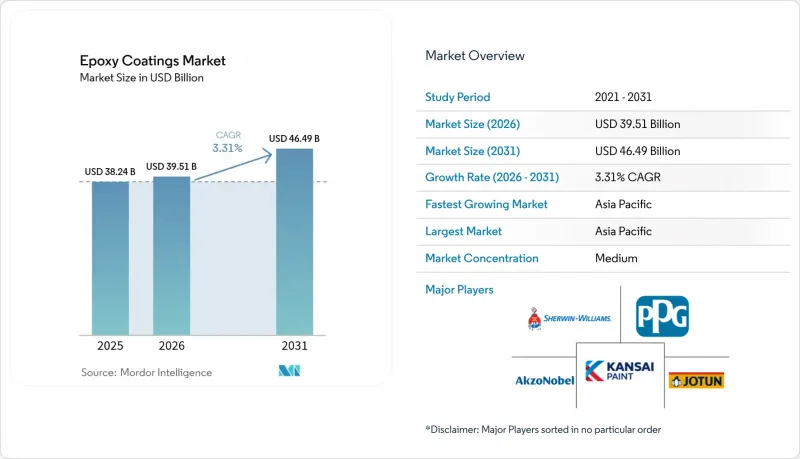
본 보고서는 기술별(수성, 용제형, 분체), 최종사용자 산업별(건축·건설, 자동차, 운송, 산업, 기타) 및 지역별(아시아태평양, 북미, 유럽, 남미, 중동 및 아프리카)로 분류되어 있습니다. 시장 예측은 금액(달러) 기준으로 제시되어 있습니다.
세계 에폭시 코팅 시장의 동향 및 인사이트
산업용 보호 코팅 분야에서 수성 에폭시의 보급이 확대되고 있습니다
현재 2액형 수성 시스템은 건조 막 두께의 균일성을 ±5µm 이내로 실현하고 있으며, 용제계 제품과 동등한 성능을 발휘하면서도 VOC를 80% 감축함으로써 REACH 규정의 420 g/L라는 상한치를 충족하고 있습니다. 프로필렌 카보네이트계 공용매를 사용함으로써 CARB 규정을 위반하지 않고 20분의 개방 시간을 확보할 수 있어, 미국 전역에서 도입이 가능해졌습니다. 석유화학 및 폐수처리 기업들은 인화점이 0인 특성을 높이 평가하고 있으며, 이를 통해 보험료를 최대 15% 절감할 수 있습니다. 독일에서는 2025년에 수성 탱크 라이닝 시공량이 28% 증가했습니다. 2024년 말 용제계 시스템과의 가격 평준화가 달성됨에 따라, 주류 시장 진입을 가로막던 마지막 장벽이 제거되었습니다.
아시아태평양 및 아프리카 지역의 건설 부문 확대
인도에서는 철근에 에폭시 프라이머 사용이 지정된 고속도로, 지하철, 공항 건설에 1조 3,000억 달러가 투자되고 있습니다. 아세안(ASEAN)은 2025년에 2400억 달러 규모의 외국인 직접 투자(FDI)를 유치했으며, 그 중 42%는 내화학성 바닥재가 필요한 공장 및 데이터센터에 투자되었습니다. 사우디아라비아의 5,000억 달러 규모 NEOM 프로젝트에서는 염분 농도가 높은 지역을 위해 선박용 등급의 도료가 채택되었습니다. 아프리카개발은행은 아프리카 대륙의 인프라 부족 규모를 연간 1,000억 달러로 추산하고 있으며, 그 대부분에는 내식성 에폭시 시스템이 필요할 것으로 전망됩니다. 남아프리카의 항만에서도 해안 지역의 습기 속에서 강재의 수명을 연장하는 에폭시 코팅을 통한 개보수 작업이 진행되고 있습니다.
BPA 및 에피클로로히드린의 가격 변동이 비용 구조를 교란
중국산 에폭시 수지 수입에 대한 잠정적 반덤핑 관세가 부과됨에 따라, 2025년 유럽의 비스페놀 A 가격은 22% 상승했습니다. 미국에서는 멕시코만 연안의 생산자들이 천연가스 가격 급등에 따라 생산량을 줄였기 때문에 에피클로로히드린 가격이 18% 급등했습니다. 인도의 공급업체들은 관세가 부과되지 않는 원료를 활용하여 중동 입찰에서 유럽 공급업체보다 12% 저렴한 가격을 제시했습니다. 현재 대부분의 배합 제조업체는 유연성을 희생하더라도 현물 계약보다는 분기별 계약을 선호하는 추세입니다. 그 결과, 원자재비는 완제품 원가의 62%까지 상승하여 중견 기업의 이익률을 압박하고 있습니다.
부문 분석
수성 배합 제품은 2025년 매출의 41.81%를 차지하며, 2031년까지 연평균 성장률(CAGR) 4.38%로 확대되고 있습니다. 이는 보호용 도료의 경우 REACH 규정에 따른 VOC 상한치가 420 g/L, 건축용 도료는 250 g/L로 정해져 있기 때문입니다. 용제형 도료는 10°C 이하에서도 경화가 빠르고 염분으로 오염된 강재에도 내성이 있어, 해양 공사나 겨울철 공사에 필수적입니다. 분체 도료는 EU의 미세 플라스틱 규제의 영향을 받고 있으며, 이로 인해 자동차 제조사들이 저VOC 액체 도료로 전환하고 있습니다. UV 경화 시스템은 1% 미만으로 틈새 시장에 머물러 있지만, 인쇄회로기판에 대해 3초 만에 경화를 실현하고 있어 향후 성장이 기대됩니다.
수성 도료는 2024년 하반기 이후 규모의 경제가 본격화되면서 비용 면에서 동등한 경쟁력을 확보했으며, ISO 4624에 따른 접착력이 3.5 MPa 이상을 달성하여 용제형 도료와 동등한 성능을 보여주고 있습니다. 그러나 표면 염분 농도가 50 mg/m²에 달해 수성 도료의 허용 한계를 초과하는 해양용 탱크의 경우, 여전히 용제계 에폭시 도료가 주류를 이루고 있습니다. 분말 수지 공급업체들은 정전기 방지제를 배합한 초저발진 처방을 시험 중이지만, kg당 0.40달러의 비용 증가와 QUV-A 시험 2,000시간 후 광택 저하 10%를 감수하고 있습니다. UV 경화형 등급은 인라인 가공을 통해 기판 처리 능력이 120유닛/h로 향상되고, 에너지 소비를 대폭 절감할 수 있기 때문에 전자 분야에서 보급이 확대되고 있습니다.
지역별 분석
아시아태평양은 2025년 매출의 46.55%를 차지하고 있으며, 인도의 인프라 구축 추진과 아세안(ASEAN) 국가 공장들에 대한 2,400억 달러 규모의 외국인 직접 투자(FDI)를 원동력으로 2031년까지 연평균 성장률(CAGR) 3.68%로 성장할 것으로 예상됩니다. 인도의 에폭시 도료 시장 규모는 국내 기업들이 2선 도시의 판매망 밀도를 활용하고 있어 가장 빠르게 확대되고 있습니다. 중국 시장은 ISO 클래스 5를 준수하는 바닥이 필요한 반도체 클린룸에 의해 뒷받침되고 있습니다. LG 에너지솔루션의 배터리용 코팅 생산능력 확대가 한국 시장을 견인하고 있습니다.
북미 시장의 성장은 동결 및 해동에 대한 내성을 확보하기 위해 에폭시계 데크 실러 사용을 의무화하는 1,100억 달러 규모의 미국 인프라법에 힘입고 있습니다. 지역 매출의 78%를 미국이 차지하고 있으며, 그 다음으로 캐나다가 14%를 차지하고 있습니다. 캐나다에서는 토론토의 250억 캐나다 달러 규모 교통망 확장 계획에 방습층을 갖춘 터널 내벽재가 채택되고 있습니다. 멕시코는 에폭시 바닥재를 지정하는 항공우주 및 자동차 공장에 대한 350억 달러 규모의 니어쇼어링 투자의 혜택을 받고 있습니다.
유럽은 큰 매출 비중을 차지했으나, VOC(휘발성 유기 화합물) 규제 상한선으로 인해 제품 라인당 800만-1,500만 유로의 배합 변경 비용이 필요해져 이익률 압박에 직면해 있습니다. 독일은 자동차용 LED 생산 라인을 통해 경화 주기를 12분으로 단축한 것이 효과를 발휘하여, 지역 매출의 28%를 차지하며 1위를 차지했습니다. 영국은 18%로 그 뒤를 이었으며, 내식성 강재 코팅이 필요한 440억 파운드 규모의 철도 개량 사업이 이를 뒷받침했습니다. 프랑스, 이탈리아 및 북유럽 지역은 에폭시 보호 코팅이 필요한 대규모 지하철, 크루즈선, 해상 풍력발전 프로젝트 덕분에 이 지역을 마무리하고 있습니다.
기타 혜택:
- 엑셀 형식의 시장 예측(ME) 시트
- 3개월간의 애널리스트 지원
자주 묻는 질문
목차
제1장 소개
제2장 조사 방법
제3장 주요 요약
제4장 시장 구도
제5장 시장 규모와 성장 예측
제6장 경쟁 구도
제7장 시장 기회와 향후 전망
KSM 26.09.02According to Mordor Intelligence, the epoxy coatings market size is expected to grow from USD 38.24 billion in 2025 to USD 39.51 billion in 2026 and is forecast to reach USD 46.49 billion by 2031 at 3.31% CAGR over 2026-2031.
This report is Segmented by Technology (Water-Based, Solvent-Based, and Powder-Based), End-User Industry (Building and Construction, Automotive, Transportation, Industrial, and Others), and Geography (Asia-Pacific, North America, Europe, South America, and Middle East and Africa). The Market Forecasts are Provided in Terms of Value (USD).
Global Epoxy Coatings Market Trends and Insights
Waterborne Epoxy Penetration Rising in Industrial Protective Coatings
Two-component waterborne systems now deliver dry-film uniformity within +-5 µm, matching solvent grades while cutting VOCs by 80% to meet the 420 g/L REACH limit. Propylene-carbonate co-solvents keep 20-minute open times without breaching CARB rules, enabling full U.S. roll-out. Petro-chemical and wastewater firms value the zero-flash-point profile, which lowers insurance premiums by up to 15%. Germany recorded a 28% rise in waterborne tank-lining volumes during 2025. Price parity with solvent systems, reached in late 2024, removed the final barrier to mainstream adoption.
Construction Sector Expansion in Asia-Pacific and Africa
India's pipeline dedicates USD 1.3 trillion to highways, metros, and airports that specify epoxy primers on steel rebar. ASEAN attracted USD 240 billion of FDI in 2025, and 42% funded factories and data centers needing chemical-resistant floors. Saudi Arabia's USD 500 billion NEOM allocates marine-grade coatings for high-salinity zones. The African Development Bank pegs the continent's infrastructure deficit at USD 100 billion per year, much of which will require corrosion-resistant epoxy systems. South Africa's ports are also upgrading with epoxy layers that prolong steel life in coastal humidity.
BPA and Epichlorohydrin Price Volatility Disrupting Cost Structures
Bisphenol A prices in Europe rose 22% during 2025 after provisional anti-dumping duties on Chinese epoxy imports. U.S. epichlorohydrin jumped 18% as Gulf Coast producers trimmed output on expensive natural gas. Indian vendors exploited duty-free feedstocks to undercut European suppliers by 12% in Middle East bids. Most formulators now favor quarterly instead of spot contracts, sacrificing flexibility. Raw materials consequently rose to 62% of finished-goods cost, squeezing mid-tier margins.
Other drivers and restraints analyzed in the detailed report include:
- Industrial Flooring Upgrades in Food and Beverage Plants
- Rapid-Cure UV/LED-Curable Epoxy Technologies
- PFAS and Microplastic Rules Threatening Powder Epoxy Adoption
For complete list of drivers and restraints, kindly check the Table Of Contents.
Segment Analysis
Water-based formulations seized 41.81% of 2025 revenue and are advancing at a 4.38% CAGR to 2031, owing to REACH caps of 420 g/L VOC for protective and 250 g/L for architectural coatings. Solvent-based blends cure faster below 10 °C and tolerate salt-contaminated steel, which offshore and winter jobs require. Powder grades face EU microplastics restrictions that push automakers toward low-VOC liquids. UV systems remain niche at under 1% yet deliver three-second cures for printed-circuit boards, offering future upside.
Waterborne chemistries have reached cost parity since late 2024 as scale economies emerged, and they achieve ISO 4624 adhesion above 3.5 MPa, matching solvent peers. Solvent-borne epoxies, however, still dominate marine tanks where surface salts up to 50 mg/m2 exceed waterborne tolerance limits. Powder suppliers are trialing ultra-low-dust recipes with anti-static aids but accept a USD 0.40/kg cost penalty and 10% gloss fade after 2,000 h QUV-A. UV-curable grades gained traction in electronics because inline processing boosts board throughput to 120 units/h and slashes energy consumption.
Complete Report Scope:
- By Technology
- Water-based
- Solvent-based
- Powder-based
- By End-user Industry
- Building and Construction
- Automotive
- Transportation
- Industrial
- Others
- By Geography
- Asia-Pacific
- China
- India
- Japan
- South Korea
- ASEAN
- Rest of Asia-Pacific
- North America
- United States
- Canada
- Mexico
- Europe
- Germany
- United Kingdom
- France
- Italy
- NORDIC
- Russia
- Rest of Europe
- South America
- Brazil
- Argentina
- Rest of South America
- Middle-East and Africa
- Saudi Arabia
- United Arab Emirates
- South Africa
- Rest of Middle-East and Africa
- Asia-Pacific
Geography Analysis
Asia-Pacific contributed 46.55% of 2025 revenue and is expected to grow 3.68% CAGR to 2031, propelled by India's infrastructure push and USD 240 billion of FDI into ASEAN factories. India's epoxy coatings market size is rising fastest as domestic players leverage distribution density in tier-2 cities. The Chinese market is supported by semiconductor cleanrooms that need ISO Class 5 compliant floors. LG Energy Solution's scaled battery-coat capacity is driving the South Korean market.
North America's market growth is anchored by the USD 110 billion U.S. infrastructure law that mandates epoxy deck sealers for freeze-thaw resilience. The United States delivered 78% of regional sales, followed by Canada at 14% where Toronto's CAD 25 billion transit expansion relies on tunnel linings with moisture barriers. Mexico benefited from USD 35 billion of nearshoring investment in aerospace and auto plants that specify epoxy floors.
Europe accounted for significant revenue but faces margin pressure from VOC caps that require EUR 8-15 million reformulation outlays per product line. Germany led with 28% of regional sales thanks to automotive LED lines that sliced cure cycles to 12 min. The United Kingdom followed at 18%, boosted by GBP 44 billion of rail upgrades that need corrosion-proof steel coatings. France, Italy, and the Nordic zone round out the region with major metro, cruise, and offshore wind projects requiring epoxy protection.
- AkzoNobel N.V.
- Asian Paints
- Axalta Coating Systems LLC
- BASF
- Berger Paints India
- Diamond Vogel
- DuluxGroup Ltd
- Hempel A/S
- Jotun
- Kansai Paint Co., Ltd.
- Koster Bauchemie AG
- Nippon Paint Holdings Co., Ltd.
- Pidilite Industries Limited
- PPG Industries, Inc.
- RPM International Inc.
- Sika AG
- The Euclid Chemical Company
- The Sherwin-Williams Company
- Tikkurila
Additional Benefits:
- The market estimate (ME) sheet in Excel format
- 3 months of analyst support
TABLE OF CONTENTS
1 Introduction
- 1.1 Study Assumptions and Market Definition
- 1.2 Scope of the Study
2 Research Methodology
3 Executive Summary
4 Market Landscape
- 4.1 Market Overview
- 4.2 Market Drivers
- 4.2.1 Waterborne Epoxy Penetration Rising in Industrial Protective Coatings
- 4.2.2 Construction Sector Expansion in Asia-Pacific and Africa
- 4.2.3 Industrial Flooring Upgrades in Food and Beverage Plants
- 4.2.4 Rapid-Cure UV/LED-Curable Epoxy Technologies Enabling Higher Throughput
- 4.2.5 EV Battery Casings and Motor Housings Need Chemically Resistant Coats
- 4.3 Market Restraints
- 4.3.1 BPA and epichlorohydrin price volatility disrupting cost structures
- 4.3.2 PFAS and micro-plastic rules threatening powder epoxy adoption
- 4.3.3 Shortage of skilled robotics applicators for advanced coating lines
- 4.4 Value Chain Analysis
- 4.5 Porter's Five Forces
- 4.5.1 Bargaining Power of Suppliers
- 4.5.2 Bargaining Power of Buyers
- 4.5.3 Threat of New Entrants
- 4.5.4 Threat of Substitutes
- 4.5.5 Competitive Rivalry
5 Market Size and Growth Forecasts (Value)
- 5.1 By Technology
- 5.1.1 Water-based
- 5.1.2 Solvent-based
- 5.1.3 Powder-based
- 5.2 By End-user Industry
- 5.2.1 Building and Construction
- 5.2.2 Automotive
- 5.2.3 Transportation
- 5.2.4 Industrial
- 5.2.5 Others
- 5.3 By Geography
- 5.3.1 Asia-Pacific
- 5.3.1.1 China
- 5.3.1.2 India
- 5.3.1.3 Japan
- 5.3.1.4 South Korea
- 5.3.1.5 ASEAN
- 5.3.1.6 Rest of Asia-Pacific
- 5.3.2 North America
- 5.3.2.1 United States
- 5.3.2.2 Canada
- 5.3.2.3 Mexico
- 5.3.3 Europe
- 5.3.3.1 Germany
- 5.3.3.2 United Kingdom
- 5.3.3.3 France
- 5.3.3.4 Italy
- 5.3.3.5 NORDIC
- 5.3.3.6 Russia
- 5.3.3.7 Rest of Europe
- 5.3.4 South America
- 5.3.4.1 Brazil
- 5.3.4.2 Argentina
- 5.3.4.3 Rest of South America
- 5.3.5 Middle-East and Africa
- 5.3.5.1 Saudi Arabia
- 5.3.5.2 United Arab Emirates
- 5.3.5.3 South Africa
- 5.3.5.4 Rest of Middle-East and Africa
- 5.3.1 Asia-Pacific
6 Competitive Landscape
- 6.1 Market Concentration
- 6.2 Strategic Moves
- 6.3 Market Share(%)/Ranking Analysis
- 6.4 Company Profiles (includes Global Overview, Market Overview, Core Segments, Financials, Strategic Information, Products and Services, Recent Developments)
- 6.4.1 AkzoNobel N.V.
- 6.4.2 Asian Paints
- 6.4.3 Axalta Coating Systems LLC
- 6.4.4 BASF
- 6.4.5 Berger Paints India
- 6.4.6 Diamond Vogel
- 6.4.7 DuluxGroup Ltd
- 6.4.8 Hempel A/S
- 6.4.9 Jotun
- 6.4.10 Kansai Paint Co., Ltd.
- 6.4.11 Koster Bauchemie AG
- 6.4.12 Nippon Paint Holdings Co., Ltd.
- 6.4.13 Pidilite Industries Limited
- 6.4.14 PPG Industries, Inc.
- 6.4.15 RPM International Inc.
- 6.4.16 Sika AG
- 6.4.17 The Euclid Chemical Company
- 6.4.18 The Sherwin-Williams Company
- 6.4.19 Tikkurila
7 Market Opportunities and Future Outlook
- 7.1 White-space and Unmet-Need Assessment