

|
시장보고서
상품코드
2120802
화장품 포장기계 : 시장 점유율 분석, 업계 동향과 통계, 성장 예측(2026-2031년)Cosmetic Packaging Machinery - Market Share Analysis, Industry Trends & Statistics, Growth Forecasts (2026 - 2031) |
||||||
 Mordor Intelligence
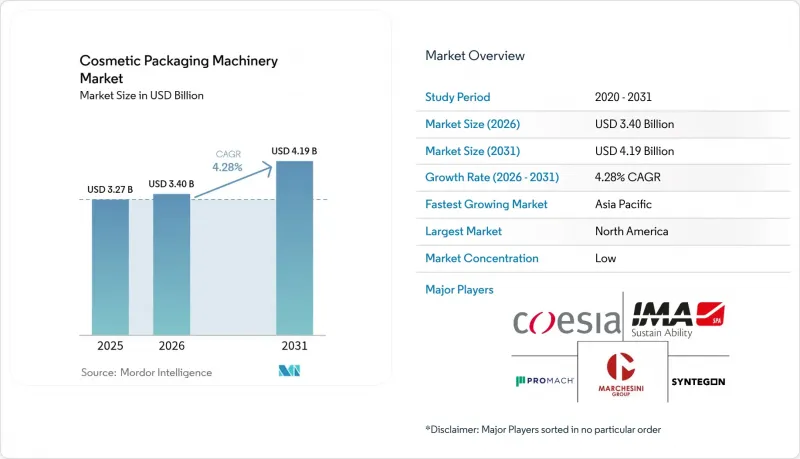
Mordor Intelligence에 따르면 화장품 포장기계 시장 규모는 2025년에 32억 7,000만 달러, 2026년에 34억 달러에 달하고, 2031년까지 41억 9,000만 달러에 달할 것으로 예측되며, 2026년부터 2031년까지 CAGR 4.28%로 성장할 것으로 전망됩니다.
본 보고서는 기계 종류(성형·충진·밀봉, 라벨링, 캡핑, 래핑 및 번들링, 카트닝 및 케이스 패킹, 기타), 자동화 수준(완전 자동, 반자동), 포장 유형(경질 용기 및 항아리, 기타), 화장품 제품(스킨케어, 헤어케어, 기타), 및 지역별로 분류되어 있습니다. 시장 전망은 금액(달러) 기준으로 제시되어 있습니다.
세계 화장품 포장기계 시장의 동향 및 인사이트
퍼스널케어 및 미용 제품에 대한 수요 증가
가처분 소득 증가, 프리미엄화 및 소셜 미디어의 영향으로 성숙 시장의 라인 가동률은 85% 이상으로 상승했으며, 이에 따라 수탁 제조업체들은 신규 공장 건설 대신 2교대 및 3교대 근무 도입을 추진하고 있습니다. 자기 이송 컨베이어를 도입한 독일의 한 공장에서는 전환 시간을 45분에서 10분 미만으로 단축하여, 생산량을 희생하지 않고 주당 SKU 수를 120개 이상으로 늘리는 데 성공했습니다. 아시아태평양의 중산층 소비자들은 할랄, 비건, 크루얼티 프리 인증을 점점 더 중요하게 여기고 있어, 현재 비전 시스템을 통해 라벨의 표시 내용을 실시간으로 검증하고 있습니다. 고급 제품 유통 채널에서는 허용 결함률을 200ppm 미만으로 엄격히 제한하고 있어, 이로 인해 완전 밀폐형에 다수의 센서를 탑재한 설비로 전환하는 속도가 빨라지고 있습니다. 화장품 기업들이 한정판 콜라보레이션 상품을 출시함에 따라, 교차 오염을 일으키지 않으면서 다양한 용기 형태를 처리할 수 있는 기계가 조달상의 최우선 과제가 되고 있습니다.
산업용 자동화 및 스마트 포장 라인의 확대
현재 포장 셀에는 IoT 센서가 내장되어 있어, 사이클 타임 이탈, 토크 이상, 충전 중량 변동을 감지함으로써 이탈이 배치 보류로 이어지기 전에 작업자가 개입할 수 있도록 지원합니다. 2024년에 도입된 딥러닝 기반 비전 플랫폼은 분당 600개 이상의 속도로 라벨 위치와 씰의 완전성을 검사하며, 규칙 기반 도구와 비교하여 오탐지로 인한 불량 판정을 40% 줄여줍니다. 디지털 트윈을 활용한 시운전을 통해 현장 설치 공수가 최대 절반으로 단축됩니다. 이는 임대 계약에서 가동 개시 지연 시 위약금이 부과되는 경우, 매우 중요한 요소가 됩니다. 케이스 포장용 협동 로봇을 통해 인간 작업자는 품질 감사 업무로 재배치되며, 예측 유지보수 루틴은 생산 스프린트 사이에 베어링 교체를 일정으로 잡습니다. 이러한 업그레이드를 종합하면 설비 종합 효율(OEE)이 향상되어, 기존 반자동 기계에 비해 2-3배에 달하는 설비 투자 비용을 상회하는 가치가 정당화됩니다.
막대한 초기 설비 투자
완전 자동화 화장품 충전 라인의 가격은 50만 달러에서 250만 달러에 달하며, 중견 수탁 제조업체의 경우 투자 회수 기간이 길어질 우려가 있습니다. 금리 상승으로 인해 기존 기간 대출의 매력이 줄어들자, 공급업체들은 현재 단위당 사용료가 포함된 36개월 리스 계약을 판매하고 있습니다. 이러한 구조는 지불액을 생산량에 연동시키는 한편, 8%를 넘는 암묵적인 차입 비용을 수반하므로 계절적 변동이 심한 사업에는 불리하게 작용합니다. 자금 조달에 어려움을 겪는 브랜드는 설비 가동률이 70%를 넘을 때까지 자동화를 미루는 경우가 많으며, 이것이 양극화된 시장 구조를 조장하고 있습니다. 세계적인 소비재 대기업은 여러 공장에서 설비 비용을 상각할 수 있는 반면, 지역 기업들은 재생 장비에 의존할 수밖에 없는 상황입니다. 부품 가격의 급등도 추가적인 압박 요인으로 작용하고 있으며, 서보 드라이브의 가격은 철강 시장 가격보다 더 빠르게 상승하고 있습니다.
부문 분석
라벨링 장비는 2031년까지 연평균 성장률(CAGR) 5.27%를 기록하며, 화장품 포장기계 시장 전체를 상회하는 성장이 예상됩니다. 2025년에는 폼-필-씰(FFS) 시스템이 28.13%로 가장 큰 점유율을 차지했으나, 현재 추적성을 중시하는 브랜드들은 QR코드나 NFC 태그를 통합한 프린터 및 어플리케이터를 우선적으로 채택하고 있습니다. 그 결과, 정부의 고유 식별자 의무화 및 소비자가 포장을 스캔하여 진위 여부를 확인하는 추세에 따라 라벨링 라인용 화장품 포장기계 시장은 확대되고 있습니다. 이러한 라인에 통합된 비전 가이드 방식의 불량품 제거 스테이션을 통해 수작업 재검사가 불필요해졌으며, 150ppm 미만의 결함 허용 기준 달성을 지원하고 있습니다. 또한, 이러한 성장은 디지털 튜토리얼이나 로열티 프로그램을 이용할 수 있게 해주는 증강 현실(AR) 트리거로의 전환도 반영하고 있습니다. 각 기계 공급업체는 공구 교체 없이 종이 라벨과 수축 슬리브를 전환할 수 있는 모듈식 헤드를 제공하고 있으며, 이러한 설계는 가동 중지 시간을 줄이고 지속가능성 목표에도 부합합니다. 시스템 통합업체는 클라우드 기반 데이터 수집 기능을 패키지로 제공하고 있어, 브랜드 소유자는 모든 로트를 공장, 라인,작업자까지 거슬러 올라가 추적할 수 있으므로 ISO 22716의 기록 보관 규정을 충족할 수 있습니다. E-Commerce가 확산됨에 따라 라벨의 복잡성은 더욱 증가하고 있습니다. 이는 풀필먼트 센터가 자동 피킹 시 발생하는 마모를 견딜 수 있는 단위 수준의 바코드를 선호하기 때문입니다.
반자동 라벨 디스펜서는 인디 브랜드에게는 여전히 유용하지만, 분당 600개 이상의 처리 능력을 갖춘 서보 구동식 어플리케이터에 점차 그 자리를 내주고 있습니다. 투자의 초점은 병의 흔들림이나 메탈릭 잉크로 인한 반사를 보정하는 카메라 기반 정렬 기술에 맞춰지고 있습니다. 화장품 포장기계 시장에서 성형·충진·밀봉 장치가 차지하는 점유율은 앞으로도 유지될 전망이지만, 그 성장은 일회용 사셰나 샘플 파우치와 밀접한 관련이 있습니다. 이러한 생산 라인에는 현재 비타민이 풍부한 에멀전을 보존하기 위해 초음파 밀봉 조와 가스 플러시 모듈이 탑재되어 있습니다. 한편, 캡핑기, 카토닝기, 번들링기는 통합된 제어 시스템에 연결되어 끊김 없는 데이터 연동을 실현함으로써, 규제가 엄격한 수출 시장에서 검증 절차를 간소화하고 있습니다.
2025년에는 완전 자동화 시스템이 시장 점유율의 62.43%를 차지할 것으로 예상되며, 반자동 시스템은 2031년까지 연평균 성장률(CAGR)이 5.61%로 가장 높은 성장률을 보일 것으로 예측됩니다. 연속 작동 컨베이어와 다축 로봇은 간헐적으로 작동하는 기계보다 타크트 타임을 단축할 수 있으므로, 수탁 제조업체는 여러 브랜드 소유자에게 동시에 서비스를 제공하기 위해 필요한 처리 능력을 확보할 수 있게 됩니다. 예지 정비 대시보드는 센서 데이터를 클라우드 서버로 전송하여, 미세한 정지가 수 시간에 이르는 정지로 눈덩이처럼 불어나기 전에 기술자에게 경고를 보냅니다.
반자동 라인과 관련된 화장품 포장기계의 시장 규모는 절대값으로는 축소되고 있지는 않지만, 리스-투-오운(Lease-to-Own) 모델을 통해 자본 측면의 장벽이 완화됨에 따라 그 상대적 비중은 낮아지고 있습니다. 현재 반자동 충전기에는 생산량이 일정 수준에 도달했을 때 로봇식 캡핑 모듈을 추가할 수 있는 업그레이드 경로가 표준으로 장착되어 있습니다. 이러한 모듈식 전략을 통해 노후화 위험을 줄이고 초기 도입 비용을 15만 달러 미만으로 억제할 수 있으며, 이는 벤처 캐피탈의 지원을 받는 스타트업 기업에게도 현실적인 금액입니다. 하지만 월간 수주량이 10만 대를 초과하면, 대부분의 사업자는 인건비, 에너지 비용 및 불량품 발생을 줄이는 효과를 회수하기 위해 완전 자동화 구성으로 전환합니다.
지역별 분석
북미는 성숙한 수탁 제조 인프라와 견조한 갱신 수요에 힘입어 2025년에는 39.87%의 시장 점유율을 차지하며 화장품 포장기계 시장을 주도하고 있습니다. 국내 브랜드들은 2일 이내 배송을 목표로 하고 있으며, 가동 중단 시간을 한 자릿수 분 단위로 단축하는 디지털 전환 기술에 대한 투자를 촉진하고 있습니다. 미국에서는 많은 신흥 시장에서 이용할 수 없는 설비 금융 옵션이 활용되고 있어, 중견 제조업체들이 라이프사이클의 초기 단계에서 자동화를 도입할 수 있게 되었습니다. 캐나다의 청정에너지 장려 정책 덕분에 서보 모터를 많이 사용하는 생산 라인의 운영 비용이 절감되어 순현재가치(NPV) 산정이 개선되고 있습니다.
아시아태평양은 절대적인 매출액 면에서는 뒤처져 있지만, 2031년까지의 연평균 성장률(CAGR)은 6.11%로 가장 높은 성장세를 보이고 있습니다. 중국은 수입 완제품에 대한 관세를 회피하기 위해 생산능력을 확대하고 있으며, 각 성에서 제공하는 보조금을 통해 시각 검사 시스템 도입이 지원되고 있습니다. 방갈로르와 뭄바이를 중심으로 한 인도의 화장품 생태계에서는 E-Commerce를 통해 판매되는 지역 한정 제품에 최적화된, 2,500개 단위의 라벨을 인쇄할 수 있는 디지털 인쇄기가 도입되고 있습니다. 그러나 동남아시아의 조립 제조업체들은 첨단 서보 모터에 대한 수출 규제에 직면해 있어 리드 타임이 길어지고 있는 탓에, 다국적 기업 고객들은 일본 및 한국의 시스템 통합업체와의 합작 사업으로 무게중심을 옮겨가고 있습니다.
유럽은 매출액 기준으로 3위이지만, 전 세계적인 규정 준수 기준을 설정하고 있습니다. EU의 미세 플라스틱 금지 조치로 인해 단일 소재 튜브에 대한 수요가 급증하고 있으며, 라미네이트 박리를 방지하기 위해 수분을 실시간으로 측정하는 기계의 업그레이드가 진행되고 있습니다. 이탈리아와 독일에 본사를 둔 각 OEM 기업들은 당분간 지역 내 미결 주문량이 정체 상태임에도 불구하고, 종이 기반 라미네이트에 대한 연구 개발비 지출을 가속화하고 있습니다. 남미는 통화 변동과 높은 대출 금리로 인해 성장이 둔화되고 있지만, 브라질과 아르헨티나에서는 인디 브랜드를 위한 유연 충전재 수입이 계속되고 있습니다. 중동 및 아프리카에서는 수탁 제조 투자를 유치하기 위해 면세 지역 전략을 채택하고 있는 반면, 멕시코는 국경에서의 체류 시간을 단축하는 2거점 체제를 제안함으로써 USMCA 협정에 따른 니어쇼어링 흐름을 흡수하고 있습니다.
기타 혜택:
- 엑셀 형식의 시장 예측(ME) 시트
- 3개월간의 애널리스트 지원
자주 묻는 질문
목차
제1장 소개
제2장 조사 방법
제3장 주요 요약
제4장 시장 구도
제5장 시장 규모와 성장 예측
제6장 경쟁 구도
제7장 시장 기회와 향후 전망
KSM 26.09.02According to Mordor Intelligence, the cosmetic packaging machinery market size is projected to be USD 3.27 billion in 2025, USD 3.40 billion in 2026, and reach USD 4.19 billion by 2031, growing at a CAGR of 4.28% from 2026 to 2031.
This report is Segmented by Machine Type (Form/Fill/Seal, Labelling, Capping, Wrapping and Bundling, Cartoning and Case-Packing, and More), Automation Level (Fully-Automatic, and Semi-Automatic), Packaging Type (Rigid Containers and Jars, and More), Cosmetic Product (Skin-Care, Hair-Care, and More), and Geography. The Market Forecasts are Provided in Terms of Value (USD).
Global Cosmetic Packaging Machinery Market Trends and Insights
Growing Demand for Personal Care and Beauty Products
Rising disposable income, premiumization, and social-media influence have lifted line-utilization rates above 85 % in mature markets, encouraging contract manufacturers to add second and third shifts rather than build new plants. A German plant using magnetic-transport conveyors cut changeover time from 45 minutes to under 10 minutes, enabling weekly SKU counts to top 120 without sacrificing output. Asia-Pacific middle-class consumers increasingly insist on halal, vegan, and cruelty-free credentials, so vision systems now verify label claims in real time. Prestige distribution channels tighten acceptable defect levels to below 200 ppm, which is accelerating migration toward fully enclosed, sensor-rich equipment. As beauty companies roll out limited-edition collaborations, machinery that handles multiple container shapes without cross-contamination has become a procurement priority.
Increasing Industrial Automation and Smart Packaging Lines
Packaging cells now ship with embedded IoT sensors that capture cycle-time deviation, torque anomalies, and fill-weight drift, helping operators intervene before deviations trigger batch holds. A deep-learning vision platform launched in 2024 inspects label placement and seal integrity at more than 600 units per minute and reduces false rejects by 40 % compared with rule-based tools. Digital-twin commissioning shortens on-site installation by up to half, vital when lease agreements penalize late ramp-up. Collaborative robots for case packing reassign human operators to quality audits, while predictive maintenance routines schedule bearing replacements between production sprints. Taken together, these upgrades lift overall equipment effectiveness and justify a two- to three-times capital premium over legacy semi-automatic machinery.
High Upfront Capital Expenditure
Fully automatic cosmetic filling lines range from USD 500,000 to USD 2.5 million, a commitment that can stretch payback periods for mid-tier contract manufacturers. Elevated interest rates have made traditional term loans less attractive, so vendors now market 36-month leases with per-unit usage fees. Although these structures align payments with production volume, they embed implicit borrowing costs above 8 % and penalize seasonal operations. Cash-constrained brands often delay automation until utilization rates rise above 70 %, which reinforces a two-tier market; global consumer-goods giants amortize equipment across multiple plants, while regional players rely on refurbished machinery. Component inflation adds further pressure, with servo-drive prices rising faster than headline steel costs.
Other drivers and restraints analyzed in the detailed report include:
- E-Commerce Shift Toward Smaller SKUs and Flexible Formats
- Sustainability Regulations Pressuring Eco-Friendly Packaging
- Shortage of Skilled Mechatronics Technicians
For complete list of drivers and restraints, kindly check the Table Of Contents.
Segment Analysis
Labeling units are projected to outpace the broader cosmetic packaging machinery market with a 5.27% CAGR through 2031. Form-fill-seal systems held the largest share of 28.13% in 2025, yet brands focusing on traceability now prioritize printers and applicators that integrate QR codes and NFC tags. In consequence, the cosmetic packaging machinery market for labeling lines is growing as governments mandate unique identifiers and shoppers scan packs for authenticity checks. Vision-guided reject stations attached to these lines eliminate manual reinspection, supporting defect thresholds of fewer than 150 ppm. Growth also reflects a pivot toward augmented-reality triggers that unlock digital tutorials and loyalty programs. Machinery suppliers offer modular heads that swap between paper labels and shrink sleeves without tool changes, a design that lowers downtime and aligns with sustainability targets. Integrators bundle cloud-based data capture so brand owners can trace every lot back to plant, line, and operator, satisfying ISO 22716 record-keeping rules. Rising e-commerce penetration further increases label complexity, as fulfillment centers prefer unit-level barcodes that withstand abrasion during automated picking.
Semi-automatic label dispensers remain relevant for indie brands but are gradually ceding ground to servo-driven applicators capable of 600-plus units per minute. Investments focus on camera-based alignment that compensates for bottle wobble and glare from metallic inks. The cosmetic packaging machinery market share commanded by form-fill-seal equipment will persist, yet its growth is closely tied to single-serve sachets and sample pouches. These lines now host ultrasonic sealing jaws and gas-flush modules to preserve vitamin-rich emulsions. Meanwhile, capping, cartoning, and bundling machines plug into unified controls for uninterrupted data hand-off, simplifying validation in regulated export markets.
Fully automatic systems captured 62.43% of the market share in 2025, and semi-automatic systems recorded the highest projected 5.61% CAGR through 2031. Continuous motion conveyors and multi-axis robots achieve shorter tact times than intermittent machines, enabling contract manufacturers to achieve the throughput needed to service multiple brand owners simultaneously. Predictive-maintenance dashboards stream sensor data to cloud servers, alerting technicians before micro-stops snowball into hour-long outages.
The cosmetic packaging machinery market size associated with semi-automatic lines is not shrinking in absolute terms, yet its relative weight declines as lease-to-own models dilute capital hurdles. Semi-automatic fillers now ship with upgrade paths that add robotic capping modules when volumes justify. This modular strategy reduces obsolescence risk and keeps initial invoices below USD 150,000, an amount compatible with venture-backed start-ups. Nevertheless, once monthly order volumes pass 100,000 units, most operators migrate to fully automatic configurations to recover labor, energy, and scrap savings.
Complete Report Scope:
- By Machine Type
- Form/Fill/Seal Machinery
- Labelling Machinery
- Capping Machinery
- Wrapping and Bundling Machinery
- Cartoning and Case-Packing Machinery
- Inspection and Vision Systems
- Other Machine Types
- By Automation Level
- Fully-Automatic Systems
- Semi-Automatic Systems
- By Packaging Type
- Rigid Containers and Jars
- Tubes, Sachets and Pouches
- Bottles, Pumps and Dispensers
- Flexible Films and Wraps
- By Cosmetic Product
- Skin-Care Products
- Hair-Care Products
- Make-Up and Color Cosmetics
- Fragrances and Deodorants
- Other Cosmetic Products
- By Geography
- North America
- United States
- Canada
- Mexico
- South America
- Brazil
- Argentina
- Rest of South America
- Europe
- Germany
- France
- United Kingdom
- Italy
- Rest of Europe
- Asia-Pacific
- China
- Japan
- South Korea
- India
- Australia
- Rest of Asia-Pacific
- Middle East and Africa
- Middle East
- Saudi Arabia
- United Arab Emirates
- Turkey
- Rest of Middle East
- Africa
- South Africa
- Kenya
- Rest of Africa
- Middle East
- North America
Geography Analysis
North America leads the cosmetic packaging machinery market with 39.87 % of market share in 2025, supported by mature contract-manufacturing infrastructure and robust replacement demand. Domestic brands target two-day shipping windows, driving investment in digital changeover technologies that compress downtime to single-digit minutes. The United States benefits from equipment-financing options unavailable in many emerging markets, allowing mid-cap producers to automate earlier in their life cycles. Canada's clean-energy incentives lower operating costs for servo-rich lines, improving net present value calculations.
Asia-Pacific trails in absolute revenue but posts the fastest 6.11 % CAGR through 2031. China adds capacity to sidestep tariffs on imported finished goods, and provincial grants subsidize vision-inspection retrofits. India's cosmetics ecosystem, centered in Bengaluru and Mumbai, installs digital presses that print 2,500-unit label runs, ideal for regional formulations sold through e-commerce. Southeast Asian assemblers, however, face export controls on advanced servos, lengthening lead times and prompting multinational customer pivots to joint ventures with Japanese or South Korean integrators.
Europe ranks third in revenue yet sets global compliance benchmarks. The EU microplastics ban triggers a spike in mono-material tube demand, fostering machinery upgrades that measure moisture in real time to avoid laminate delamination. OEMs headquartered in Italy and Germany accelerate R and D spending on paper-based laminates even as regional order books flatten near term. South America grows more slowly due to currency volatility and high loan rates, though Brazil and Argentina still import flexible fillers to serve indie brands. The Middle East and Africa adopt duty-free-zone strategies to attract contract-manufacturing investments, while Mexico captures near-shoring flows under the USMCA agreement by offering dual-plant footprints that cut border dwell times.
- Syntegon Technology GmbH
- IMA Industria Macchine Automatiche SpA
- Marchesini Group SpA
- Coesia S.p.A (PackSys Global etc.)
- ProMach Inc.
- Accutek Packaging Equipment Co.
- Krones AG
- Sidel Group
- Optima Packaging Group GmbH
- Norden Machinery AB
- Barry-Wehmiller (Pneumatic Scale Angelus)
- Uhlmann Packaging Systems
- ProSys Innovative Packaging Equipment
- TurboFil Packaging Machines LLC
- Vetraco Group
- Zhejiang Rigao Machinery Corp.
- Quadpack
- Cosmogen
- APACKS
- Shemesh Automation
Additional Benefits:
- The market estimate (ME) sheet in Excel format
- 3 months of analyst support
TABLE OF CONTENTS
1 INTRODUCTION
- 1.1 Study Assumptions and Market Definition
- 1.2 Scope of the Study
2 RESEARCH METHODOLOGY
3 EXECUTIVE SUMMARY
4 MARKET LANDSCAPE
- 4.1 Market Overview
- 4.2 Market Drivers
- 4.2.1 Growing Demand for Personal Care and Beauty Products
- 4.2.2 Increasing Industrial Automation and Smart Packaging Lines
- 4.2.3 E-Commerce Shift Toward Smaller SKUs and Flexible Formats
- 4.2.4 Sustainability Regulations Pressuring Eco-Friendly Packaging
- 4.2.5 AI-Enabled Vision Inspection Boosts Throughput
- 4.2.6 Indie Cosmetic Brands Need Agile Short-Run Equipment
- 4.3 Market Restraints
- 4.3.1 High Upfront Capital Expenditure
- 4.3.2 Volatile Prices of Precision Components and Steel
- 4.3.3 Shortage of Skilled Mechatronics Technicians
- 4.3.4 Export Controls on Advanced Servo Drives and Sensors
- 4.4 Industry Value Chain Analysis
- 4.5 Regulatory Landscape
- 4.6 Technological Outlook
- 4.7 Porter's Five Forces Analysis
- 4.7.1 Bargaining Power of Suppliers
- 4.7.2 Bargaining Power of Consumers
- 4.7.3 Threat of New Entrants
- 4.7.4 Threat of Substitutes
- 4.7.5 Intensity of Competitive Rivalry
- 4.8 Impact of Macroeconomic Factors on the Market
5 MARKET SIZE AND GROWTH FORECASTS (VALUE)
- 5.1 By Machine Type
- 5.1.1 Form/Fill/Seal Machinery
- 5.1.2 Labelling Machinery
- 5.1.3 Capping Machinery
- 5.1.4 Wrapping and Bundling Machinery
- 5.1.5 Cartoning and Case-Packing Machinery
- 5.1.6 Inspection and Vision Systems
- 5.1.7 Other Machine Types
- 5.2 By Automation Level
- 5.2.1 Fully-Automatic Systems
- 5.2.2 Semi-Automatic Systems
- 5.3 By Packaging Type
- 5.3.1 Rigid Containers and Jars
- 5.3.2 Tubes, Sachets and Pouches
- 5.3.3 Bottles, Pumps and Dispensers
- 5.3.4 Flexible Films and Wraps
- 5.4 By Cosmetic Product
- 5.4.1 Skin-Care Products
- 5.4.2 Hair-Care Products
- 5.4.3 Make-Up and Color Cosmetics
- 5.4.4 Fragrances and Deodorants
- 5.4.5 Other Cosmetic Products
- 5.5 By Geography
- 5.5.1 North America
- 5.5.1.1 United States
- 5.5.1.2 Canada
- 5.5.1.3 Mexico
- 5.5.2 South America
- 5.5.2.1 Brazil
- 5.5.2.2 Argentina
- 5.5.2.3 Rest of South America
- 5.5.3 Europe
- 5.5.3.1 Germany
- 5.5.3.2 France
- 5.5.3.3 United Kingdom
- 5.5.3.4 Italy
- 5.5.3.5 Rest of Europe
- 5.5.4 Asia-Pacific
- 5.5.4.1 China
- 5.5.4.2 Japan
- 5.5.4.3 South Korea
- 5.5.4.4 India
- 5.5.4.5 Australia
- 5.5.4.6 Rest of Asia-Pacific
- 5.5.5 Middle East and Africa
- 5.5.5.1 Middle East
- 5.5.5.1.1 Saudi Arabia
- 5.5.5.1.2 United Arab Emirates
- 5.5.5.1.3 Turkey
- 5.5.5.1.4 Rest of Middle East
- 5.5.5.2 Africa
- 5.5.5.2.1 South Africa
- 5.5.5.2.2 Kenya
- 5.5.5.2.3 Rest of Africa
- 5.5.5.1 Middle East
- 5.5.1 North America
6 COMPETITIVE LANDSCAPE
- 6.1 Market Concentration
- 6.2 Strategic Moves
- 6.3 Market Share Analysis
- 6.4 Company Profiles (Includes Global Level Overview, Market Level Overview, Core Segments, Financials as Available, Strategic Information, Market Rank/Share, Products and Services, and Recent Developments)
- 6.4.1 Syntegon Technology GmbH
- 6.4.2 IMA Industria Macchine Automatiche SpA
- 6.4.3 Marchesini Group SpA
- 6.4.4 Coesia S.p.A (PackSys Global etc.)
- 6.4.5 ProMach Inc.
- 6.4.6 Accutek Packaging Equipment Co.
- 6.4.7 Krones AG
- 6.4.8 Sidel Group
- 6.4.9 Optima Packaging Group GmbH
- 6.4.10 Norden Machinery AB
- 6.4.11 Barry-Wehmiller (Pneumatic Scale Angelus)
- 6.4.12 Uhlmann Packaging Systems
- 6.4.13 ProSys Innovative Packaging Equipment
- 6.4.14 TurboFil Packaging Machines LLC
- 6.4.15 Vetraco Group
- 6.4.16 Zhejiang Rigao Machinery Corp.
- 6.4.17 Quadpack
- 6.4.18 Cosmogen
- 6.4.19 APACKS
- 6.4.20 Shemesh Automation
7 MARKET OPPORTUNITIES AND FUTURE OUTLOOK
- 7.1 White-Space and Unmet-Need Assessment


