|
시장보고서
상품코드
2120811
동물용 항감염제 : 시장 점유율 분석, 업계 동향과 통계, 성장 예측(2026-2031년)Veterinary Anti-infectives - Market Share Analysis, Industry Trends & Statistics, Growth Forecasts (2026 - 2031) |
||||||
 Mordor Intelligence
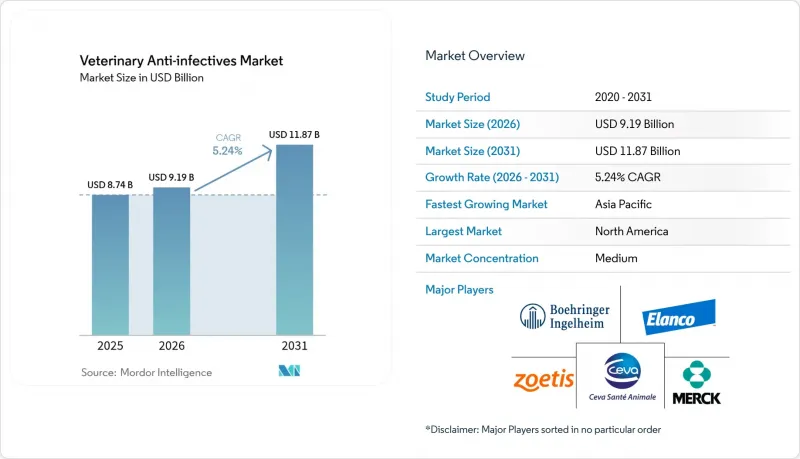
Mordor Intelligence에 의하면, 동물용 항감염제 시장 규모는 2025년에 87억 4,000만 달러로 평가되었고, 2026년 91억 9,000만 달러에서 2031년까지 118억 7,000만 달러에 이를 것으로 예측되며, 예측 기간(2026년-2031년) CAGR은 5.24%를 기록할 전망입니다.
본 보고서는 동물 유형별(소, 가금류 등), 제품 유형별(항균제, 항바이러스제 등), 투여 경로별(경구, 비경구 등), 유통 채널별(동물병원, 동물진료소 등), 지역별(북미, 유럽, 아시아태평양 등)로 세분화되어 있습니다. 시장 규모 및 전망은 금액(달러) 기준으로 제시되어 있습니다.
전 세계 동물용 항감염제 시장 동향 및 인사이트
인수공통감염병 및 식중독 발생률 증가
가금류에서 H5N1이 빈번하게 발생하고, 미국의 젖소 무리에서 최근 검출 사례가 보고됨에 따라 종간 감염 위험에 대한 인식이 높아지고 있으며, 엘란코(Elanco)와 메드진(Medgene)의 긴급 백신 개발 공동 프로젝트가 추진되고 있습니다. 감시 보고서에 따르면 신종 감염병의 75%가 인수공통감염병인 것으로 나타났으며, 이에 따라 수의학 당국은 감시 예산을 증액하고 신속 진단법의 승인을 우선적으로 추진하고 있습니다. 조에티스는 참고 검사실과 동등한 품질의 결과를 제공하는 AI 탑재 병원용 혈액 검사 분석 장치를 도입하여 치료 방침 결정을 신속화하고, 데이터에 기반한 항생제의 적정 사용을 지원하고 있습니다. 그 결과, 동물용 항감염제 시장 전체에서 광범위 항균제 및 장기 작용형 약제에 대한 수요가 증가하고 있습니다. 또한 각국 정부는 인간과 동물의 역학 데이터를 통합하는 ‘원 헬스(One Health)’ 이니셔티브에 자금을 지원하고 있으며, 항감염제 비축을 위한 지속 가능한 조달 체계가 구축되고 있습니다. 바이오 보안에 대한 투자가 증가하는 가운데, 생산 능력 확장이 가능하고 규제 관련 지식이 풍부한 공급업체는 경쟁 우위를 확보하고 있습니다.
반려동물 사육률 및 지출 증가
2025년에는 반려동물 보유율이 다시 상승했으나, 미국 반려동물 소유자의 절반 이상이 주로 비용에 대한 우려로 인해 적어도 한 가지 의료 서비스를 미루었습니다. 이러한 경제적 부담의 격차로 인해, 1회 투여로 2주간 효과가 지속되어 동물병원 방문 횟수를 줄일 수 있는 세포베신과 같은 장기 작용형 주사제에 대한 관심이 높아지고 있습니다. 기업 계열 동물병원 그룹과 보험사는 진단과 처방전을 세트로 묶은 웰니스 플랜 모델을 시범적으로 도입하고 있으며, 이를 통해 수의학용 항감염제 시장에서 고부가가치 치료제의 예측 가능한 보급이 촉진되고 있습니다. 베링거 인겔하임(Boehringer Ingelheim)이 2024년에 사이바 동물 건강(Cyba Animal Health)를 인수함에 따라, 개의 만성 질환에 대한 치료용 백신 제조를 목적으로 한 바이러스 유사 입자(VLP) 플랫폼이 추가되었으며, 이는 새로운 치료법에 대한 폭넓은 수요를 반영하고 있습니다. 원격 분류 및 전자 처방전 서비스가 급속히 확대되면서, 그동안 충분한 의료 서비스를 받지 못했던 반려동물 주인을 공식적인 치료 경로로 끌어들이고, 항감염제 처방 기반을 확대되고 있습니다. 디지털 약국은 이러한 서비스와 원활하게 연계되어 익일 배송 및 자동 재처방 알림 서비스를 제공함으로써, 약물 복용 순응도 향상에 기여하고 있습니다.
위조 동물용 의약품의 만연
WHO의 추정에 따르면, 전 세계적으로 압수되는 위조 의약품의 대부분은 항균제 및 항말라리아제이며, 규제 감독 체계가 미흡한 지역에서는 특히 수의약품 유통 경로가 취약한 상황입니다. 연구에 따르면 사하라 이남 아프리카의 의약품 5분의 1이 품질 기준을 충족하지 못해 치료 성과를 저해하고 약물 내성을 가속화하고 있습니다. 비공식 농업·수의용품점에 의존하는 파편화된 공급망은 유명 브랜드 이름을 도용한 위조 제품의 유입을 초래하고 있습니다. 다국적 제조업체들이 시작한 일련번호 부여 및 블록체인을 활용한 추적·추적 가능성 시범 사업은 기술적 실현 가능성을 입증하고 있지만, 이익률이 낮은 지방 시장에는 여전히 비용이 너무 높습니다. ECOWAS를 비롯한 지역 경제 블록은 무허가 수입을 차단하기 위해 등록 절차의 조화에 착수하고 있지만, 집행 능력은 여전히 미흡합니다. 이러한 위조 의약품의 만연은 브랜드 가치를 저하시키고, 관리를 복잡하게 하며, 동물용 항감염제 시장의 가치 성장을 저해하고 있습니다.
부문 분석
2025년, 동물용 항감염제 시장에서 젖소와 육우 사육 사업자들이 유방염 및 호흡기 질환 통제를 위해 항균제에 의존함에 따라, 소 부문이 39.22%의 점유율을 차지하며 시장 내에서 가장 큰 수익을 창출했습니다. 대규모 소 사육 사업자들이 투여량을 억제하면서 1회당 가치를 높이는 정밀 투여 도구를 채택함에 따라, 소용 치료제의 동물용 항감염제 시장 규모는 꾸준히 확대될 것으로 예측됩니다. 한편, 가금류 부문은 중국, 인도, 브라질의 육계 생산 능력 확대에 힘입어 2031년까지 연평균 성장률(CAGR) 6.22%를 기록하며, 다른 모든 종을 능가하는 성장률을 보일 것으로 전망됩니다. 수출업체들이 더욱 엄격한 잔류 기준을 준수함에 따라, 휴약 기간이 짧은 가금류 전용 제제가 보급되고 있습니다. 돼지 사육자들은 이유 후 설사 및 아프리카 돼지열병의 위협에 계속해서 직면하고 있으며, 이는 항생제와 면역 조절 사료 첨가제 모두에 대한 수요를 뒷받침하고 있습니다. 반려동물 시장은 반려인들이 편의성이 높은 제제를 선호하기 때문에 여전히 프리미엄 틈새 시장으로 남아 있지만, 저소득층에서는 가격에 대한 민감도가 구매 결정에 영향을 미치고 있습니다.
각 부문의 전망은 디지털 모니터링에 의해 점점 더 형성되고 있으며, 소 비육장에서는 클라우드 대시보드에 연결된 RFID 귀 태그가 도입되어 무증상 질병을 수의사에게 경고하는 시스템이 구축되고 있습니다. 이러한 시스템 덕분에 질병 주기의 초기 단계에서 사용되는 고효능 주사제 구매가 촉진되어, 치료 성과를 향상시키는 동시에 치료 기간을 단축하고 있습니다. 가금류 통합 생산 업체들은 실시간 무리 데이터를 기반으로 투여량을 조정하는 급수 라인 투약 제어 장치에 투자하고 있으며, pH 값이 변동하는 환경에 맞게 설계된 수용성 분말에 대한 수요를 높이고 있습니다. 수산물 양식은 매출 규모는 아직 작지만, 대서양 연어 생산자들이 바다벼룩(카이리) 및 비브리오균 감염증 대책으로 파지를 이용한 생물학적 방제 및 나노캡슐화된 항생제를 시험적으로 도입하고 있어 전략적인 신흥 분야로 부상하고 있습니다. 양식 대상 종의 다양화로 인해 적정 사용에 대한 압박으로 개별 사용 패턴이 변화하더라도, 동물용 항감염제 시장의 회복력은 확보되어 있습니다.
항균제는 여러 종에서 승인된 B-락탐계, 테트라사이클린계, 마크로라이드계 등 폭넓은 제품군에 힘입어 2025년 동물용 항감염제 시장 규모에서 28.95%의 점유율을 유지했습니다. 현재 스튜어드십(stewardship) 노력의 일환으로 특정 병원체를 표적으로 하는 협역 스펙트럼 약물이나 복합 제제가 권장되고 있으며, 주요 브랜드들 사이에서 제형 재검토가 진행되고 있습니다. 항바이러스제는 H5N1, 돼지 생식 호흡기 증후군, 그리고 잉어 헤르페스 바이러스의 발생으로 예방 조치의 미비함이 드러난 것을 계기로, 8.05%라는 가장 높은 연평균 성장률(CAGR)을 나타낼 전망입니다. 연구 개발 파이프라인에서는 치료 기간 단축과 내성 발현 위험 감소가 기대되는 뉴클레오시드 아날로그 및 바이러스 유사 입자 백신이 주목받고 있습니다. 항진균제는 매출 규모는 작지만, 반려동물에서 말라세지아 및 아스페르길루스 감염증의 발생률 증가에 대응하고 있으며, ‘오티세렌’이나 ‘모메타맥스 싱글’과 같은 1회 투여형 귀용 겔은 복약 순응도가 높다는 점 때문에 채택이 확대되고 있습니다. 항원충제는 콕시듐증이나 바베시아증과 싸우는 유행 지역에서 여전히 그 중요성을 유지하고 있으며, 톨트라즈릴을 함유한 제제의 진행 중인 임상시험은 다중 표적 요법으로의 전환을 부각시키고 있습니다.
신약 개발 파이프라인은 투여 방법의 개선에 중점을 두고 있습니다. 지속형 주사용 현탁액은 최장 2주 동안 안정적인 혈장 농도를 유지하여 복약 순응도를 높이는 동시에 재진료 횟수를 줄여줍니다. 수중에서 안정된 마이크로 펠릿은 가금류나 새우 양식 연못 내에서 균일하게 분산되므로, 저질에 침전되어 발생하는 낭비를 줄여줍니다. 또한, 각 기업은 돼지를 위한 서방형 항바이러스 펩타이드용 생분해성 임플란트 매트릭스도 연구하고 있어, 예방과 치료의 가교 역할을 수행하고 있습니다. 이러한 발전들이 어우러져, 동물용 항감염제 시장은 확립된 약물 군과 종별 특이적 질병 부담에 대응하는 획기적인 치료법 간의 균형 잡힌 구성을 유지하고 있습니다.
지역별 분석
북미는 선진적인 수의학 인프라와 1두당 높은 지출액을 배경으로 2024년에도 최대 매출을 유지했습니다. FDA의 처방전 제한 개혁으로 인해 취미로 가축을 사육하는 농가의 항생제 구매는 억제되었지만, 한편으로는 스튜어드십이 엄격하게 감시되는 환경 하에서 수의사가 치료의 정당성을 입증하는 데 도움이 되는 진단약과 보다 정교한 투여 도구에 대한 수요가 촉진되었습니다. 캐나다 수의약품국(VDD)은 미국의 규제와 긴밀히 연계되어 있어 국경을 넘는 무역을 원활하게 하고, 신규 분자의 라벨 기재 범위를 통일적으로 확대하는 데 기여하고 있습니다. 멕시코는 통합된 공급망의 혜택을 누리고 있지만, 법 집행 능력에 편차가 있기 때문에 다국적 기업들은 브랜드 신뢰성을 지키기 위해 교육 및 품질 보증 활동을 중시하고 있습니다.
유럽은 세계에서 가장 엄격한 항균제 사용 규제를 시행하고 있으며, ESVAC 감시 네트워크를 통해 12년 동안 수의용 항생제 매출을 50% 감축하는 데 성공했습니다. 현재 판매업체들은 사용량을 EU 중앙 데이터베이스에 보고하고 있으며, 이러한 투명성 확보 노력은 구매 및 공급업체와의 협상에 영향을 미치고 있습니다. 카테고리 B의 상한선 규제로 인해 판매는 1차 선택 약물로 전환되고 있으며, 기업들은 신규 신청 서류를 제출할 때 항균제 적정 사용에 관한 설득력 있는 논거를 제시해야 합니다. 브렉시트 이후, 영국은 혁신적인 동물용 의약품에 대한 신속 심사 절차를 도입하여 시장 출시를 가속화하는 한편, 내성 발생을 방지하기 위한 사후 의약품 감시 체계를 유지하고 있습니다.
아시아태평양은 중국과 인도의 단백질 수요 증가 및 반려동물 시장의 성숙에 힘입어 연평균 성장률(CAGR) 7.05%로 가장 빠르게 성장하는 시장입니다. 낙농 및 육계 부문의 현대화를 목표로 하는 정부 프로그램에서는 생물 보안이 우선시되고 있으며, 고품질의 주사용 세프티오플루르 및 플로르페니콜에 대한 주문이 증가하고 있습니다. 동시에, 중국 내 제약 공장 폐수에 대한 환경 규제가 강화됨에 따라 API(원료의약품) 수출이 정기적으로 제한되고 있어, 테트라사이클린계 및 마크로라이드계의 지역 공급에 변동이 발생하고 있습니다. 일본 농림수산성은 2026년부터 농장 단위의 항생제 사용량에 대한 연례 보고를 의무화하고 있으며, 이러한 선례는 아세안(ASEAN) 국가들에서도 유사한 규제의 도입을 촉진하여 수의학용 항감염제 시장을 더욱 발전시킬 가능성이 있습니다.
기타 혜택:
- 엑셀 형식 시장 예측(ME) 시트
- 3개월간의 애널리스트 지원
자주 묻는 질문
목차
제1장 서론
제2장 조사 방법
제3장 주요 요약
제4장 시장 구도
제5장 시장 규모와 성장 예측
제6장 경쟁 구도
제7장 시장 기회와 향후 전망
LSH 26.09.08According to Mordor Intelligence, the veterinary anti-infectives market size was valued at USD 8.74 billion in 2025 and estimated to grow from USD 9.19 billion in 2026 to reach USD 11.87 billion by 2031, at a CAGR of 5.24% during the forecast period (2026-2031).
This report is Segmented by Animal Type (Cattle, Poultry, and More), Product Type (Antibacterials, Antivirals, and More), Mode of Administration (Oral, Parenteral, and More), Distribution Channel (Veterinary Hospitals, Veterinary Clinics, and More), and by Geography (North America, Europe, Asia-Pacific, and More). The Market Sizes and Forecasts are Provided in Terms of Value (USD).
Global Veterinary Anti-infectives Market Trends and Insights
Rising Prevalence of Zoonotic & Food-Borne Diseases
Frequent H5N1 outbreaks in poultry and recent detections in US dairy herds have heightened awareness of cross-species transmission risks, prompting emergency vaccine collaborations between Elanco and Medgene. Surveillance reports show 75% of emerging infectious diseases are zoonotic, leading veterinary authorities to boost monitoring budgets and fast-track rapid diagnostic approvals. Zoetis introduced an AI-enabled in-clinic hematology analyser that delivers reference-lab quality results, accelerating therapy decisions and supporting data-driven antimicrobial stewardship. Demand for broad-spectrum and long-acting drugs consequently increases across the veterinary anti-infectives market. Governments are also funding One-Health initiatives that merge human and animal epidemiological data, creating sustained procurement pipelines for anti-infective stockpiles. As biosecurity investments rise, suppliers with scalable manufacturing and regulatory fluency gain competitive leverage.
Growing Companion-Animal Ownership & Spending
Pet ownership rates climbed again in 2025, yet more than half of US pet owners deferred at least one medical service primarily due to cost concerns. This affordability gap fuels interest in long-acting injectables such as cefovecin, which provide two-week coverage from a single dose and reduce repeat clinic visits. Corporate practice groups and insurers are piloting wellness-plan models that bundle diagnostics and prescriptions, supporting predictable uptake of premium therapeutics in the veterinary anti-infectives market. Boehringer Ingelheim's 2024 acquisition of Saiba Animal Health added a virus-like-particle platform that aims to produce therapeutic vaccines for chronic canine diseases, reflecting broader demand for novel modalities. Tele-triage and e-prescribing services are scaling rapidly, bringing previously underserved owners into the formal care pathway and expanding the prescription base for anti-infectives. Digital pharmacies integrate seamlessly with these services, offering overnight delivery and automated refill reminders that enhance compliance.
Proliferation of Counterfeit Veterinary Medicines
The WHO estimates that antimicrobial and antimalarial agents dominate global counterfeit seizures, with veterinary channels particularly vulnerable in regions lacking robust regulatory oversight.Studies indicate one-fifth of medicines in sub-Saharan Africa fail quality specifications, threatening treatment outcomes and accelerating resistance. Fragmented supply chains that rely on informal agro-vet stores invite infiltration by falsified products bearing popular brand names. Serialization and blockchain track-and-trace pilots launched by multinational producers demonstrate technical feasibility but remain costly for low-margin rural markets. Regional economic blocs, including ECOWAS, have begun harmonizing registration processes to block unlicensed imports, yet enforcement capacity lags. This proliferation depresses brand equity and complicates stewardship, restraining value growth within the veterinary anti-infectives market.
Other drivers and restraints analyzed in the detailed report include:
- Expansion of Intensive Livestock Production Systems
- Pipeline of Novel Antimicrobial Classes & Formulations
- Escalating Cost of Veterinary Care Services
For complete list of drivers and restraints, kindly check the Table Of Contents.
Segment Analysis
Cattle generated the most significant revenue within the veterinary anti-infectives market in 2025, with a 39.22% share, as dairy and beef operations relied on antimicrobials for mastitis and respiratory disease control. The veterinary anti-infectives market size for bovine therapeutics is forecast to grow steadily as large herd operations adopt precision-dosing tools that increase value per dose while containing volumes. Poultry, however, is projected to outpace all other species at a 6.22% CAGR through 2031, propelled by expanding broiler capacity in China, India, and Brazil. Avian-specific formulations with short withdrawal times gain uptake as exporters comply with tighter residue limits. Swine producers continue to grapple with post-weaning diarrhea and African swine fever threats, supporting demand for both antibiotics and immune-modulating feed additives. Companion animals remain a premium niche as owners prioritize convenience formulations, though cost sensitivity shapes purchasing decisions in lower-income brackets.
The segmental outlook is increasingly shaped by digital surveillance, with cattle feedlots integrating RFID ear tags connected to cloud dashboards that alert veterinarians to subclinical illnesses. These systems shift purchases toward high-potency injectables used earlier in disease cycles, enhancing therapeutic outcomes while reducing course length. Poultry integrators invest in waterline medication controllers that adjust dosing based on real-time flock metrics, raising demand for soluble powders designed for variable pH environments. Aquaculture, though still modest in revenue, emerges as a strategic frontier as Atlantic salmon producers trial phage biocontrol and nano-encapsulated antibiotics to combat sea lice and vibrio infections. The diversified species mix ensures resilience in the veterinary anti-infectives market even as stewardship pressure alters individual usage patterns.
Antibacterials retained a 28.95% share of the veterinary anti-infectives market size in 2025, supported by a broad catalogue of B-lactams, tetracyclines, and macrolides cleared across multiple species. Stewardship initiatives now favor narrow-spectrum and combination products aimed at specific pathogens, prompting reformulation activity among leading brands. Antivirals are forecast to register the fastest 8.05% CAGR as H5N1, porcine reproductive and respiratory syndrome, and koi herpesvirus outbreaks expose gaps in preventive measures. R&D pipelines feature nucleoside analogues and virus-like particle vaccines that promise shorter treatment courses and lower resistance development potential. Antifungals, while representing a smaller revenue pool, address rising incidences of Malassezia and Aspergillus infections in pets, with single-dose otic gels such as Otiserene and Mometamax Single gaining adoption due to simplified compliance. Antiprotozoals maintain relevance in endemic regions battling coccidiosis and babesiosis, and ongoing trials of toltrazuril combinations highlight a shift toward multi-target therapies.
The innovation pipeline concentrates on delivery enhancements. Long-acting injectable suspensions deliver steady plasma levels for up to two weeks, boosting adherence while limiting clinic revisits. Water-stable micropellets allow uniform dispersion in poultry and shrimp ponds, reducing sediment wastage. Companies also explore biodegradable implant matrices for slow-release antiviral peptides in swine, bridging prophylaxis and treatment. Collectively, these advances ensure the veterinary anti-infectives market retains a balanced mix of established classes and breakthrough modalities that respond to species-specific disease burdens.
Complete Report Scope:
- By Animal Type
- Cattle
- Poultry
- Swine
- Cats
- Dogs
- Other Animals
- By Product Type
- Antibacterials
- Antivirals
- Antifungals
- Antiprotozoals & Others
- By Mode of Administration
- Oral
- Parenteral
- Topical
- Others
- By Distribution Channel
- Veterinary Hospitals
- Veterinary Clinics
- Pharmacies & Drug Stores
- Online Channels
- By Geography
- North America
- United States
- Canada
- Mexico
- Europe
- Germany
- United Kingdom
- France
- Italy
- Spain
- Rest of Europe
- Asia Pacific
- China
- Japan
- India
- South Korea
- Australia
- Rest of Asia Pacific
- Middle East and Africa
- GCC
- South Africa
- Rest of Middle East and Africa
- South America
- Brazil
- Argentina
- Rest of South America
- North America
Geography Analysis
North America retained the largest revenue in 2024, anchored by advanced veterinary infrastructure and high per-animal spending. FDA prescription-only reforms curtailed hobby-farmer antibiotic purchases, but stimulated demand for diagnostics and refined dosing tools that help practitioners justify therapies in stewardship-scrutinized environments. Canada's Veterinary Drugs Directorate aligns closely with US regulations, easing cross-border trade and encouraging harmonized label expansions for new molecules. Mexico benefits from integrated supply chains, though varied enforcement capacity leads multinational firms to emphasize training and quality-assurance initiatives to safeguard brand integrity.
Europe showcases the world's strictest antimicrobial-usage controls, achieving a 50% reduction in veterinary antibiotic sales over 12 years through the ESVAC surveillance network. Distributors now report usage volumes into a centralized EU database, a transparency measure that influences purchasing and supplier negotiations. Category-B caps reorient sales toward first-line products, prompting companies to divulge robust stewardship arguments when submitting new dossiers. Post-Brexit, the UK introduced fast-track procedures for innovative veterinary medicines, accelerating launches but maintaining follow-up pharmacovigilance to guard against resistance.
Asia Pacific is the fastest-growing arena at 7.05% CAGR, propelled by China and India's expanding protein appetites and maturing companion-animal markets. Government programs to modernize dairy and broiler sectors prioritize biosecurity, elevating orders for high-quality injectable ceftiofur and florfenicol. Simultaneously, environmental crackdowns on pharmaceutical-plant effluent in China periodically tighten API exports, adding volatility to regional supply of tetracyclines and macrolides. Japan's Ministry of Agriculture requires annual farm-level antibiotic reporting from 2026, a precedent that could inspire similar mandates across ASEAN and further evolve the veterinary anti-infectives market.
List of Companies Covered in this Report:
- Zoetis
- Boehringer Ingelheim
- Merck
- Elanco Animal Health Inc.
- Ceva
- Virbac
- Vetoquinol
- Phibro Animal Health
- Dechra Pharmaceuticals
- Huvepharma EOOD
- Bimeda Holdings PLC
- Norbrook Laboratories Ltd.
- HIPRA SA
- Kyoritsu Seiyaku Corp.
- Orion Animal Health
- Ourofino Saude Animal
- Zydus Animal Health
Additional Benefits:
- The market estimate (ME) sheet in Excel format
- 3 months of analyst support
TABLE OF CONTENTS
1 Introduction
- 1.1 Study Assumptions & Market Definition
- 1.2 Scope of the Study
2 Research Methodology
3 Executive Summary
4 Market Landscape
- 4.1 Market Overview
- 4.2 Market Drivers
- 4.2.1 Rising Prevalence of Zoonotic & Food-Borne Diseases
- 4.2.2 Growing Companion-Animal Ownership & Spending
- 4.2.3 Expansion Of Intensive Livestock Production Systems
- 4.2.4 Pipeline of Novel Antimicrobial Classes & Formulations
- 4.2.5 Precision-Livestock Tools Enabling Targeted Dosing
- 4.2.6 Aquaculture Regulations Spurring Next-Gen Anti-Infectives
- 4.3 Market Restraints
- 4.3.1 Proliferation of Counterfeit Veterinary Medicines
- 4.3.2 Escalating Cost of Veterinary Care Services
- 4.3.3 AMR-Driven Usage Caps Reducing Prophylactic Volumes
- 4.3.4 API Supply Shocks from Stricter Environmental Rules
- 4.4 Value Chain Analysis
- 4.5 Regulatory Landscape
- 4.6 Technological Outlook
- 4.7 Porter's Five Forces
- 4.7.1 Threat of New Entrants
- 4.7.2 Bargaining Power of Buyers
- 4.7.3 Bargaining Power of Suppliers
- 4.7.4 Threat of Substitutes
- 4.7.5 Intensity of Competitive Rivalry
5 Market Size & Growth Forecasts (Value)
- 5.1 By Animal Type
- 5.1.1 Cattle
- 5.1.2 Poultry
- 5.1.3 Swine
- 5.1.4 Cats
- 5.1.5 Dogs
- 5.1.6 Other Animals
- 5.2 By Product Type
- 5.2.1 Antibacterials
- 5.2.2 Antivirals
- 5.2.3 Antifungals
- 5.2.4 Antiprotozoals & Others
- 5.3 By Mode of Administration
- 5.3.1 Oral
- 5.3.2 Parenteral
- 5.3.3 Topical
- 5.3.4 Others
- 5.4 By Distribution Channel
- 5.4.1 Veterinary Hospitals
- 5.4.2 Veterinary Clinics
- 5.4.3 Pharmacies & Drug Stores
- 5.4.4 Online Channels
- 5.5 By Geography
- 5.5.1 North America
- 5.5.1.1 United States
- 5.5.1.2 Canada
- 5.5.1.3 Mexico
- 5.5.2 Europe
- 5.5.2.1 Germany
- 5.5.2.2 United Kingdom
- 5.5.2.3 France
- 5.5.2.4 Italy
- 5.5.2.5 Spain
- 5.5.2.6 Rest of Europe
- 5.5.3 Asia Pacific
- 5.5.3.1 China
- 5.5.3.2 Japan
- 5.5.3.3 India
- 5.5.3.4 South Korea
- 5.5.3.5 Australia
- 5.5.3.6 Rest of Asia Pacific
- 5.5.4 Middle East and Africa
- 5.5.4.1 GCC
- 5.5.4.2 South Africa
- 5.5.4.3 Rest of Middle East and Africa
- 5.5.5 South America
- 5.5.5.1 Brazil
- 5.5.5.2 Argentina
- 5.5.5.3 Rest of South America
- 5.5.1 North America
6 Competitive Landscape
- 6.1 Market Concentration
- 6.2 Market Share Analysis
- 6.3 Company Profiles (includes Global level Overview, Market level overview, Core Segments, Financials as available, Strategic Information, Market Rank/Share for key companies, Products & Services, and Recent Developments)
- 6.3.1 Zoetis Inc.
- 6.3.2 Boehringer Ingelheim GmbH
- 6.3.3 Merck & Co., Inc.
- 6.3.4 Elanco Animal Health Inc.
- 6.3.5 Ceva Sante Animale
- 6.3.6 Virbac SA
- 6.3.7 Vetoquinol SA
- 6.3.8 Phibro Animal Health Corp.
- 6.3.9 Dechra Pharmaceuticals PLC
- 6.3.10 Huvepharma EOOD
- 6.3.11 Bimeda Holdings PLC
- 6.3.12 Norbrook Laboratories Ltd.
- 6.3.13 HIPRA SA
- 6.3.14 Kyoritsu Seiyaku Corp.
- 6.3.15 Orion Animal Health
- 6.3.16 Ourofino Saude Animal
- 6.3.17 Zydus Animal Health
7 Market Opportunities & Future Outlook
- 7.1 White-space & Unmet-need Assessment