
|
시장보고서
상품코드
2120817
글리포세이트 제초제 시장 : 시장 점유율 분석, 업계 동향 및 통계, 성장 예측(2026-2031년)Glyphosate Herbicide - Market Share Analysis, Industry Trends & Statistics, Growth Forecasts (2026 - 2031) |
||||||
 Mordor Intelligence
Mordor Intelligence에 의하면, 글리포세이트 제초제 시장 규모는 2025년 107억 8,000만 달러로 평가되었고, 2026년 114억 8,000만 달러에서 2031년까지 155억 8,000만 달러로 확대될 전망이며, 2026-2031년 CAGR 6.3%를 나타낼 것으로 예측됩니다.
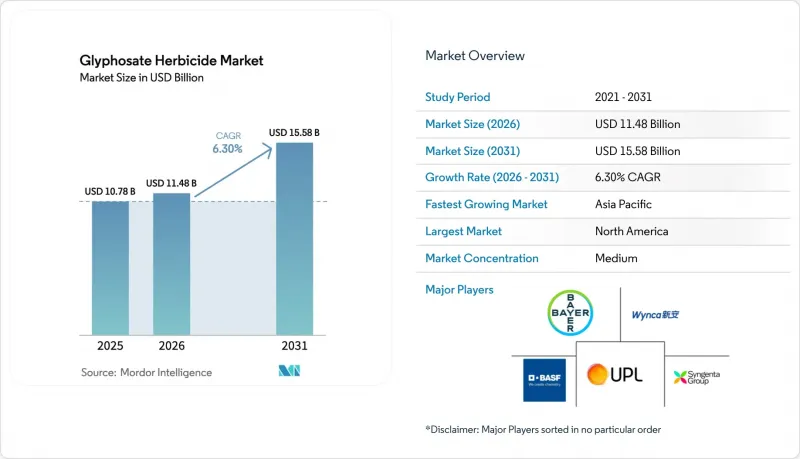
본 보고서는 작물 유형별(곡물 및 곡류, 상업 작물 등), 생명공학 도입 현황별(유전자 변형 작물 및 비유전자 변형 작물), 제형별(액체, 건조제), 그리고 지역별(아시아태평양, 북미, 남미, 유럽, 중동 및 아프리카)로 분류되어 있습니다. 시장 전망은 금액(달러) 기준으로 제시되어 있습니다.
세계의 글리포세이트 제초제 시장 동향 및 인사이트
유전자 변형(GM) 제초제 내성 작물의 상용화
규제 당국의 승인이 잇따르고, 농가들의 유전자 변형 제초제 내성 작물 채택이 증가함에 따라, 생산자들이 종자·농약 통합 시스템을 도입함에 따라 글리포세이트 수요가 견인되고 있습니다. 2025년 6월, 아르헨티나 농업부(Secretaria de Agricultura)는 스택형 옥수수 품종 MON-87427-7×MON-94804-4×MON-00603-6의 상업적 출시를 승인했습니다. 이 품종은 식물의 키를 작게 하는 특성과 글리포세이트 내성을 겸비하고 있으며, 농업 생명공학 국가 자문위원회(CONABIA) 및 농산물 위생·품질 국가국(SENASA)으로부터 긍정적인 평가를 받았습니다. 두 기관은 이 스택형 품종이 기존 옥수수에 비해 추가적인 위험을 초래하지 않는다는 결론을 내렸습니다. 종자 기업들이 글리포세이트 내성 작물에 더 많은 형질을 도입함에 따라, 글리포세이트는 표준 투입 자재가 되었으며, 단기적인 가격 변동이나 대체 제초제와의 경쟁에도 불구하고 수요는 안정적입니다.
효과적인 잡초 방제 솔루션에 대한 수요 증가
주요 농업 지역의 노동력 부족과 임금 상승으로 인해, 생산자들은 수작업이나 기계적 방법을 대체할 비용 효율적인 수단으로서 화학적 잡초 방제 도입을 추진하고 있습니다. 이러한 추세는 소규모 농가들이 가족 노동의 기회 비용 상승에 직면해 있는 아시아태평양과, 계절 노동자 공급을 뛰어넘는 속도로 상업 농업이 확대되고 있는 아프리카에서 특히 두드러집니다. 글리포세이트는 광범위한 방제 효과와 헥타르당 살포 비용이 비교적 저렴하다는 점 때문에 유전자 변형(GM) 및 비유전자 변형(비GM) 재배 시스템 모두에서 파종 전 제초 및 발아 후 잡초 방제에 선호되는 선택지가 되고 있습니다. 뿌리와 뿌리줄기로 이동하는 전신성 작용 덕분에, 기계적 경작으로는 방제가 어려운 경우가 많은 시노돈 다크틸론(Cynodon dactylon)이나 사이페루스 로툰두스(Cyperus rotundus) 등의 다년생 잡초를 효과적으로 방제합니다. 예를 들어, 아르헨티나의 제품 라벨에는 현재 내성을 가진 소르검 할레펜세(Sorghum halepense)의 바이오유형에 대한 경고가 기재되어 있으며, 내성 관리 및 병용 전략에 대해서는 기술 고문과 상담할 것을 권장하고 있습니다.
규제상의 제한 및 단계적 사용 금지
유럽연합(EU) 및 지방 자치 단체의 규제 조치에 따라 공공 장소, 수역 주변 및 유기농 인증을 받은 생산 시스템에서의 글리포세이트 사용이 제한되어 장기적인 수요가 감소하고 있습니다. 유럽식품안전청(EFSA)은 2023년에 글리포세이트에 대한 종합적인 위험 평가와 동료 검토를 실시하여, 중대한 우려 사항은 확인되지 않았으나 데이터상의 부족은 여전히 남아 있다는 결론을 내렸습니다. 이러한 과학적 평가에도 불구하고, 정치적 압력과 예방 원칙의 해석에 따라 일부 회원국에서는 부분적인 사용 금지 조치가 취해지거나, 비화학적 대체 수단을 우선시하는 종합 해충 관리 계획의 수립이 의무화되고 있습니다. 이러한 규제로 인해 유럽 내 대상 시장 규모가 축소되고 규제상의 불확실성이 발생하여 글리포세이트 생산 능력에 대한 장기적인 투자를 저해하고 있습니다. 이러한 끊임없이 변화하는 규제 체계를 준수하기 위해 제조업체는 여러 제품 제형과 라벨 변형을 유지해야 하며, 이로 인해 관리 비용이 증가하고 공급망의 물류가 복잡해지고 있습니다.
부문 분석
2025년, 곡물 및 시리얼은 글리포세이트 제초제 시장에서 44.0%의 점유율을 차지했습니다. 이러한 압도적인 점유율은 글리포세이트 내성 품종이 널리 사용되고, 파종 전 번다운 처리가 일반적인 관행인 북미와 남미의 대두 및 옥수수 재배에 기인합니다. 콩류 및 유지종자는 렌틸콩, 병아리콩, 카놀라 등의 작물에서 수확 전 건조 처리에 글리포세이트가 사용된 데 힘입어 주목할 만한 2위 점유율을 차지했습니다. 이 방법은 성숙의 동기화를 촉진하고 수확 시 수분 함량을 낮춥니다. 과일 및 채소는 시장에서 비교적 비중이 작은 부문입니다. 이는 많은 고부가가치 작물이 글리포세이트 사용을 제한하는 유기농 재배나 통합 해충 관리(IPM) 시스템 하에서 재배되고 있기 때문입니다. 일부 과수원에서는 수관 아래의 잡초 방제에 글리포세이트가 사용되고 있습니다.
면화, 사탕수수, 플랜테이션 작물을 포함한 상업용 작물은 2031년까지 연평균 성장률(CAGR) 6.8%를 나타낼 것으로 예측됩니다. 이러한 성장은 면화의 섬유 품질을 향상시키고 사탕수수의 수확 일정을 효율화하는 건조 처리 프로토콜의 도입에 의해 주도되고 있습니다. 아르헨티나에서는 규제 체계가 글리포세이트 내성 면화 품종의 승인 및 국가농업식품위생품질청(SENASA)에 의한 잔류 기준 준수의 철저한 이행을 통해 이러한 확장을 지원하고 있으며, 생산자와 수출업체에게 법적 보장을 제공합니다. 목초지 및 임업과 같은 기타 작물, 그리고 철도 및 도로 유지 관리와 같은 비농업 용도는 시장에서 안정적인 점유율을 차지하고 있으나, 성장 속도는 비교적 완만합니다. 이러한 부문 수요는 인프라 유지 관리 예산과 공공 부문의 조달 주기에 따라 좌우됩니다.
지역별 분석
2025년 글리포세이트 제초제 시장에서 북미가 30%의 점유율을 차지한 배경에는 무경운 재배 방식의 대두 및 옥수수 재배 시스템이 널리 보급되어 있기 때문입니다. 이 지역 생산자의 80% 이상이 번다운 처리 및 생육 중인 작물에 제초제를 살포하고 있습니다. 캐나다에서는 프레리 지대의 밀 및 카놀라 재배에서도 유사한 관행이 나타납니다. 한편, 멕시코에서는 옥수수 재배의 기계화로의 전환이 꾸준한 수요 증가에 기여하고 있습니다. 소송은 시장에 중대한 위험 요인으로 작용하고 있습니다. 바이엘사가 시장에서 철수할 경우, 계류 중인 소송이 국내 공급에 영향을 미칠 가능성이 있기 때문입니다. 이에 대응하기 위해 조지아주에서 제정된 것과 같은 주 차원의 책임 면제 조치가 생산의 지속을 보장하는 것을 목적으로 하고 있습니다. 미국은 여전히 단일 국가로는 최대 시장이며, 무경운 농법을 장려하는 탄소 크레딧 제도의 지원을 받고 있습니다. 이러한 제도로 인해 파종 전 글리포세이트 살포가 유지되고 있지만, 잡초의 내성이 높아짐에 따라 더 높은 투여량이나 탱크 혼합을 통한 조합이 필요해지고 있습니다.
아시아태평양은 2031년까지 연평균 성장률(CAGR) 6.90%를 기록할 전망이며, 지역별로는 가장 빠른 성장률을 보일 것으로 예측됩니다. 중국에서는 농약 사용량이 약 2억 4,000만-2억 5,000만 메트르톤으로 안정적이며, 글리포세이트는 여전히 상위 10대 유효 성분 중 하나로 꼽히고 있습니다. 인도의 농약 밸류체인은 확대되고 있으며, 농가들이 비용 대비 효과가 높은 잡초 방제 방법을 채택함에 따라 제네릭 글리포세이트의 사용량이 증가하고 있습니다. 인도네시아, 베트남, 태국 등의 국가에서는 이모작을 지원하기 위해 파종 전 제초(번다운)가 점점 더 보편화되고 있습니다. 호주에서는 광활한 곡물 농장에서 투입 자재 살포를 최적화하는 정밀 안내 시스템에 힘입어, 성숙하면서도 안정적인 수요가 나타나고 있습니다. 인도의 규제 환경은 여전히 신중한 입장을 유지하고 있으며, 글리포세이트 등록에 대한 정기적인 재검토가 이루어지고 있을 뿐만 아니라, 환경 보호 단체가 지하수 오염에 대한 우려를 표명하고 있는 지역에서는 주 차원의 규제가 마련되어 있습니다.
남미는 글리포세이트 소비량에서 2위를 차지하고 있으며, 그 주된 요인은 2025년 브라질에서 3억 2,230만 메트르톤의 곡물 수확되어 제초제 사용량을 끌어올렸기 때문입니다. 이 지역에서는 3,500만 헥타르 이상에서 무경운 재배가 이루어지고 있어, 파종 전 벼과 잡초 방제에 글리포세이트가 필수적입니다. 아르헨티나에서는 통화 문제로 인해 가격에 대한 민감도가 높아지고 있지만, 글리포세이트에 대한 의존도는 줄어들지 않고 있습니다. 신젠타(Syngenta)사가 파울리니아에 건설한 6,500만 달러 규모의 시설 등, 이 지역의 기술적 진보는 높은 습도 조건에서도 효과를 유지하기 위한 열대 기후용 제제 개발에 초점을 맞추고 있으며, 이는 장기적인 시장 성장을 뒷받침하고 있습니다. 브라질의 세라두 지역에서는 목초지와 사바나가 계속해서 대두 농장으로 전환되고 있으며, 이로 인해 파종 전 제초 처리와 발아 후 잡초 방제에서 글리포세이트 수요가 서서히 증가하고 있습니다. 브라질과 아르헨티나 양국에서는 특히 아마란스와 할레펜세 수수 같은 종에서 잡초의 내성이 증가하고 있습니다. 이에 따라 농업 전문가들은 잔효성 제초제와 기계적 방제 방법을 결합한 통합 잡초 관리 프로그램을 제안하고 있습니다.
기타 혜택 :
- 엑셀 형식 시장 예측(ME) 시트
- 3개월간의 애널리스트 지원
자주 묻는 질문
목차
제1장 서론
제2장 조사 방법
제3장 주요 요약
제4장 시장 구도
제5장 시장 규모 및 성장 예측
제6장 경쟁 구도
제7장 시장 기회 및 향후 전망
AJY 26.09.09According to Mordor Intelligence, the glyphosate herbicide market size is projected to expand from USD 10.78 billion in 2025 and USD 11.48 billion in 2026 to USD 15.58 billion by 2031, registering a CAGR of 6.3% between 2026 to 2031.
This report is Segmented by Crop Type (Grains and Cereals, Commercial Crops, and More), by Biotechnology Adoption (GM Crops and Non-GM Crops), by Formulation (Liquid, and Dry), and by Geography (Asia-Pacific, North America, South America, Europe, Middle East, and Africa). The Market Forecasts are Provided in Terms of Value (USD).
Global Glyphosate Herbicide Market Trends and Insights
Commercialization of Genetically Modified (GM) Herbicide-Tolerant Crops
The ongoing regulatory approvals and increasing adoption of genetically modified herbicide-tolerant crops by farmers are driving glyphosate demand as growers integrate into seed-and-chemistry systems. In June 2025, Argentina's Secretaria de Agricultura approved the commercial release of the stacked maize event MON-87427-7 x MON-94804-4 x MON-00603-6. This event combines reduced plant height with glyphosate tolerance, following favorable evaluations by the National Advisory Commission on Agricultural Biotechnology (CONABIA) and the National Service of Agri-Food Health and Quality (SENASA), which concluded that the stacked event poses no additional risks compared to conventional maize. As seed companies incorporate more traits into glyphosate-tolerant crops, glyphosate becomes a standard input, stabilizing demand against short-term price fluctuations and competition from alternative herbicides.
Rising Demand for Effective Weed-Control Solutions
Labor shortages and increasing wages in key agricultural regions are encouraging growers to adopt chemical weed control as a cost-effective alternative to manual or mechanical methods. This trend is particularly evident in the Asia-Pacific region, where smallholder farms face rising opportunity costs for family labor, and in Africa, where commercial agriculture is expanding faster than the availability of seasonal workers. Glyphosate's broad-spectrum efficacy and relatively low application cost per hectare make it a preferred choice for pre-plant burndown and post-emergence weed control in both genetically modified (GM) and non-genetically modified (non-GM) cropping systems. Its systemic action, which translocates to roots and rhizomes, effectively controls perennial weeds such as Cynodon dactylon and Cyperus rotundus, which are often resistant to mechanical tillage. For example, product labels in Argentina now include warnings about resistant Sorghum halepense biotypes and recommend consulting technical advisors for resistance management and combination strategies.
Regulatory Restrictions and Phased Bans
European Union and sub-national regulatory actions are trimming long-term demand by restricting glyphosate use in public spaces, near water bodies, and in organic-certified production systems. The European Food Safety Authority conducted a comprehensive risk assessment and peer review of glyphosate in 2023, concluding that no critical areas of concern were identified, and data gaps remained. Despite this scientific assessment, political pressure and precautionary-principle interpretations have led several member states to impose partial bans or require integrated pest management plans that prioritize non-chemical alternatives. These restrictions reduce the addressable market size in Europe and create regulatory uncertainty that discourages long-term investment in glyphosate production capacity. Compliance with these evolving frameworks requires manufacturers to maintain multiple product formulations and labeling variants, which increases administrative costs and complicates supply-chain logistics.
Other drivers and restraints analyzed in the detailed report include:
- Expansion of Agricultural Land and Intensified Farming
- Capacity Consolidation Stabilizes Long-Term Prices
- Accelerating Weed Resistance in Major Crop Belts
For complete list of drivers and restraints, kindly check the Table Of Contents.
Segment Analysis
Grains and cereals held a 44.0% glyphosate herbicide market share in 2025. This dominance is attributed to the cultivation of soybeans and maize in North and South America, where glyphosate-tolerant varieties are widely used, and pre-plant burndown applications are a common practice. Pulses and oilseeds held a notable secondary share, driven by the use of glyphosate for pre-harvest desiccation in crops such as lentils, chickpeas, and canola. This practice facilitates synchronized maturity and reduces harvest moisture content. Fruits and vegetables represent a smaller segment of the market, as many high-value crops are cultivated under organic or integrated pest management systems that limit the use of glyphosate. Some tree-fruit orchards utilize glyphosate for under-canopy weed control.
Commercial crops, including cotton, sugarcane, and plantation crops, are forecast to grow at a 6.8% CAGR through 2031. This growth is driven by the adoption of desiccation protocols that enhance fiber quality in cotton and streamline harvest scheduling in sugarcane. In Argentina, the regulatory framework supports this expansion by authorizing glyphosate-tolerant cotton varieties and enforcing residue compliance through the National Service of Agri-Food Health and Quality (SENASA), providing legal assurance for growers and exporters. Other crops, such as pastures and forestry, along with non-agricultural applications like railway and roadside maintenance, contribute a stable but slower-growing share of the market. Infrastructure maintenance budgets and public-sector procurement cycles influence demand in these segments.
Complete Report Scope:
- By Crop Type
- Grains and Cereals
- Pulses and Oilseeds
- Fruits and Vegetables
- Commercial Crops
- Other Crops
- By Biotechnology Adoption
- GM Crops
- Non-GM Crops
- By Formulation
- Liquid
- Dry
- By Geography
- North America
- United States
- Canada
- Mexico
- Rest of North America
- South America
- Brazil
- Argentina
- Rest of South America
- Europe
- Germany
- France
- Italy
- Spain
- United Kingdom
- Russia
- Rest of Europe
- Asia-Pacific
- China
- India
- Japan
- Australia
- Rest of Asia-Pacific
- Middle East
- Saudi Arabia
- United Arab Emirates
- Turkey
- Rest of Middle East
- Africa
- South Africa
- Nigeria
- Rest of Africa
- North America
Geography Analysis
North America's 30% share of the glyphosate herbicide market in 2025 is driven by the widespread adoption of no-till soy and corn farming systems. Over 80% of growers in the region rely on herbicides for burndown and in-crop applications. In Canada, similar practices are observed in prairie wheat and canola farming, while Mexico's shift to mechanized maize farming is contributing to steady incremental demand. Litigation poses a significant risk to the market, as pending cases could impact domestic supply if Bayer were to exit the market. To address this, state-level liability shields, such as those enacted in Georgia, aim to ensure continued production. The United States remains the largest single-country market, supported by carbon-credit programs that incentivize no-till farming. These programs sustain pre-plant glyphosate applications, even as increasing weed resistance necessitates higher doses and tank-mix combinations.
The Asia-Pacific region is projected to deliver the fastest regional growth, at a 6.90% CAGR, by 2031. In China, pesticide volumes have stabilized at approximately 240-250 million metric tons, with glyphosate remaining among the top 10 active ingredients. India's agrochemical value chain is expanding, with increasing volumes of generic glyphosate as farmers adopt cost-effective weed control methods. Countries such as Indonesia, Vietnam, and Thailand are increasingly adopting pre-plant burndown practices to support double cropping. In Australia, broadacre cereal farms exhibit mature but steady demand, bolstered by precision guidance systems that optimize the application of inputs. India's regulatory environment remains cautious, with periodic reviews of glyphosate registrations and state-level restrictions in areas where environmental advocacy groups have raised concerns about groundwater contamination.
South America ranks second in glyphosate consumption, largely due to Brazil's projected 322.3 million metric ton grain harvest in 2025, which drives high herbicide usage. No-till farming spans over 35 million hectares in the region, making glyphosate essential for controlling grass weeds prior to planting. In Argentina, currency challenges have heightened price sensitivity but have not reduced reliance on glyphosate. Regional technological advancements, such as Syngenta's USD 65 million facility in Paulinia, focus on developing tropical-climate formulations to maintain efficacy under high humidity, supporting long-term market growth. In Brazil's cerrado region, the conversion of pasture and savanna into soybean plantations continues to drive incremental demand for glyphosate in pre-plant burndown and post-emergence weed control. Both Brazil and Argentina face increasing weed resistance, particularly in species like Amaranthus and Sorghum halepense. This has led agronomists to advocate for integrated weed management programs that combine residual herbicides with mechanical control methods.
- Bayer AG
- Zhejiang Xinan Chemical Industrial Group Co., Ltd
- BASF SE
- Syngenta Group Co., Ltd.
- UPL Limited
- Corteva, Inc.
- FMC Corporation
- Nufarm Limited
- Albaugh LLC
- Zhejiang Jiangshan Agrochemical & Chemical Co., Ltd.
- Jiangsu Yangnong Chemical Group Co., Ltd. (Sinochem Holdings Corporation Ltd.)
- ADAMA Ltd.
- Bharat Rasayan Limited
- Jiangsu Good-Harvest Weien Agrochemical Co., Ltd.
- Anhui Huaxing Chemical Industry Co., Ltd.
Additional Benefits:
- The market estimate (ME) sheet in Excel format
- 3 months of analyst support
TABLE OF CONTENTS
1 Introduction
- 1.1 Study Assumptions and Market Definition
- 1.2 Scope of the Study
2 Research Methodology
3 Executive Summary
4 Market Landscape
- 4.1 Market Overview
- 4.2 Market Drivers
- 4.2.1 Commercialization of Genetically Modified (GM) herbicide-tolerant crops
- 4.2.2 Rising demand for effective weed-control solutions
- 4.2.3 Expansion of agricultural land and intensified farming
- 4.2.4 Capacity consolidation stabilizes long-term prices
- 4.2.5 Carbon-credit backed regenerative no-till acreage
- 4.2.6 Clustered Regularly Interspaced Short Palindromic Repeats (CRISPR)-based stacked-trait pipelines
- 4.3 Market Restraints
- 4.3.1 Regulatory restrictions and phased bans
- 4.3.2 Accelerating weed resistance in major crop belts
- 4.3.3 Litigation-driven exit risk for branded suppliers
- 4.3.4 Venture funding shift to bio-herbicide start-ups
- 4.4 Regulatory Landscape
- 4.5 Technological Outlook
- 4.6 Porter's Five Forces Analysis
- 4.6.1 Bargaining Power of Suppliers
- 4.6.2 Bargaining Power of Buyers
- 4.6.3 Threat of New Entrants
- 4.6.4 Threat of Substitutes
- 4.6.5 Intensity of Competitive Intensity
5 Market Size and Growth Forecasts (Value)
- 5.1 By Crop Type
- 5.1.1 Grains and Cereals
- 5.1.2 Pulses and Oilseeds
- 5.1.3 Fruits and Vegetables
- 5.1.4 Commercial Crops
- 5.1.5 Other Crops
- 5.2 By Biotechnology Adoption
- 5.2.1 GM Crops
- 5.2.2 Non-GM Crops
- 5.3 By Formulation
- 5.3.1 Liquid
- 5.3.2 Dry
- 5.4 By Geography
- 5.4.1 North America
- 5.4.1.1 United States
- 5.4.1.2 Canada
- 5.4.1.3 Mexico
- 5.4.1.4 Rest of North America
- 5.4.2 South America
- 5.4.2.1 Brazil
- 5.4.2.2 Argentina
- 5.4.2.3 Rest of South America
- 5.4.3 Europe
- 5.4.3.1 Germany
- 5.4.3.2 France
- 5.4.3.3 Italy
- 5.4.3.4 Spain
- 5.4.3.5 United Kingdom
- 5.4.3.6 Russia
- 5.4.3.7 Rest of Europe
- 5.4.4 Asia-Pacific
- 5.4.4.1 China
- 5.4.4.2 India
- 5.4.4.3 Japan
- 5.4.4.4 Australia
- 5.4.4.5 Rest of Asia-Pacific
- 5.4.5 Middle East
- 5.4.5.1 Saudi Arabia
- 5.4.5.2 United Arab Emirates
- 5.4.5.3 Turkey
- 5.4.5.4 Rest of Middle East
- 5.4.6 Africa
- 5.4.6.1 South Africa
- 5.4.6.2 Nigeria
- 5.4.6.3 Rest of Africa
- 5.4.1 North America
6 Competitive Landscape
- 6.1 Market Concentration
- 6.2 Strategic Moves
- 6.3 Market Share Analysis
- 6.4 Company Profiles (Includes Global Level Overview, Market Level Overview, Core Segments, Financials as Available, Strategic Information, Market Rank/Share, Products and Services, Recent Developments)
- 6.4.1 Bayer AG
- 6.4.2 Zhejiang Xinan Chemical Industrial Group Co., Ltd
- 6.4.3 BASF SE
- 6.4.4 Syngenta Group Co., Ltd.
- 6.4.5 UPL Limited
- 6.4.6 Corteva, Inc.
- 6.4.7 FMC Corporation
- 6.4.8 Nufarm Limited
- 6.4.9 Albaugh LLC
- 6.4.10 Zhejiang Jiangshan Agrochemical & Chemical Co., Ltd.
- 6.4.11 Jiangsu Yangnong Chemical Group Co., Ltd. (Sinochem Holdings Corporation Ltd.)
- 6.4.12 ADAMA Ltd.
- 6.4.13 Bharat Rasayan Limited
- 6.4.14 Jiangsu Good-Harvest Weien Agrochemical Co., Ltd.
- 6.4.15 Anhui Huaxing Chemical Industry Co., Ltd.


