

|
시장보고서
상품코드
2120833
유럽의 에너지 관리 시스템 시장 : 시장 점유율 분석, 업계 동향 및 통계, 성장 예측(2026-2031년)Europe Energy Management Systems - Market Share Analysis, Industry Trends & Statistics, Growth Forecasts (2026 - 2031) |
||||||
 Mordor Intelligence
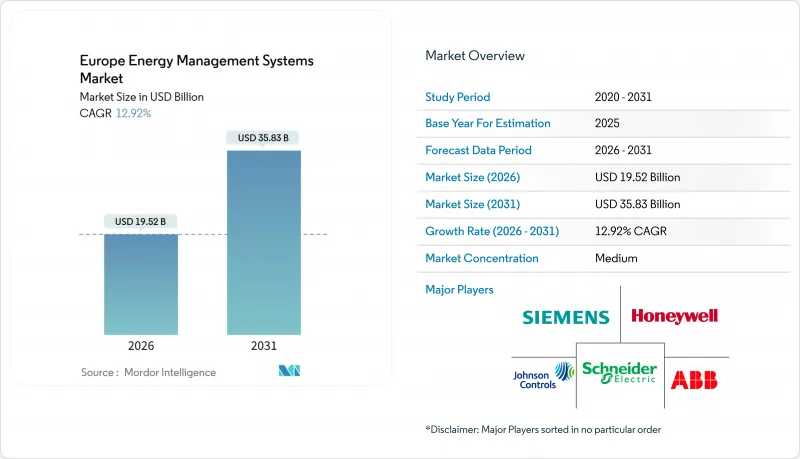
Mordor Intelligence에 의하면, 유럽의 에너지 관리 시스템 시장 규모는 2026년에 195억 2,000만 달러로 추정되고, 2031년까지 358억 3,000만 달러에 이를 것으로 예측되며, 이 기간 CAGR은 12.92%로 성장이 전망됩니다.
본 보고서는 솔루션 유형별(빌딩 에너지 관리 시스템, 산업용 에너지 관리 시스템 등), 구성 요소별(하드웨어, 소프트웨어, 서비스), 도입 형태별(온프레미스, 클라우드 기반), 최종 사용자별(상업·소매, 주거, 산업 시설, 의료, 기타 최종 사용자) 및 국가별로 분류되어 있습니다. 시장 전망은 금액(달러) 기준으로 제시되어 있습니다.
유럽의 에너지 관리 시스템 시장 동향 및 인사이트
스마트 그리드 인프라 도입 확대
유럽의 송배전 사업자들은 지난 10년간 그리드 업그레이드에 5,840억 유로를 투자했으며, 그 중 약 40%를 기존의 수동형 계량기를 지능형 엔드포인트로 전환하는 디지털 기술에 할당하고 있습니다. 2032년까지 5,000만 대의 스마트 계량기를 도입하겠다는 독일의 목표와 프랑스에서 완료된 ‘Linky’ 도입을 결합함으로써, 에너지 관리 플랫폼이 15분 단위로 부하를 최적화하고 도매 시장의 가격 신호와 동기화될 수 있도록 하는 정교한 데이터 백본이 구축되고 있습니다. 북유럽의 전력 회사들은 이미 EMS를 지역 난방 루프와 연동하여 피크 수요를 최대 12%까지 줄이고 있습니다. 이러한 성공 사례는 다른 지역에서의 비즈니스 사례 타당성을 입증하고 있으며, 스페인 및 베네룩스 국가의 송배전 사업자들이 첨단 계량기 도입을 가속화하는 데 박차를 가하고 있습니다. 양방향 통신이 성숙해짐에 따라, EMS를 갖춘 건물은 단순한 에너지 소비자로부터 그리드 자산으로 변모하여, 균형 시장이나 용량 시장에서 새로운 수익원을 확보하게 될 것입니다.
EU의 ‘Fit-for-55’ 에너지 효율화 의무
지침 2023/1791에 따르면, 연간 85 TJ 이상의 에너지를 사용하는 기업에 대해 인증된 에너지 관리 시스템의 도입이 의무화되었으며, 이로 인해 의무 적용 대상 시설은 순식간에 약 12,000개의 산업 시설로 확대되었습니다. 개정된 건축물 지침에서는 HVAC(냉난방·환기) 시스템의 기준치가 290 kW로 하향 조정되어, 소매, 숙박, 사무실 공간의 수백만 제곱미터에 달하는 면적이 규정 준수 대상 목록에 추가되었습니다. 회원국들은 기록적인 속도로 이러한 규정을 국내법에 반영했습니다. 독일의 『Gebaudeenergiegesetz』, 프랑스의 『Decret Tertiaire』, 스페인의 『Real Decreto 390/2021』은 모두 벌금의 단계적 인상을 배경으로 엄격한 개보수 일정을 부과하고 있습니다. 과태료 액수가 프로젝트의 회수 기간을 초과함에 따라, 최고재무책임자(CFO)들은 현재 EMS에 대한 지출을 재량적 지출이 아닌 규제 대응을 위한 자본으로 분류하고 있으며, 조달 주기가 수년 단위에서 분기 단위로 단축되고 있습니다.
국가별로 분절된 건축 기준
EU 지침은 높은 수준의 목표를 설정하고 있지만, 각 회원국은 독자적인 기술적 검사 항목, 센서 밀도, 점검 빈도를 규정하고 있어 27개의 병행된 규정 준수 트랙이 발생하고 있습니다. 벤더는 각국의 서로 다른 기준을 충족하기 위해 펌웨어와 문서를 맞춤화해야 하며, 이로 인해 통합 비용이 최대 30% 증가하고 시장 출시 기간이 18개월 연장됩니다. 중소 공급업체들은 특히 어려움을 겪고 있으며, 간접비를 흡수할 수 있는 대형 기존 기업들에게 사실상 지역 간 거래를 양보하는 형태가 되고 있습니다. 규제 조화를 위한 노력은 진행 중이지만, 공통된 규칙이 마련되기 전까지는 남유럽 및 동유럽의 도입 속도가 독일이나 프랑스와 같은 핵심 시장에 비해 뒤처질 것으로 보입니다.
부문 분석
2025년, 유럽 에너지 관리 시스템 시장에서 건물용 에너지 관리 시스템이 가장 큰 매출을 창출하여 총 매출의 56.78%를 차지했습니다. 이는 사무실, 공장, 병원 등에 수십 년간 도입되어 온 시스템 덕분입니다. 그러나 성장 동력은 가정용 에너지 관리 시스템으로 이동하고 있으며, 히트펌프에 대한 보조금이 확대되고 변동 요금제가 가정에 유리한 차익 거래 기회를 창출함에 따라, 해당 분야의 예측 연평균 성장률(CAGR)은 13.89%를 나타낼 것으로 전망됩니다. 유럽에서는 2024년에 300만 대 이상의 주택용 히트펌프가 새로 도입되었으며, 현재 일부 회원국에서는 스마트 계량기 보급률이 주택의 70%를 넘어, HEMS(가정용 에너지 관리 시스템)에 부하 자동 전환에 필요한 상세한 데이터를 제공합니다.
또한, 2027년부터 모든 신축 주택에 ‘스마트 대응 라벨’ 표시를 의무화하는 ‘건축물 에너지 성능 지침(EPBD)’이 시행됨에 따라 이러한 추세는 더욱 가속화되고 있습니다. 슈나이더 일렉트릭의 ‘Wiser Home’과 같은 플랫폼은 이미 유럽의 50만 가구에 도입되어 있으며, 예측 기반 스케줄링 기능을 통해 가스 사용량을 최대 12%까지 절감하고 있습니다. 산업용 EMS 솔루션은 성장 속도가 완만하지만, 에너지 비용이 운영 비용의 30-40%를 차지하는 중공업 분야에서 여전히 필수적인 존재입니다. 데이터센터의 전력 최적화를 포함한 틈새 분야도 시장 구성을 보완하고 있으며, 이는 유럽의 에너지 관리 시스템 시장이 건물 유형이나 이용 사례를 넘어 지속적으로 다양화되고 있음을 보여줍니다.
2025년에는 하드웨어가 부품 매출의 47.93%를 차지했으며, EMS의 신경계를 구성하는 센서, 게이트웨이, 액추에이터 등을 포함할 것으로 보입니다. 한편, 소프트웨어는 익명화된 여러 거점의 데이터 세트를 수익화하고 구독형 가격 책정을 가능하게 하는 클라우드 분석에 힘입어 연평균 성장률(CAGR) 13.66%를 나타낼 것으로 예측되는 등 가장 눈부신 성장을 이루고 있습니다. 디지털 트윈, 포트폴리오 대시보드, 그리고 BIM 및 ERP 제품군과 동기화되는 오픈 API는 원시 데이터를 경영진을 위한 KPI로 변환합니다. 각 벤더사는 현재 로컬 AI 모델을 호스팅하는 유연한 연산 블록을 엣지 컨트롤러에 미리 탑재하고 있으며, 실시간 제어와 클라우드 수준의 인사이트를 융합함으로써 복원력을 높이고 대역폭을 절약하고 있습니다.
통합업체들이 설계, 시운전, 분석 관리를 묶어 제공함으로써 서비스 수익은 견조한 추세를 보이고 있지만, 셀프 서비스 포털과 자동화된 장치 감지 기능으로 인해 이익률은 점차 압박받고 있습니다. 코드를 많이 활용한 가치 제안으로의 전환은 더 광범위한 ‘인더스트리 4.0’ 추세를 반영하고 있으며, 하드웨어 업그레이드가 진행되는 가운데에서도 소프트웨어가 유럽 에너지 관리 시스템 시장에서 점유율을 계속 확대해 나갈 것으로 확실히 전망됩니다.
기타 혜택 :
- 엑셀 형식 시장 예측(ME) 시트
- 3개월간의 애널리스트 지원
자주 묻는 질문
목차
제1장 서론
제2장 조사 방법
제3장 주요 요약
제4장 시장 구도
제5장 시장 규모 및 성장 예측
제6장 경쟁 구도
제7장 시장 기회 및 향후 전망
AJY 26.09.09According to Mordor Intelligence, the Europe energy management systems market size is USD 19.52 billion in 2026 and is projected to reach USD 35.83 billion by 2031, translating into a 12.92% CAGR over the period.
This report is Segmented by Solution Type (Building Energy Management Systems, Industrial Energy Management Systems, and More), Component (Hardware, Software, Services), Deployment Mode (On-Premise, and Cloud-Based), End-User (Commercial and Retail, Residential, Industrial Facilities, Healthcare, Other End-Users), and Country. The Market Forecasts are Provided in Terms of Value (USD).
Europe Energy Management Systems Market Trends and Insights
Growing Deployment of Smart-Grid Infrastructure
European transmission and distribution operators have earmarked EUR 584 billion for grid upgrades this decade, allocating nearly 40% to digital technologies that turn passive meters into intelligent endpoints. Germany's goal to install 50 million smart meters by 2032, combined with France's completed Linky rollout, provides a granular data backbone that enables energy management platforms to optimize loads in 15-minute increments and synchronize with wholesale market price signals. Nordic utilities already coordinate EMS with district-heating loops, trimming peak demand by up to 12%. These successes validate business cases elsewhere, encouraging Spain and Benelux network operators to fast-track advanced metering. As two-way communication matures, buildings equipped with EMS shift from energy takers to grid assets, capturing new revenue streams from balancing and capacity markets.
EU Fit-for-55 Energy-Efficiency Mandates
Directive 2023/1791 requires enterprises that use more than 85 TJ annually to install certified energy management systems, instantly expanding the mandatory addressable base to roughly 12,000 industrial facilities. The revised buildings directive slashes the HVAC threshold to 290 kW, adding millions of square meters of retail, hospitality, and office space to the compliance roster. Member states transposed the rules into national codes at record speed. Germany's Gebaudeenergiegesetz, France's Decret Tertiaire, and Spain's Real Decreto 390/2021 each impose aggressive retrofit schedules backed by escalating fines. Because penalties outweigh project paybacks, chief financial officers now classify EMS spending as regulatory capital rather than a discretionary outlay, accelerating procurement cycles from years to quarters.
Fragmented Country-Level Building Codes
While EU directives set high-level goals, each member state specifies its own technical test points, sensor densities, and inspection cadences, creating 27 parallel compliance tracks. Vendors must customize firmware and documentation to satisfy divergent national norms, adding as much as 30% to integration costs and 18 months to go-to-market timelines. Smaller suppliers struggle most, effectively ceding pan-regional deals to large incumbents that can absorb the overhead. Harmonization efforts are underway, but until a common rulebook emerges, deployment speed in Southern and Eastern Europe will lag behind that of the core markets of Germany and France.
Other drivers and restraints analyzed in the detailed report include:
- Corporate Net-Zero Targets Accelerating EMS Adoption
- Building-Level AI and ML Optimization of HVAC Loads
- Skill-Set Shortage for Advanced Analytics
For complete list of drivers and restraints, kindly check the Table Of Contents.
Segment Analysis
The Europe energy management systems market generated its highest revenue from building energy management systems in 2025, capturing 56.78% of total revenue, thanks to decades-old installations in offices, factories, and hospitals. Growth, however, is tilting toward home energy management systems, which boast a 13.89% forecast CAGR as heat-pump subsidies proliferate and dynamic tariffs create lucrative arbitrage windows for households. Europe installed more than 3 million new residential heat pumps in 2024, and smart meters now cover over 70% of dwellings in several member states, providing HEMS with the data granularity needed for automated load shifting.
Momentum builds further because the Energy Performance of Buildings Directive requires a smart-readiness label for every new home from 2027. Platforms such as Schneider Electric's Wiser Home already equip half a million European residences with predictive scheduling that cuts gas use by up to 12%. Industrial EMS solutions, while slower-growing, remain critical for heavy-process sectors where energy equals 30-40% of operating costs. Niche categories, including data-center power optimization, round out the mix, underscoring how the Europe energy management systems market continues to diversify across building classes and use cases.
Hardware controlled 47.93% of component revenue in 2025, covering sensors, gateways, and actuators that form the nervous system of an EMS. Software, however, is the star performer with a projected 13.66% CAGR, propelled by cloud analytics that monetize anonymized multi-site datasets and enable subscription pricing. Digital twins, portfolio dashboards, and open APIs that sync with BIM and ERP suites transform raw data into executive-ready KPIs. Vendors now preload edge controllers with flexible compute blocks that host local AI models, blending real-time control with cloud-level insight for resilience and bandwidth savings.
Services revenue holds steady as integrators bundle design, commissioning, and analytics management, yet self-service portals and automated device discovery are slowly compressing margins. The shift toward code-heavy value propositions mirrors broader Industry 4.0 trends, ensuring that software will continue to expand its share of the Europe energy management systems market even as hardware upgrades roll out.
Complete Report Scope:
- By Solution Type
- Building Energy Management Systems
- Home Energy Management Systems
- Industrial Energy Management Systems
- Other Solution Types
- By Component
- Hardware
- Software
- Services
- By Deployment Mode
- On-Premise
- Cloud-Based
- By End-User
- Commercial and Retail
- Residential
- Industrial Facilities
- Healthcare
- Other End-Users
- By Country
- United Kingdom
- Germany
- France
- Italy
- Spain
- Benelux
- Nordics
- Rest of Europe
List of Companies Covered in this Report:
- Schneider Electric SE
- Siemens AG
- Honeywell International Inc.
- ABB Ltd.
- Johnson Controls International plc
- Panasonic Holdings Corporation
- Enel X S.r.l.
- Uplight Inc.
- SAP SE
- British Gas Services Limited
- Green Energy Options Ltd.
- Efergy Technologies SL
- Cisco Systems Inc.
- IBM Corporation
- Eaton Corporation plc
- Rockwell Automation Inc.
- ENGIE Digital
- Landis+Gyr AG
- Delta Electronics Inc.
- Trane Technologies plc
- C3.ai Inc.
- GridPoint Inc.
- mCloud Technologies Corp.
- Veritone Inc.
Additional Benefits:
- The market estimate (ME) sheet in Excel format
- 3 months of analyst support
TABLE OF CONTENTS
1 INTRODUCTION
- 1.1 Study Assumptions and Market Definition
- 1.2 Scope of the Study
2 RESEARCH METHODOLOGY
3 EXECUTIVE SUMMARY
4 MARKET LANDSCAPE
- 4.1 Market Overview
- 4.2 Market Drivers
- 4.2.1 Growing Deployment of Smart-Grid Infrastructure
- 4.2.2 EU Fit-for-55 Energy-Efficiency Mandates
- 4.2.3 Corporate Net-Zero Targets Accelerating EMS Adoption
- 4.2.4 Building-Level AI and ML Optimisation of HVAC Loads
- 4.2.5 Rise of Flexibility Markets and Demand-Response Revenues
- 4.2.6 Edge-to-Cloud Cybersecurity Toolkits Reducing Project Risk
- 4.3 Market Restraints
- 4.3.1 Fragmented Country-Level Building Codes
- 4.3.2 Skill-Set Shortage for Advanced Analytics
- 4.3.3 Interoperability Gaps Across Legacy BMS Protocols
- 4.3.4 Inflation-Driven Capex Deferrals in Small and Medium Businesses
- 4.4 Industry Value Chain Analysis
- 4.5 Regulatory Landscape
- 4.6 Technological Outlook
- 4.7 Porter's Five Forces Analysis
- 4.7.1 Bargaining Power of Suppliers
- 4.7.2 Bargaining Power of Buyers
- 4.7.3 Threat of New Entrants
- 4.7.4 Threat of Substitutes
- 4.7.5 Degree of Competition
- 4.8 Impact of Macroeconomic Factors on the Market
5 MARKET SIZE AND GROWTH FORECASTS (VALUE)
- 5.1 By Solution Type
- 5.1.1 Building Energy Management Systems
- 5.1.2 Home Energy Management Systems
- 5.1.3 Industrial Energy Management Systems
- 5.1.4 Other Solution Types
- 5.2 By Component
- 5.2.1 Hardware
- 5.2.2 Software
- 5.2.3 Services
- 5.3 By Deployment Mode
- 5.3.1 On-Premise
- 5.3.2 Cloud-Based
- 5.4 By End-User
- 5.4.1 Commercial and Retail
- 5.4.2 Residential
- 5.4.3 Industrial Facilities
- 5.4.4 Healthcare
- 5.4.5 Other End-Users
- 5.5 By Country
- 5.5.1 United Kingdom
- 5.5.2 Germany
- 5.5.3 France
- 5.5.4 Italy
- 5.5.5 Spain
- 5.5.6 Benelux
- 5.5.7 Nordics
- 5.5.8 Rest of Europe
6 COMPETITIVE LANDSCAPE
- 6.1 Market Concentration
- 6.2 Strategic Moves
- 6.3 Market Share Analysis
- 6.4 Company Profiles (includes Global Level Overview, Market Level Overview, Core Segments, Financials as Available, Strategic Information, Market Rank/Share for Key Companies, Products and Services, and Recent Developments)
- 6.4.1 Schneider Electric SE
- 6.4.2 Siemens AG
- 6.4.3 Honeywell International Inc.
- 6.4.4 ABB Ltd.
- 6.4.5 Johnson Controls International plc
- 6.4.6 Panasonic Holdings Corporation
- 6.4.7 Enel X S.r.l.
- 6.4.8 Uplight Inc.
- 6.4.9 SAP SE
- 6.4.10 British Gas Services Limited
- 6.4.11 Green Energy Options Ltd.
- 6.4.12 Efergy Technologies SL
- 6.4.13 Cisco Systems Inc.
- 6.4.14 IBM Corporation
- 6.4.15 Eaton Corporation plc
- 6.4.16 Rockwell Automation Inc.
- 6.4.17 ENGIE Digital
- 6.4.18 Landis+Gyr AG
- 6.4.19 Delta Electronics Inc.
- 6.4.20 Trane Technologies plc
- 6.4.21 C3.ai Inc.
- 6.4.22 GridPoint Inc.
- 6.4.23 mCloud Technologies Corp.
- 6.4.24 Veritone Inc.
7 MARKET OPPORTUNITIES AND FUTURE OUTLOOK
- 7.1 White-Space and Unmet-Need Assessment


