
|
시장보고서
상품코드
2121208
열전대 온도 센서 : 시장 점유율 분석, 업계 동향과 통계, 성장 예측(2026-2031년)Thermocouple Temperature Sensors - Market Share Analysis, Industry Trends & Statistics, Growth Forecasts (2026 - 2031) |
||||||
 Mordor Intelligence
Mordor Intelligence에 의하면, 2026년 열전대 온도 센서 시장 규모는 74억 6,000만 달러로 추정되며, 2025년 69억 3,000만 달러에서 2031년에는 107억 7,000만 달러에 달할 것으로 예측됩니다.
또한 2026-2031년 연평균 성장률(CAGR) 7.62%를 기록할 전망입니다.
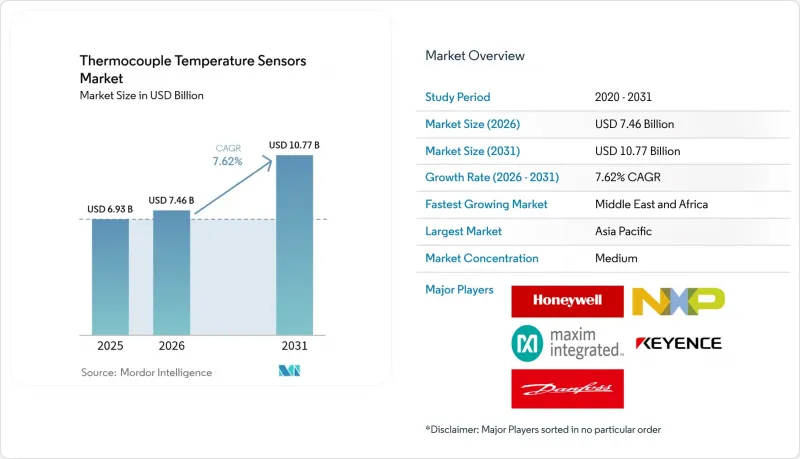
본 보고서는 열전대의 유형, 접합부 유형(접지 접합부, 비접지 접합부 등), 온도 범위(0°C 미만, 0°C-350°C 등),프로브 구성(비드형 와이어, 광물 절연(MI) 케이블 등), 최종 사용자 산업(석유 및 가스, 발전 등), 지역별로 분류되어 있습니다. 시장 전망은 금액(달러) 기준으로 제시되어 있습니다.
세계 열전대 온도 센서 시장 동향 및 인사이트
예지 보수가 다중 지점 열전대 채택을 촉진
인더스트리 4.0 표준을 채택하는 공장 운영자들은 단일 지점 센서를 상세한 열 분포도를 생성하는 다점 열전대 어레이로 대체하고 있습니다. 이러한 어레이를 머신러닝 알고리즘과 결합함으로써, 고장이 발생하기 몇 주 전에 드리프트나 핫스팟을 감지하여 예기치 않은 가동 중지 시간을 최대 30%까지 줄일 수 있습니다. 유럽의 공장들이 이러한 개조 물결을 주도해 왔지만, CEN 워크숍 합의 18038이 데이터 기반 유지보수의 청사진을 제시함에 따라 북미의 자동차 제조업체와 화학 가공업체들도 이를 따르고 있습니다. 컴퓨팅 비용의 감소와 통합 시간을 단축하는 ODVA의 플러그 앤 플레이 방식 EtherNet/IP 프로파일 덕분에 더 광범위한 도입이 촉진되고 있습니다. 열 프로파일링이 더 많은 공장에서 표준화됨에 따라, 센서와 분석 서비스를 세트로 제공할 수 있는 공급업체는 더 높은 이익률을 확보하고 있습니다.
그린 수소가 고온 모니터링 수요를 주도
고체 산화물 전지의 대형화에 따라 작동 온도 범위는 800°C를 초과하게 되었습니다. 이 임계값에서는 N형 및 개량형 K형 프로브가 다른 금속계 센서를 능가합니다. 지속적인 프로파일링은 스택의 수명을 단축시키는 열 사이클로부터 보호하는 역할을 하며, 캘리포니아주 에너지 위원회의 보조금 지원으로 인해 온도 제어 프로토콜에 대한 전 세계적인 관심이 높아지고 있습니다. 아시아의 전해조 공급업체들은 현재 수소 노출에 대응하는 정격을 갖춘, 미리 용접된 광물 절연(MI) 어셈블리를 사양으로 채택하고 있으며, 이로 인해 열전대 온도 센서 시장 내에 프리미엄 계층이 형성되고 있습니다. 유럽의 기후 정책 자금이 그린 수소 클러스터로 유입됨에 따라 초고안정성 프로브에 대한 총 수요가 확대되고 있으며, 대상 판매 시장은 파일럿 플랜트의 범위를 훨씬 뛰어넘고 있습니다.
가격 하락이 유럽 및 미국 제조업체들의 과제로 대두
중국과 인도산 저가 K형 및 J형 프로브의 급증으로 인해 2023년 이후 평균 판매 가격이 15-20% 하락하면서, 판매량의 절반 이상을 차지하는 표준 어셈블리의 이익률이 압박받고 있습니다. 또한 아시아 공급업체들은 MI 케이블을 30-40% 할인된 가격에 출하하고 있어, 전통 있는 브랜드들은 전문적인 설계 및 서비스 중심의 계약으로 사업 전환을 강요받고 있습니다. 미국 유통업체에 따르면, 최종 사용자가 추가적인 가격 하락을 예상하여 교체를 미루고 있어 재고 회전율이 둔화되고 있다고 합니다. 니켈과 크롬의 단기적인 가격 급등은 유럽 기업들의 비용 관리 난항을 더욱 심화시키고 있지만, 구매자들은 여전히 추가 비용 부담에 소극적이어서 수익 성장에 대한 제약이 더욱 강화되고 있습니다.
부문 분석
K형은 -200°C에서 +1350°C에 이르는 광범위한 온도 범위를 지원할 수 있는 범용성 덕분에 2025년 열전대 온도 센서 시장에서 34.60%의 점유율을 유지했습니다. 이 온도 범위는 주류 제조업, 식품 가공 및 HVAC 루프를 포괄하고 있으며, 상품화로 인해 이익률이 압박받고 있음에도 불구하고, 이 유형은 대량 수주 계약을 확보할 수 있는 입장에 있습니다. 한편, N형은 그린로트 산화에 대한 내성을 강점으로 삼아 2031년까지 연평균 성장률(CAGR) 8.78%를 기록하며, 항공우주 분야의 시험 장비 및 수소 반응로용 주문을 확보하고 있습니다. 각 OEM 업체들은 교정 주기 연장에 따른 수명 주기 비용 절감 효과를 기대하고 있으며, 이에 따라 구매 부서는 초기 비용이 높아지더라도 구매를 결정하는 경향이 있습니다. 신흥 R, S, B 합금은 여전히 틈새 시장인 초고온 용도에 맞추어 가격이 책정되어 있지만, 백금선의 순도에 대한 단계적인 기술적 진보로 인해 1200°C에서의 드리프트 제어가 극히 중요한 반도체 에피택시 라인에 채택되는 추세가 확대되고 있습니다.
최근 재료 과학의 발전으로 인해 채택 범위가 확대되고 있습니다. 박막 증착 기술을 통해 세라믹 기판 위에 마이크론 규모의 열전대 그리드를 삽입할 수 있게 되어, 웨이퍼의 온도를 실시간으로 측정할 수 있게 되었습니다. 각 공급업체들은 1600°C에서 연속 사용이 가능한 알루미나 절연체 및 ‘파이버 플래티넘’ 와이어를 강조하고 있으며, 이를 통해 유리, 내화물 및 적층 가공용 가마에서 기존의 광학식 고온계를 폐지할 수 있게 되었습니다. T형은 정밀도가 비용보다 우선시되는 -200°C의 LNG 용도에서 여전히 활기를 띠는 마이크로 틈새 시장을 유지하고 있습니다. 이러한 움직임들이 합쳐져 대량 생산 제품의 가격 압박에 대해 프리미엄 부문의 회복력이 강화되고 있습니다.
접지형 접합 모델은 밀리초 단위의 응답 시간을 실현하기 때문에 여전히 OEM 카탈로그를 지배하고 있습니다. 그러나 서보 드라이브 및 가변 주파수 모터 시스템에서 전기적 절연에 대한 수요가 증가함에 따라, 응답 속도를 불과 20%만 희생하면서도 접지 루프 노이즈를 90% 저감하는 비접지형 버전에 대한 조달 경향이 강해지고 있습니다. 반도체 제조업체들은 민감한 측정 전자 기기를 표류 전류로부터 보호하기 위해 이러한 변형 제품을 지정하고 있습니다. 노출된 접합부는 실험용 유리 기구나 비가압 파일럿 장치에서 여전히 사용되고 있지만, 파손되기 쉬워 시장 점유율은 제한적입니다. 공장이 예측 유지보수를 위해 배선을 재검토하는 가운데, 제어 엔지니어들은 전자기 호환성과 동적 응답성의 균형을 맞추기 위해 부분 절연된 미니 접합부와 같은 하이브리드 설계를 선호하고 있습니다.
레이저 용접을 통한 첨단 구조의 발전으로 피로 수명이 향상되어, 비접지형 MI 프로브도 고진동 터빈 단을 견딜 수 있게 되었습니다. 각 공급업체는 열 지연을 방해하지 않으면서 밀봉성을 향상시키는 소형 커넥터나 에폭시 봉지재를 추가하고 있습니다. 일부 배터리 제조업체는 셀 하우징의 온도를 모니터링하기 위해 클립형 스킨 센서(기본적으로 세라믹 비드에 내장된 노출형 접점)를 채택하고 있으며, 이를 통해 접점 기술의 혁신이 소비자용 전자기기 분야로도 확대되고 있습니다. 이러한 산업 전반에 걸친 인사이트력 덕분에, 실리콘계 칩의 부상에 불구하고 열전대 온도 센서 시장은 활기를 유지하고 있습니다.
지역별 분석
아시아태평양이 열전대 온도 센서 시장의 41.70%를 차지하는 것은 이 지역의 밀집된 제조 거점에 힘입은 것입니다. 중국의 배터리 소성로와 일본의 반도체 팹에서는 고정밀 프로브가 사용되고 있으며, 한국에서는 OLED 유리의 용융 구역에 백금 합금의 사용이 지정되어 있습니다. 인도의 석유화학 산업 확장에 따라 표준 K형 및 J형 주문이 증가하는 한편, 현지 조달 수요도 높아지면서 합작 투자 설립이 촉진되고 있습니다. 이 지역 전역의 저비용 공장에서는 상품화된 프로브가 제조되어 전 세계 공급망으로 유입되고 있어, 다른 지역에서는 가격 측면에서 역풍이 불고 있습니다.
중동은 2031년까지 연평균 성장률(CAGR)이 9.40%로, 지역별 가장 빠른 성장세를 기록하고 있습니다. 담맘에 위치한 사우디 아람코 인증 시설에서는 현재 MI 프로브와 써모웰을 국내에서 생산하고 있습니다. 투자 흐름은 석유화학 허브, 태양열 발전소, 해수 담수화 플랜트까지 미치고 있으며, 이 모든 분야에서 극저온부터 1000°C 영역까지 대응 가능한 견고한 센서가 요구되고 있습니다. 현지 조립을 통해 리드 타임이 단축되고, 공급업체가 국내 부가가치 요건을 충족하는 데 도움이 되며, 열전대 온도 센서 시장의 유통 네트워크가 재구축되고 있습니다.
북미는 항공우주, LNG, 첨단 제조 분야를 통해 여전히 큰 점유율을 유지하고 있습니다. 멕시코만 연안의 신규 액화 플랜트에서는 -162°C에서 사용될 T형 스트링이 발주되고 있는 반면, 제트 엔진 OEM 각사는 1200°C의 연소실을 위한 귀금속 프로브의 인증을 추진하고 있습니다. 유럽에서의 보급은 규제에 따른 뒷받침에 달려 있습니다. EU 자동차 규정 2019/1781에서는 연비 라벨 표기를 위해 내장형 열전대의 검증이 의무화되어 있으며, 독일의 수소 시범 플랜트에서는 SOEC 스택의 900°C 측정이 요구되고 있습니다. 남미 및 아프리카에서는 아직 시장이 발전 단계에 있지만, 광업, 펄프·제지, 그리고 공정 개선을 목표로 하는 비료 공장과 관련하여 수요가 증가하는 추세를 보이고 있습니다.
기타 혜택:
- 엑셀 형식 시장 예측(ME) 시트
- 3개월간의 애널리스트 지원
자주 묻는 질문
목차
제1장 서론
제2장 조사 방법
제3장 주요 요약
제4장 시장 구도
제5장 시장 규모와 성장 예측
제6장 경쟁 구도
제7장 시장 기회와 향후 전망
LSH 26.09.08According to Mordor Intelligence, thermocouple temperature sensors market size in 2026 is estimated at USD 7.46 billion, growing from 2025 value of USD 6.93 billion with 2031 projections showing USD 10.77 billion, growing at 7.62% CAGR over 2026-2031.
This report is Segmented by Thermocouple Type, Junction Type (Grounded Junction, Ungrounded Junction and More), Temperature Range (Below 0 °C, 0 °C - 350 °C and More), Probe Configuration (Beaded-Wire, Mineral-Insulated (MI) Cable and More) End-User Industry (Oil and Gas, Power Generation and More), and Geography. The Market Forecasts are Provided in Terms of Value (USD).
Global Thermocouple Temperature Sensors Market Trends and Insights
Predictive maintenance driving multi-point thermocouple adoption
Factory operators adopting Industry 4.0 standards are replacing single-point sensors with multi-point thermocouple strings that create detailed thermal maps. When paired with machine-learning algorithms, these arrays detect drift or hotspots weeks ahead of a fault, reducing unplanned downtime by up to 30%. European plants pioneered the retrofit wave, yet North American automakers and chemical processors are following as CEN Workshop Agreement 18038 offers a blueprint for data-driven maintenance. Broader adoption is fuelled by falling computing costs and ODVA's plug-and-play EtherNet/IP profiles that shrink integration time. As more plants normalize thermal profiling, suppliers able to bundle sensors with analytics services capture higher margins.
Green hydrogen driving high-temperature monitoring demand
Scaling of solid-oxide electrolyser cells pushes operating zones beyond 800 °C, a threshold where Type N and upgraded Type K probes outclass other metal-based sensors. Continuous profiling guards against thermal cycling that shortens stack life, and California Energy Commission grants have sharpened global attention on temperature-control protocols. Asian electrolyser vendors now specify pre-welded mineral-insulated (MI) assemblies rated for hydrogen exposure, creating a premium tier within the thermocouple temperature sensors market. As European climate-policy funds funnel into green-hydrogen clusters, collective demand for ultra-stable probes widens the addressable sales pool well past pilot plants.
Price erosion challenging Western manufacturers
A surge of low-cost K and J probes from China and India has cut average selling prices by 15-20% since 2023, squeezing margins on standard assemblies that make up over half of unit volumes. Asian vendors also ship MI cables at 30-40% discounts, forcing legacy brands to pivot toward specialized designs or service-heavy contracts. Distributors in the United States report inventory turns slowing as end users defer replacements in anticipation of further price drops. Short-cycle inflationary spikes in nickel and chromium amplify cost control woes for European firms, yet buyers remain reluctant to shoulder surcharges, deepening the restraint on revenue growth.
Other drivers and restraints analyzed in the detailed report include:
- LNG infrastructure expansion boosts cryogenic sensor demand
- EV battery manufacturing driving precision temperature control
- Fiber-optic sensors threatening high-EMI applications
For complete list of drivers and restraints, kindly check the Table Of Contents.
Segment Analysis
Type K maintained a 34.60% hold on the thermocouple temperature sensors market share in 2025 on versatility across -200 °C to +1350 °C. That span covers mainstream manufacturing, food processing and HVAC loops, positioning the variant for volume contracts even as commoditization trims margins. Type N, however, is capturing orders in aerospace test stands and hydrogen reactors at an 8.78% CAGR through 2031, aided by immunity to green-rot oxidation. OEMs see life-cycle savings from longer calibration intervals, swinging purchasing departments toward higher upfront costs. Emerging R, S and B alloys remain priced for boutique ultra-high-temperature work, but incremental breakthroughs in platinum wire purity are nudging them into semiconductor epitaxy lines where 1200 °C drift control is paramount.
Recent material science gains widen adoption envelopes. Thin-film deposition now embeds micron-scale thermocouple grids on ceramic substrates, serving real-time wafer temperature measurement. Suppliers highlight alumina insulation and Fibro Platinum wire for 1600 °C continuous service, enabling glass, refractory and additive-manufacturing kilns to retire legacy optical pyrometers. Type T retains a thriving micro-niche at -200 °C LNG duties where accuracy trumps cost. Collectively, these moves reinforce the premium segments' resilience against bulk price compression.
Grounded junction models still dominate OEM catalogues because they achieve millisecond response times. Yet the push for electrical isolation in servo drives and variable-frequency motor systems moves procurement toward ungrounded versions that damp ground-loop noise by 90% while sacrificing only 20% response speed. Semiconductor fabricators specify these variants to shield sensitive measurement electronics from stray currents. Exposed junctions continue in lab glassware and non-pressurized pilot rigs but carry limited share due to fragility. As factories re-wire for predictive maintenance, control engineers balance electromagnetic compatibility against dynamic response, favouring hybrid designs such as partially insulated mini junctions.
Advances in laser-welded tip construction lift fatigue life, letting ungrounded MI probes survive high-vibration turbine stages. Vendors add miniature connectors and epoxy potting salts that improve seal integrity without hampering thermal lag. Some battery producers adopt clip-on skin sensors-essentially exposed junctions set in ceramic beads-to audit cell casing temperatures, pulling junction innovation into consumer-electronics territory. These cross-industry learnings keep the thermocouple temperature sensors market vibrant despite encroachment from silicon-based chips.
Complete Report Scope:
- Thermocouple Type
- Type J
- Type T
- Type N
- Type E
- Type R and S
- Type B
- Others
- By Junction Type
- Grounded Junction
- Ungrounded Junction
- Exposed Junction
- By Temperature Range
- Below 0 C
- 0 C 350 C
- 350 C 700 C
- Above 700 C
- By Probe Configuration
- Beaded-Wire
- Mineral-Insulated (MI) Cable
- Thermowell and Protection Tube
- Surface and Penetration
- Flexible / Custom Harness
- By End-User Industry
- Oil and Gas
- Power Generation
- Chemicals and Petrochemicals
- Metals and Mining
- Food and Beverage
- Automotive and EV Battery
- Aerospace and Defense
- Semiconductor and Electronics
- Healthcare and Life Sciences
- HVAC and Building Automation
- By Geography
- North America
- United States
- Canada
- Mexico
- Rest of North America
- South America
- Brazil
- Argentina
- Rest of South America
- Europe
- Germany
- United Kingdom
- France
- Italy
- Spain
- Russia
- Rest of Europe
- Asia Pacific
- China
- Japan
- India
- South Korea
- Australia
- Rest of Asia Pacific
- Middle East
- Saudi Arabia
- United Arab Emirates
- Turkey
- Rest of Middle East
- Africa
- South Africa
- Egypt
- Nigeria
- Rest of Africa
- North America
Geography Analysis
Asia Pacific's 41.70% command of the thermocouple temperature sensors market rests on its dense manufacturing base. China's battery kilns and Japan's chip fabs consume high-accuracy probes, while South Korea specifies platinum alloys for OLED glass melt zones. India's petrochemical expansion adds orders for standard K and J variants yet increasingly demands local content, spurring joint ventures. Low-cost plants across the region manufacture commoditized probes that flow into global supply chains, creating price headwinds elsewhere.
The Middle East posts the quickest regional climb at 9.40% CAGR through 2031. Saudi Aramco-approved facilities in Dammam now produce MI probes and thermowells domestically. Investment flows span petrochemical hubs, solar-thermal farms and desalination units, all requiring rugged sensors from cryogenic to 1000 °C zones. Local assembly shortens lead times and helps suppliers meet in-country value mandates, reshaping distribution networks in the thermocouple temperature sensors market.
North America maintains substantial share via aerospace, LNG and advanced manufacturing. New liquefaction trains along the Gulf Coast order Type T strings for -162 °C service, whereas jet-engine OEMs qualify noble-metal probes for 1200 °C combustors. Europe's uptake hinges on regulatory stimuli; EU Motor Regulation 2019/1781 obliges embedded thermocouple verification for efficiency labelling, and hydrogen pilot plants in Germany necessitate 900 °C measurement of SOEC stacks. South America and Africa remain nascent but show upticks tied to mining, pulp-and-paper and fertilizer plants seeking process upgrades.
- Omega Engineering (Spectris plc)
- Emerson Electric Co.
- Endress+Hauser Group
- Honeywell International Inc.
- ABB Ltd
- Yokogawa Electric Corp.
- WIKA Alexander Wiegand SE
- TE Connectivity Ltd.
- Watlow Electric Manufacturing Co.
- Fluke Corporation
- Siemens AG
- JUMO GmbH and Co. KG
- Tempsens Instruments
- Pyromation Inc.
- Durex Industries
- Thermo Fisher Scientific Inc.
- GHM Group (Greisinger)
- TC Ltd (UK)
- Thermo Electric Instrumentation
- Tip TEMP
Additional Benefits:
- The market estimate (ME) sheet in Excel format
- 3 months of analyst support
TABLE OF CONTENTS
1 INTRODUCTION
- 1.1 Study Assumptions and Market Definition
- 1.2 Scope of the Study
2 RESEARCH METHODOLOGY
3 EXECUTIVE SUMMARY
4 MARKET LANDSCAPE
- 4.1 Market Drivers
- 4.1.1 Shift toward predictive maintenance in Industry 4.0 boosting multi-point thermocouple retrofits across European factories
- 4.1.2 Expansion of green-hydrogen electrolyzes build-outs (>800 C monitoring) in Asia Pacific
- 4.1.3 LNG regasification terminal build-outs requiring cryogenic Type-T probes in North America
- 4.1.4 EV battery gigafactory kiln installations in China demanding high-accuracy Type-K sensors
- 4.1.5 EU Regulation 2019/1781 mandating tighter motor-efficiency tests and embedded thermocouples
- 4.2 Market Restraints
- 4.2.1 Price erosion from commoditized K and J imports out of low-cost Asian supply chains
- 4.2.2 Substitution threat from fiber-optic sensors in high-EMI aerospace engines
- 4.2.3 Calibration drift >1 200 C limiting use in semiconductor epitaxy lines
- 4.2.4 Nickel and chromium supply volatility disrupting MI-cable probe output in Europe
- 4.3 Value / Supply-Chain Analysis
- 4.4 Regulatory Outlook
- 4.5 Technological Outlook
- 4.6 Porter's Five Forces Analysis
- 4.6.1 Threat of New Entrants
- 4.6.2 Bargaining Power of Buyers
- 4.6.3 Bargaining Power of Suppliers
- 4.6.4 Threat of Substitute Products
- 4.6.5 Intensity of Competitive Rivalry
- 4.7 PESTLE Analysis
5 MARKET SIZE AND GROWTH FORECASTS (VALUE)
- 5.1 Thermocouple Type
- 5.1.1 Type J
- 5.1.2 Type T
- 5.1.3 Type N
- 5.1.4 Type E
- 5.1.5 Type R and S
- 5.1.6 Type B
- 5.1.7 Others
- 5.2 By Junction Type
- 5.2.1 Grounded Junction
- 5.2.2 Ungrounded Junction
- 5.2.3 Exposed Junction
- 5.3 By Temperature Range
- 5.3.1 Below 0 C
- 5.3.2 0 C 350 C
- 5.3.3 350 C 700 C
- 5.3.4 Above 700 C
- 5.4 By Probe Configuration
- 5.4.1 Beaded-Wire
- 5.4.2 Mineral-Insulated (MI) Cable
- 5.4.3 Thermowell and Protection Tube
- 5.4.4 Surface and Penetration
- 5.4.5 Flexible / Custom Harness
- 5.5 By End-User Industry
- 5.5.1 Oil and Gas
- 5.5.2 Power Generation
- 5.5.3 Chemicals and Petrochemicals
- 5.5.4 Metals and Mining
- 5.5.5 Food and Beverage
- 5.5.6 Automotive and EV Battery
- 5.5.7 Aerospace and Defense
- 5.5.8 Semiconductor and Electronics
- 5.5.9 Healthcare and Life Sciences
- 5.5.10 HVAC and Building Automation
- 5.6 By Geography
- 5.6.1 North America
- 5.6.1.1 United States
- 5.6.1.2 Canada
- 5.6.1.3 Mexico
- 5.6.1.4 Rest of North America
- 5.6.2 South America
- 5.6.2.1 Brazil
- 5.6.2.2 Argentina
- 5.6.2.3 Rest of South America
- 5.6.3 Europe
- 5.6.3.1 Germany
- 5.6.3.2 United Kingdom
- 5.6.3.3 France
- 5.6.3.4 Italy
- 5.6.3.5 Spain
- 5.6.3.6 Russia
- 5.6.3.7 Rest of Europe
- 5.6.4 Asia Pacific
- 5.6.4.1 China
- 5.6.4.2 Japan
- 5.6.4.3 India
- 5.6.4.4 South Korea
- 5.6.4.5 Australia
- 5.6.4.6 Rest of Asia Pacific
- 5.6.5 Middle East
- 5.6.5.1 Saudi Arabia
- 5.6.5.2 United Arab Emirates
- 5.6.5.3 Turkey
- 5.6.5.4 Rest of Middle East
- 5.6.6 Africa
- 5.6.6.1 South Africa
- 5.6.6.2 Egypt
- 5.6.6.3 Nigeria
- 5.6.6.4 Rest of Africa
- 5.6.1 North America
6 COMPETITIVE LANDSCAPE
- 6.1 Strategic Moves
- 6.2 Market Share Analysis
- 6.3 Company Profiles (includes Global level Overview, Market level overview, Core Segments, Financials as available, Strategic Information, Market Rank/Share for key companies, Products and Services, and Recent Developments)
- 6.3.1 Omega Engineering (Spectris plc)
- 6.3.2 Emerson Electric Co.
- 6.3.3 Endress+Hauser Group
- 6.3.4 Honeywell International Inc.
- 6.3.5 ABB Ltd
- 6.3.6 Yokogawa Electric Corp.
- 6.3.7 WIKA Alexander Wiegand SE
- 6.3.8 TE Connectivity Ltd.
- 6.3.9 Watlow Electric Manufacturing Co.
- 6.3.10 Fluke Corporation
- 6.3.11 Siemens AG
- 6.3.12 JUMO GmbH and Co. KG
- 6.3.13 Tempsens Instruments
- 6.3.14 Pyromation Inc.
- 6.3.15 Durex Industries
- 6.3.16 Thermo Fisher Scientific Inc.
- 6.3.17 GHM Group (Greisinger)
- 6.3.18 TC Ltd (UK)
- 6.3.19 Thermo Electric Instrumentation
- 6.3.20 Tip TEMP
7 MARKET OPPORTUNITIES AND FUTURE OUTLOOK
- 7.1 White-space and Unmet Need Analysis