

|
시장보고서
상품코드
2121216
북미의 레저용 차량 : 시장 점유율 분석, 업계 동향 및 통계, 성장 예측(2026-2031년)North America Recreational Vehicle - Market Share Analysis, Industry Trends & Statistics, Growth Forecasts (2026 - 2031) |
||||||
 Mordor Intelligence
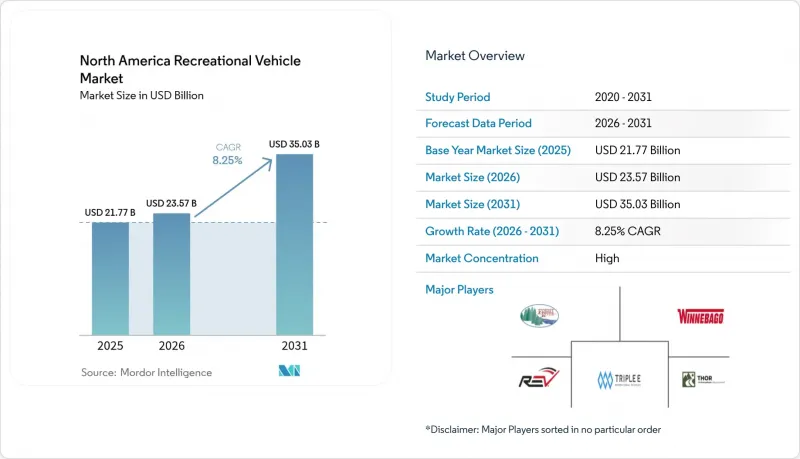
Mordor Intelligence에 의하면, 북미의 레저용 차량 시장 규모는 2025년에 217억 7,000만 달러로 평가되었습니다. 2026년 235억 7,000만 달러에서 2031년까지 350억 3,000만 달러에 이를 것으로 예상되며, 예측 기간(2026-2031년) CAGR은 8.25%를 나타낼 전망입니다.
본 보고서는 유형별(견인형 RV·모터홈), 용도별(개인용·상업용),연료 유형별(가솔린, 디젤, 하이브리드, 배터리식 전기), 유통 채널별(RV 신차 판매·RV 중고차 판매), 지역별(미국, 캐나다, 기타 북미)로 분류되어 있습니다. 시장 예측은 금액(달러)과 수량(대수)으로 제시되어 있습니다.
북미의 레저용 차량 시장 동향 및 인사이트
전동화와 하이브리드 RV 모델의 성장
배터리식 전기자동차와 하이브리드 파워트레인은 북미의 레저용 차량 시장에서 현재 진행 중인 가장 획기적인 제품 전환을 상징합니다. Thor Industries는 140kWh 배터리 팩과 가솔린 방식의 레인지 익스텐더를 탑재하여 총 주행 거리 500마일을 실현하는 하이브리드 클래스 A 코치를 발표했습니다. 이 설계는 주행 거리에 대한 불안을 해소하는 동시에, 새롭게 도입되고 있는 저배출 가스 규제 요건도 충족합니다. 전기 토크로 인해 오르막 주행 성능이 향상되는 한편, 정숙성이 뛰어난 주행은 캠핑장의 쾌적함을 높여줍니다. 각 제조업체들은 대용량 배터리 팩과 지붕에 설치된 태양광 패널을 결합하여 Off-grid 기능을 강조하고 있으며, 주차 중에 가정용 전원으로 활용할 수 있습니다. 지속가능성에 대한 메시지는 Thor가 2019년 이후 달성해 온 스코프 1 및 2 배출량 감축과 일치하며, 환경 의식이 높은 구매자들에게 브랜드의 매력을 높이고 있습니다. 충전 인프라가 정비됨에 따라 전기 RV 소유의 장벽은 계속해서 낮아지고 있습니다.
코로나19 이후 국내 로드트립 관광 증가
국경 규제가 완화된 후에도 국내 로드트립은 해외여행을 대체할 매력적인 선택지로 남아 있습니다. 약 810만 가구의 미국인이 RV를 소유하고 있으며, 향후 5년 내에 1,690만 가구가 RV를 소유할 것으로 예측됩니다. 연간 평균 이용 일수는 2021년 20일에서 2025년에는 30일로 급증하며, 라이프스타일에 더욱 깊이 정착하고 있음을 보여주었습니다. 현재 50세 이하의 젊은 세대가 신규 구매의 주류를 이루고 있어, 장기적인 교체 수요가 지속될 것으로 보입니다. 브랜드 충성도가 높아, 팬데믹 기간에 구매한 사람의 80% 이상이 동일한 브랜드를 재구매할 의향을 보이고 있으며, 이로 인해 주요 OEM 업체들은 예측 가능한 재구매 매출을 확보하고 있습니다. 지역 밀착형 체험과 사회적 거리두기를 준수한 레크리에이션으로의 전환이, 관광 전반이 정상화되더라도 수요가 지속되는 배경이 되고 있습니다.
연료 가격 변동이 여행 비용을 상승시켜
2024년 미국의 평균 휘발유 가격은 갤런당 3.30달러로, 2023년 대비 20센트 하락했습니다. A급 모터홈은 6-10마일당 1갤런을 소비하므로, 2주간의 투어에는 1,000달러의 연료비가 필요하며, 여행 결정은 휘발유 가격 변동에 쉽게 좌우됩니다. 디젤 차량의 경우, 다른 가격 변동 양상이 나타나 상업용 차량 함대의 예산 편성을 복잡하게 만들고 있습니다. 높은 비용이 지속되면서 연비를 향상시키는 하이브리드 구동 시스템과 경량 복합 소재에 대한 소비자의 관심이 다시 높아지고 있습니다. 전동화는 구조적인 리스크 헤지 수단이 되지만, 충전 인프라에 대한 투자가 필요하기 때문에 보급에는 수년이 걸릴 것으로 예측됩니다.
부문별 분석
2025년 북미의 레저용 차량 시장에서 견인형 RV는 63.52%의 점유율을 차지했습니다. 한편, 모터홈은 연평균 성장률(CAGR) 12.93%를 나타낼 것으로 예측되어 북미의 레저용 차량 시장의 주요 성장 동력이 될 전망입니다. 프리미엄 유형 A 모델에는 주택 수준의 인테리어, 슬라이드아웃, 배기 가스를 줄이고 주행 거리를 연장하는 하이브리드 파워트레인이 채택되어 있습니다. 유형 B 캠핑밴은 조작성과 스텔스 캠핑을 중시하는 도시 지역의 전문직 계층을 대상으로 합니다. 유형 C 유닛은 가격과 거주 공간의 균형이 잘 잡혀 있어 가족층에 대한 호소력을 높이고 있습니다. 각 제조업체는 등급 간에 유연하게 대응할 수 있는 모듈식 생산 방식을 도입하여 규모의 경제를 유지하면서도 다양한 수요에 대응하고 있습니다.
견인식 RV는 구매 비용이 저렴하고, 견인이 가능한 픽업 트럭이 널리 보급되어 있어 여전히 중요한 위치를 차지하고 있습니다. 트래블 트레일러는 다채로운 평면 배치와 합리적인 유지보수 비용으로 이 카테고리를 선도하고 있습니다. 피프스 휠은 계절마다 이동하는 ‘스노우버드’에게 적합한 다층 구조와 주거용 가전제품을 갖추고 있습니다. 접이식 캠핑 트레일러와 트럭 캠퍼는 각각 입문 수준의 예산층과 오프로드 틈새 시장을 충족시키고 있습니다. 이러한 다양성 덕분에 부유층이 자가 주행형 제품으로 전환하는 와중에도 견인식 RV의 판매 대수는 견조한 추세를 보이고 있습니다.
2025년, 북미의 레저용 차량 시장 점유율의 69.48%를 개인 용도가 차지했으며, 이는 이 부문이 레저에서 비롯되었음을 반영합니다. 한편, 상업용 이용은 2031년까지 연평균 성장률(CAGR) 9.22%로 확대될 것으로 예측되며, 북미의 레저용 차량 시장 전체 규모를 웃도는 속도로 성장할 전망입니다. 기업들은 외딴 지역의 프로젝트에서 맞춤형 RV를 이동식 지휘본부, 팝업 쇼룸, 또는 임시 직원 숙소로 활용하고 있습니다. 의료 기관은 자립형 클리닉을 활용하여 지방으로의 의료 제공 범위를 확대되고 있습니다. 호텔·리조트 업계는 1박당 요금이 고가인 글램핑 시설을 위해 고급 유닛을 마련하고 있습니다.
비즈니스 여행과 레저 여행의 경계가 모호해짐에 따라 듀얼 유스(업무·레저 겸용) 구매가 촉진되고 있으며, 소유자는 경비를 개인용과 업무용 예산으로 분류할 수 있게 되었습니다. 특정 주에서 이용할 수 있는 세제 혜택도 상업용 차량 도입을 더욱 뒷받침하고 있습니다. OEM 업체들은 현재 기업의 사양을 충족하는 공장 출하 시 기본 사양의 오피스 포드, 위성 통신 기능, 발전기 패키지를 제공합니다.
기타 혜택
- 엑셀 형식 시장 예측(ME) 시트
- 3개월간의 애널리스트 지원
자주 묻는 질문
목차
제1장 서론
제2장 조사 방법
제3장 주요 요약
제4장 시장 구도
제5장 시장 규모 및 성장 예측
제6장 경쟁 구도
제7장 시장 기회 및 향후 전망
KTH 26.09.04According to Mordor Intelligence, the North America rV market size was valued at USD 21.77 billion in 2025 and estimated to grow from USD 23.57 billion in 2026 to reach USD 35.03 billion by 2031, at a CAGR of 8.25% during the forecast period (2026-2031).
This report is Segmented by Type (Towable RVs and Motorhomes), Application (Private and Commercial), Fuel Type (Gasoline, Diesel, Hybrid, and Battery-Electric), Sales Channel (New RV Sales and Used RV Sales), and Geography (United States, Canada, and Rest of North America). The Market Forecasts are Provided in Terms of Value (USD) and Volume (Units).
North America Recreational Vehicle Market Trends and Insights
Growth in Electrified & Hybrid RV Models
Battery-electric and hybrid powertrains represent the most disruptive product shift underway in the North America recreational vehicle market. Thor Industries unveiled a hybrid Class A coach featuring a 140-kWh battery pack and a gasoline range extender that delivers a 500-mile total range. The design answers range anxiety and qualifies for emerging low-emission regulations. Electric torque improves hill-climbing performance, while silent operation raises campsite comfort. Manufacturers highlight off-grid capability by pairing large battery packs with roof solar arrays, enabling auxiliary power for residential needs when parked. Sustainability messaging aligns with the Scope 1 and 2 emissions cut Thor achieved since 2019, sharpening brand appeal to eco-conscious buyers. As charging infrastructure grows, electric RV ownership barriers continue to fall.
Increased Domestic Road-Trip Tourism Post-COVID
Domestic road travel remains the preferred alternative to international trips even after border restrictions eased. Approximately 8.1 million American households own an RV, and 16.9 million are expected to own an RV in the coming five years. Average annual usage days jumped from 20 in 2021 to 30 in 2025, signaling deeper lifestyle integration. Younger cohorts under 50 now dominate new purchases, reinforcing a long replacement-demand runway. With high brand loyalty, more than 80% of pandemic-era buyers intend to repurchase the same marque, which creates predictable repeat sales for leading OEMs. The shift toward localized experiences and socially distanced recreation underpins persistent demand even as broader tourism normalizes.
Volatile Fuel Prices Increasing Trip Costs
Average U.S. gasoline prices averaged USD 3.30 per gallon in 2024, down 20 cents from 2023. Class A motorhomes consume 1 gallon every 6-10 miles, so a two-week tour can require USD 1,000 in fuel, making travel decisions sensitive to pump swings. Diesel variants face separate volatility patterns that complicate budgeting for commercial fleets. Persistently high costs have revived consumer interest in hybrid drivetrains and lighter composite materials that improve mileage. Electrification provides a structural hedge but will take years to scale due to charging-site investments.
Other drivers and restraints analyzed in the detailed report include:
- Rising Popularity of Remote Work Enabling Long-Term RV Living
- Advanced Connectivity & IoT Enhancing User Experience
- Rising Interest Rates Impacting Financing Affordability
For complete list of drivers and restraints, kindly check the Table Of Contents.
Segment Analysis
Towable RVs held 63.52% of the North American Recreational Vehicle market share in 2025, while Motorhomes are forecast to log a 12.93% CAGR, positioning it as the principal growth engine for the North America RV market. Premium Type A models add residential finishes, slide-outs, and hybrid powertrains that reduce emissions and extend range. Type B camper vans target urban professionals who value maneuverability and stealth camping. Type C units balance price and livable space, widening appeal to families. Manufacturers deploy modular production that flexes between classes, preserving scale advantages while accommodating varied demand.
Towables retain relevance due to lower acquisition costs and the widespread availability of pickup trucks capable of towing. Travel trailers lead the category thanks to versatile floorplans and modest maintenance needs. Fifth-wheels add multi-level layouts and residential appliances suited for seasonal snowbird migration. Folding campers and truck campers serve entry-level budgets and off-road niches, respectively. This diversity keeps towable volume robust even as affluent cohorts shift into motorized products.
Private use captured 69.48% of the North American Recreational Vehicle market share in 2025, reflecting the recreational origins of the sector. Commercial usage, however, is forecast to compound at a 9.22% CAGR through 2031, outpacing the overall North America RV market size. Corporations deploy customized RVs as mobile command centers, pop-up showrooms, or temporary workforce housing on remote projects. Healthcare systems leverage self-contained clinics to expand rural reach. Hospitality firms outfit luxury units for glamping sites that command premium nightly rates.
The blurring of business and leisure travel fuels dual-use purchasing, allowing owners to classify expenses across personal and professional budgets. Tax advantages available in certain states further encourage commercial fleet formation. OEMs now offer factory-installed office pods, satellite connectivity, and generator packages that meet enterprise specifications.
Complete Report Scope:
- By Type
- Towable RVs
- Travel Trailers
- Fifth Wheel Trailers
- Folding Camp Trailers
- Truck Campers
- Motorhomes
- Type A
- Type B
- Type C
- Towable RVs
- By Application
- Private
- Commercial
- By Fuel Type
- Gasoline
- Diesel
- Hybrid
- Battery-Electric
- By Sales Channel
- New RV Sales
- Used RV Sales
- By Country
- United States
- Canada
- Rest of North America
List of Companies Covered in this Report:
- Thor Industries Inc.
- Forest River Inc.
- Winnebago Industries Inc.
- REV Group
- Tiffin Motorhomes Inc.
- Entegra Coach Inc.
- NeXus RV
- Cruiser RV
- Triple E Recreational Vehicles
- Newmar Corporation
- Jayco Inc.
- Airstream Inc.
- Lance Camper Manufacturing Corp.
- Pleasure-Way Industries
- Keystone RV Company
- Coachmen RV
- Grand Design RV
- Roadtrek Inc.
- Fleetwood RV
- Holiday Rambler
Additional Benefits:
- The market estimate (ME) sheet in Excel format
- 3 months of analyst support
TABLE OF CONTENTS
1 Introduction
- 1.1 Study Assumptions and Market Definition
- 1.2 Scope of the Study
2 Research Methodology
3 Executive Summary
4 Market Landscape
- 4.1 Market Overview
- 4.2 Market Drivers
- 4.2.1 Growth In Electrified and Hybrid RV Models
- 4.2.2 Increased Domestic Road-Trip Tourism Post-COVID
- 4.2.3 Rising Popularity Of Remote Work Enabling Long-Term RV Living
- 4.2.4 Advanced Connectivity and IoT Enhancing User Experience
- 4.2.5 Expansion Of RV-Sharing Peer-To-Peer Platforms
- 4.2.6 Favorable State Tax Incentives For Motorhome Ownership
- 4.3 Market Restraints
- 4.3.1 Volatile Fuel Prices Increasing Trip Costs
- 4.3.2 Rising Interest Rates Impacting Financing Affordability
- 4.3.3 Campground Capacity Shortages Limiting Usage
- 4.3.4 Proliferation Of RV Rental Platforms
- 4.4 Value / Supply-Chain Analysis
- 4.5 Regulatory Landscape
- 4.6 Technological Outlook
- 4.7 Porter's Five Forces
- 4.7.1 Bargaining Power of Suppliers
- 4.7.2 Bargaining Power of Buyers/Consumers
- 4.7.3 Threat of New Entrants
- 4.7.4 Threat of Substitute Products
- 4.7.5 Intensity of Competitive Rivalry
5 Market Size and Growth Forecasts (Value (USD) and Volume (Units))
- 5.1 By Type
- 5.1.1 Towable RVs
- 5.1.1.1 Travel Trailers
- 5.1.1.2 Fifth Wheel Trailers
- 5.1.1.3 Folding Camp Trailers
- 5.1.1.4 Truck Campers
- 5.1.2 Motorhomes
- 5.1.2.1 Type A
- 5.1.2.2 Type B
- 5.1.2.3 Type C
- 5.1.1 Towable RVs
- 5.2 By Application
- 5.2.1 Private
- 5.2.2 Commercial
- 5.3 By Fuel Type
- 5.3.1 Gasoline
- 5.3.2 Diesel
- 5.3.3 Hybrid
- 5.3.4 Battery-Electric
- 5.4 By Sales Channel
- 5.4.1 New RV Sales
- 5.4.2 Used RV Sales
- 5.5 By Country
- 5.5.1 United States
- 5.5.2 Canada
- 5.5.3 Rest of North America
6 Competitive Landscape
- 6.1 Market Concentration
- 6.2 Strategic Moves
- 6.3 Market Share Analysis
- 6.4 Company Profiles (includes Global level Overview, Market level overview, Core Segments, Financials as available, Strategic Information, Market Rank/Share for key companies, Products & Services, and Recent Developments)
- 6.4.1 Thor Industries Inc.
- 6.4.2 Forest River Inc.
- 6.4.3 Winnebago Industries Inc.
- 6.4.4 REV Group
- 6.4.5 Tiffin Motorhomes Inc.
- 6.4.6 Entegra Coach Inc.
- 6.4.7 NeXus RV
- 6.4.8 Cruiser RV
- 6.4.9 Triple E Recreational Vehicles
- 6.4.10 Newmar Corporation
- 6.4.11 Jayco Inc.
- 6.4.12 Airstream Inc.
- 6.4.13 Lance Camper Manufacturing Corp.
- 6.4.14 Pleasure-Way Industries
- 6.4.15 Keystone RV Company
- 6.4.16 Coachmen RV
- 6.4.17 Grand Design RV
- 6.4.18 Roadtrek Inc.
- 6.4.19 Fleetwood RV
- 6.4.20 Holiday Rambler
7 Market Opportunities and Future Outlook
- 7.1 Autonomous RVs to transform caravanning experience
- 7.2 Subscription-based RV ownership models


