
|
시장보고서
상품코드
2121218
선박용 오염방지 코팅 : 시장 점유율 분석, 업계 동향 및 통계, 성장 예측(2026-2031년)Marine Anti-fouling Coatings - Market Share Analysis, Industry Trends & Statistics, Growth Forecasts (2026 - 2031) |
||||||
 Mordor Intelligence
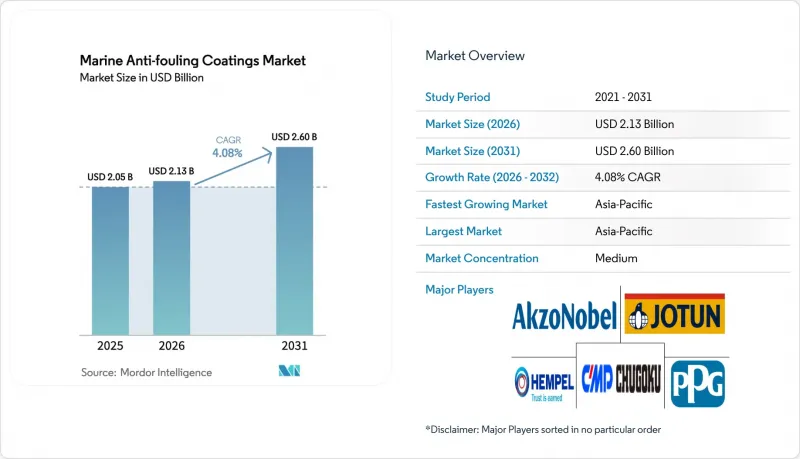
Mordor Intelligence에 의하면, 선박용 오염방지 코팅 시장 규모는 2025년 20억 5,000만 달러로 평가되었습니다. 2026년 21억 3,000만 달러에서 2031년까지 26억 달러로 확대되고 2026-2031년에 걸쳐 CAGR 4.08%를 기록할 전망입니다.
본 보고서는 유형별(구리계, 자가 연마성 코폴리머(SPC), 하이브리드·나노 하이브리드, 기타), 제형 기술별(살생물제, 비살생물제 파울 릴리스,스마트·자가복구형), 용도별(선체용 도료, 탱크·밸러스트용 도료, 기타 용도), 지역별(아시아태평양, 북미, 유럽, 기타)로 분류되어 있습니다. 시장 예측은 금액(달러) 기준으로 제시되어 있습니다.
세계의 선박용 오염방지 코팅 시장 동향 및 인사이트
세계 해상 무역의 급속한 성장
2025년 컨테이너선이 희망봉을 우회함에 따라 아시아와 유럽 간 항해 거리가 3,500해리 연장되었고, 화물량은 불과 0.5% 증가에 그쳤음에도 불구하고 톤마일 수는 6% 증가했습니다. 따뜻한 해역에 노출되는 시간이 길어짐에 따라 따개비의 부착이 가속화되어, 자가 연마성 코폴리머의 수명이 60개월에서 48개월로 단축되었고, 예정에 없던 드라이독 입항을 강요받게 되었습니다. 이에 대해 운항사는 처음 18개월 동안 구리를 다량 함유한 도료를 도포하고, 그 후 부착 방지 탑코트를 덧칠하는 2단계 코팅 전략을 채택했습니다. 이로 인해 선체 1척당 비용은 15-20% 증가했으나, 심각한 부착으로 인한 40%의 연료 소비 증가를 피할 수 있었습니다. 2만 4,000TEU급 초대형 컨테이너선으로의 전환에 따라 코팅되는 표면적은 화물 수송 능력 증가 속도를 웃도는 속도로 확대되고 있어, 선박용 오염방지 코팅 시장 수요 증가가 지속되고 있습니다. 무역 항로의 다양화, 특히 아시아 지역 내 항로의 확장으로 인해 수리 수요가 싱가포르, 두바이, 산토스 등 각 허브로 분산되고 있으며, 공급업체 입장에서는 적시(JIT) 조제 기회가 증가하고 있습니다.
선박 수리 및 유지보수 활동 증가
2024년, 선단의 평균 선령은 22.4년에 달하여 지난 20년 동안 최고치를 기록했습니다. 이는 신조선 가격의 급등으로 인해 선주들이 해체를 미루었기 때문입니다. 노후화된 선체에는 미세한 균열이 생기기 쉬우며, 30-36개월마다 보수가 필요하기 때문에 수리용 도료의 잠재 수요는 실질적으로 두 배로 증가하고 있습니다. 2024-2025년에 걸쳐 중국과 동남아시아의 조선소가 전 세계 수리 작업의 60%를 차지함에 따라, 도료 제조업체들은 사전에 재고를 확보하고 향후 거래 지역에 맞추어 구리 함량을 조정할 수 있게 되었습니다. 구형 엔진에 사용되는 고황분 연료는 밸러스트 탱크 내부의 부식을 가속화하여, 방오 도료 수요를 선체 외장 범위를 넘어 확대시키고 있습니다. 이러한 동향은 신조선 인도량이 증가하고 있는 상황에서도 선박용 오염방지 코팅 시장을 지탱하는 지속적인 갱신 주기를 뒷받침하고 있습니다.
엄격한 살생물제 규제
현재 95개국이 비준한 AFS 협약은 구리 방출을 제한하고 있으며, EU는 2024년에 용출 한도치를 200μg cm²·일-¹에서 150μg cm²·일-¹로 하향 조정하여, 구리 함량이 높은 도료에 대해 배합 변경 또는 시장 철수를 강요했습니다. 캘리포니아주는 더욱 엄격한 상한선을 적용하여 레저용 항만에서 고함량 도료를 사실상 금지하고 있습니다. 살생물제가 포함되지 않은 방오 대체품은 비용이 40-60% 더 비싸고, 도크 입항 일정에 2-3일이 추가되어 예산을 압박하고 있습니다. 전 세계적으로 사업을 전개하는 선주는 가장 엄격한 규정을 준수하거나 지역별 재고를 관리해야 하므로, 어느 쪽이든 업무의 복잡성이 증가하고 있습니다. 규제 동향에 따라, 실리콘계 탑코트 아래에 저농도의 살생물제가 함유된 프라이머를 도포하는 하이브리드 층 구조의 채택이 가속화되고 있지만, 수년에 걸친 해상 검사가 보급을 저해하고 있습니다.
부문별 분석
구리계 도료는 2025년 선박용 오염방지 코팅 시장 점유율의 58.08%를 차지했으며, 리터당 8-12달러라는 가격이 나노 하이브리드계 도료보다 저렴하고 5년간의 보호 효과가 입증되어 신조선 사양에서도 여전히 주류를 이루고 있습니다. 조선소가 첫 재도장을 2-3년 미루려고 노력하고, 규제 당국이 구리 용출 규제를 강화하고 있기 때문에 하이브리드 및 나노 하이브리드 도료는 2031년까지 연평균 성장률(CAGR) 4.76%로 성장을 지속하고 있습니다. 그 결과, 마찰을 20-30% 저감하여 연료비를 절감하는 그래핀 및 실리카 나노 입자의 지원에 힘입어, 하이브리드 제품의 선박용 오염방지 코팅 시장 규모는 기존 구리 제품보다 빠르게 확대되고 있습니다.
고급 화학 기술(양성이온성, 하이드로겔, PFPE, 바이오 매트릭스)은 극지 조사선이나 해상 풍력 발전의 모노파일 등 무독성이 최우선으로 고려되는 부문에서 규모는 작지만 전략적으로 중요한 틈새 시장을 차지하고 있습니다. PFPE는 2028년 이후 PFAS 규제 대상이 될 가능성이 있습니다. 한편, 바이오 유래 도료는 비용이 50-70% 더 비싸고 수명이 24-36개월에 불과하기 때문에 단기적인 보급에는 한계가 있습니다. 그럼에도 불구하고, 이러한 대체재에 대한 특허 출원 건수는 2024-2025년에 걸쳐 40% 증가하여 주요 공급업체들의 연구 개발 노력을 보여주고 있습니다.
지역별 분석
아시아태평양은 2025년 선박용 오염방지 코팅 시장의 68.90%를 차지했으며, 중국과 한국의 조선소 활동, 싱가포르, 부산, 상하이의 수리 거점에 힘입어 2031년까지 연평균 성장률(CAGR) 4.66%를 기록할 전망입니다. 한국의 LNG 운반선 수주 잔고와 일본의 특수선 건조 수요로 인해, 에너지 효율 설계 지수(EEDI) 목표를 충족하는 고품질 나노 하이브리드 도료에 대한 수요가 증가하고 있습니다. 인도가 조선업 활성화를 목적으로 시행하고 있는 30억 달러 규모의 인센티브 프로그램으로 인해, 2028년 이후 수요가 더욱 증가할 전망입니다.
북미에서는 양극화된 동향이 보입니다. 캘리포니아주의 무구리 규제로 인해 레저 보트에서는 실리콘계 방오 도료로의 전환이 진행되고 있는 반면, 심해 선박에서는 여전히 살생물제가 함유된 SPC가 채택되고 있습니다. 미국 해군의 스텔스 도료는 고부가가치이면서도 기밀로 취급되는 틈새 시장을 형성하고 있습니다. 유럽에서는 발트해와 지중해에서 세계에서 가장 엄격한 구리 함유량 제한이 시행되고 있으며, 이에 따라 도막 수명을 연장하는 하이브리드 다층 도료와 로봇을 이용한 선체 세척 시스템에 대한 수요가 촉진되고 있습니다.
남미, 중동 및 아프리카에서는 해상 석유 및 가스 개발, 컨테이너 항만 확대, 지역 내 해운을 배경으로 시장이 확대되고 있습니다. 브라질의 프레솔트층용 FPSO(부유식 생산·저장·하역 설비)에서는 탄화수소 및 파울링에 대한 노출을 견딜 수 있는 이중 기능 도료가 채택되어 있으며, 가격은 통상보다 50-70% 비쌉니다. 두바이와 푸자이라에 위치한 드라이독 거점에서는 비용 면과 납기 단축이라는 이점을 살려 전 세계의 선박 수리 업무를 유치하고 있습니다. 한편, 아프리카의 신생 조선소에서는 수입한 원료를 현지에서 배합하여 내륙 운하용 바지선이나 어선단의 건조에 활용하고 있습니다.
기타 혜택
- 엑셀 형식 시장 예측(ME) 시트
- 3개월간의 애널리스트 지원
자주 묻는 질문
목차
제1장 서론
제2장 조사 방법
제3장 주요 요약
제4장 시장 구도
제5장 시장 규모 및 성장 예측
제6장 경쟁 구도
제7장 시장 기회 및 향후 전망
KTH 26.09.04According to Mordor Intelligence, the marine anti-fouling coatings market size is projected to expand from USD 2.05 billion in 2025 and USD 2.13 billion in 2026 to USD 2.60 billion by 2031, registering a CAGR of 4.08% between 2026 to 2031.
This report is Segmented by Type (Copper-Based, Self-Polishing Copolymer, Hybrid and Nano-Hybrid, and Others), Formulation Technology (Biocidal, Non-Biocidal Foul-Release, and Smart/Self-healing), Application (Hull Coatings, Tank and Ballast Coatings, and Other Applications), and Geography (Asia-Pacific, North America, Europe, and Others). The Market Forecasts are Provided in Terms of Value (USD).
Global Marine Anti-fouling Coatings Market Trends and Insights
Rapid Growth in Global Seaborne Trade
Container reroutings around the Cape of Good Hope in 2025 lengthened Asia-Europe voyages by 3,500 nautical miles and lifted ton-miles 6% even though cargo volumes grew only 0.5%. Longer exposure to warmer waters accelerates barnacle settlement, cutting the service life of self-polishing copolymers from 60 months to 48 months and prompting unscheduled dry-dockings. Operators responded with a two-tier coating strategy that loads copper heavily for the first 18 months then overlays foul-release topcoats, lifting spend per hull 15%-20% but avoiding the 40% fuel penalty of severe fouling. The shift toward 24,000 TEU ultra-large container ships expands coated surface faster than cargo capacity, sustaining volume growth in the marine antifouling coatings market. Diversifying trade lanes, notably intra-Asian routes, is distributing repair demand to hubs in Singapore, Dubai, and Santos, increasing just-in-time blending opportunities for suppliers.
Increasing Ship Repairs and Maintenance Activities
Average fleet age reached 22.4 years in 2024, the highest in two decades, after owners deferred scrapping amid high newbuild prices. Older hulls suffer micro-crack formation that forces touch-ups at 30-36 months, effectively doubling addressable demand for repair-grade coatings. Chinese and Southeast Asian yards captured 60% of global repair work in 2024-2025, enabling formulators to pre-position inventory and offer copper-content adjustments matched to future trading regions. Higher-sulfur fuels burned in legacy engines accelerate corrosion in ballast tanks, extending antifouling needs beyond exterior hulls. These dynamics support sustained replacement cycles that underpin the marine antifouling coatings market even as newbuild deliveries climb.
Stringent Biocide Bans
The AFS Convention now ratified by 95 states restricts copper release, while the EU cut leaching limits from 200 μg cm2 day-1 to 150 μg cm2 day-1 in 2024, forcing reformulation or exit for high-copper paints. California imposes even tighter caps, effectively banning high-loading coatings in leisure harbors. Non-biocidal foul-release alternatives cost 40%-60% more and add two or three days to dry-dock schedules, squeezing budgets. Owners operating globally must specify to the strictest rules or manage regional inventories, both raising complexity. The regulatory trajectory accelerates hybrid layering where a thin biocidal primer sits under a silicone topcoat, but multi-year sea trials slow mass adoption.
Other drivers and restraints analyzed in the detailed report include:
- Expansion of Asian Shipbuilding Capacity
- Increasing Production of Leisure Boats and Cruise Ships
- Volatility in Cuprous-Oxide Pricing
For complete list of drivers and restraints, kindly check the Table Of Contents.
Segment Analysis
Copper-based held 58.08% of marine antifouling coatings market share in 2025 and still dominate newbuild specifications because their USD 8-12 per liter cost undercuts nano-hybrids and provides proven five-year protection. Hybrid and nano-hybrid coatings are posting 4.76% CAGR to 2031 as yards seek to defer first recoating by two or three years and regulators ratchet down copper leaching. The marine antifouling coatings market size for hybrids is therefore expanding faster than for legacy copper products, supported by graphene or silica nanoparticles that cut friction 20%-30% and trim fuel bills.
Advanced chemistries-zwitterionic, hydrogel, PFPE, and bio-based matrices-occupy small yet strategic niches such as polar research vessels and offshore wind monopiles where zero toxicity is paramount. PFPE faces potential PFAS restrictions from 2028, while bio-based paints cost 50%-70% more and last 24-36 months, limiting near-term uptake. Nonetheless, patent filings for these alternatives grew 40% in 2024-2025, signaling R&D commitment among leading suppliers.
Complete Report Scope:
- By Type
- Copper-based
- Self-polishing Copolymer (SPC)
- Hybrid and Nano-hybrid
- Others (Organo-metallic, Hydrogel, PFPE, Bio-based)
- By Formulation Technology
- Biocidal
- Non-biocidal Foul-release
- Smart/Self-healing
- By Application
- Hull Coatings
- Tank and Ballast Coatings
- Other Applications (Offshore Structures, Aquaculture and Inland Waterways Assets)
- By Geography
- Asia-Pacific
- China
- India
- Japan
- South Korea
- Vietnam
- Malaysia
- Indonesia
- Thailand
- Rest of Asia-Pacific
- North America
- United States
- Canada
- Mexico
- Europe
- Germany
- United Kingdom
- France
- Italy
- Spain
- NORDIC Countries
- Rest of Europe
- South America
- Brazil
- Argentina
- Rest of South America
- Middle East and Africa
- Saudi Arabia
- South Africa
- Qatar
- Nigeria
- United Arab Emirates
- Rest of Middle East and Africa
- Asia-Pacific
Geography Analysis
Asia-Pacific controlled 68.90% of marine antifouling coatings market share in 2025 and will post a 4.66% CAGR to 2031, anchored by Chinese and South Korean yard activity and by repair hubs in Singapore, Busan, and Shanghai. South Korea's LNG-carrier backlog and Japan's specialty builds demand premium nano-hybrid coatings that meet Energy Efficiency Design Index targets. India's USD 3 billion incentive program to boost shipbuilding will add incremental volumes from 2028.
North America shows bifurcated trends: copper-free rules in California push leisure boats toward silicone foul-release, while deep-sea vessels still employ biocidal SPCs. The U.S. Navy's stealth coatings create a high-value but classified niche. Europe enforces the world's strictest copper limits in the Baltic and Mediterranean, spurring demand for hybrid layering and robotic hull-clean systems that extend coating life.
South America and the Middle East and Africa grow from offshore oil and gas, container-port expansion, and intra-regional shipping. Brazil's pre-salt FPSOs use dual-function coatings that withstand hydrocarbon and fouling exposure at 50%-70% premiums. Dry-dock hubs in Dubai and Fujairah attract global repair work on cost and turnaround advantages, while nascent African shipyards blend imported raw materials locally for river barges and fishing fleets.
- Akzo Nobel N.V.
- Altex Coatings Ltd
- Axalta Coating Systems, LLC
- BASF
- Chugoku Marine Paints, Ltd.
- Gruppo Boero
- Hempel A/S
- Jotun A/S
- Kansai Paint Marine Co.,Ltd.
- KCC CORPORATION
- LANXESS
- Nippon Paint Marine Coatings Co., Ltd.
- PPG Industries Inc.
- RPM International Inc.
- The Sherwin-Williams Company
Additional Benefits:
- The market estimate (ME) sheet in Excel format
- 3 months of analyst support
TABLE OF CONTENTS
1 Introduction
- 1.1 Study Assumptions and Market Definition
- 1.2 Scope of the Study
2 Research Methodology
3 Executive Summary
4 Market Landscape
- 4.1 Market Overview
- 4.2 Market Drivers
- 4.2.1 Rapid Growth in Global Seaborne Trade
- 4.2.2 Increasing Ship Repairs and Maintenance Activities
- 4.2.3 Expansion of Asian Shipbuilding Capacity
- 4.2.4 Increasing Production of Leisure Boats and Cruise Ships
- 4.2.5 Military Sonar-Friendly Stealth Coatings Demand
- 4.3 Market Restraints
- 4.3.1 Stringent Biocide Bans
- 4.3.2 Volatility in Cuprous-Oxide Pricing
- 4.3.3 Accelerated Uptake of Non-Coating Hull-Clean Robots
- 4.4 Value Chain Analysis
- 4.5 Porter's Five Forces
- 4.5.1 Bargaining Power of Suppliers
- 4.5.2 Bargaining Power of Buyers
- 4.5.3 Threat of New Entrants
- 4.5.4 Threat of Substitutes
- 4.5.5 Degree of Competition
5 Market Size and Growth Forecasts (Value)
- 5.1 By Type
- 5.1.1 Copper-based
- 5.1.2 Self-polishing Copolymer (SPC)
- 5.1.3 Hybrid and Nano-hybrid
- 5.1.4 Others (Organo-metallic, Hydrogel, PFPE, Bio-based)
- 5.2 By Formulation Technology
- 5.2.1 Biocidal
- 5.2.2 Non-biocidal Foul-release
- 5.2.3 Smart/Self-healing
- 5.3 By Application
- 5.3.1 Hull Coatings
- 5.3.2 Tank and Ballast Coatings
- 5.3.3 Other Applications (Offshore Structures, Aquaculture and Inland Waterways Assets)
- 5.4 By Geography
- 5.4.1 Asia-Pacific
- 5.4.1.1 China
- 5.4.1.2 India
- 5.4.1.3 Japan
- 5.4.1.4 South Korea
- 5.4.1.5 Vietnam
- 5.4.1.6 Malaysia
- 5.4.1.7 Indonesia
- 5.4.1.8 Thailand
- 5.4.1.9 Rest of Asia-Pacific
- 5.4.2 North America
- 5.4.2.1 United States
- 5.4.2.2 Canada
- 5.4.2.3 Mexico
- 5.4.3 Europe
- 5.4.3.1 Germany
- 5.4.3.2 United Kingdom
- 5.4.3.3 France
- 5.4.3.4 Italy
- 5.4.3.5 Spain
- 5.4.3.6 NORDIC Countries
- 5.4.3.7 Rest of Europe
- 5.4.4 South America
- 5.4.4.1 Brazil
- 5.4.4.2 Argentina
- 5.4.4.3 Rest of South America
- 5.4.5 Middle East and Africa
- 5.4.5.1 Saudi Arabia
- 5.4.5.2 South Africa
- 5.4.5.3 Qatar
- 5.4.5.4 Nigeria
- 5.4.5.5 United Arab Emirates
- 5.4.5.6 Rest of Middle East and Africa
- 5.4.1 Asia-Pacific
6 Competitive Landscape
- 6.1 Market Concentration
- 6.2 Strategic Moves
- 6.3 Market Share(%)/Ranking Analysis
- 6.4 Company Profiles (includes Global level Overview, Market level overview, Core Segments, Financials as available, Strategic Information, Market Rank/Share for key companies, Products and Services, Recent Developments)
- 6.4.1 Akzo Nobel N.V.
- 6.4.2 Altex Coatings Ltd
- 6.4.3 Axalta Coating Systems, LLC
- 6.4.4 BASF
- 6.4.5 Chugoku Marine Paints, Ltd.
- 6.4.6 Gruppo Boero
- 6.4.7 Hempel A/S
- 6.4.8 Jotun A/S
- 6.4.9 Kansai Paint Marine Co.,Ltd.
- 6.4.10 KCC CORPORATION
- 6.4.11 LANXESS
- 6.4.12 Nippon Paint Marine Coatings Co., Ltd.
- 6.4.13 PPG Industries Inc.
- 6.4.14 RPM International Inc.
- 6.4.15 The Sherwin-Williams Company
7 Market Opportunities and Future Outlook
- 7.1 White-space and Unmet-Need Assessment
- 7.2 Fleet digital-twin adoption enabling hull-condition ROI tracking