

|
시장보고서
상품코드
2121219
목재 데크 : 시장 점유율 분석, 업계 동향 및 통계, 성장 예측(2026-2031년)Wooden Decking - Market Share Analysis, Industry Trends & Statistics, Growth Forecasts (2026 - 2031) |
||||||
 Mordor Intelligence
Mordor Intelligence에 의하면, 목재 데크 시장 규모는 2026년에 257억 1,000만 달러로 평가되었습니다. 예측 기간(2026-2031년) CAGR 5.27%로 성장을 지속하여, 2031년까지 332억 4,000만 달러에 이를 전망입니다.
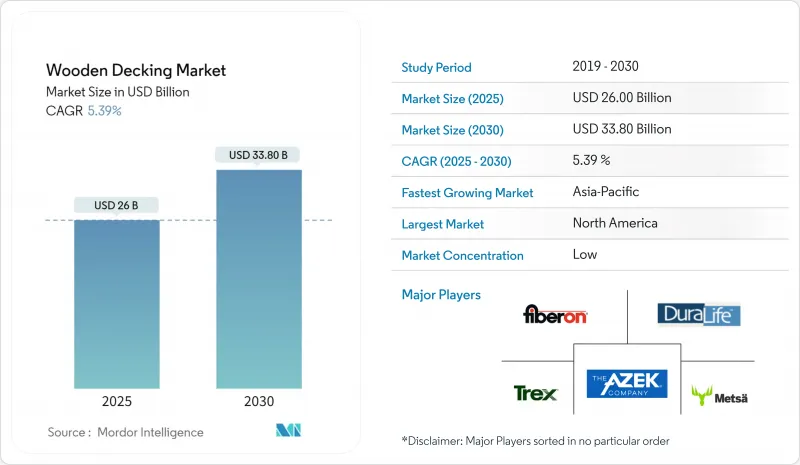
본 보고서는 유형별(가압 처리 목재, 레드우드, 열대 활엽수, 삼나무, 목재-플라스틱 복합재(WPC), 기타), 용도별(난간, 바닥, 벽, 기타), 최종 사용자 산업별(주거용·비주거용), 지역(아시아태평양, 북미, 유럽, 남미, 중동 및 아프리카)별로 분류되어 있습니다. 시장 예측은 금액(달러) 기준으로 제시되어 있습니다.
세계의 목재 데크 시장 동향 및 인사이트
리모델링 및 개보수 공사 증가
2024년, 미국의 주택 리모델링 지출은 4,850억 달러에 달했으며, 데크 교체 등 야외 공간 개보수가 지출의 12%를 차지했습니다. 2024년 기준, 미국 주택의 연식 중앙값은 40년을 넘어섰으며, 1980년대부터 1990년대에 걸쳐 건설된 데크는 수명이 다해 광범위한 교체 작업이 진행되고 있습니다. 주택담보대출 금리 급등이 주택 판매를 억제하고 있어, 소유주들은 기존 주택의 개보수에 투자하고 있으며, 데크 개보수는 프로젝트 우선순위가 높은 항목으로 자리 잡고 있습니다. 유럽에서는 영국의 ‘건설 분야 목재 이용 로드맵’이 2030년까지 연간 30만 입방미터의 목재 사용량 증가를 목표로 하고 있으며, 이 중 상당 부분은 정원 데크나 발코니 리모델링과 관련되어 있습니다. 에너지 효율 개선 공사와 야외 공간 확충을 결합함으로써 수요는 더욱 증가하고 있습니다. 그 결과, 목재 데크 시장에서는 예측 가능한 교체 수요를 확보하여 경기 변동의 영향을 완화하고 있습니다.
주택에서의 아웃도어 라이프 및 DIY 문화의 급증
미국 주택 소유자의 68%가 2025년에 야외 프로젝트를 계획했으며, 이는 2019년의 52%에서 증가한 수치로, 집에서 여가를 중시하는 라이프스타일로 지속적인 변화가 일어나고 있음을 여실히 보여주었습니다. 대형 할인점에서 DIY 고객을 대상으로 한 데크 자재 매출은 2024년에 두 자릿수 성장률을 기록했습니다. 조립이 간편한 키트, 숨겨진 고정 장치 시스템, 어디서나 이용할 수 있는 온라인 튜토리얼 덕분에 데크 설치에 대한 어려움에 대한 인식이 줄어들었고, 잠재적 구매자층이 확대되었습니다. 호주에서도 비슷한 추세가 관찰되었으며, 2024년에는 복합재 및 목재 데크의 판매량이 전년 대비 15% 증가했습니다. 따라서 목재 데크재 시장은 라이프스타일에 따른 재량 지출과 설치 기술의 대중화라는 두 가지 요인의 혜택을 동시에 누리고 있습니다.
복합재 및 PVC 데크 자재에 의한 급속한 대체
2025년에는 목재-플라스틱 복합재가 미국 데크 수요의 28%를 차지하여, 5년 동안 6퍼센트 포인트 증가했습니다. 습도가 높은 지역이나 염분이 포함된 공기가 있는 지역에 거주하는 주택 소유자들은 유지보수가 필요 없는 바닥재를 선호하고 있으며, 전국의 건설업자들도 보증 위험을 줄이기 위해 복합재를 지정하는 사례가 늘고 있습니다. 규제 측면에서의 뒷받침도 이러한 전환을 가속화하고 있습니다. 캘리포니아주의 2025년 ‘제7A장’ 개정안에서는 산림과 도시 지역의 경계 구역에서 클래스 A 인증 데크 자재의 사용을 의무화하고 있으며, 이 기준은 처리되지 않은 침엽수 대부분이 충족할 수 없는 것입니다. 복합재가 희귀 목재의 미관을 재현하고 색상 선택의 폭도 넓어짐에 따라, 연안 지역의 목재 데크 시장 점유율은 지속적으로 하락하고 있습니다.
부문별 분석
가압 처리 목재는 1 선형 피트당 1.50-2달러의 가격대와 확립된 소매 네트워크 덕분에 2025년 목재 데크재 시장에서 39.75%의 점유율을 유지했습니다. 이 부문은 내구성을 저해하지 않으면서 구리 아졸 함량을 12% 줄인, AWPA의 2024년 개정판 ‘사용 범주’ 시스템의 혜택을 여전히 누리고 있습니다. 이러한 기반에도 불구하고, 복합재는 2026년부터 2031년까지 연평균 성장률(CAGR) 8.67%를 나타낼 것으로 예측되며, 이는 모든 소재 중 가장 높은 성장률입니다. 캡슐화 쉘 구조는 습기 침투를 방지하고 최대 50년의 보증이 제공되므로, 장기적인 비용 차이가 줄어들고 있습니다. ‘기타’로 분류되는 열개질 목재와 아세틸화 목재는 Accsys의 생산 능력 확대와 Kebony 및 Thermory가 맺은 유통 파트너십의 혜택을 받았습니다. 그 결과, 목재 데크 시장은 비용을 중시하는 가압 처리 목재와 프리미엄 가격을 정당화하는 성능을 중시하는 대체재 사이에서 양극화가 계속 진행되고 있습니다.
가압 처리된 소나무 목재는 여전히 예산을 중시하는 구매자나 대규모 DIY 프로젝트 수요를 충족시키고 있는 반면, 복합재는 습도, 염수 비말, 방화 규제로 인해 수명 주기상 교체 주기가 빨라지는 연안 지역에서 점유율을 확대되고 있습니다. 열대 활엽수는 여전히 틈새 시장으로 남아 있으며, 자연스러운 아름다움과 매우 높은 밀도가 요구되는 고급 호텔이나 하이엔드 주거 환경에 집중되어 있습니다. 캘리포니아주에서 연방 정부의 목재 수량 감소로 인해 발생한 레드우드와 삼나무공급 제약으로 인해 가격 프리미엄이 유지되고 있으며, 일부 설계 담당자들은 열처리 목재로 대체하는 방안을 검토하고 있습니다. 이러한 동향들이 종합적으로 작용하여, 목재 데크 시장의 중심에 혁신을 계속 두게 하는 끊임없이 진화하는 자재 구성을 뒷받침하고 있습니다.
지역별 분석
2025년, 북미는 목재 데크 시장의 36.77%를 차지했습니다. 이는 미국의 리모델링 지출 4,850억 달러 중 12%가 야외 프로젝트에 할당되고 있다는 점이 뒷받침하고 있습니다. 2000년 이전에 설치된 데크의 대부분이 일반적인 수명인 20-25년에 도달함에 따라 교체 주기가 활발한 상태가 지속되고 있습니다. 캐나다에서는 18층 규모의 대형 목조 건축물을 허용하는 2025년 개정 건축기준법이 시행되면서 공공 광장의 데크 수요가 증가하고 있습니다. 또한 멕시코에서는 2024년 3분기에 시멘트 소비량이 전년 동기 대비 증가하여 건설 활동의 활기가 확산되고 있음을 보여주고 있으며, 이는 데크 수요 증가에도 기여하고 있습니다. 미국 서부 주들의 방화 규제로 인해 복합재의 보급이 가속화되고 있는 반면, 목재 가격 변동은 소규모 건설업체들의 계획 수립을 어렵게 만들고 있으며, 가격 변동을 피하기 위해 복합재 공급 계약을 확정하는 업체들도 나타나고 있습니다.
아시아태평양은 2031년까지의 연평균 성장률(CAGR)이 5.37%로 가장 높은 성장세를 보이고 있습니다. 중국에서는 부동산 시장의 침체가 광범위하게 확산되고 있음에도 불구하고, 기존 도시 주택의 삶의 질 향상에 중점을 두고 있어 데크 자재가 필요한 발코니와 테라스의 개보수가 촉진되고 있습니다. 인도에서는 2024년 주택 착공 건수가 11% 증가함에 따라 2급 도시로의 가압 처리 목재 출하가 확대되고 있습니다. 일본과 한국에서는 고층 빌딩의 발코니용으로 고급 아세틸화 처리 또는 열처리를 거친 수종이 선호되고 있습니다. 이는 케보니(Kebony)사가 2025년 현지 유통망을 확대한 이래 목표로 삼아온 틈새 시장입니다. 2024년에는 아세안(ASEAN)의 관광 산업이 회복되고, 태국과 인도네시아의 호텔 체인이 수영장 데크와 해변 산책로를 개보수함에 따라 복합재와 활엽수의 소비가 증가했습니다.
유럽은 목재 데크재 산업에서 여전히 기술 및 정책 측면에서 중심적인 리더로서의 지위를 유지하고 있습니다. 영국은 2030년까지 연간 30만 입방미터의 목재를 건설 부문에 도입하는 것을 목표로 하고 있으며, 이 수치에는 주택 정원용 데크도 포함됩니다. 독일과 프랑스에서는 DGNB 기준에 더해 LEED v5의 도입이 시작되면서, 이에 따라 FSC 인증 목재의 사용이 촉진되고 제품에 대한 환경 선언에 대한 수요가 높아지고 있습니다. 북유럽 제조업체인 Thermory와 Metsa Wood는 열처리에 적합한 전나무와 자작나무 자원에 인접해 있다는 이점을 활용하여, 유럽 전역과 북미로의 경쟁력 있는 수출을 실현하고 있습니다. 그러나 제재용 원목을 둘러싼 바이오에너지 부문과의 경쟁으로 인해 공급이 부족해지면서, 이는 유럽 전역의 활엽수와 복합재 가격을 지지하는 요인이 되고 있습니다.
남미와 중동 및 아프리카는 여전히 기여도가 낮은 상황입니다. 브라질에서는 2024년 국내 건설 시장이 2.1% 위축되었음에도 불구하고, 리조트 개발 프로젝트에서 열대 활엽수의 사용이 계속해서 지정되고 있습니다. 사우디아라비아의 ‘비전 2030’ 프로젝트에는 산책로 데크가 포함되어 있지만, 수입 의존도가 높아 북미공급망에 비해 비용이 30% 가까이 치솟고 있습니다. 이 지역들의 총 취급량은 여전히 소규모이지만, 전략적인 공급업체들은 현지 기준이 지속가능성이나 내화 성능을 우선시하는 방향으로 발전한다면, 이 지역들이 미래 성장의 거점이 될 것으로 전망하고 있습니다.
기타 혜택
- 엑셀 형식 시장 예측(ME) 시트
- 3개월간의 애널리스트 지원
자주 묻는 질문
목차
제1장 서론
제2장 조사 방법
제3장 주요 요약
제4장 시장 구도
제5장 시장 규모 및 성장 예측
제6장 경쟁 구도
제7장 시장 기회 및 향후 전망
KTH 26.09.04According to Mordor Intelligence, the wooden decking market size is estimated at USD 25.71 billion in 2026, and is expected to reach USD 33.24 billion by 2031, at a CAGR of 5.27% during the forecast period (2026-2031).
This report is Segmented by Type (Pressure-Treated Wood, Redwood, Tropical Hardwood, Cedar, Wood-Plastic Composites, and Others), Application (Railing, Floor, Wall, and Other Applications), End-User Industry (Residential and Non-Residential), and Geography (Asia-Pacific, North America, Europe, South America, and Middle East and Africa). Market Forecasts are Provided in Terms of Value (USD).
Global Wooden Decking Market Trends and Insights
Increase in Remodeling and Refurbishment Activities
Residential remodeling expenditure in the United States reached USD 485 billion in 2024, with outdoor-living upgrades such as deck replacement representing 12% of spend. The median US home age exceeded 40 years in 2024, and decks built during the 1980s-1990s have reached end-of-life, prompting widespread replacement. Mortgage-rate pressure is discouraging home sales, so owners invest in improving existing properties, placing decking high on the project list. In Europe, the United Kingdom's Timber in Construction Roadmap targets 300,000 cubic meters of additional timber usage each year by 2030, much of it tied to garden-decking and balcony upgrades. Bundling of energy-efficiency retrofits with outdoor-space enhancements further lifts volume. As a result, the wooden decking market gains predictable replacement demand that moderates cyclicality.
Surge in Residential Outdoor-Living and DIY Culture
Sixty-eight percent of US homeowners plan an outdoor project in 2025, up from 52% in 2019, underlining durable lifestyle shifts toward at-home leisure. Sales of decking materials to DIY customers at big-box retailers expanded at double-digit rates in 2024. Easy-to-assemble kits, hidden-fastener systems, and ubiquitous online tutorials have lowered the perceived difficulty of installing a deck, broadening the addressable buyer pool. Comparable momentum appears in Australia, where composite and timber decking volumes rose 15% year over year in 2024. The wooden decking market, therefore, benefits from both discretionary lifestyle spending and the democratization of installation skills.
Rapid Substitution by Composite and PVC Decking
Wood-plastic composites captured 28% of U.S. decking demand in 2025, gaining six percentage points in five years. Homeowners in high-moisture or salt-air regions favor maintenance-free surfaces, and national builders increasingly specify composites to cut warranty risk. Regulatory support compounds the shift: California's 2025 Chapter 7A update requires Class A-rated decking in wildland-urban interface areas, a threshold that most untreated softwoods fail to meet. As composites replicate exotic-wood aesthetics and widen color choices, the wooden decking market confronts ongoing share dilution in coastal geographies.
Other drivers and restraints analyzed in the detailed report include:
- Demand for Eco-Certified Wood Under Green-Building Codes
- Advances in Thermally Modified and Acetylated Wood Technologies
- Volatile Lumber Prices and Supply-Chain Shocks
For complete list of drivers and restraints, kindly check the Table Of Contents.
Segment Analysis
Pressure-treated wood retained a 39.75% share of the wooden decking market in 2025, thanks to its USD 1.50-2.00 per linear-foot price point and established retail networks. The segment still benefits from the AWPA 2024 updated Use Category system that reduced copper-azole loading by 12% without undercutting durability. Despite this base, composites are projected to log an 8.67% CAGR during 2026-2031, the quickest among all materials. Their encapsulated-shell designs prevent moisture ingress and carry warranties up to 50 years, narrowing long-term cost differentials. Thermally modified and acetylated woods, grouped under Others, were helped by capacity expansion at Accsys and distribution partnerships forged by Kebony and Thermory. As a result, the wooden decking market continues to bifurcate between value-driven pressure-treated lumber and performance-driven alternatives that command premium pricing.
Pressure-treated pine still satisfies budget buyers and large-volume DIY projects, while composites seize coastal share where humidity, salt spray, and fire codes accelerate lifecycle replacements. Tropical hardwoods remain a niche, concentrated in luxury hospitality and high-end residential settings that demand natural aesthetics and extreme density. Redwood and cedar supply constraints, triggered by lower federal timber sales in California, sustain pricing premiums that edge some specifiers toward thermally modified substitutes. Collectively, these dynamics underpin an evolving material mix that keeps innovation at the core of the wooden decking market.
Complete Report Scope:
- By Type
- Pressure-treated Wood
- Redwood
- Tropical Hardwood
- Cedar
- Wood-Plastic Composites (WPC)
- Others (Thermally Modified Wood, Acetylated Wood)
- By Application
- Railing
- Floor
- Wall
- Other Applications
- By End-user Industry
- Residential
- Non-residential
- By Geography
- Asia-Pacific
- China
- India
- Japan
- South Korea
- ASEAN Countries
- Rest of Asia-Pacific
- North America
- United States
- Canada
- Mexico
- Europe
- Germany
- United Kingdom
- France
- Italy
- Spain
- Russia
- Rest of Europe
- South America
- Brazil
- Argentina
- Rest of South America
- Middle-East and Africa
- Saudi Arabia
- South Africa
- Rest of Middle-East and Africa
- Asia-Pacific
Geography Analysis
North America controlled 36.77% of the wooden decking market in 2025, anchored by USD 485 billion in US remodeling spend that funnels 12% toward outdoor projects. Replacement cycles remain active because most decks installed before 2000 have reached the typical 20-25-year service limit. Canada's updated 2025 building code, permitting 18-story mass-timber structures, adds public-plaza decking demand, and Mexico's year-over-year rise in cement consumption during Q3 2024 indicates broader construction momentum that also lifts decking volumes. Fire-safety regulations in western US states accelerate composite penetration, while lumber-price volatility complicates planning for smaller contractors, nudging some to lock in composite supply contracts to avoid price swings.
Asia-Pacific delivers the fastest CAGR at 5.37% through 2031. China's focus on quality-of-life improvements in existing urban housing, despite wider real-estate cooling, favors balcony and terrace refurbishments that require decking. India's 11% increase in 2024 housing starts boosts pressure-treated lumber shipments into tier-2 cities. Japan and South Korea gravitate toward premium acetylated or thermally modified species for high-rise balconies, a niche Kebony has targeted since expanding local distribution in 2025. ASEAN tourism rebounded in 2024, and hospitality chains in Thailand and Indonesia refurbished pool decks and beachfront walkways, thereby lifting composite and hardwood consumption.
Europe remains a pivotal technology and policy leader within the wooden decking industry. The United Kingdom aims to inject 300,000 cubic meters of timber into construction annually by 2030, a figure that includes residential garden decking. Germany and France have begun adopting LEED v5 alongside DGNB standards, spurring uptake of FSC-certified lumber and boosting demand for product-specific environmental declarations. Nordic producers Thermory and Metsa Wood enjoy proximity to spruce and ash resources suitable for thermal modification, enabling competitive exports across Europe and into North America. Bioenergy competition for sawlogs, however, tightens supply and supports hardwood and composite pricing across the continent.
South America and the Middle East & Africa remain smaller contributors. Brazilian resort developments continue specifying tropical hardwoods despite a 2.1% contraction in domestic construction in 2024. Saudi Arabia's Vision 2030 projects incorporate promenade decks, yet high reliance on imports inflates costs by nearly 30% compared with North American supply chains. While their combined volume remains modest, strategic vendors view these regions as future growth pockets once local standards evolve to prioritize sustainability and fire performance.
- Advantage Lumber, LLC.
- Deck Solutions LLC
- Deckorators Inc.
- DuraLife Decking and Railing Systems
- Fiberon
- Humboldt Sawmill Company LLC
- Kebony AS
- Metsa Wood
- NeoTimber
- Setra
- Shubh Composites
- Tecnodeck (Mitera Group)
- The AZEK Company LLC
- Thermory
- Trex Company Inc.
- UFP Industries, Inc.
- United Construction Products Inc. (BISON Innovative Products)
- West Fraser Timber Co.
- Weyerhaeuser Company
Additional Benefits:
- The market estimate (ME) sheet in Excel format
- 3 months of analyst support
TABLE OF CONTENTS
1 Introduction
- 1.1 Study Assumptions & Market Definition
- 1.2 Scope of the Study
2 Research Methodology
3 Executive Summary
4 Market Landscape
- 4.1 Market Overview
- 4.2 Market Drivers
- 4.2.1 Increase in remodeling and refurbishment activities
- 4.2.2 Surge in residential outdoor-living and DIY culture
- 4.2.3 Demand for eco-certified wood under green-building codes
- 4.2.4 Advances in thermally-modified and acetylated wood technologies
- 4.2.5 Municipal mass-timber procurement boosting public decks
- 4.3 Market Restraints
- 4.3.1 Rapid substitution by composite and PVC decking
- 4.3.2 Volatile lumber prices and supply-chain shocks
- 4.3.3 Stringent fire-safety rules limiting untreated softwoods
- 4.4 Value Chain Analysis
- 4.5 Porter's Five Forces
- 4.5.1 Threat of New Entrants
- 4.5.2 Bargaining Power of Suppliers
- 4.5.3 Bargaining Power of Buyers
- 4.5.4 Threat of Substitutes
- 4.5.5 Intensity of Rivalry
5 Market Size & Growth Forecasts (Value)
- 5.1 By Type
- 5.1.1 Pressure-treated Wood
- 5.1.2 Redwood
- 5.1.3 Tropical Hardwood
- 5.1.4 Cedar
- 5.1.5 Wood-Plastic Composites (WPC)
- 5.1.6 Others (Thermally Modified Wood, Acetylated Wood)
- 5.2 By Application
- 5.2.1 Railing
- 5.2.2 Floor
- 5.2.3 Wall
- 5.2.4 Other Applications
- 5.3 By End-user Industry
- 5.3.1 Residential
- 5.3.2 Non-residential
- 5.4 By Geography
- 5.4.1 Asia-Pacific
- 5.4.1.1 China
- 5.4.1.2 India
- 5.4.1.3 Japan
- 5.4.1.4 South Korea
- 5.4.1.5 ASEAN Countries
- 5.4.1.6 Rest of Asia-Pacific
- 5.4.2 North America
- 5.4.2.1 United States
- 5.4.2.2 Canada
- 5.4.2.3 Mexico
- 5.4.3 Europe
- 5.4.3.1 Germany
- 5.4.3.2 United Kingdom
- 5.4.3.3 France
- 5.4.3.4 Italy
- 5.4.3.5 Spain
- 5.4.3.6 Russia
- 5.4.3.7 Rest of Europe
- 5.4.4 South America
- 5.4.4.1 Brazil
- 5.4.4.2 Argentina
- 5.4.4.3 Rest of South America
- 5.4.5 Middle-East and Africa
- 5.4.5.1 Saudi Arabia
- 5.4.5.2 South Africa
- 5.4.5.3 Rest of Middle-East and Africa
- 5.4.1 Asia-Pacific
6 Competitive Landscape
- 6.1 Market Concentration
- 6.2 Strategic Moves
- 6.3 Market Share/Ranking Analysis
- 6.4 Company Profiles (includes Global level Overview, Market level overview, Core Segments, Financials as available, Strategic Information, Market Rank/Share, Products & Services, Recent Developments)
- 6.4.1 Advantage Lumber, LLC.
- 6.4.2 Deck Solutions LLC
- 6.4.3 Deckorators Inc.
- 6.4.4 DuraLife Decking and Railing Systems
- 6.4.5 Fiberon
- 6.4.6 Humboldt Sawmill Company LLC
- 6.4.7 Kebony AS
- 6.4.8 Metsa Wood
- 6.4.9 NeoTimber
- 6.4.10 Setra
- 6.4.11 Shubh Composites
- 6.4.12 Tecnodeck (Mitera Group)
- 6.4.13 The AZEK Company LLC
- 6.4.14 Thermory
- 6.4.15 Trex Company Inc.
- 6.4.16 UFP Industries, Inc.
- 6.4.17 United Construction Products Inc. (BISON Innovative Products)
- 6.4.18 West Fraser Timber Co.
- 6.4.19 Weyerhaeuser Company
7 Market Opportunities and Future Outlook
- 7.1 White-space and Unmet-need Assessment


