
|
시장보고서
상품코드
2121222
유럽의 포장 검사 : 시장 점유율 분석, 업계 동향 및 통계, 성장 예측(2026-2031년)Europe Package Testing - Market Share Analysis, Industry Trends & Statistics, Growth Forecasts (2026 - 2031) |
||||||
 Mordor Intelligence
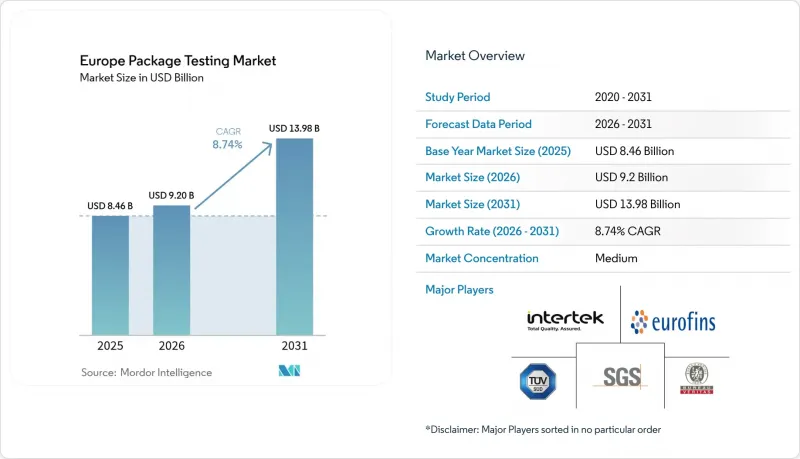
Mordor Intelligence에 의하면, 유럽의 포장 검사 시장 규모는 2025년 84억 6,000만 달러로 평가되었습니다. 2026년에는 92억 달러로 확대되어 2026-2031년에 걸쳐 CAGR 8.74%로 성장을 지속하여, 2031년에는 139억 8,000만 달러에 이를 것으로 예측됩니다.

본 보고서는 주요 소재별(유리, 종이, 기타), 검사 유형별(물리적 성능 검사, 화학 검사, 환경 검사), 검사 기술별(물리적 검사, 분광법·광도법에 의한 검사, 기타), 최종 사용자 산업별(식음료, 의료 및 의약품, 기타), 국가별로 분류되어 있습니다. 시장 예측은 금액(달러)으로 표시되어 있습니다.
유럽의 포장 검사 시장 동향 및 인사이트
포장 안전성 및 성능에 관한 EU의 엄격한 규제 준수
2025년 1월부터 시행되고 있는 PPWR(포장 및 포장 폐기물 규정)에 따르면, 10그램을 초과하는 모든 포장재에 대해 단일 시장에 유통되기 전에 재활용 가능성, 퇴비화 가능성, 화학 물질 이동성 검사를 통과해야 합니다. 각 검사소는 25ppm의 한계치를 정량할 수 있는 PFAS 검출 시스템에 거점당 200만 유로(218만 달러) 이상을 투자하고 있으며, 이 검사만의 샘플량은 전년 대비 40% 증가했습니다. 디지털 제품 여권 데이터를 통해 수명 주기 지표가 각 출하 건과 연계됨에 따라, 유럽의 포장 검사 시장에서 환경적 검증과 물리적 검증이 밀접하게 연결되어 있습니다. 리드타임이 2주에서 6주로 연장됨에 따라, 측정 장비를 동적으로 배정하여 병목 현상을 해소하는 AI 스케줄링 도구에 대한 수요가 증가하고 있습니다. PPWR의 적용 범위가 화장품, 의약품, 산업용 포장에 이르기까지, 규제 준수에 대한 압박으로 인해 중기적으로 검사량 수요가 높은 수준을 유지할 것으로 예측됩니다.
전자상거래의 성장에 따른 운송 대응 포장 검증 수요 증가
아마존이 2024년에 갱신한 ISTA 6-아마존 시뮬레이션에서는 고속 진동 검사, 기후 사이클 검사, 라스트 마일 낙하 분석을 하나의 시퀀싱로 수행할 것을 요구하고 있습니다. 유럽의 검사 기관에서는 파손되기 쉬운 바이오 의약품이 좁은 온도 범위 내에서 흠집 없이 소비자에게 직접 전달되어야 하기 때문에 배송 경로에 특화된 검사 장비에 최대 150만 유로(164만 달러)를 투자하고 있습니다. 머신러닝 모델은 택배 업체의 센서 데이터를 수집하여 고장 모드를 예측함으로써 재설계 주기를 20% 단축하고 있습니다. 약국에서 자택으로의 배송이 급증함에 따라, 향후 2년간 전자상거래는 유럽의 포장 검사 시장에서 가장 큰 수요 촉진요인이 될 전망입니다.
고도 검사 장비 및 인증 획득에 드는 높은 자본 비용
용기 및 밀폐체 무결성 검사 장비는 대당 120만 유로(131만 달러)를 초과할 수 있으며, 완전한 기후 시험실에는 추가로 50만 유로(54만 5,000달러)의 비용이 듭니다. ISO 17025 유지 관리 비용은 연간 최대 15만 유로(16만 3,500달러)에 달하며, 이러한 부담이 소규모 신규 진출기업 시장 진입을 가로막고 있습니다. 특히 PFAS를 둘러싼 검사 프로토콜의 급속한 발전으로 인해 3-5년마다 재투자가 불가피하여, 유럽의 포장 검사 시장의 비용 곡선을 상승시키고 있습니다. 동유럽의 검사 기관들은 12-18개월의 납기 지연을 겪고 있으며, 이는 처리 능력 부족을 더욱 심화시켜 지역 브랜드들이 서유럽의 대형 공급업체로 눈을 돌리게 하고 있습니다.
부문별 분석
2025년, 플라스틱 포장은 유럽의 포장 검사 시장에서 46.38%의 점유율을 유지했습니다. 이는 고부가가치 식품 및 의약품을 보호하는 다층 배리어 필름에 의해 확보된 입지입니다. PFAS에 대한 규제가 지속됨에 따라, 새로운 수지 유형가 등장할 때마다 광범위한 전환 및 용출 분석이 필요합니다. 현재 일반적인 검증 주기에서는 크로마토그래피, 분광 분석, 이미지 분석 시스템에 대한 투자로 80만-200만 유로(87만 2,000-218만 달러)의 자본이 소요되고 있습니다. 한편, 종이 포장은 재활용 가능한 성분을 유지하면서 폴리머 경쟁 제품에 버금가는 성능을 실현하는 습윤 강도 향상 첨가제 덕분에 2031년까지 연평균 성장률(CAGR) 10.15%로 성장을 지속하고 있습니다.
종이의 부상은 PPWR 목표에 따라 탄소 발자국을 줄이려는 브랜드의 의지도 반영하고 있습니다. 이에 따라 검사소에서는 코브 흡수도, 인장 강도, 섬유 회수율 시뮬레이션을 하나의 복합 프로토콜로 통합하여 소요 시간을 절반으로 단축하고 있습니다. 유리 및 금속 부문은 규모는 작지만, 특히 고급 화장품 및 RTD 음료용으로 코팅 접착력 및 부식 검사에 대한 수요가 계속되고 있습니다. 검사소는 기존 검사 프로토콜과 새로운 섬유 검증 기법을 균형 있게 조합함으로써 서비스 메뉴를 확충하고, 유럽의 포장 검사 시장을 강화하고 있습니다.
물리적 성능 검사, 즉 낙하, 진동, 압축 검사는 2025년 매출의 48.75%를 차지했습니다. 이러한 검사는 모든 전자상거래 주문 처리 모델을 뒷받침하며, ISTA.ORG에 따르면 유럽의 포장 검사 시장 규모에서 여전히 필수적인 요소로 남아 있습니다. 그러나 탄소 발자국에서 생분해 속도에 이르는 환경 검사는 연평균 성장률(CAGR) 9.31%로 가장 빠르게 확대될 전망입니다. 검사 기관들은 1회의 검사로 CO2 발생, 분해, 생태 독성을 모니터링할 수 있는 40만-150만 유로(43만 6,000-164만 달러) 규모의 퇴비화 검사 장비를 도입하고 있습니다.
화학 검사는 중간 수준에 위치하며, 저농도 전환 및 첨가물의 정량 분석에 특화되어 있습니다. PPWR 디지털 패스포트의 도입이 확대됨에 따라, 검사 기관들은 물리적, 화학적, 환경적 세 가지 부문을 모두 통합된 프로토콜에 결합하고 있습니다. 단일 보고서를 통해 완벽한 규정 준수 포장을 제공할 수 있는 능력은 유럽의 포장 검사 시장 전체에서 결정적인 차별화 요인으로 부상하고 있습니다.
기타 혜택
- 엑셀 형식 시장 예측(ME) 시트
- 3개월간의 애널리스트 지원
자주 묻는 질문
목차
제1장 서론
제2장 조사 방법
제3장 주요 요약
제4장 시장 구도
제5장 시장 규모 및 성장 예측
제6장 경쟁 구도
제7장 시장 기회 및 향후 전망
KTH 26.09.04According to Mordor Intelligence, the Europe package testing market size is expected to grow from USD 8.46 billion in 2025 to USD 9.2 billion in 2026 and is forecast to reach USD 13.98 billion by 2031 at 8.74% CAGR over 2026-2031.
This report is Segmented by Primary Material (Glass, Paper, and More), Type of Testing (Physical Performance Testing, Chemical Testing, and Environmental Testing), Testing Technology (Physical Tests, Spectroscopy and Photometric-Based, and More), End-User Vertical (Food and Beverage, Healthcare and Pharmaceuticals, and More), and Country. The Market Forecasts are Provided in Terms of Value (USD).
Europe Package Testing Market Trends and Insights
Stringent EU Regulatory Compliance on Packaging Safety and Performance
The PPWR, in force since January 2025, obliges every package above 10 grams to pass recyclability, compostability, and chemical-migration tests before entering the single market. Laboratories have poured more than EUR 2 million (USD 2.18 million) per site into PFAS detection systems able to quantify 25 ppm limits, and sample volumes for that assay alone have climbed 40% year on year. Digital product passport data now links life-cycle metrics to each shipment, intertwining environmental and physical validations inside the Europe package testing market. Extended lead times from two to six weeks are driving demand for AI scheduling tools that allocate instrumentation dynamically, shrinking bottlenecks. Given PPWR's scope across cosmetics, pharmaceuticals, and industrial packages, compliance pressure is likely to keep test-volume demand elevated through the medium term.
Growing E-commerce Intensifying Demand for Transit-Ready Packaging Validation
Amazon's 2024 update to ISTA 6-Amazon simulations requires high-speed vibration, climate cycling, and last-mile drop analytics in one sequence. European labs have spent up to EUR 1.5 million (USD 1.64 million) on route-specific chambers because fragile direct-to-consumer biologics must arrive intact within narrow temperature bands. Machine-learning models ingest courier sensor data to predict failure modes, cutting redesign cycles by 20 %. The surge of pharmacy-to-door deliveries positions e-commerce as a top volume driver for the Europe package testing market over the next two years.
High Capital Costs for Advanced Test Equipment and Accreditation
Container-closure integrity rigs can exceed EUR 1.2 million (USD 1.31 million) each, while full climate chambers add another EUR 500,000 (USD 545,000). ISO 17025 maintenance costs run up to EUR 150,000 (USD 163,500) annually, a burden that keeps small entrants on the sidelines. Rapid protocol evolution, especially around PFAS, forces reinvestment every three to five years, inflating the cost curve inside the Europe package testing market. Eastern European labs face 12- to 18-month delivery delays, compounding capacity gaps and pushing regional brands toward larger Western providers.
Other drivers and restraints analyzed in the detailed report include:
- Transition to Sustainable Materials Creating New Test Protocol Demand
- Rapid Deployment of AI-Enabled Automated Test Benches
- Shortage of ISTA-Certified Technicians Causing Certification Bottlenecks
For complete list of drivers and restraints, kindly check the Table Of Contents.
Segment Analysis
Plastic packaging retained 46.38% share of the Europe package testing market in 2025, a position secured by multilayer barrier films that protect high-value foods and medicines. Ongoing PFAS limits mean every new resin variant triggers extensive migration and leachate analytics. A typical validation cycle now consumes EUR 800,000-2 million (USD 872,000-2.18 million) in capital toward chromatography, spectroscopy, and image-analysis suites. Paper formats, however, are registering a 10.15% CAGR through 2031, thanks to wet-strength additives that raise performance closer to that of polymer rivals while keeping recyclable content intact.
Paper's ascent also reflects brand ambitions to cut carbon footprints in line with PPWR targets. Testing labs therefore bundle Cobb absorption, tensile integrity, and fiber-recovery simulations into one composite protocol that halves turnaround time. Glass and metal, though smaller, continue to demand coating-adhesion and corrosion assays, especially for premium cosmetics and RTD beverages. By balancing legacy protocols with emerging fiber validations, laboratories are broadening service menus and reinforcing the Europe package testing market.
Physical performance examinations, drop, vibration, and compression still command 48.75% of 2025 revenue. These tests underpin every e-commerce fulfillment model and remain integral to the Europe package testing market size ISTA.ORG. Yet environmental assays, from carbon footprint to biodegradation kinetics, will expand fastest at 9.31% CAGR. Laboratories are buying EUR 400,000-1.5 million (USD 436,000-1.64 million) composting rigs capable of monitoring CO2 evolution, disintegration, and ecotoxicity in a single pass.
Chemical testing occupies the middle ground, specializing in low-level migration and additive quantification. As PPWR's digital passport rollout scales, labs are merging all three disciplines, physical, chemical, and environmental, into integrated protocols. The ability to deliver a complete compliance pack in one report is emerging as a decisive differentiator across the Europe package testing market.
Complete Report Scope:
- By Primary Material
- Glass
- Paper
- Plastic
- Metal
- By Type of Testing
- Physical Performance Testing
- Chemical Testing
- Environmental Testing
- By Testing Technology
- Physical Tests
- Spectroscopy and Photometric-based
- Chromatography-based
- Other Advanced Methods
- By End-user Vertical
- Food and Beverage
- Healthcare and Pharmaceuticals
- Industrial and Manufacturing
- Personal and Household Products
- Other End-user Verticals
- By Country
- United Kingdom
- Germany
- Italy
- France
- Spain
- Rest of Europe
List of Companies Covered in this Report:
- SGS SA
- Bureau Veritas SA
- Intertek Group plc
- Eurofins Scientific SE
- TUV SUD AG
- ALS Limited
- Merieux NutriSciences Corporation
- Smithers Group Inc.
- UL Solutions Inc.
- Campden BRI Group
- Microbac Laboratories, Inc.
- Institut fur Produktqualitat GmbH
- National Technical Systems, Inc.
- TUV Rheinland AG
- Fera Science Limited
- Nelson Labs Europe BVBA
- NSF International
- RISE Research Institutes of Sweden AB
- Nefab AB
Additional Benefits:
- The market estimate (ME) sheet in Excel format
- 3 months of analyst support
TABLE OF CONTENTS
1 INTRODUCTION
- 1.1 Study Assumptions and Market Definition
- 1.2 Scope of the Study
2 RESEARCH METHODOLOGY
3 EXECUTIVE SUMMARY
4 MARKET LANDSCAPE
- 4.1 Market Overview
- 4.2 Market Drivers
- 4.2.1 Stringent EU regulatory compliance on packaging safety and performance
- 4.2.2 Growing e-commerce intensifying demand for transit-ready packaging validation
- 4.2.3 Transition to sustainable materials creating new test protocol demand
- 4.2.4 Rising need to extend shelf-life for food and pharma
- 4.2.5 Rapid deployment of AI-enabled automated test benches
- 4.2.6 Converter-brand in-house lab partnerships accelerating innovation cycles
- 4.3 Market Restraints
- 4.3.1 High capital costs for advanced test equipment and accreditation
- 4.3.2 Offshore low-cost labs undercutting European service pricing
- 4.3.3 Shortage of ISTA-certified technicians causing certification bottlenecks
- 4.3.4 Uneven enforcement of EU directives creating compliance uncertainty
- 4.4 Industry Value Chain Analysis
- 4.5 Regulatory Landscape
- 4.6 Technological Outlook
- 4.7 The Impact of Macroeconomic Factors on the Market
- 4.8 Investment Analysis
- 4.9 Porter's Five Forces Analysis
- 4.9.1 Bargaining Power of Suppliers
- 4.9.2 Bargaining Power of Buyers
- 4.9.3 Threat of New Entrants
- 4.9.4 Threat of Substitutes
- 4.9.5 Intensity of Competitive Rivalry
5 MARKET SIZE AND GROWTH FORECASTS (VALUE)
- 5.1 By Primary Material
- 5.1.1 Glass
- 5.1.2 Paper
- 5.1.3 Plastic
- 5.1.4 Metal
- 5.2 By Type of Testing
- 5.2.1 Physical Performance Testing
- 5.2.2 Chemical Testing
- 5.2.3 Environmental Testing
- 5.3 By Testing Technology
- 5.3.1 Physical Tests
- 5.3.2 Spectroscopy and Photometric-based
- 5.3.3 Chromatography-based
- 5.3.4 Other Advanced Methods
- 5.4 By End-user Vertical
- 5.4.1 Food and Beverage
- 5.4.2 Healthcare and Pharmaceuticals
- 5.4.3 Industrial and Manufacturing
- 5.4.4 Personal and Household Products
- 5.4.5 Other End-user Verticals
- 5.5 By Country
- 5.5.1 United Kingdom
- 5.5.2 Germany
- 5.5.3 Italy
- 5.5.4 France
- 5.5.5 Spain
- 5.5.6 Rest of Europe
6 COMPETITIVE LANDSCAPE
- 6.1 Market Concentration
- 6.2 Strategic Moves
- 6.3 Market Share Analysis
- 6.4 Company Profiles (includes Global level Overview, Market level overview, Core Segments, Financials as available, Strategic Information, Market Rank/Share for key companies, Products and Services, and Recent Developments)
- 6.4.1 SGS SA
- 6.4.2 Bureau Veritas SA
- 6.4.3 Intertek Group plc
- 6.4.4 Eurofins Scientific SE
- 6.4.5 TUV SUD AG
- 6.4.6 ALS Limited
- 6.4.7 Merieux NutriSciences Corporation
- 6.4.8 Smithers Group Inc.
- 6.4.9 UL Solutions Inc.
- 6.4.10 Campden BRI Group
- 6.4.11 Microbac Laboratories, Inc.
- 6.4.12 Institut fur Produktqualitat GmbH
- 6.4.13 National Technical Systems, Inc.
- 6.4.14 TUV Rheinland AG
- 6.4.15 Fera Science Limited
- 6.4.16 Nelson Labs Europe BVBA
- 6.4.17 NSF International
- 6.4.18 RISE Research Institutes of Sweden AB
- 6.4.19 Nefab AB
7 MARKET OPPORTUNITIES AND FUTURE OUTLOOK
- 7.1 White-space and Unmet-Need Assessment