

|
시장보고서
상품코드
2121232
바이오 폴리유산(PLA) : 시장 점유율 분석, 업계 동향 및 통계, 성장 예측(2026-2031년)Bio-polylactic Acid (PLA) - Market Share Analysis, Industry Trends & Statistics, Growth Forecasts (2026 - 2031) |
||||||
 Mordor Intelligence
에 의하면, 바이오 폴리유산(PLA) 시장 규모는 2025년 92만 톤에서 2026년에는 110만 톤으로 확대되어 2031년까지 265만 톤에 이를 것으로 예측되며, 2026-2031년에 걸쳐 CAGR 19.31%로 성장할 전망입니다.
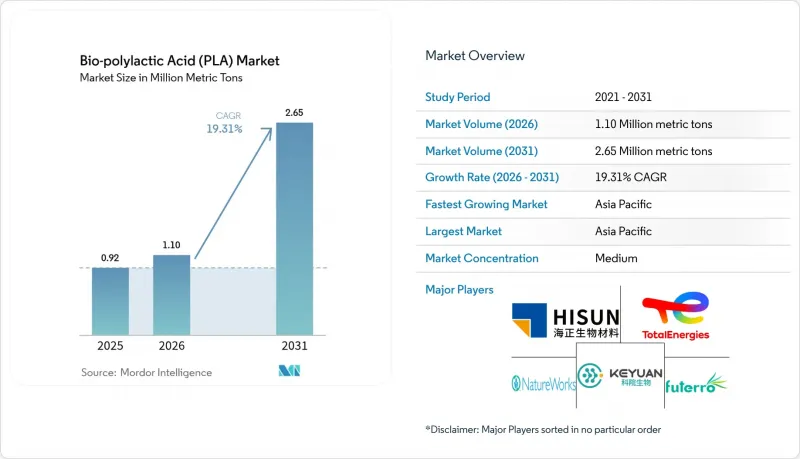
본 보고서는 원료별(옥수수, 카사바, 사탕수수·사탕무, 기타), 형태별(섬유, 필름 및 시트, 코팅, 기타 형태), 최종 사용자 산업별(포장, 의료, 전자기기, 농업, 기타),지역별(아시아태평양, 북미, 유럽, 남미, 중동 및 아프리카)로 분류되어 있습니다. 시장 규모와 전망은 수량(톤) 단위로 표시되어 있습니다.
세계의 바이오 폴리유산(PLA) 시장 동향 및 인사이트
중국의 생산 능력 급증에 따른 PLA 생산 비용 감소
장쑤성의 젖산 및 PLA 통합 생산 거점 덕분에 2024-2025년에 걸쳐 수지 납품 비용이 18-22% 절감되어, 열성형 트레이용 중국산 PLA 가격이 폴리프로필렌보다 낮은 수준으로 떨어졌습니다. Lianhong Xinke의 연간 생산 능력 14만 톤 규모의 복합 시설에서는 2025년에 톤당 1,350달러에 가까운 현금 원가를 달성했습니다. 가공업체가 컴파운딩과 필름 압출 공정을 동일한 산업 단지 내에 통합함으로써 물류 비용을 8-12% 절감할 수 있습니다. 현재 유럽과 미국의 브랜드 소유주들은 관세 리스크를 헤지하면서 주기적인 공급 과잉을 차익 거래하기 위해 수입품과 국산품을 혼합하여 수지를 이중 조달하고 있습니다. 중국 생산자들은 EU 시장 진출을 위해 ISO 14855 인증 취득을 가속화하고 있으며, 이는 대량 판매에서 규정 준수를 중시하는 수출로 전환하고 있음을 시사합니다.
전자상거래의 밀키트 붐에 따른 퇴비화 가능 필름 수요 증가
북미와 유럽의 120개 이상의 도시에서 시행된 지자체 금지 조치에 따라, 밀키트 기업들은 2025년까지 인증된 퇴비화 가능한 PLA 재질의 오버랩 사용을 의무화하게 되었습니다. Earthfirst Films에서는 PLA 코팅 보드 수요가 전년 대비 340% 급증했습니다. 이스라엘의 컨버터인 TIPA는 2025년 3월에 4,300만 달러를 조달하여 연간 2만 5,000톤 규모의 파우치 생산 라인 확장을 추진했습니다. 이 회사는 폴리에틸렌 대비 PLA 필름의 가격 차이가 2026년 말까지 15%까지 축소될 것으로 전망하고 있습니다. 2025년에는 생분해성 제품 협회(Biodegradable Products Institute)에 접수된 신청 건수가 60% 증가하여, 브랜드들의 채택이 확산되고 있음을 보여줍니다. 인프라는 여전히 제약 요인으로 작용하고 있으며, 산업용 퇴비화 처리의 적용률은 여전히 미국 인구 평균 기준으로 고작 12%에 그치고 있어, 허가 절차가 가속화되지 않는 한 순환 경제의 추진이 위태로워질 우려가 있습니다.
대부분의 지역에서 산업용 퇴비화 처리 능력 부족
2025년 시점에서 생분해성 플라스틱을 수용하는 미국의 시설은 고작 185곳에 불과했으며, 이는 인구의 12%만을 커버하는 수준이었습니다. 또한 PLA의 분해 주기가 90-120일로 장기간 소요되기 때문에 처리 비용은 일반 유기성 폐기물보다 20-30% 더 높았습니다. 시더 그로브(Seeder Grove)사는 2025년, PLA 전용 풍건 퇴비화 처리 관리에 톤당 15-18달러의 추가 비용을 지출했습니다. EU의 처리율은 45-50%에 달했으나, 사업자들로부터는 여전히 혼입이나 체류 시간 장기화에 대한 불만이 제기되고 있으며, 일부 사업자에서는 PLA 필름의 수거를 전면적으로 금지하는 움직임도 보이고 있습니다. 캘리포니아주의 SB 1383 법에 따라 주 전역에서 유기물 재활용이 의무화되어 있지만, 많은 수거 업체가 생분해성 플라스틱을 제외하고 있어 브랜드의 주장에도 불구하고 PLA로 만든 푸드서비스 산업용 식기가 매립지로 보내지는 사태가 발생하고 있습니다. 브랜드 소유자들은 현재 PET의 광학적 특성을 모방한 기계적 재활용이 가능한 PLA 등급을 검사하고 있지만, MRF(자재 회수 시설)에서의 선별은 여전히 신뢰성이 낮아, 베일 내 혼입으로 인한 벌칙을 받을 위험이 있습니다.
부문별 분석
사탕수수와 사탕무 유래 등급은 2025년 총 취급량의 62.15%를 차지했으며, 2026-2031년의 예측 기간 동안 연평균 성장률(CAGR) 19.98%로 확대될 것으로 예상되어,바이오 폴리유산(PLA) 시장에서 주도적인 입지를 공고히 할 전망입니다. 2026년 초 발람푸르에서 연간 8만 톤 규모의 복합 시설이 가동을 시작하면, 인도 국내 수요를 뒷받침하는 동시에 잉여 수지를 톤당 1,550달러 이하로 동남아시아에 수출하게 될 것입니다. 옥수수 유래 원료는 네이처웍스의 블레어 공장에서만 경쟁하고 있으나, 에탄올 혼합 목표에 따른 원료 가격 급등에 직면해 있습니다. 태국에서는 카사바를 원료로 사용함으로써 비유전자변형(비GMO) 프리미엄을 얻을 수 있습니다. 2026년 하반기 가동을 예정하고 있는 토탈 코비온(Total Corbion)의 라용 공장(연산 10만 톤)의 확장으로 인해, 해당 지역공급량은 확대될 전망입니다.
당밀 추출, 발효, 열전병급 유닛의 운영 유연성 덕분에 제당 공장은 전력 수출 및 CO2 포집를 통해 수익을 창출하고, 톤당 순비용을 절감하며, 원당 가격 변동으로부터 보호받을 수 있습니다. 이해관계자들 사이에서는 바이오 탄소에 대한 주장을 뒷받침하기 위해 EN 16785 인증에 대한 수요가 증가하고 있으며, 이에 따라 제당 공장은 부지 내에 동위원소 질량 분석 실험실을 설치하고 있습니다. EU의 호라이즌(Horizon) 계획 자금 지원을 받는 잔여물 유래 PLA 시범 사업은 2028년에 실증 규모에 도달할 전망이지만, 설탕 공급원이 불균일하기 때문에 2031년까지 생산량은 5% 이하에 그칠 것으로 예측됩니다.
지역별 분석
아시아태평양은 2025년 세계 생산량의 40.55%를 차지했으며, 바이오 폴리유산(PLA) 시장을 연평균 성장률(CAGR) 22.17%로 견인할 전망입니다. 2027-2028년에 가동이 예정된 중국의 복합 시설 덕분에 이 지역의 생산 능력은 연간 100만 톤을 넘어, 국내 경질 포장 수요를 충분히 상회하게 될 것입니다. 인도 발람푸르에서의 가동 개시로 중국 이외 지역 최초로 사탕수수에서 PLA에 이르는 완전 통합형 공급망이 실현되어, 2025년 국내 퀵커머스용 포장재 시장의 19% 성장에 대응했습니다. 일본의 포지티브 리스트가 규제 장벽을 해소함에 따라, 국내 가공업체들은 석유 유래 PS 트레이에서 PLA로의 전환을 촉진하고 있으며, 2025년 전년 대비 성장률은 23%에 달했습니다.
북미에서는 네이처웍스(NatureWorks)사의 블레어 공장이 2027년 말까지 연간 생산량 22만 5,000톤으로 병목 현상 해소를 추진하는 한편, SB 1383법의 시행 상황에 편차가 나타나고 있어 생산 능력의 일부는 수출 변동의 영향을 받기 쉬운 상황입니다. 캐나다의 단계적 일회용 제품 금지 조치에는 인증된 퇴비화 가능 수지에 대한 예외 규정이 마련되어 있어, 국내 패스트푸드 체인에서의 도입이 가속화되고 있습니다. 멕시코로의 수입량은 식품 가공업체들이 미국 소매업체의 친환경 라벨 기준을 준수함에 따라 2025년에는 1만 2,000톤에 달했습니다.
유럽에서는 ‘포장 및 포장 폐기물 규정’에 따라 2030년까지 재생 재료 함유율 10% 할당량이 정해져, 가공업체들은 카르비오스(Carbios)사나 향후 효소 라이선스 제공업체와 수년에 걸친 테이크-오어-페이(take-or-pay) 계약을 체결해야 하는 상황에 직면해 있습니다. 독일의 퇴비화 사업자들은 2025년에 유기 폐기물 흐름에서 PLA의 비중이 5%에서 8%로 증가할 것에 대비하여, 자연 건조 퇴비화 시설의 업그레이드에 투자했습니다. 프랑스의 AGEC법에 따라 2025년 PLA 식기 수요는 전년 대비 42% 증가했습니다. 남미와 중동 및 아프리카에서는 브라스크엠(Braskem)사가 브라질에서 5만 톤 규모의 사탕수수 유래 PLA 생산 라인에 대한 타당성 조사를 진행 중이며, 이는 해당 지역 최초의 실용적인 생산 능력이 될 전망입니다.
기타 혜택
- 엑셀 형식 시장 예측(ME) 시트
- 3개월간의 애널리스트 지원
자주 묻는 질문
목차
제1장 서론
제2장 조사 방법
제3장 주요 요약
제4장 시장 구도
제5장 시장 규모 및 성장 예측
제6장 경쟁 구도
제7장 시장 기회 및 향후 전망
KTH 26.09.04According to Mordor Intelligence, the bio-polylactic acid market size is expected to increase from 0.92 million metric tons in 2025 to 1.10 million metric tons in 2026 and reach 2.65 million metric tons by 2031, growing at a CAGR of 19.31% over 2026-2031.
This report is Segmented by Raw Material (Corn, Cassava, Sugarcane and Sugar Beet, and Other Raw Materials), Form (Fiber, Films and Sheets, Coatings, and Other Forms), End-User Industry (Packaging, Medical, Electronics, Agriculture, and More), and Geography (Asia-Pacific, North America, Europe, South America, and Middle-East and Africa). The Market Size and Forecasts are Provided in Terms of Volume (Tons).
Global Bio-polylactic Acid (PLA) Market Trends and Insights
Chinese Capacity Surge Lowering PLA Production Cost
Integrated lactic-acid and PLA parks in Jiangsu reduced delivered resin costs by 18-22% between 2024 and 2025, positioning China-made PLA below polypropylene for thermoformed trays. Lianhong Xinke's 140,000 t/y complex reached near-USD 1,350 t cash costs in 2025. Logistics savings of 8-12% arise when converters co-locate compounding and film extrusion in the same industrial zone. Western brand owners now dual-source resin, blending imports with domestic grades to hedge tariff risk while arbitraging periodic oversupply. Chinese producers increasingly certify to ISO 14855 for EU market access, signaling a pivot from volume selling to compliance-oriented exports.
E-commerce Meal-Kit Boom Driving Demand for Compostable Films
Municipal bans covering 120-plus North American and European cities pushed meal-kit firms to specify certified-compostable PLA overwraps in 2025. Earthfirst Films logged a 340% YoY spike in PLA-coated board demand. Israeli converter TIPA raised USD 43 million in March 2025 to scale a 25,000 t/y pouch line, betting that the PLA film premium over polyethylene will narrow to 15% by end-2026. Submissions to the Biodegradable Products Institute rose 60% in 2025, signaling broader brand adoption. Infrastructure remains a constraint; industrial composting coverage still averages only 12% of the US population, threatening the circular narrative unless permitting accelerates.
Insufficient Industrial Composting Capacity in Most Regions
Only 185 US sites accepted compostable plastics in 2025, covering 12% of the population, and tipping fees ran 20-30% above standard organics due to extended 90-120 day PLA degradation cycles. Cedar Grove spent an extra USD 15-18 t managing dedicated PLA windrows in 2025. EU coverage reached 45-50% but operators still complain of contamination and longer retention times, prompting some to ban PLA film loads outright. California's SB 1383 requires statewide organics diversion, yet many haulers exclude compostable plastics, forcing PLA food-service ware into landfills despite brand claims. Brand owners now test mechanically recyclable PLA grades that mimic PET optical properties, but MRF sortation remains unreliable, risking bale contamination penalties.
Other drivers and restraints analyzed in the detailed report include:
- Closed-Loop PLA Chemical-Recycling Pilots Gaining EU and Japan Traction
- High-Heat PLA Adoption in Automotive Interior Composites
- Concentrated IP Around Enzymatic PLA Depolymerization Raises Costs
For complete list of drivers and restraints, kindly check the Table Of Contents.
Segment Analysis
Sugarcane- and beet-based grades captured 62.15% of 2025 tonnage and are projected to expand at 19.98% CAGR during the forecast period 2026-2031, consolidating their lead in the Bio-polylactic Acid (PLA) market. Early 2026 commissioning of Balrampur's 80,000 t/y complex will anchor domestic Indian demand while exporting surplus resin to Southeast Asia at sub-USD 1,550 t. Corn routes remain competitive only at NatureWorks' Blair site, but face rising feedstock prices tied to ethanol blending targets. Cassava input provides a non-GMO premium in Thailand; Total Corbion's 100,000 t/y Rayong expansion coming online H2 2026 will widen regional supply.
Operational flexibility across crushing, fermentation, and combined-heat-and-power units lets sugar mills monetize power exports and CO2 capture, lowering net cost per tonne and shielding against raw-sugar price swings. Stakeholders increasingly demand EN 16785 certificates to substantiate bio-based carbon claims, prompting mills to install isotope-ratio mass spectrometry labs onsite. Residue-based PLA pilots under EU Horizon funding may reach demo scale in 2028, but volumes stay below 5% through 2031 due to heterogeneous sugar streams.
Complete Report Scope:
- By Raw Material
- Corn
- Cassava
- Sugarcane and Sugar Beet
- Other Raw Materials
- By Form
- Fiber
- Films and Sheets
- Coatings
- Other Forms
- By End-user Industry
- Packaging
- Medical
- Electronics
- Agriculture
- Textiles
- Other End-user Industries
- By Geography
- Asia-Pacific
- China
- India
- Japan
- South Korea
- Rest of Asia-Pacific
- North America
- United States
- Canada
- Mexico
- Europe
- Germany
- United Kingdom
- Italy
- France
- Benelux
- Austria
- Czech Republic and Slovakia
- Poland
- Hungary
- Switzerland
- Nordic
- Rest of Europe
- South America
- Brazil
- Argentina
- Rest of South America
- Middle-East and Africa
- Saudi Arabia
- South Africa
- Rest of Middle-East and Africa
- Asia-Pacific
Geography Analysis
Asia-Pacific contributed 40.55% of global 2025 volumes and will pace the Bio-polylactic Acid (PLA) market at 22.17% CAGR. Chinese complexes scheduled for 2027-2028 start-ups extend regional capacity past 1 Mt/y, comfortably exceeding domestic rigid-packaging demand. India's Balrampur startup brings the first fully integrated cane-to-PLA chain outside China, meeting domestic quick-commerce packaging growth of 19% in 2025. Japan's Positive List cleared compliance hurdles, stimulating local converters to swap petroleum PS trays with PLA; YoY growth hit 23% in 2025.
In North America, NatureWorks' Blair debottleneck to 225 kt y by late 2027 coincides with inconsistent implementation of SB 1383, leaving capacity partially exposed to export swings. Canada's phased single-use ban filters in exemptions for certified-compostable resins, accelerating adoption among national QSR chains. Mexican imports hit 12 kt in 2025 as food processors align with US retailer eco-labels.
In Europe, the Packaging and Packaging Waste Regulation fixes a 10% recycled-content quota by 2030, pressing converters to sign multiyear take-or-pay deals with Carbios and future enzyme licensors. Germany's composters invested in windrow upgrades to manage a rise from 5% to 8% PLA share in organic-waste streams during 2025. France's AGEC law boosted PLA tableware demand 42% YoY in 2025. In South America and MEA, Braskem's feasibility review for a 50 kt Brazilian sugarcane PLA line represents the region's first credible capacity.
- Balrampur Chini Mills Limited
- BASF
- BEWi
- COFCO
- Danimer Scientific
- Evonik Industries AG
- Futerro
- Jiangxi Keyuan Bio-Material Co. Ltd
- Mitsubishi Chemical Group Corporation
- Musashino Chemical Laboratory, Ltd.
- NatureWorks LLC
- Polysciences Inc.
- Shanghai Tong Jie Liang Biomaterials Co. Ltd
- Shenzhen Esun Industrial Co., Ltd.
- Sulzer Ltd
- TotalEnergies
- Zhejiang Hisun Biomaterials Co., Ltd.
Additional Benefits:
- The market estimate (ME) sheet in Excel format
- 3 months of analyst support
TABLE OF CONTENTS
1 Introduction
- 1.1 Study Assumptions and Market Definition
- 1.2 Scope of the Study
2 Research Methodology
3 Executive Summary
4 Market Landscape
- 4.1 Market Overview
- 4.2 Market Drivers
- 4.2.1 Chinese capacity surge lowering PLA production cost
- 4.2.2 E-commerce meal-kit boom driving demand for compostable films
- 4.2.3 Closed-loop PLA chemical-recycling pilots gaining Eorpean Union and Japan traction
- 4.2.4 High-heat PLA adoption in automotive interior composites
- 4.2.5 PLA-based 3-D printing filaments enabling decentralized spare-parts production
- 4.3 Market Restraints
- 4.3.1 Insufficient industrial composting capacity in most regions
- 4.3.2 Concentrated IP around enzymatic PLA depolymerisation raises costs
- 4.3.3 Limited food-contact approvals for non-GMO feedstocks in key markets
- 4.4 Value Chain Analysis
- 4.5 Porter's Five Forces
- 4.5.1 Bargaining Power of Suppliers
- 4.5.2 Bargaining Power of Buyers
- 4.5.3 Threat of New Entrants
- 4.5.4 Threat of Substitutes
- 4.5.5 Degree of Competition
5 Market Size and Growth Forecasts (Volume)
- 5.1 By Raw Material
- 5.1.1 Corn
- 5.1.2 Cassava
- 5.1.3 Sugarcane and Sugar Beet
- 5.1.4 Other Raw Materials
- 5.2 By Form
- 5.2.1 Fiber
- 5.2.2 Films and Sheets
- 5.2.3 Coatings
- 5.2.4 Other Forms
- 5.3 By End-user Industry
- 5.3.1 Packaging
- 5.3.2 Medical
- 5.3.3 Electronics
- 5.3.4 Agriculture
- 5.3.5 Textiles
- 5.3.6 Other End-user Industries
- 5.4 By Geography
- 5.4.1 Asia-Pacific
- 5.4.1.1 China
- 5.4.1.2 India
- 5.4.1.3 Japan
- 5.4.1.4 South Korea
- 5.4.1.5 Rest of Asia-Pacific
- 5.4.2 North America
- 5.4.2.1 United States
- 5.4.2.2 Canada
- 5.4.2.3 Mexico
- 5.4.3 Europe
- 5.4.3.1 Germany
- 5.4.3.2 United Kingdom
- 5.4.3.3 Italy
- 5.4.3.4 France
- 5.4.3.5 Benelux
- 5.4.3.6 Austria
- 5.4.3.7 Czech Republic and Slovakia
- 5.4.3.8 Poland
- 5.4.3.9 Hungary
- 5.4.3.10 Switzerland
- 5.4.3.11 Nordic
- 5.4.3.12 Rest of Europe
- 5.4.4 South America
- 5.4.4.1 Brazil
- 5.4.4.2 Argentina
- 5.4.4.3 Rest of South America
- 5.4.5 Middle-East and Africa
- 5.4.5.1 Saudi Arabia
- 5.4.5.2 South Africa
- 5.4.5.3 Rest of Middle-East and Africa
- 5.4.1 Asia-Pacific
6 Competitive Landscape
- 6.1 Market Concentration
- 6.2 Strategic Moves
- 6.3 Market Share(%)/Ranking Analysis
- 6.4 Company Profiles (includes Global Overview, Market Overview, Core Segments, Financials, Strategic Information, Products and Services, Recent Developments)
- 6.4.1 Balrampur Chini Mills Limited
- 6.4.2 BASF
- 6.4.3 BEWi
- 6.4.4 COFCO
- 6.4.5 Danimer Scientific
- 6.4.6 Evonik Industries AG
- 6.4.7 Futerro
- 6.4.8 Jiangxi Keyuan Bio-Material Co. Ltd
- 6.4.9 Mitsubishi Chemical Group Corporation
- 6.4.10 Musashino Chemical Laboratory, Ltd.
- 6.4.11 NatureWorks LLC
- 6.4.12 Polysciences Inc.
- 6.4.13 Shanghai Tong Jie Liang Biomaterials Co. Ltd
- 6.4.14 Shenzhen Esun Industrial Co., Ltd.
- 6.4.15 Sulzer Ltd
- 6.4.16 TotalEnergies
- 6.4.17 Zhejiang Hisun Biomaterials Co., Ltd.
7 Market Opportunities and Future Outlook
- 7.1 White-space and Unmet-need Assessment


