

|
시장보고서
상품코드
2121237
무선 의료 자산 관리 : 시장 점유율 분석, 업계 동향과 통계, 성장 예측(2026-2031년)Wireless Healthcare Asset Management - Market Share Analysis, Industry Trends & Statistics, Growth Forecasts (2026 - 2031) |
||||||
 Mordor Intelligence
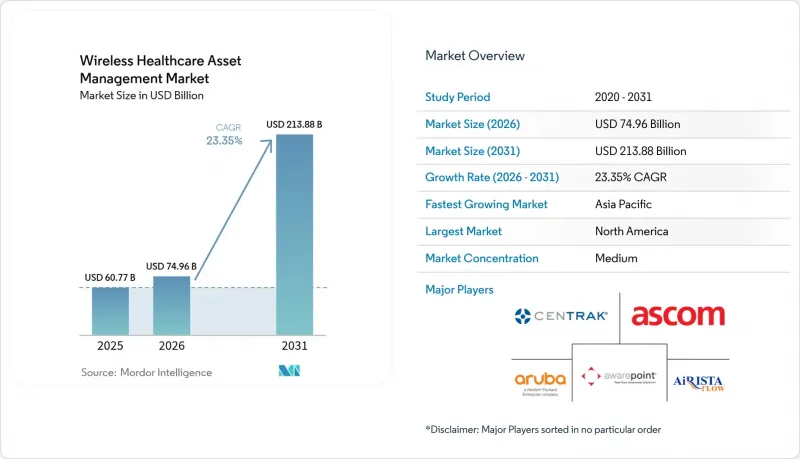
에 따르면 무선 의료 자산 관리 시장 규모는 2025년 607억 7,000만 달러에서 2026년에는 749억 6,000만 달러로 확대되고, 2026년부터 2031년까지 CAGR 23.35%를 기록하며 2031년에는 2,138억 8,000만 달러에 달할 것으로 예측됩니다.

본 보고서는 제품별(자산 태그, 웨어러블 태그, 무선 센서, 기타), 기술별(RFID, Wi-Fi, 기타), 용도별(자산 및 재고 추적, 환자 및 직원 안전, 기타), 최종사용자별(병원 및 통합 의료 네트워크, 외래 수술 센터, 기타), 지역별로 분류되어 있습니다. 시장 예측은 금액(달러)으로 표시되어 있습니다.
세계 무선 의료 자산 관리 시장의 동향 및 인사이트
RFID를 활용한 자산 태깅의 급속한 보급
병원에서는 수액 펌프, 인공호흡기, 휠체어에 패시브형 RFID 태그를 탑재하고 있습니다. 이 기술은 배터리가 필요 없이 3m-10m의 판독 범위를 실현하기 때문에 의료진의 이직률이 연간 20%를 넘는 환경에서 매우 중요한 이점이 되기 때문입니다. 2024년에 출시된 Impinj의 M800 리더기는 태그 판독 밀도를 40% 향상시켜, 단 하나의 고정형 리더기로 붐비는 복도에 있는 200개의 자산을 모니터링할 수 있게 했습니다. 같은 해 발표된 FDA 지침에서는 클래스 II 의료기기에 부착된 RFID 라벨에 대해 별도의 510(k) 신청이 필요하지 않음이 확인되어, 중요한 규제 장벽이 제거되었습니다. 동료 심사를 거친 연구에 따르면, 300병상 규모의 병원에서 RFID 추적을 통해 검색 시간이 68% 단축되어 수술실 1개당월 4.2건의 추가 수술이 가능해진 것으로 입증되었습니다. 교대 근무당 최대 90분이나 되는 시간을 수동 점검에 소비하고 있는 외래 수술 센터에서는 그 결과 도입이 가속화되고 있습니다.
의료기기 검색 시간을 단축하기 위한 실시간 자산 가시화의 필요성
미국 병원의 임상 팀은 교대 근무당 21분을 의료기기 검색에 소비하고 있으며, 이러한 부담은 입원 기간이 길어질 경우 페널티가 부과되는 금액 기반 결제 모델로 인해 더욱 악화되고 있습니다. 5-10초마다 갱신되는 실시간 위치추적 시스템을 통해, 사용 가능한 가장 가까운 펌프나 심전도 장비를 요청한 병동으로 안내함으로써 대응 시간을 12분에서 3분 이하로 단축할 수 있습니다. 2024년, 한 통합 의료 네트워크에서는 Wi-Fi를 활용한 삼각 측량을 통해 95%의 가시화를 실현한 결과, 연간 180만 달러의 임대 비용을 절감했습니다. Zebra Technologies의 보고서에 따르면, 고객사는 자사의 MotionWorks 분석을 통해 파악된 유휴 자산을 재배치함으로써 설비 투자를 18% 절감했습니다.
하드웨어 및 통합에 소요되는 높은 초기 비용
300병상 규모의 도입에는 일반적으로 150-200개의 인프라 노드와 3,000개의 태그가 필요하며, 소프트웨어 및 인건비를 제외하더라도 40만-60만 달러의 초기 투자가 필요합니다. 이익률이 3-5%인 외래 수술 센터에서는 24개월 만에 투자 회수가 가능한 모델이라 하더라도 이러한 투자 자금을 확보하는 데 어려움을 겪고 있습니다. Epic 등의 전자건강기록(EHR)과 플랫폼을 연동하려면 시간당 150-250달러의 비용이 드는 맞춤형 인터페이스 개발에 6-9개월이 소요될 수 있습니다. ‘RTLS-as-a-Service’(벤더가 하드웨어를 소유하고 태그당월 사용료를 청구하는 모델)는 도입 장벽을 낮추고 있지만, 북미 이외 지역에서는 아직 보급 초기 단계에 있습니다.
부문 분석
소프트웨어 플랫폼은 연평균 25.95%의 속도로 성장하고 있으며, 이는 무선 의료 자산 관리 시장 전체의 성장률을 상회하는 수치입니다. 병원 측은 예측 분석, EHR과의 통합, 자동화된 감사 추적이 없다면 원시 위치 정보 데이터의 가치는 제한적이라는 점을 인식하고 있습니다. 자산 태그는 2025년에도 42.65%의 점유율을 유지하고 있으며, 이는 기존 RFID 및 BLE의 도입 실적을 반영한 것이지만, 수익은 정기적인 소프트웨어 이용료로 전환되고 있습니다. 행동 건강 부문에서는 응급 상황 및 탈출 방지를 위한 웨어러블 태그가 주목받고 있습니다. USP 797 무균 규정 개정에 따라 온도 및 습도를 모니터링하는 무선 센서의 사용이 급증했습니다. 반도체 기업들이 UWB를 범용 Wi-Fi 칩셋에 통합함에 따라 하드웨어 이익률은 압박을 받고 있으며, 플랫폼 경제로의 전환이 두드러지고 있습니다.
소프트웨어 중심의 벤더들은 더 높은 평가 배율을 기록하는 경향이 있습니다. Zebra의 2024년 제출 자료에 따르면, 소프트웨어 및 서비스 매출은 전년 대비 31% 증가한 반면, 하드웨어 매출은 12% 증가에 그쳤습니다. 그 결과, 무선 의료 자산 관리 시장은 인프라, 태그, 분석, 규정 준수 보고를 예측 가능한 OPEX로 통합하는 종단간 구독 모델로 전환되고 있습니다.
2025년에는 배터리가 필요 없는 패시브 태그의 도입과 리더기의 보급이 확대됨에 따라 RFID 시장 점유율은 55.10%를 차지했습니다. 그러나 수술실, 카테터실, 신생아 집중 치료실(NICU)에서는 Wi-Fi를 이용한 삼각 측량이나 BLE 비콘으로는 달성할 수 없는 30cm 이하의 정밀도가 요구되기 때문에 UWB는 연간 26.05%의 성장률을 보이고 있습니다. Wi-Fi 솔루션은 기존 액세스 포인트를 활용하지만, 금속이 밀집된 환경에서는 3m-5m의 오차가 발생합니다. BLE는 비용과 성능의 균형이 잘 잡혀 있어 장기 요양 시설에서 선호되는 선택지입니다. ZigBee와 적외선은 여전히 틈새 시장으로 남아 있습니다. Qorvo는 2024년에 1,200만 개의 UWB 칩을 출하했으며, 수술기구 추적 수요에 힘입어 47%의 증가를 기록했습니다.
현재 병원에서는 2계층 아키텍처가 채택되어 있어, 휠체어나 펌프에는 RFID나 BLE를, 고가의 의료기기에는 UWB가 활용되고 있습니다. 단일 대시보드 내에서 두 계층을 통합 관리할 수 있는 공급업체들은 통합 의료 네트워크 전반에 걸쳐 수년에 걸친 계약을 수주하고 있습니다.
지역별 분석
2025년 매출액 중 북미가 37.45%를 차지했습니다. 이는 HCA Healthcare와 같은 통합 의료 네트워크가 수백 곳의 시설에 걸쳐 자산 가시화를 표준화했기 때문입니다. 전자건강기록(EHR) 보급률이 높아, Epic, Oracle, Cerner가 미국 병상의 70%를 커버하고 있어 신속한 데이터 통합이 가능해졌습니다. 캐나다에서는 주 차원의 도입이 가속화되고 있으며, 온타리오 헬스는 2024년에 42개 병원에 시스템을 도입하기 위해 8,500만 캐나다 달러(6,300만 달러)를 투자했습니다. 멕시코 IMSS의 시범 사업에서는 18개 병원 전체에서 임대 비용을 25% 절감하는 것을 목표로 했습니다. CMS는 결제를 이용 지표와 연동할 것을 제안하고 있으며, 이 조치가 채택되면 무선 의료 자산 관리 시장의 확대로 이어질 가능성이 있습니다.
아시아태평양은 연평균 성장률(CAGR) 25.9%를 기록하며 가장 빠르게 성장하고 있는 지역입니다. 중국은 병상 수 500개 이상의 모든 신규 3차 병원에 RTLS 도입을 의무화하고 있으며, 이를 위해 300억 위안(42억 달러)을 투자하고 있습니다. 인도는 12,000개 병원을 대상으로 하는 ‘아유슈만 바라트 디지털 미션’에 자산 추적 기능을 통합하고 있습니다. 일본에서는 2025년까지 예상되는 37만 명의 인력 부족을 완화하기 위해 고령자 요양용 RTLS 프로젝트에 대해 최대 50%의 보조금을 지급하고 있습니다. 한국은 인증 인센티브를 제공하고 있으며, 호주는 진단 목적 이외의 RTLS 소프트웨어에 대해 보다 유연한 규제 체계를 명확히 했습니다. WHO가 예측한 급속한 도시화로 인해 2030년까지 도시 지역 주민이 4억 명 증가할 것으로 예상되며, RTLS를 지원하는 배선 공사가 완료된 신규 병원 건설 수요가 높아질 것으로 전망됩니다.
유럽, 중동 및 아프리카에서는 RTLS 도입 현황에 편차가 보입니다. 독일, 영국, 프랑스, 스페인에서는 의료기기 규정(MDR)의 추적성 요건을 충족하기 위해 RTLS가 도입되고 있습니다. GDPR에서는 익명화와 로컬 데이터 호스팅이 의무화되어 있어, 지역 밀착형 클라우드 서비스를 제공하는 벤더에게 유리한 상황이 되고 있습니다. 사우디아라비아는 2024년, ‘비전 2030’의 일환으로 RTLS가 내장된 병원 건설에 120억 사우디아라비아 리얄(32억 달러)을 투자했습니다. 아랍에미리트(UAE)는 세계 상위 100대 의료 제공 기관 중 하나가 되겠다는 야심찬 목표의 일환으로, 모든 신규 시설에 RTLS 도입을 의무화하고 있습니다. 아프리카와 남미에서는 아직 도입이 초기 단계이지만, 브라질, 남아프리카공화국, 나이지리아의 민간 병원 체인에서는 의료 관광객을 유치하기 위해 RTLS 검사 시스템 도입이 진행되고 있습니다.
기타 혜택
- 엑셀 형식의 시장 예측(ME) 시트
- 3개월간의 애널리스트 지원
자주 묻는 질문
목차
제1장 소개
제2장 조사 방법
제3장 주요 요약
제4장 시장 구도
제5장 시장 규모와 성장 예측
제6장 경쟁 구도
제7장 시장 기회와 향후 전망
KSM 26.09.03According to Mordor Intelligence, the wireless healthcare asset management market size is expected to grow from USD 60.77 billion in 2025 to USD 74.96 billion in 2026 and is forecast to reach USD 213.88 billion by 2031 at 23.35% CAGR over 2026-2031.
This report is Segmented by Product (Asset Tags, Wearable Tags, Wireless Sensors, and More), Technology (RFID, Wi-Fi, and More), Application (Asset and Inventory Tracking, Patient and Staff Safety, and More), End User (Hospitals and Integrated Delivery Networks, Ambulatory Surgery Centers, and More), and Geography. The Market Forecasts are Provided in Terms of Value (USD).
Global Wireless Healthcare Asset Management Market Trends and Insights
Rapid Adoption of RFID-Based Asset Tagging
Hospitals are embedding passive RFID tags into infusion pumps, ventilators, and wheelchairs because the technology provides read ranges of 3 m-10 m without requiring batteries, a critical benefit in settings where biomedical staff turnover exceeds 20% annually. Impinj's M800 reader, launched in 2024, improves tag-read density by 40%, allowing one fixed reader to monitor 200 assets in busy corridors. FDA guidance issued the same year confirmed that RFID labels attached to Class II devices need no separate 510(k) filing, removing a key regulatory hurdle. A peer-reviewed study demonstrated that RFID tracking reduced search time by 68% in a 300-bed hospital and enabled 4.2 additional monthly procedures per operating room. Ambulatory surgery centers, where manual audits consume up to 90 minutes per shift, are consequently accelerating rollouts.
Need for Real-Time Asset Visibility to Cut Equipment Search Time
Clinical teams in U.S. hospitals lose 21 minutes per shift searching for devices, a drain exacerbated by value-based payment models that penalize extended lengths of stay. Real-time location systems, which refresh every 5-10 seconds, route the nearest available pump or ECG unit to the requesting ward, reducing response time from 12 minutes to under 3 minutes. A 2024 integrated delivery network saved USD 1.8 million a year on rentals after achieving 95% visibility via Wi-Fi triangulation. Zebra Technologies reports customers trimmed capital expenditure by 18% by redeploying idle assets surfaced through its MotionWorks analytics.
High Upfront Hardware and Integration Costs
A 300-bed deployment typically requires 150-200 infrastructure nodes, along with 3,000 tags, resulting in a capital outlay of USD 400,000-600,000 before accounting for software and labor costs. Ambulatory surgery centers operating on 3%-5% margins struggle to fund such investments despite 24-month payback models. Linking platforms to EHRs like Epic can add 6-9 months of custom interface work priced at USD 150-250 per hour. RTLS-as-a-Service, where vendors retain hardware ownership and bill monthly per-tag fees, is easing friction but remains nascent outside North America.
Other drivers and restraints analyzed in the detailed report include:
- Rising Investment in Smart Hospital Infrastructure
- Edge-AI Predictive Maintenance Reducing Device Downtime
- Data-Privacy and Cybersecurity Compliance Hurdles
For complete list of drivers and restraints, kindly check the Table Of Contents.
Segment Analysis
Software Platforms are expanding at a rate of 25.95% annually, outpacing the overall wireless healthcare asset management market. Hospitals recognize that raw location data has limited value without predictive analytics, EHR integration, and automated audit trails. Asset Tags retained a 42.65% share in 2025, reflecting a legacy RFID and BLE installed base, yet revenue is migrating to recurring software fees. Wearable Tags for duress and elopement prevention are gaining steam in behavioral health units. Wireless Sensor monitoring of temperature and humidity surged following the updated USP 797 sterility rules. Hardware margins are being compressed as semiconductor firms integrate UWB into general-purpose Wi-Fi chipsets, underscoring the shift toward platform economics.
Software-centric vendors tend to capture higher valuation multiples; Zebra's 2024 filing showed that software and services rose 31% year-over-year, compared to 12% for hardware. As a result, the wireless healthcare asset management market is tilting toward end-to-end subscriptions that roll infrastructure, tags, analytics, and compliance reporting into predictable OPEX.
RFID held a 55.10% share in 2025, thanks to the adoption of battery-free passive tags and the increasing ubiquity of readers. However, UWB is growing 26.05% a year as surgical theaters, catheter labs, and neonatal ICUs demand <30 cm accuracy, unattainable with Wi-Fi triangulation or BLE beacons. Wi-Fi solutions leverage existing access points but deliver errors of 3 m-5 m in metal-dense environments. BLE balances cost and performance, making it the preferred option for long-term care facilities. ZigBee and infrared remain niche. Qorvo shipped 12 million UWB chips in 2024, a 47% increase, driven by the demand for surgical instrument tracking.
Hospitals now operate dual-tier architectures, utilizing RFID or BLE for wheelchairs and pumps, and UWB for high-value instruments. Vendors that can orchestrate both layers within a single dashboard are winning multi-year contracts across integrated delivery networks.
Complete Report Scope:
- By Product
- Asset Tags
- Wearable Tags
- Wireless Sensors
- Software Platforms
- Other Products
- By Technology
- RFID
- Wi-Fi
- Bluetooth Low Energy
- Ultra-Wideband
- ZigBee and Other Technologies
- By Application
- Asset and Inventory Tracking
- Patient and Staff Safety
- Environmental and Condition Monitoring
- Workflow and Capacity Optimization
- Compliance and Audit Trail Management
- By End User
- Hospitals and Integrated Delivery Networks
- Ambulatory Surgery Centers
- Long-Term Care and Senior Living Facilities
- Diagnostic Laboratories and Imaging Centers
- Other Healthcare Institutions
- By Geography
- North America
- United States
- Canada
- Mexico
- South America
- Brazil
- Argentina
- Rest of South America
- Europe
- Germany
- United Kingdom
- France
- Italy
- Spain
- Russia
- Rest of Europe
- Asia Pacific
- China
- Japan
- India
- South Korea
- Australia
- Rest of Asia Pacific
- Middle East and Africa
- Middle East
- Saudi Arabia
- United Arab Emirates
- Turkey
- Rest of Middle East
- Africa
- South Africa
- Nigeria
- Egypt
- Rest of Africa
- Middle East
- North America
Geography Analysis
North America accounted for 37.45% of the revenue in 2025, as integrated delivery networks, such as HCA Healthcare, standardized asset visibility across hundreds of sites. High EHR penetration: Epic and Oracle Cerner cover 70% of U.S. beds, facilitating rapid data integration. Canada accelerated provincial deployments; Ontario Health invested CAD 85 million (USD 63 million) in 2024 to outfit 42 hospitals. Mexico's IMSS pilot aimed to achieve a 25% reduction in rental costs across 18 hospitals. CMS has proposed tying payments to utilization metrics, a policy that could expand the wireless healthcare asset management market if adopted.
The Asia Pacific is the fastest-growing region, with a 25.9% CAGR. China mandated RTLS in all new tertiary hospitals larger than 500 beds, directing CNY 30 billion (USD 4.2 billion) toward deployments. India has embedded asset-tracking in the Ayushman Bharat Digital Mission, which spans 12,000 hospitals. Japan subsidizes up to 50% of elder-care RTLS projects to mitigate a projected 370,000-worker shortfall by 2025. South Korea offers certification incentives, and Australia clarified a lighter regulatory path for non-diagnostic RTLS software. Rapid urbanization, as forecasted by the WHO, is expected to add 400 million new city residents by 2030, driving the need for new hospital construction pre-wired for RTLS.
Europe, the Middle East, and Africa display mixed adoption. Germany, the United Kingdom, France, and Spain are deploying RTLS to meet the Medical Device Regulation's traceability rules. GDPR requires anonymization and local data hosting, benefiting vendors with regional cloud services. Saudi Arabia invested SAR 12 billion (USD 3.2 billion) in 2024 for Vision 2030 hospitals with built-in RTLS. The UAE requires RTLS in all new facilities as part of its ambitious goal to become one of the top 100 global healthcare providers. Africa and South America remain nascent, though private chains in Brazil, South Africa, and Nigeria are piloting deployments to attract medical tourists.
- AiRISTA Flow, Inc.
- Aruba Networks (Hewlett Packard Enterprise Development LP)
- Ascom Holding AG
- Awarepoint Corporation
- CenTrak, Inc.
- Cisco Systems, Inc.
- Cognosos, Inc.
- Decawave Limited
- GE Healthcare Technologies, Inc.
- HID Global Corporation
- Honeywell International Inc.
- Impinj, Inc.
- Intelligent InSites, Inc.
- Midmark Corporation
- Motorola Solutions, Inc.
- Securitas Healthcare USA, Inc.
- Siemens Healthineers AG
- Sonitor Technologies AS
- Stanley Black and Decker, Inc. (STANLEY Healthcare)
- TeleTracking Technologies, Inc.
- Zebra Technologies Corporation
Additional Benefits:
- The market estimate (ME) sheet in Excel format
- 3 months of analyst support
TABLE OF CONTENTS
1 INTRODUCTION
- 1.1 Study Assumptions and Market Definition
- 1.2 Scope of the Study
2 RESEARCH METHODOLOGY
3 EXECUTIVE SUMMARY
4 MARKET LANDSCAPE
- 4.1 Market Overview
- 4.2 Market Drivers
- 4.2.1 Rapid adoption of RFID?based asset tagging
- 4.2.2 Need for real-time asset visibility to cut equipment search time
- 4.2.3 Rising investment in smart hospital infrastructure
- 4.2.4 Edge-AI predictive maintenance reducing device downtime
- 4.2.5 ESG targets driving low-power BLE and UWB retrofit projects
- 4.2.6 Shift to subscription-based RTLS-as-a-Service business models
- 4.3 Market Restraints
- 4.3.1 High upfront hardware and integration costs
- 4.3.2 Data-privacy and cybersecurity compliance hurdles
- 4.3.3 Shortage of RTLS-skilled biomedical engineers
- 4.3.4 RF interference from 5G/Wi-Fi-6E in legacy hospital buildings
- 4.4 Industry Value Chain Analysis
- 4.5 Regulatory Landscape
- 4.6 Technological Outlook
- 4.7 Impact of Macroeconomic Factors
- 4.8 Porter's Five Forces Analysis
- 4.8.1 Threat of New Entrants
- 4.8.2 Bargaining Power of Suppliers
- 4.8.3 Bargaining Power of Buyers
- 4.8.4 Threat of Substitutes
- 4.8.5 Intensity of Competitive Rivalry
5 MARKET SIZE AND GROWTH FORECASTS (VALUE)
- 5.1 By Product
- 5.1.1 Asset Tags
- 5.1.2 Wearable Tags
- 5.1.3 Wireless Sensors
- 5.1.4 Software Platforms
- 5.1.5 Other Products
- 5.2 By Technology
- 5.2.1 RFID
- 5.2.2 Wi-Fi
- 5.2.3 Bluetooth Low Energy
- 5.2.4 Ultra-Wideband
- 5.2.5 ZigBee and Other Technologies
- 5.3 By Application
- 5.3.1 Asset and Inventory Tracking
- 5.3.2 Patient and Staff Safety
- 5.3.3 Environmental and Condition Monitoring
- 5.3.4 Workflow and Capacity Optimization
- 5.3.5 Compliance and Audit Trail Management
- 5.4 By End User
- 5.4.1 Hospitals and Integrated Delivery Networks
- 5.4.2 Ambulatory Surgery Centers
- 5.4.3 Long-Term Care and Senior Living Facilities
- 5.4.4 Diagnostic Laboratories and Imaging Centers
- 5.4.5 Other Healthcare Institutions
- 5.5 By Geography
- 5.5.1 North America
- 5.5.1.1 United States
- 5.5.1.2 Canada
- 5.5.1.3 Mexico
- 5.5.2 South America
- 5.5.2.1 Brazil
- 5.5.2.2 Argentina
- 5.5.2.3 Rest of South America
- 5.5.3 Europe
- 5.5.3.1 Germany
- 5.5.3.2 United Kingdom
- 5.5.3.3 France
- 5.5.3.4 Italy
- 5.5.3.5 Spain
- 5.5.3.6 Russia
- 5.5.3.7 Rest of Europe
- 5.5.4 Asia Pacific
- 5.5.4.1 China
- 5.5.4.2 Japan
- 5.5.4.3 India
- 5.5.4.4 South Korea
- 5.5.4.5 Australia
- 5.5.4.6 Rest of Asia Pacific
- 5.5.5 Middle East and Africa
- 5.5.5.1 Middle East
- 5.5.5.1.1 Saudi Arabia
- 5.5.5.1.2 United Arab Emirates
- 5.5.5.1.3 Turkey
- 5.5.5.1.4 Rest of Middle East
- 5.5.5.2 Africa
- 5.5.5.2.1 South Africa
- 5.5.5.2.2 Nigeria
- 5.5.5.2.3 Egypt
- 5.5.5.2.4 Rest of Africa
- 5.5.5.1 Middle East
- 5.5.1 North America
6 COMPETITIVE LANDSCAPE
- 6.1 Market Concentration
- 6.2 Strategic Moves
- 6.3 Market Share Analysis
- 6.4 Company Profiles (includes Global level Overview, Market level overview, Core Segments, Financials as available, Strategic Information, Market Rank/Share for key companies, Products and Services, and Recent Developments)
- 6.4.1 AiRISTA Flow, Inc.
- 6.4.2 Aruba Networks (Hewlett Packard Enterprise Development LP)
- 6.4.3 Ascom Holding AG
- 6.4.4 Awarepoint Corporation
- 6.4.5 CenTrak, Inc.
- 6.4.6 Cisco Systems, Inc.
- 6.4.7 Cognosos, Inc.
- 6.4.8 Decawave Limited
- 6.4.9 GE Healthcare Technologies, Inc.
- 6.4.10 HID Global Corporation
- 6.4.11 Honeywell International Inc.
- 6.4.12 Impinj, Inc.
- 6.4.13 Intelligent InSites, Inc.
- 6.4.14 Midmark Corporation
- 6.4.15 Motorola Solutions, Inc.
- 6.4.16 Securitas Healthcare USA, Inc.
- 6.4.17 Siemens Healthineers AG
- 6.4.18 Sonitor Technologies AS
- 6.4.19 Stanley Black and Decker, Inc. (STANLEY Healthcare)
- 6.4.20 TeleTracking Technologies, Inc.
- 6.4.21 Zebra Technologies Corporation
7 MARKET OPPORTUNITIES AND FUTURE OUTLOOK
- 7.1 White-space and Unmet-Need Assessment


