|
시장보고서
상품코드
2121245
치료용 백신 : 시장 점유율 분석, 업계 동향과 통계, 성장 예측(2026-2031년)Therapeutic Vaccines - Market Share Analysis, Industry Trends & Statistics, Growth Forecasts (2026 - 2031) |
||||||
 Mordor Intelligence
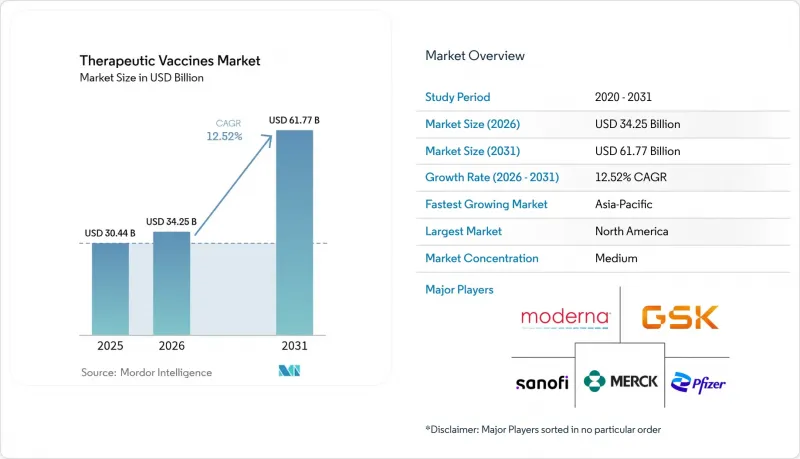
Mordor Intelligence에 따르면 치료용 백신 시장 규모는 2025년 304억 4,000만 달러, 2026년 342억 5,000만 달러에서 2031년에는 617억 7,000만 달러로 확대될 것으로 예측되며, 2026년부터 2031년까지 연평균 성장률(CAGR)은 12.52%가 될 전망입니다.
본 보고서는 제품별(자가면역 질환 백신, 신경계 질환 백신, 암 백신, 감염병 백신, 기타), 기술별(동종 백신, 자가 백신), 연령대별(성인, 소아, 고령자), 유통 채널별(공공, 민간), 지역별(북미, 유럽, 기타)로 분류되어 있습니다. 시장 전망은 금액(달러) 기준으로 제시되어 있습니다.
세계 치료용 백신 시장의 동향 및 인사이트
만성 질환 및 감염병 유병률의 증가
만성 질환과 감염병의 유행이 공존하는 가운데, 치료용 백신은 다각적인 의료의 중심적인 위치를 차지하게 되었습니다. WHO의 2024년판 ‘세계 보건 추정’에 따르면, 전 세계 사망 원인의 74%를 비감염성 질환이 차지하고 있으며, 이 통계는 암 및 심혈관 대사 질환용 백신에 대한 수요를 더욱 높이고 있습니다. 동시에 2030년까지 전 세계 신규 암 발병 건수가 연간 3,000만 건을 넘어설 것으로 예측됨에 따라, 환자 고유의 변이를 표적으로 하는 맞춤형 신생항원 백신 개발 경쟁이 격화되고 있습니다. 감염병 부문의 후보 백신에서는 현재 HIV에 대한 기능적 치료 및 결핵 치료 기간 단축이 추구되고 있으며, 치료용 백신 시장은 암 분야를 넘어 확대되고 있습니다.
백신 연구 개발에 대한 정부의 자금 지원 강화
‘프로젝트 넥스트젠(Project NextGen)’은 차세대 COVID-19 대책과 파생 기술을 추진하기 위해 2024년에 50억 달러를 배정했으나,BARDA가 2025년 8월에 5억 달러 규모의 mRNA 계약을 종료한 것은 향후 자금 지출이 다목적적인 임상적 가치에 좌우될 것임을 시사합니다. 중국에서는 국내 암 백신에 대한 신속 승인 절차가 새로운 자금을 유치하고 있는 반면, ‘Horizon Europe’의 보조금은 계속해서 mRNA 및 바이러스 벡터 플랫폼을 지원하고 있습니다. 이러한 지역별 특화된 정책들이 맞물려 치료용 백신 시장을 확대하고 있지만, 후원사는 환급을 확보하기 위해 여전히 설득력 있는 비용 대비 효과 데이터세트를 제시해야 합니다.
자본 집약적이고 위험이 높은 임상 개발 주기
후보 약물 1건당 총 비용은 2억-5억 달러에 달하는 반면, 성공 확률은 10% 미만으로 머물러 있습니다. 맞춤형 신항원 검사에서는 환자 1인당 15만 달러의 염기서열 분석 비용과 맞춤형 GMP 비용이 추가됩니다. 신흥 시장의 혁신 기업들은 자금이 풍부한 파트너에게 자산을 라이선싱하는 경우가 많으며, 이러한 추세가 독립적인 상용화를 저해하고 치료용 백신 시장의 성장을 둔화시키고 있습니다.
부문 분석
2025년, 암 백신은 무재발 생존 기간을 연장하는 병용요법의 호조에 힘입어 치료용 백신 시장에서 42.55%의 점유율을 차지했습니다. 신경 질환용 백신은 알츠하이머병의 병태를 표적으로 하는 ACI-24.060과 UB-612의 중기 임상시험에 힘입어 2031년까지 연평균 성장률(CAGR) 15.85%를 기록할 것으로 예측됩니다.
자가면역 질환 및 진행성 감염증 후보 약물은 시장의 다양화에 기여하고 있지만, 전신 면역력을 손상시키지 않으면서 항원 특이적 내성을 입증해야 하기 때문에 개발 단계는 여전히 초기 단계에 머물러 있습니다. 규제 요건은 적응증에 따라 다릅니다. 종양학 프로그램에서는 무재발 생존 기간 등의 대체 평가 지표가 자주 활용되는 반면, 신경 질환에 대한 적용에서는 수년에 걸친 인지 기능 유지를 입증해야 합니다. 이는 더 높은 증거 기준이며 승인을 지연시키는 요인이 되지만, 일단 충족되면 막대한 가치를 창출할 가능성이 있습니다.
동종 백신은 배치 단위의 경제성과 신속한 유통 덕분에 2025년 매출의 55.53%를 차지했습니다. 자가 백신은 AI를 통한 신항원 발견 가속화로 제조 주기가 30-60일로 단축되고, 임상 적격 범위가 확대됨에 따라 2031년까지 연평균 성장률(CAGR) 16.75%로 성장할 전망입니다.
유효성 측면에서 이 두 가지 방식 간에는 차이가 나타납니다. 동종 백신 프로그램의 객관적 반응률이 30%를 넘는 경우는 드문 반면, 자가 백신은 흑색종과 비소세포폐암에서 40%를 초과하고 있습니다. 이러한 차이는 지속적인 치료 성과를 중시하는 지불 주체에게 높은 제조 비용을 정당화하는 요인이 되고 있습니다.
지역별 분석
2025년에는 FDA의 패스트트랙 지정과 집중적인 벤처 자금 지원에 힘입어 북미가 42.55%의 점유율로 1위를 차지했습니다. 유럽은 이에 이어 EMA의 통합 승인 절차를 활용하고 있지만, 승인 후 가격 책정 과정에서 지연을 겪고 있습니다. 아시아태평양은 치료용 백신 시장 중 가장 빠르게 성장하고 있으며, 중국이 승인 절차를 효율화하고 인도가 저비용의 주요 임상시험을 유치하고 있어 2031년까지 연평균 성장률(CAGR) 13.72%로 확대될 것으로 전망됩니다. 일본의 현지 안전성 데이터 요건은 시판까지의 주기에 18-24개월을 추가하지만, 그 대신 대규모 고령자 대상의 연령대별 프로토콜을 확보하고 있습니다.
라틴아메리카, 중동 및 아프리카는 여전히 시장 기여도가 낮지만, 신속한 승인 절차 덕분에 규제 당국이 FDA나 EMA의 결정을 참고하는 동시에 국내 후원사가 기술 이전을 추진할 수 있어 관심이 높아지고 있습니다.
기타 혜택
- 엑셀 형식의 시장 예측(ME) 시트
- 3개월간의 애널리스트 지원
자주 묻는 질문
목차
제1장 소개
제2장 조사 방법
제3장 주요 요약
제4장 시장 구도
제5장 시장 규모와 성장 예측
제6장 경쟁 구도
제7장 시장 기회와 향후 전망
KSM 26.09.03According to Mordor Intelligence, the therapeutic vaccines market size is projected to expand from USD 30.44 billion in 2025 and USD 34.25 billion in 2026 to USD 61.77 billion by 2031, registering a CAGR of 12.52% between 2026 and 2031.
This report is Segmented by Products (Autoimmune Disease Vaccines, Neurological Disease Vaccines, Cancer Vaccines, Infectious Disease Vaccines, Other Products), Technology (Allogeneic Vaccines, Autologous Vaccines), Age Group (Adult, Pediatric, Geriatric), Distribution Channel (Public, Private), and Geography (North America, Europe, and More). The Market Forecasts are Provided in Terms of Value (USD).
Global Therapeutic Vaccines Market Trends and Insights
Rising Prevalence of Chronic & Infectious Diseases
Therapeutic vaccines have moved to the center of multimodal care as chronic conditions coexist with infectious outbreaks. WHO's 2024 Global Health Estimates found non-communicable diseases responsible for 74% of worldwide deaths, a statistic that amplifies oncology and cardiometabolic vaccine demand. Concurrently, global cancer incidence is projected to top 30 million new cases annually by 2030, intensifying the hunt for individualized neoantigen vaccines that target patient-specific mutations. Infectious-disease candidates now pursue functional cures in HIV and shortened regimens in tuberculosis, broadening the therapeutic vaccines market beyond oncology.
Government Funding Intensification for Vaccine R&D
Project NextGen allocated USD 5 billion in 2024 to advance next-generation COVID-19 countermeasures and spin-off technologies, yet BARDA's August 2025 cancellation of USD 500 million in mRNA contracts indicates that future disbursements will hinge on multipurpose clinical value. In China, expedited pathways for domestic cancer vaccines have unlocked fresh capital, while Horizon Europe grants continue to support mRNA and viral-vector platforms. These region-specific policies collectively expand the therapeutic vaccines market, though sponsors must still deliver compelling cost-effectiveness dossiers to secure reimbursement.
Capital-Intensive, High-Risk Clinical Development Cycle
End-to-end expenses reach USD 200-500 million per candidate, while success odds linger below 10%. Personalized neoantigen trials add USD 150,000 per patient in sequencing and bespoke GMP costs. Emerging-market innovators often license out assets to deep-pocketed partners, a dynamic that curtails independent commercialization and tempers growth in the therapeutic vaccines market.
Other drivers and restraints analyzed in the detailed report include:
- Pharma/Biotech Surge in Oncology Vaccine Pipelines
- Breakthrough Approvals of mRNA-Based Therapeutic Vaccines
- Stringent Multi-Jurisdictional Regulatory Hurdles
For complete list of drivers and restraints, kindly check the Table Of Contents.
Segment Analysis
Cancer vaccines held 42.55% therapeutic vaccines market share in 2025, buoyed by combination regimens that prolong progression-free survival. Neurological disease vaccines are projected to clock a 15.85% CAGR to 2031, supported by mid-stage trials of ACI-24.060 and UB-612 that target Alzheimer's pathology.
Autoimmune and advanced infectious-disease candidates add diversification but remain earlier in development, constrained by the need to demonstrate antigen-specific tolerance without compromising systemic immunity. Regulatory requirements differ by indication. Oncology programs often leverage surrogate endpoints such as recurrence-free survival, whereas neurological applications must showcase multi-year cognitive maintenance, a higher evidentiary bar that slows approval yet could deliver large-scale value once met.
Allogeneic formulations generated 55.53% of 2025 revenue thanks to batch economies and rapid distribution. Autologous constructs are set to expand at a 16.75% CAGR through 2031 as AI accelerates neoantigen discovery, shrinking manufacturing cycles to 30-60 days and widening clinical eligibility.
Efficacy divides the two modalities. Allogeneic programs rarely exceed 30% objective response rates, whereas autologous vaccines cross 40% in melanoma and non-small cell lung cancer, a gap that justifies higher production costs among payers keen on durable outcomes.
Complete Report Scope:
- By Products
- Autoimmune Disease Vaccines
- Neurological Disease Vaccines
- Cancer Vaccines
- Infectious Disease Vaccines
- Other Products
- By Technology
- Allogeneic Vaccines
- Autologous Vaccines
- By Age Group
- Adult
- Pediatric
- Geriatric
- By Distribution Channel
- Public
- Private
- By Geography
- North America
- United States
- Canada
- Mexico
- Europe
- Germany
- United Kingdom
- France
- Italy
- Spain
- Rest of Europe
- Asia-Pacific
- China
- India
- Japan
- Australia
- South Korea
- Rest of Asia-Pacific
- Middle East and Africa
- GCC
- South Africa
- Rest of Middle East and Africa
- South America
- Brazil
- Argentina
- Rest of South America
- North America
Geography Analysis
North America led with 42.55% share in 2025, propelled by FDA fast-track designations and concentrated venture backing. Europe follows, leveraging centralized EMA approvals but facing post-authorization pricing delays. Asia-Pacific is the fastest growing therapeutic vaccines market, advancing 13.72% CAGR through 2031 as China streamlines approvals and India attracts lower-cost pivotal trials. Japan's local safety data requirements add 18-24 months to launch cycles but ensure age-tailored protocols for its sizable elderly population.
Latin America, the Middle East, and Africa collectively remain small contributors but display rising interest as expedited reliance pathways let regulators lean on FDA or EMA decisions while domestic sponsors pursue technology transfers.
- Agenus
- AstraZeneca
- Bavarian Nordic
- BioNTech
- Celldex Therapeutic
- CSL Seqirus
- CureVac N.V.
- Gilead Sciences
- GlaxoSmithKline
- Inovio Pharmaceuticals
- Merck
- Moderna
- Novartis
- Nykode Therapeutics
- Pfizer
- Sanofi
- Takeda Pharmaceutical Co.
- Vaccitech plc
Additional Benefits:
- The market estimate (ME) sheet in Excel format
- 3 months of analyst support
TABLE OF CONTENTS
1 Introduction
- 1.1 Study Assumptions & Market Definition
- 1.2 Scope of the Study
2 Research Methodology
3 Executive Summary
4 Market Landscape
- 4.1 Market Overview
- 4.2 Market Drivers
- 4.2.1 Rising prevalence of chronic & infectious diseases
- 4.2.2 Government funding intensification for vaccine R&D
- 4.2.3 Pharma/Biotech surge in oncology vaccine pipelines
- 4.2.4 Breakthrough approvals of mRNA-based therapeutic vaccines
- 4.2.5 AI-driven neo-antigen discovery accelerating personalization
- 4.2.6 On-site modular micro-factory manufacturing models
- 4.3 Market Restraints
- 4.3.1 Capital-intensive, high-risk clinical development cycle
- 4.3.2 Stringent multi-jurisdictional regulatory hurdles
- 4.3.3 Shortage of GMP viral-vector / plasmid manufacturing capacity
- 4.3.4 Late-stage I-O trial failures dampening investor sentiment
- 4.4 Supply-Chain Analysis
- 4.5 Regulatory Landscape
- 4.6 Technological Outlook
- 4.7 Porter's Five Forces
- 4.7.1 Threat of New Entrants
- 4.7.2 Bargaining Power of Buyers
- 4.7.3 Bargaining Power of Suppliers
- 4.7.4 Threat of Substitutes
- 4.7.5 Intensity of Competitive Rivalry
5 Market Size & Growth Forecasts (Value, USD)
- 5.1 By Products
- 5.1.1 Autoimmune Disease Vaccines
- 5.1.2 Neurological Disease Vaccines
- 5.1.3 Cancer Vaccines
- 5.1.4 Infectious Disease Vaccines
- 5.1.5 Other Products
- 5.2 By Technology
- 5.2.1 Allogeneic Vaccines
- 5.2.2 Autologous Vaccines
- 5.3 By Age Group
- 5.3.1 Adult
- 5.3.2 Pediatric
- 5.3.3 Geriatric
- 5.4 By Distribution Channel
- 5.4.1 Public
- 5.4.2 Private
- 5.5 By Geography
- 5.5.1 North America
- 5.5.1.1 United States
- 5.5.1.2 Canada
- 5.5.1.3 Mexico
- 5.5.2 Europe
- 5.5.2.1 Germany
- 5.5.2.2 United Kingdom
- 5.5.2.3 France
- 5.5.2.4 Italy
- 5.5.2.5 Spain
- 5.5.2.6 Rest of Europe
- 5.5.3 Asia-Pacific
- 5.5.3.1 China
- 5.5.3.2 India
- 5.5.3.3 Japan
- 5.5.3.4 Australia
- 5.5.3.5 South Korea
- 5.5.3.6 Rest of Asia-Pacific
- 5.5.4 Middle East and Africa
- 5.5.4.1 GCC
- 5.5.4.2 South Africa
- 5.5.4.3 Rest of Middle East and Africa
- 5.5.5 South America
- 5.5.5.1 Brazil
- 5.5.5.2 Argentina
- 5.5.5.3 Rest of South America
- 5.5.1 North America
6 Competitive Landscape
- 6.1 Market Concentration
- 6.2 Market Share Analysis
- 6.3 Company Profiles (includes Global level Overview, Market level overview, Core Segments, Financials as available, Strategic Information, Market Rank/Share for key companies, Products & Services, and Recent Developments)
- 6.3.1 Agenus Inc.
- 6.3.2 AstraZeneca plc
- 6.3.3 Bavarian Nordic A/S
- 6.3.4 BioNTech SE
- 6.3.5 Celldex Therapeutics Inc.
- 6.3.6 CSL Seqirus
- 6.3.7 CureVac N.V.
- 6.3.8 Gilead Sciences (Kite Pharma)
- 6.3.9 GSK plc
- 6.3.10 Inovio Pharmaceuticals
- 6.3.11 Merck & Co., Inc.
- 6.3.12 Moderna Inc.
- 6.3.13 Novartis AG
- 6.3.14 Nykode Therapeutics
- 6.3.15 Pfizer Inc.
- 6.3.16 Sanofi SA
- 6.3.17 Takeda Pharmaceutical Co.
- 6.3.18 Vaccitech plc
7 Market Opportunities & Future Outlook
- 7.1 White-space & Unmet-Need Assessment