

|
시장보고서
상품코드
2121253
해상 초계기 : 시장 점유율 분석, 업계 동향과 통계, 성장 예측(2026-2031년)Maritime Patrol Aircraft - Market Share Analysis, Industry Trends & Statistics, Growth Forecasts (2026 - 2031) |
||||||
 Mordor Intelligence
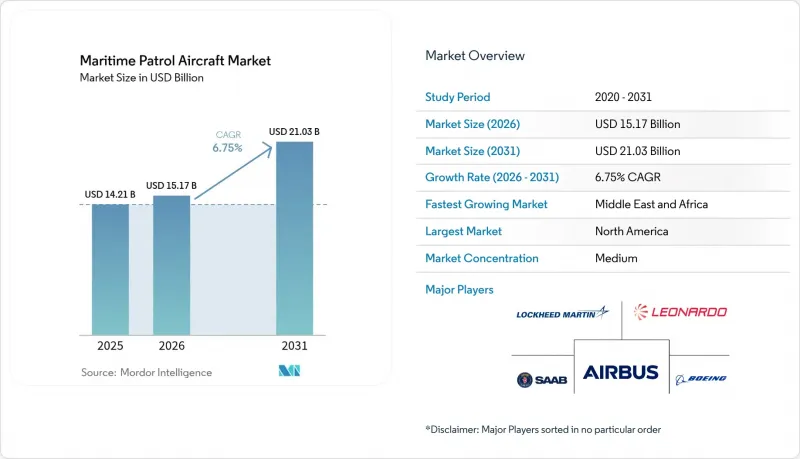
Mordor Intelligence에 의하면, 2026년 해상 초계기 시장 규모는 151억 7,000만 달러로 추정되며, 2025년 142억 1,000만 달러에서 성장하여 2031년에는 210억 3,000만 달러에 달할 것으로 예측됩니다.
또한 2026-2031년 연평균 성장률(CAGR)은 6.75%를 기록할 전망입니다.
본 보고서는 플랫폼(유인 및 무인), 추진 시스템(제트 엔진 등), 임무 유형(대잠전, 정보·감시·정찰, 수색 및 구조 등), 최종 사용자(해군, 해안경비대 등), 지역(북미, 유럽, 아시아태평양, 남미 등)별로 분류되어 있습니다. 시장 전망은 금액(달러) 기준으로 제시되어 있습니다.
세계 해상 순찰기 시장 동향 및 인사이트
증가하는 장거리 대잠전 요구 사항
중국과 러시아의 잠수함 재강화에 따라 각국 해군은 11시간 이상의 항속 시간, 멀티스태틱 소나 처리 및 확장된 센서 융합 기능을 갖춘 플랫폼을 우선적으로 도입할 수밖에 없게 되었습니다. 미국 해군은 이러한 요건을 충족하기 위해 2025년에 P-8A 인크리먼트 3 블록 2의 업그레이드를 완료했습니다. 독일의 P-8A 8대 발주와 일본의 사상 최대 규모인 7조 9,500억 엔(547억 달러)에 달하는 국방 예산은 연안 지역에서 외해로 대잠전(ASW)의 전환을 여실히 보여주고 있습니다. 광대한 배타적 경제 수역(EEZ)을 보유한 인도-태평양 국가들은 기존의 P-3 기단으로는 대처할 수 없는 해저 침투를 저지하기 위해 지속적인 감시가 필수적이라고 보고 있습니다.
노후화된 P-3/P-8 함대의 다목적 기종으로의 교체
20개국에 걸쳐 600대 이상의 노후화된 오리온 기체가 곧 퇴역할 예정이며, 함대 교체는 해상 항공 역사상 최대 규모의 현대화 물결이 되고 있습니다. 한국은 2025년 P-3 추락 사고를 계기로 P-8A로의 전환을 가속화했는데, 이는 안전상의 문제가 현대화 일정을 앞당긴 한 가지 사례입니다. 프랑스가 더 소형인 팔콘 플랫폼 대신 에어버스 A321 MPA를 선택한 것은 탑재 능력이 뛰어난 다목적 기체를 우선시하고 있음을 보여줍니다. 방위 예산이 제한된 국가들은 능력 격차를 메우기 위해 저비용의 C295나 C-130 미션 키트를 채택하고 있습니다.
생산 대수 감소에 따른 단가 급등
MQ-4C 등의 프로그램에서 생산 대수가 70대에서 27대로 감소함에 따라 단가가 상승했고, 기체당 비용은 4억 달러를 초과하여 고객의 예산에 부담을 주고 있습니다. 효율성을 중시하는 생산 시스템을 도입했음에도 불구하고, 보잉사 역시 P-8A의 생산량을월1.5대로 확대하는 과정에서 유사한 비경제성에 직면하고 있습니다. RAND의 분석에 따르면, 연간 생산 대수가 10% 증가할 때마다 납품 가격을 약 3% 낮출 수 있는 것으로 나타났으며, 이는 소량 구매국이 직면한 비용 대비 효과의 과제를 여실히 드러내고 있습니다. 센서 시스템이 점점 더 복잡해짐에 따라 이 가격 곡선은 더욱 두드러지게 나타나며, 국방 예산에 제약이 있는 국가들에게 어려운 절충점을 야기하고 있습니다.
부문 분석
2025년, 유인기는 해상 초계기 시장 매출의 75.10% 점유율을 유지했습니다. 이는 모두 복잡하고 많은 승무원이 필요한 임무에 적합한 P-8A 포세이돈과 일본의 P-1이 주도한 결과입니다. 그러나 무인 플랫폼은 연평균 성장률(CAGR) 9.78%로 성장을 지속하고, 있으며, AI를 활용한 자율 기술이 성숙해짐에 따라 유인기의 우위를 꾸준히 잠식해 나갈 것입니다. ‘로열 윙맨(Royal Wingman)’ 계획의 시험 운용을 통해 운용상의 실현 가능성이 확인되었으며, 미 해군이 항공모함에 MQ-28을 배치하는 데 강한 관심을 보이고 있는 점은 유인·무인 혼합 함대에 대한 전략적 의지를 보여줍니다.
비용 효율성, 승조원의 한계를 뛰어넘는 지속 시간, 그리고 분쟁 지역에서의 위험 감소가 무인기의 매력을 뒷받침하고 있습니다. 2024년 림팩(RIMPAC)에서 ‘시 가디언(Sea Guardian)’이 처음 등장했을 때, 소노부이 투하 및 LRASM 유도 작전이 수행되어, 무인 항공기(UAV)가 현재 대잠전(ASW) 및 대수상전의 핵심 임무를 수행할 수 있음이 입증되었습니다. 유인 초계기(MPA)가 여러 대의 자율형 초계기를 지휘하는 하이브리드형 아키텍처는 2031년까지의 전력 구상에 관한 논의의 중심이 될 것입니다.
2025년에는 제트 엔진이 매출의 85.05%를 차지했으나, DARPA의 XRQ-73 등 하이브리드 전기식 실증기가 첫 비행에 성공하면서 전기 시스템의 연평균 성장률(CAGR)은 11.86%에 달했습니다. 미 육군의 자금 지원을 받아 개발된 그룹 3용 UAV용 GE 에어로스페이스사의 1MW 하이브리드 모듈은 이러한 전환의 추세를 여실히 보여주고 있습니다.
전기 추진은 음향 시그니처를 줄이고 체공 시간을 연장할 뿐만 아니라, 국방 분야의 탄소 배출 감축 목표에도 부합합니다. 하이브리드 전기식 실증기를 대상으로 한 해상 순찰기 시장 규모는 현재로서는 소규모이지만, 민수용과 군수용의 이중 연구 개발 경로라는 이점을 누리고 있습니다. 터보샤프트 엔진은 수직 이착륙형 초계정에서 여전히 중요성을 유지하고 있지만, 유럽 및 북미에서 지속되는 전동화에 대한 자금 지원은 2028년 이후 더욱 확산될 것임을 시사합니다.
지역별 분석
2025년, 북미는 해상 정찰기 시장 매출의 38.20%를 차지했습니다. 이는 미국 해군의 캐나다 및 독일 대상 34억 달러 규모의 P-8A 구매와 진행 중인 CP-140 오로라 현대화 계획에 힘입은 결과입니다. 자국 내 생산 능력, 확립된 서브시스템 공급업체, 그리고 지속적인 연구개발 파이프라인이 이 지역의 주도적 지위를 공고히 하고 있습니다. 캐나다의 참여는 상호 운용성을 뒷받침하고 있으며, 멕시코의 향후 조달 계획은 3개국 간의 안보 통합을 반영하고 있습니다. ‘해안경비대 전력 구상 2028’은 1만 5,000명의 신규 인력과 차세대 ISR 자산 도입을 목표로 하고 있어 지속적인 국내 수요를 뒷받침하고 있습니다.
나토(NATO) 함대가 P-3 오리온을 단계적으로 퇴역시키는 가운데, 유럽에서는 견조한 현대화 사이클이 이어지고 있습니다. 2025년 2월에 인도된 독일 최초의 P-8A는 동맹의 표준화 과정에서 중요한 이정표가 되었습니다. 프랑스의 에어버스 A321 MPA 도입 결정은 조달 과정에서 산업 정책의 영향력을 부각시키고 있는 반면, 스페인의 C295 16대 발주는 지역 내 업무 분담을 유지하고 있습니다. 유럽의 지속가능성 정책은 MPA용 하이브리드 전기 개념 및 지속가능한 항공 연료 시험에 대한 투자를 촉진하고 있습니다.
중동 및 아프리카는 걸프 국가들과 아프리카 연안 국가들이 해양 안보 체제를 강화하고 있어, 2031년까지 연평균 성장률(CAGR)이 10.06%로 가장 빠르게 확대되고 있는 지역입니다. UAE는 5대 규모의 ‘세계 아이(Global Eye)’ 프로그램을 완료하고, 향후 10년 동안의 운용 태세를 확보하기 위해 1억 9,000만 달러 규모의 지원 계약을 체결했습니다. 나이지리아의 50대 규모 조달 계획에는 해적 행위 및 불법 연료 보급 위협에 대응하기 위한 순찰기 모델이 포함되어 있습니다. 해상 에너지 인프라, 증가하는 불법 어업, 그리고 홍해의 안보 긴장이 해당 지역 전체의 지출을 견인하고 있습니다.
아시아태평양에서는 역동적이고 다층적인 수요가 나타나고 있습니다. 일본은 사상 최대 규모의 국방 예산을 투입해 P-1의 성능 향상 개조를 추진하고 있으며, 한국은 2027년까지 P-8A 도입을 앞당기고 있습니다. 인도가 해군 및 해안경비대의 임무를 위해 C-295를 구매한 사례는 여러 군종 간의 공동 조달 모델을 상징합니다. 호주에서는 2029년까지 62억 7,000만 호주 달러로 급증할 자본 지출에서 해양 상황 파악이 최우선 과제로 대두되고 있습니다. 광대한 배타적 경제 수역(EEZ), 분쟁이 되고 있는 항로, 그리고 활발해지는 잠수함 활동이 맞물려 이 지역의 견실한 전망을 뒷받침하고 있습니다.
기타 혜택:
- 엑셀 형식 시장 예측(ME) 시트
- 3개월간의 애널리스트 지원
자주 묻는 질문
목차
제1장 서론
제2장 조사 방법
제3장 주요 요약
제4장 시장 구도
제5장 시장 규모와 성장 예측
제6장 경쟁 구도
제7장 시장 기회와 향후 전망
LSH 26.09.08According to Mordor Intelligence, maritime patrol aircraft market size in 2026 is estimated at USD 15.17 billion, growing from 2025 value of USD 14.21 billion with 2031 projections showing USD 21.03 billion, growing at 6.75% CAGR over 2026-2031.
This report is Segmented by Platform (Manned and Unmanned), Propulsion System (Jet Engine, and More), Mission Type (Anti-Submarine Warfare, Intelligence, Surveillance and Reconnaissance, Search and Rescue, and More), End User (Naval Forces, Coast Guards and More), and Geography (North America, Europe, Asia-Pacific, South America, and More). The Market Forecasts are Provided in Terms of Value (USD).
Global Maritime Patrol Aircraft Market Trends and Insights
Escalating Long-Range Anti-Submarine Warfare Requirements
Renewed submarine build-ups by China and Russia compelled navies to prioritise platforms with 11-plus-hour endurance, multistatic sonar processing, and extended sensor fusion. The US Navy completed P-8A Increment 3 Block 2 upgrades in 2025 to meet these requirements. Germany's order of 8 P-8As and Japan's record JPY 7.95 trillion (USD 54.70 billion) defence budget underline the shift from coastal to blue-water ASW. Indo-Pacific nations with expansive EEZs see persistent surveillance as essential for deterring undersea incursions that legacy P-3 fleets cannot counter.
Replacement of Ageing P-3/P-8 Fleets with Multi-Mission Platforms
More than 600 veteran Orion aircraft across 20 countries are nearing retirement, positioning fleet renewal as the largest modernisation wave in maritime aviation history. South Korea accelerated its transition to P-8A after a 2025 P-3 crash, illustrating how safety events compress replacement timelines. France's Airbus A321 MPA choice over a smaller Falcon platform signals a preference for payload-rich, multi-mission airframes. Nations lacking large defence budgets are adopting lower-cost C295 or C-130 mission kits to bridge capability gaps.
Ballooning Unit Cost Amid Low Production Volumes
Unit prices climbed as programs such as MQ-4C dropped from 70 to 27 aircraft, raising per-aircraft cost beyond USD 400 million and stressing customer budgets. Despite adopting an efficiency-focused production system, Boeing faces similar diseconomies while scaling P-8A output to 1.5 jets per month. RAND analysis shows that each 10% uptick in annual volume can trim about 3% from flyaway cost, underscoring the affordability challenge small-batch buyers endure. Rising complexity in sensor suites magnifies this price curve, creating difficult trade-offs for nations with constrained defence spending.
Other drivers and restraints analyzed in the detailed report include:
- Integration of Unmanned "Loyal-Wingman" Concepts with MPAs
- Modular Sensor Pods Enabling Rapid Role Change
- Supply-Chain Chokepoints for Specialised ASW Sonobuoys
For complete list of drivers and restraints, kindly check the Table Of Contents.
Segment Analysis
The manned fleet retained 75.10% share of maritime patrol aircraft market revenue in 2025, anchored by the P-8A Poseidon and Japan's P-1, both suited for complex, crew-intensive missions. However, unmanned platforms post a 9.78% CAGR and will steadily erode manned dominance as AI-enabled autonomy matures. Loyal-wingman trials confirm operational viability, and the US Navy's strong interest in MQ-28 insertion aboard carriers illustrates strategic commitment to mixed fleets.
Cost efficiency, endurance beyond crew limits, and lower risk in contested zones sustain the unmanned appeal. SeaGuardian's 2024 RIMPAC debut featured sonobuoy dispense and LRASM cueing, proving that UAVs can now execute core ASW and anti-surface tasks. Hybrid architectures where a manned MPA orchestrates multiple autonomous sentinels will dominate force-design discussions through 2031.
Jet engines controlled 85.05% of revenue in 2025, yet hybrid-electric demonstrators such as DARPA's XRQ-73 achieved first flight, supporting a 11.86% CAGR for electric systems. GE Aerospace's 1-MW hybrid module for Group 3 UAVs under US Army funding showcases transition momentum.
Electric propulsion reduces acoustic signature, increases loiter time, and aligns with defence-sector carbon goals. The maritime patrol aircraft market size for hybrid-electric demonstrators is modest today, but benefits from dual civilian-military R&D paths. Turboshafts retain relevance for vertical-lift patrol craft, yet sustained electrification funding in Europe and North America hints at wider adoption after 2028.
Complete Report Scope:
- By Platform Type
- Manned
- Unmanned
- By Propulsion System
- Jet Engine
- TurboFan
- TurboProp
- TurboShaft
- Electric Propulsion
- Jet Engine
- By Mission Type
- Anti-Submarine Warfare
- Intelligence, Surveillance and Reconnaissance (ISR)
- Search and Rescue (SAR)
- Anti-Surface Warfare
- Border / EEZ Patrol
- By End User
- Naval Forces
- Coast Guards
- Other Government Agencies
- By Geography
- North America
- United States
- Canada
- Mexico
- Europe
- United Kingdom
- Germany
- France
- Italy
- Spain
- Russia
- Rest of Europe
- Asia-Pacific
- China
- India
- Japan
- South Korea
- Australia
- Rest of Asia-Pacific
- South America
- Brazil
- Rest of South America
- Middle East and Africa
- Middle East
- Saudi Arabia
- United Arab Emirates
- Turkey
- Rest of Middle East
- Africa
- South Africa
- Rest of Africa
- Middle East
- North America
Geography Analysis
North America commanded 38.20% of the maritime patrol aircraft market revenue in 2025, buoyed by the US Navy's USD 3.4 billion P-8A buy for Canada and Germany and the ongoing CP-140 Aurora replacement. Indigenous production capacity, established subsystem suppliers, and continuous R&D pipelines safeguard the region's leadership. Canada's participation underpins interoperability, while Mexico's prospective procurement reflects trilateral security integration. Coast Guard Force Design 2028, targeting 15,000 new personnel and next-generation ISR assets, reinforces sustained domestic demand.
Europe continues a robust modernisation cycle as NATO fleets phase out P-3 Orions. Germany's first P-8A, delivered in February 2025, marked a pivotal milestone in alliance standardisation. France's Airbus A321 MPA decision underscores the influence of industrial policy on procurement, while Spain's 16-aircraft C295 order sustains regional workshare. European sustainability policies spur investment in hybrid-electric concepts and sustainable aviation fuel trials for MPAs.
The Middle East and Africa are the fastest expanding regions at 10.06% CAGR to 2031 as Gulf states and African littoral nations strengthen maritime-security architectures. UAE completed its 5-aircraft GlobalEye program and signed a USD 190 million support contract ensuring readiness through the decade. Nigeria's 50-aircraft procurement pipeline includes patrol models that address piracy and illegal bunkering threats. Offshore energy infrastructure, rising illegal fishing, and Red Sea security tensions drive spending across the region.
Asia-Pacific demonstrates dynamic, multi-tier demand. Japan's record defence budget funds enhanced P-1 upgrades, while South Korea advances P-8A induction by 2027. India's C-295 buy for the navy and coast-guard roles exemplifies dual-service acquisition models. Australia's capital expenditure surge to AUD 6.27 billion by 2029 prioritises maritime domain awareness. Collectively, vast EEZs, contested sea lanes, and accelerating submarine activity underpin a strong regional outlook.
- The Boeing Company
- Saab AB
- Dassault Aviation SA
- Lockheed Martin Corporation
- Airbus SE
- Kawasaki Heavy Industries, Ltd.
- Leonardo S.p.A.
- Textron Inc.
- Israel Aerospace Industries Ltd.
- Diamond Aircraft Industries GmbH
- Northrop Grumman Corporation
- Hindustan Aeronautics Limited (HAL)
- Aviation Industry Corporation of China, Ltd. (AVIC)
- Bombardier Inc.
- Singapore Technologies Engineering Ltd.
- De Havilland Aircraft of Canada Limited
- Gulfstream Aerospace Corporation
- ShinMaywa Industries, Ltd.
- General Atomics
Additional Benefits:
- The market estimate (ME) sheet in Excel format
- 3 months of analyst support
TABLE OF CONTENTS
1 INTRODUCTION
- 1.1 Study Assumptions and Market Definition
- 1.2 Scope of the Study
2 RESEARCH METHODOLOGY
3 EXECUTIVE SUMMARY
4 MARKET LANDSCAPE
- 4.1 Market Overview
- 4.2 Market Drivers
- 4.2.1 Escalating long-range anti-submarine warfare requirements
- 4.2.2 Replacement of ageing P-3/P-8 fleets with multi-mission platforms
- 4.2.3 Integration of unmanned "loyal-wingman" concepts with MPAs
- 4.2.4 Modular sensor pods enabling rapid role change
- 4.2.5 Blue-economy monitoring mandates (IUU fishing, seabed mining)
- 4.2.6 Defence "Green-Deal" push for hybrid-electric propulsion
- 4.3 Market Restraints
- 4.3.1 Ballooning unit cost amid low production volumes
- 4.3.2 Preference shift toward maritime-surveillance drones
- 4.3.3 Supply-chain chokepoints for specialised ASW sonobuoys
- 4.3.4 Export-control barriers on next-gen AESA maritime radars
- 4.4 Value Chain Analysis
- 4.5 Regulatory Landscape
- 4.6 Technological Outlook
- 4.7 Porter's Five Forces Analysis
- 4.7.1 Bargaining Power of Buyers
- 4.7.2 Bargaining Power of Suppliers
- 4.7.3 Threat of New Entrants
- 4.7.4 Threat of Substitute Products
- 4.7.5 Intensity of Competitive Rivalry
5 MARKET SIZE AND GROWTH FORECASTS
- 5.1 By Platform Type
- 5.1.1 Manned
- 5.1.2 Unmanned
- 5.2 By Propulsion System
- 5.2.1 Jet Engine
- 5.2.1.1 TurboFan
- 5.2.1.2 TurboProp
- 5.2.1.3 TurboShaft
- 5.2.2 Electric Propulsion
- 5.2.1 Jet Engine
- 5.3 By Mission Type
- 5.3.1 Anti-Submarine Warfare
- 5.3.2 Intelligence, Surveillance and Reconnaissance (ISR)
- 5.3.3 Search and Rescue (SAR)
- 5.3.4 Anti-Surface Warfare
- 5.3.5 Border / EEZ Patrol
- 5.4 By End User
- 5.4.1 Naval Forces
- 5.4.2 Coast Guards
- 5.4.3 Other Government Agencies
- 5.5 By Geography
- 5.5.1 North America
- 5.5.1.1 United States
- 5.5.1.2 Canada
- 5.5.1.3 Mexico
- 5.5.2 Europe
- 5.5.2.1 United Kingdom
- 5.5.2.2 Germany
- 5.5.2.3 France
- 5.5.2.4 Italy
- 5.5.2.5 Spain
- 5.5.2.6 Russia
- 5.5.2.7 Rest of Europe
- 5.5.3 Asia-Pacific
- 5.5.3.1 China
- 5.5.3.2 India
- 5.5.3.3 Japan
- 5.5.3.4 South Korea
- 5.5.3.5 Australia
- 5.5.3.6 Rest of Asia-Pacific
- 5.5.4 South America
- 5.5.4.1 Brazil
- 5.5.4.2 Rest of South America
- 5.5.5 Middle East and Africa
- 5.5.5.1 Middle East
- 5.5.5.1.1 Saudi Arabia
- 5.5.5.1.2 United Arab Emirates
- 5.5.5.1.3 Turkey
- 5.5.5.1.4 Rest of Middle East
- 5.5.5.2 Africa
- 5.5.5.2.1 South Africa
- 5.5.5.2.2 Rest of Africa
- 5.5.5.1 Middle East
- 5.5.1 North America
6 COMPETITIVE LANDSCAPE
- 6.1 Market Concentration
- 6.2 Strategic Moves
- 6.3 Market Share Analysis
- 6.4 Company Profiles (includes Global level Overview, Market level overview, Core Segments, Financials as available, Strategic Information, Market Rank/Share for key companies, Products and Services, and Recent Developments)
- 6.4.1 The Boeing Company
- 6.4.2 Saab AB
- 6.4.3 Dassault Aviation SA
- 6.4.4 Lockheed Martin Corporation
- 6.4.5 Airbus SE
- 6.4.6 Kawasaki Heavy Industries, Ltd.
- 6.4.7 Leonardo S.p.A.
- 6.4.8 Textron Inc.
- 6.4.9 Israel Aerospace Industries Ltd.
- 6.4.10 Diamond Aircraft Industries GmbH
- 6.4.11 Northrop Grumman Corporation
- 6.4.12 Hindustan Aeronautics Limited (HAL)
- 6.4.13 Aviation Industry Corporation of China, Ltd. (AVIC)
- 6.4.14 Bombardier Inc.
- 6.4.15 Singapore Technologies Engineering Ltd.
- 6.4.16 De Havilland Aircraft of Canada Limited
- 6.4.17 Gulfstream Aerospace Corporation
- 6.4.18 ShinMaywa Industries, Ltd.
- 6.4.19 General Atomics
7 MARKET OPPORTUNITIES and FUTURE OUTLOOK
- 7.1 White-space and Unmet-need Assessment


