|
시장보고서
상품코드
2121262
나노세라믹 분말 : 시장 점유율 분석, 업계 동향과 통계, 성장 예측(2026-2031년)Nanoceramic Powder - Market Share Analysis, Industry Trends & Statistics, Growth Forecasts (2026 - 2031) |
||||||
 Mordor Intelligence
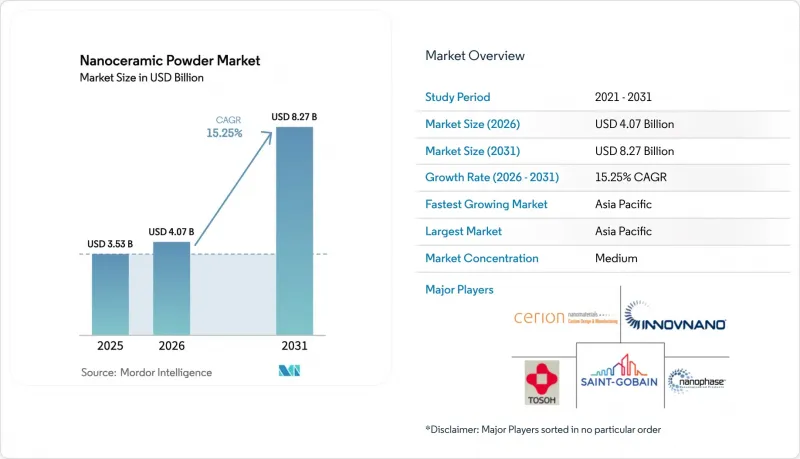
Mordor Intelligence에 따르면 나노세라믹 분말 시장 규모는 2025년에 35억 3,000만 달러, 2026년에 40억 7,000만 달러에 달하고, 2031년까지 82억 7,000만 달러에 달할 것으로 예측되며, 2026년부터 2031년까지 CAGR 15.25%로 성장할 것으로 전망됩니다.
본 보고서는 분말 유형별(산화물, 탄화물, 질화물, 붕소, 기타), 합성 기술별(전기·전자기기, 산업, 운송, 의료 분야, 화학제품, 국방, 기타), 지역별(아시아태평양, 북미, 유럽, 남미, 중동 및 아프리카)로 분류되어 있습니다. 시장 전망은 금액(달러) 기준으로 제시되어 있습니다.
세계 나노세라믹 분말 시장의 동향 및 인사이트
전자 산업에서의 보급
미세화 로드맵에 따라 로직 및 메모리 노드의 유전체 층 두께 목표는 5마이크로미터 이하로 낮아졌습니다. 이 임계값을 달성하기 위해서는 100nm 이하의 알루미나 및 질화알루미늄 분산액의 사용이 필수적입니다. 삼성은 미래를 내다보며 2025년 이후의 자본 계획에 패키징 라인에 대한 막대한 투자를 반영하고 있습니다. 이러한 라인에는 120nm를 초과하는 응집체를 제거하도록 설계된 입자 선별 광학 시스템이 장착되어 있습니다. TSMC는 2nm 공정 흐름에서 알루미늄 산화물 원자층 증착(ALD)용 전구체의 도입을 추진하고 있습니다. 엄격한 공차 하에서 TSMC는 무작위 결함 밀도를 줄이고, 후면 전원 공급의 수율을 높은 수준으로 유지하는 것을 목표로 하고 있습니다. 퀄컴(Qualcomm)의 RF360 모듈에는 유전율이 2,000을 초과하는 티타늄산 바륨(BaTiO₃) 가변 필터가 요구됩니다. 이러한 요구 사항으로 인해 필러 공급업체는 특히 5G 밀리미터파 대역에서 입자 크기 분포를 엄격하게 관리해야 합니다. 이에 대응하여 아시아태평양의 공급업체들은 IEC 60384 추적성 기준을 준수하는 레이저 회절 측정법을 채택하고 있습니다. 이러한 움직임으로 인해 강력한 공정 제어 역량을 갖춘 기존 업체들의 우위가 더욱 공고해지고 있습니다.
의료 분야의 수요
정형외과 및 치과 부문에서는 기존 코발트-크롬 합금 대신 지르코니아 강화 알루미나로 제작된 대퇴골두와 크라운이 점점 더 선호되고 있습니다. 2025년, Zimmer Biomet은 세라믹-온-세라믹(CoC) 베어링이 유럽 내 인공 고관절 치환술 시장에서 이미 상당한 점유율을 확보하고 있으며, 연간 마모율이 0.05mm 이하임을 밝혔습니다. 스외상사는 FDA 510(k) 승인을 획득하고, 진료 시간을 대폭 단축하는 ‘1회 내원 완료’ 지르코니아 수복물을 도입했습니다. 이를 통해 외래 진료 센터에서의 보급이 촉진될 전망입니다. 2025년에 실시된 동료 심사 연구에서, 골이식 블록에 포함된 하이드록시아파타이트 나노파우더가 베타 TCP를 대조군으로 삼았을 때와 비교하여 골유착 속도를 가속화한다는 사실이 밝혀졌습니다. 한편, ISO 13356 규격에서는 분말의 순도를 99.9% 이상으로 규정하고 중금속 함유량을 10ppm 이하로 제한하고 있어, 이에 따라 소규모 제조업체들은 대규모 수직 통합형 복합 기업과 위탁 제조 제휴 관계를 맺고 있습니다.
높은 가공 비용
나노세라믹의 제조 비용은 주로 졸-겔법, 수열법, 기상 응축법 등의 제조 방법에 기인하여, 마이크론 크기의 세라믹에 비해 상당히 높습니다. 화학 기상 증착(CVD) 반응기에서 처리되는 실리콘 카바이드 분말은 다량의 에너지를 소비하기 때문에 전기 요금은 전력 요금 체계에 따라 달라집니다. 2025년, 각 설비 공급업체들은 고에너지 볼 밀에서 처리량에 따라 연간 막대한 매체 교체 비용이 발생한다고 밝혔습니다. 폴리머 분산에 필수적인 실란 처리는 표면 기능화 공정을 통해 추가 비용을 초래합니다. 국제에너지기구(IEA)는 소성 가마의 전기화를 통해 단위 비용을 절감할 수 있다고 시사하고 있지만, 탄소 가격이 일정 임계값 아래로 계속 유지될 경우 투자 회수 기간은 수 년 이상으로 늘어날 것입니다.
부문 분석
2025년 시점에서 산화물 계열 등급이 나노세라믹 분말 시장의 62.72%를 차지하고 있음에도 불구하고, 탄화물 분말, 특히 실리콘 카바이드가 산화물 계열로부터 시장 점유율을 빼앗고 있습니다. 실리콘 카바이드 나노 분말은 현재 200°C의 접합 온도를 견딜 수 있는 와이드 밴드 갭 칩에 없어서는 안 될 존재가 되었습니다. 이러한 발전 덕분에 전기자동차 인버터에서 부피가 큰 냉각 장치를 제거할 수 있게 되었으며, 그 결과 무게가 대폭 감소했습니다. 자동차용 프레스 가공 부문에서는 텅스텐 카바이드 나노그레인 인서트가 경화강 절단 시 공구 수명을 연장하고 기계 가동률을 향상시키고 있습니다. 카바이드 등급 나노세라믹 분말 시장의 규모는 2031년까지 연평균 성장률(CAGR) 17.07%로 확대될 것으로 예측됩니다. 이는 주로 콘덴서, 임플란트, 연마 용도에서의 수요가 지속되고 있기 때문입니다. 질화물, 특히 질화알루미늄 기판은 열 관리 부문에서 틈새 시장을 개척하고 있으며, LED 패키징에 탁월한 열전도성을 자랑합니다. 한편, 붕소계 분말은 비용 측면의 우려를 상회하는 중성자 흡수 능력이 높이 평가되어 방위 및 원자력 부문에서 확고한 입지를 다지고 있습니다. 항공우주 부문에서는 ASTM F3303 규격을 준수하며 1,600°C를 초과하는 산화 임계치를 목표로 한 이붕화티타늄 및 탄화 하프늄 구형체의 평가가적층 제조(Additive Manufacturing) 검사 과정에서 진행되고 있습니다.
각 산화물 공급업체들은 생산능력 확대와 규제 상황에 대한 깊은 이해를 통해 시장 내 입지를 강화하고 있습니다. 알루미나(알루미나)는 다층 세라믹 콘덴서의 주력 소재로 자리매김하고 있지만, 지르코니아의 고유한 인성과 생체적합성 덕분에 정형외과 부문에서 존재감을 높이고 있습니다. 그러나 조달 담당 팀은 특히 이트리아와 같은 희토류 안정제를 둘러싼 지정학적 불안정성을 감안하여, 산화물과 관련된 가격 변동에 대한 우려를 품고 있습니다. 이에 대응하여 각 제조사는 도판트를 최적화한 배치 개발에 주력하고 있으며, 상의 안정성을 유지하면서 이트리아 함유량을 줄이는 데 성공했습니다. 탄화물과 질화물 분말을 우대하는 이러한 가치 동향의 변화는 시장의 양극화를 부각시키고 있습니다. 즉, 대량 생산되는 산화물 제품 라인에서는 비용 효율성이 우선시되는 반면, 탄화물 제품 라인에서는 이익률 향상에 주력하고 있으며, 반도체 및 초음속 응용 분야에 필수적인 정밀한 입자 크기 제어에 중점을 두고 있습니다.
지역별 분석
아시아태평양은 2025년 매출의 50.73%를 차지하며, 연평균 성장률(CAGR) 16.06%로 가장 높은 성장이 예상됩니다. 중국의 ‘중국 제조 2025’ 이니셔티브의 후속 조치에서는 2028년까지 전자 등급 분말의 국내 생산 비율을 높이는 것을 목표로 막대한 보조금이 배정되었습니다. 일본의 NEDO는 6G용 공진기에 사용되는 50nm 이하의 알루미나에 초점을 맞추어 14개의 컨소시엄을 지원하고 있습니다. 세라믹 콘덴서 수출이 활발한 한국은 부산과 세종에 대량의 분말이 필요한 생산 라인을 다수 보유하고 있습니다. 인도의 PLI 제도는 잠나가르에서 진행 중인 LLZO 전해질 시범 프로젝트에 투자하고 있습니다. 한편, 베트남과 태국에서는 세라믹 조립 단지에 대한 외국인 직접 투자(FDI)가 현저히 증가하여 지역 공급망의 회복탄력성이 강화되고 있습니다.
큰 시장 점유율을 차지하는 북미에서는 국방 관련 노력과 막대한 인센티브를 제공하는 ‘CHIPS 법’에 힘입어 시장이 활성화되고 있습니다. 이러한 인센티브 조치에 따라 오하이오주와 애리조나주의 신규 팹에서는 미국산 고순도 알루미나 사용이 의무화되었습니다. 캐나다의 희토류 정제소에 대한 세액 공제는 아직 가동 개시라는 단계에 이르지 못했지만, 멕시코는 USMCA(미국·멕시코·캐나다 협정) 규정의 혜택을 받아 2025년에는 세라믹 코팅이 적용된 엔진 부품을 미국으로 수출할 예정입니다.
매출의 상당 부분을 차지하는 유럽에서는 독일 자동차 산업의 추진, 프랑스의 사프란(Safran)사가 CMC로 제작된 핫 섹션을 통합하는 움직임, 영국의 핵융합로용 타일 투자 등이 눈에 띕니다. 남미, 중동 및 아프리카의 시장 점유율은 합쳐서 작지만, 브라질의 페트로브라스(Petrobras)사가 알루미나 나노입자를 포함한 시추 유체를 검사하고 있으며, 사우디아라비아의 NEOM 프로젝트가 세라믹 코팅된 태양열 집열기를 조달하고 있다는 점이 주목됩니다.
기타 혜택
- 엑셀 형식의 시장 예측(ME) 시트
- 3개월간의 애널리스트 지원
자주 묻는 질문
목차
제1장 소개
제2장 조사 방법
제3장 주요 요약
제4장 시장 구도
제5장 시장 규모와 성장 예측
제6장 경쟁 구도
제7장 시장 기회와 향후 전망
KSM 26.09.03According to Mordor Intelligence, the nanoceramic powder market size is projected to be USD 3.53 billion in 2025, USD 4.07 billion in 2026, and reach USD 8.27 billion by 2031, growing at a CAGR of 15.25% from 2026 to 2031.
This report is Segmented by Powder Type (Oxide, Carbide, Nitride, Boron, and Other Types), Synthesis Technology (Electrical and Electronics, Industrial, Transportation, Medical, Chemical, Defense, and Other End-User Industries), and Geography (Asia-Pacific, North America, Europe, South America, and Middle-East and Africa). Market Forecasts are Provided in Terms of Value (USD).
Global Nanoceramic Powder Market Trends and Insights
Widespread Use in Electronics Industry
Miniaturization roadmaps have pushed dielectric-layer thickness targets below 5 µm in logic and memory nodes. Achieving this threshold now hinges on using sub-100-nm alumina and aluminum-nitride dispersions. Samsung, eyeing the future, has earmarked significant investments in its post-2025 capital plan for packaging lines. These lines come equipped with particle-classification optics, designed to reject agglomerates exceeding 120 nm. TSMC, in its 2 nm process flow, is turning to aluminum-oxide atomic-layer-deposition precursors. With tight tolerances, TSMC aims to reduce random-defect density, ensuring backside-power-delivery yields remain high. Qualcomm's RF360 module is on the hunt for barium-titanate tunable filters, demanding dielectric constants greater than 2,000. This requirement is compelling filler suppliers to ensure tight particle-size distributions, especially for the 5G millimeter-wave bands. In response, suppliers in the Asia-Pacific have adopted laser-diffraction metrology, aligning with IEC 60384 traceability standards. This move further solidifies the advantage for established players with a strong process-control background.
Demand from Healthcare Sector
Orthopedic and dental segments are increasingly favoring zirconia-toughened alumina femoral heads and crowns over traditional cobalt-chrome alloys. In 2025, Zimmer Biomet revealed that ceramic-on-ceramic bearings had already secured a significant share of hip-replacement procedures in Europe, boasting wear rates below 0.05 mm annually. Straumann, having obtained FDA 510(k) clearance, introduced single-visit zirconia restorations that reduce chair time significantly, paving the way for broader adoption in ambulatory centers. A peer-reviewed trial in 2025 highlighted that hydroxyapatite nanopowders in bone-graft blocks accelerated osseointegration speeds compared to beta-TCP controls. Meanwhile, ISO 13356 mandates powder purities greater than 99.9% and restricts heavy metals to less than 10 ppm, prompting smaller mills to forge tolling partnerships with larger, vertically integrated conglomerates.
High Processing Cost
Production costs for nanoceramics soar significantly higher than their micron-scale counterparts, primarily due to methods like sol-gel, hydrothermal, and gas-phase condensation. Silicon-carbide powders, processed in chemical-vapor-deposition reactors, consume substantial energy, leading to electricity bills that depend on tariff rates. Equipment vendors disclosed in 2025 that high-energy ball mills incur notable annual media replacement costs, based on throughput levels. Silane treatments, essential for polymer dispersion, contribute an added cost through surface-functionalization steps. While the IEA suggests that electrifying calcination kilns could reduce unit costs, the payback period stretches beyond several years if carbon prices remain below certain thresholds.
Other drivers and restraints analyzed in the detailed report include:
- Increasing Adoption of High-performance Ceramic Coatings
- Need for High-temperature, Corrosion-resistant Powders in Hypersonic Weapons
- Environmental and Health Regulatory Compliance
For complete list of drivers and restraints, kindly check the Table Of Contents.
Segment Analysis
Carbide powders, notably silicon carbide, are stealing share from oxides despite oxide grades locking in 62.72% of the nanoceramics powder market in 2025. Silicon-carbide nanopowders are now integral to wide-bandgap chips, which can withstand junction temperatures of 200 °C. This advancement allows electric-vehicle inverters to eliminate bulky cooling hardware, resulting in a significant reduction in mass. In the realm of automotive stamping, tungsten-carbide nano-grain inserts boost tool life during hardened-steel cuts, enhancing machine uptime. The nanoceramics powder market size for carbide grades is projected to grow at a 17.07% CAGR through 2031. This is largely due to their continued demand in capacitors, implants, and polishing applications. Nitrides, particularly aluminum-nitride substrates, are carving out niches in thermal management, boasting commendable conductivity for LED packages. Meanwhile, boron-based powders find their footing in defense and nuclear sectors, where their neutron-absorption capabilities overshadow cost considerations. In aerospace, additive-manufacturing trials are evaluating titanium-diboride and hafnium-carbide spheres, aiming for oxidation thresholds exceeding 1,600 °C, in line with ASTM F3303 standards.
Oxide suppliers are bolstering their market position through scaled capacities and a keen understanding of regulatory landscapes. Alumina remains the go-to for multilayer ceramic capacitors, while zirconia's inherent toughness and biocompatibility are carving out a larger presence in orthopedics. However, procurement teams are wary of the price sensitivity associated with oxides, particularly given the geopolitical volatility surrounding rare-earth stabilizers like yttria. In response, producers are innovating with dopant-optimized batches, managing to reduce yttria loadings while ensuring phase stability remains intact. This shift in value dynamics, favoring carbide and nitride powders, highlights a market divergence: while high-volume oxide lines prioritize cost efficiency, carbide lines are honing in on margins, emphasizing precise particle-size control crucial for semiconductor and hypersonic applications.
Complete Report Scope:
- By Powder Type
- Oxide Powder
- Carbide Powder
- Nitride Powder
- Boron Powder
- Other Types
- By Synthesis Technology
- Electrical and Electronics
- Industrial
- Transportation
- Medical
- Chemical
- Defense
- Other End-user Industries
- By Geography
- Asia-Pacific
- China
- India
- Japan
- South Korea
- ASEAN Countries
- Rest of Asia-Pacific
- North America
- United States
- Canada
- Mexico
- Europe
- Germany
- United Kingdom
- France
- Italy
- Russia
- Rest of Europe
- South America
- Brazil
- Argentina
- Rest of South America
- Middle-East and Africa
- Saudi Arabia
- South Africa
- Rest of Middle-East and Africa
- Asia-Pacific
Geography Analysis
Asia-Pacific accounted for 50.73% of 2025 revenue and carries the fastest 16.06% CAGR outlook. China's successor to the "Made in China 2025" initiative has allocated a substantial amount in subsidies, aiming for high domestic content in electronic-grade powders by 2028. Japan's NEDO is backing 14 consortia, focusing on sub-50 nm alumina for 6G resonators. South Korea, with significant exports in ceramic capacitors, boasts numerous powder-demanding lines in Busan and Sejong. India's PLI scheme has invested in LLZO electrolyte pilots in Jamnagar. Meanwhile, Vietnam and Thailand have seen a notable surge in FDI for ceramic assembly parks, enhancing regional supply resilience.
North America, holding a significant market share, is bolstered by defense initiatives and the CHIPS Act, which offers substantial incentives. These incentives mandate U.S.-sourced high-purity alumina for new fabs in Ohio and Arizona. While Canada's tax credit for rare-earth refineries hasn't yet led to commissioning milestones, Mexico benefited from USMCA rules, exporting ceramic-coated engine parts to the U.S. in 2025.
Europe, capturing a notable portion of the revenue, sees Germany's automotive push, France's Safran integrating CMC hot sections, and the UK investing in fusion-reactor tiles. South America and the Middle-East and Africa, together accounting for a smaller share, are highlighted by Brazil's Petrobras testing alumina-nanoparticle drilling fluids and Saudi Arabia's NEOM project procuring ceramic-coated solar-thermal receivers.
- ABM Advance Ball Mill Inc.
- American Elements
- Beijing DK Nano Technology Co. Ltd
- Cerion LLC
- Inframat Advanced Materials LLC
- Innovnano-Materiais Avancados SA
- IoLiTec Ionic Liquids Technologies GmbH
- Nanografi
- Nanophase Technologies Corporation
- Nanoshel LLC
- Nanostructured & Amorphous Materials, Inc.
- NYACOL Nano Technologies Inc.
- PlasmaChem GmbH
- Resonac Corporation
- Saint-Gobain
- Sumitomo Chemical Co., Ltd.
- Tosoh Corporation
- TRUNNANO
Additional Benefits:
- The market estimate (ME) sheet in Excel format
- 3 months of analyst support
TABLE OF CONTENTS
1 Introduction
- 1.1 Study Assumptions and Market Definition
- 1.2 Scope of the Study
2 Research Methodology
3 Executive Summary
4 Market Landscape
- 4.1 Market Overview
- 4.2 Market Drivers
- 4.2.1 Widespread Use in Electronics Industry
- 4.2.2 Demand from Healthcare Sector
- 4.2.3 Increasing Adoption of High-performance Ceramic Coatings
- 4.2.4 Need for High-temperature, Corrosion-resistant Powders in Hypersonic Weapons
- 4.2.5 Quantum-dot and Solid-state Battery Integration
- 4.3 Market Restraints
- 4.3.1 High Processing Cost
- 4.3.2 Environmental and Health Regulatory Compliance
- 4.3.3 Supply-chain Bottlenecks in Rare-earth Precursors
- 4.4 Value Chain Analysis
- 4.5 Porter's Five Forces
- 4.5.1 Bargaining Power of Suppliers
- 4.5.2 Bargaining Power of Buyers
- 4.5.3 Threat of New Entrants
- 4.5.4 Threat of Substitute Products
- 4.5.5 Degree of Competition
- 4.6 Patent Analysis
- 4.7 Raw Material Analysis
5 Market Size and Growth Forecasts (Value)
- 5.1 By Powder Type
- 5.1.1 Oxide Powder
- 5.1.2 Carbide Powder
- 5.1.3 Nitride Powder
- 5.1.4 Boron Powder
- 5.1.5 Other Types
- 5.2 By Synthesis Technology
- 5.2.1 Electrical and Electronics
- 5.2.2 Industrial
- 5.2.3 Transportation
- 5.2.4 Medical
- 5.2.5 Chemical
- 5.2.6 Defense
- 5.2.7 Other End-user Industries
- 5.3 By Geography
- 5.3.1 Asia-Pacific
- 5.3.1.1 China
- 5.3.1.2 India
- 5.3.1.3 Japan
- 5.3.1.4 South Korea
- 5.3.1.5 ASEAN Countries
- 5.3.1.6 Rest of Asia-Pacific
- 5.3.2 North America
- 5.3.2.1 United States
- 5.3.2.2 Canada
- 5.3.2.3 Mexico
- 5.3.3 Europe
- 5.3.3.1 Germany
- 5.3.3.2 United Kingdom
- 5.3.3.3 France
- 5.3.3.4 Italy
- 5.3.3.5 Russia
- 5.3.3.6 Rest of Europe
- 5.3.4 South America
- 5.3.4.1 Brazil
- 5.3.4.2 Argentina
- 5.3.4.3 Rest of South America
- 5.3.5 Middle-East and Africa
- 5.3.5.1 Saudi Arabia
- 5.3.5.2 South Africa
- 5.3.5.3 Rest of Middle-East and Africa
- 5.3.1 Asia-Pacific
6 Competitive Landscape
- 6.1 Market Concentration
- 6.2 Strategic Moves
- 6.3 Market Share(%)/ Ranking Analysis
- 6.4 Company Profiles (includes Global level Overview, Market level overview, Core Segments, Financials as available, Strategic Information, Products and Services, and Recent Developments)
- 6.4.1 ABM Advance Ball Mill Inc.
- 6.4.2 American Elements
- 6.4.3 Beijing DK Nano Technology Co. Ltd
- 6.4.4 Cerion LLC
- 6.4.5 Inframat Advanced Materials LLC
- 6.4.6 Innovnano-Materiais Avancados SA
- 6.4.7 IoLiTec Ionic Liquids Technologies GmbH
- 6.4.8 Nanografi
- 6.4.9 Nanophase Technologies Corporation
- 6.4.10 Nanoshel LLC
- 6.4.11 Nanostructured & Amorphous Materials, Inc.
- 6.4.12 NYACOL Nano Technologies Inc.
- 6.4.13 PlasmaChem GmbH
- 6.4.14 Resonac Corporation
- 6.4.15 Saint-Gobain
- 6.4.16 Sumitomo Chemical Co., Ltd.
- 6.4.17 Tosoh Corporation
- 6.4.18 TRUNNANO
7 Market Opportunities and Future Outlook
- 7.1 White-space and Unmet-need Assessment