

|
시장보고서
상품코드
2121283
이탈리아의 발전 : 시장 점유율 분석, 업계 동향과 통계, 성장 예측(2026-2031년)Italy Power - Market Share Analysis, Industry Trends & Statistics, Growth Forecasts (2026 - 2031) |
||||||
 Mordor Intelligence
Mordor Intelligence에 따르면 이탈리아의 발전 시장 규모(설치 용량 기준)는 2026년 155.68 GW에서 2031년까지 199.10 GW로 확대되고, 예측 기간(2026-2031년) 동안 CAGR은 5.04%에 달할 것으로 전망됩니다.
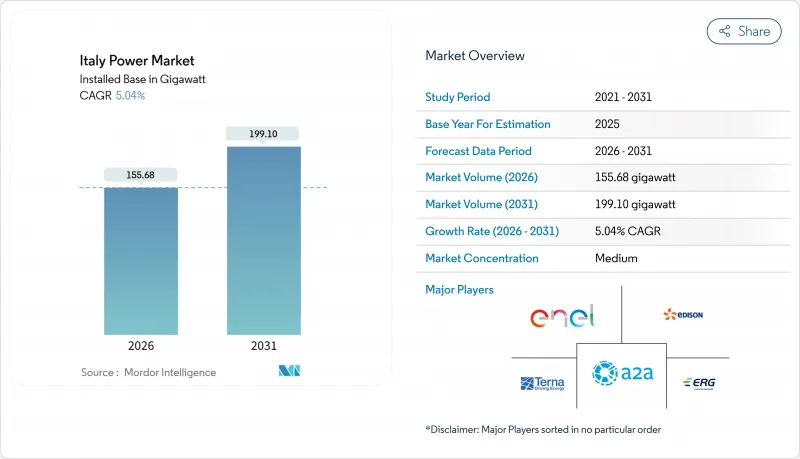
본 보고서는 발전원별(화력, 원자력, 재생에너지) 및 최종사용자별(공익사업, 상업·산업용, 주택)로 분류되어 있습니다. 시장 규모와 전망은 설치 용량(GW) 단위로 제시되어 있습니다.
이탈리아 발전 시장의 동향 및 인사이트
정령 제199/2021호에 따른 허가 절차 개혁 가속화
정령 제199/2021호에 따라 10MW 이하 프로젝트의 경우, 태양광발전 및 육상 풍력발전의 승인 주기가 2년 이상에서 약 6개월로 단축되었습니다. 또한, 제190/2024호 정령에 따라 이 신속한 승인 절차가 리파워링 및 하이브리드 전력 저장 구성으로도 확대되었습니다. 2024년부터 2025년 초까지 15GW를 초과하는 신청이 제출되었습니다. 이 중 상당수는 자원 품질이 가장 우수한 풀리아주, 시칠리아섬, 칼라브리아주에 집중되어 있습니다. 경관을 이유로 한 지자체의 거부권으로 인해, 문화재 보호 구역 내 프로젝트는 여전히 지연되고 있으며, 이탈리아가 EU 전체의 131GW라는 재생에너지 목표에 발맞추려 하고 있음에도 불구하고 지역 간 격차가 발생하고 있습니다. 현재 프로젝트를 성공적으로 추진하기 위해서는 간헐적인 발전 유입을 흡수하면서도 출력 제한을 증가시키지 않도록 송전망 업그레이드를 동시에 진행하는 것이 필수적입니다. 지역 계획 위험에 신속하게 대응할 수 있는 시장 진입 기업은 희소한 송전망 노드를 확보하고, 선구자로서 확실한 수익을 얻을 수 있습니다.
그리드 규모의 에너지 저장 용량 시장 경매(MACSE)
Terna가 실시한 2024년 MACSE 경매에서는 2.3GW 규모의 10년 공급 계약이 체결되어, 이탈리아 발전 시장에서 에너지 저장 전용 수익 구조가 처음으로 확립되었습니다. 낙찰된 프로젝트는 주로 풀리아주와 시칠리아섬의 태양광발전소와 병설된 50MW 규모의 리튬이온 시스템으로, 2025년 여름 가격 차이가 100유로/MWh를 초과한 정오의 공급 과잉 및 저녁 시간대의 피크 수요에 대응하기 위한 것입니다. 이 모델에서는 수년이 소요되는 건설이 필요한 양수 발전 제안은 제외되고, 대신 18개월 이내에 도입 가능한 모듈형 배터리가 우선시되었습니다. Terna의 2026년 경매에서는 6-8시간 카테고리가 도입될 전망이며, 이는 흐름 전지나 압축 공기 저장 기술에 대한 기회가 열리게 될 것입니다. 조기에 진입한 프로젝트 스폰서는 차익 거래와 용량 정산 양쪽에서 이익을 얻는 동시에, 태양광발전 자산을 출력 제한으로부터 보호할 수 있으므로, 자금 조달이 어려운 환경에서도 프로젝트의 자금 조달 가능성을 강화할 수 있습니다.
풀리아 주·시칠리아 섬의 송전망 혼잡(36개월 이상의 지연)
풀리아 주와 시칠리아 섬에는 재생에너지 개발 계획의 40% 이상이 집중되어 있지만, 북쪽에서 남쪽으로의 송전을 가정하고 설계된 150kV 송전선로에서는 현재 역방향 과부하가 발생하고 있어, 2024년에는 8%의 출력 억제를 초래하여,발전 사업자에게 2억 유로 이상의 수익 손실을 초래했습니다. 2023년에 제출된 계통연계 신청은 변전소 보강 공사가 대기열에 꽂혀 있어 36개월 이상의 지연을 겪고 있으며, 개발 사업자는 출력 억제 위험을 프로젝트의 수익성에 전가하는 ‘중단 가능 계약’을 수용할 수밖에 없는 상황입니다. Terna의 110억 유로 규모 ‘하이퍼그리드’계획에 따르면 2034년까지 남부 송전선의 전선 교체와 동적 정격 센서 도입이 이루어질 예정이지만, 그 기간 동안의 병목 현상으로 인해 일시적 용량 정산 또는 그리드 포밍 인버터를 통해 위험이 완화되지 않는 한, 재생에너지의 예상 연평균 성장률(CAGR) 8.9% 달성이 지연될 우려가 있습니다.
부문 분석
2025년에는 재생에너지가 설치 용량의 56.1%를 차지하며 이탈리아 발전 시장에서 가장 큰 점유율을 기록하고 있으며, 2031년까지 연평균 성장률(CAGR) 8.9%로 성장할 것으로 예측됩니다. 2023년에는 태양광발전 용량이 5.3GW 급증하여 이탈리아 태양광발전 시장 규모가 30GW를 돌파했습니다. 이 증설분의 60% 이상은 풀리아주와 시칠리아섬의 상업용 규모 프로젝트에 기인합니다. 석탄 화력 발전소의 폐지로 인해 2025년까지 5.7GW가 감축될 전망이며, 태양광발전과 육상 풍력발전이 주요 대체 전원으로 입지를 공고히 할 것으로 보이지만, 송전망의 병목 현상이 성장세를 둔화시킬 가능성이 있습니다. 해상 풍력은 2028년까지 여전히 극히 미미한 수준에 머물 것이며, 수력발전의 확대는 EU의 물 프레임워크 지침에 의해 제한되고 있어, 전력원의 다각화 선택지는 제한적입니다.
수력발전은 여전히 저수지식과 유수식 발전 자산으로 19GW를 차지하고 있으며, 토스카나 주에서는 지열발전이 약 800MW를 추가하고, 바이오매스 및 폐기물 발전이 4GW를 차지하고 있어, 이로 인해 이탈리아는 유럽에서 가장 다양화된 재생에너지 구성을 갖추고 있습니다. 현재 50GW의 용량을 보유한 복합 사이클 가스 터빈 발전은 재생에너지의 공급 부족을 보완하기 위해 스윙 디스패치로서의 역할을 점점 더 많이 수행하게 될 것으로 보입니다. 개방형 사이클 가스 피크 발전소는 순차적으로 동기 콘덴서로 대체되고 있으며, 원자력 계획에 대해서는 현재 논의되고 있지 않습니다. 전반적으로 재생에너지의 급증은 장기적인 탈탄소화를 뒷받침하는 한편, 이탈리아의 발전 시장이 시스템적 위험 없이 변동하는 발전 공급에 대응할 수 있도록 에너지 저장 및 고전압 직류 송전(HVDC)의 도입이 시급한 과제가 되고 있습니다.
기타 혜택
- 엑셀 형식의 시장 예측(ME) 시트
- 3개월간의 애널리스트 지원
자주 묻는 질문
목차
제1장 소개
제2장 조사 방법
제3장 주요 요약
제4장 시장 구도
제5장 시장 규모와 성장 예측
제6장 경쟁 구도
제7장 시장 기회와 향후 전망
KSM 26.09.03According to Mordor Intelligence, the Italy power market size in terms of installed base is expected to grow from 155.68 gigawatt in 2026 to 199.10 gigawatt by 2031, at a CAGR of 5.04% during the forecast period (2026-2031).
This report is Segmented by Power Source (Thermal, Nuclear, and Renewables) and End-User (Utilities, Commercial and Industrial, and Residential). The Market Sizes and Forecasts are Provided in Terms of Installed Capacity (GW).
Italy Power Market Trends and Insights
Accelerated Permitting Reforms Under Legislative Decree 199/2021
Legislative Decree 199/2021 cut solar and onshore wind approval cycles from more than two years to roughly six months for projects under 10 MW, while Decree 190/2024 extended the fast track to repowering and hybrid storage configurations. Over 15 GW of applications were filed between 2024 and early 2025, concentrated in Apulia, Sicily, and Calabria, where resource quality is strongest. Municipal veto power on landscape grounds continues to slow projects in heritage zones, creating regional disparities even as Italy aligns with its EU-wide 131 GW renewable target. Successful execution now depends on synchronized transmission upgrades that absorb intermittent inflows without driving up curtailment. Market participants who navigate local planning risks first can secure scarce grid nodes and lock in early-mover returns.
Grid-scale Battery Capacity Market Auctions (MACSE)
Terna's 2024 MACSE auction awarded 2.3 GW of 10-year availability contracts, creating the first dedicated revenue stack for storage in the Italy power market. Winning projects, mainly 50 MW lithium-ion systems co-located with solar farms in Apulia and Sicily, address midday oversupply and evening peaks where price spreads topped EUR 100/MWh in summer 2025. The model sidelined pumped-hydro proposals that require multi-year construction and instead favored modular batteries deployable within 18 months. Terna's 2026 auction is expected to introduce a six-to-eight-hour category, opening opportunities for flow batteries and compressed-air storage. Early project sponsors gain dual upside from arbitrage and capacity payments while shielding solar assets from curtailment, strengthening project bankability in a tight financing environment.
Grid Congestion in Apulia & Sicily (>=36-Month Delays)
Apulia and Sicily host more than 40% of the renewable pipeline, yet 150 kV corridors designed for north-to-south flows now experience reverse overloads that triggered 8% curtailment in 2024, costing producers over EUR 200 million in lost revenue. Connection requests lodged in 2023 face >=36-month delays as substations queue for reinforcement, forcing developers to accept interruptible agreements that shift curtailment risk onto project economics. Terna's EUR 11 billion Hypergrid plan will reconductor southern lines and deploy dynamic-rating sensors by 2034, yet interim bottlenecks threaten to slow the forecast 8.9% renewable CAGR unless temporary capacity payments or grid-forming inverters mitigate risk.
Other drivers and restraints analyzed in the detailed report include:
- Coal Phase-Out by 2025 Creating Capacity Gap
- REPowerEU-funded HVDC Projects (Tyrrhenian Link)
- Gas-Import Exposure to Geopolitical Shocks
For complete list of drivers and restraints, kindly check the Table Of Contents.
Segment Analysis
Renewables accounted for 56.1% of installed capacity in 2025, the largest slice of the Italy power market, and are projected to grow at an 8.9% CAGR through 2031. Solar capacity surged by 5.3 GW in 2023, pushing the Italy power market size for solar past 30 GW; utility-scale projects in Apulia and Sicily contributed more than 60% of that buildout. The coal retirement removes 5.7 GW by 2025, cementing solar and onshore wind as primary replacements, though grid bottlenecks could temper momentum. Offshore wind remains marginal until 2028, and hydro expansion is capped by the EU Water Framework Directives, limiting diversification options.
Hydro still contributes 19 GW of reservoir and run-of-river assets, geothermal adds about 800 MW in Tuscany, and biomass-plus-waste holds 4 GW, giving Italy one of Europe's most diversified renewable stacks. Combined-cycle gas turbines, presently 50 GW, will increasingly swing-dispatch to cover renewable droughts. Open-cycle gas peakers are being phased into synchronous condensers, and no nuclear program is under discussion. Altogether, the renewable surge underpins long-run decarbonization but heightens the urgency of storage and HVDC delivery so that the Italy power market can accommodate variable inflows without systemic risk.
Complete Report Scope:
- By Power Source
- Thermal (Coal, Natural Gas, Oil and Diesel)
- Nuclear
- Renewables (Solar, Wind, Hydro, Geothermal, Biomass & Waste, Tidal)
- By End User
- Utilities
- Commercial and Industrial
- Residential
- By T&D Voltage Level (Qualitative Analysis only)
- High-Voltage Transmission (Above 230 kV)
- Sub-Transmission (69 to 161 kV)
- Medium-Voltage Distribution (13.2 to 34.5 kV)
- Low-Voltage Distribution (Up to 1 kV)
List of Companies Covered in this Report:
- Enel SpA
- Terna SpA
- Edison SpA
- A2A SpA
- ERG SpA
- Acea SpA
- Sorgenia SpA
- Hera Group
- Eni Plenitude
- ENGIE SA (Italy)
- Renantis (Falck Renewables)
- Vestas Wind Systems A/S
- Siemens Gamesa Renewable Energy SA
- Prysmian Group
- Sonnedix Power Holdings Ltd
- SunPower Corporation
- RWE Renewables Italia
- Iberdrola Renovables Italia
- InterGen SpA
- PLT Energia SRL
Additional Benefits:
- The market estimate (ME) sheet in Excel format
- 3 months of analyst support
TABLE OF CONTENTS
1 Introduction
- 1.1 Study Assumptions & Market Definition
- 1.2 Scope of the Study
2 Research Methodology
3 Executive Summary
4 Market Landscape
- 4.1 Market Overview
- 4.2 Market Drivers
- 4.2.1 Accelerated Permitting Reforms under Legislative Decree 199/2021
- 4.2.2 Grid-scale Battery Capacity Market Auctions (Terna)
- 4.2.3 Coal Phase-out by 2025 Creating Capacity Gap
- 4.2.4 REPowerEU-funded HVDC Projects (e.g., Tyrrhenian Link)
- 4.2.5 Corporate PPAs Surge among Luxury & FMCG Majors
- 4.2.6 Superbonus 110 % Stimulus for Rooftop PV
- 4.3 Market Restraints
- 4.3.1 Grid Congestion in Apulia & Sicily (>=36-month Delays)
- 4.3.2 Offshore Wind Tender Under-realisation (Adriatic)
- 4.3.3 Gas-Import Exposure to Geopolitical Shocks (≈90 %)
- 4.3.4 Landscape-related Permit Litigation for Wind Farms
- 4.4 Supply-Chain Analysis
- 4.5 Regulatory Outlook
- 4.6 Technological Outlook (Digitalisation, HVDC, Storage)
- 4.7 Porters Five Forces
- 4.7.1 Bargaining Power of Suppliers
- 4.7.2 Bargaining Power of Buyers
- 4.7.3 Threat of New Entrants
- 4.7.4 Threat of Substitutes
- 4.7.5 Competitive Rivalry
- 4.8 PESTLE Analysis
5 Market Size & Growth Forecasts
- 5.1 By Power Source
- 5.1.1 Thermal (Coal, Natural Gas, Oil and Diesel)
- 5.1.2 Nuclear
- 5.1.3 Renewables (Solar, Wind, Hydro, Geothermal, Biomass & Waste, Tidal)
- 5.2 By End User
- 5.2.1 Utilities
- 5.2.2 Commercial and Industrial
- 5.2.3 Residential
- 5.3 By T&D Voltage Level (Qualitative Analysis only)
- 5.3.1 High-Voltage Transmission (Above 230 kV)
- 5.3.2 Sub-Transmission (69 to 161 kV)
- 5.3.3 Medium-Voltage Distribution (13.2 to 34.5 kV)
- 5.3.4 Low-Voltage Distribution (Up to 1 kV)
6 Competitive Landscape
- 6.1 Market Concentration
- 6.2 Strategic Moves (M&A, Partnerships, PPAs)
- 6.3 Market Share Analysis (Market Rank/Share for key companies)
- 6.4 Company Profiles (includes Global level Overview, Market level overview, Core Segments, Financials as available, Strategic Information, Products & Services, and Recent Developments)
- 6.4.1 Enel SpA
- 6.4.2 Terna SpA
- 6.4.3 Edison SpA
- 6.4.4 A2A SpA
- 6.4.5 ERG SpA
- 6.4.6 Acea SpA
- 6.4.7 Sorgenia SpA
- 6.4.8 Hera Group
- 6.4.9 Eni Plenitude
- 6.4.10 ENGIE SA (Italy)
- 6.4.11 Renantis (Falck Renewables)
- 6.4.12 Vestas Wind Systems A/S
- 6.4.13 Siemens Gamesa Renewable Energy SA
- 6.4.14 Prysmian Group
- 6.4.15 Sonnedix Power Holdings Ltd
- 6.4.16 SunPower Corporation
- 6.4.17 RWE Renewables Italia
- 6.4.18 Iberdrola Renovables Italia
- 6.4.19 InterGen SpA
- 6.4.20 PLT Energia SRL
7 Market Opportunities & Future Outlook
- 7.1 White-space & Unmet-Need Assessment


