
|
시장보고서
상품코드
2121304
M2M 연결 : 시장 점유율 분석, 업계 동향과 통계, 성장 예측(2026-2031년)M2M Connections - Market Share Analysis, Industry Trends & Statistics, Growth Forecasts (2026 - 2031) |
||||||
 Mordor Intelligence
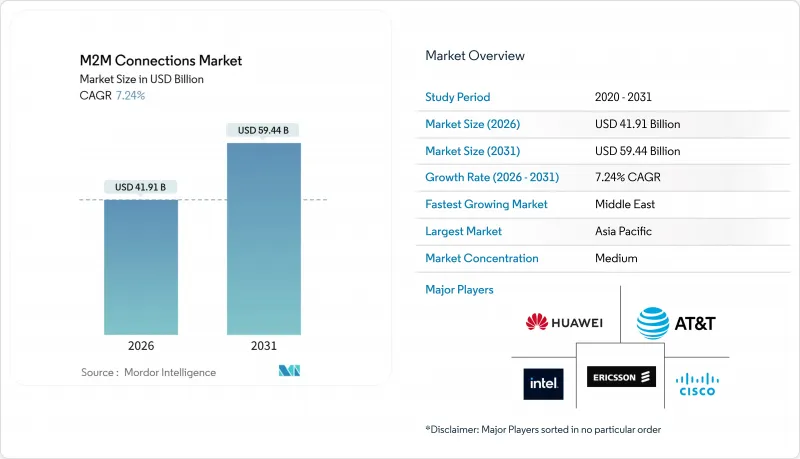
Mordor Intelligence에 따르면 M2M 연결 시장 규모는 2026년에 419억 1,000만 달러에 달하고, 2031년까지 594억 4,000만 달러에 달할 것으로 예측되며, CAGR은 7.24%로 확대될 전망입니다.
본 보고서는 연결 유형(유선, 무선), 기술(셀룰러 연결, 저전력 광역 통신(LPWA), 단거리 통신, 대도시 지역 네트워크(MAN), 광역 고정 통신, 위성 통신), 전개 모델(온프레미스, 클라우드, 하이브리드), 최종사용자 산업(소매, 은행·금융 기관, 통신·IT, 기타), 지역별로 분류되어 있습니다. 시장 전망은 금액(달러) 기준으로 제시되어 있습니다.
세계 M2M 연결 시장의 동향 및 인사이트
산업 전반에 걸친 IoT 기기의 보급
산업 기업들은 과거에는 고립되어 있던 장비에 센서를 내장하고, 예측 유지보수 프로그램에 활용되는 텔레메트리 데이터를 수집함으로써 예기치 못한 가동 중단 시간과 에너지 낭비를 줄이고 있습니다. 제조사의 보조금 및 모듈 가격 하락(NB-IoT 칩셋은 현재 5달러 미만입니다) 덕분에 저가 자산에서도 연결성이 실현되고 있습니다. 소매 체인에서는 자동으로 재입고를 촉발하는 스마트 선반을 도입하고 있으며, 파이프라인 사업자는 누수를 수 분 이내에 감지하는 압력 센서를 수천 킬로미터에 달하는 인프라에 설치하고 있습니다. 이러한 움직임이 가장 두드러지는 분야는 1시간의 가동 중단으로 6자리 수의 손실이 발생하는 중공업, 광업, 석유화학 산업입니다. 장비 제조업체들은 현재 연결 기능을 표준으로 탑재한 기계를 출하하고 있으며, 이로 인해 도입 대수가 가속화되고 사업자 및 분석 벤더의 지속적인 서비스 수익이 촉진되고 있습니다.
모바일 연결 수의 증가와 스마트폰 보급률 상승
신흥 시장에서 스마트폰이 급속히 보급됨에 따라 통신 사업자는 기존의 LTE 및 5G 통신 용량을 재사용할 수 있게 되었으며, M2M 엔드포인트를 추가할 때의 한계 비용이 낮아지고 있습니다. 인도 통신부는 새로 설치되는 모든 통신탑에 NB-IoT 및 LTE-M 지원을 의무화하고 있으며, 이로 인해 농촌 지역의 농업용 센서 커버리지가 확대되고 있습니다. 기술자들은 현재 전용 노트북 대신 핸드헬드 단말기의 블루투스나 NFC를 통해 게이트웨이를 설정함으로써 설치 시간을 몇 시간에서 몇 분으로 단축하고 있습니다. 차이나모바일의 ‘OneLink’ 플랫폼은 2024년 9월까지 12개월 동안 1억 8,000만 건의 연결 수를 늘리며, 앱 기반 온보딩의 확장성을 입증했습니다. 물류 차량 플릿에서도 유사한 변화가 나타나고 있으며, 운전자가 스마트폰을 차량 단말기와 페어링하여 전용 스캐너 없이도 텔레매틱스 데이터를 업로드할 수 있게 됨에 따라, 통신 사업자의 수익성에 대한 플라이휠 효과가 더욱 강화되고 있습니다.
M2M 통신의 개인정보 보호 및 보안 우려
취약한 인증 및 구형 펌웨어는 중요 인프라를 위험에 빠뜨리고 있습니다. CISA는 2024년에 23건의 산업 제어 시스템 관련 권고안을 발표하며, 하드코딩된 인증 정보와 보안 조치가 미흡한 부트로더를 지적했습니다. 제조사가 기본 비밀번호를 그대로 둔 채 기기를 출하한 결과, 봇넷에 의해 4만 대의 라우터가 장악되는 사태가 발생하며 프로비저닝상의 미비점이 드러났습니다. 의료 규제 당국은 인슐린 펌프와 심전도 모니터에 대해 종단 간 암호화를 요구하고 있으며, 이로 인해 규정 준수 비용이 증가하고 제품 출시가 지연되고 있습니다. 기업들은 제로 트러스트 아키텍처를 도입하고 있지만, 레거시 센서에 암호화 하드웨어를 사후 장착하는 것은 가치가 낮은 자산의 경우 여전히 비용 면에서 현실적이지 않습니다. IEC 62443과 같은 인증 제도는 부품 원가를 10-15% 끌어올려 이익률을 압박하고 있습니다.
부문 분석
2025년 현재, M2M 연결 시장의 72.33%를 무선 회선이 차지하고 있으며, 2031년까지 연평균 성장률(CAGR) 7.66%를 기록할 전망입니다. 호주와 칠레의 광산 기업들은 광대한 채굴 현장을 LTE-M으로 커버하여, 고가의 광섬유 설치를 필요로 하지 않고 자율주행 트럭을 연결하고 있습니다. 스마트 농업의 경우, 세분화된 농지에 산재한 센서나 기상 관측소 때문에 도랑을 파는 공사의 비용 대비 효과를 얻을 수 없기 때문에 무선 통신이 선호되고 있습니다. 파이프라인이나 해상 자산의 통신 사각지대를 메우는 것은 위성 통신이며, 이리듐(Iridium)과 세계스타(Globalstar)는 지상파 전파가 닿지 않는 지역에서 협대역 서비스를 제공하고 있습니다.
2022년부터 2024년까지 모듈 가격이 40% 하락하는 반면, 숙련된 인력 부족으로 유선 설치 비용이 상승하고 있어 총 소유 비용(TCO)은 계속해서 무선 쪽으로 기울고 있습니다. 유선 이더넷은 빌딩 자동화 부문에서 여전히 확고한 입지를 유지하고 있습니다. 이 부문에서는 PoE(Power over Ethernet)를 통해 프로비저닝이 간소화되고 배터리 유지보수가 불필요해집니다. 신뢰성과 비용의 균형을 맞추기 위해 유선 센서 클러스터를 셀룰러 백홀로 통합하는 하이브리드 토폴로지가 등장하고 있지만, M2M 연결 시장 전체에서는 여전히 무선 기술이 확고한 성장세를 유지하고 있습니다.
2025년에는 고대역폭 동영상 및 실시간 추적을 지원하는 LTE 및 5G 네트워크의 보급에 힘입어, 셀룰러 연결이 M2M 연결 시장 점유율의 47.19%를 차지할 것으로 전망됩니다. NB-IoT와 LTE-M은 계량기 및 환경 모니터의 배터리 수명을 연장하여, LPWA를 2031년까지 연평균 성장률(CAGR) 8.41%라는 가장 빠른 성장 궤도로 끌어올리고 있습니다. 차이나모바일만 해도 14억 7,000만 회선 이상의 IoT 회선을 관리하고 있으며, 그 대부분은 NB-IoT를 이용하고 있습니다.
블루투스 저에너지(Bluetooth Low Energy)나 지그비(Zigbee)와 같은 단거리 무선 기술은 게이트웨이에서 100미터 이내의 웨어러블 기기나 스마트홈 클러스터에서 주류를 이루고 있습니다. LoRaWAN은 셀룰러 데이터 요금제가 지속 불가능한 정기 비용을 초래하는 도시 규모의 배포에서 중간적인 위치를 차지하고 있으며, 암스테르담과 싱가포르에서는 주차장 및 대기질 센서를 호스팅하는 공공 네트워크가 운영되고 있습니다. 위성 기술은 해상, 항공, 외딴 지역의 파이프라인에서 여전히 필수적이며, 칩셋 공급업체들이 현재 동적 네트워크 선택이 가능한 통합 무선 기능으로 대응하고 있는 다중 모드 환경을 강화하고 있습니다.
지역별 분석
2025년에는 스마트 시티 및 공공 사업에 대한 정부 규제를 배경으로 아시아태평양이 전 세계 연결 건수의 33.82%를 차지했습니다. 중국의 막대한 도입 대수에 더해, 인도의 ‘국가 IoT 정책’이 이를 보완하고 있습니다. 이 정책은 2027년까지 5억 대의 기기 도입을 목표로 하고 있으며, 모듈 제조업체에 보조금을 지급하고 있습니다. 일본에서는 5G 독립형 네트워크를 활용한 V2I(차량 대 인프라) 사용 사례가 시범적으로 도입되고 있는 반면, 한국에서는 공장 자동화를 뒷받침하는 민간 5G 테스트베드에 자금을 지원하고 있습니다.
북미와 유럽에서는 기업들이 부가가치가 높은 분석 및 엄격한 보안 인증에 주력하고 있어 연결 수 증가세는 완만하지만, 회선당 수익은 더 높아지고 있습니다. 2025년 1월에 발효될 유럽연합(EU)의 ‘무선 기기 지침’에서는 모든 기기가 안전한 소프트웨어 업데이트를 지원하도록 의무화하고 있어, 규정 준수 부담은 커지겠지만 연결된 엔드포인트에 대한 신뢰도는 높아질 것입니다. 미국에서는 FirstNet이 공공안전용 M2M 트래픽에 우선 차선을 제공하고 있으며, 2024년 중반까지 500만 대의 기기가 이용될 전망입니다.
중동에서는 사우디아라비아 NEOM의 100만 개 센서 도입과 에너지 사용량을 30% 절감한 두바이의 스마트 인프라에 힘입어, 2031년까지 연평균 성장률(CAGR)이 8.91%로 가장 높을 것으로 예측됩니다. 남미에서는 브라질 농업부의 보조금 지원에 힘입어 브라질과 아르헨티나에서 정밀 농업 도입이 집중되고 있습니다. 아프리카에서는 농촌 지역의 보급률이 뒤처지고 있지만, 남아프리카공화국과 이집트의 도시 지역에서 NB-IoT가 확산됨에 따라 계량 및 차량 관리가 점차 가능해지고 있습니다.
기타 혜택
- 엑셀 형식의 시장 예측(ME) 시트
- 3개월간의 애널리스트 지원
자주 묻는 질문
목차
제1장 소개
제2장 조사 방법
제3장 주요 요약
제4장 시장 구도
제5장 시장 규모와 성장 예측
제6장 경쟁 구도
제7장 시장 기회와 향후 전망
KSM 26.09.03According to Mordor Intelligence, the M2M connections market size stands at USD 41.91 billion in 2026 and is forecast to reach USD 59.44 billion by 2031, expanding at a 7.24% CAGR.
This report is Segmented by Connection Type (Wired, and Wireless), Technology (Cellular Connections, Low Power Wide Area (LPWA), Short Range, Metropolitan Area Network (MAN), Wide Area Fixed, Satellite), Deployment Model (On-Premise, Cloud, Hybrid), End-User Industry (Retail, Banking and Financial Institutions, Telecom and IT, and More), and Geography. Market Forecasts are Provided in Terms of Value (USD).
Global M2M Connections Market Trends and Insights
Proliferation Of IoT Devices Across Industries
Industrial firms are embedding sensors in once-isolated equipment to collect telemetry that feeds predictive maintenance programs, trimming unplanned downtime and energy waste. Manufacturer subsidies and falling module prices, now below USD 5 for NB-IoT chipsets, make connectivity viable for low-value assets. Retail chains run smart shelves that trigger restocks automatically, and pipeline operators outfit thousands of kilometers of infrastructure with pressure sensors that detect leaks within minutes. Momentum is strongest in heavy industry, mining, and petrochemicals, where every hour of outage carries six-figure losses. Equipment makers now ship connectivity-ready machines by default, accelerating the installed base and stimulating recurring service revenue for operators and analytics vendors.
Increasing Number Of Mobile Connections And Smartphone Penetration
Rapid smartphone adoption in emerging markets lowers the marginal cost of adding M2M endpoints by allowing carriers to reuse existing LTE and 5G capacity. India's Department of Telecommunications requires every new tower to support NB-IoT and LTE-M, expanding rural coverage for agriculture sensors. Technicians now provision gateways via Bluetooth and NFC on handheld devices rather than proprietary laptops, cutting installation times from hours to minutes. China Mobile's OneLink platform added 180 million connections in the 12 months ending September 2024, proving the scalability of app-based onboarding. Logistics fleets mirror this shift, as drivers pair smartphones with vehicle units to upload telematics without dedicated scanners, reinforcing the flywheel effect for operator economics.
Privacy And Security Concerns In M2M Communications
Weak authentication and outdated firmware expose critical infrastructure. CISA issued 23 industrial control advisories in 2024, citing hardcoded credentials and insecure bootloaders. A botnet hijacked 40,000 routers after manufacturers shipped devices with default passwords, underscoring provisioning lapses. Healthcare regulators demand end-to-end encryption for insulin pumps and cardiac monitors, raising compliance costs and delaying launches. Enterprises are adopting zero-trust architectures, but retrofitting cryptographic hardware onto legacy sensors remains cost-prohibitive for low-value assets. Certification regimes such as IEC 62443 add 10-15% to the bill of materials, squeezing margins.
Other drivers and restraints analyzed in the detailed report include:
- Growing Adoption Of Telematics In Automotive And Transport
- Integration of eSIM Technology Enabling Massive M2M Scalability
- Lack Of Global M2M Standards And Interoperability
For complete list of drivers and restraints, kindly check the Table Of Contents.
Segment Analysis
Wireless links accounted for 72.33% of the M2M connections market in 2025 and are on track for a 7.66% CAGR through 2031. Mining companies in Australia and Chile cover sprawling pits with LTE-M, connecting autonomous haul trucks without costly fiber runs. Smart agriculture favors wireless because sensors and weather stations spread across fragmented acreage cannot justify trenching. Satellite fills coverage gaps for pipelines and maritime assets, with Iridium and Globalstar offering narrowband service where terrestrial signals fade.
Total cost of ownership keeps tilting toward wireless as module prices drop 40% between 2022 and 2024, while skilled-labor shortages drive up wired-installation costs. Wired Ethernet still holds its ground in building automation, where power-over-Ethernet simplifies provisioning and eliminates battery maintenance. Hybrid topologies are emerging, aggregating wired sensor clusters into cellular backhaul to balance reliability and cost, but the overall momentum remains firmly behind wireless in the M2M connections market.
Cellular connections secured 47.19% of the M2M connections market share in 2025, driven by ubiquitous LTE and 5G networks that support high-bandwidth video and real-time tracking. NB-IoT and LTE-M extend battery life for meters and environmental monitors, propelling LPWA toward the fastest 8.41% CAGR to 2031. China Mobile alone manages more than 1.47 billion IoT lines, the majority of which are on NB-IoT.
Short-range radios like Bluetooth Low Energy and Zigbee dominate wearables and smart home clusters within 100 meters of a gateway. LoRaWAN occupies a middle ground for city-scale deployments where cellular data plans incur unsustainable recurring fees, with Amsterdam and Singapore running public networks that host parking and air-quality sensors. Satellite technologies remain indispensable for maritime, aviation, and remote pipelines, reinforcing a multi-modal landscape that chipset vendors now address with integrated radios capable of dynamic network selection.
Complete Report Scope:
- By Connection Type
- Wired
- Wireless
- By Technology
- Cellular Connections
- Low Power Wide Area (LPWA)
- Short Range
- Metropolitan Area Network (MAN)
- Wide Area Fixed
- Satellite
- By Deployment Model
- On-Premise
- Cloud
- Hybrid
- By End-User Industry
- Retail
- Banking and Financial Institutions
- Telecom and IT
- Healthcare
- Automotive
- Oil and Gas
- Transportation
- Other End-User Industries
- By Geography
- North America
- United States
- Canada
- Mexico
- Europe
- Germany
- United Kingdom
- France
- Russia
- Rest of Europe
- Asia-Pacific
- China
- Japan
- India
- South Korea
- Australia
- Rest of Asia-Pacific
- Middle East and Africa
- Middle East
- Saudi Arabia
- United Arab Emirates
- Rest of Middle East
- Africa
- South Africa
- Egypt
- Rest of Africa
- Middle East
- South America
- Brazil
- Argentina
- Rest of South America
- North America
Geography Analysis
Asia-Pacific accounted for 33.82% of global connections in 2025, driven by state mandates for smart cities and utilities. China's vast installed base is complemented by India's National IoT Policy, which aims to reach 500 million devices by 2027 and offers subsidies to module makers. Japan trials vehicle-to-infrastructure use cases over 5G standalone networks, while South Korea funds private 5G testbeds that anchor factory automation.
North America and Europe show slower connection growth yet richer revenue per line as enterprises focus on value-added analytics and stringent security certifications. The European Union's Radio Equipment Directive, effective January 2025, requires all devices to support secure software updates, raising compliance hurdles but boosting trust in connected endpoints. In the United States, FirstNet provides priority lanes for public-safety M2M traffic, tallying 5 million devices by mid-2024.
The Middle East projects the highest CAGR of 8.91% through 2031, fueled by Saudi Arabia's NEOM deployment of 1 million sensors and Dubai's smart infrastructure, which cut energy use by 30%. South America sees concentrated adoption of precision agriculture in Brazil and Argentina, aided by subsidies from the Brazilian Ministry of Agriculture. Africa lags in rural coverage, but urban NB-IoT rollouts in South Africa and Egypt are enabling metering and fleet management.
- AT&T Inc.
- Vodafone Group Plc
- Deutsche Telekom AG
- China Mobile Ltd.
- Verizon Communications Inc.
- Cisco Systems Inc.
- Huawei Technologies Co., Ltd.
- Intel Corporation
- Sierra Wireless Inc.
- Telefonica SA
- Telit Communications PLC
- Gemalto NV (Thales Group)
- Ericsson AB
- Orange Business Services
- Telenor Group
- China Unicom Ltd.
- VMware Inc.
- Texas Instruments Incorporated
- Quectel Wireless Solutions Co., Ltd.
- Semtech Corporation
Additional Benefits:
- The market estimate (ME) sheet in Excel format
- 3 months of analyst support
TABLE OF CONTENTS
1 INTRODUCTION
- 1.1 Study Assumptions and Market Definition
- 1.2 Scope of the Study
2 RESEARCH METHODOLOGY
3 EXECUTIVE SUMMARY
4 MARKET LANDSCAPE
- 4.1 Market Overview
- 4.2 Market Drivers
- 4.2.1 Proliferation of IoT Devices Across Industries
- 4.2.2 Increasing Number of Mobile Connections and Smartphone Penetration
- 4.2.3 Growing Adoption of Telematics in Automotive and Transport
- 4.2.4 Integration of eSIM Technology Enabling Massive M2M Scalability
- 4.2.5 Rise of Private 5G Networks for Industrial M2M Applications
- 4.2.6 Emerging Demand for Real-Time Edge Analytics Reducing Latency
- 4.3 Market Restraints
- 4.3.1 Privacy and Security Concerns in M2M Communications
- 4.3.2 Lack of Global M2M Standards and Interoperability
- 4.3.3 Scarcity of IPv4 Address Space and Delays in IPv6 Transition
- 4.3.4 Supply-Chain Disruptions for Specialized M2M Chipsets
- 4.4 Industry Value Chain Analysis
- 4.5 Impact of Macroeconomic Factors on the Market
- 4.6 Regulatory Landscape
- 4.7 Technological Outlook
- 4.8 Porter's Five Forces Analysis
- 4.8.1 Bargaining Power of Suppliers
- 4.8.2 Bargaining Power of Buyers
- 4.8.3 Threat of New Entrants
- 4.8.4 Threat of Substitute Products
- 4.8.5 Intensity of Competitive Rivalry
- 4.9 Assessment of the Impact of COVID-19 on the Market
5 MARKET SIZE AND GROWTH FORECASTS (VALUE)
- 5.1 By Connection Type
- 5.1.1 Wired
- 5.1.2 Wireless
- 5.2 By Technology
- 5.2.1 Cellular Connections
- 5.2.2 Low Power Wide Area (LPWA)
- 5.2.3 Short Range
- 5.2.4 Metropolitan Area Network (MAN)
- 5.2.5 Wide Area Fixed
- 5.2.6 Satellite
- 5.3 By Deployment Model
- 5.3.1 On-Premise
- 5.3.2 Cloud
- 5.3.3 Hybrid
- 5.4 By End-User Industry
- 5.4.1 Retail
- 5.4.2 Banking and Financial Institutions
- 5.4.3 Telecom and IT
- 5.4.4 Healthcare
- 5.4.5 Automotive
- 5.4.6 Oil and Gas
- 5.4.7 Transportation
- 5.4.8 Other End-User Industries
- 5.5 By Geography
- 5.5.1 North America
- 5.5.1.1 United States
- 5.5.1.2 Canada
- 5.5.1.3 Mexico
- 5.5.2 Europe
- 5.5.2.1 Germany
- 5.5.2.2 United Kingdom
- 5.5.2.3 France
- 5.5.2.4 Russia
- 5.5.2.5 Rest of Europe
- 5.5.3 Asia-Pacific
- 5.5.3.1 China
- 5.5.3.2 Japan
- 5.5.3.3 India
- 5.5.3.4 South Korea
- 5.5.3.5 Australia
- 5.5.3.6 Rest of Asia-Pacific
- 5.5.4 Middle East and Africa
- 5.5.4.1 Middle East
- 5.5.4.1.1 Saudi Arabia
- 5.5.4.1.2 United Arab Emirates
- 5.5.4.1.3 Rest of Middle East
- 5.5.4.2 Africa
- 5.5.4.2.1 South Africa
- 5.5.4.2.2 Egypt
- 5.5.4.2.3 Rest of Africa
- 5.5.4.1 Middle East
- 5.5.5 South America
- 5.5.5.1 Brazil
- 5.5.5.2 Argentina
- 5.5.5.3 Rest of South America
- 5.5.1 North America
6 COMPETITIVE LANDSCAPE
- 6.1 Market Concentration
- 6.2 Strategic Moves
- 6.3 Market Share Analysis
- 6.4 Company Profiles (includes global level overview, market level overview, core segments, financials as available, strategic information, market rank/share for key companies, products and services, and recent developments)
- 6.4.1 AT&T Inc.
- 6.4.2 Vodafone Group Plc
- 6.4.3 Deutsche Telekom AG
- 6.4.4 China Mobile Ltd.
- 6.4.5 Verizon Communications Inc.
- 6.4.6 Cisco Systems Inc.
- 6.4.7 Huawei Technologies Co., Ltd.
- 6.4.8 Intel Corporation
- 6.4.9 Sierra Wireless Inc.
- 6.4.10 Telefonica SA
- 6.4.11 Telit Communications PLC
- 6.4.12 Gemalto NV (Thales Group)
- 6.4.13 Ericsson AB
- 6.4.14 Orange Business Services
- 6.4.15 Telenor Group
- 6.4.16 China Unicom Ltd.
- 6.4.17 VMware Inc.
- 6.4.18 Texas Instruments Incorporated
- 6.4.19 Quectel Wireless Solutions Co., Ltd.
- 6.4.20 Semtech Corporation
7 MARKET OPPORTUNITIES AND FUTURE OUTLOOK
- 7.1 White-Space and Unmet-Need Assessment