

|
시장보고서
상품코드
2121306
항공우주용 패스너 : 시장 점유율 분석, 업계 동향과 통계, 성장 예측(2026-2031년)Aerospace Fasteners - Market Share Analysis, Industry Trends & Statistics, Growth Forecasts (2026 - 2031) |
||||||
 Mordor Intelligence
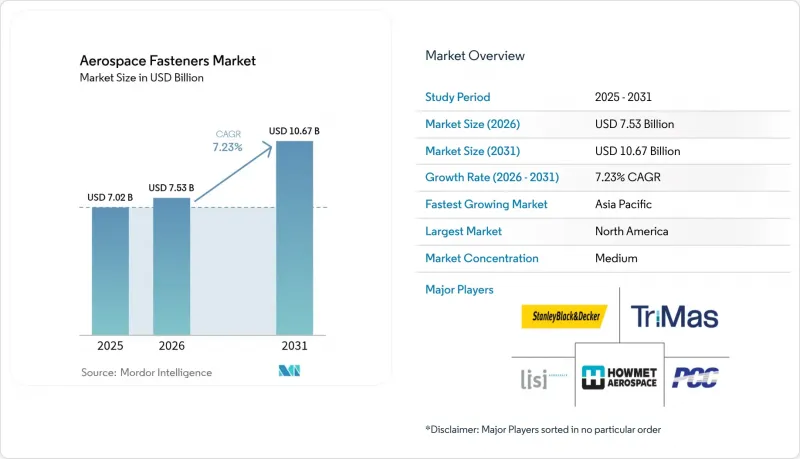
Mordor Intelligence에 의하면, 항공우주용 패스너 시장 규모는 2025년에 70억 2,000만 달러로 평가되었고, 2026년 75억 3,000만 달러에서 2031년까지 106억 7,000만 달러에 이를 것으로 예측되며, 예측 기간(2026년-2031년) CAGR은 7.23%를 기록할 전망입니다.
본 보고서는 제품 유형(볼트·나사, 너트·칼라, 리벳·블라인드 패스너, 핀·인서트, 특수/패널용 패스너), 재질(알루미늄 합금, 티타늄 합금 등), 용도(민간 항공기 등), 최종 사용자(민간·군사),지역(북미, 유럽 등)별로 분류되어 있습니다. 시장 예측은 금액(달러) 기준으로 제시되어 있습니다.
전 세계 항공우주용 패스너 시장 동향 및 인사이트
민간 항공기 생산 및 납품 가속화
에어버스사의 8,600대, 보잉사의 6,100대를 넘는 사상 최대의 미인도 주문량은 인증된 볼트, 나사, 리벳 및 특수 패널용 패스너의 수주 증가로 직접 이어지고 있습니다. 기체당 약 100만 개의 패스너가 필요한 단일 통로 제트기가 생산 확대의 중심이 되고 있어, 공급업체의 생산 능력을 압박하는 동시에 대량 생산 라인에서 프리미엄 가격 책정이 가능하게 하고 있습니다. LISI AEROSPACE는 2024년 매출이 8억 3,890만 유로(9억 8,670만 달러)에 달했다고 보고했습니다. 이는 단일 통로 항공기 생산 속도의 가속화와 유럽 내 패스너 사업의 26.5% 증가에 기인한 것으로, 전년 대비 17% 증가한 수치입니다. 엠브라에르가 예측한 150석 미만의 신형 제트기 10,500대라는 전망은 기존의 협폭기 프로그램을 뛰어넘는 장기적인 수요를 뒷받침하고 있습니다. 레이저 유도 로봇을 핵심으로 하는 자동 조립 셀은 항공우주용 패스너 시장 전체에서 생산량과 품질의 일관성을 향상시키고 있습니다.
항공기 기단의 현대화 및 경량화 추진
연료 소비량을 15-20% 절감하는 것을 목표로 하는 항공사들은 항공기의 공차 중량을 줄여주는 첨단 합금과 통합형 체결 솔루션을 점점 더 많이 지정하고 있습니다. Ti-6Al-2Sn-2Zr-2Mo-2Cr 등의 티타늄 등급은 엄격한 피로 강도 기준을 충족하면서 강철 부품에 비해 최대 30%의 경량화를 실현합니다. CFRP 외판과 금속 프레임을 접합할 때 갈바닉 부식을 방지하는 복합재료용 폴리머 패스너는 가장 빠르게 보급되고 있으며, 2030년까지 연평균 10.65%의 성장이 예상됩니다. B787 및 A350 기체의 사례에서 볼 수 있듯이, 전략적인 패스너 경량화를 통해 구조 전체의 질량을 2-3% 줄일 수 있습니다. 이러한 추세는 캡티브 너트, 씰, 퀵 릴리스 기능을 통합한 특수 패널용 장치로도 확대되고 있으며, 대량 생산되는 도어 및 내장 모듈의 부품 수 감소로 이어지고 있습니다.
원자재 가격 변동이 비용 안정성에 영향
항공우주용 티타늄 가격은 2024년 초부터 2025년 말까지 10.91% 상승하여 파운드당 15-30달러에 달했습니다. 이에 비해 상용 등급의 가격은 파운드당 6-10달러였습니다. 러시아·우크라이나 분쟁과 수출 규제 강화로 인해 각 OEM 기업들은 다년 계약을 통해 공급량을 확보하거나 재활용 공정을 수직 통합하는 움직임을 가속화하고 있습니다. 또한, 유럽 제련소의 에너지 관련 규제로 인해 알루미늄과 니켈 비용이 상승하면서, 패스너 공급업체들은 원자재 헤지를 실시할지, 아니면 비용을 고객에게 전가할지에 대한 압박이 커지고 있습니다.
부문별 분석
볼트 및 나사는 주요 구조물과 엔진이 그 인장 강도에 의존하고 있기 때문에 2025년에도 35.12%라는 최대 점유율을 유지했습니다. 특수 패널용 패스너는 절대 수량으로는 적지만, 2031년까지 연평균 성장률(CAGR)이 9.08%에 달하고, 뚜렷한 성장 동력이 되고 있습니다. 이 틈새 시장인 항공우주용 패스너 시장 규모는 일체형으로 표면과 수평이 되도록 매립되는 설계 덕분에 도어, 페어링, 내장재의 조립 공정이 줄어들 것으로 예상되어 확대될 전망입니다. TriMas Aerospace사는 에어버스 A320, A350, A220 프로그램을 대상으로 한 세계 계약을 수주했습니다. 이 계약의 핵심은 타크트 타임을 단축하는 로봇 대응형 패스너 형상입니다. Click Bond사의 접착식 스터드는 구멍 뚫기 공정을 생략함으로써 설치 시간을 60% 단축할 수 있을 뿐만 아니라, 복합재 패널의 층간 박리도 방지할 수 있음을 보여주고 있습니다. 2034년까지 1억 8,590만 달러 규모 시장에 달할 것으로 예상되는 고속 리베팅 시스템도 자동화의 추세를 뒷받침하고 있습니다.
이와 동시에, 각 OEM 업체들이 높은 바이패스 비율 엔진 및 회전익기의 진동·누출 제한 기준을 충족하는 셀프락(self-lock)형 및 셀프씰(self-seal)형의 표준화를 추진함에 따라, 너트, 칼라, 핀, 인서트에 대한 수요는 견조한 추세를 보이고 있습니다. 블라인드 리벳은 날개나 동체의 한쪽에서만 접근 가능한 부분에 사용되며, 동일한 질량에서 전단 강도가 10% 더 높은 신형 합금의 등장으로 혜택을 보고 있습니다. 이러한 동향들이 맞물려, 기체 1대당 총 부품 수가 감소하고 있음에도 불구하고 항공우주용 패스너 시장을 지탱하고 있습니다.
2025년에는 티타늄 합금이 32.45%의 점유율로 1위를 차지할 전망이며, 뛰어난 강도 대 중량비와 내식성을 고려할 때 이 위치를 유지할 것으로 보입니다. 한편, 탄소섬유 외판의 보급에 따라 복합재료에 대응하는 폴리머 패스너는 10.21%라는 가장 높은 연평균 성장률(CAGR)을 기록하고 있습니다. 알루미늄 합금은 기존의 알루미늄 동체에 여전히 필수적인 반면, 고온용 니켈 초합금은 엔진 및 배기 시스템의 설치 부위에서 중요한 역할을 하고 있습니다.
재활용 기술의 성숙에 따라 티타늄 관련 항공우주용 패스너 시장 점유율은 확대될 가능성이 있습니다. IperionX사와 Vegas Fastener사는 미 육군을 대상으로 재활용 티타늄 하드웨어를 공급하기 위해 제휴하고 있으며, 이는 순환형 자재 흐름에 대한 수용이 확대되고 있음을 시사합니다. 한편, EJOT사의 ‘FLOWpoint DELTA PT’ 나사는 사전 구멍을 뚫지 않고도 CFRP에 직접 체결할 수 있어, 전도성 갈바닉 커플링을 방지할 수 있습니다. 이러한 혁신 기술을 통해 OEM 각사는 금속 인서트를 제거하고, 비행에 필수적인 접합부의 경량화를 실현할 수 있습니다.
지역별 분석
2025년, 북미는 항공우주용 패스너 시장에서 35.18%의 점유율을 차지하며 시장을 주도했습니다. 이는 보잉사의 생산 거점, 막대한 국방 예산, 그리고 세계 최대 규모의 MRO 시설 네트워크에 힘입은 결과입니다. 하우메트 에어로스페이스(Haumet Aerospace)는 견조한 국내 수요를 반영하여 2025년 1분기에 사상 최대 매출과 28.8%의 EBITDA 마진을 기록했습니다. 프레시전 캐스트 파츠(Precision Castparts)의 공장 화재는 공급망의 취약성을 드러냈으며, 국내 티타늄 생산 확대와 지역별 패스너 생산 능력 다변화를 위한 정책 조치를 촉진했습니다. 현재 정부는 수입 의존도를 최소화하기 위해 재활용 및 신규 광산 개발에 대한 타당성 조사를 지원하고 있습니다.
아시아태평양은 2031년까지 연평균 성장률(CAGR)이 9.02%에 달하며, 뚜렷한 성장 동력이 되고 있습니다. 인도는 이러한 성장세를 상징적으로 보여주고 있습니다. 보잉사만 해도 현지 공급업체로부터 연간 12억 5,000만 달러 이상을 조달하고 있으며, 생산 연계형(PLS) 제도에 기반한 정책 인센티브는 현지 항공우주 분야의 부가가치 향상을 목표로 하고 있습니다. 1,000대 이상의 수주를 확보한 중국의 COMAC C919는 2029년까지 연간 생산 대수가 200대 가까이 증가함에 따라, 해당 지역의 패스너 수요를 끌어올릴 것입니다. 중국은 전 세계 티타늄 생산량의 60%를 차지하며 소재 면에서 우위를 점하고 있지만, 항공우주 등급의 품질 격차로 인해 중요 부품에 대해서는 여전히 수입에 의존할 수밖에 없습니다.
유럽은 에어버스의 생산 확대와 활발한 애프터마켓 활동에 힘입어, 성숙 단계에 접어들었음에도 불구하고 여전히 매우 중요한 위치를 유지하고 있습니다. 유럽사법재판소가 이전의 6가 크롬 사용 승인을 취소함에 따라, 업계는 3가 크롬으로의 전환을 가속화하고 있으며, 코팅 라인에는 규정 준수 압박이 가해지고 있습니다. LISI AEROSPACE는 8분기 연속 두 자릿수 성장을 기록하며, 프랑스와 독일의 주요 공장에서의 회복세를 여실히 보여주고 있습니다. 브렉시트는 계속해서 물류 구조를 재편하고 있으며, 여러 공급업체들이 통관 지연 없이 EU 및 영국 고객에게 서비스를 제공하기 위해 이중 재고 허브를 구축하고 있습니다.
남미는 엠브라에르(Embraer)의 프로그램과 지역 MRO 센터의 부상으로 혜택을 보고 있지만, 환율 변동으로 인해 단기 투자는 억제되고 있습니다. 중동 및 아프리카는 현재 규모는 작지만, 걸프 국가들에서는 장거리 항공기 기단과 현지 정비 거점이 부상하면서 항공우주용 패스너 시장 점유율을 서서히 확대되고 있습니다.
기타 혜택:
- 엑셀 형식 시장 예측(ME) 시트
- 3개월간의 애널리스트 지원
자주 묻는 질문
목차
제1장 서론
제2장 조사 방법
제3장 주요 요약
제4장 시장 구도
제5장 시장 규모와 성장 예측
제6장 경쟁 구도
제7장 시장 기회와 향후 전망
LSH 26.09.08According to Mordor Intelligence, the aerospace fasteners market size was valued at USD 7.02 billion in 2025 and estimated to grow from USD 7.53 billion in 2026 to reach USD 10.67 billion by 2031, at a CAGR of 7.23% during the forecast period (2026-2031).
This report is Segmented by Product Type (Bolts and Screws, Nuts and Collars, Rivets and Blind Fasteners, Pins and Inserts, and Specialty/Panel Fasteners), Material (Aluminum Alloy, Titanium Alloy, and More), Application (Commercial Aircraft, and More), End-User (Commercial and Military), and Geography (North America, Europe, and More). The Market Forecasts are Provided in Terms of Value (USD).
Global Aerospace Fasteners Market Trends and Insights
Accelerated growth in commercial aircraft production and deliveries
Record backlogs exceeding 8,600 aircraft at Airbus and 6,100 at Boeing translate directly into rising orders for certified bolts, screws, rivets, and specialty panel fasteners. Single-aisle jets, which each require nearly 1 million fasteners, are the focal point of the ramp-up, stretching supplier capacity and allowing premium pricing for high-volume lines. LISI AEROSPACE reported EUR 838.9 million (USD 986.70 million) in 2024 revenue, a 17% jump linked to single-aisle build rates and 26.5% growth in European fastener operations. Embraer's outlook for 10,500 new sub-150-seat jets augments long-term demand beyond traditional narrowbody programs. Automated assembly cells built around laser-guided robots boost throughput and consistency across the aerospace fasteners market.
Fleet-modernisation and lightweighting push
Airlines targeting 15-20% fuel-burn cuts increasingly specify advanced alloys and integrated fastening solutions that reduce aircraft empty weight. Titanium grades such as Ti-6Al-2Sn-2Zr-2Mo-2Cr provide up to 30% weight savings over steel counterparts while meeting stringent fatigue limits. Composite-compatible polymer fasteners, which avoid galvanic corrosion when joining CFRP skins to metallic frames, post the fastest adoption and are forecast to rise 10.65% annually through 2030. The B787 and A350 airframes show that strategic fastener lightweighting can shave 2-3% of overall structural mass. The drive also extends to specialty panel devices that merge captive nuts, seals, and quick-release features, trimming part counts on high-volume doors and interior modules.
Fluctuating raw-material prices impacting cost stability
Aerospace-grade titanium moved 10.91% higher between early 2024 and late 2025, reaching USD 15-30 per pound, compared with USD 6-10 for commercial grades. The Russia-Ukraine conflict and tightening export controls spur OEMs to lock in volume through multiyear contracts or vertically integrate recycling streams. Aluminum and nickel costs rose on energy-related curbs at European smelters, raising pressure on fastener suppliers to hedge inputs or pass costs to customers.
Other drivers and restraints analyzed in the detailed report include:
- Increased procurement of next-generation military aircraft
- Expansion of global MRO infrastructure and aftermarket demand
- Disruptions in OEM production lines affecting fastener demand cycles
For complete list of drivers and restraints, kindly check the Table Of Contents.
Segment Analysis
Bolts and screws retained the largest 35.12% share in 2025 as primary structures and engines rely on their tensile strength. Specialty panel fasteners, though smaller in absolute volume, are the clear growth engine at 9.08% CAGR to 2031. This niche's aerospace fasteners market size is projected to expand as integrated, flush-mount designs reduce assembly steps on doors, fairings, and interiors. TriMas Aerospace won a global contract covering Airbus A320, A350, and A220 programs, centred on robot-friendly fastener geometries that lower takt time. Adhesive-bonded studs from Click Bond illustrate how eliminating drilling can cut installation time by 60% while avoiding delamination on composite panels. Fast-advance riveting systems valued at USD 185.9 million by 2034 add to automation momentum.
In parallel, demand for nuts, collars, pins, and inserts remains steady as OEMs standardize self-locking and self-sealing variants that meet high-bypass engines' and rotorcraft's vibration and leakage limits. Blind rivets serve one-sided-access sections of wings and fuselages, benefiting from new alloys offering 10% higher shear strength at equal mass. Together, these trends sustain the aerospace fasteners market even as total part count per airframe falls.
Titanium alloys led with a 32.45% share in 2025, a position they will likely maintain given superior weight-to-strength and corrosion resistance. Yet composite-compatible polymer fasteners register the highest 10.21% CAGR as carbon-fiber skins proliferate. Aluminum alloys remain vital for legacy aluminum fuselages, while high-temperature nickel super-alloys secure engine and exhaust placements.
The aerospace fasteners market share tied to titanium may widen as recycling technology matures; IperionX and Vegas Fastener are partnering to supply recycled titanium hardware for the US Army, signalling growing acceptance of circular-material flows. Meanwhile, EJOT's FLOWpoint DELTA PT screws drive direct fastening into CFRP without pilot holes, avoiding conductive galvanic couples. Such innovations allow OEMs to eliminate metallic inserts and save weight on flight-critical joints.
Complete Report Scope:
- By Product Type
- Bolts and Screws
- Nuts and Collars
- Rivets and Blind Fasteners
- Pins and Inserts
- Specialty/Panel Fasteners
- By Material
- Aluminum Alloy
- Titanium Alloy
- Stainless and Alloy Steel
- Super-Alloys
- Composite-compatible Polymer Fasteners
- By Application
- Commercial Aviation
- Military Aviation
- General and Business Aviation
- Helicopters
- Spacecraft and Launch Vehicles
- Unmanned Aerial Vehicles (UAVs)
- By End-User
- Commercial
- Military
- By Geography
- North America
- United States
- Canada
- Mexico
- Europe
- Germany
- United Kingdom
- France
- Italy
- Spain
- Rest of Europe
- Asia-Pacific
- China
- India
- Japan
- South Korea
- Rest of Asia-Pacific
- South America
- Brazil
- Rest of South America
- Middle East and Africa
- Middle East
- Saudi Arabia
- United Arab Emirates
- Rest of Middle East
- Africa
- South Africa
- Rest of Africa
- Middle East
- North America
Geography Analysis
North America led the aerospace fasteners market with 35.18% share in 2025, anchored by Boeing's production centers, extensive defense budgets, and the world's largest network of MRO facilities. Howmet Aerospace posted record Q1 2025 revenue and a 28.8% EBITDA margin, reflecting robust domestic demand. The Precision Castparts plant fire exposed supply-chain fragility, prompting policy moves to expand domestic titanium output and diversify regional fastener capacity. Government initiatives now support recycling and new mine feasibility studies to minimize import reliance.
Asia-Pacific is the clear growth engine at 9.02% CAGR to 2031. India exemplifies momentum: Boeing alone sources over USD 1.25 billion annually from local suppliers, while policy incentives under the Production-Linked scheme aim to lift aerospace value addition locally. China's COMAC C919, carrying more than 1,000 orders, will lift regional fastener volumes as annual production climbs toward 200 jets by 2029. China's 60% share of global titanium production provides material leverage, though aerospace-grade quality gaps still require imports for critical parts.
Europe maintains a mature yet pivotal position backed by Airbus ramps and strong aftermarket activity. The European Court of Justice annulled earlier chromium VI authorizations, accelerating the industry toward trivalent alternatives and placing compliance pressure on coating lines. LISI AEROSPACE recorded double-digit growth across eight straight quarters, highlighting recovery at key French and German plants. Brexit continues to reshape logistics, with several suppliers establishing dual inventory hubs to serve EU and UK customers without customs delays.
South America benefits from Embraer programs and the rise of regional MRO centers, though currency volatility moderates near-term investment. While smaller today, the Middle East and Africa see long-range fleets and local overhaul clusters emerging in the Gulf states, gradually expanding the aerospace fasteners market footprint.
- Stanley Black & Decker, Inc.
- Arconic Corporation
- Howmet Aerospace Inc.
- LISI Aerospace (LISI Group)
- Precision Castparts Corp. (Berkshire Hathaway Inc.)
- TriMas Corporation
- Boeing Distribution Services Inc. (The Boeing Company)
- Bufab International AB
- National Aerospace Fasteners Corporation
- FSL Aerospace Ltd.
- SFS Group AG
- Avantus Aerospace, Inc.
- Alinabal LLC
- B&B Specialties, Inc.
Additional Benefits:
- The market estimate (ME) sheet in Excel format
- 3 months of analyst support
TABLE OF CONTENTS
1 INTRODUCTION
- 1.1 Study Assumptions and Market Definition
- 1.2 Scope of the Study
2 RESEARCH METHODOLOGY
3 EXECUTIVE SUMMARY
4 MARKET LANDSCAPE
- 4.1 Market Overview
- 4.2 Market Drivers
- 4.2.1 Accelerated growth in commercial aircraft production and deliveries
- 4.2.2 Fleet-modernisation and lightweighting push
- 4.2.3 Increased procurement of next-generation military aircraft
- 4.2.4 Expansion of global MRO infrastructure and aftermarket demand
- 4.2.5 Adoption of automated robotic fastening in complex assembly lines
- 4.2.6 Rising fastener demand from emerging urban air mobility (eVTOL) platforms
- 4.3 Market Restraints
- 4.3.1 Fluctuating raw material prices impacting cost stability
- 4.3.2 Disruptions in OEM production lines affecting fastener demand cycles
- 4.3.3 Increasing adoption of adhesives and integrated composite assemblies reducing fastener usage
- 4.3.4 Environmental regulations limiting the use of cadmium-plated steel fasteners
- 4.4 Value Chain Analysis
- 4.5 Regulatory Landscape
- 4.6 Technological Outlook
- 4.7 Porter's Five Forces Analysis
- 4.7.1 Bargaining Power of Suppliers
- 4.7.2 Bargaining Power of Buyers
- 4.7.3 Threat of New Entrants
- 4.7.4 Threat of Substitutes
- 4.7.5 Intensity of Competitive Rivalry
5 MARKET SIZE AND GROWTH FORECASTS (VALUE)
- 5.1 By Product Type
- 5.1.1 Bolts and Screws
- 5.1.2 Nuts and Collars
- 5.1.3 Rivets and Blind Fasteners
- 5.1.4 Pins and Inserts
- 5.1.5 Specialty/Panel Fasteners
- 5.2 By Material
- 5.2.1 Aluminum Alloy
- 5.2.2 Titanium Alloy
- 5.2.3 Stainless and Alloy Steel
- 5.2.4 Super-Alloys
- 5.2.5 Composite-compatible Polymer Fasteners
- 5.3 By Application
- 5.3.1 Commercial Aviation
- 5.3.2 Military Aviation
- 5.3.3 General and Business Aviation
- 5.3.4 Helicopters
- 5.3.5 Spacecraft and Launch Vehicles
- 5.3.6 Unmanned Aerial Vehicles (UAVs)
- 5.4 By End-User
- 5.4.1 Commercial
- 5.4.2 Military
- 5.5 By Geography
- 5.5.1 North America
- 5.5.1.1 United States
- 5.5.1.2 Canada
- 5.5.1.3 Mexico
- 5.5.2 Europe
- 5.5.2.1 Germany
- 5.5.2.2 United Kingdom
- 5.5.2.3 France
- 5.5.2.4 Italy
- 5.5.2.5 Spain
- 5.5.2.6 Rest of Europe
- 5.5.3 Asia-Pacific
- 5.5.3.1 China
- 5.5.3.2 India
- 5.5.3.3 Japan
- 5.5.3.4 South Korea
- 5.5.3.5 Rest of Asia-Pacific
- 5.5.4 South America
- 5.5.4.1 Brazil
- 5.5.4.2 Rest of South America
- 5.5.5 Middle East and Africa
- 5.5.5.1 Middle East
- 5.5.5.1.1 Saudi Arabia
- 5.5.5.1.2 United Arab Emirates
- 5.5.5.1.3 Rest of Middle East
- 5.5.5.2 Africa
- 5.5.5.2.1 South Africa
- 5.5.5.2.2 Rest of Africa
- 5.5.5.1 Middle East
- 5.5.1 North America
6 COMPETITIVE LANDSCAPE
- 6.1 Market Concentration
- 6.2 Strategic Moves
- 6.3 Market Share Analysis
- 6.4 Company Profiles (includes Global level Overview, Market level overview, Core Segments, Financials as available, Strategic Information, Market Rank/Share for key companies, Products and Services, and Recent Developments)
- 6.4.1 Stanley Black & Decker, Inc.
- 6.4.2 Arconic Corporation
- 6.4.3 Howmet Aerospace Inc.
- 6.4.4 LISI Aerospace (LISI Group)
- 6.4.5 Precision Castparts Corp. (Berkshire Hathaway Inc.)
- 6.4.6 TriMas Corporation
- 6.4.7 Boeing Distribution Services Inc. (The Boeing Company)
- 6.4.8 Bufab International AB
- 6.4.9 National Aerospace Fasteners Corporation
- 6.4.10 FSL Aerospace Ltd.
- 6.4.11 SFS Group AG
- 6.4.12 Avantus Aerospace, Inc.
- 6.4.13 Alinabal LLC
- 6.4.14 B&B Specialties, Inc.
7 MARKET OPPORTUNITIES AND FUTURE OUTLOOK
- 7.1 White-space and Unmet-need Assessment


