

|
시장보고서
상품코드
2121317
동결건조 장비 및 서비스 : 시장 점유율 분석, 업계 동향과 통계, 성장 예측(2026-2031년)Lyophilization Equipment And Services - Market Share Analysis, Industry Trends & Statistics, Growth Forecasts (2026 - 2031) |
||||||
 Mordor Intelligence
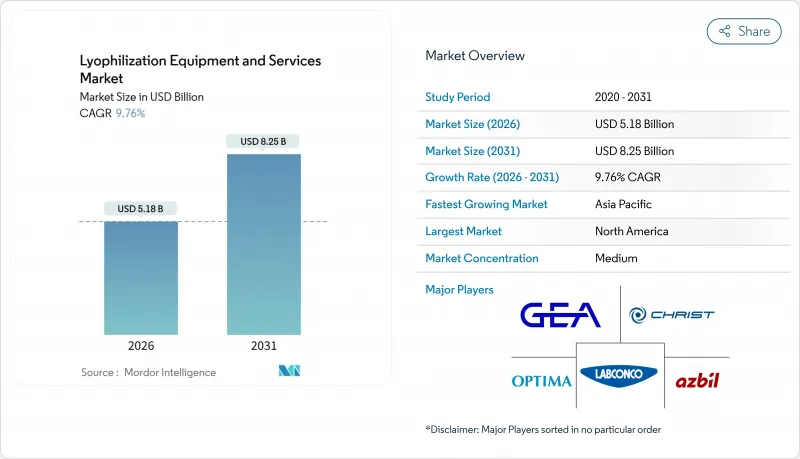
에 따르면 동결건조 장비 및 서비스 시장 규모는 2026년에 51억 8,000만 달러로 추정되며, 예측 기간(2026-2031년) 동안 CAGR 9.76%로 확대되어 2031년에는 82억 5,000만 달러에 달할 것으로 전망됩니다.
본 보고서는 모달리티(건조기 유형, 부속품, 서비스), 용도(제약·바이오기술 제조, 식품 가공·포장, 의료·진단, 기타), 지역(북미, 유럽, 아시아태평양, 중동 및 아프리카, 남미)별로 분류되어 있습니다. 시장 전망은 금액(달러) 기준으로 제시되어 있습니다.
세계 동결건조 장비 및 서비스 시장의 동향과 인사이트
동결건조 생물제제 및 주사제에 대한 수요 증가
2025년, FDA의 생물학적 제제 승인 중 단일클론 항체, 백신, 항체약물접합체가 68%를 차지했으며, 이들 대부분은 수년에 걸친 실온 안정성을 확보하기 위해 동결건조에 의존했습니다. 특허 만료로 인해 바이오시밀러의 출시가 가속화되었습니다. 트라스투주맙의 바이오시밀러인 ‘Bisintex’는 2024년 12월 유럽에서 승인을 받았으며, 아달리무맙의 바이오시밀러는 2025년 중반까지 미국 시장에서 42%의 점유율을 확보했습니다. 두 제품 모두 동결건조 바이알을 채택함으로써 원개발품의 안정성을 재현하고 있습니다. 차세대 동종 CAR-T 플랫폼에서는 액체 질소를 이용한 물류를 피하기 위해 건조 제제의 평가가 진행되고 있으며, 대규모로 상용화될 경우 필요한 생산능력이 15%-20% 확대될 가능성이 있습니다. 모더나사는 2024년 10-K 보고서에서 mRNA 백신용 슈가 글라스 건조에 관한 파일럿 테스트를 공개하며, 핵산 제제도 동결건조 방식으로 전환될 가능성이 있음을 시사하고 있습니다. 이러한 파이프라인은 동결건조 장비 및 서비스 시장의 수주 잔고를 직접적으로 끌어올리는 요인입니다.
위탁 동결건조 능력 확대
각 CDMO 기업들은 2024년 이후 사내 투자 규모의 3배에 달하는 속도로 투자를 진행하고 있으며, 이러한 추세는 삼성바이오로직스가 인천에 건설 중인 제5플랜트와 론자가 2025년 비스프에서 실시할 건조기 8기 증설로 뒷받침되고 있습니다. 베터(Vetter)사가 라벤스부르크에서 진행한 1억 5,000만 유로 규모의 프로젝트에서는 프리필드 주사기용 고속 생산 라인이 추가되었습니다. 무균 동결건조를 통해 수분 침투를 방지할 수 있기 때문에 이러한 제품들은 고가대로 거래되고 있습니다. 아웃소싱은 스타트업 기업의 자본 부담을 경감시키는 한편, 노하우가 소수의 서비스 제공업체에 집중되게 하여, 현재 동결건조 장비 및 서비스 시장의 상당한 점유율을 차지하고 있는 엔드투엔드 서비스 제공 체제를 강화하고 있습니다.
동결건조기의 높은 설비 투자 및 유지관리 비용
100제곱미터 규모의 산업용 트레이식 동결건조기의 정가는 300만-500만 달러이며, 유지보수 계약에는 연간 설비 투자액의 최대 12%에 달하는 비용이 소요됩니다. 2024년 찰스턴 프로젝트에서 한 건의 설치에 120만 달러를 지출한 사례에서 볼 수 있듯이, 공조 설비나 클린룸 개보수로 인해 시설 통합에 드는 비용이 추가로 30% 가량 더 발생할 수 있습니다. 인도 및 브라질의 15%-25%에 달하는 수입 관세가 도착 가격을 상승시키고 있습니다. 동시에, 현지 서비스 네트워크가 취약하여 가동 중단 시간이 증가하고, 중소기업은 CDMO(위탁 개발·제조 조직)에 의존할 수밖에 없어 동결건조 장비 및 서비스 시장에서 직접 구매가 제한되고 있습니다.
부문 분석
서비스 부문은 2026년에 가장 빠른 성장세를 기록할 것이며, 스폰서 기업들이 설비 보유에서 배치별 아웃소싱으로 예산을 재분배함에 따라 2031년까지 연평균 성장률(CAGR) 10.29%를 기록할 전망입니다. 부속품 부문은 진공 펌프, CIP·SIP 모듈, 제어 시스템의 업그레이드가 필요한 대규모 도입 기반에 힘입어 2025년 매출의 39.28%를 차지했습니다. 론자(Lonza)는 동결건조 사이클의 검증에 15만-25만 달러를 청구하지만, 이는 자체 소유 건조기에 필요한 300만-500만 달러보다 훨씬 낮은 금액이어서 소규모 고객들이 아웃소싱을 선택하도록 부추기고 있습니다. 가동률 90%로 3대의 건조기를 운영하는 CDMO는 가동률 60%의 단일 건조기 플랜트에 비해 바이알 단가를 40%-50% 낮게 유지할 수 있으며, 이러한 구조적 우위 덕분에 서비스 수익을 통해 동결건조 장비 및 서비스 시장이 확대되고 있습니다.
트레이식 시스템은 바이알의 형태에 관계없이 유연하게 대응할 수 있어 여전히 설비 판매의 대부분을 차지하고 있지만, 매니폴드식 유닛은 맞춤형 의료에 중점을 두고 있습니다. 로터리 건조기는 사이클 시간이 10%-15% 단축됨으로써 30% 높은 가격 차이를 상쇄할 수 있는 프리미엄 틈새 시장을 차지하고 있습니다. 부속품에 대한 수요는 공정 분석 기술(PAT)에 의한 개조와 계속해서 밀접한 관련이 있습니다. 파장 가변 다이오드 레이저 센서를 추가함으로써 사이클 개발 시간을 30% 단축할 수 있으며, 대량 사용 사용자의 경우 2년 이내에 투자 회수가 가능합니다.
지역별 분석
2025년, 북미는 전 세계 매출의 36.86%를 차지했으며, FDA 규제 하에서 가동되는 2,000대 이상의 산업용 건조기가 이를 주도했습니다. PCI Pharma Services는 2024년, 뉴햄프셔주 공장에서 1억 달러를 투자한 확장 공사를 완료하고 12대의 건조기를 증설했습니다. 찰스턴에서의 확장으로 4대가 추가로 가동을 시작했습니다. 인건비와 전력 비용이 높아 신규 구매를 억제하고 있기는 하지만, PAT 준수를 위한 빈번한 개조로 인해 부속품 및 서비스 수요는 견조한 추세를 보이고 있습니다. 캐나다 시장 규모가 비교적 작고, 멕시코의 바이오시밀러 생산능력이 초기 단계에 있다는 점이 수요의 점진적인 증가로 이어지고 있으며, 론자(Lonza)는 2025년에 니어쇼어(nearshore) 생산을 위한 몬테레이 거점 설치를 검토하고 있습니다.
아시아태평양은 가장 빠르게 성장하고 있으며, 2031년까지 연평균 성장률(CAGR) 13.19%를 기록할 것으로 예측됩니다. 우시 바이오로직스는 2024년 수출 고객을 위해 3개의 새로운 제조 시설을 가동하며, 40%-50% 낮은 생산 비용을 활용했습니다. 세람 인스티튜트와 바이오로지컬 E는 각각 내열성 백신을 공급하기 위해 생산 라인을 확장하고 있으며, 이는 백신 제조가 동결건조 장비 및 서비스 시장에 미치는 견인력을 여실히 보여주고 있습니다. 토플론(Tofflon)은 트레이식 건조기 가격을 유럽 및 미국의 경쟁사보다 25%-30% 낮게 책정함으로써 2025년에 수출을 47% 증가시켰으나, FDA 시장 내 침투는 여전히 제한적입니다. 호주와 한국은 소폭의 기여에 그치고 있지만, 중국과 인도에서는 사업자의 기술 부족이 생산 확대를 제약하고 있어, 검증 완료된 턴키 방식의 생산능력에 대한 수요가 증가하고 있음이 부각되고 있습니다.
2025년, 유럽은 매출의 약 28%를 유지했으며, 독일, 이탈리아, 프랑스, 영국, 스페인이 이를 주도했습니다. 2025년 독일의 산업용 전기 요금은 1kWh당 평균 0.22유로로, 미국의 약 3배에 달해 에너지 집약형 건조기의 수익성을 저해하고 있습니다. EU의 F가스 감축 규제를 준수하기 위해서는 개조 비용이 발생하지만, 주요 CDMO 기업들은 계속해서 이에 대응하고 있습니다. 예를 들어, Recipharm은 2024년에 이탈리아에서 370만 유로를 투자했으며, Vetter도 같은 해 라벤스부르크에서 1억 5,000만 유로를 투자했습니다. 그럼에도 불구하고 일부 프로젝트가 비용이 저렴한 아시아태평양 거점으로 이전함에 따라, 2025년 유럽의 설비 출하량은 6% 감소했습니다.
남미, 중동 및 아프리카를 합쳐도 그 점유율은 15% 이하에 그치고 있습니다. 이는 브라질의 제약 투자와 남아프리카공화국의 백신 개발에 대한 의지가 주도하고 있는 결과입니다. 인프라 부족과 수입 관세가 성장을 둔화시키고 있지만, Gavi가 자금을 지원하는 백신 보급이 수요를 더욱 확대시켜 동결건조 장비 및 서비스 시장의 세계 확장을 촉진할 가능성이 있습니다.
기타 혜택
- 엑셀 형식의 시장 예측(ME) 시트
- 3개월간의 애널리스트 지원
자주 묻는 질문
목차
제1장 소개
제2장 조사 방법
제3장 주요 요약
제4장 시장 구도
제5장 시장 규모와 성장 예측
제6장 경쟁 구도
제7장 시장 기회와 향후 전망
KSM 26.09.03According to Mordor Intelligence, the lyophilization equipment and services market size is estimated at USD 5.18 billion in 2026, and is expected to reach USD 8.25 billion by 2031, at a CAGR of 9.76% during the forecast period (2026-2031).
This report is Segmented by Modality (Dryer Type, Accessories, and Services), Application (Pharmaceutical & Biotech Manufacturing, Food Processing & Packaging, Medical & Diagnostics, and More), and Geography (North America, Europe, Asia-Pacific, Middle East & Africa, South America). The Market Forecasts are Provided in Terms of Value (USD).
Global Lyophilization Equipment And Services Market Trends and Insights
Rising Demand for Lyophilized Biologics & Injectables
Monoclonal antibodies, vaccines, and antibody-drug conjugates accounted for 68% of FDA biologics approvals in 2025, and most relied on freeze-drying to ensure multi-year room-temperature stability. Patent expiries accelerated biosimilar launches: Trastuzumab biosimilar Bisintex gained European approval in December 2024, and adalimumab biosimilars captured a 42% U.S. share by mid-2025, each emulating the originator's stability with lyophilized vials. Next-generation allogeneic CAR-T platforms are evaluating dry formats to avoid liquid-nitrogen logistics, potentially expanding required capacity by 15%-20% if commercialized at scale. Moderna disclosed pilot sugar-glass drying for mRNA vaccines in its 2024 10-K, signaling that nucleic-acid modalities may also pivot to freeze-drying. These pipelines directly swell order books for the lyophilization equipment and services market.
Expansion of Contract Lyophilization Capacity
CDMOs have outpaced in-house investments three-to-one since 2024, a pattern underscored by Samsung Biologics' Plant 5 build in Incheon and Lonza's eight-dryer expansion at Visp in 2025. Vetter's EUR 150 million project in Ravensburg added a high-speed line for pre-filled syringes, which command premium prices because aseptic freeze-drying prevents moisture ingress. Outsourcing eases capital burdens for start-ups yet concentrates know-how within a handful of service providers, reinforcing end-to-end offerings that now underpin a sizable share of the lyophilization equipment and services market.
High Capital & Maintenance Costs of Freeze-Dryers
A 100 m2 industrial tray dryer lists at USD 3 million to USD 5 million, and maintenance contracts consume up to 12% of the capital cost annually. Facility integration can add 30% due to HVAC and clean-room retrofits, as demonstrated by a 2024 Charleston project that spent USD 1.2 million on a single installation. Import tariffs of 15%-25% in India and Brazil elevate landed prices. At the same time, sparse local service networks increase downtime, prompting small firms to turn to CDMOs and limiting direct purchases in the lyophilization equipment and services market.
Other drivers and restraints analyzed in the detailed report include:
- Advances in High-Capacity Continuous & Microwave-Assisted Freeze-Drying
- Cold-Chain-Independent Vaccine Distribution Initiatives
- Adoption of Alternative Drying Methods
For complete list of drivers and restraints, kindly check the Table Of Contents.
Segment Analysis
Services generated the fastest growth in 2026 and are on track to post a 10.29% CAGR to 2031 as sponsors reallocate budgets from ownership to per-batch outsourcing. Accessories accounted for 39.28% of revenue in 2025, driven by a sizable installed base that requires vacuum pumps, SIP/CIP modules, and control upgrades. Lonza charges USD 150,000-USD 250,000 to validate a freeze-drying cycle, which is far less than the USD 3 million-USD 5 million required for an in-house dryer, encouraging smaller clients to outsource. CDMOs operating three dryers at 90% utilization achieve vial costs 40%-50% lower than single-dryer plants running at 60%, a structural advantage that expands the lyophilization equipment and services market through service revenues.
Tray-style systems retain the majority of equipment sales due to their flexibility across vial formats, while manifold units focus on personalized medicine. Rotary dryers claim premium niches where 10%-15% faster cycles offset 30% higher prices. Accessories demand remains linked to Process Analytical Technology (PAT) retrofits; adding tunable diode laser sensors can cut cycle development time by 30% and deliver a payback within two years for high-volume users.
Complete Report Scope:
- By Modality
- Dryer Type
- Tray-style Freeze Dryers
- Manifold Freeze Dryers
- Rotary Freeze Dryers
- Vacuum Freeze Dryers
- Accessories
- Vacuum Systems
- CIP / SIP Systems
- Loading & Unloading Systems
- Control & Monitoring Modules
- Services
- Process & Cycle Development
- Contract Manufacturing / Bulk Lyophilization
- Maintenance & Validation
- Dryer Type
- By Application
- Pharmaceutical & Biotech Manufacturing
- Food Processing & Packaging
- Medical & Diagnostics
- Other Applications
- By Geography
- North America
- United States
- Canada
- Mexico
- Europe
- Germany
- United Kingdom
- France
- Italy
- Spain
- Rest of Europe
- Asia-Pacific
- China
- Japan
- India
- Australia
- South Korea
- Rest of Asia-Pacific
- Middle East & Africa
- GCC
- South Africa
- Rest of Middle East & Africa
- South America
- Brazil
- Argentina
- Rest of South America
- North America
Geography Analysis
North America generated 36.86% of global revenue in 2025, driven by over 2,000 industrial dryers operating under FDA regulations. PCI Pharma Services completed a USD 100 million expansion of its New Hampshire plant in 2024, adding 12 dryers. Expansion at Charleston brought four additional units online. Although high labor and electricity costs temper new purchases, frequent retrofits for PAT compliance keep accessories and services buoyant. Canada's smaller base and Mexico's early-stage biosimilar capacity add incremental volume, with Lonza studying a Monterrey site for near-shored manufacturing in 2025.
The Asia-Pacific region is the fastest-growing, projected to post a 13.19% CAGR through 2031. WuXi Biologics commissioned three new suites in 2024 to serve export clients, leveraging 40%-50% lower production costs. The Serum Institute and Biological E each expanded their lines to supply thermostable vaccines, underscoring the pull of vaccine manufacturing on the lyophilization equipment and services market. Tofflon boosted exports by 47% in 2025 by pricing tray dryers 25%-30% below those of its Western peers, although limited FDA penetration persists. Australia and South Korea contribute modestly, while operator-skill gaps across China and India constrain ramp-ups, underscoring the demand for validated, turnkey capacity.
Europe maintained roughly 28% of revenue in 2025, led by Germany, Italy, France, the United Kingdom, and Spain. Industrial electricity prices in Germany averaged EUR 0.22 per kWh in 2025, nearly triple the U.S. rates, eroding the economics for energy-intensive dryers. Compliance with the EU's F-gas cuts incurs retrofit costs, yet major CDMOs remain committed. For instance, Recipharm invested EUR 3.7 million in Italy in 2024, and Vetter spent EUR 150 million in Ravensburg the same year. Nonetheless, European equipment shipments slipped 6% in 2025 as some projects migrated to lower-cost Asia-Pacific hubs.
South America and Middle East & Africa together form a sub-scale share below 15%, driven by Brazil's pharmaceutical investments and South Africa's vaccine ambitions. Infrastructure gaps and import duties dampen growth, though Gavi-funded vaccine rollouts could spur incremental demand, extending the global footprint of the lyophilization equipment and services market.
- Azbil
- Biopharma Process Systems
- Buchi Labortechnik
- Cryotec FR
- Cuddon Freeze Dry
- GEA Group
- Harvest Right
- HOF Sonderanlagenbau
- IMA S.p.A.
- Labconco
- Lyophilization Technology Inc.
- Martin Christ Gefriertrocknungsanlagen
- Millrock Technology
- Optima Packaging Group Gmbh
- Scala Scientific
- SP Industries (ATS)
- Thermo Fisher Scientific
- Tofflon Science & Technology
- Vikumer Freeze Dry
- ZIRBUS Technology
Additional Benefits:
- The market estimate (ME) sheet in Excel format
- 3 months of analyst support
TABLE OF CONTENTS
1 Introduction
- 1.1 Study Assumptions & Market Definition
- 1.2 Scope of the Study
2 Research Methodology
3 Executive Summary
4 Market Landscape
- 4.1 Market Overview
- 4.2 Market Drivers
- 4.2.1 Rising Demand for Lyophilized Biologics & Injectables
- 4.2.2 Expansion of Contract Lyophilization (CMO/CDMO) Capacity
- 4.2.3 Advances In High-Capacity Continuous & Microwave-Assisted Freeze-Drying
- 4.2.4 Cold-Chain-Independent Vaccine Distribution Initiatives
- 4.2.5 Sustainability Incentives for Energy-Efficient Lyophilizers
- 4.2.6 Personalised-Medicine Micro-Batch Requirements
- 4.3 Market Restraints
- 4.3.1 High Capital & Maintenance Costs of Freeze-Dryers
- 4.3.2 Adoption of Alternative Drying Methods
- 4.3.3 Tightening Fluorinated-Refrigerant Regulations
- 4.3.4 Shortage of PAT-Skilled Freeze-Drying Operators
- 4.4 Regulatory Landscape
- 4.5 Technological Outlook
- 4.6 Porter's Five Forces Analysis
- 4.6.1 Threat of New Entrants
- 4.6.2 Bargaining Power of Buyers
- 4.6.3 Bargaining Power of Suppliers
- 4.6.4 Threat of Substitutes
- 4.6.5 Competitive Rivalry
5 Market Size & Growth Forecasts
- 5.1 By Modality
- 5.1.1 Dryer Type
- 5.1.1.1 Tray-style Freeze Dryers
- 5.1.1.2 Manifold Freeze Dryers
- 5.1.1.3 Rotary Freeze Dryers
- 5.1.1.4 Vacuum Freeze Dryers
- 5.1.2 Accessories
- 5.1.2.1 Vacuum Systems
- 5.1.2.2 CIP / SIP Systems
- 5.1.2.3 Loading & Unloading Systems
- 5.1.2.4 Control & Monitoring Modules
- 5.1.3 Services
- 5.1.3.1 Process & Cycle Development
- 5.1.3.2 Contract Manufacturing / Bulk Lyophilization
- 5.1.3.3 Maintenance & Validation
- 5.1.1 Dryer Type
- 5.2 By Application
- 5.2.1 Pharmaceutical & Biotech Manufacturing
- 5.2.2 Food Processing & Packaging
- 5.2.3 Medical & Diagnostics
- 5.2.4 Other Applications
- 5.3 By Geography
- 5.3.1 North America
- 5.3.1.1 United States
- 5.3.1.2 Canada
- 5.3.1.3 Mexico
- 5.3.2 Europe
- 5.3.2.1 Germany
- 5.3.2.2 United Kingdom
- 5.3.2.3 France
- 5.3.2.4 Italy
- 5.3.2.5 Spain
- 5.3.2.6 Rest of Europe
- 5.3.3 Asia-Pacific
- 5.3.3.1 China
- 5.3.3.2 Japan
- 5.3.3.3 India
- 5.3.3.4 Australia
- 5.3.3.5 South Korea
- 5.3.3.6 Rest of Asia-Pacific
- 5.3.4 Middle East & Africa
- 5.3.4.1 GCC
- 5.3.4.2 South Africa
- 5.3.4.3 Rest of Middle East & Africa
- 5.3.5 South America
- 5.3.5.1 Brazil
- 5.3.5.2 Argentina
- 5.3.5.3 Rest of South America
- 5.3.1 North America
6 Competitive Landscape
- 6.1 Market Concentration
- 6.2 Market Share Analysis
- 6.3 Company Profiles (includes Global level Overview, Market-level Overview, Core Segments, Financials, Strategic Information, Market Rank/Share, Products & Services, Recent Developments)
- 6.3.1 Azbil Corporation
- 6.3.2 Biopharma Process Systems
- 6.3.3 Buchi Labortechnik
- 6.3.4 Cryotec FR
- 6.3.5 Cuddon Freeze Dry
- 6.3.6 GEA Group Aktiengesellschaft
- 6.3.7 Harvest Right
- 6.3.8 HOF Sonderanlagenbau
- 6.3.9 IMA S.p.A.
- 6.3.10 Labconco Corporation
- 6.3.11 Lyophilization Technology Inc.
- 6.3.12 Martin Christ Gefriertrocknungsanlagen GmbH
- 6.3.13 Millrock Technology
- 6.3.14 Optima Packaging Group Gmbh
- 6.3.15 Scala Scientific
- 6.3.16 SP Industries (ATS)
- 6.3.17 Thermo Fisher Scientific
- 6.3.18 Tofflon Science & Technology
- 6.3.19 Vikumer Freeze Dry
- 6.3.20 ZIRBUS Technology
7 Market Opportunities & Future Outlook
- 7.1 White-space & Unmet-need Assessment


